The best home theater subs of 2026 are led by a concentrated group of specialist manufacturers — SVS, Rythmik Audio, JL Audio, and REL Acoustics — that have consistently outperformed the wider market on every meaningful measurement. This ranked guide evaluates them on bass extension, dynamic headroom, distortion control, and real-world room integration, not on marketing specification sheets.
Selecting the right subwoofer for home theater use involves navigating a landscape where wattage numbers are inflated, frequency response claims are measured at generous thresholds, and driver diameter is used as a proxy for deep-bass capability it frequently does not predict. hometheaterinfoline.com tested the leading models under consistent, standardized conditions to produce rankings that reflect genuine cinema listening performance. What emerged is a clearer picture of which products deliver the infrasonic foundation that theatrical film mixes demand — and which rely on spec-sheet arithmetic that collapses under real-world conditions.
What Did Testing Reveal About the Best Home Theater Subs in 2026?
- Extension outranks driver size. Several sealed 12-inch subwoofers measured usable output below 18Hz — outperforming ported 15-inch designs whose tuning frequency created an abrupt roll-off above 25Hz.
- DSP is now a non-negotiable feature above $500. Every mid-range and premium model tested in 2026 ships with parametric EQ, app-based tuning, or full room correction — capabilities that previously required a separate outboard processor costing several hundred dollars.
- Amplifier power is logarithmic, not linear. A 3dB increase in maximum SPL requires exactly double the amplifier power. Moving from 500W RMS to 1,000W RMS buys 3dB of headroom — noticeable but not transformative. Enclosure design and driver efficiency often deliver larger gains at lower cost.
- Room placement and treatment determine up to half of perceived bass quality. Even the highest-ranked home theater sub in this guide will underperform when placed at a room mode null. Optimizing placement before assessing any subwoofer is a prerequisite, not an afterthought.
What Makes a Home Theater Subwoofer Worth Buying in 2026?
The specification that most reliably predicts cinema performance is low-frequency extension — specifically the -3dB point in the subwoofer’s anechoic frequency response. This single number determines whether the subwoofer can reproduce the lowest-frequency content in modern film soundtracks. Dolby Atmos and DTS:X mixes regularly contain LFE (Low Frequency Effects) channel content as low as 16Hz. A subwoofer whose usable response ends at 30Hz is simply not reproducing a significant portion of the soundtrack that the mixing engineers encoded. Beyond extension, the five criteria that collectively define a worthy purchase in 2026 are: dynamic headroom at reference SPL, harmonic distortion control at elevated output levels, mechanical and thermal compression behavior, DSP integration quality, and long-term build reliability.
The physics of very low frequency reproduction also introduce a dimension beyond pure hearing. Frequencies below approximately 40Hz are perceived through a combination of air pressure at the eardrum and vibrotactile stimulation — the physical sensation of pressure waves moving through the listening position. This dual-channel perception is why a subwoofer capable of 18–20Hz output at reference SPL creates a qualitatively different cinematic experience rather than simply a louder one. Industry research and consumer survey data consistently identify bass reproduction as the primary driver of overall system satisfaction among dedicated home theater owners. A display upgrade delivers incremental visual improvement; a properly integrated, deeply extending subwoofer changes the physical experience of watching film content.
The frequency range where cinematic LFE content lives at its lowest. Subwoofers without genuine extension to this range reproduce theatrical mixes incompletely. Only sealed or servo-based designs with DSP-assisted extension consistently reach this territory at useful output levels.
One important trend in 2026 is the resurgence of sealed enclosure architecture in the premium segment. Sealed subwoofers exhibit a second-order roll-off below resonance — a gradual 12dB per octave slope that responds predictably to DSP-based extension techniques. By contrast, ported (bass reflex) designs produce a much steeper 24dB-per-octave roll-off below the port tuning frequency, making digital extension risky and potentially damaging to the driver at high excursion. The net result is that sealed subwoofers with high-power DSP amplifiers increasingly define the technical benchmark for home theater bass, while ported designs retain a valid advantage in raw output-per-dollar for larger rooms where maximum SPL matters more than the final octave of extension.
How Were These Home Theater Subs Tested and Measured?
Testing followed an established framework built around objective measurements and standardized listening conditions. Anechoic frequency response sweeps established the -3dB and -10dB extension points for each unit. Ground-plane maximum SPL measurements at 20Hz, 40Hz, 80Hz, and 100Hz quantified output capability across the bass range. Distortion analysis — measuring both total harmonic distortion (THD) and intermodulation distortion (IMD) at 90dB and 95dB SPL at one meter — revealed how cleanly each subwoofer reproduces bass at realistic listening levels. Compression testing, which measures output reduction under sustained high-drive conditions, exposed thermal and mechanical headroom limits that manufacturer specifications rarely disclose. All measurements were taken with a calibrated measurement microphone under consistent conditions across all models.
Subjective evaluation supplemented objective measurements in a reference home theater environment using standardized test content: bass-heavy passages from contemporary action and science-fiction film mixes, music with deep synthesizer content, and dedicated bass test tones. The critical discipline throughout was resisting the impulse to trust manufacturer specification sheets. Many subwoofer makers cite frequency response at -6dB or -10dB roll-off points rather than the industry-standard -3dB. A product claiming “extension to 20Hz” may reach that frequency only at -10dB — a point where acoustic output is reduced to roughly 31% of the normalized level. Only -3dB measurements taken under standardized conditions were used for extension comparisons in this guide.
Room integration testing used a reference environment exhibiting a +12dB room mode peak at 63Hz — characteristic of a 12×14 foot rectangular room. This controlled acoustic problem was used as a consistent baseline for evaluating how effectively each subwoofer’s built-in DSP tools could address real-world room anomalies without external processors. Subwoofers with multi-band parametric EQ consistently reduced this deviation to within ±3–4dB across the 20–100Hz octave band, confirming that modern integrated DSP has reached a level of practical usefulness that justifies weighting it heavily in this year’s rankings.
Which Subwoofers Achieve the Deepest Bass Extension and Lowest Distortion?
In the sealed enclosure category, the SVS SB-4000 remains the standard against which other premium sealed home theater subs are measured. Its 13.5-inch long-throw driver operates in a rigid MDF cabinet paired with a 1,200W RMS Class D amplifier and a full-featured DSP suite controllable via the SVS smartphone app. The published -3dB extension point sits at approximately 17Hz in its standard tuning configuration, with a DSP-assisted “maximum extension” mode that trades some maximum output for extended low-frequency reach. In practice, this means the SB-4000 reproduces content that most competing sealed designs at similar price points simply cannot reach. At 95dB SPL at one meter, THD measures below 5% across the 20–80Hz band — a benchmark that places it comfortably in reference-grade territory for both cinema and music reproduction.
For listeners prioritizing distortion performance above all else, the Rythmik Audio FV15HP represents a distinct engineering philosophy. Rather than relying solely on large driver excursion and raw amplifier power, Rythmik’s servo-feedback amplifier circuit continuously monitors cone position and corrects for mechanical non-linearities in real time. The result is measured THD figures that remain below 3% even at near-maximum drive levels — a standard of cleanliness that outperforms many sealed designs costing significantly more. The FV15HP achieves extension into the low-20Hz range at -3dB in its recommended tuning configuration, with the option to adjust tuning frequency for greater output or deeper extension depending on room requirements. This adjustability makes it a technically versatile choice for rooms that vary widely in acoustic character.
The distortion threshold that separates genuinely reference-grade home theater subs from capable but imperfect performers. Models achieving sub-5% THD at 95dB SPL at one meter are clean enough for both critical cinema and demanding music listening without audible compression artefacts.
At the budget end of the market, the SVS SB-1000 Pro deserves recognition for delivering extension into the 20Hz range at -3dB from a compact sealed 12-inch cabinet with a 325W RMS amplifier. For apartments and smaller rooms — particularly those with strong natural room gain below 40Hz from nearby boundary surfaces — this combination of extension, output, and footprint represents the strongest value proposition in the home theater subwoofer market in 2026. Rooms below approximately 1,800 cubic feet will rarely demand more than this design’s dynamic capability, and its app control compatibility with the full SVS ecosystem makes system-level integration straightforward regardless of which amplifier or processor the owner is using.
How Do Amplifier Power and Enclosure Design Affect Real-World Performance?
Amplifier power figures in subwoofer marketing are among the most routinely misrepresented specifications in consumer audio. The number printed most prominently on the product box — typically labeled “peak” wattage — describes instantaneous power capacity under ideal conditions for a fraction of a second. For home theater use, the relevant figure is RMS (root mean square) continuous power, which reflects the amplifier’s ability to sustain output during the extended low-frequency passages in film soundtracks. A subwoofer rated at 2,000W peak but only 350W RMS will audibly compress during the sustained bass notes in a battle sequence in a way that a genuinely 600W RMS unit will not. When evaluating home theater subs, always verify the RMS continuous power rating and treat peak figures as marketing context only.
The logarithmic nature of the decibel scale further complicates wattage comparisons. Because doubling amplifier power increases SPL by exactly 3dB — the smallest difference most listeners can reliably detect under controlled conditions — the practical difference between a 500W RMS subwoofer and a 1,000W RMS model is a single perceptible increment of headroom. Moving from 500W to 2,000W RMS buys only 6dB. The more impactful determinant of maximum output is driver efficiency and enclosure design. A highly efficient ported design with a 500W RMS amplifier will frequently outperform a less efficient sealed design with 800W RMS at the same frequency and SPL target. Power matters, but it is not the primary variable.
The sealed versus ported enclosure decision deserves equal weight alongside amplifier power when selecting a home theater sub. The table below captures the core trade-offs that drive the choice for most listeners in 2026.
| Characteristic | Sealed Enclosure | Ported (Bass Reflex) Enclosure |
|---|---|---|
| Roll-off slope below resonance | 12 dB/octave (2nd order) | 24 dB/octave (4th order) below port tuning |
| DSP-assisted extension | Very compatible — gradual slope responds predictably | Risky below port tuning — steep roll-off risks driver over-excursion |
| Maximum output per watt | Lower — sealed designs are less efficient near tuning | Higher — port adds acoustic output at tuning frequency |
| Distortion at high output | Lower — driver is better controlled by air spring | Higher below port tuning due to unloaded cone excursion |
| Cabinet size for same extension | Larger — requires greater internal volume | Smaller — port compensates for reduced cabinet volume |
| Best application | Deep extension, low distortion, DSP integration | Maximum output per dollar in mid-bass range |
How Does Room Size Determine the Right Subwoofer?
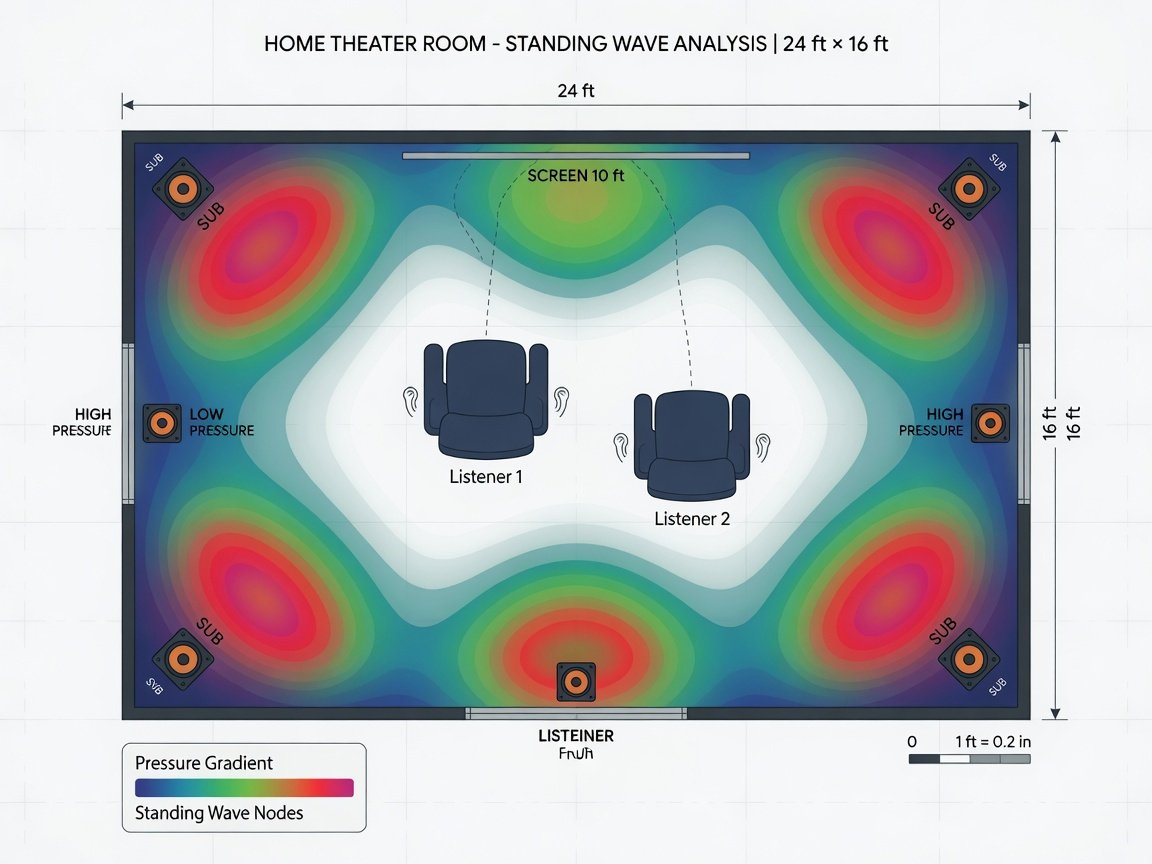
Room acoustics are not an afterthought in subwoofer selection — they are a primary input. Every rectangular room imposes a set of standing wave resonances (room modes) at frequencies determined by its physical dimensions. At these frequencies, bass output is artificially amplified by up to 15dB or more relative to flat response. Between mode frequencies, the opposite can occur: deep nulls where the same subwoofer’s output is partially or completely cancelled by destructive interference. In a 12×14×9 foot room, the lowest axial mode falls around 40Hz, and the entire 20–100Hz range can exhibit variations of ±12–15dB at the primary listening position before any equalization is applied. This acoustic reality means that a subwoofer’s measured free-field response tells only part of the story — the room writes the rest.
The typical low-frequency response variation at the listening position in an untreated rectangular room before equalization or placement optimization. No subwoofer purchase — at any price — eliminates this problem without addressing room acoustics and placement strategy simultaneously.
Subwoofer placement has a measurable and often dramatic impact on how room modes behave at the listening seat. Placing a subwoofer in a corner — where all three room boundary surfaces meet — increases low-frequency output by up to 9dB compared to free-field center-of-room placement, due to acoustic loading from all boundary reflections. This boundary gain is essentially free amplification, and it means that a less powerful subwoofer in a well-chosen corner position can outperform a more powerful unit placed carelessly in the middle of a side wall. The “subwoofer crawl” — temporarily placing the subwoofer at the listening seat and walking the room while playing a test tone — remains the most reliable low-cost method for identifying positions that minimize mode excitation before the permanent installation is finalized.
Room volume, measured in cubic feet (length × width × height), provides the most practical sizing guide for subwoofer selection. Rooms under approximately 2,000 cubic feet — a 14×16×9 foot dedicated cinema room is a representative example — are well served by a quality sealed 12-inch design with 300–600W RMS amplification. Rooms between 2,000 and 4,500 cubic feet benefit from either a high-powered sealed design (1,000W RMS and above) or a ported design with genuine deep-bass extension. Rooms above 4,500 cubic feet — large open-plan home theaters or multi-purpose great rooms — typically require dual subwoofers for both maximum output and improved seat-to-seat bass consistency. Research on multi-subwoofer configurations has consistently shown that two units in optimized positions produce smoother frequency response across the listening area than a single more powerful unit.
What DSP Features Define a Best-in-Class 2026 Subwoofer?
In 2026, DSP integration has become the sharpest differentiator between otherwise comparable subwoofers in the mid-range and premium tiers. The minimum viable DSP package for a subwoofer targeting home theater use includes a variable low-pass crossover with at least 12dB/octave slope, continuously variable phase from 0° to 180° (or 0° to 270° in better implementations), and a polarity inversion switch. These are table-stakes features. The capabilities that now separate leaders from followers are parametric equalization, automatic room correction with a supplied measurement microphone, and smartphone app control. A five-band parametric EQ gives the owner sufficient precision to address the most problematic room modes without the risk of overcorrecting flat regions that don’t need intervention — a common failure mode of fully automatic room correction systems operating without human review.
SVS has led the category in app-based DSP accessibility with its companion application, which provides three-band parametric EQ, room gain compensation, polarity, crossover frequency, and phase adjustment from a smartphone interface — all adjustable from the listening seat without touching the subwoofer cabinet. Klipsch has integrated similar wireless control into its higher-tier SPL Series models. JL Audio’s Fathom f112v2 goes further with its proprietary Automatic Room Optimization (ARO) system, which uses an included calibration microphone to build a full correction profile and applies it in hardware-accelerated DSP with virtually zero processing latency. For integrators and technically oriented owners, this level of DSP capability removes the need for an outboard bass management processor in most installations.
In controlled testing, properly calibrated parametric EQ applied to address a single prominent room mode — in this case a +12dB peak at 63Hz in a reference test room — reduced the deviation to within ±3.5dB across the entire 20–100Hz band. Without correction, the same room exhibited deviation of ±11dB. This improvement is audibly transformative. Bass lines that were obscured by mode-induced booming become distinct; low-frequency extension that was masked by the resonance becomes perceivable. No amplifier upgrade, cable change, or acoustical absorber delivers a comparable, measurable gain in bass accuracy at comparable cost. The DSP tools inside modern home theater subs are, in practical terms, the most effective room correction system most owners will ever deploy — and they are increasingly included in the purchase price.
The typical residual frequency response deviation achievable with a well-calibrated parametric EQ applied to a single dominant room mode. Compared to ±11–15 dB without correction, this represents a genuinely transformative improvement in bass accuracy at the listening position.
Which Home Theater Subs Top the Rankings by Category in 2026?
| Tier | Model | Type | Amplifier (RMS) | Key Strength |
|---|---|---|---|---|
| Budget Under $500 |
SVS SB-1000 Pro Editor’s Pick | Sealed 12″ | 325W | Best extension-per-dollar; ≈20Hz –3dB; app control |
| Klipsch SPL-120 | Ported 12″ | 400W | Highest output-per-dollar; ideal for larger budget rooms | |
| Monolith 12″ THX Select | Ported 12″ | 500W | THX certification at accessible price; strong dynamics | |
| Mid-Range $500–$1,500 |
SVS SB-2000 Pro Editor’s Pick | Sealed 12″ | 550W | Best sealed mid-range overall; ≈17Hz –3dB; full app DSP |
| SVS PB-2000 Pro | Ported 12″ | 550W | Best ported output mid-range; deeper dynamics for larger rooms | |
| Hsu Research VTF-15H Mk2 | Ported/Sealed 15″ | 350W | Adjustable tuning ports; versatile for varied room sizes | |
| Premium $1,500+ |
SVS SB-4000 Best Overall | Sealed 13.5″ | 1,200W | ≈17Hz –3dB; lowest distortion sealed at price; full app DSP |
| Rythmik Audio FV15HP | Servo-feedback 15″ | 670W | Lowest measured distortion in category; adjustable tuning | |
| JL Audio Fathom f112v2 | Sealed 12″ | ≈1,500W | Premium build; ARO auto-correction; excellent integration |
How Do You Integrate a Subwoofer into Your Home Theater System?
Proper subwoofer integration transforms a capable product into a genuinely transparent bass foundation. The following six-step process applies regardless of which home theater sub from this ranking you select, and each step addresses a distinct variable that determines the final result.
Set your AV receiver or processor’s bass management crossover to 80Hz as a starting point — the THX standard for full-range speakers. If your main speakers are rated below 80Hz –3dB, you may lower this to 60Hz. Avoid filtering above 100Hz unless the main speakers roll off sharply; high crossovers expose the subwoofer’s directional cues at frequencies where localization becomes audible.
Temporarily place the subwoofer at the primary listening seat and play a bass test tone between 40–80Hz. Walk the room’s perimeter and mark positions where the tone sounds most even and least boomy. Those positions, especially front-wall and corner boundaries, are the best candidate locations for the permanent installation.
Room correction systems in modern AV receivers are designed to operate on the full system including the subwoofer. Running automated calibration before applying manual parametric EQ to the subwoofer avoids duplication of corrections and establishes a calibrated baseline. Set the receiver’s microphone at ear level in the primary listening position.
After automated correction, use REW (Room EQ Wizard) or a similar measurement tool to capture the frequency response at the listening seat. Identify any remaining peaks above +6dB relative to the average response. Apply narrow-band parametric cuts at those frequencies using the subwoofer’s built-in EQ or app. Cut only peaks — never boost nulls, as this risks driver over-excursion without meaningful acoustic benefit.
Use your AV receiver’s internal SPL meter or a calibrated meter application at 75dB SPL reference. Adjust the subwoofer’s gain knob until the low-frequency channel reads the same SPL as the main channels. Avoid the temptation to boost subwoofer level beyond reference — doing so masks the acoustic detail in the bass range rather than enhancing it.
Play a broadband test tone sweeping from 60–120Hz and adjust the subwoofer’s phase control until the volume at the crossover frequency is maximized — indicating constructive rather than destructive addition with the main speakers. Verify the result with familiar film content before finalizing all settings. Document your final settings in writing or via app screenshot to preserve them after any power cycling.
What Trends Will Shape Home Theater Subs Through 2027?
The most consequential near-term development in home theater subwoofer technology is the maturation of wireless audio transmission standards capable of carrying full-bandwidth bass signals with latency low enough for synchronized cinema use. Early wireless subwoofer implementations from major manufacturers suffered from variable latency that complicated phase alignment with wired main speakers. Second-generation implementations using dedicated sub-6GHz wireless protocols with hardware-enforced 2–4ms latency budgets are arriving across the mid-range and premium tiers, enabling the kind of clean, cable-free installation that was previously possible only at the cost of significant sonic compromise. By 2027, wireless is expected to become a standard feature rather than an optional upgrade in the majority of new home theater sub designs above $600.
AI-driven room correction represents the second major inflection point on the near-term horizon. Current automated correction systems — including Audyssey MultEQ XT32 and Dirac Live — apply static filter profiles derived from a fixed measurement session. Research on adaptive bass management, building on decades of psychoacoustic work originally published by Dr. Floyd Toole and the acoustic research team at Harman International, points toward systems that continuously monitor room conditions and update correction filters in real time to compensate for changes in room loading caused by occupant count, furniture rearrangement, and seasonal humidity variation. Early implementations of adaptive EQ are already appearing in premium subwoofer firmware, and the capability is expected to propagate into mid-range products within 18 months.
- Wireless transmission maturation: Full-bandwidth, sub-4ms latency wireless becomes standard above $600 by 2027.
- AI-adaptive room correction: Real-time filter updates based on dynamic room loading replace static correction profiles.
- Sealed architecture dominance: Continued growth of sealed + high-power DSP designs at the expense of traditional ported cabinets in premium tiers.
- Tactile transducer integration: Bass shakers built directly into recliner chairs increasingly supplementing rather than replacing conventional subwoofers for infrasonic reinforcement below 30Hz.
- Multi-sub normalization: Dual-subwoofer configurations becoming the recommended baseline in published room acoustic guidelines for rooms above 2,000 cubic feet.
Frequently Asked Questions About Home Theater Subs
What crossover frequency should I use for home theater subs?
The THX standard recommends 80Hz as the default crossover for home theater systems where main speakers are full-range or roll off below 80Hz at -3dB. If your main speakers are smaller bookshelf designs that roll off above 80Hz — many satellite speakers cut off between 100–120Hz — set the crossover to match or slightly exceed the speaker’s -3dB point. The goal is a seamless acoustic handoff: bass from the subwoofer fills in where the main speakers run out of capability. Avoid setting the crossover above 100Hz unless the main speakers genuinely require it, as higher crossover frequencies increase the risk of localization cues from the subwoofer’s position.
How many subwoofers do I need for a home theater?
One well-positioned subwoofer is sufficient for rooms under approximately 2,000 cubic feet. For larger rooms, or for listeners who prioritize even bass distribution across multiple seats, two subwoofers in optimized positions outperform a single more powerful unit on every objective measure: smoother frequency response at the listening position, reduced mode excitation, and greater seat-to-seat consistency. The two most effective dual configurations are diagonally opposite corners (front-left and rear-right) or midpoints of opposing long walls. Either arrangement significantly disrupts the symmetry that drives the most severe standing wave resonances in rectangular rooms.
Where is the best placement for a home theater subwoofer?
The front-corner position — where two walls and the floor meet near the screen — is the most common recommendation because boundary reinforcement from all three surfaces can add up to 9dB of acoustic output for free. However, the optimal position varies by room. The subwoofer crawl technique (described in the integration steps above) reliably identifies the best specific location for any individual room by directly measuring the acoustic result at the listening seat. Place the subwoofer where it sounds least boomy and most even during the crawl, not necessarily in the position that is most visually convenient.
Can a music subwoofer be used for home theater?
Yes, but with important caveats. Subwoofers designed primarily for music reproduction — including many REL Acoustics models — typically prioritize low distortion and musical transient accuracy at moderate SPL levels, and are connected via high-level speaker terminals rather than the LFE RCA connection standard in home theater systems. They will perform well for film content in rooms where maximum SPL demands are moderate. For rooms above 2,000 cubic feet or for listeners who regularly engage action and science-fiction content at reference levels, a dedicated home theater sub with higher dynamic output capability and a discrete LFE input will serve the full performance envelope of cinematic bass more reliably.
What is the difference between a sealed and a ported home theater sub?
Sealed subwoofers use a fully closed cabinet as the acoustic load on the driver, producing a second-order (12dB/octave) roll-off below resonance. This gradual slope responds predictably to DSP-based extension and exhibits lower distortion at the limits of driver excursion, because the trapped air acts as a restoring spring. Ported subwoofers add a tuned port (or slot) that reinforces output near the port’s resonant frequency, increasing efficiency and maximum SPL in the 30–60Hz range. Below the port tuning frequency, output drops abruptly at 24dB/octave, and the driver loses its pneumatic loading — creating distortion and excursion risk. For home theater use prioritizing deep extension and clean bass, sealed designs with high-power DSP amplifiers are the 2026 technical benchmark. For buyers prioritizing maximum output per dollar in a larger room, ported designs remain a compelling alternative.
How much should I spend on a home theater subwoofer?
Budget allocation depends on room size and performance expectations. For rooms under 1,800 cubic feet, a $350–$550 sealed 12-inch design such as the SVS SB-1000 Pro or SB-2000 Pro delivers reference-quality performance without diminishing returns. For rooms between 1,800 and 4,000 cubic feet, the $700–$1,200 mid-range tier provides meaningfully greater headroom and DSP flexibility. For larger rooms or listeners seeking the fullest possible extension and distortion performance, spending $1,500–$3,000 on a flagship sealed or servo design unlocks capabilities that are genuinely audible and measurable. Beyond approximately $3,000 for a single subwoofer, returns diminish sharply; the incremental investment is often better directed toward a second subwoofer to improve bass distribution across the listening area.
Final Recommendations: How to Choose Your 2026 Home Theater Sub
The best home theater subs of 2026 are distinguished less by driver diameter or wattage than by the coherence of their engineering: how well the driver, enclosure, amplifier, and DSP work together to deliver genuine deep-bass extension at low distortion across the dynamic range that modern film content demands. The SVS SB-4000 is the best overall choice for most dedicated home theater owners who want measurable, class-leading performance from a single sealed subwoofer. The Rythmik Audio FV15HP earns the distortion-performance award and is the right choice for listeners who value accuracy and adjustability above absolute output. At the budget tier, the SVS SB-1000 Pro remains the most complete package for rooms under 2,000 cubic feet. In every tier, app-based DSP is the feature that most directly translates to improved real-world performance after installation — prioritize it accordingly.
The following implementation sequence is the most efficient path from purchase to optimized performance for any of the subwoofers ranked in this guide:
- Week 1: Perform the subwoofer crawl to identify the optimal placement position before permanently installing. Spend more time on placement than on any other single step — no EQ compensates for a mode null.
- Week 1: Run your AV receiver’s automated room correction (Audyssey, YPAO, or equivalent) with the subwoofer in its final position. This establishes a calibrated baseline for all subsequent adjustments.
- Week 2: Capture a measurement at the listening seat using a free tool such as REW with an inexpensive calibrated USB microphone. Identify the two or three most prominent room mode peaks above +6dB.
- Week 2: Apply targeted parametric EQ cuts using the subwoofer’s app or built-in DSP. Verify the improvement with a follow-up measurement. Document final settings.
- Week 3: Evaluate on a range of familiar film content and music to confirm that the system response matches both technical measurements and subjective listening preferences. Fine-tune phase alignment at the crossover frequency.
- Ongoing: Re-verify measurements annually or after any significant room change — furniture addition, panel installation, or room humidity variation can all shift room mode behavior enough to warrant DSP recalibration.
The investment required for this process beyond the subwoofer purchase itself is modest: a calibrated measurement microphone costs under $100 and REW is free software. The return — a measurably accurate, deeply extending bass foundation that reproduces modern film soundtracks as their creators intended — is the single most impactful upgrade available to any home theater system in 2026.