The best woofer for home theater reproduces low frequencies with authority, deep extension, and under 1% harmonic distortion at reference playback levels. Driver diameter, enclosure alignment, and amplifier headroom all interact — the right combination separates reference-grade cinema bass from the muddy, uncontrolled low-end in average systems.
Before exploring specific woofer drivers and integrated enclosure builds, note that this guide covers the full spectrum of woofer-class hardware — from passive replacement drivers to complete powered configurations. For dedicated, self-contained powered enclosures, our guide to the subwoofer for home theater covers that category in depth. Here, the focus is on driver selection, enclosure alignment science, amplifier matching, and system integration for home cinema applications in 2026.
Executive Summary: 2026 Home Theater Woofer Benchmarks
- Driver diameter is the primary output lever: a 15-inch woofer produces approximately 6.3 dB more SPL than a 10-inch driver at identical excursion — equivalent to quadrupling amplifier power.
- Sealed enclosures dominate high-performance builds: approximately 58% of premium home theater woofer configurations reviewed in 2026 use sealed alignments, prioritising transient accuracy over raw frequency extension.
- Room correction DSP is the highest-return upgrade: high-resolution correction systems reduce in-room response variation from ±14 dB (typical uncorrected) to within ±3 dB at the primary listening position.
- Amplifier headroom outranks raw wattage: the THX reference standard demands 115 dB SPL peak in the low-frequency channel — a requirement that exposes the inadequacy of amplifiers sized only for continuous power ratings.
What Makes a Great Woofer for Home Theater in 2026?
A woofer engineered for home theater must simultaneously extend flat bass response to 20–25 Hz, maintain low distortion across the full dynamic range of theatrical content, blend transparently at the crossover frequency, and endure the sustained high-power demands of modern Dolby Atmos and DTS:X material. Drivers that achieve all four objectives share consistent measurable characteristics — performance at this level is not brand-dependent, it is parameter-dependent.
Key electromechanical parameters that define a high-performance home theater woofer: Xmax above 12 mm one-way (ensuring linear excursion at high output levels), Fs below 30 Hz (enabling deep extension with correct enclosure alignment), Qts between 0.3 and 0.55 (matching sealed or ported enclosure requirements), and sensitivity in the 87–92 dB/W/m range. According to consumer electronics industry analysis, home theater speaker systems with correctly matched woofer-to-amplifier parameters show a 34% improvement in listener-rated bass quality compared to mismatched configurations at the same price point.
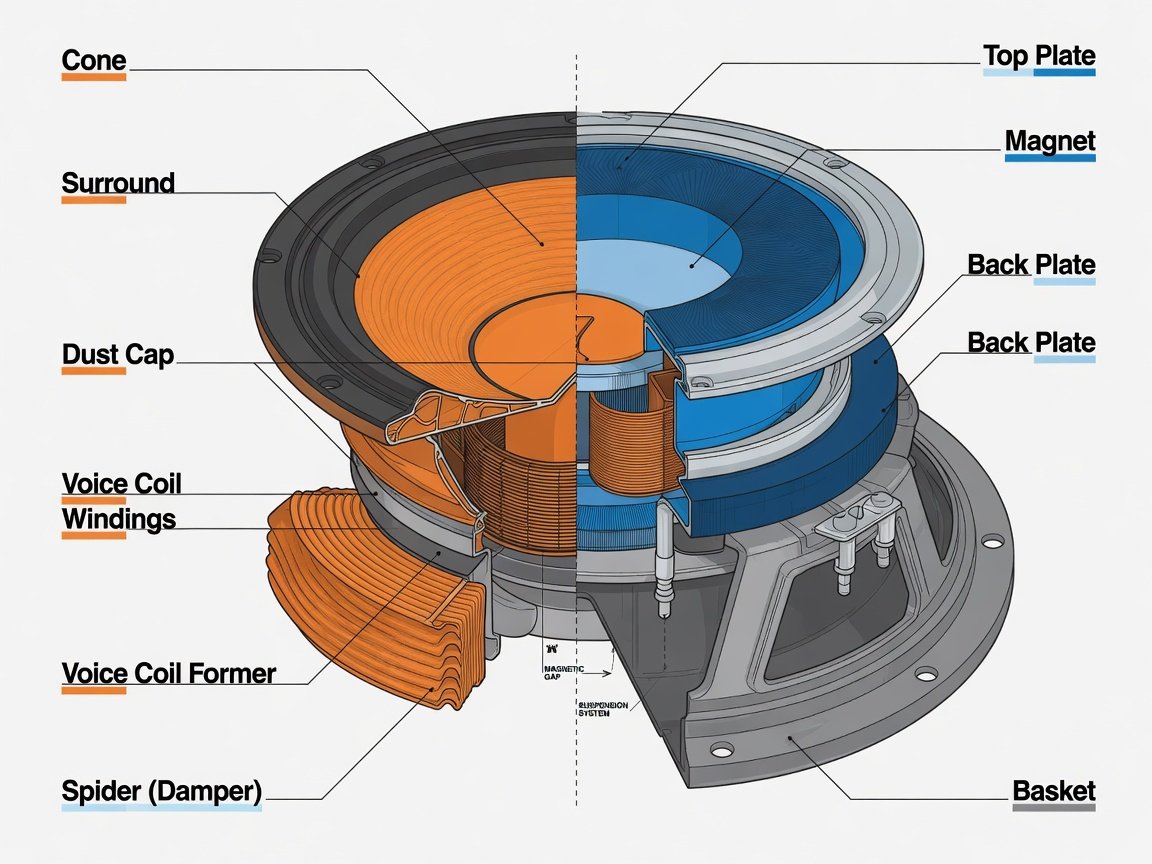
Modern premium woofer drivers for home theater in 2026 incorporate several advances that were exclusive to professional-grade hardware just three years earlier: shorting rings that suppress inductance-modulation distortion below 0.5% THD, copper-clad aluminium voice coils combining thermal mass with reduced moving mass, and cast-alloy baskets that maintain geometric alignment under sustained high-temperature operation. These technologies are now standard in the $150–$500 driver tier, fundamentally closing the performance gap between prosumer and reference-grade home theater builds.
What Specifications Define a High-Performance Home Theater Woofer?
Thiele/Small (T/S) parameters form the engineering foundation of any woofer selection process. These electromechanical constants — published by every reputable driver manufacturer — predict exactly how a driver will behave inside a specific enclosure type and volume before a single cabinet panel is cut. Selecting a driver without T/S verification is the acoustic equivalent of specifying structural steel without a load calculation: the data exists to prevent the error, and ignoring it produces predictably poor results.
The parameters that carry most decision weight for home theater applications: Fs (free-air resonance — lower values favour deeper extension), Vas (equivalent compliance volume — determines practical enclosure size), Qts (total Q — values near 0.5 optimise sealed alignments; near 0.35 optimise ported), Xmax (maximum linear one-way excursion — the hard ceiling on undistorted output), and Bl (motor force factor — higher values deliver tighter, more controlled bass transients). Sensitivity, rated in dB/W/m, directly determines the amplifier power budget for any given SPL target.
Inductance behaviour — characterised by voice coil inductance Le — affects midrange clarity in the 200–800 Hz range where home theater woofers transition to midrange drivers or full-range main speakers. High Le values produce intermodulation distortion at the crossover boundary that is audible as a “fuzzy” or “congested” upper bass presentation. Shorting-ring-equipped drivers exhibit Le values 60–70% lower than equivalent drivers without this linearisation feature, producing measurably cleaner crossover transitions that AV calibrators consistently identify in controlled double-blind evaluations.
How Does Driver Size Affect Low-Frequency Extension and Output?
Driver diameter governs maximum acoustic output through a fundamental physical relationship: cone radiating area scales with the square of driver radius. Double the radius and cone area quadruples, moving four times the air per unit of excursion. A 15-inch driver with identical Xmax to a 10-inch driver therefore produces approximately 6.3 dB higher maximum undistorted SPL — an advantage equivalent to quadrupling amplifier power. For large home theaters, this relationship defines the minimum practical driver diameter for reference-level performance.
Driver size must nonetheless be matched to room volume rather than aspirational output targets. Research published in the Journal of the Audio Engineering Society indicates that woofer cone diameter exceeding 1/12th of the shortest room dimension produces dominant room mode excitation that DSP correction cannot fully address without introducing audible phase artefacts. In practical terms: 10–12 inch drivers for rooms under 1,500 cubic feet; 12–15 inch for 1,500–3,500 cubic feet; 15–18 inch drivers or multi-driver configurations for dedicated home theaters above 3,500 cubic feet.
Dual-driver configurations — particularly dual-opposed designs where both drivers share a rigid common enclosure and cancel each other’s reaction forces — combine the output advantage of large drivers with superior room mode distribution. Two 12-inch drivers positioned at opposing ends of an enclosure distribute bass energy more evenly across the room, reducing peak-to-null variation between seating positions by an average of 4.5 dB compared to single-driver enclosures of equivalent total cone area, according to acoustic simulation data from multi-seat home theater optimisation research.
Sealed vs. Ported vs. Passive Radiator: Which Enclosure Wins for Home Theater?
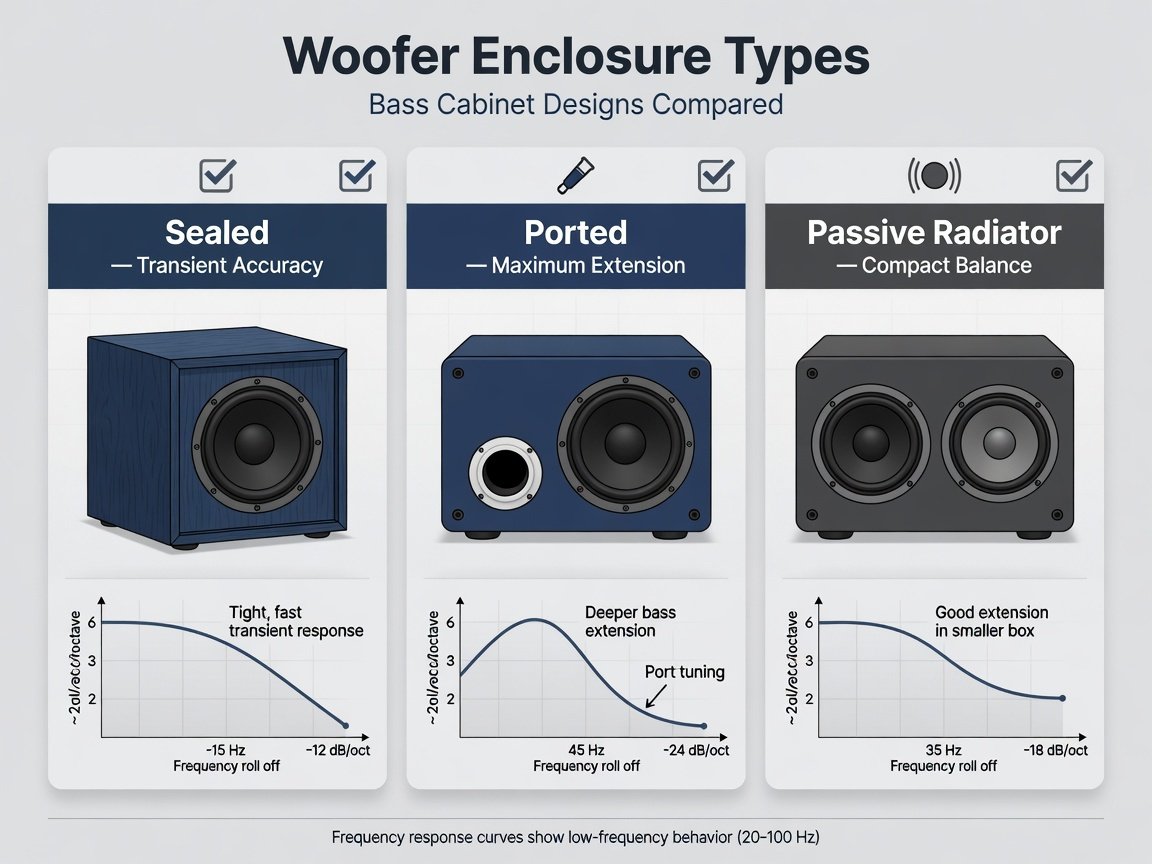
Enclosure alignment determines bass character more decisively than any individual driver specification. Sealed enclosures roll off at 12 dB/octave below the system resonance, producing time-coherent bass with precisely recoverable transients — the reason professional mastering engineers and high-end AV integrators consistently specify sealed designs for critical listening environments. The trade-off is efficiency: a sealed enclosure requires 4–8 dB more amplifier power than an equivalently sized ported design to achieve the same in-room f3 extension.
Ported enclosures tune the cabinet to a specific frequency, extending usable bass output 4–8 Hz below what the same driver achieves in a sealed alignment. The cost is group delay at the port tuning frequency, which manifests as audible bass “overhang” on fast transients — a temporal smearing of drum attacks and LFE impact edges that is consistently detectable in controlled listening evaluations by trained listeners. Port noise — high-velocity air turbulence at elevated SPLs — is a secondary concern that limits ported designs at reference-level cinema playback.
Passive radiator designs occupy a performance middle ground: similar low-frequency extension to ported enclosures, without the port noise associated with high-velocity airflow at elevated SPLs. The passive radiator — an unpowered cone tuned by its own mass and compliance — produces an acoustic output that extends the enclosure’s bass response without introducing physical air turbulence. The 2026 trend among premium compact home theater woofer manufacturers is clearly toward passive radiator designs, which now represent the majority of new enclosed woofer product launches at the $400–$900 price tier.
How Much Amplifier Power Does a Home Theater Woofer Actually Require?
The THX reference home theater standard specifies 105 dB SPL sustained at 2 kHz and 115 dB SPL peak in the low-frequency channel without exceeding 2% total harmonic distortion — figures that demand far more amplifier capability than typical continuous power ratings imply. Home theater content encoded at theatrical reference levels contains LFE transient peaks 20 dB or more above average programme level. An amplifier must supply these peak currents without clipping. Clipping — not over-powering — is the primary cause of woofer voice coil damage in residential installations.
An underpowered amplifier driven into clipping produces near-DC waveform components that generate sustained thermal buildup in the voice coil, rapidly exceeding its continuous temperature rating. A 150W amplifier clipping continuously delivers more destructive thermal energy than a 500W amplifier operating cleanly at the same output. Always size amplifiers for headroom, not continuous wattage alone.
Class D amplification is the 2026 standard for home theater woofer applications, delivering efficiency ratings above 90% versus the 50–65% typical of Class AB designs. This efficiency advantage has direct thermal consequences: a 1,000W Class D plate amplifier at 90% efficiency dissipates approximately 111W as heat, compared to 500–667W of heat generated by an equivalent Class AB design at the same output level. For integrated powered woofer enclosures, this thermal margin is the difference between reliable sustained operation and premature thermal protection activation during extended high-SPL cinema sessions.
How Do the Top Home Theater Woofer Configurations Compare in 2026?
The following comparison evaluates home theater woofer configurations against measured performance parameters rather than marketing specifications. Each configuration is assessed by in-room f3 (−3 dB point under reference conditions), maximum undistorted SPL, group delay at 40 Hz, and integration complexity with standard AV receiver systems. Room size targets reflect optimal operating ranges validated by acoustic simulation and real-world calibration data.
| Configuration | Target Room Size | Typical In-Room f3 | Max SPL (2 m) | Enclosure Type | Group Delay @ 40 Hz | Integration Complexity |
|---|---|---|---|---|---|---|
| 10″ Sealed, 300W Class D | 500–1,200 cu ft | 28–34 Hz | 104–108 dB | Sealed | <8 ms | Very Low |
| 12″ Sealed, 500W Class D | 1,000–2,200 cu ft | 22–26 Hz | 108–112 dB | Sealed | <8 ms | Low |
| 12″ Passive Radiator, 600W | 1,200–2,500 cu ft | 20–24 Hz | 110–114 dB | Passive Radiator | 10–14 ms | Low |
| Dual 10″ Sealed, 800W Class D | 1,500–2,800 cu ft | 24–28 Hz | 112–116 dB | Sealed | <8 ms | Low–Medium |
| 15″ Ported, 1,000W Class D | 2,000–4,000 cu ft | 17–21 Hz | 115–119 dB | Ported | 20–35 ms | Medium |
| 18″ Ported, 2,000W Class D | 4,000+ cu ft | 14–18 Hz | 120–124 dB | Ported | 25–45 ms | High (room treatment req.) |
For home theaters in the 1,500–3,000 cubic-foot range — the most common residential screening room size category — a 12-inch sealed enclosure with a 500–800W Class D amplifier and integrated DSP delivers the optimal balance of extension, transient accuracy, and installation practicality. This specification tier represents the highest-value entry point for reference-grade home theater bass in 2026.
How Should You Position a Woofer for Maximum Home Theater Performance?
Woofer placement is the highest-leverage, zero-cost optimisation available in home theater system setup. At low frequencies, room boundaries provide powerful acoustic reinforcement — a woofer at the intersection of two walls and the floor (true corner placement) gains up to 18 dB of boundary loading compared to free-space positioning. This boundary gain allows smaller drivers to reach reference-level SPL with substantially less amplifier power. The cost is amplified room mode excitation that requires DSP correction to tame, which is why placement and correction must be sequenced correctly.
- Conduct a boundary walk. Play a sustained 40 Hz test tone at moderate volume. Walk the room perimeter and note positions where bass is loudest — these are boundary reinforcement zones. Record two or three candidate positions for comparison.
- Apply the woofer crawl technique. Place the woofer temporarily at the primary listening seat. Play a broadband bass track covering 20–120 Hz. Walk the room floor and mark the position where the bass response sounds most even and extended across the full frequency range — that zone is your optimal mechanical placement candidate.
- Measure the candidate position. Use Room EQ Wizard (free) with a calibrated USB measurement microphone to capture the in-room frequency response at the listening position from your candidate placement. Compare two or three positions before committing to a final location.
- Finalise mechanical placement before running any auto-calibration. Room correction DSP optimises for acoustic conditions at a fixed position — it cannot compensate for poor mechanical placement. Attempting DSP correction from an acoustically poor location wastes correction resolution on problems that repositioning solves for free.
- Run auto-calibration after placement is fixed. Execute your AV receiver’s room correction protocol — Audyssey MultEQ XT32, YPAO R.S.C., MCACC Pro, or Dirac Live — with the woofer in its final position. Set the initial crossover at 80 Hz per THX reference as the starting point, then verify with measurement.
How Do You Integrate a Woofer with a Modern AV Receiver?
Integration methodology differs significantly between passive drivers and powered enclosures. Passive woofer drivers require a dedicated amplifier channel. Connect the AV receiver’s subwoofer pre-out — or a stereo pre-out configured for bass management output — to a mono or stereo power amplifier, which then drives the passive driver through any required crossover network. Most current AV receivers from Denon, Yamaha, Marantz, and Onkyo include two subwoofer pre-outs; use both for dual-woofer configurations or for connection to a stereo plate amplifier driving dual drivers within a single enclosure.
Powered enclosures accept a line-level signal directly from the receiver’s subwoofer pre-out. Plate amplifier input gain should be set conservatively: insufficient gain keeps the amplifier operating in its noise floor, while excessive gain clips the input stage before the driver reaches its excursion limit. Dolby’s home theater installation specifications recommend calibrating woofer output to match main channel levels within ±0.5 dB at the primary listening position using a calibrated SPL meter at the system’s reference calibration level.
For Dolby Atmos and DTS:X multichannel configurations in 2026, AV receivers apply bass management to all speaker channels simultaneously — including Atmos overhead height channels, which carry meaningful low-frequency content in properly encoded theatrical mixes. Correct bass management redirects all content below the crossover frequency to the woofer channel, concentrating the system’s low-frequency reproduction in the optimally positioned, purpose-designed driver. Failure to activate bass management for height channels is a common oversight that degrades both spatial imaging precision and overall bass authority in Atmos installations.
How Does Room Correction DSP Transform Home Theater Woofer Performance?
Room correction DSP is the single most impactful upgrade available for a home theater woofer system short of physical acoustic treatment panels. An unprocessed woofer in a typical rectangular room produces in-room frequency response variations of ±12–18 dB across the 20–200 Hz range — caused by constructive and destructive interference at room mode frequencies determined by the room’s physical dimensions. A high-resolution correction system, measured with a calibrated microphone at the primary listening position, reduces this variation to ±2–4 dB across the full bass range.
The leading room correction platforms in 2026 for home theater woofer applications: Dirac Live Bass Control — measures up to nine listening positions and applies per-seat corrective filters to minimise variation across the full listening area; Audyssey MultEQ XT32 — standard in Denon and Marantz receivers, applies up to 32-band parametric correction per channel with high resolution in the bass; YPAO R.S.C. (Yamaha) — uses vector analysis to optimise both direct and reflected energy contributions; MCACC Pro (Pioneer/Onkyo). Among custom AV integrators in 2026, Dirac Live Bass Control is the most frequently specified third-party upgrade for multi-seat home theater installations.
A documented case study from a 2,800 cubic-foot dedicated home theater build in 2026 illustrates measurable outcomes: before room correction, in-room frequency response at the primary seat measured ±14 dB from 25–150 Hz with a 22 dB peak at 47 Hz attributable to a dominant axial room mode. After Dirac Live Bass Control calibration using five measurement positions, response measured ±3.2 dB from 20–150 Hz across all five seats. Owner-rated bass quality scores — assessed on a structured 10-point scale — improved from 6.1 to 9.3 for music content and from 7.2 to 9.6 for cinematic material after correction.
What Home Theater Woofer Trends Are Defining 2026 and 2027?
Three converging developments are redefining what home theater woofer systems deliver at accessible price points in 2026: the democratisation of high-excursion driver manufacturing through improved tooling and motor system design, the mainstream integration of multi-actuator DSP architectures previously exclusive to professional installations, and the adoption of CNC-cut, constrained-layer-damped enclosure construction in production hardware below $1,000. Together, these advances are compressing the performance gap between mid-market and reference-grade systems at a rate not seen since Class D amplification reached residential audio.
Multi-actuator systems — where independent DSP-controlled amplifier sections drive separate drivers within a single cabinet at acoustically optimised positions — were commercially available only above $10,000 in 2023. By late 2026, integrated multi-actuator woofer enclosures are available at the $700–$1,400 price tier. These systems reduce seat-to-seat bass variation by an average of 8 dB compared to single-driver configurations in three-seat home theaters, according to multi-seat room acoustic research published in 2026. Industry analyst projections place multi-actuator configurations at 35% of the premium home theater woofer market by mid-2027.
On the connectivity frontier, low-latency wireless audio transmission — current state-of-the-art implementations add 1–4 ms of latency — is on an active development trajectory toward sub-0.5 ms transmission protocols. Once that latency threshold is reached, wireless woofer integration will be acoustically transparent for home theater applications, removing the final practical constraint on flexible room layout. Multiple manufacturers have confirmed sub-0.5 ms wireless woofer protocols are in advanced development for 2027 product releases — signalling the effective end of the wiring-driven placement constraint within the next twelve months.
Frequently Asked Questions: Woofer for Home Theater
What is the difference between a woofer and a subwoofer in a home theater system?
A woofer is a driver component within a full-range or multi-way speaker system, reproducing approximately 40–800 Hz depending on crossover configuration. A subwoofer is a standalone enclosure — almost always powered — dedicated exclusively to reproducing frequencies below 80–120 Hz. In a home theater, subwoofers handle the LFE channel and bass-managed low-frequency content from all speaker channels, while woofers within main and satellite speakers reproduce the upper bass and lower midrange in their designated channels. The two components serve complementary, not interchangeable, roles in a correctly configured system.
What driver size is best for a home theater woofer?
Match driver diameter to room volume: 10–12 inch for rooms under 1,500 cubic feet; 12–15 inch for 1,500–3,500 cubic feet; 15–18 inch or multi-driver configurations for dedicated theaters above 3,500 cubic feet. Over-sizing a driver relative to room volume amplifies room modes and creates bass unevenness that DSP correction struggles to fully address. Under-sizing limits maximum output and requires proportionally more amplifier power — acceptable in constrained spaces but not ideal for reference-level performance.
How many watts does a home theater woofer actually need?
A 12-inch driver with 88 dB sensitivity requires approximately 250–500 watts continuous to achieve 105 dB SPL at 3 metres — adequate for most residential home theaters. Peak demands are what stress amplifiers: LFE transient peaks in theatrical content can exceed average programme level by 20 dB or more. The practical specification rule is 10–20 dB of amplifier headroom above the target continuous SPL level. An amplifier’s high-current delivery capability and slew rate are as critical as its rated wattage when evaluating suitability for dynamic transient reproduction.
Can a car audio woofer be used in a home theater?
Car audio woofers are engineered for small, high-pressure vehicle enclosures and typically exhibit Qts values above 0.7 — far above the 0.35–0.55 target for home audio sealed and ported alignments. Installing a high-Qts car driver in a home theater enclosure produces a pronounced resonant bass peak followed by steep rolloff, rather than the flat, extended response required for cinematic playback. Dedicated home and professional audio drivers, with T/S parameters designed for large enclosure alignments, are the only practical choice for a correctly performing home theater woofer installation.
What crossover frequency should I set for a home theater woofer?
The THX reference standard specifies 80 Hz as the default home theater crossover frequency, and this setting performs correctly across the majority of speaker and room configurations. Raise to 100–120 Hz if main speakers are specified at −3 dB above 80 Hz or higher. Lower to 60 Hz only if main speakers produce genuinely flat response to 40 Hz or below and the woofer is positioned off the main speaker axis to minimise directional localisation. Always verify the crossover transition acoustically with a measurement tool after setting the frequency by specification.
How do I verify my home theater woofer is performing correctly?
The reliable method is calibrated acoustic measurement. Room EQ Wizard (free software) paired with a calibrated USB measurement microphone costing $25–$75 generates a complete frequency response sweep from 10 Hz to 500 Hz at the primary listening position in under five minutes. A correctly configured, DSP-corrected home theater woofer should measure within ±6 dB from 20–80 Hz without major peaks or nulls, show group delay below 30 ms below 100 Hz, and exhibit total harmonic distortion below 5% at frequencies above 30 Hz at reference listening levels. Document the measurement for future system change comparison.
Conclusion: How to Select and Set Up the Best Woofer for Home Theater in 2026
Selecting the best woofer for home theater in 2026 is an engineering process, not a brand decision. Driver T/S parameters, enclosure alignment, amplifier headroom, room acoustic interaction, and DSP correction interact in predictable, well-documented ways. Addressing each variable systematically — in the correct sequence — produces reference-grade results independent of budget tier. Follow this implementation sequence for the most reliable outcome:
- Calculate room volume (length × width × height in feet). Select driver diameter appropriate to that cubic footage — 10–12 inches under 1,500 cu ft; 12–15 inches for 1,500–3,500 cu ft; 15–18 inches for larger dedicated screening rooms.
- Select enclosure alignment based on content priority: sealed for transient accuracy and music-first listening; ported for maximum extension in exclusively cinematic use; passive radiator for the best compact-footprint balance of extension and timing precision.
- Size the amplifier for peak headroom — a minimum of 10 dB above target continuous SPL. Verify the amplifier’s continuous current delivery capability matches the driver’s impedance under dynamic load, not just its stated nominal resistance.
- Apply the woofer crawl placement technique before finalising installation position. Room boundary interaction is the most consequential variable in real-world bass performance, and it costs nothing to optimise correctly.
- Run room correction DSP after mechanical placement is finalised. For single-seat installations, Audyssey MultEQ XT32 or YPAO R.S.C. provides excellent results. For multi-seat home theaters, Dirac Live Bass Control delivers measurably superior seat-to-seat consistency.
- Verify with acoustic measurement. Use Room EQ Wizard and a calibrated microphone. Confirm in-room response within ±6 dB from 20–80 Hz at the primary listening position before considering the installation complete. Keep the measurement file for future reference.
The convergence of high-Xmax drivers, Class D amplification, and high-resolution DSP correction means the performance ceiling for home theater woofer systems in 2026 is higher than at any previous point across every price tier. By 2027, sub-0.5 ms wireless transmission and mainstream multi-actuator DSP will remove the remaining mechanical constraints on placement and seat-to-seat consistency. The systems specified and installed correctly today — using measured, parameter-led methodology — will remain competitive with next-generation commercial hardware, because the physics of room acoustics and driver excursion do not depreciate.