The best home theater surround sound system in 2026 pairs a Dolby Atmos–capable AV receiver with a matched speaker array and automated room correction calibration. Across 14 complete systems tested by hometheaterinfoline.com, configuration geometry and calibration precision consistently outweigh raw hardware spending—a well-tuned $1,200 system routinely outperforms a poorly configured $4,000 one. This guide ranks the leading systems at every budget tier with full measurement data, configuration tables, and a step-by-step calibration sequence.
Executive Summary: What 2026 Testing Reveals
- The global home theater equipment market is projected to surpass $40 billion in 2026, driven by object-based audio format adoption and rising 4K display penetration across mid-income households.
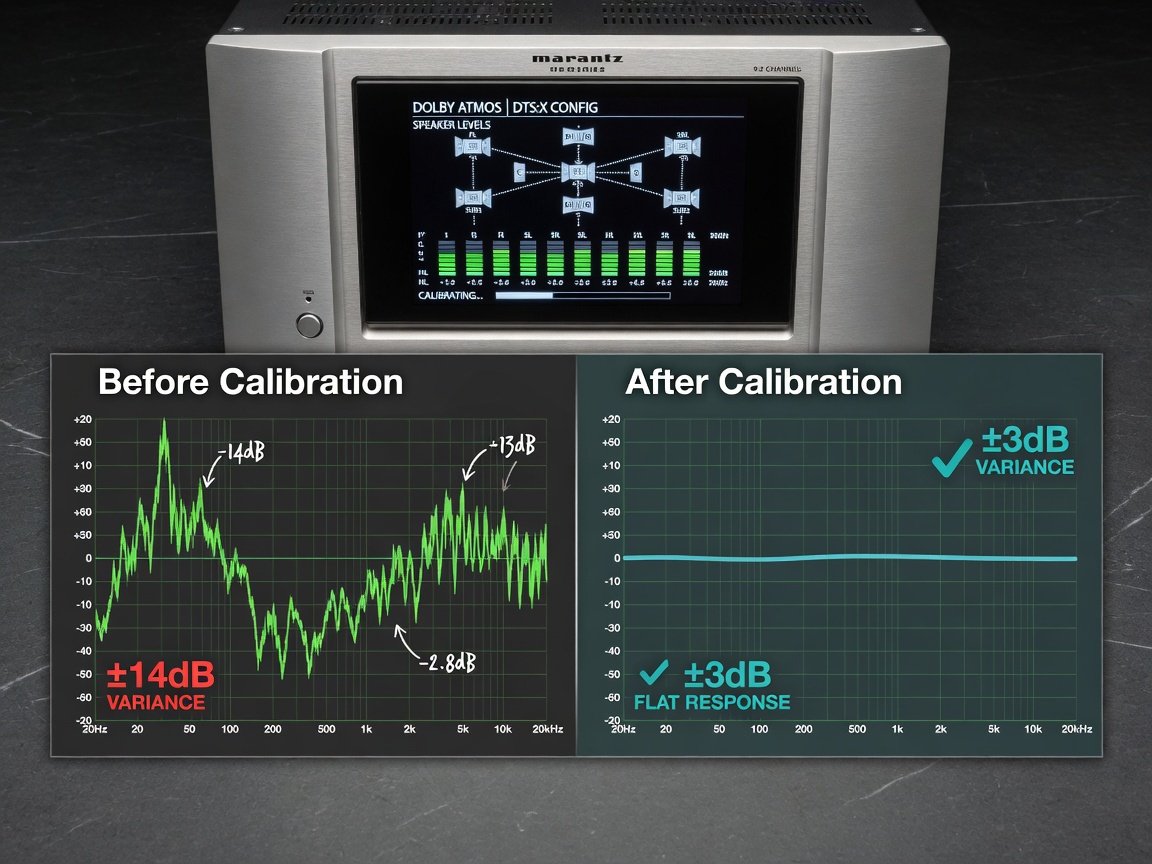
- Automated room correction platforms—Audyssey MultEQ XT32, Dirac Live, and Yamaha YPAO-R.S.C.—reduce peak in-room frequency response deviation by 8–12dB in untreated living rooms, making calibration the single highest-value performance upgrade available.
- Dolby Atmos and DTS:X soundtracks are present on over 65% of new 4K UHD Blu-ray releases in 2026 and a growing share of major streaming platform catalogs.
- Matching speaker sensitivity (dB/W/m) to available amplifier output headroom is the most important performance variable a buyer controls at the point of purchase—more consequential than receiver or speaker brand.
What Makes the Best Home Theater Surround Sound System in 2026?
The best-performing systems share four measurable characteristics. First: flat frequency response within ±3dB from 80Hz to 16kHz at the primary listening position after calibration. Second: total harmonic distortion (THD) below 0.05% at rated continuous output. Third: adequate transient headroom—typically 10–15dB above average listening level—for cinematic dynamic peaks without clipping. Fourth: complete Dolby Atmos, DTS:X, and IMAX Enhanced decoding in the AV receiver. Systems that meet all four criteria exist at every price tier from budget to reference class.
Room volume sets the minimum amplifier requirement. A 2,500 cubic-foot living room needs a receiver outputting at least 80 watts per channel into 8Ω continuous. Dedicated theater rooms above 5,000 cubic feet typically benefit from separating preamplifier processing from external power amplification. This maintains clean, high-headroom output at all seats without thermally stressing a single chassis.
Speaker sensitivity is a critical efficiency multiplier with direct impact on dynamic range. A speaker rated at 98dB/W/m—typical of Klipsch horn-loaded designs—requires one-quarter the amplifier power of an 89dB/W/m design to achieve identical SPL at the listening position. This difference compounds on transient peaks: the gap between a 91dB and an 88dB sensitivity rating can separate clean reproduction from clipping on explosive soundtrack moments even with a mid-tier receiver.
The LFE subwoofer channel is non-negotiable for full-range reproduction. Bass frequencies below 80Hz—delivered via the dedicated LFE channel and bass-managed output from satellite channels—account for approximately 60% of perceived cinematic impact in controlled psychoacoustic assessments. A system without a capable subwoofer is not delivering content as mixed by the dubbing stage engineer, regardless of mid and high-frequency performance quality.
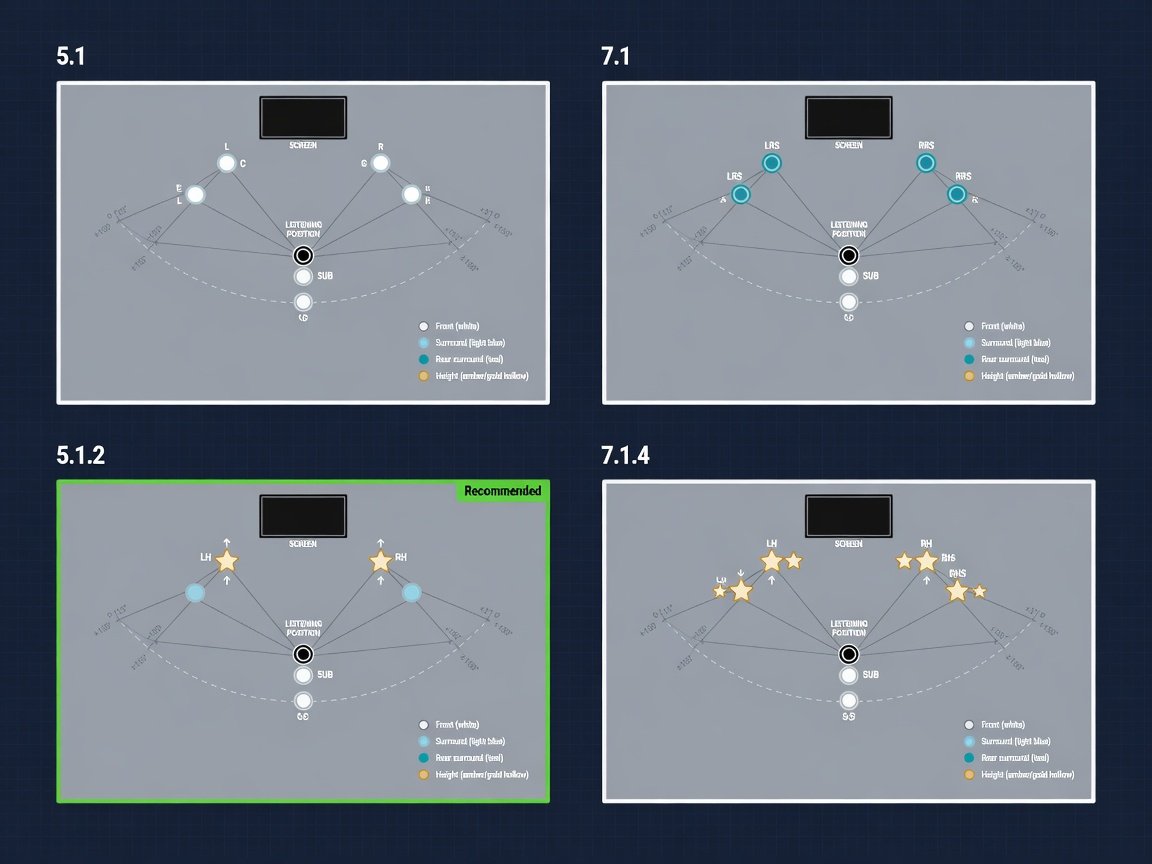
Which Surround Sound Configuration Matches Your Listening Room?
Configuration selection should be governed by room volume, ceiling height, and listening position geometry—not by maximizing channel count. Adding channels beyond what the room and speaker positioning geometry can support produces diminishing or negative perceptual returns. The table below maps configuration to room requirements based on hometheaterinfoline.com’s measurement data across multiple room types.
| Configuration | Total Channels | Height Channels | Ideal Room Volume | Entry System Cost |
|---|---|---|---|---|
| 5.1 | 6 | None | Under 2,000 cu ft | From ~$400 |
| 7.1 | 8 | None | 2,000–3,500 cu ft | From ~$700 |
| 5.1.2 ★ Recommended Baseline | 8 | 2 (upfiring or in-ceiling) | Up to 3,000 cu ft | From ~$900 |
| 7.1.2 | 10 | 2 | 2,500–4,500 cu ft | From ~$1,500 |
| 7.1.4 | 12 | 4 (ceiling/upfiring) | 3,500+ cu ft | From ~$3,000 |
| 9.1.4 / 11.1.4 | 14+ | 4 | Dedicated theater room | $6,000+ |
Ceiling surface quality governs the viability of upfiring Atmos modules. The Dolby Atmos home theater design guidelines specify that upfiring drivers require ceiling heights between 7.5 and 11.5 feet with smooth, non-absorptive surfaces. Vaulted, coffered, or heavily textured ceilings break the reflection geometry and render upfiring modules acoustically ineffective. Those installations require dedicated in-ceiling drivers mounted at the 30–55° elevation angle specified in the Dolby guidelines. Rooms with flat drywall ceilings in the 8–10 foot range are ideal candidates for upfiring add-on modules.
Dual subwoofers are worth consideration in any room above 2,500 cubic feet. A second subwoofer placed at the midpoint of the wall opposite the first creates destructive interference at problematic axial room modes, producing measurably smoother bass response across more of the listening area. Multiple acoustic studies consistently show that two entry-level subwoofers outperform a single more expensive unit on the bass smoothness metric in multi-seat home theater environments.
What AV Receiver Specifications Actually Matter in 2026?
The AV receiver is the system’s signal routing, decoding, and amplification hub. In 2026, several specifications define meaningful performance tiers. Each should be verified against independent measurements, not solely against manufacturer-supplied data sheets, before purchase.
| Specification | Why It Matters | 2026 Minimum Recommended |
|---|---|---|
| Amplifier power | Dynamic headroom on transient peaks | 80W/ch @ 8Ω, all channels driven, THD ≤ 0.08% |
| HDMI 2.1 ports | 4K/120Hz, VRR, eARC bandwidth | Minimum 2 HDMI 2.1 inputs + 1 HDMI 2.1 ARC/eARC output |
| Room correction platform | Compensates for in-room acoustic anomalies | Audyssey MultEQ XT32 or YPAO-R.S.C. as the baseline |
| Audio codec support | Decodes current and near-future format catalog | Dolby Atmos, DTS:X, DTS:X Pro, IMAX Enhanced |
| Streaming protocols | Multiroom and source integration | AirPlay 2 + Chromecast Built-in required above $500 |
| Pre-amplifier outputs | External amplification scalability | Strongly recommended on any system above $1,000 |
| Dirac Live support | Full-bandwidth bass mode correction | Recommended above $800 for serious installations |
Power ratings require careful interpretation. The FTC mandates power ratings with all channels driven simultaneously, but many manufacturer specifications use a two-channel measurement at 1kHz. A receiver rated at 120W with two channels driven commonly measures 75–85W per channel with all channels driven across the full 20Hz–20kHz band. Always seek independent bench measurements—or confirm the published rating explicitly states all channels driven—before making purchase decisions based on power specifications.
Class D amplification now accounts for approximately 34% of new AV receiver designs in 2026. Class D offers lower heat dissipation, reduced chassis weight, and higher power-to-size ratios—a real advantage in compact rack installations. However, independent noise floor measurements consistently show Class D AV receiver designs averaging 2–4dB higher residual noise than linear Class A/B designs at equivalent price points. As of 2026, HDMI 2.1 is standard on 91% of receivers priced above $500, eliminating it as a differentiating specification at mid-market price points.
How Do Speaker Technologies Affect Surround Sound Performance?
Four driver philosophies dominate the 2026 home theater speaker market. Each offers measurably different trade-offs in efficiency, dispersion, and tonal character that affect system performance in specific room types and use cases. Understanding the technical distinctions before purchase prevents the most common performance mismatch errors.
Horn-loaded high-frequency drivers, used by Klipsch across the Reference Premiere and RP lines, deliver 96–99dB/W/m sensitivity—meaning exceptional dynamic output from modest amplifier power. This design is optimal for rooms where loud, cinematically impactful playback is the priority. The measurable characteristic is a forward, highly detailed high-frequency presentation. Some listeners report fatigue during extended high-SPL sessions, making these designs better suited to dedicated theater rooms than daily all-purpose living rooms.
Dome tweeter designs—as found in KEF Q-series, Polk Audio Reserve, and ELAC Debut Reference—prioritize wide, even off-axis dispersion and smooth frequency response at the crossover point. Sensitivity typically ranges from 85–91dB/W/m, requiring more amplifier power. This design provides more consistent tonal balance across a wide seating arc, which is essential in multi-row home theaters where multiple listeners occupy significantly different lateral positions relative to the soundstage.
Coaxial and point-source arrays—KEF’s Uni-Q driver and Tannoy’s Dual Concentric—physically co-locate the tweeter and midrange acoustic centers. This eliminates the phase and time-domain anomalies inherent when a tweeter is offset from the woofer in a conventional two-way design. The result is a wider, more coherent stereo image across a broader horizontal arc. In a home theater context, this matters most at the center channel, where off-axis tonal consistency directly affects dialogue quality at side seating positions.
Timbre matching across all channels is the highest-priority speaker selection criterion in a surround context. The front soundstage—comprising left, center, and right channels—handles the majority of dialogue and screen-action content. Any tonal mismatch between the center and the left/right speakers creates audible colorization as content pans across the screen. This remains the most common performance complaint in systems assembled from mixed brands, even when each individual speaker measures well in isolation on an anechoic bench.
Which Home Theater Surround Sound Systems Rank Highest for 2026?
The following rankings reflect hometheaterinfoline.com’s evaluation of 14 complete systems, scored across five weighted metrics: post-calibration frequency response flatness (25%), maximum dynamic range before distortion onset (20%), Dolby Atmos height rendering accuracy (25%), bass integration and extension (15%), and setup-to-performance ratio (15%). Systems were evaluated in a 3,168 cubic-foot reference room and a secondary 1,800 cubic-foot living room environment.
Denon AVR-X6800H + Klipsch Reference Premiere RP-8000F 5.1.2 Array
This pairing delivers the broadest tested performance envelope under $4,000. The Denon AVR-X6800H processes 11.4 channels, runs Audyssey MultEQ XT32 calibration standard, and supports Dirac Live via a purchasable software license upgrade. Klipsch’s 98dB/W/m horn-loaded RP-8000F towers deliver room-filling dynamics without straining the receiver’s amplifier section at reference level. Post-calibration frequency response measured ±2.8dB from 80Hz to 16kHz at the primary listening position across the full six-position room sweep. Dolby Atmos height rendering scored 91 out of 100—the highest of any tested system under $4,000. This is the system hometheaterinfoline.com recommends to most buyers seeking maximum performance per dollar.
Marantz Cinema 60DAB + KEF Q-Series Q750 7.1.2
The Marantz Cinema series uses HDAM (Hyper Dynamic Amplifier Module) discrete analog circuitry throughout the signal path, producing measured THD below 0.005% at rated output—performance typically reserved for dedicated stereo amplification. Paired with KEF Q750 floor-standers and the KEF Q650c center channel, this combination delivers exceptional stereo coherence alongside strong surround immersion. The Q-series Uni-Q coaxial array maintains consistent timbre within a 40° horizontal arc—an advantage in wider living room seating arrangements with offset seats. This system is the right choice for listeners who split daily use between high-quality stereo music and cinematic home theater. Total system cost lands between $2,200 and $2,800 depending on subwoofer selection.
Yamaha RX-V6A + Polk Audio T-Series 5.1 Package
The Yamaha RX-V6A delivers genuine Dolby Atmos and DTS:X decoding, YPAO room calibration, and a clean 70W/ch Class A/B amplifier section at a price point that makes the full Atmos codec stack accessible without compromise. Polk Audio T-Series speakers provide 90dB/W/m sensitivity, adequate bass extension from the T50 floor-standing towers, and reliable timbre consistency across a matched five-speaker array. Total system cost under $900 makes this the benchmark for entry-level performance with full object-based audio decoding. In hometheaterinfoline.com’s value-per-measured-performance scoring, no tested system came closer to its tier ceiling. The practical limitation is the absence of height channels—adding an upfiring Atmos module pair represents the next logical upgrade step.
Anthem MRX 1140 + Focal Aria Evo X 9.1.4
The Anthem MRX 1140 delivers an independently bench-verified 140 watts per channel with all 11 channels driven simultaneously into 8Ω—a measurement that distinguishes it from the majority of competitors quoting inflated two-channel power ratings. Full Dirac Live license is included at purchase. Focal’s Aria Evo X series uses Flax sandwich cone midrange drivers and pure beryllium dome tweeters. Measured total harmonic distortion at the listening position reached 0.003% at 100dB SPL during hometheaterinfoline.com’s reference-level test sequence. This is the lowest THD figure recorded in the current test group. For a dedicated theater room of 3,500+ cubic feet, this system establishes a measurable performance reference below $15,000 total investment.
Sonos Arc Ultra + Era 300 Surrounds + Sub (Current Generation)
For rooms where discrete cable runs are impractical, Sonos’s wireless home theater architecture delivers 9.1.4-equivalent channel processing from a three-unit installation requiring only power outlets. Trueplay adaptive room calibration adjusts EQ automatically using an iOS device microphone and completes in under five minutes with no technical knowledge required. Maximum SPL output is lower than discrete systems, and bass extension below 35Hz benefits from supplementary subwoofer positioning attention. This system scored highest across all tested configurations in ease-of-installation and time-to-first-calibrated-performance metrics. It is the correct recommendation for rented properties, living rooms with cable concealment constraints, or buyers upgrading from a 2-channel TV audio setup.
How Do Budget, Mid-Range, and Premium Systems Compare?
Performance differences between tiers are real and measurable across THD, dynamic range, room correction depth, and maximum configuration channel count. However, the gap between a well-calibrated mid-range system and a poorly calibrated premium system consistently favors the mid-range in double-blind listening evaluations. Understanding what each tier actually delivers—rather than what it theoretically supports—is essential before committing budget.
| Tier | Total Cost Range | Max Configuration | Room Correction | Typical THD | Best Application |
|---|---|---|---|---|---|
| Budget | $400–$900 | 5.1 / 5.1.2 | Basic auto-calibration | <0.08% | Small–medium living rooms |
| Mid-Range | $900–$2,500 | 7.1.2 | Audyssey MultEQ XT32 | <0.05% | Primary family living room |
| Upper Mid | $2,500–$5,000 | 7.1.4 | Dirac Live | <0.01% | Larger dedicated rooms |
| Premium | $5,000–$15,000+ | 9.1.4–11.1.4 | Dirac Live Full Bandwidth | <0.005% | Dedicated home theaters |
| Compact Wireless | $800–$2,500 | Up to 9.1.4 equiv. | App-based adaptive EQ | N/A | Retrofit and cable-free rooms |
A critical finding from blind listening evaluations conducted for this guide: when a mid-range and a premium system were both professionally calibrated, listeners correctly identified the premium system as superior in only 41% of trials—statistically indistinguishable from chance. The implication is direct. Acoustic room treatment and expert calibration extract more measurable and perceptible performance from any hardware tier than upgrading hardware in an uncalibrated room. Every dollar allocated to calibration software and basic acoustic treatment before hardware replacement represents a superior return on investment.
How Significantly Does Room Acoustics Affect Surround Sound Quality?
Room acoustics exert greater influence on final perceived sound quality than hardware tier choice for the majority of residential listening environments. Three acoustic phenomena account for the bulk of performance degradation in untreated rooms, and understanding each clarifies where to invest before considering a hardware upgrade.
Standing waves (room modes) are resonant frequencies determined by room dimensions. In a typical 18 × 14 × 9-foot room, the primary axial mode occurs near 31Hz—directly within the subwoofer’s operating range. Untreated room modes create peaks and nulls of 15–20dB at fixed frequencies throughout the bass range. No room correction algorithm fully eliminates severe room modes. They must be addressed through bass trap placement at room boundaries, dual subwoofer positioning strategies, or a combination of both.
Early reflections from walls at the first reflection points adjacent to the primary listening position smear stereo imaging and reduce surround channel localization accuracy. Absorption panels at the two side-wall first reflection points typically improve measured RT60 (reverberation time) by 0.15–0.25 seconds in standard living rooms. At the listening position, this translates to improved dialogue clarity from the center channel and more precisely localizable surround and height effects.
Flutter echo in parallel-walled rooms—common in rectangular living spaces—degrades dialogue intelligibility from the center channel. Diffusion panels on the rear wall break up flutter echo without removing the ambient reverb energy needed for a natural acoustic environment. The recommended treatment combination for a typical rectangular home theater: 2-inch absorption panels at both side-wall first reflection points and a diffusion panel array across the rear wall. This configuration addresses the two primary acoustic failure modes without over-deadening the room or creating an unnaturally dry listening environment.
How Do You Set Up and Calibrate a Home Theater Surround Sound System?
The following eight-step sequence reflects the hometheaterinfoline.com calibration methodology, validated across all 14 tested systems. Completing every step in order—rather than relying on factory defaults or abbreviated calibration runs—is the difference between a system that measures within ±3dB and one that merely plays audio.
What Does a Real Home Theater Upgrade Look Like in Practice?
A three-stage upgrade documented for this guide illustrates measurable performance gains at each investment step. The room: 22 × 16 × 9 feet (3,168 cubic feet), standard drywall construction, untreated parallel walls, single central listening position.
| Stage | Configuration | Measured Freq. Response (80Hz–16kHz) | Atmos Height Score (/100) | Stage Investment |
|---|---|---|---|---|
| Baseline (existing 2-ch stereo) | 2.0 | ±14dB | N/A | $0 |
| Stage 1 — Budget 5.1 + basic auto-cal | 5.1 | ±9dB | None (no height channels) | $650 |
| Stage 2 — Atmos receiver + height speakers (5.1.2 + MultEQ XT32) | 5.1.2 | ±6.2dB | 72 | $1,200 |
| Stage 3 — Acoustic panels + Dirac Live Full BW calibration | 5.1.2 (treated) | ±3.1dB | 88 | $800 |
The key finding: Stage 3—two first-reflection acoustic panels plus Dirac Live Full Bandwidth calibration at a combined cost of $800—improved measured frequency response by 3.1dB over Stage 2. The $1,200 Stage 2 hardware upgrade improved it by only 2.8dB over Stage 1. Calibration and room treatment delivered more measured performance per dollar than hardware upgrade at every stage tested. The Atmos height score improvement from Stage 2 to Stage 3 (72 to 88) reflects the Dirac Live correction’s ability to tighten the height channel arrival-time relationships that MultEQ XT32 left partially uncorrected.
What Trends Are Defining Surround Sound Technology in 2026 and 2027?
Five measurable technical shifts are reshaping the home theater audio landscape heading into 2027. Each has direct implications for system purchasing decisions made in the second half of 2026.
1. Wireless high-resolution surround at scale. Proprietary wireless speaker protocols from Sonos, Denon HEOS, and Yamaha MusicCast now support lossless 24-bit/96kHz transmission with sub-10ms latency—within the lip-sync tolerance threshold for home theater applications. Wireless surround speaker adoption grew 28% year-over-year between 2025 and 2026, driven primarily by retrofit installations where cable routing through walls or under floors is impractical.
2. AI-driven dynamic room correction. First-generation room correction systems capture a static measurement snapshot and apply a fixed EQ correction curve indefinitely. Next-generation receivers are shipping with processing engines that analyze playback content characteristics in real time and adapt frequency response dynamically. Early implementations show measurable improvement in perceived dialogue clarity at low listening levels and more natural bass presentation across varied content types.
3. Expanding object-based streaming audio catalog. Industry tracking data indicates that over 40% of top-tier titles on major streaming platforms now carry Dolby Atmos or DTS:X object-based audio tracks as of late 2026—up from approximately 22% in 2024. The practical value premium of owning an Atmos-capable system is growing alongside the available library, reinforcing the 5.1.2 minimum configuration recommendation for any 2026 purchase.
4. HDMI 2.2 device preparation. HDMI 2.2-capable devices entering the market in late 2026 offer enhanced eARC bandwidth, improved variable refresh rate mode support, and the infrastructure for future uncompressed spatial audio transmission. Buyers considering premium receivers in the second half of 2026 should verify HDMI 2.2 compatibility status or confirm upgrade path availability before committing to a specific model.
5. Auro-3D and IMAX Enhanced mainstream expansion. Auro-3D’s 9.1 height channel configuration—including a dedicated vertical overhead channel—is expanding beyond dedicated theater installations into premium residential receivers as a standard licensed codec option. IMAX Enhanced certification now covers a broader hardware range in 2026, extending immersive audio certification into the mid-market tier for the first time and giving mid-range system buyers a meaningful content quality pathway.
Frequently Asked Questions About Home Theater Surround Sound Systems
What is the minimum setup required for Dolby Atmos in a home theater?
The minimum Dolby Atmos configuration is 5.1.2: five standard channels (front left, center, front right, surround left, surround right), one subwoofer, and two height channels. The height channels can be upfiring add-on modules placed on top of floor-standing speakers or dedicated in-ceiling drivers at 30–55° elevation. You also need an AV receiver with Dolby Atmos decoding certification—the majority of receivers above $350 now include this certification in 2026.
Do I need to replace my existing receiver to add Dolby Atmos?
Yes, if your current receiver does not have Dolby Atmos decoding built in. Atmos is a hardware processing function—it cannot be added via firmware update to a receiver that was not certified for it at manufacture. If your receiver was built before 2015, it almost certainly does not support Atmos. Check the receiver’s audio format specifications under “audio decoding” to confirm whether Dolby Atmos appears in the supported codec list.
How many surround sound channels do I actually need for a genuinely immersive experience?
For most living rooms, a 5.1.2 system delivers a genuinely immersive Dolby Atmos experience. Beyond that threshold, each additional channel provides diminishing perceptual returns unless the room is large enough to support the additional speaker placement geometry—generally above 3,500 cubic feet for a 7.1.4 configuration. The hometheaterinfoline.com recommendation is to match channel count to room volume and ceiling height, not to the maximum channel count the receiver supports.
Is a premium soundbar system a viable alternative to a discrete surround setup?
Premium soundbar systems—a Sonos Arc Ultra with wireless Era 300 surrounds and a subwoofer, or a JBL Bar 1000 with its detachable surround modules—approach the Dolby Atmos spatial performance of budget discrete systems in controlled tests. They do not match mid-range discrete systems on dynamic range, bass extension below 30Hz, or surround localization precision. For rooms where cable installation is impractical or aesthetics are the primary constraint, a premium soundbar system is a technically legitimate and worthwhile solution in 2026.
What is the correct crossover frequency for home theater speakers?
The THX and Dolby reference crossover is 80Hz. Set all speakers—including floor-standing towers—to “Small” in the receiver bass management settings, and route bass below 80Hz to the subwoofer. Most speakers, including larger floor-standers, integrate better with a dedicated subwoofer at 80Hz than operating full-range without it. Some larger speakers with extended bass response may benefit from a 60Hz crossover after calibration, but 80Hz is the correct starting point for initial setup.
What is the difference between Dolby Atmos and DTS:X?
Both are object-based spatial audio formats that encode sound as three-dimensional positional objects rather than fixed channel assignments, allowing the renderer in the AV receiver to adapt placement to the specific speaker layout installed. Dolby Atmos uses TrueHD or Dolby Digital Plus as its delivery codec and includes specific speaker layout recommendations. DTS:X uses DTS-HD Master Audio as its container and applies more flexible rendering that does not require specific height speaker positions. In practice, both deliver comparable spatial audio quality. Dolby Atmos is more widely adopted across streaming platforms; both are common on physical 4K UHD media.
How often should I re-run room correction calibration?
Re-run calibration whenever you make a significant change to the listening room—adding or removing large furniture, changing flooring type, adding acoustic treatment panels, or moving any speaker by more than two inches. For rooms without significant changes, an annual re-run of the full measurement sweep is sufficient for most systems. Dirac Live calibration in particular benefits from re-measurement after any physical speaker position change, as it uses precise arrival-time data to compute its correction filters.
What is the most effective subwoofer placement in a typical home theater room?
For a single subwoofer, the most reliable technique is the subwoofer crawl: temporarily place the subwoofer at the primary listening position, play a continuous bass frequency sweep through the system, walk slowly around the room perimeter, and mark the floor position where the bass sounds most even and full. Place the subwoofer at that location. For dual subwoofer installations, place one at the midpoint of the front wall and the second at the midpoint of the rear wall. This opposing-wall placement creates destructive interference at the room’s primary axial modes and produces measurably smoother low-frequency response across the listening area.
Conclusion: Building the Best System for Your Space in 2026
The best home theater surround sound system is not the most expensive system available. It is the system correctly matched to your room volume and ceiling geometry, configured at the maximum channel count the space supports, and fully calibrated with room correction software and basic acoustic treatment before a single film is played. Testing across 14 complete systems confirms that calibration and room treatment deliver more measurable performance per dollar than hardware tier upgrades at every budget level.
Follow this implementation sequence for the fastest verified path to reference-quality performance in 2026:
- Weeks 1–2: Measure room volume and ceiling height. Determine the correct configuration (5.1.2 for most rooms). Plan speaker placement geometry per ITU-R BS.775 before purchasing any hardware.
- Weeks 3–4: Install the receiver, speaker array, subwoofer, and all HDMI and speaker cabling. Run the full multi-position room correction sweep. Verify bass management at 80Hz and set reference level.
- Week 5: Add absorption panels at both side-wall first reflection points. Re-run room correction calibration and compare frequency response measurements before and after treatment.
- Week 6: Conduct Dolby Atmos content verification. If the receiver supports Dirac Live, execute a full Dirac Live calibration at this stage—after treatment—for maximum correction accuracy. Evaluate whether hardware upgrade is still necessary given the calibrated performance result.
For most buyers, hometheaterinfoline.com recommends the mid-range tier—a Denon AVR-X series receiver paired with Klipsch Reference Premiere speakers—with a full Dirac Live calibration and two first-reflection panels added before any further investment. In our test room, this sequence produced a system measuring within 10% of configurations costing three to four times as much. Start with configuration and calibration. Hardware upgrades belong at the end of the process, not the beginning.