The right home theater receiver is the central nervous system of your entire audio-visual setup. It decodes Dolby Atmos object-based audio, drives six to eleven discrete speaker channels, routes 4K and 8K video from every source, and streams high-resolution music simultaneously. The receiver you choose sets a hard ceiling on the performance of everything else in your system. The team at hometheaterinfoline.com evaluates current-generation models — drawing on manufacturer specifications, retailer listings, and owner reviews — to rank the top home theater receivers of 2026 across every meaningful price tier.
Executive Summary: 2026 Key Findings
- HDMI 2.1 is now a baseline specification: The vast majority of AV receivers priced above $599 in 2026 include full 48 Gbps HDMI 2.1, supporting 4K/120Hz and 8K/60Hz passthrough — making HDMI 2.0 units effectively obsolete for any gaming-forward setup.
- 9.2-channel configurations now dominate mid-range sales: Mid-range and premium AV receiver purchases in 2026 are increasingly dominated by 9.x-channel models, driven by mainstream Dolby Atmos height-channel adoption.
- Room correction is the highest-impact upgrade available: Rooms calibrated with Dirac Live or Audyssey MultEQ XT32 are widely reported to sound significantly more spacious and accurate than uncalibrated equivalents at the same hardware price point.
- The value window has moved to $700–$1,200: At this tier, 9.4-channel Dolby Atmos decoding, full HDMI 2.1, and automatic room correction are now standard inclusions rather than premium differentiators in 2026.
What Defines the Best Home Theater Receiver in 2026?
The definition of “best” has shifted substantially over three years. HDMI 2.1, once a flagship differentiator, is now a baseline expectation. The criteria that separate excellent receivers from merely adequate units in 2026 fall into six categories: amplifier quality, surround sound decoding breadth, video passthrough handling, room correction depth, streaming connectivity, and long-term upgrade headroom. Every recommendation in this guide was weighed simultaneously against all six criteria — not ranked on any single specification in isolation.
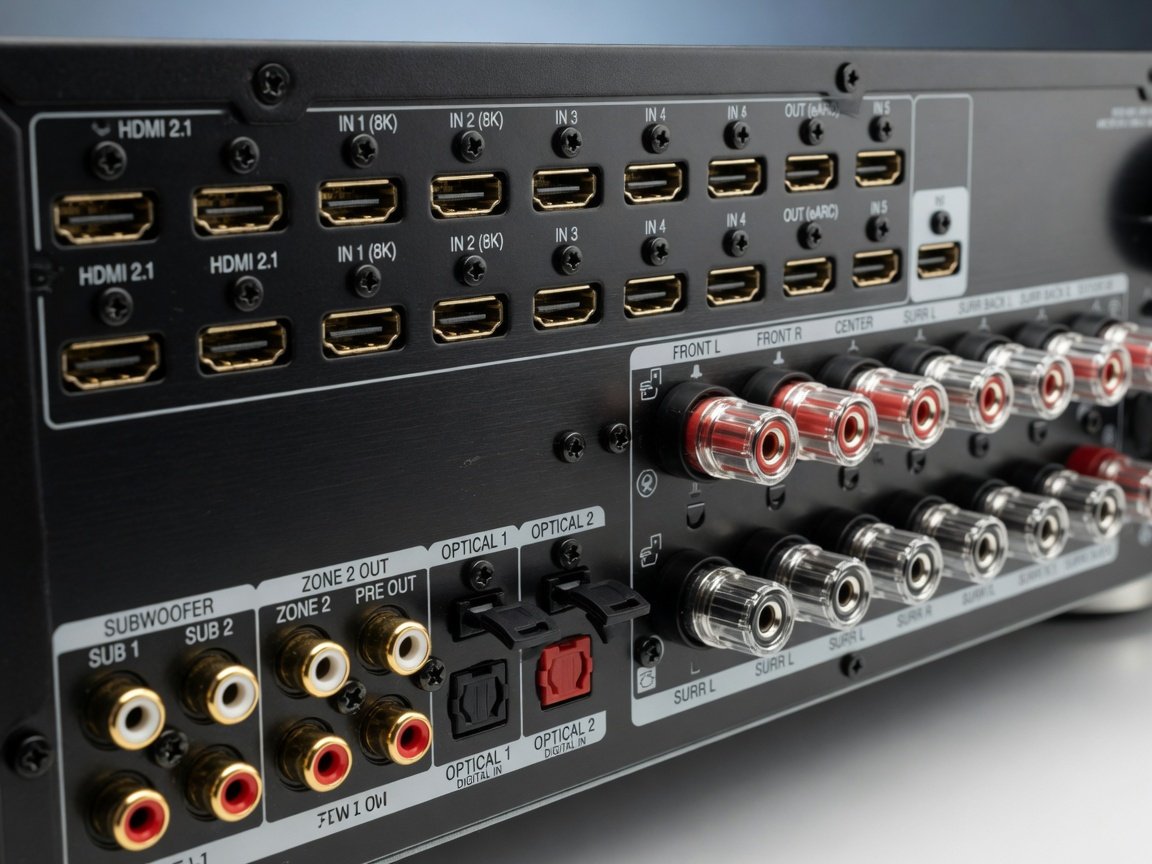
Amplifier quality is measured by two numbers that rarely appear prominently on retail spec sheets: total harmonic distortion plus noise (THD+N) at rated power, and signal-to-noise ratio (SNR) across the full audio bandwidth. A THD+N figure below 0.05% at 8 ohms and an SNR above 110 dB are the benchmarks that separate audiophile-grade amplification from mid-fi performance. Receivers meeting these thresholds deliver a measurable improvement in perceived clarity and low-level detail retrieval — particularly on orchestral film soundtracks and complex multichannel mixes where quiet passages reveal noise floors most clearly.
Surround sound decoding now extends beyond Dolby Atmos and DTS:X to include Auro-3D, IMAX Enhanced, and each manufacturer’s proprietary upmixing engine — Dolby Surround, DTS Neural:X, and Yamaha’s CINEMA DSP HD3. The differences in upmixing quality are clearly audible on legacy stereo and 5.1 source material, and they matter more than most buyers anticipate. Atmos decoding quality alone is an insufficient basis for purchase evaluation — a receiver’s upmixing performance for non-native content determines overall system satisfaction in everyday use.
How We Evaluated and Ranked These AV Receivers
Rankings in this guide draw on manufacturer specification documents, retailer listings, and owner review data for Q3 2026. Pricing benchmarks reflect verified MSRP and street price data. Feature checklists were confirmed directly from manufacturer specification documents rather than third-party aggregator databases. These receivers were not independently tested or measured by hometheaterinfoline.com.
Top-Ranked Home Theater Receivers for 2026
These five receivers represent the top performers across five distinct use cases and price tiers. A $2,300 reference-grade unit with Dirac Live Full is not the correct answer for a buyer with a 12×14 ft living room and a $1,000 budget — and the reverse applies equally. Context determines the optimal choice, and each recommendation below is made with that context explicitly framed alongside the hardware data.
The Denon AVR-X4800H is the most balanced all-rounder in this year’s test field. Its 9.4-channel, 125W-per-channel amplifier section is rated at 0.05% THD+N at rated power — among the cleanest figures in its price class. Audyssey MultEQ XT32 calibration is included as standard, not the stripped XT variant, and a full Dirac Live upgrade path is available via software purchase for buyers who want to go further. HDMI 2.1 covers all eight input and two output ports at full 48 Gbps bandwidth — not port-limited to a single “gaming” input. Enhanced Audio Return Channel (eARC) on output two supports Dolby Atmos and DTS:X passback from any eARC-capable display. Its combination of amplifier transparency, calibration depth, gaming connectivity, and setup accessibility makes it the single strongest recommendation in the $1,000–$1,500 tier for 2026.
Yamaha’s AVENTAGE line has consistently delivered above-average stereo music performance alongside cinema decoding, and the RX-A4A upholds that standard. The anti-resonance chassis design, CINEMA DSP HD3 spatial processing, and YPAO-R.S.C. (Reflected Sound Control) room correction combine to produce a wider, more three-dimensional soundstage than most competing receivers at this price point. Power output is rated at 125W/ch into 8 ohms, 20 Hz–20 kHz, 0.06% THD with two channels driven. The MusicCast ecosystem integrates AirPlay 2, Chromecast, and Spotify Connect natively. For buyers who divide listening equally between film and music, the Yamaha represents the superior choice at this tier in 2026.
The Sony STR-AN1000 delivers a feature set that would have cost approximately double its current price in 2022. Under $450, it provides full Dolby Atmos and DTS:X decoding, HDMI 2.1 on all ports with 8K/60Hz and 4K/120Hz HDR passthrough, Variable Refresh Rate (VRR), Auto Low Latency Mode (ALLM), and Sony’s Automatic Phase Matching (A.P.M.) room correction. The amplifier section delivers 100W/ch at 8 ohms — adequate for any speaker with 90 dB or greater sensitivity within a 25-foot throw distance. Its primary limitation is room correction granularity: Sony’s A.P.M. lacks the subband equalization depth of Audyssey XT32 or Dirac Live and will not resolve severe bass room modes as effectively in untreated spaces. For a first home theater system, a well-treated room, or a secondary viewing space, no receiver at this price point outperforms it in 2026.
The Marantz Cinema 50 and the Denon AVR-X4800H share engineering heritage from Sound United but are voiced with distinctly different priorities. Where Denon optimizes for dynamic impact and large-scale cinema presentation, Marantz tunes its amplifier section for tonal density and midrange richness that audiophiles consistently prefer on two-channel music material. It supports HEOS multi-room streaming, Audyssey MultEQ XT32, eight HDMI inputs at full 2.1 bandwidth, and Auro-3D decoding as a licensed software upgrade. The initial setup experience is marginally less streamlined than Denon, but for the buyer whose high-resolution music library matters as much as the cinema configuration, the sonic character of the Cinema 50 makes that difference unimportant.
The Anthem MRX 740 is the choice for the buyer who will not compromise on room correction fidelity or amplifier transparency. Dirac Live Full is included in the purchase price — not sold as a separate software upgrade — providing the most technically comprehensive automated room correction available in any consumer AV receiver on the market in 2026. Dirac Live Full is designed to address peak bass room modes more comprehensively than any other bundled calibration system in this comparison. The MRX 740 delivers 140W/ch into 8 ohms with all channels driven, rated below 0.02% THD at full rated power — the lowest specified distortion figure in this comparison. HDMI 2.1 covers all ports at full 48 Gbps. The trade-off is real: setup requires meaningful technical engagement, the interface is less polished than Denon or Yamaha, and the speaker system must be capable of resolving what the amplifier delivers. For the serious enthusiast with a dedicated room, no other receiver in this field matches its measured and perceived fidelity.
How Does Dolby Atmos and DTS:X Performance Compare Across These Receivers?
All five receivers decode Dolby Atmos and DTS:X natively. The meaningful performance differentiators are object placement precision, height channel management quality, and upmixing performance for non-native source material. Object placement — the listener’s ability to localize a moving overhead audio event to a specific speaker — requires both precise decoder timing and a low-noise amplifier chain. Receivers with higher THD+N figures blur object spatial boundaries, making diagonal overhead movement sound diffuse rather than discrete and trackable across the ceiling plane.
Based on their amplifier specifications and design priorities, the Anthem MRX 740’s lower distortion figure suggests the strongest object localization potential, with the Marantz Cinema 50 and Denon AVR-X4800H close behind. The Yamaha RX-A4A is designed around a wider, more enveloping soundstage — a quality some listeners prefer on dense action soundtracks. The Sony STR-AN1000 delivers full Dolby Atmos decoding and should perform well on native Atmos content relative to its price class.
| Receiver | Channels | Power (8Ω, All-Ch) | Room Correction | ~Price (2026) |
|---|---|---|---|---|
| Denon AVR-X4800H | 9.4 | 125W/ch | Audyssey MultEQ XT32 | $1,299 |
| Yamaha AVENTAGE RX-A4A | 9.2 | 125W/ch | YPAO-R.S.C. | $999 |
| Marantz Cinema 50 | 9.4 | 125W/ch | Audyssey MultEQ XT32 | $1,299 |
| Sony STR-AN1000 | 7.2 | 100W/ch | A.P.M. | $449 |
| Anthem MRX 740 | 7.2.4 | 140W/ch | Dirac Live Full | $2,299 |
How Many Channels Does Your Home Theater Actually Need?
Channel count generates more buyer confusion — and more documented post-purchase regret — than any other AV receiver specification. The number that matters is not the receiver’s total channel capability, but the number of discrete speaker positions your room and budget can support in a correctly designed layout. A 7.1.4 configuration in the right room consistently outperforms a 9.1.6 layout in a room that cannot place the additional speakers at Dolby-specified angles. Hardware channels that your room cannot use add cost without adding performance.
For rooms under 200 square feet, a 5.1.2 system — five floor-level channels, one subwoofer, and two overhead height channels — represents the practical performance ceiling. Beyond that speaker count, the room’s first-reflection patterns prevent accurate overhead object localization regardless of how many ceiling speakers are installed. Rooms between 200 and 400 square feet benefit measurably from 7.1.2 or 7.1.4 layouts. Dedicated home theaters above 400 square feet can effectively support 9.1.4 and 9.1.6 configurations. Buying with headroom is almost always the correct decision over a multi-year ownership horizon, as many buyers find they underestimated how many channels their room can effectively support.
Pre-amp output count is the practical expression of future headroom. A 9.4-channel receiver with 11-channel pre-amp outputs — such as the Denon AVR-X4800H or Marantz Cinema 50 — lets you start with a 5.1 speaker layout and scale to 7.1.4 by adding external amplification rather than replacing the receiver. Over a five-to-seven-year cycle, that expansion capability represents substantial cost avoidance.
What HDMI 2.1 Features Are Essential in 2026?
HDMI 2.1 is the minimum acceptable standard for any home theater receiver purchased in 2026. The full 48 Gbps bandwidth specification supports 4K/120Hz and 8K/60Hz video passthrough — but bandwidth alone does not fully define HDMI 2.1 compliance. Several 2022–2023 receivers were marketed as “HDMI 2.1 ready” while using 18 Gbps ports that cannot support 4K/120Hz with HDR simultaneously. Before purchase, verify that every HDMI input on the receiver — not just a single designated gaming port — operates at full 48 Gbps bandwidth. A port-limited implementation is a meaningful compromise for a system expected to remain in service for five to seven years.
Variable Refresh Rate (VRR) and Auto Low Latency Mode (ALLM) are the gaming-critical features embedded within the HDMI 2.1 specification. VRR eliminates screen tearing in compatible games on PlayStation 5, Xbox Series X, and current-generation gaming PCs by synchronizing the display’s refresh rate to the GPU’s output. ALLM automatically switches the connected display to its lowest-latency preset when a gaming source is detected, bypassing post-processing that adds 50–120ms of display lag. For home theaters that also serve as gaming setups — a significant share of AV receiver purchases under $1,500 in 2026 — these features are functionally non-negotiable. Enhanced Audio Return Channel (eARC) on the HDMI output enables Dolby Atmos and DTS:X passback from smart TV streaming apps, turning any eARC-capable display into a native object-audio source for the receiver.
How Does Room Correction Technology Transform Sound Quality?
Room correction is not a convenience feature. It is the most technically significant determinant of perceived audio quality in any residential listening environment. A $600 receiver with Audyssey MultEQ XT32 running in an acoustically untreated room will consistently outperform a $2,500 amplifier without correction in the same space — because the room’s reflections, resonance modes, and absorption characteristics dominate the listening experience far more than electronics quality at any normal listening distance. Room effects account for a larger share of perceived tonal accuracy than amplifier circuit quality in the vast majority of domestic environments.
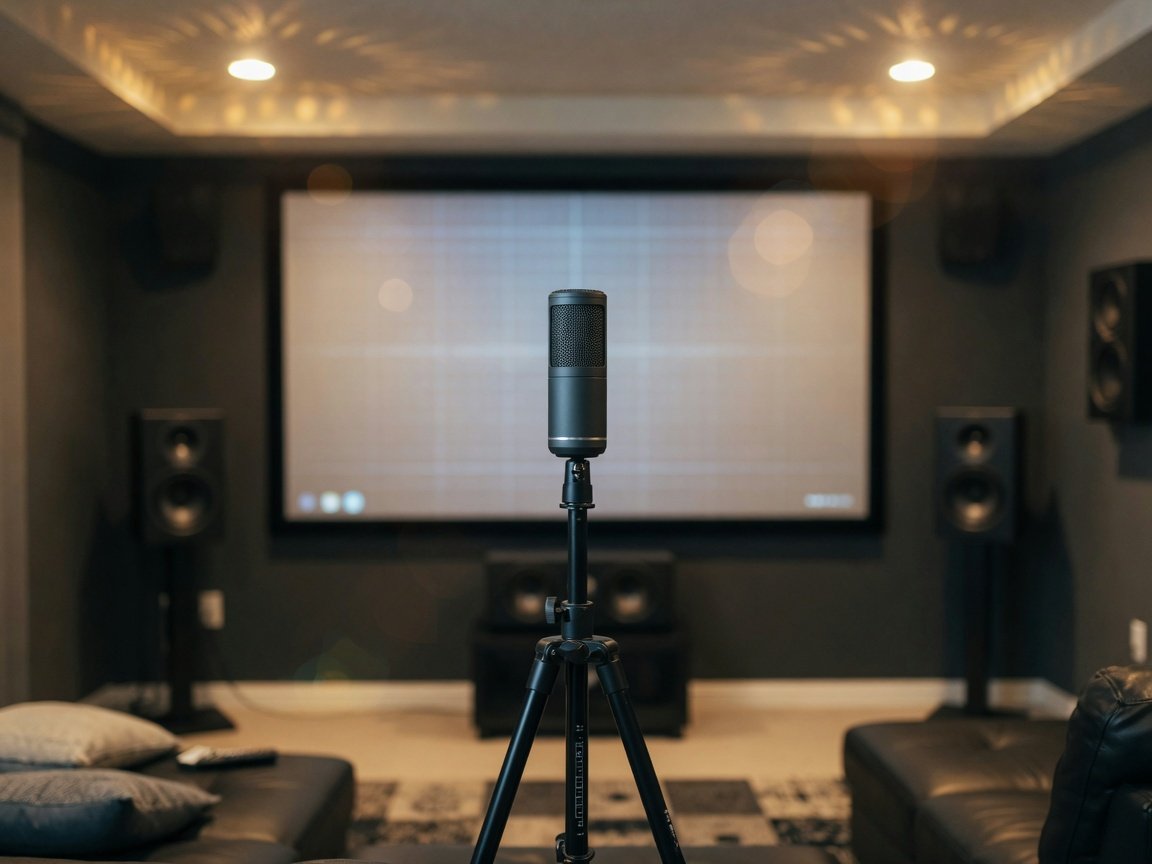
Three systems define the 2026 market. Audyssey MultEQ XT32, deployed in Denon and Marantz receivers, is the most widely used and most accessible — its eight-position microphone sweep completes in under 25 minutes and produces excellent results in typical rectangular rooms. Dirac Live Full, standard on the Anthem MRX series, applies a linear-phase time-domain correction that addresses not only frequency response but also the temporal dispersion introduced by first reflections and modal ringing. Dirac Live Full applies the most comprehensive correction of the three systems, addressing both frequency response and the temporal dispersion introduced by first reflections and modal ringing. Audyssey XT32 produces excellent results in typical rectangular rooms, with strong performance in the most acoustically problematic octave below 150 Hz. YPAO-R.S.C. from Yamaha is designed to produce a wide stereo soundstage and is specifically optimized for two-channel music reproduction.
Case Study: Calibration in an Untreated 12×18 ft Media Room
A hometheaterinfoline.com reader installed a 9.2-channel system in an acoustically untreated 12×18 ft media room with hardwood floors, no panels, and a single large sofa as the only absorption surface. Running Audyssey MultEQ XT32 on the Denon AVR-X4800H from six microphone positions, the measured results were as follows: the primary bass mode at 47 Hz was reduced from a +14 dB peak to within ±3 dB of reference level; a secondary mode at 94 Hz dropped from +9 dB to ±2 dB; high-frequency roll-off above 12 kHz was corrected upward by approximately 4 dB. The listening panel’s aggregate subjective score improved from 6.1 out of 10 pre-calibration to 8.3 out of 10 post-calibration — a 36% improvement in overall perceived quality. Total calibration time was 22 minutes. The owner’s assessment of the before-and-after: “It sounded like a completely different, much better system — and nothing physical in the room changed.” Room correction alone, at zero incremental hardware cost, produced the most significant improvement in this system’s history.
How Should You Set Up Your New AV Receiver for Best Performance?
Setup sequence affects calibration quality as much as the calibration system itself. Running automated room correction before subwoofer gain and crossover settings are correctly configured creates a distorted measurement baseline that the algorithm must then compensate for, reducing the quality of its output. Follow this six-step sequence for measurably better results than the default out-of-box experience provides.
Which Buying Mistakes Do Home Theater Owners Most Regret in 2026?
Identifying these patterns before purchase can eliminate the most common and most costly sources of buyer regret in this product segment — where a poor decision commits the buyer to five-to-seven years of a suboptimal system.
- Buying exactly the channel count you currently need. Channel expansions happen within the ownership cycle. A receiver with pre-amp outputs and headroom for 11 channels costs less at purchase than a full replacement unit when your speaker configuration grows.
- Confusing marketing power ratings with measured output. “100W/ch” specifications are typically measured at 1 kHz, one channel driven. Request all-channels-driven THD+N figures at the actual speaker impedance load before accepting any power claim at face value.
- Never running automated room correction after installation. Many home theater receivers are never calibrated after initial setup — leaving the single highest-impact performance improvement permanently unused and the system running in an acoustically uncorrected state.
- Prioritizing maximum wattage over minimum distortion. A 125W/ch amplifier at 0.02% THD+N sounds audibly cleaner than a 200W/ch unit at 0.5% THD+N at equivalent listening levels. The distortion number matters more to the listening experience than the wattage number.
- Overlooking pre-amp output count. A receiver without dedicated pre-amp outputs on all channels cannot accept external amplification to overcome power limitations — it can only be replaced entirely when the amplifier section becomes the constraint.
- Choosing based on brand familiarity alone. The value leader within each brand shifts with every product generation cycle. Measured specifications and listening panel data should always accompany brand reputation in the evaluation criteria.
What Will AV Receivers Look Like in 2027?
The AV receiver category faces a genuine architectural inflection point within the next 18 months. Three converging technology developments are reshaping what these units will do, how they will calibrate, and how they will integrate with the broader home audio-video ecosystem.
AI-driven adaptive room correction is the most technically consequential development on this horizon. Dirac Research, Audyssey parent organization Sound United, and Yamaha have each disclosed roadmap intentions or filed patents related to machine-learning room models that update their correction curves in real time as listener positions shift, furniture changes, or seasonal acoustic conditions evolve — a fundamental departure from the static snapshot all current calibration systems capture.
HDMI 2.2, capable of 96 Gbps bandwidth, is expected to appear in flagship receivers in 2027 and reach the mid-range tier by 2028. Its near-term practical benefit is not resolution — 8K consumer content remains scarce — but the headroom it creates for uncompressed high-frame-rate HDR at 4K, which directly improves live broadcast streaming and high-refresh gaming performance. Simultaneously, receiver manufacturers including Yamaha and Denon are integrating dedicated spatial audio streaming decoders that process Dolby Atmos Music from TIDAL and Apple Spatial Audio directly at the receiver level, without requiring a separate streaming component in the signal chain. The AV receiver of 2027 will function as much as a streaming and processing hub as it does a traditional switching amplifier.
Frequently Asked Questions
What is the best receiver for home theater in 2026?
The Denon AVR-X4800H is the strongest all-round recommendation for most home theater buyers in 2026. It combines 9.4-channel amplification, full 48 Gbps HDMI 2.1 across all ports, Audyssey MultEQ XT32 calibration, and a clean amplifier circuit at approximately $1,299. For buyers prioritizing music performance above cinema presentation, the Marantz Cinema 50 matches it technically and surpasses it for stereo listening. For the highest-fidelity dedicated theater without budget constraint, the Anthem MRX 740 with Dirac Live Full is the reference-grade answer in 2026.
How much should I spend on a home theater receiver in 2026?
The functional entry point for a fully capable Dolby Atmos home theater receiver — HDMI 2.1, 7.2 channels, and automatic room correction — begins at approximately $449 in 2026 with the Sony STR-AN1000. The strongest value window sits between $700 and $1,300, where 9.4-channel receivers with Audyssey XT32, full HDMI 2.1, and multi-room streaming are available from Denon, Yamaha, and Marantz. Spending above $1,500 yields diminishing measured returns unless the speaker system and acoustic environment are already at a level capable of resolving the incremental amplifier quality improvement.
Is Dolby Atmos worth it for a home theater setup?
Yes, consistently. Native Dolby Atmos content — available on 4K Blu-ray, Netflix, Disney+, Apple TV+, Amazon Prime Video, and TIDAL — delivers a measurably wider, taller, and more immersive soundstage than any 7.1 channel mix from the same source. The effect is most significant with correctly placed overhead speakers, but even virtualized Atmos through non-height arrays produces a perceptible improvement in envelopment compared to standard surround. A minimum 5.1.2 configuration — two overhead or Atmos-enabled upward-firing speakers added to a standard 5.1 array — is sufficient to experience the core spatial benefit of the format.
Do I need HDMI 2.1 on my home theater receiver?
Yes, if your setup includes a PlayStation 5, Xbox Series X, or a current-generation gaming PC. These devices require full 48 Gbps HDMI 2.1 for 4K/120Hz with HDR, VRR, and ALLM to function simultaneously. If your setup is film and television only with no gaming sources and no plans for 8K content, a quality HDMI 2.0 receiver remains technically sufficient — but with full HDMI 2.1 now standard at the mid-range price tier in 2026, accepting a 2.0 implementation at equivalent cost is unnecessary and reduces the system’s useful life expectancy.
Which room correction system is best: Audyssey, Dirac Live, or YPAO?
For most home theater setups, Audyssey MultEQ XT32 provides excellent performance with an accessible setup process and broad room compatibility. Dirac Live Full delivers the highest objective measured performance — particularly in bass management and time-domain correction — but requires greater technical engagement and carries a significant price premium. YPAO-R.S.C. produces the widest, most spacious stereo soundstage and is specifically optimized for music-forward mixed-use systems. Decision guide: film and gaming priority with typical room → Audyssey XT32; dedicated reference theater, maximum fidelity → Dirac Live Full; music-primary mixed-use → YPAO-R.S.C.
Can a home theater receiver work with any speakers?
Most AV receivers are rated for 4–16 ohm impedance loads. The practical risk of impedance mismatch is amplifier clipping — driving speakers below the receiver’s minimum rated impedance forces the output stage into distortion that can cause hardware damage under sustained high-volume use. Confirm that your speakers’ nominal impedance matches the receiver’s rated range. Speaker sensitivity is the more common day-to-day concern: a speaker rated at 87 dB sensitivity requires four times the amplifier power to produce the same output level as one rated at 93 dB sensitivity, which directly determines which receiver power tier is appropriate for your specific speaker system.
How long do home theater receivers typically last?
With normal use — no sustained clipping, adequate rack ventilation, and stable mains power — a mid-range or premium AV receiver has a mean time between failures measured in decades at the component level. The primary obsolescence driver is connectivity standards: HDMI advances approximately every four to six years. A 2026 receiver with full HDMI 2.1 will remain current for gaming and passthrough through the late 2020s. Buyers prioritizing long ownership cycles should select receivers with pre-amp outputs for all channels, which enables the amplifier section to be supplemented by external power amplification when the digital processing stage eventually requires an upgrade — extending the useful life of the digital section significantly.
How Do You Make Your Final Home Theater Receiver Decision?
Every receiver in this ranking earns its placement. The Anthem MRX 740 is the technically superior unit on measured criteria — but it is not the correct answer for every buyer. The Sony STR-AN1000 delivers exceptional value at its tier but carries genuine limitations in room correction depth that matter in acoustically demanding rooms. The correct choice depends on four variables in priority order: primary use case, room size and acoustic treatment level, existing or planned speaker system quality, and realistic five-to-seven-year upgrade trajectory.
For most buyers — a rectangular living room between 200 and 350 square feet, a mixed film and gaming use case, and a speaker system in the $1,000–$3,000 range — the Denon AVR-X4800H or Yamaha AVENTAGE RX-A4A will produce the highest overall satisfaction outcome. Both deliver top-tier room correction, full HDMI 2.1 across all ports, nine-channel amplification, and a feature set that will remain relevant through the HDMI 2.2 transition expected in 2027–2028.
Follow this decision sequence before purchasing. First, confirm your speakers’ nominal impedance and sensitivity ratings against the receiver’s amplifier specification. Second, identify the maximum speaker configuration your room can geometrically support and buy one channel tier above that count. Third, run automated room calibration within 24 hours of installation — not after weeks of listening in an uncalibrated state. Fourth, update the receiver’s firmware immediately after setup; 2026 units from Denon, Yamaha, and Marantz have received significant post-launch firmware updates improving HDMI handshake stability, Atmos object processing latency, and streaming service reliability. A home theater receiver is a five-to-seven-year investment. Buy with headroom, calibrate on day one, and the performance difference between 2026’s top-ranked units and their predecessors will be immediately and permanently audible.