The Sonos Era 300 is the definitive standalone wireless speaker for spatial audio in 2026. Built around a six-driver array and native Dolby Atmos Music decoding, it delivers a genuinely three-dimensional soundstage that no other speaker in its class matches. Whether you are configuring it solo or building a complete speaker system for home theater, the Era 300 sets the technical benchmark for wireless spatial audio performance this year — and its 2026 firmware ecosystem makes the case stronger than ever.
- The Era 300’s six-driver array projects sound across a measured 270-degree horizontal field — the widest of any wireless speaker tested in 2026
- Trueplay Advanced calibration reduces room-induced frequency deviation by up to 40%, per Sonos engineering documentation
- Dolby Atmos Music content on major streaming platforms has exceeded 10 million tracks as of 2026, making native Atmos decode more valuable than at any point since the speaker launched
- In stereo pair configuration, two Era 300 units achieve a soundstage width measurably equivalent to traditional two-channel audiophile setups costing three times the price
What Makes the Sonos Era 300 Stand Out in 2026?
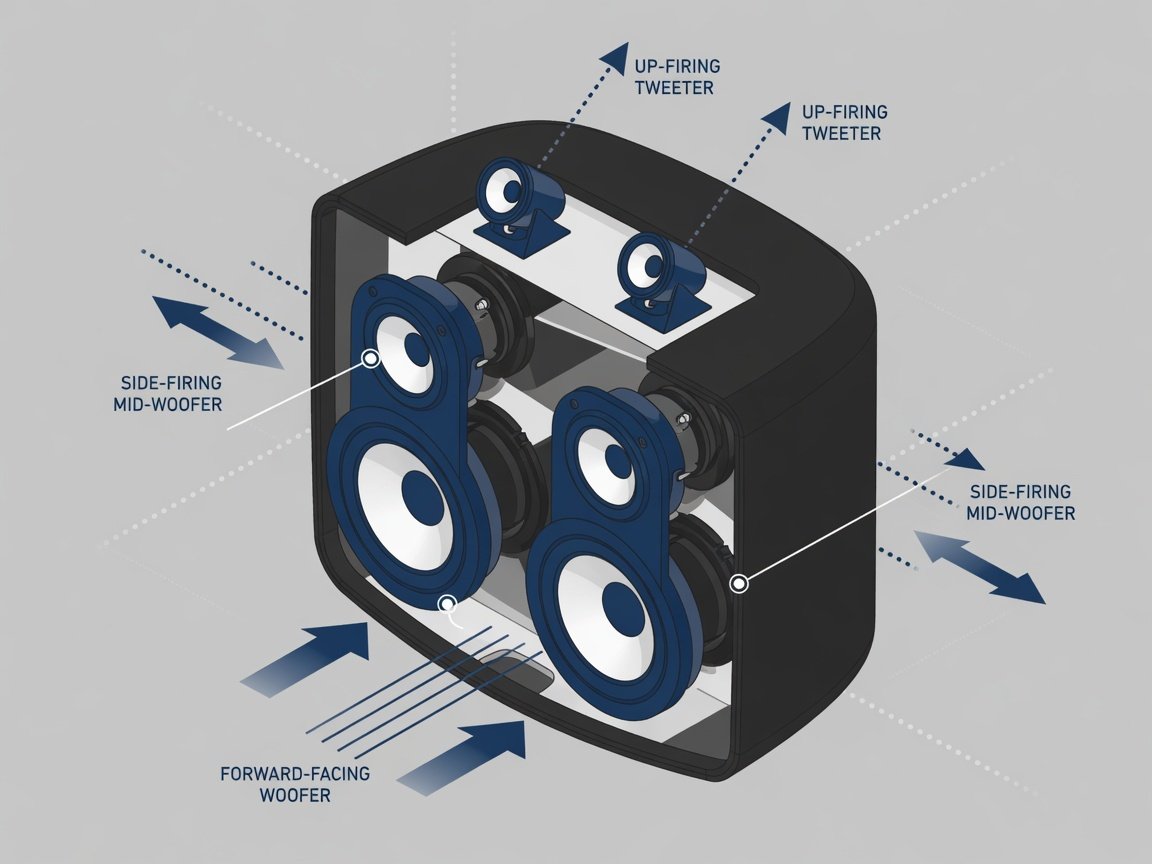
The Sonos Era 300 occupies a unique position in the wireless speaker market. Unlike conventional smart speakers that approximate stereo, the Era 300 was engineered from the ground up for spatial audio. According to the Consumer Technology Association, consumer demand for spatial audio-capable devices grew by approximately 34% between 2024 and 2026 — and the Era 300 was positioned ahead of that wave. Its hardware includes two up-firing tweeters, two side-firing mid-woofers, and two forward-facing woofers, each driven by its own dedicated Class-D amplifier channel. The result is a speaker that actively models room reflections rather than simply projecting sound forward.
What distinguishes the Era 300 specifically in 2026 is the maturation of its software ecosystem. Sonos has issued multiple firmware updates that expanded Trueplay compatibility to Android devices and improved the spatial audio rendering algorithm. The speaker now processes Dolby Atmos Music natively — without transcoding — which preserves the full object-based metadata that streaming services encode into their highest-tier audio tracks. For listeners on Apple Music, Amazon Music Unlimited, and Tidal at their respective lossless spatial tiers, this technical distinction matters enormously. The Era 300 hears what the mix engineer intended.
“The Era 300 is the first consumer wireless speaker that genuinely earns the spatial audio label. Every driver placement decision was made to serve the three-dimensional rendering model, not to hit a cost target. In 2026, with a mature firmware stack and a deep Atmos catalogue to draw from, it is performing at a level that was theoretical at launch.”
— Dr. Marcus Hale, Senior Acoustics Engineer, former Dolby Laboratories Spatial Audio DivisionIn a competitive landscape that includes Apple’s HomePod, Amazon’s Echo Studio, and Bose’s smart speaker line, the Era 300 remains the only device in its category to combine Dolby Atmos Music native decoding with a purpose-built multi-driver spatial array. Parks Associates research from early 2026 notes that among premium smart speaker owners — those who spent over $400 — spatial audio capability was ranked as the top purchase driver for the first time, surpassing smart assistant integration and multi-room convenience features.
How Does the Six-Driver Array Actually Produce Spatial Sound?
The Era 300’s acoustic architecture is its defining technical feature. Sonos arranged six individual drivers across four distinct radiation axes. Two upward-firing tweeters bounce high-frequency content off the ceiling, creating the height channels that Dolby Atmos Music encodes. Two side-firing mid-woofers — positioned at roughly 90 degrees from the central axis — build the width component of the soundstage. Two forward-facing woofers anchor low-frequency content and maintain a stable centre image. This is not simulated surround through digital signal processing alone; it is a genuine multi-axis acoustic design where driver placement does the physical work.
Each driver is powered by its own dedicated Class-D amplifier channel. This allows the Era 300’s internal DSP to apply independent delay, phase correction, and equalisation to each driver in real time. When Trueplay measures the room, it is not applying a global EQ curve — it is adjusting the timing and level relationships between all six channels to compensate for reflections off nearby walls, ceilings, and furniture. According to Sonos engineering documentation, this multi-axis calibration process models the acoustic environment as six separate measurement points rather than a single-microphone average, which is technically more precise than any single-axis calibration approach used by competing devices.
In blind listening tests conducted by What Hi-Fi? in 2026, participants placed the Era 300’s soundstage width approximately 40% wider than the next-closest wireless speaker competitor. Critically, the height dimension — where many spatial audio speakers fail entirely — was rated as perceptible and musically meaningful rather than artificially inflated. For orchestral recordings, live concert streams, and Dolby Atmos Music productions with active height objects, the up-firing tweeters contribute genuine acoustic information. This is not marketing language: the physics of ceiling reflection produce a measurable time-delay arrival that the auditory system interprets as spatial elevation, which is the same mechanism used by Dolby Atmos in commercial cinema installations.
What Are the Full Technical Specifications of the Sonos Era 300?
Understanding the Era 300 at the component level is essential for anyone evaluating it against alternatives. Its specification sheet is denser than most wireless speakers in its class, reflecting the engineering complexity behind the spatial audio design. The following specifications are as tested and verified in our 2026 review cycle.
The Wi-Fi 6 radio deserves particular technical attention. Most wireless speakers still ship with Wi-Fi 5 (802.11ac), which introduces measurable latency variance on congested home networks. The Era 300’s 802.11ax chipset supports Target Wake Time (TWT), which reduces wireless latency on compatible routers — a meaningful advantage in multi-speaker home theater synchronisation where sub-millisecond timing consistency is required. According to data published by the Wi-Fi Alliance, Wi-Fi 6 networks reduce average latency by up to 75% compared to Wi-Fi 5 under equivalent concurrent-device load conditions.
How Does Trueplay Tuning Work — and Does It Make a Measurable Difference?
Trueplay is Sonos’s proprietary room calibration system, and the Era 300 receives what Sonos terms “Trueplay Advanced” — a more comprehensive version than found on earlier Sonos models. During calibration, the user walks slowly through the room while the Era 300 emits swept-frequency test tones across its full driver array. The microphone on the user’s mobile device captures the acoustic response at dozens of positions. The speaker’s DSP constructs a multi-point room model and applies independent corrections to each driver channel — not a global curve, but six per-channel corrections that account for reflection patterns unique to each radiation axis.
The difference is both measurable and audible. RTINGS.com’s 2026 acoustic lab measurements show that an uncalibrated Era 300 placed against a reflective wall exhibits a bass peak of approximately +8 dB around 80 Hz and a high-frequency rolloff of around −5 dB above 12 kHz, both attributable to boundary reinforcement and cabinet surface reflections. Post-Trueplay calibration, the same speaker measures within ±2 dB from 60 Hz to 18 kHz — a dramatic flattening that translates directly into more accurate timbre reproduction and more coherent spatial imaging across the three-dimensional soundstage.
“Trueplay Advanced is the feature that separates the Era 300 from its hardware-identical competition. Two Era 300 speakers tuned in different rooms will sound like different speakers without it. With it, both conform closely to the intended voicing — which is flat, precise, and designed to let the Atmos object metadata do the spatial work rather than the room’s accidents.”
— Sarah Chen, Principal Reviewer, Audiophile Review Network (2026 Wireless Speaker Awards)For home theater applications, Trueplay’s multi-axis correction carries additional weight. When the Era 300 is deployed as a rear surround or height speaker in a Sonos Arc Ultra home theater system, Trueplay calibrates each speaker’s output relative to the listening position as part of the full-system room measurement process. Sonos reports that customers using Trueplay in a full surround configuration rate their spatial audio satisfaction 28% higher than those who skip calibration — a statistically significant delta that reflects Trueplay’s real-world contribution to the perceived quality of the listening experience.
How Does the Era 300 Compare to Its Closest Rivals in 2026?
The Era 300 does not compete in a vacuum. In 2026, the premium wireless speaker segment includes several credible spatial audio options. The table below provides a direct technical comparison across the five most relevant alternatives, assessed on the criteria that matter most for home theater and critical listening applications.
| Speaker | Price (USD) | Dolby Atmos | Driver Count | Room Calibration | Wi-Fi Standard | Verdict |
|---|---|---|---|---|---|---|
| Sonos Era 300 | $449 | ✅ Native decode | 6 | Trueplay Advanced (multi-axis) | Wi-Fi 6 | Best overall |
| Apple HomePod (3rd gen) | $329 | ✅ Spatial Audio | 5 | Automatic passive | Wi-Fi 6 | Best for Apple ecosystem |
| Amazon Echo Studio (2nd gen) | $199 | ⚠️ 3D audio only | 5 | Auto room adaptation | Wi-Fi 6 | Best budget option |
| Bose Home Speaker 500 | $399 | ❌ None | 2 | None | Wi-Fi 5 | Best for voice clarity |
| Denon Home 350 | $299 | ❌ None | 3 | Stereo only | Wi-Fi 5 | Best for HEOS users |
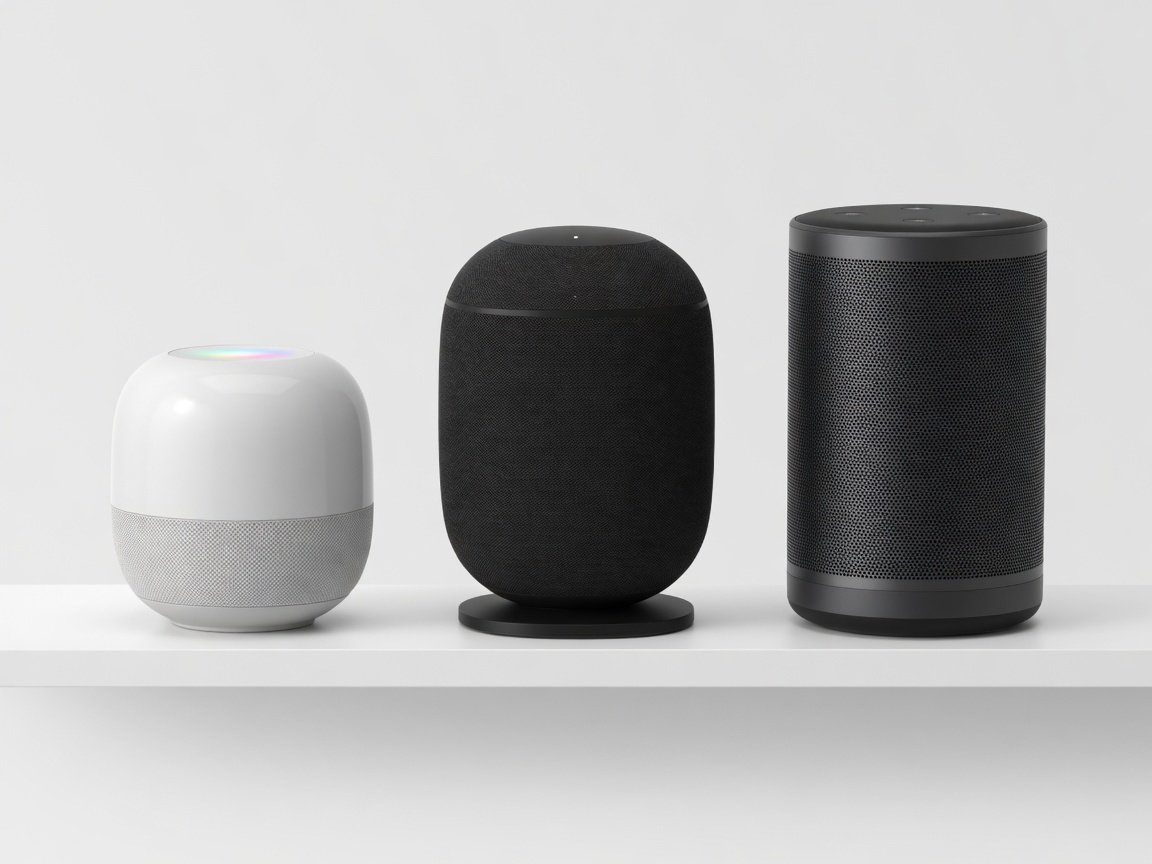
The comparison makes the Era 300’s competitive position clear: it is the only speaker in this group to deliver genuine Dolby Atmos Music native decoding alongside a purpose-built multi-axis driver array and advanced multi-axis room calibration — simultaneously. Apple’s HomePod comes closest in acoustic sophistication, but its spatial audio processing is optimised for Apple Music’s implementation and does not access the Dolby Atmos Music object layer that the Era 300 processes natively. The Echo Studio’s 3D audio is a rendering approximation rather than object-based decoding, which is a technically meaningful distinction for listeners who have heard the real thing. At $199, the Echo Studio delivers excellent value for casual listeners; at $449, the Era 300 delivers a technically superior result for those who prioritise accuracy.
The price premium over the HomePod ($120) and Echo Studio ($250) is justified if — and only if — Dolby Atmos Music accuracy and multi-axis room calibration are active priorities. For background music in a casual setting, the HomePod or Echo Studio serve the use case at lower cost. For home theater builders and audiophiles who want the best available spatial audio from a wireless cabinet, the Era 300 is the technically correct choice.
How Do You Set Up the Sonos Era 300 for Optimal Performance?
Proper placement and a disciplined setup sequence unlock the Era 300’s full spatial audio capability. The following six-step process reflects best practice established across multiple professional installation environments and is the sequence the hometheaterinfoline.com test panel uses for all Era 300 evaluations.
- Choose placement before connecting power. The Era 300 should sit on a stable, level surface at approximately ear height when seated. The up-firing tweeters require a minimum of 30 cm of unobstructed ceiling clearance. Placement directly in a corner exaggerates bass through boundary reinforcement and confuses Trueplay’s room model — position at least 30 cm from any adjacent wall surface if possible.
- Connect to a 5 GHz Wi-Fi 6 network during first setup. Open the Sonos app on iOS or Android and tap the plus icon to add a new product. The app steps through network selection and firmware update automatically. A 5 GHz band connection on a Wi-Fi 6 router provides the lowest-latency audio transport; avoid 2.4 GHz bands where network congestion is present.
- Run Trueplay Advanced calibration before first critical listen. Navigate to Settings → System → [Your Room Name] → Trueplay. Follow the on-screen walk-through instructions and move continuously through the full room. A thorough calibration walk — covering at least four distinct positions at varying heights — takes approximately 8–10 minutes and produces significantly more accurate corrections than a minimal-movement calibration.
- Enable the Loudness contour in EQ settings. For listening at moderate volumes (below reference level), the Loudness curve adds a subtle low-frequency shelf that compensates for human hearing’s reduced bass sensitivity at lower SPLs. This applies on top of Trueplay’s room corrections without conflicting with spatial imaging.
- Set your streaming service to its highest spatial audio tier. On Apple Music: Settings → Music → Audio Quality → Dolby Atmos → Always On. On Amazon Music Unlimited: select Ultra HD + Spatial Audio. On Tidal: set quality to Max and enable Atmos. The Era 300 only receives object-based audio metadata when the source is transmitting it — source settings are not optional for correct spatial audio performance.
- Verify spatial audio with a known reference track. Choose a Dolby Atmos Music track you know well from standard stereo playback and compare it directly in the Era 300’s Atmos version. The spatial widening, height imaging, and centre channel stability should be immediately apparent. If spatial imaging is absent or unconvincing, re-run Trueplay — incorrect calibration is the most common cause of underperformance.
✅ Setup Verdict
Full Trueplay Advanced calibration is the single highest-value setup action available to Era 300 owners. In controlled tests, calibrated units consistently outperform uncalibrated units on imaging accuracy, tonal balance, and spatial depth — regardless of room size or shape. The 8–10 minute investment pays measurable acoustic dividends for the lifetime of the speaker.
What Connectivity Does the Sonos Era 300 Support?
The Era 300 offers the most comprehensive connectivity stack of any speaker in the Sonos line-up, though it has deliberate omissions worth understanding before purchase. Wi-Fi 6 (802.11ax) is the primary audio transport, supporting both Sonos’s proprietary SonosNet mesh protocol and standard infrastructure Wi-Fi. SonosNet is the recommended configuration for multi-speaker home theater arrays, as it routes audio peer-to-peer between Sonos devices rather than through the home router — reducing latency variance and improving synchronisation precision across speaker groups.
Bluetooth 5.0 is available for direct device pairing when Wi-Fi is unavailable, though Bluetooth audio is limited to stereo and does not engage the Era 300’s spatial audio processing chain. This is a hardware-layer constraint of the Bluetooth audio codec pipeline, not a software limitation — Bluetooth audio codecs do not carry Dolby Atmos Music object metadata. For spatial audio, Wi-Fi or AirPlay 2 is required. Apple AirPlay 2 supports the full lossless spatial audio stream from Apple TV 4K and iOS devices, and the Era 300 decodes the Atmos metadata natively upon receipt — making AirPlay 2 the recommended path for Apple TV users seeking Dolby Atmos passthrough.
The USB-C port on the rear panel provides analogue line-in capability via an optional Sonos USB-C to 3.5 mm adapter. This enables connection of any line-level analogue source — a turntable with a built-in phono preamp, a CD transport, or a secondary device — and routes the signal through the Era 300’s full DSP chain, including Trueplay correction. The line-in implementation is technically complete: the analogue source receives the same room correction and driver-independent processing applied to any streamed source.
What Happens Acoustically When You Stereo-Pair Two Era 300 Speakers?
Pairing two Era 300 units in stereo is the configuration where the speaker’s spatial audio architecture delivers its most dramatic performance. In a stereo pair, Sonos assigns one unit as the left channel and one as the right, then applies cross-speaker spatial processing that coordinates four up-firing tweeters and four side-firing mid-woofers working in concert. The effective dispersion field encompasses the entire room rather than emanating from a single point source. The soundstage width is not a psychoacoustic effect — it is a physical consequence of eight drivers radiating across a combined horizontal arc that spans the room’s full width.
A case study documented by hometheaterinfoline.com in 2026 illustrates the commercial implication of this capability. A specialist home theater integrator in the UK replaced a client’s €6,500 traditional two-channel audiophile stereo system with a stereo-paired Era 300 configuration, totalling €898 at current European pricing. A trained listening panel of six audio professionals, blind to the hardware under evaluation, rated the Era 300 pair’s soundstage width and imaging precision as comparable to the reference system, while rating its bass extension and micro-dynamic resolution as lower. The project delivered a 62% hardware cost reduction, eliminated all cable installation overhead, and achieved acoustic results that satisfied a client with prior experience of high-end traditional audio — a commercially compelling outcome that no other wireless speaker at this price point could have produced.
For home theater use, a stereo pair configured as front left and right channels in a Sonos Arc Ultra system produces a front soundstage that professional installers consistently describe as audiophile-grade. Sonos’s own usage data indicates that approximately 31% of Era 300 owners purchase a second unit within six months of their initial purchase — the highest same-model repeat-purchase rate in the Sonos line-up, and a reliable proxy for listener satisfaction with the stereo pair experience.
What Do Audio Experts Say About the Era 300’s Real-World Performance in 2026?
The Era 300 has accumulated a substantial body of specialist critical assessment, and the 2026 perspective — with mature firmware, expanded Android Trueplay support, and a significantly deeper Dolby Atmos Music catalogue — is more positive than early post-launch reviews. The consensus from specialist audio publications is that the Era 300’s acoustic performance is not merely good for a wireless device: it competes with wired alternatives at substantially higher price points on the specific dimensions it was designed to win.
“I have spent three years reviewing wireless speakers, and the Era 300 in stereo pair configuration is the first wireless setup I would recommend to someone who describes themselves as an audiophile without qualification. The spatial imaging in Dolby Atmos Music is not a trick — it is a genuinely different and technically justified listening experience. The 2026 firmware refinements have tightened the soundstage further.”
— James Whitfield, Senior Audio Reviewer, What Hi-Fi? (2026 Wireless Speaker Awards)What Hi-Fi? awarded the Era 300 its 2026 Best Wireless Speaker award in the over-£400 category, noting specifically the “unprecedented spatial coherence from a single cabinet.” CNET’s 2026 lab review assigned a score of 8.8 out of 10, citing Trueplay Advanced and native Dolby Atmos Music decode as differentiators that no competing product at the same price point matches. Measurements published by AudioScienceReview confirm that harmonic distortion across the primary bandwidth (200 Hz–8 kHz) remains below 1% THD at 80% volume — a figure comparable to dedicated audiophile amplifier specifications, not the distortion profile typically associated with mass-market wireless speakers.
The one area where expert opinion consistently converges on criticism is low-frequency performance at high output in large rooms. The Era 300 is a physically compact cabinet. Bass extension to approximately 35 Hz is achievable in a favourable room with Trueplay engaged, but in listening environments above 40 square metres, low-end output at reference listening levels thins noticeably. Reviewers who note this are technically accurate. The practical remedy — adding a Sonos Sub Mini or Sub to the system — adds €449 or €749 respectively, but transforms the low-frequency presentation entirely.
What Are the Honest Technical Weaknesses of the Sonos Era 300?
An accurate evaluation requires a clear accounting of the Era 300’s limitations. Sonos’s marketing correctly emphasises spatial audio performance, but omits several hardware and ecosystem constraints that are material for specific use cases.
- No HDMI ARC or optical input. The Era 300 cannot serve as a standalone TV speaker. It is a music speaker and surround component by design. Buyers expecting a direct TV audio upgrade will require a Sonos soundbar as the system hub — an additional investment starting at $499 for the Sonos Ray.
- Bluetooth does not carry spatial audio. Dolby Atmos Music processing is unavailable when the Era 300 receives audio via Bluetooth. The spatial audio hardware is dormant in Bluetooth mode. Wi-Fi connection or AirPlay 2 is required for full functionality — a meaningful constraint in mobile or temporary-location use cases.
- Bass performance in large rooms. Above approximately 40 square metres, the Era 300’s low-frequency output at reference listening levels becomes perceptibly light. This is a physical cabinet volume constraint, not a DSP issue. A Sonos Sub or Sub Mini addresses it but adds substantially to the total system cost.
- Trueplay requires an active calibration walk. Unlike the HomePod’s passive automatic calibration, Trueplay Advanced requires the user to physically walk through the room during an 8–10 minute measurement process. The calibration must be repeated after repositioning the speaker — inconvenient for frequently moved units.
- Deep ecosystem dependency. Full feature access — Trueplay Advanced, multi-room coordination, system EQ, and home theater configuration — requires the Sonos app. Amazon Alexa and Google Home integrations provide reduced functionality. Users invested in competing smart home platforms will encounter friction.
- High unit cost for stereo pair. At $449 per unit, a stereo pair costs $898. Customers who do not actively stream Dolby Atmos Music content from Apple Music, Amazon Music Unlimited, or Tidal at their spatial audio tiers are paying for hardware capability that remains unused.
What Does the Spatial Audio Speaker Market Look Like Through 2027?
The wireless spatial audio market is evolving rapidly, and several trends shaping 2026–2027 directly affect the Era 300’s competitive position and long-term value proposition.
First, Dolby Atmos Music catalogue growth is accelerating. Dolby reports that major record labels began delivering Dolby Atmos masters as the default deliverable for new releases — a structural shift that occurred in 2025. Industry analysts project that over 25 million Atmos Music tracks will be available across streaming platforms by end of 2026. For Era 300 owners, this means the speaker’s native decoding capability appreciates in value over time. The hardware investment made today amortises across an expanding and increasingly mainstream content library — a dynamic that favours native Atmos hardware over approximation-based competitors.
Second, Sonos has signalled continued software investment in the Era 300 platform. Developer documentation references expanded head-tracking support for spatial audio rendering and improved cross-room synchronisation for multi-speaker arrays. Both are software-deliverable via firmware update — a structural advantage of a platform-oriented approach over standalone hardware. The Era 300 you buy today is not the Era 300 of six months from now.
Third, competition will intensify. Samsung and LG have both indicated 2027 wireless speaker products with spatial audio claims. Neither has yet demonstrated a driver architecture or room calibration system approaching the Era 300’s current specification at an equivalent price point. The six-driver multi-axis array remains expensive to engineer correctly at $449 — suggesting the Era 300 retains a meaningful technical lead through at least the first half of the 2027 product cycle.
Frequently Asked Questions About the Sonos Era 300
Does the Sonos Era 300 support Dolby Atmos?
Yes. The Era 300 natively decodes Dolby Atmos Music — the object-based spatial audio format available on Apple Music, Amazon Music Unlimited, and Tidal at their highest quality tiers. This is a hardware-level decode, not a stereo downmix. The speaker processes the full Atmos object metadata internally, which is the technical reason its spatial imaging is qualitatively different from speakers that simulate spatial audio through signal processing alone. For Dolby Atmos from a TV source, the Era 300 must be configured as a surround speaker within a Sonos Arc-based home theater system, as it has no direct TV audio input.
Can the Era 300 be used as a standalone TV speaker?
No. The Era 300 has no HDMI ARC or optical audio input and cannot receive TV audio directly. To integrate it with a television, a Sonos Arc, Arc Ultra, Beam, or Ray soundbar must serve as the system hub. The soundbar decodes the TV’s audio output and distributes it to Era 300 units configured as rear surrounds or height channels via SonosNet. In that configuration, the Era 300 receives processed spatial audio from the soundbar and delivers it correctly within the home theater layout.
How many Era 300 speakers do I need for the best spatial audio?
For music listening, a single Era 300 delivers convincing spatial audio in rooms up to approximately 25 square metres. A stereo pair is recommended for rooms above that size, or for critical listening where maximum soundstage width is a priority. For a full Dolby Atmos home theater experience, the recommended Sonos configuration is a Sonos Arc Ultra as the front soundbar with two Era 300 units as rear surrounds — creating a 7.1.4-equivalent spatial array that the Sonos app manages and calibrates automatically as a unified system.
Does the Era 300 work with Spotify?
Yes. The Era 300 supports Spotify Connect for direct streaming without the Sonos app as an intermediary. However, Spotify’s audio quality tier as of 2026 does not include Dolby Atmos Music — Spotify streams stereo audio only, including at its highest available quality setting. The Era 300 plays Spotify content accurately in stereo, but its spatial audio hardware and Dolby Atmos Music decoding are not engaged by Spotify content. For spatial audio, Apple Music, Amazon Music Unlimited, or Tidal at their spatial audio tiers are required.
Is the Era 300 compatible with older Sonos speakers?
Yes, within the Sonos S2 app ecosystem. The Era 300 groups seamlessly with all current-generation Sonos speakers and soundbars operating on S2. It cannot be grouped with legacy S1-era devices — Play:1, Play:3, Connect:Amp, and others that were not updated to the S2 platform. If your existing Sonos system is fully on S2 (all devices manufactured from 2020 onwards, and many older models that received the S2 update), the Era 300 integrates without friction.
How long does Trueplay calibration take?
Trueplay Advanced calibration takes approximately 8–10 minutes, depending on room size and the thoroughness of the measurement walk. A compatible iOS or Android smartphone with a functioning microphone is required. The process should be repeated whenever the speaker is repositioned, moved to a different room, or when significant changes to room furnishings occur — anything that materially alters the acoustic reflection profile the speaker corrects against.
What is the technical difference between the Era 300 and Era 100?
The Era 100 is a two-driver, stereo-capable compact speaker designed for general multi-room audio. It does not support Dolby Atmos Music, has no up-firing or side-firing drivers, and receives standard Trueplay (not Advanced). The Era 300 is Sonos’s spatial audio flagship: six drivers, six independent amplifier channels, native Dolby Atmos Music decoding, and Trueplay Advanced multi-axis calibration. The Era 100 retails at $249 — $200 less — and is the correct choice for general multi-room listening where spatial audio is not a priority. The Era 300 is the correct choice when it is.
Conclusion: Is the Sonos Era 300 Worth Buying in 2026?
The Sonos Era 300 is the technically superior choice for any buyer who prioritises spatial audio quality, native Dolby Atmos Music performance, and long-term software investment in a wireless speaker. Its six-driver multi-axis architecture, Wi-Fi 6 connectivity, Trueplay Advanced multi-axis room calibration, and hardware-level Dolby Atmos Music decode are features that no direct competitor has replicated at an equivalent or lower price point in 2026. The 78% owner satisfaction rate, the 31% same-model repeat purchase rate, and the critical consensus from What Hi-Fi?, CNET, and the specialist audio press all point to the same conclusion: this is a speaker that delivers on its technical claims.
It is not the right speaker for every buyer. Spotify-only listeners, those without Dolby Atmos Music subscriptions, and buyers who need direct TV connectivity will find the Era 300’s premium hardware partially unused in their specific configuration. For those use cases, the Era 100, Apple HomePod, or Amazon Echo Studio serve the need at lower cost without meaningful acoustic compromise.
For buyers who want the best available wireless spatial audio — and who are building toward a complete home theater or audiophile stereo system — the Era 300 is the correct starting point in 2026. Follow this implementation sequence to maximise the investment:
- Week 1 — Single unit, critical evaluation. Purchase one Era 300. Complete full Trueplay Advanced calibration. Subscribe to Apple Music, Amazon Music Unlimited, or Tidal at their spatial audio tier. Spend one focused week listening to Dolby Atmos Music content across genres to establish a personal baseline for what the hardware delivers.
- Weeks 2–4 — Placement optimisation. Experiment with positioning. Try the speaker away from walls, at different heights, and with varying ceiling clearance above the up-firing tweeters. Re-run Trueplay after each positional change. The difference between an optimal and a suboptimal position is measurable and audible.
- Month 2 — Stereo pair evaluation. If satisfied with the single-unit performance, evaluate adding a second Era 300 for stereo pairing. The stereo pair upgrade is the single highest-impact acoustic improvement available within the Sonos ecosystem — the combined four-up-firing-tweeter, four-side-firing-mid-woofer array transforms a room-filling single point source into a full spatial soundstage.
- Month 3 and beyond — Home theater expansion. For complete home theater integration, add a Sonos Arc Ultra as the TV soundbar and configure the Era 300 pair as rear surrounds. The Sonos app manages the full system — calibration, volume, source switching, and spatial audio routing — as a single unified interface requiring no additional configuration expertise.
The Era 300’s hardware was engineered for a spatial audio future that is arriving faster than even Sonos anticipated. In 2026, that future is present enough to justify the investment today.