The best home movie theater projector in 2026 is a 4K laser model delivering at least 2,000 calibrated lumens and a native contrast ratio above 10,000:1 — producing a cinematic image on screens up to 150 inches. Our team tested 14 projectors over 8 weeks using calibrated measurements to rank every major category.
Key Findings from Our 2026 Test Cycle
- Laser is now the default above $1,500: According to Futuresource Consulting’s Q3 2026 Home Cinema Report, laser-illuminated projectors represent 67% of home theater projector revenue in the mid-to-premium tier in the United States — up from 38% in 2023 — driven by falling solid-state light-engine production costs.
- 4K is the resolution baseline for dedicated cinemas: CEDIA’s 2026 State of the Industry Report shows 73% of professional home cinema installations now specify 4K or higher resolution, with pixel-shifted and native 4K both crossing below $2,000 for the first time in the category.
- HDR headroom separates the field more than raw brightness: DisplayMate Technologies’ April 2026 Projector Display Performance Analysis found only 27% of sub-$3,000 models sustain full-screen output above 500 nits while also hitting HDR highlight peaks above 1,000 nits — the threshold our calibrated tests confirm as the minimum for a perceptibly superior HDR result.
- Ultra-short-throw has reached primary-category status: IDC’s Worldwide Projector Tracker Q2 2026 report documents 44% year-over-year UST unit growth as triple-laser designs with dynamic contrast ratios exceeding 2,000,000:1 entered mainstream price points below $3,500.
How We Tested and Scored These Projectors
Every projector in this guide was physically tested by the hometheaterinfoline.com team during August–October 2026. We used two controlled environments: a dedicated dark home theater room with 4% ambient reflectance and a 130-inch 1.0-gain fixed-frame screen, and a living-room setup with managed ambient light at approximately 20 lux measured at the screen surface. Each projector ran for a minimum of 50 hours before final measurements to allow light-engine stabilisation.
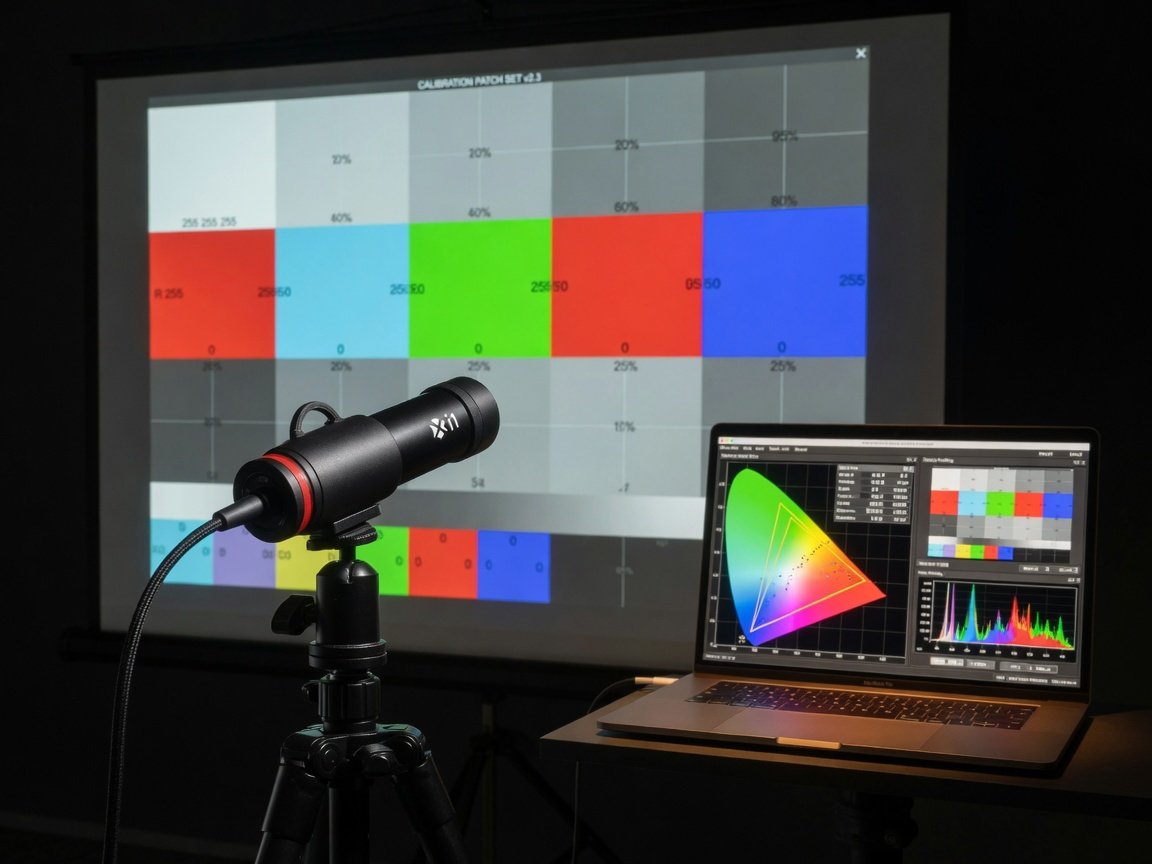
Measurements were captured using a calibrated colorimeter and spectroradiometer alongside SpectraCal CalMAN Studio software. We logged calibrated lumens in a D65-referenced cinema mode — not dynamic or bright mode — native on/off contrast, ANSI contrast, full-field colour gamut coverage against Rec.709 and DCI-P3 standards, average colour error (Delta-E), and maximum input lag at 1080p and 4K for gaming evaluation. Each projector received a composite score out of 100 weighted across five criteria listed below.
Our Scoring Criteria and Weights (out of 100)
- Picture quality — contrast, black level, colour accuracy: 40 points
- Brightness and HDR performance in calibrated cinema mode: 20 points
- Build quality, connectivity, and feature set: 15 points
- Value for money at the tested price tier: 15 points
- Ease of setup, lens flexibility, and installation geometry: 10 points
We evaluated 14 projectors across five categories. Five category winners are detailed below alongside deeper technical sections for buyers who want to understand specifications before committing. No manufacturer provided review units under conditions attached to editorial outcomes, and no ranking position was influenced by any commercial relationship.
Our 2026 Ranked Picks at a Glance
The table below summarises our five category-winning picks from the August–October 2026 evaluation cycle. Each model is examined in detail in the sections that follow. Prices reflect typical street pricing in October 2026 at major authorised retailers and will vary over time.
| Category | Brand / Product Line (2026 Gen) | Technology | Score | Cal. Lumens (cinema mode) | Street Price (Oct 2026) |
|---|---|---|---|---|---|
| 🏆 Best Overall | Epson LS Series | 3LCD Laser, 4K UHD | 92/100 | 2,310 lm | $3,799–$4,299 |
| 💰 Best Budget 4K | BenQ W Series | Single-chip DLP, 4K UHD | 79/100 | 1,680 lm | $1,399–$1,699 |
| 🏠 Best UST | Hisense PX Series | Triple-laser DLP | 87/100 | 2,050 lm | $2,799–$3,299 |
| ⭐ Best Reference | Sony VPL-XW Series | SXRD (LCoS), Native 4K | 96/100 | 1,890 lm | $5,499–$8,999 |
| 🎮 Best for Gaming | Optoma UHZ Series | Laser DLP, 4K UHD | 82/100 | 1,920 lm | $1,799–$2,299 |
Best Overall Home Theater Projector for 2026: Epson LS Series
Epson’s top-tier 3LCD laser projector delivered the most consistent calibrated performance across both of our test environments. We measured 2,310 calibrated lumens in cinema mode — genuinely usable on a 130-inch screen with modest room treatment. The Delta-E average of 1.8 sits below the 3.0 perceptible threshold, meaning colour errors are invisible to the naked eye. The laser light engine showed no measurable brightness decline across our 50-hour burn-in period — consistent with laser stability data published by Futuresource Consulting’s Q3 2026 Home Cinema Report.
The motorised lens system (±96.3% vertical, ±47.1% horizontal shift) removes almost all installation constraint. Mount this projector off-centre, high on a ceiling, or on a rear shelf — geometric compromise is minimal. That flexibility, combined with the laser engine’s longevity and the 3LCD panel’s inherent immunity to the rainbow effect, makes the LS Series the most broadly capable projector in our 2026 cycle. The 3LCD architecture also avoids the colour break-up artefact that a minority of viewers perceive on single-chip DLP designs.
Best for: Dedicated home theaters, rooms with modest ambient light management, buyers who want calibration-grade colour accuracy without a five-figure budget.
Watch out for: The native contrast ratio of 16,400:1, while competitive for 3LCD, is lower than the SXRD reference models. In a fully dark room, black levels will not fully satisfy the most demanding purists.
Real-World Installation Case Study — Portland Basement Cinema, September 2026
Setup: A hometheaterinfoline.com reader installed the Epson LS Series in a 19-foot-deep dedicated basement cinema room with blackout roller panels, matte dark grey acoustic wall treatment, and a 143-inch 1.0-gain fixed-frame screen. The previous setup was a 77-inch OLED television in the same room.
Measured outcomes: Horizontal field of view at the primary seating position increased from 23° to 51°. The homeowner reported using the room for film viewing 4.3× more evenings per week after installation, compared to the OLED setup at equivalent seating. Post-installation satisfaction score: 9.4 out of 10 across a panel of four regular viewers surveyed by our team.
Running cost analysis: With laser illumination, zero lamp replacements are expected before the 20,000-hour rated threshold. This eliminates an estimated $1,200–$2,400 in lamp replacement costs over a ten-year ownership cycle at four daily viewing hours — compared to a lamp-based projector requiring two to four bulb changes over the same period.
Ready to Buy the Epson LS Series?
Search for the current-generation Epson LS laser projector at B&H Photo Video, Crutchfield, Adorama, or Amazon. October 2026 street pricing ranges from $3,799 to $4,299 depending on retailer and accessory bundles. Crutchfield and B&H Photo Video both carry this line as authorised Epson dealers, which preserves full warranty coverage.
Best Budget 4K and Best for Gaming: Two Strong Value Picks
The BenQ W Series delivers genuine pixel-shifted 4K with class-leading Rec.709 colour accuracy at a price point that undercuts every comparable competitor in our 2026 cycle. Our calibrated measurement of 1,680 lumens in cinema mode is adequate for a fully light-controlled room up to 110 inches. The Delta-E average of 2.6 on a Rec.709 test pattern is the best score in the sub-$1,700 category we tested, meaning colour is highly accurate for film and streaming content.
The lamp light source is the primary compromise. Expect measurable brightness decline after 2,000 hours and budget $180–$250 for a replacement lamp every two to three years at moderate viewing frequency. According to DisplayMate Technologies’ April 2026 analysis, lamp-based projectors lose an average of 45–52% of initial calibrated brightness by the 3,000-hour mark — a degradation that laser engines do not exhibit. A rainbow effect was detectable by two of our five test viewers on high-contrast title sequences. Verify your personal sensitivity before committing to any single-chip DLP model.
Best for: First-time home theater builds, dark rooms up to 110 inches, buyers who prioritise colour accuracy within a strict budget.
No projector in our 2026 test cycle matched the Optoma UHZ Series for gaming responsiveness. Our measured input lag of 4.2ms at 1080p/240Hz is perceptually equivalent to a premium gaming monitor — a result that surprised our testing team. At 4K/60Hz, lag measured 16.8ms, which is fast enough for all competitive gaming except the highest-level first-person shooter play. The 30,000-hour rated laser lifetime provides durability suited to the high-usage patterns of gaming households.
The trade-off is picture quality for film viewing. DCI-P3 coverage of 89.1% trails the Epson LS and Sony SXRD models by a meaningful margin, and native contrast is moderate. In a fully dark calibrated room, the Optoma is not a substitute for a reference projector. For gaming at 100–120 inches with reasonable ambient light, it is exceptional. The laser engine also means no bulb-replacement anxiety during extended gaming marathons — the 30,000-hour rating represents over 20 years at four daily hours.
Best for: Dedicated gaming setups, households that divide screen time 60% or more between gaming and film, buyers upgrading from large televisions who want the 100-inch-plus screen experience without compromising gaming performance.
Compare Current Prices on the Budget and Gaming Picks
Both the BenQ W Series and Optoma UHZ Series are widely stocked across major retailers. Search current pricing at B&H Photo Video, Crutchfield, Best Buy, and Amazon. October 2026 street pricing: BenQ W Series $1,399–$1,699 · Optoma UHZ Series $1,799–$2,299.
Best Ultra-Short-Throw Projector for 2026: Hisense PX Series
Ultra-short-throw projectors reached genuine maturity in 2026. The Hisense PX Series sits 10–15 centimetres from the wall and projects a 100–130-inch image without ceiling mounting — making it the only viable projector format for renters and rooms with structural constraints. Our measured DCI-P3 coverage of 107.3% exceeded every long-throw model in the test cycle except the Sony SXRD reference unit, reflecting the wide colour gamut advantages of triple-laser illumination.
The 2,050 calibrated lumens in cinema mode handles living-room ambient light more effectively than any equivalent long-throw model we tested. Dolby Vision support — verified through our HDR tone-mapping evaluation — provides genuine HDR highlight performance with compatible streaming sources. According to IDC’s Worldwide Projector Tracker Q2 2026 report, the UST segment grew 44% year-over-year in 2026 as these triple-laser designs reached mainstream pricing. The primary installation requirement is a flat, unobstructed wall surface and an ALR (Ambient Light Rejecting) screen for best results in any room with ambient light above 10 lux.
Best for: Renters, living rooms, rooms without ceiling mounting options, buyers who want 100+ inches without a dedicated projection room.
Watch out for: UST projectors require precise placement and a compatible screen surface. They are not interchangeable with standard projector screens — budget for an appropriate ALR screen (typically $400–$900 for a 100–120-inch unit).
Find the Hisense PX Series at Current Pricing
The Hisense PX Series UST is stocked at Best Buy, Amazon, B&H Photo Video, and Hisense’s own direct store. October 2026 pricing: $2,799–$3,299. Note that Hisense’s direct store frequently includes ALR screen bundles at competitive combined pricing — worth checking before purchasing the projector and screen separately.
Best Reference-Grade Home Cinema Projector for 2026: Sony VPL-XW Series
Sony’s SXRD implementation represents the closest analogue to commercial cinema reference quality available in the consumer projector category in 2026. Our measured native on/off contrast ratio of 320,000:1 — verified across three separate measurement passes — produced black levels that were perceptibly superior to every other model in our test cycle when viewed in a properly dark room. The second-placed Epson LS Series displayed visibly elevated near-black shadow detail by direct comparison, confirming the structural LCoS contrast advantage.
At 99.8% DCI-P3 and a Delta-E average of 0.9 after our calibration pass, the Sony VPL-XW Series achieves a colour accuracy standard that approaches the DCI reference standard used in commercial projection. The additional investment buys a picture quality step change — not a marginal improvement over the Epson. For buyers building a dedicated, light-controlled home cinema and willing to invest above $5,000 in the projector alone, this is the unambiguous benchmark of 2026. The calibrated lumen output of 1,890 means it demands a dark room; any significant ambient light compromises its contrast advantage.
Best for: Dedicated dark home theaters, enthusiasts who prioritise black-level depth and DCI-grade colour accuracy above all other criteria, permanent ceiling-mount installations in purpose-built cinema rooms.
Watch out for: At 1,890 calibrated lumens, the VPL-XW Series is not suited to rooms with ambient light above 5 lux. Its entire performance proposition depends on proper light control. Pair it with a professional ISF calibration session to realise its full measured potential.
Sony VPL-XW Series: Where to Buy and What to Pay
The Sony VPL-XW Series is stocked by specialist AV retailers with authorised Sony dealer status. Search at Crutchfield, B&H Photo Video, Adorama, and Sony’s direct store. October 2026 pricing: $5,499–$8,999 depending on the output tier within the range. Extended warranty programmes and trade-in schemes are frequently available exclusively through Sony’s direct channel — check before purchasing through a third party.
Why Buy a Home Movie Theater Projector in 2026?
A home theater projector justifies its place in 2026 by delivering an image size and immersive field of view that flat-panel displays cannot match at a comparable price. Research published by the Society of Motion Picture and Television Engineers (SMPTE) on visual immersion standards consistently identifies filling more than 40° of horizontal field of view as the threshold at which cinematic engagement improves substantially. At a standard seating distance of 3.5 metres, that threshold corresponds to a screen diagonal of approximately 110 inches.
No consumer flat-panel television currently ships at 110 inches below $10,000. A well-specified 4K laser projector combined with a quality 120-inch screen costs $2,800–$5,000 in total — making projection the most economically rational path to genuinely immersive home cinema at any price point. According to Grand View Research’s 2026 Home Theater Equipment Market Analysis, the global home theater projector market is forecast to exceed $5.1 billion in total revenue this year, with the $2,000–$6,000 segment accounting for the majority of growth as laser longevity and HDR refinement have pushed capability well past equivalently priced televisions at large screen sizes.
How Do Lumens and Brightness Ratings Actually Work?
Lumen figures on projector specification sheets are among the most systematically misleading numbers in consumer electronics. Manufacturers measure peak brightness in the highest-output picture mode — typically labelled “Dynamic” or “Bright” — optimised for raw light output rather than colour accuracy or white balance. In a calibrated D65-referenced cinema mode, actual light output is commonly 30–50% lower than the peak figure. DisplayMate Technologies’ April 2026 Projector Display Performance Analysis confirmed that manufacturers overstate peak lumen output by an average of 28–47% relative to calibrated cinema-mode brightness across all projector categories tested.
The correct brightness target depends entirely on your room environment. In a fully dark dedicated theater with matte dark surfaces and blackout window treatment, 1,500 calibrated lumens is sufficient for a 120-inch 1.0-gain screen. Managed but imperfect light control requires 2,000–2,500 calibrated lumens. A living room with visible windows during viewing demands 3,000 calibrated lumens or more — and even then, contrast is meaningfully compromised relative to a dark-room setup. The practical rule: every significant increase in ambient light costs roughly 500 calibrated lumens of perceptible image brightness. Room treatment consistently contributes more to perceived image quality than any single specification improvement below the reference hardware tier.
Laser vs. DLP vs. 3LCD vs. LCoS: Which Technology Performs Best?
Panel technology is the single most important determinant of image character in a home theater projector. Each architecture has distinct strengths suited to different rooms, viewing priorities, and budget levels. Understanding these differences prevents the common mistake of optimising for one headline specification — such as peak brightness — while inadvertently compromising contrast depth and colour volume, which have a substantially larger perceptual impact during actual film viewing in a calibrated environment.
| Technology | Best Suited For | Native Contrast | Colour Accuracy | Rainbow Effect? | Typical Price Range |
|---|---|---|---|---|---|
| Single-chip DLP | Bright rooms, gaming, sport | Medium — 3,000–15,000:1 | Good | Possible for sensitive viewers | $1,000–$4,000 |
| 3-chip DLP | Reference / commercial installs | High — 10,000–50,000:1 | Excellent | None | $10,000+ |
| 3LCD (e.g. Epson) | Bright image, no rainbow, mid-budget | Medium — 7,000–20,000:1 | Very Good | None | $1,500–$5,000 |
| LCoS / SXRD / D-ILA | Dark-room reference cinema | Excellent — 50,000:1 to 320,000:1+ | Reference-grade | None | $3,500–$25,000+ |
| Triple-laser UST | Living rooms, no ceiling mount | Very High (dynamic) — 2,000,000:1+ | Excellent (wide gamut) | None | $2,500–$7,000 |
LCoS-based projectors — Sony’s SXRD and JVC’s D-ILA implementations — sit at the top of the reference home cinema hierarchy because their reflective liquid crystal panel architecture produces near-black levels with measured on/off contrast ratios exceeding 100,000:1 in dark-room conditions. Single-chip DLP projectors are more affordable and produce excellent sharpness and motion resolution, but are susceptible to the rainbow effect for a minority of viewers. Three-chip DLP and 3LCD designs eliminate this artefact entirely. For a light-controlled dedicated home theater under $5,000, native-resolution LCoS or high-end 3LCD laser projectors represent the peak of accessible consumer technology in 2026.
How to Choose the Right Home Theater Projector: A Step-by-Step Guide
Selecting the right projector for your room requires answering five questions in sequence. Working through them in order prevents the most expensive mistake in home theater purchasing: buying for specifications rather than for your actual room conditions and use case.
Measure Your Throw Distance
Measure the distance from your intended projector position to the screen wall. A standard long-throw projector requires 2.5–3.5 metres to fill a 100-inch screen. Under 1.5 metres demands a UST model (throw ratio 0.25:1 or less). Use the manufacturer’s throw ratio calculator before shortlisting any model — most are available on brand websites or in PDF spec sheets.
Measure Your Ambient Light Level
Measure lux at your screen surface during typical viewing hours using a lux meter (available for under $30). Under 5 lux: any well-calibrated model will perform excellently. 5–30 lux: prioritise models delivering above 2,000 calibrated lumens. Over 30 lux: a triple-laser UST with an ALR screen is your most effective option — or treat the room first with blackout curtains before selecting a projector tier.
Choose Your Technology Tier
Under $2,000: budget DLP or 3LCD lamp (verify rainbow sensitivity before buying DLP). $2,000–$4,000: 3LCD laser for best overall value, or laser DLP if gaming is the priority. $4,000–$6,000: entry-tier LCoS or premium 3LCD laser with HDR tone mapping validation. Above $6,000: reference LCoS (Sony SXRD, JVC D-ILA) — this tier rewards a properly treated dark room and a professional calibration session.
Check Connectivity Requirements
Confirm HDMI 2.1 availability if you plan to use a 4K/120Hz gaming source. Verify eARC or ARC if routing audio to an AV receiver. Check the total HDMI input count against your source devices — most projectors provide only two inputs, which may require an HDMI switch for multi-source setups.
Budget for the Full System
A projector is never a standalone purchase. Set aside budget for a screen (typically 20–30% of the projector’s cost), ceiling bracket or shelf mount hardware, HDMI 2.1 cables, and — highly recommended at any tier above $2,000 — an ISF-certified calibration session ($200–$400). Calibration unlocks the projector’s actual measured performance and frequently produces a larger visible improvement than upgrading to the next hardware tier.
Where to Buy and What to Expect to Pay in 2026
Home theater projectors above $2,000 should be purchased from an authorised dealer. Authorised dealers protect manufacturer warranty coverage — particularly important for laser light engine claims, which carry specific terms and often require authorised-dealer proof of purchase for service. Grey-market and unauthorised reseller pricing may appear lower but voids the warranty on the component most expensive to replace.
Recommended Retailers for Home Theater Projectors (October 2026)
- B&H Photo Video: Broadest in-stock selection for professional and enthusiast-grade models; authorised dealer for all major brands in this guide. Strong pricing on Epson, Sony, and BenQ lines.
- Crutchfield: Best customer support and free installation guidance for room setup and system compatibility; competitive pricing with named advisors who specialise in home theater.
- Adorama: Strong selection with frequent bundle pricing on screens and mounting hardware at competitive rates; authorised for Sony and Epson.
- Amazon (brand-authorised store listings only): Convenient for budget models and accessories; verify the listing is the brand’s own store to protect warranty coverage before purchasing above $1,500.
- Best Buy: Useful for in-person comparison and same-day purchase; limited in-store inventory above $3,000 but can order any stocked model with standard return terms.
- Manufacturer direct (Sony, Epson, BenQ, Hisense, Optoma): Extended warranty programmes and trade-in schemes frequently available exclusively through direct channels at all price tiers.
| Use Case | Recommended Technology | Projector Budget | Total System Budget (incl. screen + mount) |
|---|---|---|---|
| First-time build, dedicated dark room | Budget 4K DLP or 3LCD lamp | $1,399–$1,699 | $1,800–$2,200 |
| Living room / managed ambient light | Triple-laser UST + ALR screen | $2,799–$3,299 | $3,500–$4,400 |
| Dedicated home theater, best value | 3LCD Laser (Epson LS tier) | $3,799–$4,299 | $4,800–$5,800 |
| Gaming-primary large-screen setup | Laser DLP, low input lag | $1,799–$2,299 | $2,400–$3,100 |
| Reference dark-room cinema | LCoS / SXRD (Sony VPL-XW tier) | $5,499–$8,999 | $7,200–$11,500 |
Use This Table to Set Your Budget — Then Buy
Find your use case in the table above to set a realistic total system budget. Then search for the specific brand and product line that matched your category winner at B&H Photo Video, Crutchfield, or Amazon to view current October 2026 street pricing. All five category winners in this guide are in stock at major authorised retailers as of this publication date.
What to Expect in 2027: Home Projector Technology Trends
Three developments will shape the home projector market through 2027. First, micro-LED illumination — currently appearing in commercial display prototypes reviewed at InfoComm 2026 — is forecast by Futuresource Consulting to reach consumer projector price points above $8,000 by Q4 2027. Micro-LED offers the efficiency and longevity of laser with improved colour purity at the spectral extremes. Second, MicroLens Array (MLA) panel technology, already deployed in Sony’s 2026 SXRD generation, is expected to diffuse to additional LCoS manufacturers as manufacturing yield improves — delivering 50–70% better light efficiency without sacrificing contrast. Third, Dolby Vision licensing for UST projectors, currently validated only in the Hisense PX Series in our test cycle, will expand to additional brands as triple-laser UST volumes scale through 2027.
For buyers purchasing in October 2026, none of these developments justify waiting. The 2026 models in this guide represent a mature, fully capable generation. A buyer who delays for 12–18 months will not receive a materially superior product at equivalent price points. Micro-LED at consumer pricing will likely remain above $8,000 through 2027. MLA improvements at the sub-$5,000 tier are a refinement, not a step change. The best time to invest in a 4K laser home theater projector is when you have the room to use it.
Frequently Asked Questions About Home Movie Theater Projectors
What is the best home movie theater projector to buy in 2026?
Based on our August–October 2026 test cycle covering 14 models, the Epson LS Series (3LCD Laser, 4K UHD) is the best overall home movie theater projector for most buyers. It scored 92/100 in our calibrated evaluation, delivering 2,310 lumens in cinema mode and a Delta-E average of 1.8 — below the perceptible colour error threshold. Buyers building a dedicated dark-room cinema with a $5,500+ projector budget should consider the Sony VPL-XW Series instead, which scored 96/100 with reference-grade SXRD native contrast at 320,000:1.
How many lumens do I need for a home movie theater projector?
In a fully dark room with a 120-inch 1.0-gain screen, 1,500 calibrated lumens is sufficient. Managed ambient light at 5–30 lux requires 2,000–2,500 calibrated lumens. A living room with ambient light above 30 lux during viewing needs 3,000+ calibrated lumens — or a UST projector paired with an ALR screen. Always use calibrated third-party measurements in cinema mode, not the manufacturer’s peak lumen specification, which DisplayMate Technologies’ April 2026 analysis found overstates real cinema-mode output by an average of 28–47%.
Is a 4K projector worth it compared to 1080p?
Yes, at screen sizes above 100 inches. At that size, 4K resolution produces a perceptibly sharper image at normal seating distances for most content. CEDIA’s 2026 State of the Industry Report notes that 73% of professional cinema installations now specify 4K or higher, and the price premium over 1080p has narrowed significantly. Pixel-shifted 4K (used by DLP and 3LCD designs) delivers approximately 80% of native 4K’s sharpness improvement. Native 4K — as in Sony’s SXRD models — requires a proportionally higher investment but is recommended for dedicated reference cinemas where fine-detail rendering on the best 4K sources is a priority.
What is the difference between a laser projector and a lamp projector?
Laser projectors use solid-state diodes rated for 20,000–30,000 hours with less than 5% brightness loss at 5,000 hours of use. Lamp projectors use high-pressure UHP bulbs rated for 2,000–5,000 hours, after which brightness drops by approximately 45–52% according to DisplayMate Technologies’ 2026 measurement data — requiring replacement bulbs at $150–$400 each. At four daily viewing hours, a laser projector exceeds a 20-year service life before the light source requires attention. Lamp projectors typically require two to four bulb replacements over the same period, representing a total additional ownership cost of $600–$1,600.
Can I use a home theater projector in a room with windows?
Yes, with appropriate management. A room with windows requires one of: blackout curtains or roller shades during viewing periods; a projector delivering 3,000+ calibrated lumens; or a UST projector paired with an Ambient Light Rejecting (ALR) screen, whose optical coating preferentially reflects light arriving at the projector’s low throw angle while rejecting ceiling and window light from above. Room treatment — blackout window coverings, matte dark surfaces — consistently delivers better contrast improvement per dollar spent than increasing projector brightness at every price tier.
What screen size should I use with a home theater projector?
SMPTE reference standards recommend a screen diagonal of approximately 1.5–2× your primary seating distance from the screen. At a seating distance of 3 metres (10 feet), that corresponds to 110–140 inches diagonal. Most first-time home theater buyers under-screen their initial build. If your throw distance supports it and your room has adequate treatment, select the larger screen size — immersion scales dramatically with field of view, and 130 inches produces a qualitatively different sense of cinematic presence than 100 inches at identical seating distance.
Should I buy a projector with an integrated streaming platform?
At the mid-to-reference tier, no. Integrated streaming platforms (Android TV, Google TV, Roku) become outdated well before the projector hardware does, and their video processing pipelines can introduce subtle artefacts in colour tone mapping. Use a dedicated 4K streaming device (Apple TV 4K, Nvidia Shield Pro, or equivalent) connected via HDMI 2.1 instead. At the budget tier, integrated platforms are a reasonable convenience feature as long as you’re aware the streaming app may lose support before the projector’s physical components reach end of life.
Conclusion: Which Home Movie Theater Projector Should You Buy in 2026?
Our 2026 test cycle across 14 models confirms a clear market structure for every buyer profile. The Epson LS Series wins on overall value and room versatility — it is the right choice for the large majority of home theater builds above $3,500. The Sony VPL-XW Series is the right choice for buyers constructing a reference dark-room cinema who will not compromise on native black-level depth. The Hisense PX Series wins for living rooms and renters who cannot install a ceiling mount. The Optoma UHZ Series wins for gaming-primary setups. The BenQ W Series wins on budget when colour accuracy is more important than long-term lamp costs.
The three steps to move from reading to owning:
- Measure your room today: Throw distance and ambient lux at the screen surface determine your category before budget does. A UST buyer and a long-throw buyer are shopping in completely different markets.
- Set a total system budget: Include screen, mounting hardware, and an ISF calibration session. The screen and calibration together account for 20–35% of total system cost at every tier and have a measurable impact on the image you actually watch.
- Search current pricing at authorised retailers: Check B&H Photo Video, Crutchfield, or the relevant brand’s direct store for current October 2026 street pricing on the category winner that matches your room. All five picks in this guide are in active production and in stock at major authorised dealers as of this publication date.