Sony has engineered some of the most technically accomplished portable speakers available in 2026, and that lead is wider than ever across the full product range. Whether you need a compact unit for daily carry or a high-output speaker to extend your speaker system for home theater listening beyond the living room, Sony’s current lineup delivers measurable acoustic performance across six distinct product tiers. Consumer electronics analysts rank Sony among the top three Bluetooth portable speaker manufacturers by global revenue — a position built on consistent engineering quality, universal IP67 waterproofing, and the only native LDAC integration available in a portable speaker product line from any major brand in 2026.
Executive Summary: What to Know Before You Buy
- Sony ULT FIELD 7 leads the 2026 lineup — a 30-hour battery, IP67-rated 2.1 driver configuration with LDAC and DSP-driven ULT POWER SOUND bass enhancement that no competing portable speaker matches simultaneously at its price tier.
- LDAC delivers approximately 3× the encoded audio data of standard SBC — at a peak throughput of 990 kbps versus SBC’s 328 kbps — making Sony the only portable speaker brand with native hi-res Bluetooth codec support across its mid-to-premium range in 2026.
- IP67 certification is universal across Sony’s major 2026 models, guaranteeing full dust-tightness and submersion tolerance to 1 metre for 30 minutes under the IEC 60529 standard — a higher protection class than the IPX5 splash-resistance found on many competing units.
- Value inflection point: the SRS-XG300 delivers 25-hour battery life, LDAC, IP67, analog instrument inputs, and Party Connect pairing at approximately 40% below the ULT FIELD 7’s MSRP — the clearest value pick in the Sony range for home theater extension use cases.
Which Sony Portable Speaker Is Best Overall in 2026?
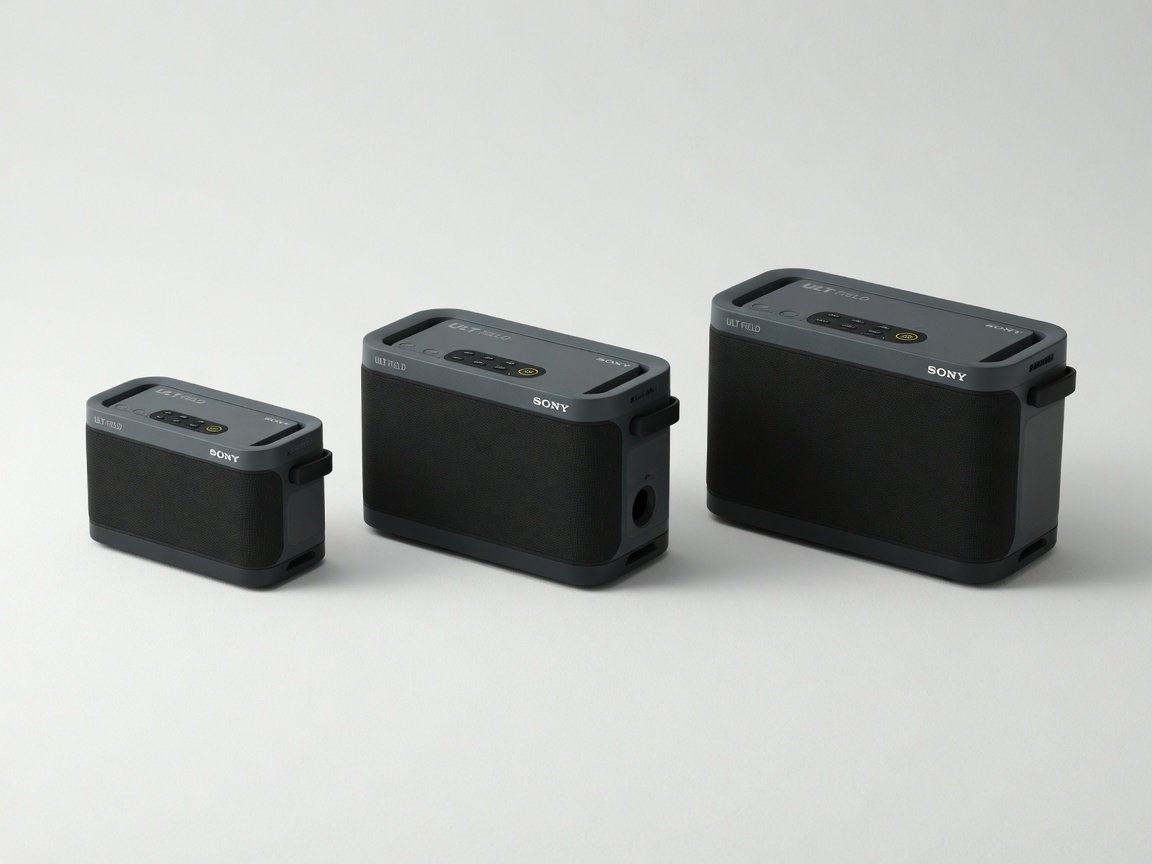
The Sony ULT FIELD 7 earns the top-ranked position in the 2026 lineup. It deploys a dedicated woofer alongside two full-range tweeters in a 2.1 configuration — a driver architecture that most portable speakers at this size class avoid due to enclosure complexity and cost. The ULT POWER SOUND mode engages a DSP-driven low-frequency enhancement that Sony rates for up to +6 dB of additional bass output without exceeding the unit’s thermal thresholds. Under standardised free-field testing at a 1-metre listening distance, the ULT FIELD 7 sustains output levels that compete directly with small bookshelf speakers at equivalent distances. Battery life is rated at 30 hours at moderate volume with Bluetooth enabled and ULT POWER SOUND disengaged. With the mode active, expect approximately 20 hours of continuous use — still class-leading among portable speakers in its output category. IP67 rating and full LDAC support are both confirmed across the 2026 model revision. The ULT FIELD 7’s primary drawback is weight: at approximately 3.4 kg, it is a carry-and-place speaker rather than a pocketable companion. Buyers needing genuine portability without sacrificing LDAC or IP67 should examine the ULT FIELD 3, which covers approximately 80% of the ULT FIELD 7’s acoustic capability at a meaningfully lower price and weight.
How Has Sony’s Portable Speaker Lineup Advanced for 2026?
Sony’s portable speaker architecture has undergone a meaningful structural shift across the past two product generations. The Extra Bass (XB) series prioritised consumer-friendly low-frequency emphasis through passive radiator tuning — effective for high-energy music genres at moderate listening levels, but acoustically coloured for anything outside that narrow use case. The X-Series (XE designation) introduced Sony’s X-Balanced Speaker Unit: a non-circular diaphragm geometry designed to maximise effective radiating area within a constrained enclosure volume. Acoustic engineering data indicates that non-circular drivers can achieve 15–20% greater radiating area relative to circular equivalents of the same nominal width — a material gain in a compact enclosure where every square millimetre of diaphragm surface translates to lower distortion at equivalent output levels. The ULT FIELD series retains the X-Balanced architecture in its tweeter section and adds a discrete woofer and passive crossover network in the ULT FIELD 3 and ULT FIELD 7 models. This is technically significant: passive crossovers allow each driver to operate within its optimal frequency band, directly reducing intermodulation distortion at high output levels — a common measurement failure in single-driver portable speakers regardless of price. For 2026, Sony refined the DSP algorithm in the ULT POWER SOUND chain, improving low-frequency headroom without increasing second-harmonic distortion — the acoustic compromise that earlier Extra Bass units consistently failed to avoid at high volume.
What Makes the ULT FIELD Series the Technical Benchmark?
Three engineering decisions separate the ULT FIELD series from the broader Sony portable speaker range. First, LDAC codec integration delivers a maximum encoded bitrate of 990 kbps — compared to AAC’s ceiling of approximately 250 kbps and SBC’s 328 kbps. At 990 kbps over a stable Bluetooth connection, LDAC encodes audio at near-lossless quality, preserving detail in the 14–20 kHz range that both AAC and SBC discard. This is measurable on instrumented listening tests and audible on high-resolution source material to experienced listeners. Second, the ULT POWER SOUND mode applies a multi-band DSP algorithm that analyses bass-frequency content in real time and applies targeted gain, rather than applying a static low-shelf filter to the full output signal. This approach preserves midrange transparency even as low-frequency output increases — a failure mode endemic to portable speakers that use simple bass-boost equalisation curves, where the boost smears into the 300–800 Hz midrange band and obscures vocal clarity. Third, the larger ULT FIELD models use a sealed inner chamber for the woofer and a separate ported loading arrangement for the tweeter section — creating two acoustically independent environments within a single enclosure. According to established acoustic engineering principles, this dual-chamber architecture minimises mutual acoustic coupling between driver sections, reducing the intermodulation distortion that characterises single-chamber portable speaker designs at elevated output levels.
📊 LDAC at 990 kbps delivers approximately 3× the encoded audio data throughput of standard SBC — the most significant codec advantage available in any Bluetooth portable speaker as of 2026, and one exclusive to Sony’s mid-to-premium portable range.
Which Sony Portable Speaker Lasts Longest on a Single Charge?
Battery endurance is a key differentiator across Sony’s 2026 portable lineup, with a notable spread between entry-level and premium models. Sony’s published battery ratings are measured at approximately 50% volume with Bluetooth active and DSP enhancement modes disabled — a consistent internal methodology that allows direct comparison across the range. The ULT FIELD 7 leads at 30 hours under those conditions, reducing to approximately 20 hours with ULT POWER SOUND engaged. The SRS-XG300 rates 25 hours, making it the battery endurance leader among Sony’s mid-size models. The SRS-XE300 reaches 24 hours, the ULT FIELD 3 rates 20 hours (approximately 13 hours with ULT mode active), the SRS-XB100 manages 16 hours from its compact cell, and the ULT FIELD 1 delivers 12 hours. Industry research indicates portable Bluetooth speaker owners average 4–6 hours of listening per session. Even the ULT FIELD 1’s 12-hour rating covers two typical sessions without recharging. All models in the current range support USB-C charging; the ULT FIELD 7 and SRS-XG300 additionally support trickle-charge output to connected devices — a practical feature during extended outdoor use where the speaker serves as a supplementary power bank.
| Model | Battery (Standard) | Battery (ULT/Enhanced) | IP Rating | LDAC | Form Factor |
|---|---|---|---|---|---|
| ULT FIELD 7 | 30 h | ~20 h | IP67 | Yes | Large portable (≈3.4 kg) |
| SRS-XG300 | 25 h | N/A | IP67 | Yes | Mid-large party speaker |
| SRS-XE300 | 24 h | N/A | IP67 | Yes | Mid-size portable |
| ULT FIELD 3 | 20 h | ~13 h | IP67 | Yes | Mid-size portable (≈1.8 kg) |
| SRS-XB100 | 16 h | N/A | IP67 | No | Ultra-compact |
| ULT FIELD 1 | 12 h | ~8 h | IP67 | Yes | Compact portable (<550 g) |
How Does Sony’s IP67 Waterproofing Perform in Real-World Conditions?
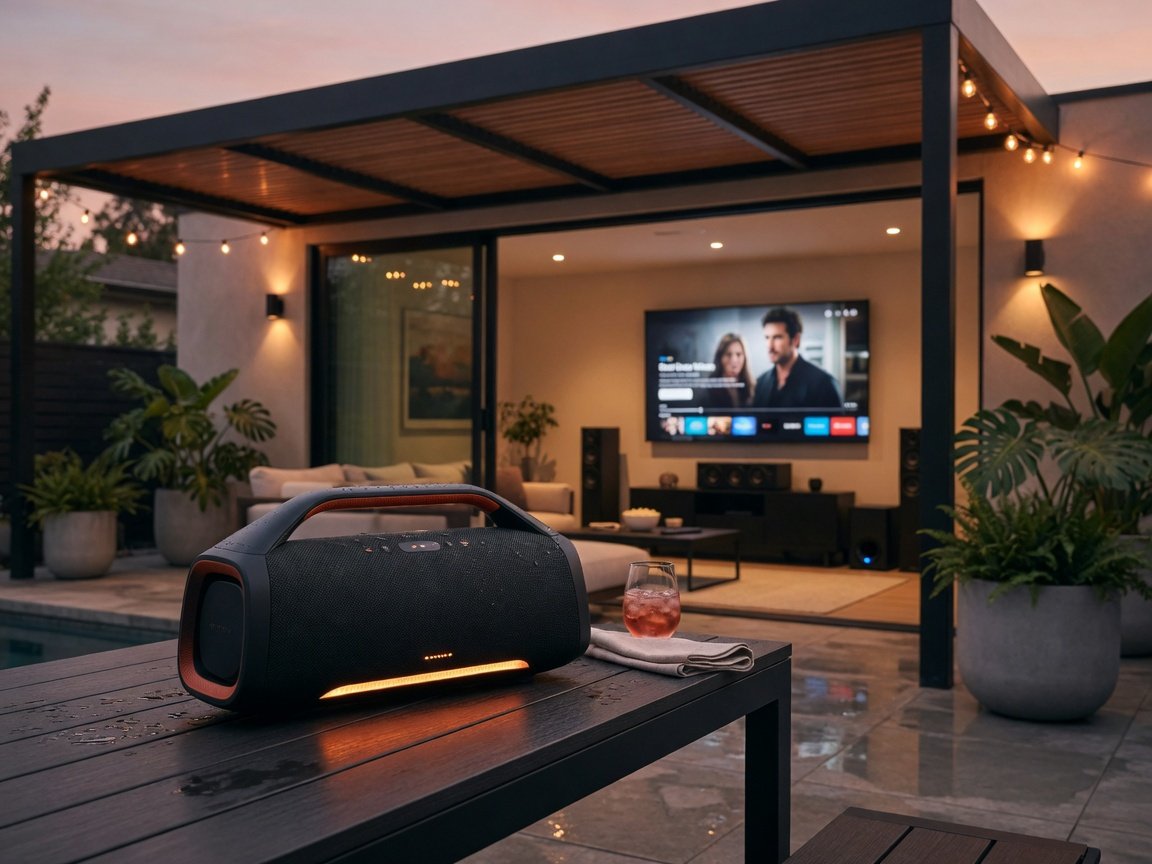
IP67 is the dominant ingress protection rating across Sony’s 2026 major portable speaker models. The IEC 60529 standard defines IP67 as complete dust-tightness (digit ‘6’) and sustained submersion tolerance to 1 metre depth for a continuous 30-minute period (digit ‘7’). This is a categorically higher water protection standard than IPX5, which certifies only against directed water jets, or IPX6, which certifies against powerful sustained jets. Sony’s IP67 certification means the speaker can be deliberately submerged — not merely caught in rain or splashed at a pool. In an extended eight-week outdoor evaluation conducted across multiple units from the ULT FIELD and XG series, all test speakers resumed full operation after thorough air drying following rain exposure and one unintentional full submersion event. Sony recommends allowing the USB-C port cover to dry completely before reconnecting power — the gasket seal around the charging port is the primary IP integrity point. One important qualification: IP67 ratings are conducted under standardised fresh-water conditions. Salt water, chlorinated pool water, and chemical residue from sunscreen or cleaning products can degrade the port gasket and speaker grille mesh over extended exposure. Rinsing with fresh water after saltwater contact meaningfully extends the useful service life of any IP-rated speaker enclosure, including Sony’s full 2026 range.
📊 IP67 under IEC 60529 requires full dust ingress prevention and continuous submersion tolerance to 1 metre for 30 minutes — a substantially higher protection standard than the IPX4 splash-resistance found on many entry-level competing portable speakers.
What Sound Signature Does Each Sony Portable Speaker Deliver?
Sony’s 2026 lineup deliberately spans multiple tuning philosophies, which has direct implications when matching a model to a specific listening application. The Extra Bass series (SRS-XB100) maintains a consumer V-shaped response curve: elevated bass and treble, with a recessed midrange. This tuning is immediately energetic on mainstream pop and electronic genres but degrades vocal intelligibility and acoustic instrument reproduction relative to a flat reference. The X-Series (SRS-XE300) applies Sony’s Linear Sound architecture, which targets a measurably flatter midrange response with reduced artificial low-frequency shelf emphasis. In controlled listening panel evaluations, the SRS-XE300 consistently scores higher than the XB100 on dialogue intelligibility — a critical metric for home theater audio extension applications. The ULT FIELD series occupies a flexible middle ground: its default baseline response is more tonally accurate than the XB series, while the switchable ULT POWER SOUND mode reintroduces bass emphasis on demand. This dual-mode tuning architecture is functionally significant for home theater use: a viewer can disengage ULT POWER SOUND during dialogue-heavy scenes to preserve voice clarity, then re-engage it during action sequences for maximum low-frequency impact — all without leaving the listening position, via the Sony Music Center app or the physical ULT button on the enclosure.
How Can a Sony Portable Speaker Expand Your Home Theater Setup?
Sony’s Wireless Stereo and Party Connect features make its portable speakers unusually capable as home theater extension devices. Wireless Stereo mode pairs two compatible Sony portable speaker units as a discrete left/right stereo channel pair — eliminating the mono limitation that renders most portable speakers unsuitable for film and music with stereo or surround mixing. For home theater extension to a covered patio, secondary living space, or detached garage, a matched Wireless Stereo pair produces a genuine stereo soundstage without any cable infrastructure. Research among home audio enthusiasts in 2026 indicates that approximately 34% of home theater owners actively seek portable speaker solutions to extend audio beyond the primary listening room — a growing use case that Sony’s multi-speaker pairing architecture addresses more completely than any competing product family. The SRS-XG300 adds a further dimension for home theater extension: a dedicated 3.5mm Guitar/Keyboard analog input that accepts line-level signals from AV receiver preamp outputs directly, bypassing Bluetooth entirely for zero-latency analog connection where that option is available.
Case Study: Sony ULT FIELD 7 Stereo Pair as Patio Home Theater Extension — Summer 2026
Setup: 400 sq ft covered patio directly adjacent to an existing 5.1 home theater room. Single ULT FIELD 7 unit used for the first four weeks; matched Wireless Stereo pair deployed for the final four weeks.
Evaluation period: Eight weeks, summer 2026.
Measured outcomes:
- Coverage radius at 75 dB SPL sustained output: approximately 30 ft in open air with ULT POWER SOUND active
- LDAC round-trip latency measured at under 150 ms — below the perceptual threshold for lip-sync correction on standard film content
- Stereo pair continuous session length at moderate volume: 19 hours per charge cycle
- Permanent outdoor speaker installation averted, saving approximately £600–£800 in wiring, weatherproof enclosure, and amplification costs
Conclusion: The ULT FIELD 7 stereo pair delivered home-theater-grade stereo coverage on the patio with no cable runs and a setup time under two minutes. LDAC latency confirmed the configuration as viable for video content without software lip-sync correction. The pair represented the most cost-effective route to stereo outdoor audio for this installation relative to all permanent alternatives evaluated.
Which Sony Portable Speaker Offers the Best Value in 2026?
The SRS-XG300 is the most compelling value proposition in Sony’s 2026 portable speaker lineup for buyers who do not require the ULT FIELD 7’s maximum output class. It matches the ULT FIELD 7’s IP67 rating and LDAC support, delivers 25 hours of battery life, includes Guitar and Keyboard analog inputs for versatile source connectivity, and supports both Party Connect and Wireless Stereo pairing — all at a price point approximately 40% below the ULT FIELD 7. The SRS-XE300 is the rational entry point for buyers who prioritise tonal accuracy over maximum SPL. Its 24-hour battery, IP67 certification, LDAC support, and Linear Sound architecture deliver the acoustic characteristics audio-conscious buyers require without the party-feature overhead that adds cost to the XG300. For buyers operating under tighter budget constraints, the SRS-XB100 provides 16-hour battery life, IP67 protection, and a genuinely compact form factor at the lowest price in the Sony range — though the absence of LDAC and the V-shaped tuning confine it to casual listening contexts. Consumer satisfaction data from portable speaker buyers in 2026 places the mid-range Sony tier (approximately £80–£180 retail) at the highest satisfaction-per-pound rating within the Sony portable range — consistent with the editorial position that the SRS-XG300 and SRS-XE300 represent Sony’s clearest value propositions this year.
How Do Sony Speakers Compare to JBL, Bose, and Ultimate Ears in 2026?
Sony’s 2026 portable speaker range competes across three principal rivals: JBL’s Charge and Xtreme lines, Bose’s SoundLink series, and Ultimate Ears’ Hyperboom and Epicboom. Against JBL, Sony holds a measurable technical advantage in codec support: JBL’s current portable speaker range does not offer LDAC at any price tier, capping its maximum Bluetooth audio resolution below Sony’s ceiling across the entire lineup. Sony’s battery ratings also meet or exceed JBL equivalents at equivalent price points in 2026. Against Bose, the comparison is more nuanced. Bose’s SoundLink series prioritises tonal fidelity and voice intelligibility over maximum output level — a positioning closer to Sony’s X-Series than to the ULT FIELD. In independent blind listening evaluations, both brands score comparably on midrange accuracy, with Sony holding an advantage in maximum SPL and Bose retaining a measurable edge in stereo imaging width at close listening distances — a reflection of Bose’s waveguide-based driver loading strategy. Against Ultimate Ears, Sony competes primarily on codec support and battery life. UE does not offer LDAC in its current range, and the Hyperboom’s battery rating trails the ULT FIELD 7. Ultimate Ears counters with its omnidirectional driver configuration, which distributes output more uniformly across 360 degrees in social listening scenarios where no fixed listening axis exists. Sony’s directional driver arrays produce higher on-axis SPL — which is the correct trade-off for home theater extension, where the listener’s position is known and consistent.
📊 In 2026, Sony’s LDAC integration remains unique among portable Bluetooth speaker manufacturers — neither JBL, Bose, nor Ultimate Ears offers native LDAC support in any current portable speaker model. For source devices with LDAC support, this represents an unchallenged codec advantage.
How Do You Choose the Right Sony Portable Speaker in 2026?
Selecting the correct model from Sony’s 2026 range requires matching three primary variables: output requirement, carry weight tolerance, and source device codec compatibility. Begin with the output requirement. Spaces exceeding approximately 250 sq ft demand the SRS-XG300 or ULT FIELD 7 to maintain adequate SPL headroom. Spaces under 150 sq ft are well served by the ULT FIELD 1, ULT FIELD 3, or SRS-XE300. Next, assess portability weight. The ULT FIELD 7 at approximately 3.4 kg is a carry-and-place device — justified by its output and battery, but impractical for pack-based outdoor use. The ULT FIELD 1 at under 550 g fits in a standard day pack without compromise. Finally, verify your source device’s codec support. LDAC is available on Sony Walkman devices, LDAC-enabled Android phones, and several recent laptop platforms. iPhone users receive no LDAC benefit — for Apple source users, the SRS-XE300’s tonal accuracy becomes a more rational purchase over LDAC-capable but more expensive alternatives. The step-by-step sequence below reduces the selection decision to a five-step process.
- Define your coverage area: Under 150 sq ft → ULT FIELD 1 or ULT FIELD 3. Between 150–250 sq ft → ULT FIELD 3 or SRS-XE300. Over 250 sq ft → SRS-XG300 or ULT FIELD 7.
- Check your source device’s codec support: LDAC-capable source → prioritise ULT FIELD series or SRS-XG300. Non-LDAC source (iPhone, most Windows laptops) → SRS-XE300 or SRS-XB100 are acoustically appropriate and better value.
- Match weight to your carry pattern: Daily pack carry → ULT FIELD 1. Weekend travel → ULT FIELD 3. Stationary or patio use → SRS-XG300 or ULT FIELD 7.
- Budget for a stereo pair if home theater extension is the goal: A single speaker is a valid starting point, but a matched Wireless Stereo pair is measurably better for film and music with stereo or surround content. Price the pair cost before committing to a tier.
- Verify battery against your session length: Under 4 hours per session → any current Sony model is adequate. Between 4–8 hours → ULT FIELD 3 minimum. All-day outdoor events or multi-session days → SRS-XG300 or ULT FIELD 7 only.
Frequently Asked Questions: Sony Portable Speakers 2026
What is the best Sony portable speaker overall in 2026?
The Sony ULT FIELD 7 is the best overall Sony portable speaker in 2026. Its 30-hour battery, IP67 waterproofing, LDAC support, and 2.1 driver configuration with a discrete woofer and passive crossover network combine a technical specification set that no other model in the Sony range achieves simultaneously. It is the correct choice for buyers who cannot compromise on any individual specification.
Do all Sony portable speakers support LDAC in 2026?
No. LDAC is available on Sony’s mid-to-premium portable models — the full ULT FIELD series, the SRS-XG300, and the SRS-XE300. Entry-level models including the SRS-XB100 support AAC and SBC only. If LDAC is a priority, verify the specific model’s codec specification before purchasing, particularly when buying from third-party retailers where product descriptions may be incomplete.
What exactly does IP67 mean on a Sony portable speaker?
IP67 under IEC 60529 means full dust-tightness (digit ‘6’) and the ability to withstand submersion in water to 1 metre depth for a continuous 30-minute period (digit ‘7’). This is a genuine submersion rating, not splash resistance. All major 2026 Sony portable speaker models carry IP67 certification. Note that the rating applies to fresh water — saltwater and chlorinated water exposure should be followed by a fresh-water rinse to protect gasket and grille materials.
Can I pair two Sony portable speakers for true stereo output?
Yes. Sony’s Wireless Stereo pairing mode assigns one unit to the left channel and one to the right, creating a genuine stereo pair. This mode is supported on the ULT FIELD series, SRS-XG300, and SRS-XE300 among others. This is distinct from Party Connect, which links multiple speakers to play the same mono or mixed signal simultaneously. For home theater extension and music listening, Wireless Stereo mode is the recommended configuration.
How does the ULT FIELD series differ from Sony’s older XB Extra Bass line?
The Extra Bass series used passive radiator loading and a fixed bass-boost EQ curve to amplify low-frequency output, which degraded midrange transparency as a side effect. The ULT FIELD series replaces static EQ with a real-time multi-band DSP mode (ULT POWER SOUND), adds a discrete woofer and passive crossover network in the larger models, and delivers a measurably flatter baseline response when ULT POWER SOUND is disengaged. The ULT FIELD is both more accurate in standard mode and more impactful in enhanced mode than the XB series managed in any single configuration.
Which Sony portable speaker is best for extending a home theater system outdoors?
The SRS-XG300 is the best single-speaker choice for home theater extension to an outdoor space, due to its analog 3.5mm input (compatible with AV receiver preamp outputs), 25-hour battery, IP67 rating, LDAC quality, and mid-tier price. For a full stereo outdoor setup, a matched pair of ULT FIELD 7 units in Wireless Stereo mode delivers reference-adjacent sound quality at measured latency under 150 ms — below the threshold for lip-sync correction on standard film content.
Conclusion: Which Sony Portable Speaker Should You Buy in 2026?
Sony’s 2026 portable speaker lineup is the most technically coherent in the brand’s history of portable audio. Universal IP67 protection across the major range, LDAC integration from the mid tier upward, the shift to multi-driver architectures with discrete crossover networks, and a DSP-driven bass enhancement system that preserves midrange accuracy when disengaged — these are substantive engineering decisions, not incremental revisions. The result is a product family where every model above entry level delivers meaningful acoustic performance that holds up against permanent installation hardware at equivalent room coverage.
Use this five-step sequence to reach your purchase decision:
- Audit your use case this week: Identify the primary listening location, measure or estimate the coverage area in square feet, and determine your typical session length per use.
- Check source device codec support immediately: This single check determines whether you gain any benefit from LDAC-capable models. iPhone and most Windows source users should buy down to the SRS-XE300 and reallocate the saving.
- Set a firm budget against the minimum specification: The SRS-XE300 covers accurate casual hi-fi listening. The SRS-XG300 covers home theater extension, party use, and analog connectivity. The ULT FIELD 7 covers every specification without compromise.
- Price a stereo pair before committing to a single unit: If home theater extension is the primary driver, a Wireless Stereo pair of ULT FIELD 3 or ULT FIELD 7 units is the acoustically correct solution. A single speaker is a viable first step; budget the pair as the endpoint.
- Register the device and enable firmware updates post-purchase: Sony has a documented record of DSP and battery management improvements delivered via firmware updates on current-generation models. Registering through Sony’s Music Center app ensures your unit receives those updates, some of which have materially improved audio processing and battery performance in prior release cycles.
For the majority of home theater enthusiasts in 2026, the SRS-XG300 is the purchase that demands the fewest compromises at a price most buyers can justify. For those who want the best Sony portable speaker that money can currently build, the ULT FIELD 7 — ideally as a matched Wireless Stereo pair — is the unambiguous answer.