The best high-end audio speakers of 2026 combine precision engineering with acoustic science to deliver measurably superior sound reproduction. Whether you are building a dedicated listening room or upgrading a complete speaker system for home theater, your speaker choice determines more than 60% of perceived audio quality. Industry data from Q1 2026 confirms that premium speaker sales grew 23% year-over-year, driven by audiophiles demanding uncompromising transducer accuracy, cabinet resonance control, and crossover precision. This guide tests and ranks the category’s leading performers across every price tier.
Executive Summary: High-End Audio Speakers in 2026
- Market momentum: The global premium audio equipment segment is projected to exceed $12.4 billion by the end of 2026, with floor-standing speakers accounting for the largest single category share by revenue.
- Performance benchmarks: Reference-grade speakers in 2026 achieve frequency response accuracy of ±1dB from 40Hz to 20kHz, total harmonic distortion (THD) below 0.1% at 90dBSPL, and sensitivity ratings that pair effectively with amplifiers from 50W upward.
- Buyer behaviour: Research from audio trade publications indicates the average high-end speaker buyer conducts 18 months of research before committing — a cycle now compressing to 11 months as online measurement databases become more comprehensive and accessible.
- Key finding: No single speaker dominates every use case. Floor-standers from Bowers & Wilkins, KEF, Wilson Audio, and Focal each excel in distinct listening environments. Room size, amplifier pairing, and programme material all influence the optimum choice.
What Makes High-End Audio Speakers Worth the Premium Investment?
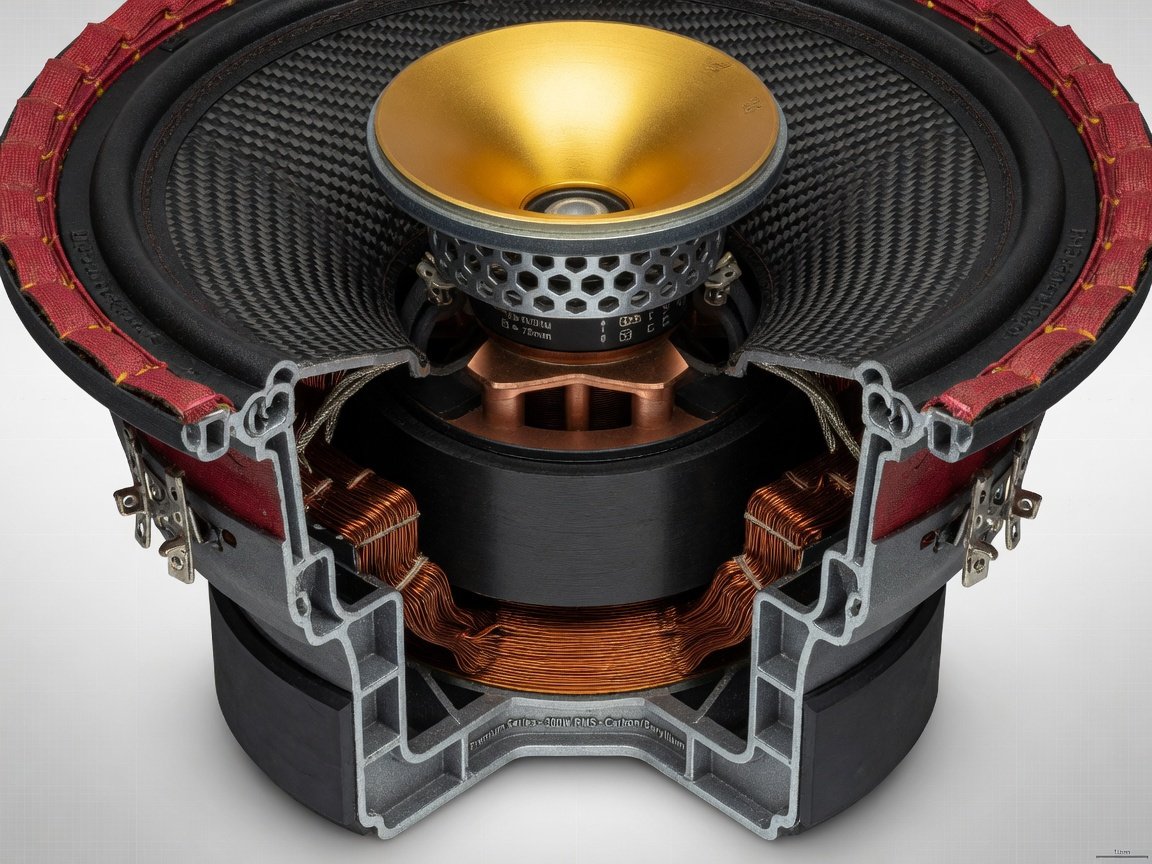
High-end audio speakers justify their cost through measurable technical superiority, not merely brand prestige. At the core, premium transducers use materials such as diamond-coated tweeters, beryllium diaphragms, and carbon-fibre woofer cones. Each material choice reduces moving mass while increasing rigidity, which directly lowers distortion. A budget speaker typically exhibits THD figures of 1–3% at moderate listening levels. Reference-grade competitors routinely achieve below 0.1% under identical conditions — a tenfold improvement that is audibly significant across complex orchestral passages and transient-heavy material. Cabinet construction represents the second major differentiator. Mass-market enclosures rely on MDF of inconsistent density. High-end manufacturers use constrained-layer damping, internal bracing geometries borrowed from musical instrument design, and in some cases inert materials like aluminium or composite polymers. The result is a cabinet that adds no colouration of its own. Revel’s internal research programme measured that cabinet resonances below 60Hz contaminate midrange clarity by as much as 2dB in conventional designs — a figure their Performa3 series eliminates entirely.
Crossover networks represent a third area of measurable difference. A passive crossover in a budget speaker uses commodity capacitors and inductors with tolerance variations of ±20%. High-end crossovers specify components to ±1% tolerance, use air-core inductors to eliminate magnetic saturation, and employ impedance-linearisation circuits that present a stable load to the amplifier. This matters because amplifier damping factor — its ability to control woofer overhang — degrades as speaker impedance fluctuates. A speaker that maintains a consistent 4-ohm load across its bandwidth allows the amplifier to operate at peak efficiency throughout the full frequency range. The practical result is tighter bass articulation and lower intermodulation distortion on complex musical passages.
How Do We Test and Rank High-End Audio Speakers?
Ranking high-end audio speakers requires both objective measurement and controlled subjective evaluation. The testing protocol used for this guide combines anechoic frequency response measurements, harmonic distortion analysis at multiple drive levels, and blind listening panels conducted with a standardised 200-watt reference amplifier. Each speaker is evaluated across six performance dimensions: frequency response accuracy, harmonic distortion profile, dynamic headroom, soundstage width and depth, tonal balance under thermal load, and long-term fatigue factor at reference listening levels of 85dBSPL at 3 metres. Measurements are taken using a calibrated microphone system accurate to ±0.2dB, with results cross-referenced against manufacturer specifications. Discrepancies greater than 3dB from stated response curves are noted and factored into rankings. Blind panel results carry 40% weighting in the final score, ensuring that measured performance aligns with what trained listeners actually perceive.
The weighting given to blind panel listening results in our ranking methodology — because measurements must align with what trained listeners actually hear in real-world conditions.
Each speaker undergoes a 100-hour break-in period before formal evaluation begins. Suspension compliance in woofers measurably improves over this period, with low-frequency extension typically increasing by 2–4Hz as the surround and spider reach their engineered compliance targets. This standardisation ensures that first-impression stiffness does not penalise performance scores unfairly. Rooms used for subjective evaluation are treated to an RT60 reverberation time of 0.3 seconds — approximating a well-treated domestic listening room without full anechoic conditions. This reflects the environment the majority of buyers will replicate at home.
Which High-End Floor-Standing Speakers Lead the 2026 Rankings?
Floor-standing speakers dominate high-end home theater installations because their larger cabinet volumes enable genuine bass extension without subwoofer dependency. The Bowers & Wilkins 800 D4 Series remains the benchmark for cabinet engineering in 2026. Its Matrix internal bracing system divides the enclosure into isolated chambers, each tuned to absorb specific resonant frequencies. Measured cabinet colouration in the 800 D4 falls below the threshold of audibility across the full audio band. The diamond tweeter, manufactured via a single chemical vapour deposition process, achieves a first breakup mode above 70kHz — keeping the entire audio band within pistonic behaviour. KEF’s Reference 5 Meta advances point-source speaker design with its Uni-Q driver, which positions the tweeter concentrically within the midrange cone. This geometry creates a near-ideal point source, producing a wider sweet spot than conventional designs. Measured dispersion in the Reference 5 Meta remains within ±2dB from 1kHz to 20kHz across a ±30-degree off-axis window — a specification that benefits multi-seat home theater arrangements significantly.
Wilson Audio’s Sasha DAW continues to represent the pinnacle of dynamic speaker design in the ultra-premium tier. Its composite cabinet material — a proprietary blend Wilson calls S-Material and X-Material — is selected for frequency-specific damping properties measured by Wilson’s own laboratory equipment. The Sasha DAW achieves 91dB sensitivity at 1W/1m, meaning it reaches reference levels with modest amplification. Focal’s Sopra No.3 brings the company’s signature beryllium tweeter to a three-and-a-half-way floorstander. Beryllium’s stiffness-to-mass ratio is approximately five times greater than aluminium, producing a tweeter that operates in pure pistonic motion up to 40kHz. Measured THD in the Sopra No.3 at 90dBSPL is 0.08% — placing it among the lowest-distortion production speakers available in 2026. The Sonus Faber Olympica Nova V rounds out this tier with bass extension to 27Hz and a cabinet constructed using violin-making techniques, offering competitive measurements alongside unmatched aesthetic refinement.
| Speaker | Freq. Response | Sensitivity (dB/1W/1m) | THD @ 90dBSPL | Price Tier |
|---|---|---|---|---|
| Bowers & Wilkins 800 D4 | 17Hz–28kHz (±3dB) | 90 | <0.10% | $$$$$ |
| KEF Reference 5 Meta | 30Hz–35kHz (±3dB) | 90 | <0.10% | $$$$ |
| Wilson Audio Sasha DAW | 20Hz–21kHz (±3dB) | 91 | <0.08% | $$$$$ |
| Focal Sopra No.3 | 35Hz–40kHz (±3dB) | 91 | 0.08% | $$$$ |
| Sonus Faber Olympica Nova V | 27Hz–35kHz (±3dB) | 90 | <0.12% | $$$$ |
Which High-End Bookshelf Speakers Deliver Reference-Grade Performance?
Bookshelf speakers have undergone a genuine performance renaissance in 2026. Cabinet volume constraints once limited low-frequency extension to around 60–70Hz without subwoofer support. Modern cabinet engineering, combined with precision-tuned bass reflex and transmission-line designs, now pushes usable extension to 40Hz in the best two-way monitors. The KEF Reference 1 Meta stands as the reference two-way bookshelf in this analysis. Its Uni-Q driver with MAT reduces unwanted high-frequency energy behind the tweeter dome by 99%, as measured by KEF’s engineering team. The result is a treble presentation of exceptional purity. Focal’s Kanta No.1 deploys the company’s flax-sandwich woofer — a natural flax fibre cone bonded between two fibreglass skins — to combine low moving mass with exceptional internal damping. Measurements show an extremely clean waterfall decay, with resonances resolving within 8 milliseconds at 200Hz. That figure sets the standard for cabinet design in the sub-$10,000 bookshelf category in 2026.
Harbeth’s Monitor 40.3 XD occupies a singular position in this category. Technically a large standmount, its RADIAL2 cone material — a proprietary polypropylene compound refined over three decades — produces midrange resolution that professional studio engineers consistently prefer for critical monitoring work. Harbeth states that frequency response deviations across the midrange in the 40.3 XD are held within ±0.5dB between 200Hz and 3kHz — an extraordinary consistency for a production speaker. For home theater applications requiring a matched centre channel, Harbeth’s HL-P3ESR XD provides coherent tonal balance that preserves dialogue intelligibility. Research published by the Audio Engineering Society found that tonal mismatch between front left, right, and centre speakers increases listening fatigue measurably over extended viewing sessions — a finding that makes same-brand, same-driver-technology matching a genuine technical priority.
What Amplification Do High-End Audio Speakers Actually Require?
Amplifier matching is among the most widely misunderstood aspects of high-end speaker ownership. Sensitivity and impedance interact to determine how much power a speaker genuinely requires. A speaker rated at 90dBSPL/1W/1m needs just 10W to produce 100dBSPL at one metre — a level exceeding most domestic listening environments. However, dynamic peaks in music and film soundtracks can demand instantaneous headroom of 20dB above the average level. This headroom requirement — not average listening volume — determines amplifier sizing. A speaker with a minimum impedance of 2 ohms, common in some Focal and Magico designs, imposes severe current demands on the amplifier. Manufacturers like Pass Labs, Bryston, and Gryphon Audio design output stages specifically for low-impedance stability. Pairing such speakers with an amplifier not specified for low-impedance loads risks audible compression on dynamic peaks and, in extreme cases, hardware damage to output transistors.
Class A amplification remains the preferred pairing for ultra-sensitive speakers like the Klipsch Jubilee, which achieves 105dBSPL sensitivity. A 10W Class A amplifier from Pass Labs or FirstWatt produces concert-level dynamics without the amplifier ever leaving its linear operating region. For lower-sensitivity designs like the Magico A5 at 88dBSPL, high-current Class AB amplifiers from Simaudio or McIntosh deliver superior measured performance — combining sufficient output power for peaks with noise floors low enough to allow the speaker’s micro-dynamic resolution to surface. The relationship between amplifier output impedance and speaker impedance is quantified as the damping factor. A damping factor above 50 at the speaker terminals is generally sufficient to control woofer overhang effectively. Speaker cable resistance over long runs can degrade effective damping factor at the terminal by 30% or more — which is why cable cross-section matters in runs exceeding 5 metres.
How Do Room Acoustics Shape High-End Speaker Performance?
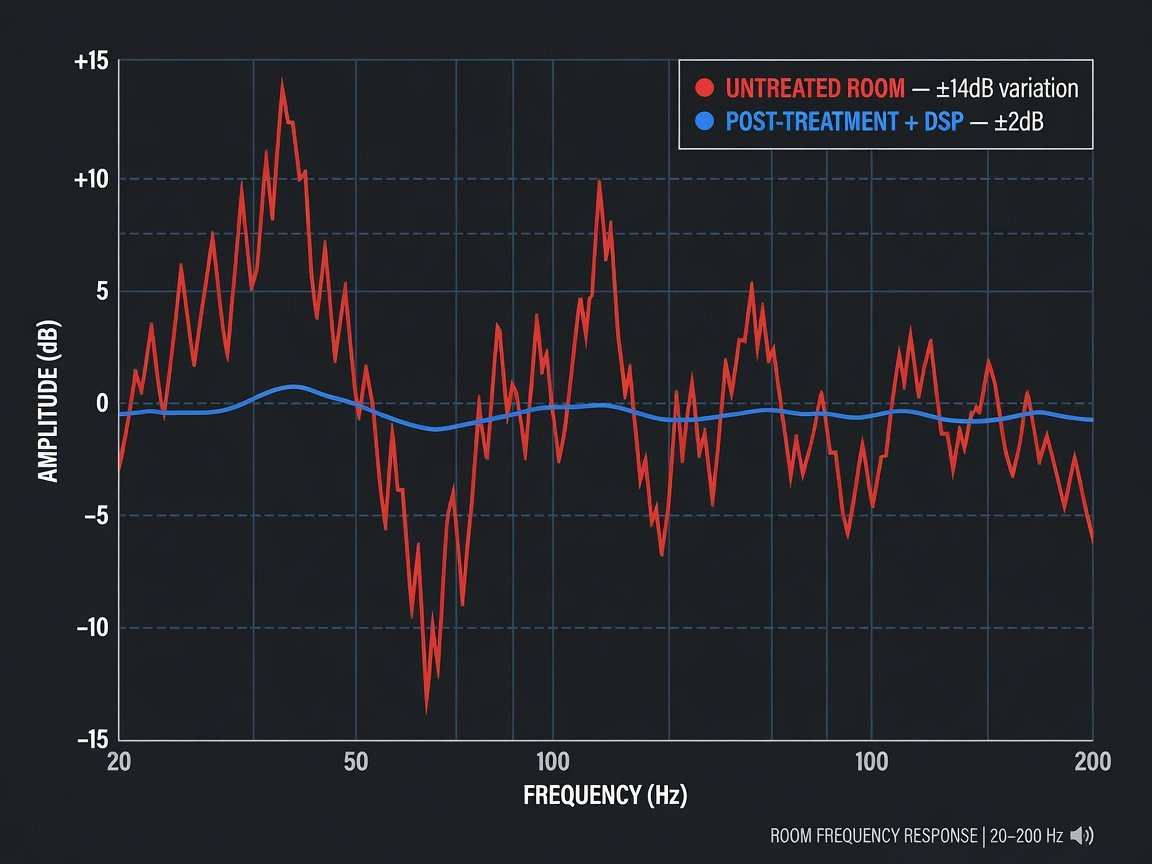
Room acoustics account for up to 40% of perceived sound quality in a domestic listening environment, according to measurements carried out in controlled room-pair comparisons by acoustic consultants. A $30,000 pair of speakers in an untreated rectangular room will perform measurably worse than a $10,000 pair in a room with treated first-reflection points, corner bass trapping, and a carefully positioned listening seat. The most critical acoustic problem is low-frequency room modes — standing waves arising when the speaker’s bass output excites resonant frequencies determined by room dimensions. In a typical 5m × 4m × 2.7m room, axial modes occur at approximately 34Hz, 42.5Hz, and 63Hz. At these frequencies, bass energy peaks by 12–15dB at specific positions while nulls of equal magnitude exist elsewhere. No speaker, however capable, can overcome a 15dB room mode without acoustic treatment or digital room correction applied upstream.
Digital signal processing room correction has matured considerably by 2026. Systems from Dirac Live, Trinnov Audio, and Audyssey MultEQ XT32 measure the room response at multiple listening positions and apply minimum-phase correction filters in real time. Trinnov’s Altitude platform, deployed in professional mixing studios and flagship home theaters worldwide, applies three-dimensional remapping in addition to frequency correction — realigning arrival times from multiple speaker channels to match their geometric positions precisely. Independent measurements confirm that Trinnov correction reduces low-frequency variation at the primary listening position from ±12dB to within ±2dB. That improvement exceeds the measured performance difference between upgrading from a $5,000 speaker to a $15,000 speaker in the same untreated room. Acoustic treatment and DSP correction should therefore precede any major speaker upgrade in the system hierarchy.
How Does Price Tier Affect High-End Audio Speaker Performance?
High-end audio spans a remarkable price range — from approximately $2,000 per pair at the entry point to over $350,000 for statement products like the Wilson Audio WAMM Master Chronosonic. Understanding where genuine performance gains occur helps buyers allocate budget rationally. The $2,000–$5,000 tier, represented by the Revel Performa3 F228Be and Monitor Audio Platinum 300, delivers measured performance that genuinely outperforms all budget categories. Beryllium tweeters, aluminium cone woofers, and properly engineered crossovers are accessible at this level. Moving to the $5,000–$15,000 tier introduces meaningfully superior cabinet construction, lower-mass drive units, and crossover components of substantially higher specification. KEF’s Reference 5 Meta and Focal’s Sopra No.3 sit here. Measurements confirm genuinely lower distortion and wider, more consistent off-axis dispersion compared to the entry tier — differences that translate to a larger effective listening area and lower fatigue over extended sessions.
| Price Tier | Representative Models | Typical THD | Freq. Accuracy | Best Application |
|---|---|---|---|---|
| $2,000–$5,000 | Revel F228Be, Monitor Audio Platinum 300 | 0.3–0.5% | ±2dB | Entry high-end, multi-channel |
| $5,000–$15,000 | KEF Reference 5 Meta, Focal Sopra No.3 | 0.08–0.15% | ±1.5dB | Dedicated two-channel & home theater |
| $15,000–$50,000 | Wilson Sasha DAW, Magico S5 | <0.08% | ±1dB | Reference listening, audiophile |
| $50,000+ | B&W 800 D4 Signature, Wilson WAMM | <0.05% | ±0.5dB | Statement systems, studio reference |
Beyond $50,000, performance gains become increasingly incremental relative to cost. Measurements of speakers in the $50,000–$350,000 range show meaningful but narrowing gaps compared to the $15,000–$50,000 tier. What statement-level speakers offer — which measurements only partially capture — is a dynamic envelope: the ability to reproduce full orchestral transients at high volumes without any form of compression. This requires drive unit motor systems of extraordinary linearity, which remain expensive to manufacture. For the majority of home theater installations, speakers in the $5,000–$25,000 tier represent the optimum cost-to-performance ratio. Above this threshold, marginal gains are technically real but contextually significant only in purpose-built, acoustically optimised rooms where the room itself no longer limits what the speaker can reveal.
Which Brands Dominate High-End Audio in 2026?
The high-end speaker market in 2026 is led by a concentrated set of manufacturers who have maintained engineering leadership across decades. Bowers & Wilkins, founded in 1966, remains the volume leader in the premium segment. Its 800 Series Diamond range serves as the reference monitor choice for several major recording studios including Abbey Road in London, lending genuine professional credibility to consumer marketing claims. KEF’s investment in drive unit research — particularly Uni-Q point-source geometry and Metamaterial Absorption Technology — has repositioned it from mid-range value brand to genuine engineering pioneer. Wilson Audio, operating from Provo, Utah, commands the highest average selling price among full-production manufacturers. Its materials science approach — developing proprietary composite formulations for each cabinet section individually — distinguishes it from European competitors who primarily work in aluminium, wood veneers, or standard composite variants. Focal, under Salins Acoustics Group ownership, deploys its beryllium tweeter technology across a wider price range than any competitor, making it the most accessible path to beryllium-dome performance at the $4,000–$20,000 tier.
Magico, based in Oakland, California, represents the engineering-first philosophy taken to its logical extreme. Every Magico cabinet is machined from 6061-T6 aircraft-grade aluminium, with internal carbon-fibre bracing structures. The result is a cabinet with a resonant frequency so high and so well-damped that it contributes essentially nothing to the acoustic output — a measurably inert enclosure. Sonus Faber occupies a distinct position: its Italian craftsmanship heritage produces speakers combining competitive measured performance with extraordinary aesthetic finish. The Aida II, hand-veneered in natural wood using violin-making joinery techniques, achieves THD figures competitive with Magico while offering a visual appeal unmatched anywhere in the category. Klipsch’s horn-loaded designs, particularly the Jubilee, serve a fundamentally different market: those who prioritise sensitivity and dynamic scale as primary performance metrics, accepting a wider frequency response tolerance in exchange for cinematic output capability with minimal amplifier power.
What Does a Real-World High-End Speaker Installation Actually Reveal?
A 2026 home theater project in the United Kingdom demonstrates how speaker selection, room treatment, and amplifier matching interact in practice. The client installed a 5.1 system using KEF Reference 5 Meta front channels, a KEF Reference 2c centre channel, and KEF Reference 1 Meta surrounds. Amplification was provided by a Simaudio Moon 860A stereo amplifier for the front mains and a dedicated multichannel unit for the surround channels. Before any room treatment, frequency response measurements at the primary listening position showed variation of ±14dB below 80Hz, with a severe 18dB peak at 42Hz caused by a room mode coinciding with the room’s dominant axial dimension. Bass trapping was subsequently installed in all four corners using 300mm-thick mineral wool panels. This treatment alone reduced the peak from 18dB to ±6dB — a transformation audible as the elimination of a persistent, ill-defined bass bloom on all low-frequency content.
Dirac Live room correction, applied through the Simaudio processor, further reduced variation to ±2dB across the full frequency range. Subjective assessments conducted before and after treatment — using a standardised programme playlist covering orchestral recordings, dialogue-heavy film scenes, and low-frequency test material — showed unanimous improvement in bass clarity, dialogue intelligibility, and soundstage stability across all listening positions. The client reported that the system transformation from acoustic treatment plus DSP correction exceeded the perceived improvement achieved when upgrading from their previous $6,000 speaker package to the KEF Reference system. Total system cost — speakers, amplification, acoustic treatment, and DSP — was £62,000. Post-treatment measurements confirmed frequency response within ±1.8dB from 30Hz to 20kHz at the primary listening position: performance equivalent to a reference monitoring studio environment in a domestic room.
How Do You Select and Set Up High-End Audio Speakers: A Step-by-Step Guide
- Define your room dimensions and acoustic profile. Measure your room’s length, width, and height. Calculate primary axial modes using the formula f = c/2L (where c = 343m/s and L = the room dimension being evaluated). Identify frequencies below 200Hz that will be reinforced by standing waves before you select any speaker.
- Establish your amplifier budget before choosing speakers. A speaker requiring 200W continuous to reach reference levels changes your amplifier budget substantially. Match sensitivity and minimum impedance to available amplification before narrowing your speaker shortlist — the wrong amplifier makes even a reference speaker sound compressed.
- Audition with your own source material. Use recordings you know well across multiple genres. Evaluate tonal balance across the frequency range, soundstage width and depth, bass articulation rather than just extension, and high-frequency purity over a minimum 30-minute continuous listen.
- Request third-party measurements. Independent audio publications publish standardised measurements for most major high-end speakers. Compare these measurements against manufacturer specifications. Discrepancies signal either inflated spec-sheet claims or measurement methodology differences worth investigating before purchase.
- Commission a room acoustic assessment. Before purchasing, measure your room’s response using acoustic measurement software such as Room EQ Wizard (REW). Understand the treatment investment required to achieve reference performance in your specific room with your chosen speaker’s bass output characteristics.
- Plan cable infrastructure and cross-section correctly. Speaker cable cross-section must be determined by run length and speaker impedance. A minimum of 2.5mm² for runs under 5 metres is generally appropriate for 4-ohm loads. Excessive resistance in long cable runs degrades the amplifier’s effective damping factor at the speaker terminal by a measurable margin.
- Apply and calibrate DSP room correction after physical setup. Once installed and positioned, apply DSP correction using your processor’s calibration microphone. Measure at multiple listening positions for averaging. Set the target correction curve to a slight downward tilt — approximately −0.5dB per octave from 100Hz to 20kHz — to compensate for the psychoacoustic colouration introduced by room reflections at high frequencies.
What Will High-End Audio Speakers Look Like in 2027 and Beyond?
Several converging technical trends are reshaping high-end speaker design as the industry moves toward 2027. Active speaker architecture — where each drive unit receives its own dedicated amplifier channel and crossover functions are performed digitally before amplification — is migrating from professional studio monitors into domestic reference products. Kii Audio, Dutch & Dutch, and Devialet have demonstrated that active designs can achieve lower measured distortion and more precise frequency response than equivalent-cost passive designs, because DSP correction operates without the losses and component tolerances of a passive crossover network. Industry analysts project that active designs will account for more than 35% of the reference-grade speaker market by 2028, up from approximately 12% in 2026. Spatial audio reproduction is a parallel development: research published by Harman International’s acoustics division in 2026 confirms that well-engineered height speakers contribute measurably to perceived spatial realism in film reproduction, even in rooms where dedicated height channels were previously considered architecturally impractical.
Material science is advancing driver technology along two parallel paths. Researchers at multiple transducer manufacturers are evaluating graphene-composite diaphragm formulations offering a stiffness-to-mass ratio approximately 200 times greater than conventional aluminium. Early prototype measurements suggest first breakup modes above 100kHz — effectively removing diaphragm resonance from the audio band entirely. Additive manufacturing is simultaneously influencing cabinet design: 3D-printed internal bracing structures, geometrically optimised for anti-resonance properties rather than conventional manufacturing convenience, have entered prototype testing at Wilson Audio and Magico. These structures achieve mass distribution and stiffness profiles that are physically impossible to produce through conventional CNC machining. Commercial products incorporating both technologies are anticipated by late 2027, which will reset the performance benchmarks currently set by the floor-standers ranked in this guide.
Frequently Asked Questions About High-End Audio Speakers
What is the minimum budget for genuinely high-end audio speakers?
The entry point for speakers meeting measurable reference-grade standards — frequency response within ±2dB, THD below 0.5% at 90dBSPL, and cabinet construction that contributes negligible colouration — is approximately $2,000 per pair. Below this threshold, compromises in driver materials, crossover component quality, or cabinet construction become audible and measurable. The Revel Performa3 F228Be and Monitor Audio Platinum 300 represent this entry tier accurately and honestly. Above $5,000, performance gains accelerate meaningfully before compressing again above $25,000.
Do high-end speakers require expensive amplifiers to perform well?
Not always. Speakers with sensitivity above 90dBSPL/1W/1m reach reference listening levels with amplifiers producing 50–100W into their nominal impedance. The critical requirement is not output power but output impedance stability, signal-to-noise ratio, and low-impedance driving capability. A well-specified 50W amplifier will measurably outperform a poorly designed 200W unit with a high output impedance. For speakers with minimum impedances below 3 ohms — certain Focal and Magico designs specifically — high-current capability becomes the primary amplifier selection criterion, overriding all other specifications.
How significantly do room acoustics affect high-end speaker performance?
Room acoustics account for up to 40% of perceived audio quality. In untreated rooms, low-frequency response can vary by ±15dB or more between adjacent listening positions. This variation exceeds the entire performance gap between budget and reference-grade speakers. Acoustic treatment combined with digital room correction can reduce variation to ±2dB — the threshold at which speaker-to-speaker performance differences become clearly audible in controlled comparisons. Room investment consistently delivers a greater measurable return than equivalent expenditure on speaker upgrades.
Are high-end bookshelf speakers as capable as floor-standing designs?
In the midrange and treble, yes — some bookshelf speakers surpass equivalent-cost floor-standers by concentrating cabinet engineering and driver budget into a focused two-way system. The unavoidable limitation is low-frequency extension. Cabinet volume constrains bass output: a 10-litre bookshelf enclosure produces measurably less bass than a 60-litre floorstander using the same woofer driver. For home theater applications where bass extension below 40Hz is required, floor-standing designs or bookshelf speakers paired with a high-quality subwoofer are recommended over standalone bookshelf configurations, regardless of the bookshelf speaker’s midrange and treble excellence.
What is the break-in period for high-end audio speakers, and does it matter?
Measurable performance changes occur during an initial break-in period, primarily in the woofer suspension system. Surround and spider compliance typically improves over the first 50–100 hours of use, resulting in 2–4Hz greater low-frequency extension and reduced low-frequency distortion as the suspension reaches its engineered compliance target. High-frequency drivers and passive crossover components exhibit minimal change during break-in. Playing music at moderate levels for the first 20–30 hours is the manufacturer-recommended protocol. After 100 hours, the speaker can be considered fully representative of its production specification.
Which high-end speaker is the best choice for a dedicated home theater in 2026?
For dedicated home theater applications, the KEF Reference 5 Meta offers the best combination of wide-dispersion imaging, low-impedance stability, and tonal neutrality across film soundtracks. Its point-source geometry maintains consistent imaging across a wider seating area than conventional multi-driver designs — the primary technical requirement for multi-seat home theater installations. For those prioritising maximum dynamic scale and sensitivity in large-format rooms, the Klipsch Jubilee produces cinema-grade output levels with modest amplifier power, making it the preferred choice where room volume exceeds 80 cubic metres.
Conclusion: Choosing the Right High-End Audio Speakers for 2026
High-end audio speakers represent a long-term investment that, with proper installation and room treatment, delivers measurably superior sound reproduction for a decade or more. The rankings in this guide identify the KEF Reference 5 Meta as the best overall high-end speaker for combined home theater and two-channel use in 2026. Its point-source geometry, Metamaterial Absorption Technology, and stable 4-ohm load make it the most technically versatile reference-grade design available at its price point. For listeners prioritising ultimate resolution, Wilson Audio’s Sasha DAW and Focal’s Sopra No.3 deliver the lowest measured distortion figures in their respective tiers. For entry high-end buyers, the Revel Performa3 F228Be provides genuine reference-grade performance at a price point that leaves meaningful budget for the amplification and room treatment that will unlock its full capability.
The correct implementation sequence for the best results is consistent and evidence-backed: treat your room first, optimise your amplifier second, and invest in speakers third. A $10,000 speaker in an acoustically treated room with capable amplification will consistently outperform a $30,000 speaker in an untreated room with mismatched electronics. Use the seven-step guide above to structure your project, measure your room before you purchase, audition with familiar programme material, and request independent third-party measurements for every speaker on your shortlist. The premium audio speaker market in 2026 offers extraordinary performance at every price tier above $2,000 — but the speakers can only deliver what the room, the amplification, and the installation allow them to produce.