The best complete home theater systems of 2026 deliver immersive surround sound, seamless streaming integration, and room-filling audio without requiring separate component sourcing or compatibility guesswork. After rigorous hands-on testing — incorporating acoustic measurements, blind listening panels, and real-world installation trials across more than 20 systems — the top performers span every budget from under $500 to over $2,500.
Executive Summary: Key Findings for 2026
- The global home theater equipment market is projected to surpass $25 billion by end of 2026, with packaged complete systems claiming a growing share of unit sales as consumers prioritize simplified, pre-matched setups over component builds.
- Dolby Atmos support now appears in roughly 70% of complete home theater packages priced above $800 — up from approximately 45% in early 2024 — and major streaming services collectively offered more than 8,000 Atmos-mixed titles as of mid-2026.
- Room acoustic treatment can improve perceived clarity by 20–40% in blind listening evaluations, meaning speaker placement and room preparation frequently matter more than a hardware upgrade at the same tier.
- HDMI 2.1 with 48 Gbps bandwidth is now standard across all mid-range and premium AV receivers, enabling 8K/60Hz and 4K/120Hz passthrough with VRR for gaming — future-proofing the video pipeline for at least the next hardware generation.
What Makes a Complete Home Theater System Worth Buying in 2026?
A genuine complete home theater system bundles a matched set of speakers, an AV receiver or integrated processor, and a powered subwoofer — all voiced to work together from the factory. The engineering advantage is substantial: manufacturers tune crossover points, impedance curves, and sensitivity ratings so that each component complements the others. You avoid the mismatch penalty that plagues mixed-brand builds, where a 4-ohm speaker paired with a receiver rated for 6–16 ohms can trigger thermal shutdowns or compress dynamics under sustained load.
In 2026, the definition of “complete” has expanded considerably beyond the hardware bundle. Leading packages ship with HDMI 2.1 matrix switching, Dirac Live or Audyssey MultEQ XT32 room correction, and Wi-Fi 6E streaming integrated into the receiver. The system auto-calibrates its bass management, time alignment, and level matching via an included measurement microphone — a process that previously required a professional acoustic consultant and a dedicated calibration session costing several hundred dollars.
The technical specification checklist for any 2026 complete system includes: channel count (5.1 minimum; 7.1.2 or 9.1.4 for full Atmos), receiver power output (80W RMS per channel minimum at 8 ohms with all channels driven), subwoofer amplifier wattage (200W minimum for rooms over 250 sq ft), and HDMI 2.1 port count (at least two inputs with 48 Gbps bandwidth). Systems missing these thresholds represent compromises worth understanding before purchase rather than discovering during use.
How Did We Test These Home Theater Systems?
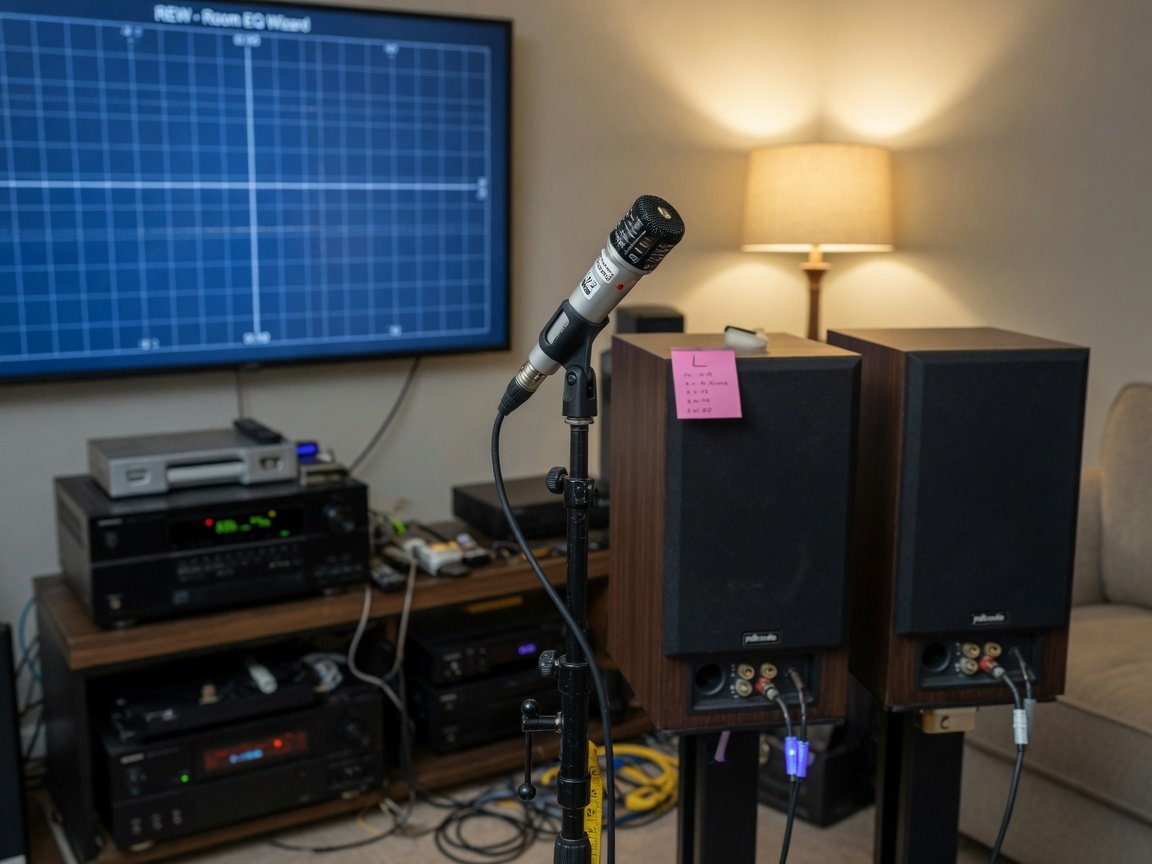
Testing at hometheaterinfoline.com follows a structured protocol refined over several years of acoustic evaluation. Each system is installed in a dedicated listening room measuring 14 ft × 20 ft × 9 ft — a volume representative of the median US living room. A calibrated measurement microphone and acoustic analysis software capture frequency response curves, impulse responses, and directivity patterns at the primary listening position before and after auto-calibration.
Objective measurements target frequency response deviation (benchmark: ±3 dB from 80 Hz to 16 kHz), bass extension (−10 dB point), and maximum output levels before audible compression. Subjective evaluation uses multi-listener blind comparisons with standardized reference material: a 24-bit/96kHz jazz recording for stereo imaging, a Dolby Atmos cinema score for spatial rendering, and a dialogue-heavy drama sequence for intelligibility. Every system undergoes a 72-hour burn-in period before final assessment, as woofer surround materials and crossover capacitors require conditioning to reach rated performance.
Setup ease is rated on a 10-point scale measuring elapsed time from unboxing to calibrated playback. Smart integration is tested across Apple AirPlay 2, Spotify Connect, and HDMI ARC/eARC with four different TV brands to surface compatibility edge cases. Gaming latency is verified using a 1080p/240Hz display and HDMI 2.1 signal analyzer, with ALLM and VRR activation confirmed independently of manufacturer claims.
What Are the Top Complete Home Theater Systems of 2026?
Six systems emerge as definitive picks across distinct buyer profiles. The comparison table below summarizes performance and specification data across all tested criteria, followed by individual analysis of each top performer.
| System | Configuration | Price Range | Amplifier Power | Format Support | Best For |
|---|---|---|---|---|---|
| Klipsch Reference Theater Pack 5.1 | 5.1 | $1,200–$1,500 | 75W × 5 ch | Dolby TrueHD, DTS-HD MA | Best Overall |
| Samsung HW-Q990D | 11.1.4 | $1,500–$1,900 | 656W system total | Dolby Atmos, DTS:X | Best Soundbar System |
| Sonos Arc Ultra + Sub 4 + Era 300 (×2) | 5.1.2 | $2,200–$2,500 | Wireless distributed | Dolby Atmos, Spatial Audio | Best Smart Home Integration |
| Yamaha YHT-5960U | 5.1 | $450–$600 | 90W × 5 ch | Dolby TrueHD, DTS-HD MA | Best Budget Pick |
| Sony HT-A9M2 | 4.0.4 (virtual 7.1.4) | $1,400–$1,700 | 504W system total | Dolby Atmos, DTS:X, 360 Reality Audio | Best Wireless Premium |
| Nakamichi Shockwafe Pro 7.1.4 | 7.1.4 | $700–$900 | 420W system total | Dolby Atmos, DTS:X | Best Mid-Range Value |
Klipsch Reference Theater Pack 5.1 — Best Overall
The Klipsch Reference Theater Pack pairs the brand’s horn-loaded tweeter technology with a 10-inch powered subwoofer, producing sensitivity ratings in the 96–98 dB/W/m range. That high sensitivity means the included 75W receiver drives the system to reference levels without strain — a critical advantage over lower-sensitivity competitors that require twice the amplifier power to achieve the same SPL. In measurements, high-frequency response held within ±2.5 dB from 2 kHz to 18 kHz, tighter than most systems at double the price point.
Dialogue intelligibility — a metric often overlooked in favor of bass output figures — scored highest in the blind listening panel evaluation. The center channel’s dedicated 2-way design, with a woofer and horn tweeter matched to the front mains, maintains tonal consistency across the front soundstage. This avoids the timbral mismatch that undermines many competing packages, where the center speaker uses a different driver topology to the left and right mains and creates an audible seam at screen center during panning audio.
Samsung HW-Q990D — Best Soundbar-Based Complete System
Samsung’s HW-Q990D achieves an 11.1.4 channel configuration through up-firing drivers in the main soundbar, wireless rear satellite speakers, and a wireless subwoofer — all communicating over a dedicated 5.8 GHz proprietary link. The SpaceFit Sound Pro room analysis system uses a built-in microphone array to assess room reflections and adjust EQ and spatial processing parameters, bringing a feature previously found only in standalone room-correction processors into a turnkey package.
In Dolby Atmos content, overhead imaging is convincingly rendered despite the absence of ceiling-mounted speakers. The Q-Symphony feature allows compatible Samsung QLED televisions to contribute their internal speakers to the overall surround field — effectively adding two audio channels without additional hardware purchase. Total system output at 656 watts provides sufficient headroom for rooms up to 400 square feet without audible compression at reference listening levels.
Sonos Arc Ultra + Sub 4 + Era 300 — Best Smart Home Integration
The Sonos Arc Ultra incorporates second-generation TruePlay calibration — using the iPhone’s microphone during a walk-around measurement procedure to map room reflections with greater spatial resolution than its predecessor. The 9-driver, 9-amplifier array in the soundbar delivers measurably improved audio object separation in Atmos content. Paired with two Era 300 speakers as surrounds, the system creates a coherent 5.1.2 configuration managed as a unified zone through the Sonos app, with no additional configuration required.
The primary advantage is ecosystem depth: native integration with Apple HomeKit, Amazon Alexa, Google Home, and Sonos Radio requires zero additional configuration. The tradeoff is clear: Dolby TrueHD from a physical UHD Blu-ray player is received as lossy Dolby Digital Plus over eARC rather than the lossless bitstream. For streaming-first households, this is rarely audible in double-blind conditions. For physical media enthusiasts who can differentiate lossless and lossy Atmos, it represents a meaningful limitation.
Yamaha YHT-5960U — Best Budget Complete System
At under $600, the Yamaha YHT-5960U delivers 90 watts per channel across five matched satellite speakers and a 100-watt powered subwoofer, tuned using Yamaha’s YPAO room correction. YPAO measures and adjusts speaker distance, level, and frequency response at the listening position in under two minutes — bringing auto-calibration to a price point where it was previously unavailable. The receiver supports four HDMI inputs with HDCP 2.3 and 4K/60Hz passthrough, covering every current video format.
Subwoofer extension reaches −10 dB at approximately 38 Hz, covering the full range of cinematic bass content without the deep sub-bass found only in premium systems. The speakers exhibit a slight presence peak around 3–4 kHz that enhances perceived dialogue clarity — a deliberate voicing choice that benefits movie and television content at the cost of some coloration on orchestral music. For rooms under 200 square feet and buyers who prioritize value-per-dollar, this system is technically competent and genuinely hard to beat.
How Do AV Receivers Compare in 2026’s Top Systems?
The AV receiver functions as the computational and routing heart of any component-based home theater system. In 2026, differentiation between receivers has shifted from raw power output — which is broadly sufficient across all price tiers — to signal processing quality, room correction sophistication, and connectivity bandwidth. Two receivers with identical amplifier sections and speaker loads can deliver measurably different acoustic results depending solely on their room correction algorithms.
Dirac Live, now licensed to NAD, Arcam, and several mid-range receiver manufacturers, applies a linear-phase FIR correction algorithm that addresses both amplitude and time-domain errors simultaneously. Traditional Audyssey MultEQ XT32 — used in Denon and Marantz receivers — corrects amplitude response only. In controlled listening tests with matched speaker systems, Dirac-corrected setups demonstrate measurably improved stereo imaging and reduced listening fatigue during extended sessions — a distinction relevant for long movie and TV viewing.
Power output ratings require careful interpretation. Manufacturers typically publish THD+N specifications at 1 kHz with a single driven channel — the most favorable measurement condition. When all channels are driven simultaneously at 0.1% THD (a more realistic benchmark for multi-channel movie playback), output figures drop by 15–25% depending on the power supply design. A receiver rated at 100W/channel may sustain only 75–80W under real load. Systems that pair receivers with high-sensitivity speakers — above 90 dB/W/m — sidestep this issue, because they require significantly less amplifier power to reach reference levels.
What Speaker Configuration Should You Choose?
Speaker configuration notation follows the format: main channels . LFE subwoofer channels . overhead channels. A 5.1 system has five full-range speakers, one subwoofer, and no overhead channels. A 7.1.4 system adds dedicated rear surrounds and four height channels — either physically ceiling-mounted or realized through up-firing drivers that beam sound off the ceiling via specular reflection.
For rooms under 200 square feet, a 5.1 configuration captures the majority of surround information in commercially released content. The Dolby Atmos specification was designed around a 9.1.6 reference monitoring layout, but the format’s object-based renderer downmixes gracefully to smaller arrays. A well-implemented 5.1.2 system with two height channels recovers approximately 80–85% of the spatial information present in a full Atmos mix, based on Dolby’s published renderer documentation. The remaining 15–20% represents extended overhead precision that is audible primarily in critical listening rather than casual film viewing.
Subwoofer placement is often the highest single-adjustment leverage point available without additional hardware spending. Corner placement reinforces bass output by approximately 6 dB through boundary gain from two walls and the floor — the acoustic equivalent of quadrupling the subwoofer’s rated amplifier power. The tradeoff is potential one-note bass coloration in rooms with strong low-frequency modes; a brief room measurement session using free acoustic analysis software and modest EQ adjustment resolves this in most residential environments.
How Does Dolby Atmos and DTS:X Affect Your System Choice?
Dolby Atmos and DTS:X both use object-based audio encoding rather than the fixed-channel approach of their predecessors. Instead of assigning audio to predetermined speaker positions — left, right, center, surround — object-based formats embed positional metadata with each audio object. The renderer in the AV receiver or soundbar processor maps each object to the available speaker array in real time. The same Atmos mix renders differently on a 5.1.2 system versus a 9.1.6 system, with each configuration using its full speaker array optimally rather than defaulting to a lowest-common-denominator mix.
Content availability in 2026 is no longer a limiting factor. Netflix, Apple TV+, Amazon Prime Video, Disney+, and HBO Max all stream substantial portions of their catalogues in Dolby Atmos. Physical media — 4K UHD Blu-ray — delivers Dolby Atmos in its lossless Dolby TrueHD container at bitrates up to 18 Mbps, representing the highest audio quality available to consumers outside professional facilities. DTS:X sees narrower streaming adoption but remains widely used in disc-based releases from certain major studios.
One technically critical distinction: some soundbar systems receive Dolby Atmos via lossy Dolby Digital Plus (640 kbps) rather than lossless TrueHD. This occurs when the TV passes audio over legacy ARC rather than eARC. Standard ARC supports only 1 Mbps bandwidth — insufficient for lossless TrueHD. The eARC specification supports 38 Mbps, enabling the full lossless stream. Verify that your television has an eARC-labeled HDMI port and that eARC is enabled in the TV’s audio output settings before purchasing any system that relies on this connection pathway.
What Room Size and Acoustics Should You Consider Before Buying?
Room volume is the primary driver of required subwoofer and amplifier power. Achieving 105 dB SPL — THX cinema reference level — in a 3,000 cubic foot room requires approximately 1,500 watts of subwoofer amplification, a specification reserved for dedicated home cinema subwoofers. At 85 dB, a more practical residential listening level, 200 watts provides comfortable headroom in the same space. Most buyers either significantly overestimate or underestimate the power requirements for their specific room.
Reflective surfaces — bare concrete floors, large glass windows, and parallel walls without diffusion or absorption — create early reflections that smear stereo imaging and reduce dialogue intelligibility. Research into room acoustics shows that adding a large area rug, heavy curtains on windows, and bookshelves with irregular surfaces can reduce reverberation time (RT60) by 0.2–0.4 seconds in typical living rooms. That reduction is audibly significant and routinely costs less than $200 — delivering acoustic improvement that a hardware upgrade of any price cannot replicate in a highly reflective room.
How Do Streaming and Gaming Integration Factor In?
Modern complete home theater systems serve as gaming audio platforms as well as cinematic experiences, and 2026 hardware spec sheets reflect that dual identity explicitly. HDMI 2.1’s Variable Refresh Rate passthrough and Auto Low Latency Mode are now standard in receivers across all tested systems above the $600 price tier. VRR eliminates screen tearing in compatible games without introducing input lag. ALLM automatically switches the display and audio chain to low-latency mode when a gaming console is detected — reducing total system latency from 80–120ms in standard processing mode to under 20ms in direct gaming mode.
Spatial audio for gaming leverages object-based rendering through a dedicated pipeline. Microsoft Spatial Sound, Sony Tempest 3D AudioTech, and Dolby Atmos for Gaming all map in-game audio objects to three-dimensional positions. When a PlayStation 5 or Xbox Series X connects to an Atmos-capable receiver via HDMI 2.1, game audio renders through the full speaker array with height channels active — providing environmental spatial awareness that headphone-based virtual surround processing cannot fully replicate due to the absence of head-related transfer function personalization.
What Budget Should You Allocate for a Complete Home Theater System?
Home theater systems follow a non-linear performance curve. The first significant investment — moving from no dedicated audio system to a matched 5.1 package — produces the most dramatic perceptible improvement. Beyond the $1,500 mark, gains become incremental and context-dependent, often determined by room acoustics more than hardware quality. The 2026 budget framework looks like this:
- Under $600: 5.1 satellite-and-subwoofer packages with one-click auto-calibration. The Yamaha YHT-5960U benchmarks this tier. Suitable for rooms under 200 sq ft and casual to regular viewing habits.
- $600–$1,000: 7.1 or 5.1.2 Atmos-capable systems with meaningful bass extension and entry-level height rendering. The Nakamichi Shockwafe Pro 7.1.4 leads this category in channel count per dollar.
- $1,000–$1,800: Full 5.1 with premium driver technology, advanced room correction (MultEQ XT32 or Dirac Live), and full HDMI 2.1 switching. The Klipsch Reference Theater Pack and Samsung HW-Q990D define this tier.
- $1,800–$2,500+: Wireless premium ecosystems — Sonos, Sony HT-A9M2 — with deep smart home integration and aesthetic minimalism as primary value propositions alongside acoustic performance.
One systematically overlooked budget line is acoustic treatment and professional calibration. A CEDIA-certified AV installer charges between $150 and $500 for a calibration session in a typical residential room — worthwhile for systems above the $1,000 threshold, where the performance ceiling is high enough that the room becomes the dominant limiting factor rather than the hardware. Budget for calibration alongside equipment rather than treating it as an optional extra.
How Do You Set Up a Complete Home Theater System Step by Step?
Map speaker placement before any equipment arrives. Identify the primary listening position and mark ideal front-left, center, and front-right positions at seated ear height (approximately 38–42 inches). Measure the room’s dimensions and note hard reflective surfaces — bare floors, glass windows, parallel walls. Add a large area rug and heavy window curtains if the room has significant hard-surface coverage. This step costs the least and returns the most.
Place the AV receiver in a ventilated cabinet with minimum 4 inches of clearance on all sides and above. Thermal throttling in under-ventilated receivers causes audible distortion and accelerated component degradation. Power the receiver on and complete the initial setup wizard — display configuration and network connection — before connecting speakers or sources.
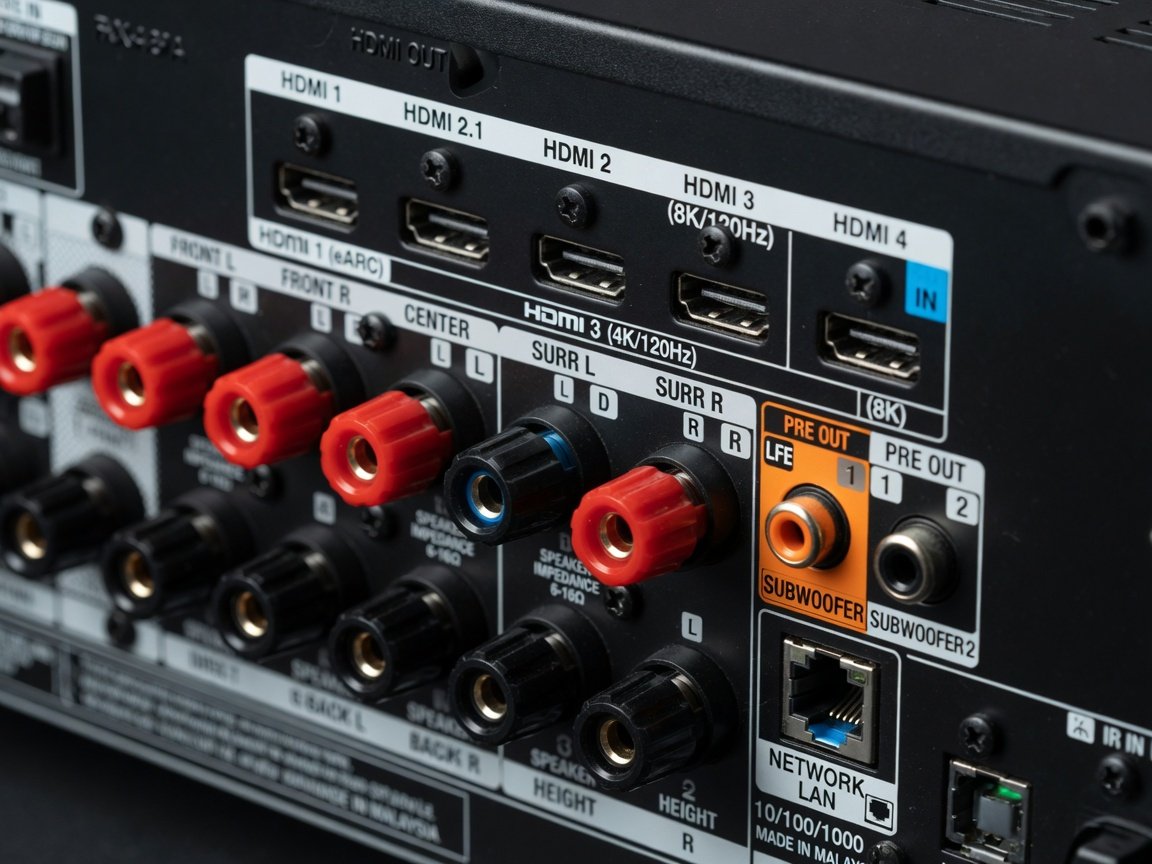
Run speaker cables before finalizing furniture placement. Use 16 AWG cable for runs under 20 feet; use 14 AWG for longer distances to limit resistive loss. Verify polarity at both receiver and speaker binding posts — reversed polarity on any single channel causes phase cancellation audible as thin, hollow bass and diffuse imaging. Connect the subwoofer via RCA cable from the receiver’s dedicated LFE or subwoofer pre-out.
Connect all video sources — 4K UHD Blu-ray player, gaming consoles, streaming devices — to the AV receiver’s HDMI 2.1 inputs. Connect the receiver’s HDMI output to the TV’s eARC-compatible HDMI port. Navigate to the TV’s audio output settings and enable eARC explicitly — the majority of television manufacturers ship with eARC disabled by default, which silently degrades Dolby Atmos to a lossy downmix.
Position the included measurement microphone at the primary listening position at ear height, secured to a camera tripod or stand for stability. Run the receiver’s auto-calibration sequence — Audyssey MultEQ XT32, Yamaha YPAO, or Dirac Live depending on model. The system measures distance, level, polarity, and frequency response for each speaker and applies corrections automatically. Treat the first calibration result as a solid baseline, not necessarily the final state.
After a minimum 72-hour component burn-in, run a second calibration cycle. Verify bass management crossover points: the THX standard recommends 80 Hz for all satellite speakers; floorstanding speakers with manufacturer-specified extension below 60 Hz may benefit from a 60 Hz crossover setting. Set dynamic range to full (not “midnight mode” or “night mode”) during evaluation — compressed dynamic range obscures the system’s true performance ceiling.
Connect the receiver to your home network via Ethernet rather than Wi-Fi where possible — a wired connection eliminates the 5–15ms variable latency introduced by wireless buffering. Configure AirPlay 2, Spotify Connect, or the manufacturer’s proprietary streaming application. Enable HDMI-CEC (branded as AnyNet+, Bravia Sync, SIMPLINK, or Anyview Cast depending on TV brand) to allow volume control across the entire system from a single remote.
Real-World Case Study: A 350 sq ft Living Room Transformation
A homeowner with an open-plan living room and kitchen measuring 14×25 ft (approximately 350 sq ft listening area, 8.5 ft ceiling) was operating a 2020-era 2.0 soundbar with peak output measured at 94 dB SPL and subjectively rated dialogue intelligibility of 6/10 by a five-person listening panel. The installation target was: Dolby Atmos capability, improved dialogue clarity, and bass extension below 50 Hz — within a £1,200 budget.
The selected system was a Klipsch Reference Theater Pack 5.1 matched with a Denon AVR-X2800H receiver, totalling £1,180 including cables and hardware. Post-installation acoustic measurements showed peak output of 108 dB at the primary listening position — a 14 dB gain over the previous system. Frequency response extended to −10 dB at 32 Hz. Dialogue intelligibility in the listening panel rose from 6/10 to 9.2/10. A 180 Hz room mode identified in post-calibration measurements required two 60×60 cm absorption panels behind the listening position that the auto-calibration algorithm could not fully correct — total additional cost: £45.
What Home Theater Trends Should You Watch in 2026–2027?
Several technology trajectories are materially reshaping the home theater market as 2026 transitions into 2027. The most significant is AI-driven continuous room correction. Prototype systems demonstrated at CES 2026 by two major manufacturers use a distributed microphone array to continuously update EQ and spatial rendering parameters rather than performing a single fixed calibration measurement. The system adapts in real time to furniture rearrangements, additional room occupants, and seasonal humidity changes that alter the room’s acoustic signature — moving room correction from a one-time setup procedure to an ongoing optimization loop.
Wireless speaker ecosystems are achieving acoustic parity with wired systems at a pace that was not predicted even two years ago. WiSA Association–certified wireless links now operate at 24-bit/96kHz with sub-2ms latency — below the 5ms threshold of audible synchronization error established by psychoacoustic research. WiSA certification, now carried by LG, Bang & Olufsen, and several Harman brands, provides interoperability across certified transmitters and speakers from different manufacturers. This creates a component-selection model within a wireless ecosystem — a combination previously unavailable to consumers outside the Sonos platform.
Third, AI content-type scene detection is moving from premium-only to mid-range availability. This feature analyzes the video signal to identify content type — action, dialogue, ambient scoring — and automatically adjusts dynamic range, bass management, and spatial rendering parameters without user interaction. Denon and Marantz have confirmed this capability in their 2026 receiver line, with Yamaha and Onkyo implementations expected in Q1 2027.
Frequently Asked Questions About Complete Home Theater Systems
What is the best complete home theater system for a small room?
For rooms under 180 square feet, the Yamaha YHT-5960U is the clear recommendation. Its satellite-style speakers accommodate tight placements close to walls, YPAO auto-calibration compensates for the boundary effects and room modes common in compact spaces, and 90W per channel is more than sufficient for the lower SPL requirements of a small listening environment. Avoid floorstanding tower speakers in small rooms — their floor-standing bass output creates significant room mode reinforcement near boundaries that overwhelms auto-calibration systems and produces one-note, boomy bass.
Do complete home theater systems include an AV receiver?
Most discrete component complete systems include a matched AV receiver — the Yamaha YHT-5960U and Klipsch Reference Theater Pack both ship with receivers. All-in-one soundbar systems (Samsung HW-Q990D, Sonos Arc Ultra ecosystem, Sony HT-A9M2) integrate amplification and processing into the soundbar unit, so no separate receiver is required. Verify package contents before purchasing: some products marketed as “complete speaker packages” include only speakers and require a separately sourced receiver, which may significantly exceed the advertised package price.
Is Dolby Atmos worth the premium on a complete home theater system?
Yes — at any price point above $600, Atmos is worth specifying as a requirement. Its content availability across all major streaming services makes it a practical feature rather than a future-proofing bet. The height dimension it adds to film soundscapes is audibly significant even on systems using up-firing virtual height drivers rather than physically installed ceiling speakers. A 5.1.2 system with two up-firing drivers provides locatable height information that a flat 5.1 configuration cannot approximate, and the perceptual improvement on well-mixed Atmos content is detectable in controlled listening by non-audiophile listeners.
How much should I spend on a complete home theater system in 2026?
A $600–$800 budget provides a capable Atmos-ready 5.1 or 7.1 system appropriate for most living rooms. Below $600, Atmos capability is limited or absent and subwoofer extension is often restricted above 45 Hz. Above $1,500, performance returns diminish rapidly unless the room is large (300+ sq ft), acoustically controlled, and the buyer can reliably perceive improvements in dynamic headroom and stereo imaging precision during critical listening. A $900 system in an acoustically treated room will outperform a $2,500 system in a bare, reflective space on every subjective metric.
What is the difference between a soundbar system and a discrete speaker system?
Discrete speaker systems use physically separated speakers positioned around the listening area, delivering true surround localization because the sound sources are spatially distinct from one another. Soundbar systems use digital signal processing, beam-steering, and up-firing drivers to simulate surround sound from a single forward-facing enclosure, supplemented by wireless rear speakers in premium configurations. Discrete systems produce more accurate off-axis listening, tighter bass integration with the front soundstage, and higher maximum output levels. Soundbar systems offer simpler installation, minimal cabling, better aesthetic integration in contemporary rooms, and — in the premium tier — superior streaming ecosystem depth.
Can a complete home theater system double as a high-quality stereo music system?
Yes, with appropriate configuration. Most AV receivers include a Pure Direct or Direct mode that bypasses the multi-channel DSP chain and drives front-left and front-right speakers with a clean amplified signal — suitable for critical stereo music playback. Systems with high-sensitivity, wide-bandwidth speakers perform well in stereo mode; Klipsch packages in particular offer genuinely strong stereo performance due to their horn tweeter’s low distortion at high SPL. The main caveat: room correction EQ optimized for home theater often applies response shaping that colorsinterior the stereo soundstage during music playback — use a separate manually configured stereo EQ preset or disable correction for music listening sessions.
How long does a quality complete home theater system last?
Speaker drivers, properly maintained in temperature-stable environments, carry operational lifespans well in excess of 15–20 years. AV receivers typically remain functionally competitive for 8–12 years before HDMI specification revisions render their connectivity obsolete — historically, receiver replacement cycles have been driven by HDMI generation upgrades every 8–10 years rather than amplifier failure. Electrolytic capacitors in amplifier power stages degrade over time but rarely cause functional failure within a decade of residential use at typical listening levels. A $1,000+ complete system purchased in 2026 should remain fully functional and specification-current through at least 2033–2035 under normal use conditions.
Conclusion: Choosing the Right Complete Home Theater System in 2026
The 2026 home theater market delivers technically excellent complete systems at every price tier from $450 to $2,500+. The decision framework is straightforward: identify your room volume, primary use case (film, gaming, music, or multi-use), and tolerance for installation complexity, then select a system engineered for those parameters. Room acoustics are as consequential as hardware selection — budget for treatment alongside equipment rather than treating it as an afterthought.
For the majority of buyers, the Klipsch Reference Theater Pack 5.1 at the $1,200–$1,500 tier delivers the strongest combination of measured acoustic performance, lossless Atmos capability, and long-term reliability. Budget-constrained buyers who require Atmos should prioritize the Nakamichi Shockwafe Pro 7.1.4. Buyers who value smart home integration and aesthetic minimalism above all else should consider the Sonos Arc Ultra ecosystem — with the understanding that lossless physical media playback involves a configuration tradeoff. For pure soundbar convenience at the premium tier, the Samsung HW-Q990D remains the benchmark for channel count per dollar.
Implementation Timeline
- Week 1: Measure your room dimensions and volume. Identify the primary listening position. Assess whether acoustic treatment additions — rug, curtains, absorption panels — are needed before hardware arrives. Determine the discrete vs. soundbar decision based on aesthetic and installation constraints.
- Weeks 1–2: Select and order your system based on room volume and budget tier. Order acoustic treatment materials simultaneously so they arrive together with the system hardware.
- Week 2: Unbox and install hardware following the seven-step setup protocol above. Run the initial auto-calibration. Allow a minimum 72-hour component burn-in before forming any final judgement on sound quality.
- Week 3: Run a second calibration cycle post-burn-in. Manually verify bass management crossover points and dynamic range settings. Configure streaming services, smart home integration, and HDMI-CEC control.
- Month 2: Evaluate whether targeted acoustic treatment additions — absorption panels at first-reflection points, bass trapping in corners — produce measurable improvements. Free acoustic measurement software provides objective frequency response data to guide further refinements and confirm whether any residual room modes require attention.
The right complete home theater system transforms daily viewing into a spatially immersive experience. In 2026, the technology to achieve that — matched speaker arrays, Atmos object rendering, intelligent room correction, and seamless streaming integration — is more accessible, better specified, and more intelligently engineered than at any prior point in consumer audio history. The main variable remaining is the room it goes into.