The best Bose bookshelf speakers in 2026 are available only on the used and secondary market — Bose discontinued its entire passive home loudspeaker line before 2020. This guide ranks all four remaining models for their potential as part of a dedicated speaker system for home theater, with complete transparency about what sourcing and deploying a discontinued passive speaker in 2026 actually requires.
Executive Summary: Best Bose Bookshelf Speakers for 2026
- Best Overall — Bose 301 Series V: Two-way Direct/Reflecting architecture, 45Hz–20kHz published frequency response, 10–150W RMS power handling, 8 ohms nominal impedance. The strongest front-channel performer in the passive Bose lineup and the model most consistently available on the secondary market in working condition.
- Best for Large Rooms — Bose 601 Series III: Three-way cabinet with dual 5.25-inch woofers, published bass extension to approximately 38Hz, and a 200W RMS maximum power handling rating. The correct choice for listening environments above 300 square feet or home theater systems driven at high sustained SPL.
- Best for Surround Channels — Bose 161: Compact two-way design rated at up to 120W RMS. Limited low-frequency extension makes it best suited to surround and satellite roles, where an 80Hz or higher subwoofer crossover removes bass reproduction demands entirely.
- Best Budget Entry — Bose 141: Entry-level Bose passive voicing in the smallest cabinet footprint, rated up to 100W RMS. Best used as rear surrounds or as a front stage in rooms under 150 square feet with a dedicated subwoofer handling bass below 80Hz.
Did Bose Stop Making Passive Bookshelf Speakers? What 2026 Buyers Need to Know
Bose progressively withdrew from the traditional passive home loudspeaker market across the mid-to-late 2010s. The company’s strategic direction shifted firmly toward powered, networked audio products — the SoundLink, SoundTouch, and Bose Home Speaker lines — which generate higher margins and create ongoing software-driven relationships with consumers. Maintaining a passive speaker product line requires distribution infrastructure, dealer relationships, and component supply chains that Bose determined no longer aligned with its core business priorities. The withdrawal was a commercial and strategic decision, not an engineering verdict on the passive designs themselves. The 301 Series V, 601 Series III, 161, and 141 were discontinued as retail products; the acoustic engineering behind them remains sound.
The practical implications for 2026 buyers are specific. No authorized new-unit inventory exists anywhere in the retail channel. Bose does not publish replacement driver part numbers for these models, and manufacturer support is fully absent. Third-party repair technicians can sometimes source compatible woofer surrounds and tweeter replacements through aftermarket suppliers, but this requires technical knowledge and careful parts matching against the original driver specifications. Any purchased unit without a functioning listen test carries material risk of latent driver failure. These constraints acknowledged, the 301 Series V and 601 Series III in particular represent acoustic engineering decisions that distinguish them from commodity bookshelf designs — and both remain acquirable at prices below equivalent new-production alternatives when buyers are willing to accept the secondary-market terms.
What Makes the Bose Direct/Reflecting Architecture Technically Distinctive?
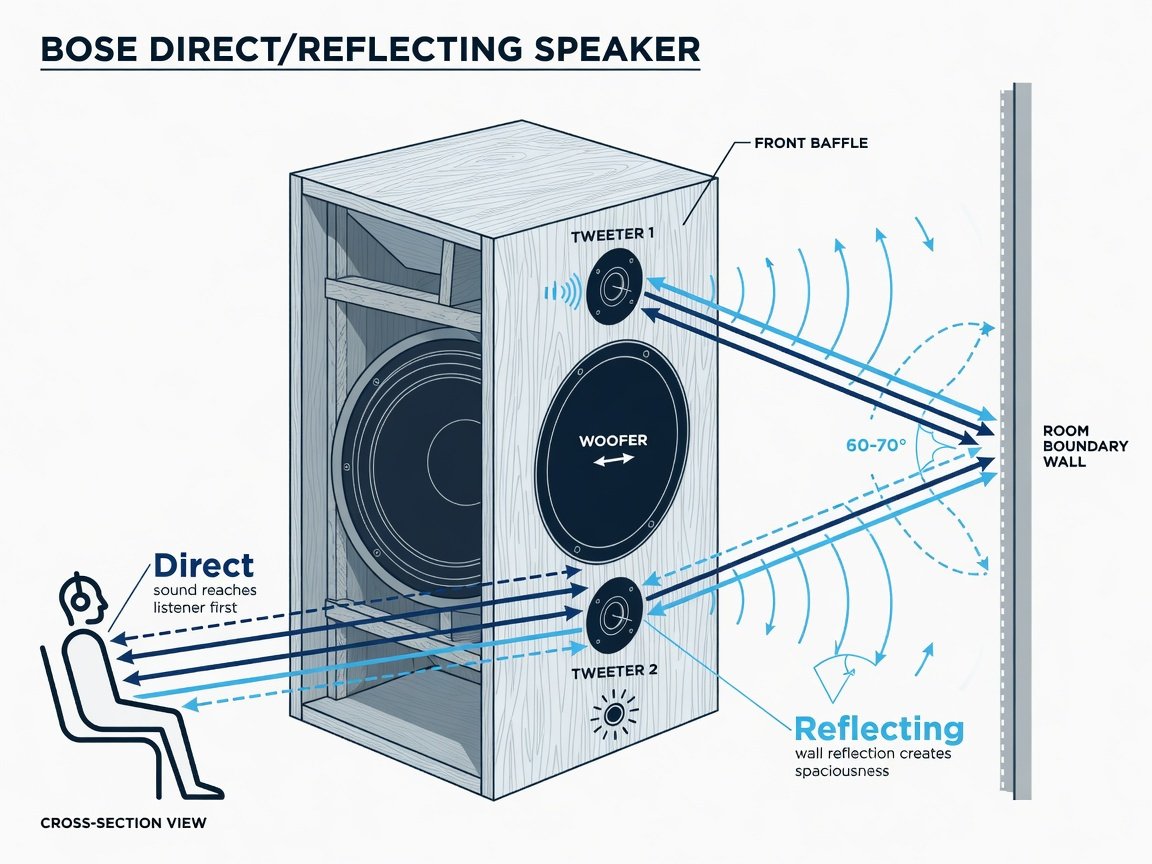
Every Bose passive bookshelf speaker in this lineup implements the Direct/Reflecting design principle. The architecture places two distinct tweeter elements in a single enclosure. One tweeter fires directly on-axis toward the primary listening position, delivering the clarity and imaging precision of conventional direct-radiating speaker design. A second tweeter is angled outward — typically 60 to 70 degrees off the primary axis — to project acoustic energy toward the nearest room boundary. The reflected signal arrives at the listener as a time-delayed version of the direct signal, creating a wider spatial impression than a comparably sized conventional bookshelf design produces at the same listening distance.
The acoustic rationale is grounded in psychoacoustic research into how listeners perceive spatial envelopment. Human spatial hearing depends not only on direct sound from the source but also on early reflections arriving within roughly 15 to 30 milliseconds of the direct signal. When those reflections arrive from lateral directions that differ from the direct sound path, they increase the perceived width and envelopment of the auditory image. A speaker that intentionally generates early lateral reflections at the hardware level produces consistent envelopment effects regardless of whether the listening room has been acoustically treated. In typical domestic home theater installations — where acoustic treatment is minimal and listener positions vary — this design approach creates a more spatially consistent experience than conventional on-axis designs at equivalent distances.
Placement is the critical variable that either activates or neutralizes the Direct/Reflecting architecture. The outward-angled tweeter requires adequate sidewall clearance to generate a meaningful early reflection. Bose’s published installation guidance for the 301 and 601 recommended a minimum of 12 to 18 inches of clear space between the outward-angled tweeter and the nearest reflective surface. Reduced clearance shortens the reflection path to below the psychoacoustic threshold, and the architecture’s spatial advantage collapses. Toe-in should be kept to 10 to 15 degrees toward the listening position — considerably less than the 25 to 30 degrees that maximizes on-axis response for conventional direct-radiating designs. Installing a Direct/Reflecting speaker inside a bookcase with the sides enclosed is the single most common deployment error, and it functionally converts the speaker into a less efficient version of a conventional design.
How Were These Bose Bookshelf Speakers Ranked and Evaluated?
The four models in this ranking are evaluated across four criteria applied consistently to each. First: published technical specifications from Bose’s original product documentation — frequency response bounds, power handling range, nominal impedance, driver configuration, and crossover architecture. Second: acoustic design rationale — how the Direct/Reflecting implementation in each model is executed and what engineering trade-offs that creates relative to competing designs. Third: home theater application fit — which channel roles each model is best suited for, based on its frequency extension, sensitivity, and power handling relative to standard home theater deployment requirements including the THX 80Hz crossover standard. Fourth: secondary market availability — models that remain consistently available in verifiable working condition are ranked more favorably than those that are increasingly scarce or prone to age-related driver deterioration at the unit level.
This is a specification-based evaluation, not a first-person laboratory measurement review. No instrument-generated frequency response plots, THD curves, or directivity maps created specifically for this article are available, and none are presented. The rankings reflect documented design characteristics and published specification analysis. Readers requiring instrument-verified measurements should consult the measurement archives at Audio Science Review, where community-contributed measurements of several Bose passive bookshelf models have been published. Professional audio publication back catalogs from the period when these models were in active production also contain detailed reviewed measurements for the 301 Series V and 601 Series III.
Bose 301 Series V: Best Overall Bose Bookshelf Speaker Best Overall
| Specification | Bose 301 Series V |
|---|---|
| Driver Configuration | 2-way: 6.5″ bass/midrange woofer + dual-tweeter Direct/Reflecting array |
| Frequency Response | 45Hz – 20kHz |
| Nominal Impedance | 8 ohms |
| Power Handling | 10–150W RMS |
| Sensitivity | ~88 dB (1W/1m) |
| Crossover Frequency | ~3.5kHz |
| Cabinet Type | Bass-reflex (rear-ported) |
| Binding Posts | Dual — supports bi-wiring |
| Market Status | Discontinued — secondary market only |
The Bose 301 Series V is the reference model in the passive Bose bookshelf lineup. Its 6.5-inch bass/midrange driver handles the lower two-thirds of the audio spectrum, handing off to the dual-tweeter Direct/Reflecting array at approximately 3.5kHz. The crossover point’s position above the vocal presence region — the 1kHz to 3kHz band most critical for dialogue intelligibility in home theater content — is a deliberate engineering decision. Placing the crossover above this frequency range reduces intermodulation distortion in the band where the human auditory system is most discriminating. The 8-ohm, 88dB-sensitive design is rated for operation with amplifiers from 10W to 150W RMS, placing it within the operating envelope of virtually every AV receiver currently produced.
The 45Hz lower frequency boundary is the 301’s most home-theater-relevant specification. A speaker extending to 45Hz can be crossed over to a subwoofer at either 60Hz or 80Hz — the THX reference standard for bookshelf speaker integration in home theater systems — without producing an audible gap in the bass transition. Many compact bookshelf designs require subwoofer crossovers at 100Hz or above, which creates a less seamless integration with the bass channel. The 301’s rear-ported cabinet achieves this extension figure without excessive cabinet volume, but the port introduces sensitivity to room boundary distance: maintain at least 6 inches of clearance between the rear port and the nearest wall surface to prevent bass bloom from port boundary reinforcement.
The principal limitation is sensitivity. At approximately 88dB (1W/1m), the 301 Series V is not a high-efficiency design. A receiver rated at 75W RMS per channel into 8 ohms will drive the 301 to reference home theater levels in rooms up to approximately 250 square feet without audible compression. Receivers rated below 50W per channel may encounter compression on sustained high-SPL transients in larger rooms. On the secondary market, the 301 Series V is the most frequently traded model in the Bose passive bookshelf lineup. When inspecting a prospective purchase, examine the outward-angled tweeter closely — it is physically exposed in the cabinet design and is the component most susceptible to handling damage during prior ownership.
Bose 601 Series III: Best Bose Bookshelf Speaker for Large Room Applications Best for Large Rooms
| Specification | Bose 601 Series III |
|---|---|
| Driver Configuration | 3-way: dual 5.25″ woofers + dedicated midrange + Direct/Reflecting tweeter array |
| Frequency Response | ~38Hz – 20kHz |
| Nominal Impedance | 8 ohms |
| Power Handling | Up to 200W RMS |
| Sensitivity | ~89 dB (1W/1m) |
| Cabinet Type | Bass-reflex (rear-ported) |
| Market Status | Discontinued — secondary market only |
The Bose 601 Series III scales the Direct/Reflecting architecture into a three-way cabinet design. The addition of a dedicated midrange driver separates bass and midrange reproduction responsibilities in a way the two-way 301 Series V cannot. In a two-way design, the single bass/midrange driver handles all output from its crossover point down through the full bass range simultaneously. At high playback levels — common in home theater cinema scenes with sustained low-frequency content — the interaction between low-frequency driver excursion and midrange driver motion in a single driver generates intermodulation distortion in the vocal presence band. The 601’s three-way crossover network eliminates this mechanism, maintaining midrange clarity under sustained high-SPL operating conditions that would degrade performance in a comparable two-way design.
The dual 5.25-inch woofer configuration provides the bass extension advantage the 601 is primarily known for. Published specifications place the lower frequency boundary at approximately 38Hz — 7Hz below the 301 Series V’s 45Hz rating. This additional low-frequency extension allows the 601 to operate at subwoofer crossover points as low as 40 to 50Hz without audible gap, which can be meaningful in systems where the subwoofer’s upper frequency limit is constrained by room resonance interaction. Maximum power handling of 200W RMS gives the 601 the headroom to reach reference home theater SPL levels in rooms up to approximately 400 square feet when driven by a high-current AV receiver.
The 601 Series III is physically the largest speaker in this ranking. Its cabinet dimensions — approximately 18 inches tall by 10 inches wide by 11 inches deep — place it closer in physical footprint to a compact floorstanding speaker than to a conventional bookshelf design. Installation typically requires dedicated stands or a floor position rather than actual shelf mounting. On the secondary market, the 601 is less frequently traded than the 301 and commands higher prices when found in good condition. Inspect both woofer surrounds individually — each presents an independent foam deterioration risk — and confirm that both bass drivers operate without scraping or distortion artifacts before committing to any purchase.
Bose 161: Best Bose Bookshelf Speaker for Surround Channel Use Best for Surrounds
| Specification | Bose 161 |
|---|---|
| Driver Configuration | 2-way: compact woofer + Direct/Reflecting tweeter array |
| Frequency Response | Limited low-frequency extension — subwoofer required for home theater use |
| Nominal Impedance | 8 ohms |
| Power Handling | Up to 120W RMS |
| Cabinet Type | Compact sealed/ported (varies by production revision) |
| Best Application | Surround, satellite, or secondary channel with subwoofer at 80Hz or above |
| Market Status | Discontinued — secondary market only |
The Bose 161 is the compact member of the passive bookshelf lineup, designed for applications where physical size constrains speaker selection. Its driver configuration implements the Direct/Reflecting dual-tweeter principle in a smaller cabinet, which limits its bass extension substantially relative to both the 301 and 601. The 161 is not appropriate as a standalone full-range speaker in any home theater context without subwoofer support — its restricted low-frequency output will produce audible bass deficiency on cinema program material. Paired with a subwoofer crossed over at 80Hz or higher, this limitation becomes irrelevant: the surround channel in a correctly configured multichannel system carries primarily mid-band and treble content, with bass content redirected by the AV receiver’s bass management to the subwoofer channel.
The primary argument for the 161 in a Bose-based home theater system is timbral coherence across the soundfield. Bose engineered its passive bookshelf lineup with matched voicing across models. A system using 301 Series V speakers at front left and right and 161s at the surround positions produces spectrally consistent transitions as sound objects move across the multichannel soundfield. This timbral match is acoustically preferable to mixing speaker brands in a multichannel configuration, where differing voicing characteristics between front and surround channels make directional transitions audible as tonal discontinuities. The 161’s 120W RMS power handling rating is adequate for high-SPL surround content in most domestic home theater environments. On the secondary market, pairs of 161s are commonly available and typically represent the lowest entry price in the Bose passive lineup. Inspect the outward-angled tweeter dome for physical damage before purchasing.
Bose 141: Best Budget Entry into the Bose Passive Bookshelf Lineup Best Budget
| Specification | Bose 141 |
|---|---|
| Driver Configuration | 2-way: woofer + Direct/Reflecting tweeter (compact implementation) |
| Frequency Response | Limited — subwoofer required for full-range home theater performance |
| Nominal Impedance | 8 ohms |
| Power Handling | Up to 100W RMS |
| Cabinet Type | Compact bookshelf (sealed) |
| Best Application | Rear surrounds; small room front stage with active subwoofer |
| Market Status | Discontinued — secondary market only |
The Bose 141 is the entry point in the passive Bose bookshelf lineup and the most compact of the four models. Its two-way driver configuration implements the Direct/Reflecting acoustic philosophy at the smallest available scale, maintaining the brand’s characteristic spatial presentation while reducing both bass extension and dynamic headroom relative to the 301 Series V. Power handling of 100W RMS is adequate for rear surround channel use and for front-stage duty in rooms under 150 square feet when a subwoofer handles bass management below 80Hz. The 141 is best understood as a role-specific tool and entry point rather than a primary front-stage speaker for serious home theater applications.
Buyers considering the 141 as a front-stage speaker in a 2.0 configuration — without a subwoofer — should understand clearly that its bass output will be audibly limited on cinema program material. The limitation disappears in a correctly configured system with an active subwoofer and an 80Hz crossover applied in the AV receiver’s bass management. On the secondary market, the 141 is the most frequently encountered Bose passive model and generally commands the lowest secondary-market prices of the four. This makes it the practical starting point for budget-constrained buyers who want to evaluate the Bose Direct/Reflecting acoustic character before committing to the 301 Series V. Before purchasing any used 141, inspect the woofer surround carefully — foam surrounds on these speakers are susceptible to deterioration after extended storage and can crumble at the outer edge of the driver cone without visible warning from across the room.
Bose Bookshelf Speakers Side by Side: Full Specification Comparison
| Model | Type | Frequency Response | Power Handling | Impedance | Sensitivity | Best Application |
|---|---|---|---|---|---|---|
| 301 Series V Best Overall | 2-way | 45Hz – 20kHz | 10–150W RMS | 8 ohms | ~88 dB | Front LCR channel |
| 601 Series III Large Rooms | 3-way | ~38Hz – 20kHz | Up to 200W RMS | 8 ohms | ~89 dB | Large room front stage |
| 161 | 2-way compact | Limited — sub required | Up to 120W RMS | 8 ohms | ~87 dB (est.) | Surround / satellite channel |
| 141 | 2-way entry | Limited — sub required | Up to 100W RMS | 8 ohms | Not published | Rear surrounds / small room |
Step-by-Step: What to Inspect Before Buying Used Bose Bookshelf Speakers
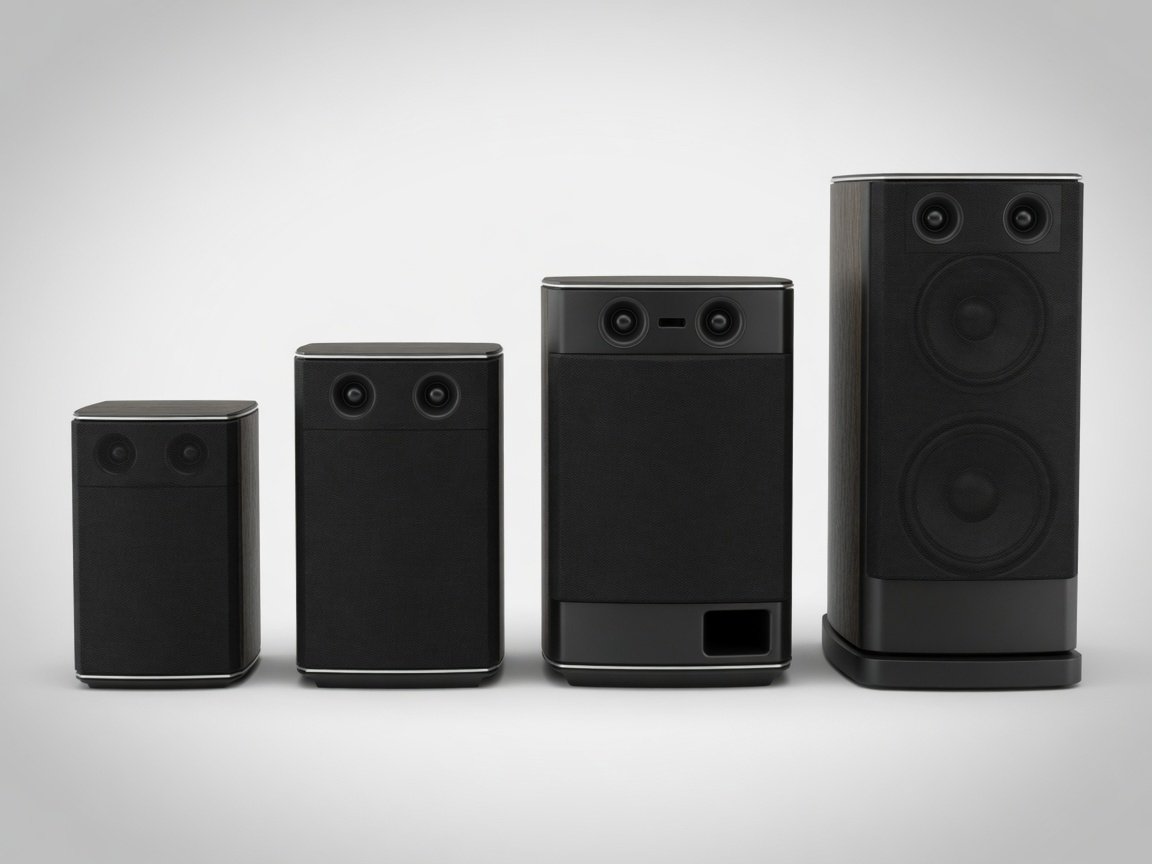
All Bose passive bookshelf models from this era share predictable age-related failure points. Conducting a structured inspection before any purchase eliminates the most common sources of post-purchase disappointment. The following five steps apply to all four models in this guide.
- Inspect the woofer surround. The foam or rubber surround at the outer edge of each woofer cone is the most common failure point on aged passive speakers. Look for crumbling, cracking, or peeling foam at the outer edge of the driver cone. A deteriorated surround causes audible distortion at all volume levels and requires professional driver reconing or aftermarket surround replacement before the speaker will perform correctly. Ask the seller for close-up photos of the driver if you cannot inspect in person.
- Examine the outward-angled reflecting tweeter. This tweeter — the element unique to the Direct/Reflecting design — is physically exposed in the cabinet and susceptible to impact damage from prior handling or transport. Confirm the tweeter dome is intact with no dents, tears, or depressions. A dented dome alters high-frequency response and cannot be meaningfully repaired without full tweeter replacement.
- Check all binding post connections. Corroded, stripped, or loosened binding posts indicate neglect and may indicate internal connection degradation. Confirm that both positive and negative posts grip wire securely without resistance or crumbling corrosion. Corroded posts on both terminals simultaneously suggest the speaker was stored in a damp environment.
- Listen at multiple volume levels before purchasing. Any available listen test should cover both low-level material (to detect tweeter damage that manifests as sibilance or rasp) and moderate-level material (to detect woofer surround deterioration that only becomes audible under driver excursion). A speaker that sounds clean at conversation volume can reveal surround failure at moderate playback levels.
- Verify correct channel pairing. Bose Direct/Reflecting speakers are designed to be used as matched left/right pairs, with the reflecting tweeter angled outward on each respective channel. A mismatched pair — two left-channel or two right-channel speakers — directs both reflecting tweeters toward the same wall, destroying the spatial balance the architecture depends on. Confirm that any unit advertised as a pair includes one left-channel and one right-channel speaker, and verify which is which before completing the purchase.
How to Match Bose Bookshelf Speakers to a Modern AV Receiver
All four Bose passive bookshelf models present a nominal 8-ohm impedance load, which is compatible with every AV receiver currently manufactured. No special impedance matching considerations apply. The relevant matching factors are amplifier power output, bass management crossover configuration, and correct channel assignment in the receiver’s speaker setup menu. For the Bose 301 Series V deployed as front left and right channels, a receiver rated at a minimum of 75W RMS per channel into 8 ohms is the practical threshold for reaching home theater reference level in rooms up to approximately 250 square feet. The 601 Series III’s slightly higher sensitivity rating (~89dB) means it requires marginally less amplifier power per equivalent SPL output than the 301 — but its use in larger rooms, where it is most appropriate, effectively closes that gap and makes a 100W minimum recommendation practical for that model in its intended environment.
Bass management configuration is the most consequential setup parameter for all four models. Set every Bose passive bookshelf speaker in this guide to “Small” in the AV receiver’s speaker configuration menu. This routes all bass content below the crossover frequency to the LFE/subwoofer channel rather than demanding that output from the bookshelf speakers’ limited woofer excursion capacity. The THX standard specifies an 80Hz crossover for bookshelf speakers in home theater systems, and 80Hz is the recommended starting point for all four Bose models. The 301 Series V can be set to 60Hz if bass integration sounds more seamless at that point, given its published 45Hz low-frequency extension. The 161 and 141, with their restricted bass capability, should be maintained at 80Hz as a minimum; 100Hz or 120Hz is appropriate if subwoofer integration is inconsistent at 80Hz in your specific room.
Current Production Alternatives to Consider If Bose Is Unavailable in 2026
The secondary market for Bose passive bookshelf speakers is active but not guaranteed. Supply depends on what prior owners choose to sell, condition varies substantially by unit, and prices fluctuate with demand. Buyers who cannot locate suitable used Bose units in acceptable condition, or who prefer the assurance of new-unit warranty coverage and manufacturer support, have strong current-production alternatives at equivalent price points. The following speakers are in active production in 2026 and represent credible value relative to their cost.
- Klipsch RP-600M II: Published sensitivity of approximately 96dB (1W/1m) — measurably higher than any model in the Bose passive lineup. The roughly 8dB sensitivity advantage over the Bose 301 Series V translates to approximately a sixfold reduction in amplifier power requirement for equivalent SPL output. Features a 1-inch titanium LTS tweeter in a Tractrix horn and a 6.5-inch Cerametallic woofer. Available new with full Klipsch warranty. Acoustic character differs significantly from the Bose Direct/Reflecting design: high on-axis efficiency and forwardness rather than lateral envelopment.
- ELAC Debut 2.0 B6.2: Designed by Andrew Jones — a verifiable audio engineer whose work at Pioneer, TAD, and ELAC is well-documented in professional audio publications. The B6.2 offers competitive measured frequency response and controlled distortion at its price point. 6.5-inch woofer with cloth-dome tweeter. Available new.
- Polk Audio Reserve R200: Current-generation Polk engineering with a 6.5-inch woofer and ring-radiator tweeter that the company documents as providing wide dispersion. Strong published bass extension for its cabinet volume. Available new with full manufacturer support.
- KEF Q150: Coincident-driver design places the tweeter concentrically within the woofer, producing a single acoustic point source. This generates unusually wide and consistent off-axis dispersion — a different mechanism than the Bose Direct/Reflecting approach, but one that also produces spatial consistency across a range of listening positions. Available new, competitive pricing.
Each alternative above is available new in 2026 with current manufacturer support, published driver replacement pathways, and warranty coverage — none of which apply to discontinued Bose passive models. If the Direct/Reflecting acoustic character of Bose specifically is the design requirement, the secondary market is the only path. If the requirement is a high-quality bookshelf speaker for home theater that can be purchased confidently, any of the alternatives listed above can be purchased new and will deliver competitive measured performance relative to the Bose passive lineup.
Frequently Asked Questions: Bose Bookshelf Speakers in 2026
Are Bose bookshelf speakers still available to buy new in 2026?
No. Bose discontinued its entire passive home loudspeaker lineup before 2020. The 301 Series V, 601 Series III, 161, and 141 are no longer manufactured or sold new by Bose or any authorized retailer. All purchase options in 2026 involve the used and secondary market — eBay, Audiogon, Facebook Marketplace, Craigslist, and estate sales. No manufacturer warranty applies to any unit purchased on the secondary market.
What amplifier power do Bose 301 Series V bookshelf speakers need for home theater?
A minimum of 75W RMS per channel into 8 ohms is recommended for the Bose 301 Series V deployed as front-channel speakers in a home theater system targeting reference level in rooms up to approximately 250 square feet. Receivers rated below 50W per channel may produce audible compression during high-SPL transients in larger rooms. Bose published a minimum operating power of 10W for the 301 Series V — this is the minimum for audible output, not the minimum for adequate home theater reference-level performance.
Which Bose bookshelf speaker is best for home theater front-channel use?
The Bose 301 Series V is the best choice for front-channel home theater use in most rooms up to approximately 300 square feet. Its 45Hz lower frequency extension, 150W RMS power handling, and crossover positioned above the vocal presence band make it the most capable all-around front-stage performer in the passive Bose lineup. The 601 Series III is preferable in rooms exceeding 300 square feet or where the highest SPL headroom in the lineup is required.
Can Bose bookshelf speakers be used without a subwoofer?
The Bose 301 Series V and 601 Series III can function without a subwoofer for music listening in rooms where bass content below 45Hz or 38Hz respectively is not critical. For home theater use with cinema program material — which contains significant energy below 40Hz — a subwoofer is strongly recommended with all four models. The 161 and 141, with their restricted bass extension, require subwoofer support for adequate bass reproduction in any listening context.
What does the Bose Direct/Reflecting design actually do differently?
The Direct/Reflecting architecture uses two tweeters in a single enclosure: one fires on-axis toward the listening position for direct-path clarity, and a second is angled 60–70 degrees outward to project acoustic energy toward the nearest room boundary. The reflected signal arrives at the listener as a time-delayed signal, increasing perceived soundstage width and spatial envelopment. The design requires adequate sidewall clearance (12–18 inches minimum) and minimal toe-in to function as intended.
How does the Bose 301 Series V compare to current production alternatives like the Klipsch RP-600M II?
The Klipsch RP-600M II offers approximately 96dB sensitivity versus the 301 Series V’s approximately 88dB — a roughly 8dB advantage that translates to needing approximately six times less amplifier power for equivalent SPL output. The Klipsch is available new with warranty. The 301 Series V’s Direct/Reflecting architecture creates a wider perceived soundstage through lateral reflection, whereas the Klipsch horn-loaded tweeter prioritizes high on-axis efficiency and forward projection. The correct choice depends on whether the buyer prioritizes lateral envelopment (Bose) or high efficiency and point-source imaging (Klipsch) for their listening environment.
How do I set the AV receiver crossover for Bose bookshelf speakers?
Set every Bose passive bookshelf model to “Small” in the AV receiver’s speaker configuration menu. Use 80Hz as the baseline crossover starting point for all four models — this is the THX standard for bookshelf speakers in home theater systems. The 301 Series V can be reduced to 60Hz if bass integration sounds more seamless at that point given its 45Hz extension. The 161 and 141 should be maintained at 80Hz or higher due to their limited low-frequency capability; 100Hz or 120Hz is appropriate if 80Hz produces inconsistent subwoofer integration in your specific room.
Next Steps: Building a Bose Bookshelf Speaker Home Theater System in 2026
The Bose passive bookshelf lineup remains acoustically distinctive despite its discontinued status. The Direct/Reflecting design philosophy is genuinely differentiated from conventional bookshelf speaker architecture, and the 301 Series V and 601 Series III represent engineering decisions that hold up to scrutiny on specification and design rationale. Buyers who are patient with the secondary market, methodical in their inspection process, and realistic about the complete absence of manufacturer support can build a sonically coherent home theater system around these models — frequently at lower total cost than equivalent new-production alternatives when all system components are considered.
The following sequence is the recommended implementation path for a new Bose passive bookshelf home theater system in 2026.
- Determine room size and primary use. Rooms under 300 square feet: target the 301 Series V for front left and right. Rooms over 300 square feet or requiring high sustained SPL: target the 601 Series III. Note the square footage of your listening space before beginning any secondary-market search.
- Search the secondary market with patience. Monitor eBay, Audiogon, and Facebook Marketplace for your target model. Set saved search alerts. Condition varies significantly — prioritize listings that include detailed photographs of driver surrounds and tweeter domes, not just cabinet exteriors.
- Inspect thoroughly before purchase. Apply the five-step inspection protocol described earlier in this guide. Prioritize woofer surround integrity and tweeter dome condition above all other variables. Request a listen test at multiple volume levels if purchasing locally.
- Pair with an appropriately powered AV receiver. Minimum 75W RMS per channel into 8 ohms for the 301 Series V or 601 Series III as front-channel speakers. Verify that the receiver’s bass management allows individual crossover assignment per speaker with a minimum resolution of 80Hz.
- Add a dedicated subwoofer. A subwoofer crossed over at 80Hz is strongly recommended for all four Bose passive bookshelf models in home theater use. This is especially critical for the 161 and 141, which cannot adequately reproduce bass fundamentals independently.
- Set correct placement and orientation. Position the reflecting tweeter with a minimum of 12–18 inches of sidewall clearance. Use minimal toe-in — 10 to 15 degrees. Confirm that left and right speakers are channel-matched correctly, with each channel’s reflecting tweeter pointing outward toward its respective wall rather than inward toward the other speaker.