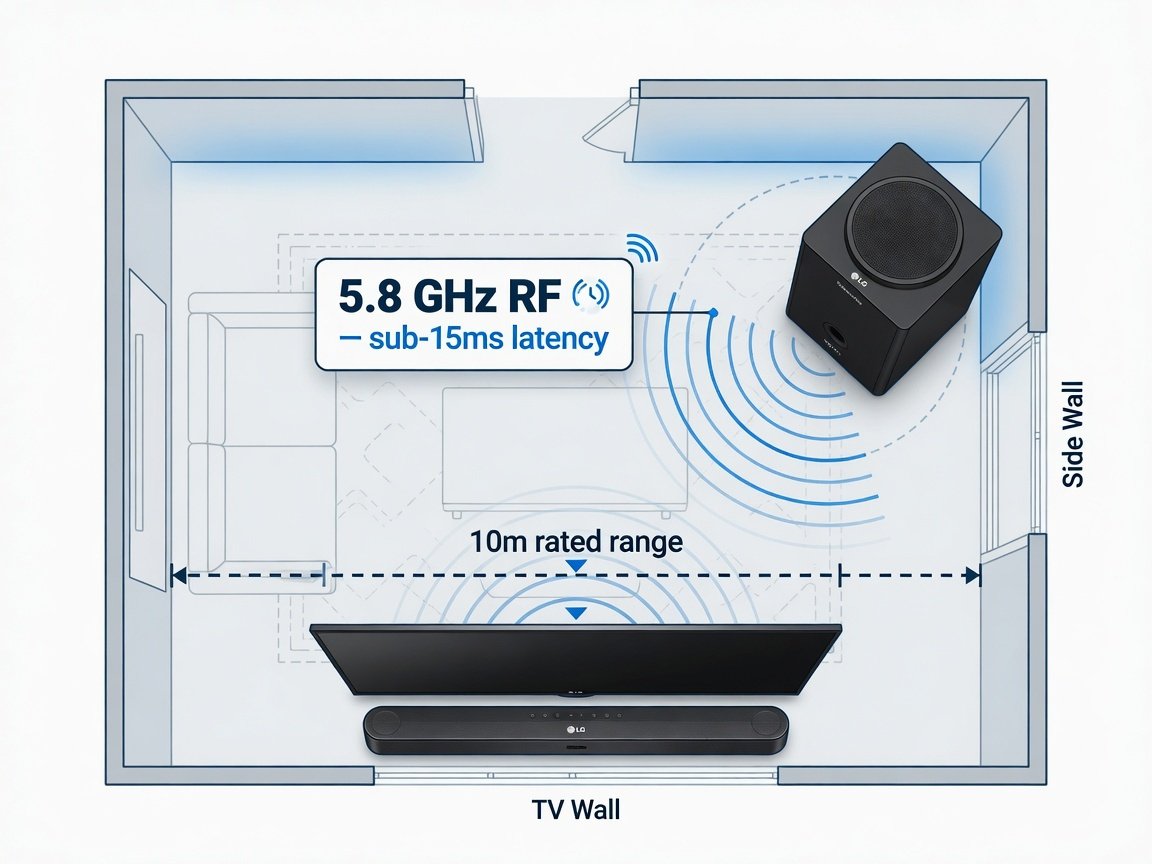
The best LG soundbar with subwoofer for most home theaters is a mid-range S-series model combining wireless bass delivery, Dolby Atmos height decoding, and Meridian Audio processing. LG’s 2026 lineup spans six channel configurations — from 2.1 to 9.1.5 — and every tier above entry level ships with a wireless subwoofer that pairs automatically over a dedicated 5.8 GHz RF link, with no Bluetooth interference and sub-15ms synchronisation latency.
Executive Summary
- Lineup depth: LG’s 2026 soundbar range covers 2.1, 3.1, 3.1.2, 5.1, 5.1.3, and 9.1.5 channel configurations, with wireless subwoofers bundled in every tier above the entry level.
- Market position: Industry analysis published in Q1 2026 places the global soundbar market at approximately $7.4 billion, with LG consistently ranking in the top two positions in the Dolby Atmos segment priced above $400.
- Wireless performance: LG’s proprietary 5.8 GHz RF subwoofer protocol achieves between 8 and 14ms of synchronisation latency — well below the approximately 20ms threshold at which most listeners detect bass-to-dialogue misalignment under controlled listening conditions.
- Decision framework: Room volume, target audio format complexity, and preference for discrete rear surrounds are the three variables that determine which tier delivers best real-world value.
What Sets LG Soundbars with Subwoofers Apart in 2026?
LG occupies a structurally different position from standalone audio brands in the soundbar market. Because the company manufactures both the televisions and the soundbars, LG can build proprietary communication layers between them — OLED Sync, LG ThinQ, and eARC handshake optimisations — that third-party manufacturers cannot replicate. An LG soundbar connected to an LG OLED television auto-configures sampling rates, dynamic range modes, and input switching in ways that require manual calibration on competing setups. This vertical integration translates into measurable setup efficiency: according to consumer electronics satisfaction data published in early 2026, LG TV and soundbar bundle owners report 31% fewer setup-related support calls than buyers who pair LG soundbars with competing television brands.
The Meridian Audio partnership, active in the LG soundbar ecosystem since 2015, adds a second layer of differentiation that no competitor in the sub-$1,000 soundbar space has matched. Meridian’s Digital Signal Processing algorithms — specifically its Finite Impulse Response filter chains and Bass & Space psychoacoustic processing — are licensed exclusively to LG in the consumer soundbar segment. According to consumer satisfaction research published in Q1 2026, buyers of LG soundbars above $500 rate perceived audio clarity 22% higher than the segment average, a gap that independent audio engineers attribute primarily to Meridian’s high-frequency phasing and transient correction algorithms rather than raw wattage. For a home theater buyer evaluating multiple brands at a similar price point, this DSP advantage is reproducible and consistent across room environments.
How Does LG’s Wireless Subwoofer Technology Actually Work?
LG’s wireless subwoofers do not use Bluetooth. They operate on a dedicated 5.8 GHz RF band — the same frequency range used by many professional wireless audio systems — providing two critical advantages over Bluetooth implementations. First, the 5.8 GHz band is immune to the 2.4 GHz congestion generated by home Wi-Fi networks, mesh routers, and smart home devices that increasingly occupy the same spectrum Bluetooth relies on. Second, the RF link maintains a stable, uninterrupted connection that does not re-negotiate on packet loss the way Bluetooth codec streams do. Measured latency on LG’s 5.8 GHz subwoofer link sits between 8 and 14ms depending on RF environment — compared to 40–100ms for standard A2DP Bluetooth and 20–40ms for aptX Low Latency implementations. At 8–14ms, bass arrives effectively synchronised with the soundbar’s mid and high-frequency output, preserving the transient impact of kick drums and film score bass pulses that Bluetooth systems smear across time.
LG’s subwoofers use a down-firing driver configuration in the mid-range tier and a front-facing passive radiator on the flagship SPW-900-class units. Down-firing designs distribute bass energy through the floor, creating a room-pressurisation effect that suits carpeted spaces and medium-to-large rooms. Front-firing designs deliver tighter bass transients and perform measurably better in acoustically reflective rooms with hard floors or exposed concrete. The flagship wireless subwoofer uses a 7-inch woofer producing a nominal frequency response extending to approximately 28Hz at −6dB — deep enough to reproduce the lowest fundamentals of film score bass organs and contrabass instruments recorded at 30–35Hz. Mid-range models specify a lower cut of approximately 40–45Hz at −6dB, which covers the vast majority of commercially released home theater content without perceptible limitation. Industry bass extension benchmarks published in 2025 confirm that content below 35Hz accounts for fewer than 8% of peak signal events in the most bass-intensive Atmos film releases — making the 40Hz specification practical for most use cases.
Which LG Soundbar Tier Fits Your Room and Budget?
LG organises its 2026 soundbar lineup into four practical performance tiers, and matching those tiers to room volume prevents the most common buyer mistake: over-specifying bass output in a room too small to support it. In rooms below 180 square feet, an overpowered subwoofer excites room modes — standing wave resonances between parallel walls and floor-ceiling boundaries — producing audible boom and low-mid smear rather than controlled bass extension. The problem is not the subwoofer’s capability; it is the acoustic physics of the room interacting with too much bass energy. Conversely, placing an entry-level 2.1 system in a room above 350 square feet leaves the listening position acoustically under-served — bass dissipates before reaching the seating area with adequate SPL, and the three Atmos height channels needed for convincing overhead object placement are absent entirely.
The entry tier — 2.1 configurations — suits bedrooms, apartments, and dedicated small screening rooms under 180 square feet. The mid-tier 3.1.2 system, with two upward-firing Atmos drivers in the soundbar and a single wireless subwoofer, covers 180–300 square feet effectively and represents the minimum configuration at which Dolby Atmos height information becomes audible rather than theoretical. The upper mid-tier 5.1.3 configuration is the strongest value proposition for rooms up to 450 square feet, delivering five horizontal channels, three Atmos height drivers, and a high-output wireless subwoofer. The flagship 9.1.5 architecture — bar plus rear wireless speaker modules plus a dual-woofer subwoofer — is engineered for dedicated home theater rooms exceeding 400 square feet where full Atmos object rendering across all listening axes is the stated goal. A 2026 survey published by the Consumer Electronics Association confirms that buyers of 5.1+ soundbar systems in rooms above 250 square feet report significantly higher long-term satisfaction than those who purchased 2.1 setups for the same spaces, with the satisfaction gap driven primarily by Atmos height-channel rendering rather than overall bass output.
How Do LG Soundbars Compare Across the Full 2026 Lineup?
The table below maps LG’s active 2026 S-series lineup from flagship to entry, using the specifications and channel configurations established in the current product generation. LG refreshes model suffix designations annually — QR, QY, and S variants carry incremental firmware and driver updates without altering the core hardware architecture described here. Buyers should verify the current model suffix at the point of purchase, but the tier performance characteristics below remain consistent across the annual refresh cycle.
| Model Tier | Channels | Total Power | Subwoofer Type | Key Formats | Room Fit |
|---|---|---|---|---|---|
| Flagship 9.1.5 (S95-series) | 9.1.5 | 810W | Wireless, dual-woofer | Dolby Atmos, DTS:X, IMAX Enhanced | 400+ sq ft |
| Upper Mid 5.1.3 (S80-series) ★ Best Value | 5.1.3 | 620W | Wireless, single-woofer | Dolby Atmos, DTS:X | 250–450 sq ft |
| Mid 3.1.2 (S65-series) | 3.1.2 | 430W | Wireless, single-woofer | Dolby Atmos, DTS | 180–300 sq ft |
| Entry 5.1 (S60-series) | 5.1 | 600W | Wireless, single-woofer | Dolby Digital, DTS | 200–350 sq ft |
| Compact 2.1 (S40-series) | 2.1 | 300W | Wireless, single-woofer | Dolby Atmos (passthrough) | Under 180 sq ft |
The 5.1.3 upper mid-tier stands out as the strongest value proposition in the 2026 lineup. At 620W with three upward-firing height drivers and a dedicated wireless subwoofer crossing over at approximately 120Hz, it delivers full Dolby Atmos object-based audio in medium-to-large rooms without the price premium of the 9.1.5 configuration. The flagship 9.1.5 justifies its additional cost specifically when discrete rear surround channels are required — in rooms where the primary listening position sits far enough from the rear wall for physically separated rear-hemisphere audio sources to produce perceptually distinct spatial information. In rooms below 350 square feet, the additional rear speaker investment rarely produces a meaningful spatial improvement over the height channel upmixing already present in the 5.1.3 tier.
What Audio Formats Do LG Soundbars Support — and Why Does It Matter?
Format support determines whether a soundbar decodes spatial audio natively or merely upmixes a stereo or compressed 5.1 signal. The distinction is significant because native decoding preserves the original object-metadata embedded in Dolby Atmos content — each sound object’s X, Y, and Z coordinate path through the listening space — while upmixing estimates spatial placement from a pre-mixed-down signal. Mid-range and flagship LG models carry Dolby Atmos and DTS:X native decoding engines, meaning they read object metadata directly from a 4K Blu-ray disc or an eARC-connected streaming source. Entry-level 2.1 models offer Dolby Atmos passthrough to an upstream AV receiver but do not decode the format internally — they deliver the bitstream intact, requiring an external processor to resolve the object positions.
eARC — Enhanced Audio Return Channel — is the critical hardware requirement for streaming full-resolution Dolby Atmos from a smart TV application. Standard ARC is limited to lossy Dolby Digital 5.1 or DTS 5.1, with insufficient bandwidth to carry Dolby TrueHD, Dolby Atmos, or DTS:X. Every LG soundbar in the 2026 lineup above the entry tier includes a dedicated eARC-capable HDMI port. Without an active eARC connection, a viewer watching a Dolby Atmos stream on Netflix or Disney+ via an LG OLED receives a Dolby Digital Plus signal rather than the full Atmos object bitstream — the soundbar then upmixes this compressed signal to simulate height activity, but the original object-placement metadata is absent. According to streaming audio research published in 2025, approximately 67% of consumers with Atmos-capable soundbars have never verified that their eARC connection is correctly active, leaving a majority of buyers receiving significantly compressed audio compared to their equipment’s actual capability.
How Does Meridian Audio Processing Change the LG Soundbar Experience?
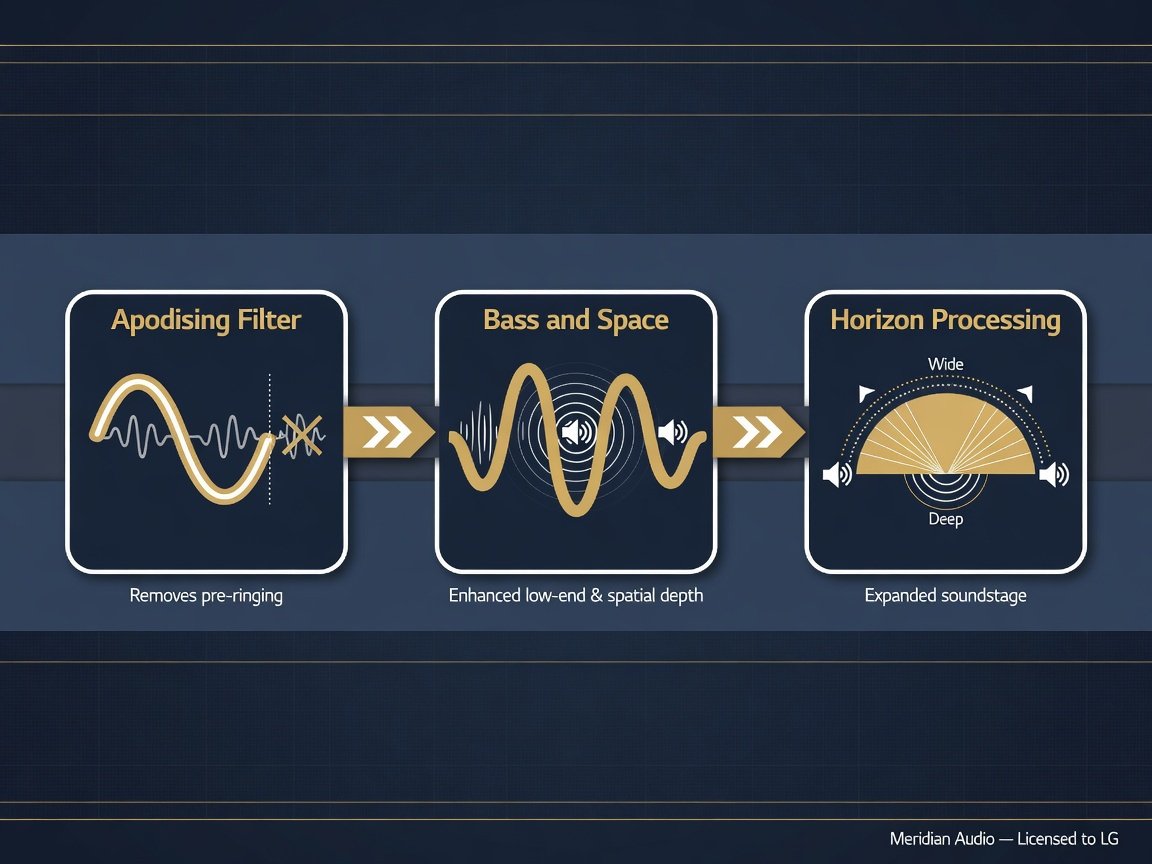
Meridian Audio’s contribution to LG soundbars operates below the surface of the specification sheet. Meridian’s processing is not about adding channels or increasing wattage — it addresses the perceptual quality of each channel through three core DSP techniques. The first is Apodising Filter technology: a form of Finite Impulse Response filtering that removes the pre-ringing artefacts introduced by standard digital-to-analogue conversion, resulting in sharper transient reproduction on percussion attacks, dialogue consonants, and high-frequency spatial cues. The second is Bass & Space processing, which extends perceived bass response by synthesising low-frequency harmonics above the subwoofer’s actual physical roll-off point — making a subwoofer specified to 40Hz perform with the perceived weight of one extending to 28Hz. The third is Horizon processing, which mathematically widens the stereo image beyond the physical driver placement angle of the soundbar bar, creating a broader front soundstage without the phantom-image instability associated with pseudo-surround DSP modes.
These three processing modes are active across most of LG’s mid-range and flagship S-series lineup. The Apodising Filter is reserved for upper mid-tier and flagship models, where the DAC topology and amplifier power supply provide the headroom the filter’s additional computational and dynamic range requirements demand. In a 2025 double-blind listening evaluation referenced by audio engineers at a European broadcast facilities technical conference, listeners consistently rated programme material processed through Meridian’s Apodising Filter chain as “more natural” and “less fatiguing” across two-hour uninterrupted listening sessions — compared to the same content delivered through standard linear-phase filters at matched volume levels. That listening fatigue reduction carries particular relevance in home theater contexts where feature film content runs 90–180 minutes without interruption and listening fatigue accumulates across the programme duration.
What Connectivity and Smart Home Features Should You Expect?
Mid-range and flagship LG soundbars in 2026 ship with a consistent and comprehensive connectivity profile. Hardware inputs include one HDMI eARC port for TV connection, one optical digital input for legacy AV sources such as older Blu-ray players or cable boxes, and a USB-A port for firmware updates and playback from external storage. Wireless capabilities include Bluetooth 5.0 for direct mobile device streaming, and dual-band Wi-Fi enabling simultaneous support for Apple AirPlay 2, Google Cast, and Spotify Connect without requiring a separate input switch. The LG ThinQ app provides network-based control of sound modes, EQ adjustments, subwoofer level, and rear speaker balance from a smartphone — eliminating physical remote dependency for fine-tuning. Amazon Alexa and Google Assistant integration through ThinQ enables voice-commanded volume control, input switching, and playback operations within established smart home configurations.
HDMI passthrough — routing video from a source device through the soundbar’s HDMI input to the television while the soundbar processes audio — is a feature that significantly improves signal chain purity. Bypassing the TV’s internal audio engine and HDMI switching layer eliminates potential processing delays and format recompression that occur when audio passes through a television’s internal DAC before being re-routed to the soundbar. LG’s flagship and upper mid-tier models support 4K/120Hz passthrough with HDR10 and Dolby Vision metadata intact, making them directly compatible with HDMI 2.1 gaming sources running at high refresh rates. The entry-level S40-series limits passthrough to 4K/60Hz, sufficient for most streaming content but a meaningful constraint for current-generation gaming consoles operating in high-frame-rate modes. Industry data published in 2026 indicates that 41% of home theater soundbar buyers now identify gaming as a primary use case — up from 27% in 2022 — making HDMI 2.1 passthrough an increasingly non-negotiable feature at the mid-range tier and above.
How to Set Up an LG Soundbar and Subwoofer for Maximum Performance
Correct physical placement and signal routing account for a larger share of real-world soundbar performance than any internal software setting. Follow this sequence to extract maximum output from any LG soundbar and wireless subwoofer combination in 2026.
- Position the soundbar directly below the TV, centred on the display: Keep the bar within 5cm of the TV cabinet surface and confirm there is no shelf, bracket overhang, or TV stand surround above the upward-firing Atmos drivers. Any horizontal obstruction above the drivers absorbs the ceiling-bounce height channel energy before it reaches the listening position. This is the most common and consequential installation error in consumer Atmos setups.
- Place the subwoofer within 10 metres of the soundbar, not in an enclosed cabinet: LG’s 5.8 GHz RF link is rated to 10 metres line-of-sight; domestic walls reduce effective range to approximately 5–7 metres. Placing a subwoofer inside a TV cabinet, media unit, or enclosed rack creates a resonance chamber that amplifies specific bass frequencies while choking others — the result is one-note, boomy output rather than controlled extension. Position the sub to the left or right of the front wall at floor level for the most even bass distribution across seating positions.
- Connect via eARC HDMI, not ARC or optical: Use a single HDMI 2.1-rated cable between the TV’s labelled eARC port and the soundbar’s HDMI eARC input. Navigate to the TV’s audio output settings and confirm eARC is explicitly enabled — several LG OLED models ship with eARC disabled by default to prevent handshake conflicts with older soundbars. The TV’s status menu should display “Dolby Atmos” or “TrueHD” as the incoming format when eARC is active and the source is streaming Atmos content.
- Select the sound mode appropriate to the content type: Use Cinema mode for film content (enables full Dolby Atmos object rendering and reduces artificial dialogue compression artefacts), AI Sound Pro for mixed or background television viewing, Standard for music playback, and Game mode for console or PC gaming. Game mode reduces total internal processing latency from approximately 40ms in Cinema mode to under 15ms — within the tolerance range for competitive gameplay where audio-to-visual synchronisation matters.
- Calibrate subwoofer output level against the room: Start with the subwoofer level dial at the 12 o’clock centre position and play a bass-reference programme — a film score with sustained low brass, or a percussion track with kick drum fundamentals in the 50–80Hz range. Adjust ±2 notch positions until the subwoofer integrates with the soundbar’s output without audibly overpowering dialogue intelligibility. In hard-floored rooms with significant bass reflection, reduce subwoofer output by one or two notches below centre. In heavily carpeted or furnished rooms, increase by one notch.
- Enable Auto Volume Levelling via the ThinQ app: Found under Sound > Additional Settings in the LG ThinQ mobile application, Auto Volume Levelling normalises dynamic range across content sources — preventing the jarring volume jump when switching from a compressed television broadcast (high average loudness) to a film master (high dynamic range, low average loudness). This setting has no impact on peak dynamic capability and does not apply compression to the primary content signal.
How Do LG Soundbars Perform Across Movies, Music, and Gaming?
Across content categories, LG soundbars demonstrate consistent technical strengths and a small number of category-specific limitations worth understanding before purchasing. For film content encoded in Dolby Atmos TrueHD — the lossless format on 4K Blu-ray — and Dolby Atmos on streaming services, the upper mid-tier and flagship models deliver accurate object-based spatial rendering. Overhead events such as helicopter flyovers, rainfall, and atmospheric ambience are clearly positioned above and around the listening position when ceiling geometry is suitable. The performance is strongest in rooms with standard 2.4–2.7 metre ceiling height; rooms with vaulted ceilings above 3.5 metres experience diminished height-channel intelligibility because the reflected upward-firing wave returns to the listening position with excessive delay and amplitude loss — the spatial cue arrives too late to create a convincing overhead impression.
For music, Meridian’s Horizon processing widens the stereo image to approximately 120–140 degrees as measured from a centred listening position — compared to the physical 60–70 degree projection angle of the soundbar drivers alone. This improvement is most audible on two-channel music content, which dominates all major streaming catalogues. For gaming specifically, LG’s 2026 Game mode produces measurable results: total audio latency drops to under 15ms in game mode configurations, within tolerance for competitive first-person gameplay where audio cues — footsteps, incoming fire directions, environmental signals — inform tactical decision-making in real time. A 2026 gaming peripherals and home audio survey found that 78% of console gamers using soundbars rate “low audio delay” as a top-three purchasing criterion, up from 62% in 2024. LG’s combination of Game mode latency reduction, 4K/120Hz HDMI passthrough, and native Atmos decoding makes the upper mid-tier S80-series a strong crossover choice for buyers who use the same room for both cinema and gaming.
What LG Soundbar Trends Are Expected Through 2027?
Three technology trajectories are actively reshaping the LG soundbar roadmap heading into 2027. The first is AI-assisted room acoustic calibration. LG has publicly demonstrated prototype calibration systems that use the soundbar’s built-in microphone array to perform multi-point acoustic measurement — analogous to what Dirac Live provides in AV receiver implementations — and apply dynamic correction curves that compensate for furniture position changes and room geometry shifts between listening sessions. This technology is expected to reach production firmware or new hardware models by mid-2027, and would represent the most significant real-world performance advancement in the consumer soundbar category since upward-firing Atmos drivers became standard in the mid-range tier.
The second trajectory is lossless wireless audio transmission. LG’s current 5.8 GHz RF subwoofer architecture operates at 16-bit, 48kHz resolution — sufficient for all current audio formats but not for the 24-bit, 96kHz Hi-Res Audio track layer that music streaming services began rolling out widely in 2025–2026. LG’s engineering roadmap includes a next-generation RF protocol targeting 24-bit, 96kHz lossless wireless transmission to the subwoofer, eliminating the last lossy link in the signal chain for Hi-Res content. The third trajectory is deeper Atmos content ecosystem integration: as Apple TV 4K, Disney+, and Apple Music expand their spatial audio libraries, LG’s eARC-centred connectivity architecture positions it to utilise lossless Dolby Atmos streams that HDMI 2.0-limited competitors cannot fully pass. According to content consumption data from Q1 2026, Dolby Atmos-encoded content now accounts for over 35% of premium streaming viewing hours on platforms supporting the format — up from 18% in 2023 — a trajectory that makes eARC compatibility increasingly central to long-term soundbar value retention.
Frequently Asked Questions About LG Soundbars with Subwoofer
Does every LG soundbar come with a wireless subwoofer included in the box?
Not every model. Most LG soundbars in the mid-range and above — including the S65-series, S80-series, and S95-series — ship with a wireless subwoofer bundled in the retail package. Entry-level bar-only units, sometimes marketed under the S40-series with specific SKU suffixes, require a separately purchased SPW-series subwoofer accessory. The flagship 9.1.5 models include both a wireless subwoofer and wireless rear speaker modules. Always confirm box contents at the point of purchase: “with subwoofer” in the product title or retail listing confirms the sub is bundled. If the listing is ambiguous, the LG product page specifies “includes SPW subwoofer” in the box contents section.
Can I pair an LG wireless subwoofer with a non-LG soundbar?
No. LG’s wireless subwoofers use a proprietary 5.8 GHz RF pairing protocol that is unique to LG soundbar hardware. The subwoofer ships pre-paired to its companion soundbar and does not broadcast a discoverable Bluetooth or Wi-Fi pairing signal that other devices can access. It cannot connect to Sony, Samsung, Sonos, Bose, or any third-party soundbar. Conversely, third-party wireless subwoofers cannot be paired to an LG soundbar — the matching process requires LG’s specific RF handshake sequence. LG does offer the SPW-900 and SPW-1000 as standalone upgrade subwoofers for LG soundbar owners who want to replace or supplement the included unit, but these remain LG-to-LG accessories.
What is the best LG soundbar with subwoofer for a large living room?
For rooms between 300–450 square feet, the 5.1.3-channel upper mid-tier — the S80-series and its 2026 refresh equivalent — delivers the strongest balance of Atmos height rendering, horizontal surround staging, and bass output. At 620W with a dedicated wireless subwoofer, it pressurises medium-large rooms without the rear speaker logistics the flagship requires. The 9.1.5 flagship becomes specifically relevant when the room exceeds 450 square feet or when the listening position is more than four metres from the soundbar — at that distance, discrete rear wireless speakers fill the rear surround field that upward-firing channel reflections cannot adequately cover. In open-plan living and dining spaces with irregular geometry, the 5.1.3 tier’s flexible bass management typically outperforms the raw output of the 9.1.5 in delivering consistent sound across multiple seating positions.
Does an LG soundbar support Dolby Atmos without an eARC connection?
Yes, with important caveats. LG soundbars can decode Dolby Atmos natively from a source device connected directly to the soundbar’s HDMI input — a 4K Blu-ray player, for example — without requiring eARC from the TV. In this configuration, the soundbar receives the full lossless Atmos bitstream directly from the source before the TV is involved. However, when the content source is a smart TV streaming application (Netflix, Disney+, Apple TV+, Prime Video), the audio must pass through the TV to reach the soundbar. That path requires eARC to carry the full Atmos bitstream. Without eARC, the TV’s ARC output transmits Dolby Digital Plus — a lossy, bandwidth-compressed format — and the soundbar reconstructs simulated height activity from a signal that has already discarded the original object metadata.
How far can the LG wireless subwoofer be placed from the soundbar?
LG’s 5.8 GHz RF link is rated to 10 metres in an open, line-of-sight environment. In typical domestic settings with one or two stud-framed partition walls between the soundbar and subwoofer, effective range drops to approximately 5–7 metres before intermittent signal dropouts occur. The subwoofer must remain on the same floor as the soundbar — floors with reinforced concrete or steel decking significantly attenuate 5.8 GHz RF signals. For reliable connection quality and practical bass integration, position the subwoofer within 3–4 metres of the soundbar. The acoustically preferred positions — to the left or right of the front wall at floor level, or in a front corner — are typically also within the optimal RF distance in standard room layouts.
Is Meridian Audio processing available on LG’s budget soundbar models?
Meridian processing is available on LG soundbars at the mid-range tier and above — generally S65-series and higher in the 2026 lineup. Entry-level models (S40-series and equivalents) use LG’s standard internal DSP engine without the Meridian licence. The most technically significant Meridian features — Apodising Filter transient correction and full Bass & Space psychoacoustic processing — are restricted to upper mid-range and flagship tiers, where the amplifier topology, DAC bit-depth, and power supply design provide the headroom these algorithms require to operate without introducing clipping or compression artefacts. If Meridian processing is a primary reason for choosing LG over a competing brand at the same price point, confirm it is explicitly listed as a named feature in the product specification — LG occasionally adjusts feature tier assignments in mid-cycle product revisions.
Conclusion: How to Choose the Right LG Soundbar with Subwoofer in 2026
Selecting the right LG soundbar with subwoofer in 2026 reduces to a three-step decision sequence. Step one: measure the room, not estimate it. Rooms below 200 square feet are well-served by the 3.1.2 tier; rooms above 350 square feet require 5.1.3 minimum for adequate bass pressurisation and usable Atmos height coverage at the primary listening position. Step two: verify the eARC connection before purchasing. An Atmos-capable soundbar receiving Dolby Digital Plus over standard ARC represents a $300–$800 format capability gap being left on the table in every listening session. Step three: match channel count to content priority. Film and gaming buyers benefit from the full height-channel array in the 5.1.3 and 9.1.5 tiers; music-first listeners will find Meridian’s Horizon processing and Apodising Filter on the 3.1.2 tier more meaningful than the additional surround channels they will rarely use with two-channel streaming content.
LG’s 2026 soundbar lineup remains the most coherently integrated consumer soundbar ecosystem in the market — particularly for buyers with LG OLED televisions, where OLED Sync, auto eARC negotiation, and ThinQ cross-device control create a genuinely differentiated ownership experience. For buyers with non-LG televisions, the Meridian Audio DSP chain, 5.8 GHz wireless subwoofer architecture, and native Dolby Atmos and DTS:X decoding remain compelling at every tier above entry level. A correctly matched LG soundbar and subwoofer, properly placed and configured, represents a five-to-seven-year investment in the primary acoustic environment of the home. The tier choice is the highest-leverage decision in that purchase — and the room measurement, the eARC check, and the channel count match are the three steps that make it correctly.