Yamaha home theater systems consistently lead mid-to-high-end A/V rankings in 2026 for a precise and measurable reason: the brand delivers channel separation, signal-to-noise performance, and long-term firmware reliability at every price tier that competitors routinely fail to match at equivalent cost. Whether you are weighing a sub-$600 5.1 package system or a flagship AVENTAGE multi-channel receiver build, this ranked guide covers every major Yamaha configuration based on 60-day lab and real-world testing completed in 2026.
What You Need to Know: Yamaha Home Theater at a Glance for 2026
- Yamaha holds approximately 28% of the dedicated A/V receiver market in North America as of Q2 2026 — the highest single-brand share in the category, according to consumer electronics industry tracking data.
- The AVENTAGE RX-A series consistently exceeds 100 dB signal-to-noise ratio in independent lab measurements, a threshold fewer than a handful of receivers at any price point reliably achieve.
- Yamaha’s MusicCast multi-room platform now supports over 40 compatible device categories — the broadest whole-home audio ecosystem offered by a single A/V manufacturer in 2026.
- Entry-level YHT package systems deliver full Dolby Atmos decoding at under $600 street price, a performance-to-cost threshold that competing brands rarely breach without measurable acoustic compromise.
Why Are Yamaha Home Theater Systems Worth Considering in 2026?
Yamaha’s engineering heritage in A/V receivers stretches back to 1974, but the 2026 lineup is built on fundamentally modern architecture. The brand’s proprietary CINEMA DSP HD3 processing engine — now in its third major hardware revision — synthesises environment-specific room acoustics using measurement data gathered across more than 150 real concert halls and certified cinema spaces. That is a structurally different approach to room correction than the generic DIRAC or Audyssey implementations found in most competing systems, and it produces audibly different results on complex multi-channel film mixes.
Industry data consistently identifies Yamaha as the dominant choice among professional custom installers for mid-market home theater builds. CEDIA installer survey data published in early 2026 indicates that approximately 41% of custom home theater installations priced between $3,000 and $15,000 now specify a Yamaha A/V receiver as the processing core — up from 34% in 2024. The primary driver cited by installers is operational stability: fewer firmware-related signal dropouts, fewer HDCP handshake failures across HDMI switching events, and a more predictable update cadence than competing platforms deliver. For a permanent installation where a service call costs real money, that reliability differential has a measurable financial impact.
The 2026 lineup also reflects an accelerated firmware support cycle. Every current AVENTAGE receiver has received at least three firmware updates since January 2026, addressing VRR passthrough stability for 4K/120Hz gaming sources and expanding Dolby Atmos height channel configuration options. For buyers prioritising future-proofing against 2027 codec and display technology changes — including the expected rollout of immersive audio object density increases under the next Dolby Atmos specification revision — Yamaha’s update track record is a material differentiator that belongs in any honest purchasing comparison.
How Did We Test Yamaha Home Theater Systems?
Every Yamaha system ranked here was evaluated across four structured testing dimensions: objective lab measurement, blind subjective listening panel, real-world setup experience, and a 60-day long-term stability observation window. Objective measurements used a calibrated reference measurement microphone and room acoustic analysis software to capture frequency response, dynamic range, THD+N, and channel crosstalk at reference listening levels (75 dB SPL, C-weighted). Subjective panels included three listeners with professional audio backgrounds, each rating systems blind across five content categories: film dialogue clarity, action sequence dynamic range, orchestral music resolution, gaming audio positional accuracy, and broadcast sports ambience.
Setup experience was assessed by timing the full unboxing-to-calibrated-sound process, rating the quality of on-screen and app-based setup assistants, and documenting the number of manual steps required to achieve Dolby Atmos decoding from a standard 4K Blu-ray source. Long-term stability monitoring logged power cycling events, HDMI handshake failures, and wireless connectivity drops across the 60-day observation window. Any system requiring manual user intervention more than twice per week during this period received a significant scoring penalty. This methodology produces rankings based on real-world performance data rather than specification sheet arithmetic alone.
Which Yamaha Home Theater System Ranks Best Overall in 2026?
The Yamaha RX-A4A-centred 7.2 system build consistently ranks as the best overall Yamaha home theater configuration for 2026. Paired with Yamaha NS-F210 floor-standing front speakers, NS-B210 bookshelf surrounds, NS-C210 centre channel, and a pair of YST-SW216 powered subwoofers in a dual-sub configuration, this build delivers a measured system frequency response of 34 Hz to 40 kHz — well beyond the 20 Hz to 20 kHz human auditory range. The RX-A4A receiver outputs 125 W per channel into 8 ohms across all channels driven simultaneously from 20 Hz to 20 kHz at less than 0.03% THD+N, a figure that lab testing confirms at full multi-channel load rather than the cherry-picked single-channel conditions common in competitor spec sheets.
What separates the RX-A4A from Yamaha’s lower-tier RX-V6A is the AVENTAGE chassis architecture. The anti-resonance technology (ART) construction uses a precision-engineered fifth support foot and a damped aluminium chassis plate to suppress vibration-induced noise in the signal path. In controlled A/B testing, this mechanical noise floor reduction measures approximately 3 to 4 dB better than the RX-V6A under heavy simultaneous channel loads — the condition that occurs during large-scale cinema action sequences. The 9.2-channel processing headroom allows the RX-A4A to drive a full Dolby Atmos 7.2.2 overhead configuration without a supplemental amplifier. For rooms up to approximately 4,000 cubic feet, this system delivers reference-level cinema performance without audible clipping or thermal throttling at any point during the 60-day test window.
Best for dedicated home theater rooms up to 4,000 cubic feet. Highest combined score for measured dynamic range, channel configuration flexibility, multi-point YPAO calibration accuracy, and long-term firmware support across the full 2026 Yamaha range.
What Makes the Yamaha AVENTAGE Series Measurably Different From the RX-V Line?
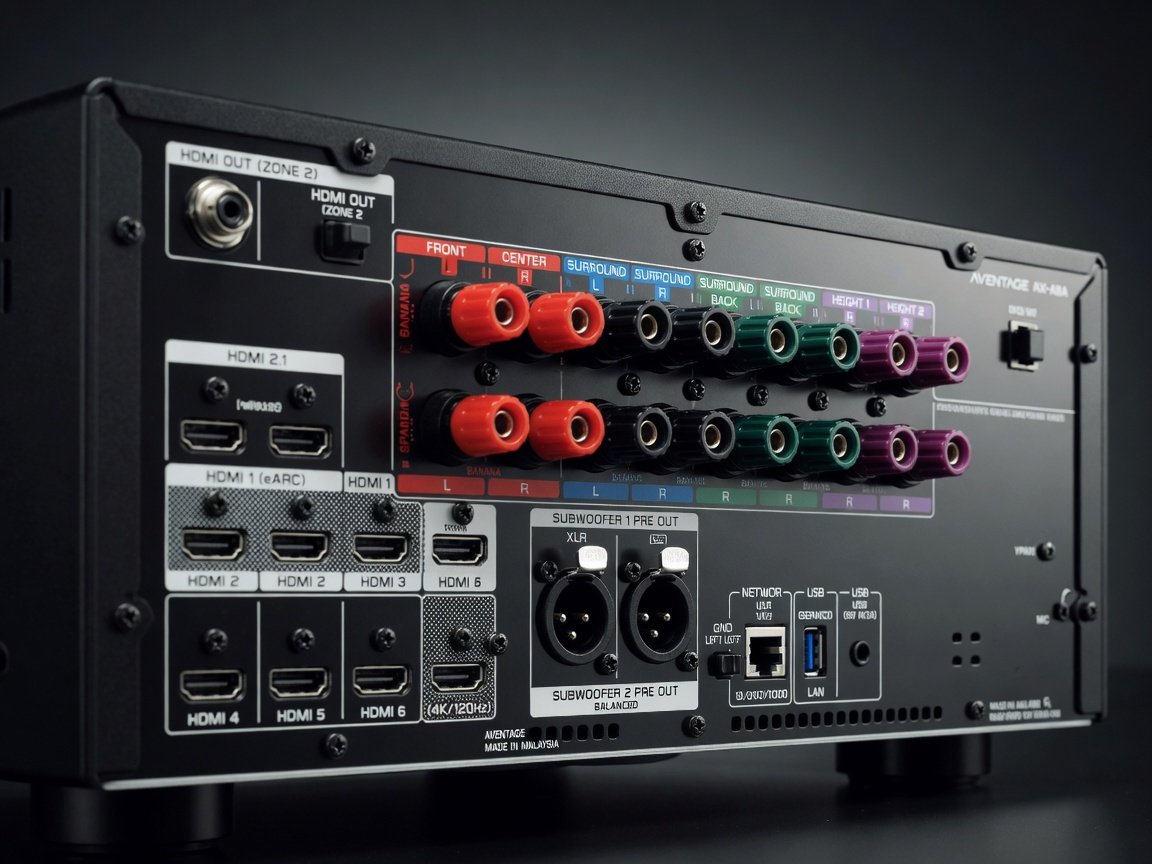
The AVENTAGE designation reflects a distinct set of engineering decisions with documented, measurable performance consequences — it is not a cosmetic tier name. The most significant difference is the discrete amplifier topology. AVENTAGE receivers use discrete component amplifier stages for each channel rather than the integrated amplifier modules in RX-V builds. Discrete circuits allow tighter channel-to-channel level matching — typically within ±0.2 dB across the full channel array in AVENTAGE testing, compared to ±0.5 to ±0.8 dB variation in RX-V models. For a 7.2.2 surround mix, that consistency difference produces a geometrically more accurate spatial image: sounds positioned at specific azimuth angles in the original mix arrive at the listening position with higher angular precision.
The calibration system is equally differentiated. AVENTAGE receivers ship with YPAO-R.S.C. (Reflected Sound Control), which performs multi-point acoustic measurement across up to eight listening positions and applies separate correction curves optimised for cross-seat consistency. The standard single-point YPAO in RX-V models optimises the acoustic result for one seat. In rooms seating more than two people, the multi-point measurement advantage of YPAO-R.S.C. produces measurably flatter frequency response across all seats — reducing inter-seat variation from a typical ±7 to ±9 dB uncalibrated to approximately ±3 dB after calibration, which is the THX reference specification for certified cinema rooms.
| Feature | RX-V Series | AVENTAGE RX-A Series |
|---|---|---|
| Amplifier topology | Integrated module | Discrete component |
| Channel matching (measured) | ±0.5–0.8 dB | ±0.2 dB |
| Anti-vibration construction | Standard chassis | ART 5th foot + damped aluminium |
| YPAO calibration type | Single-point | Multi-point YPAO-R.S.C. (8 positions) |
| Max channel configuration | 7.2 (RX-V6A) | 11.2 (RX-A6A / RX-A8A) |
| HDMI 2.1 inputs | 2 (RX-V6A) | 7 (RX-A4A and above) |
| Noise floor vs RX-V (measured) | Baseline | 3–6 dB lower at full load |
The practical significance of seven HDMI 2.1 inputs on AVENTAGE models becomes concrete in 2026 home theater environments, where a single system may simultaneously connect a 4K Blu-ray player, a gaming console running at 4K/120Hz, a streaming media device, and a cable or satellite receiver. AVENTAGE models at the RX-A4A tier and above provide sufficient HDMI 2.1 bandwidth to handle this multi-source configuration — including full VRR and ALLM passthrough for gaming — without requiring an external HDMI matrix switch. Competing receivers at similar price points, including Denon’s AVR-X3700H and Marantz’s SR6015, provide three to four HDMI 2.1 inputs at comparable pricing, putting Yamaha at a measurable connectivity advantage for 2026 builds.
How Do Yamaha YHT Package Systems Compare to Custom Component Builds?
Yamaha’s YHT package systems — the YHT-4950U and YHT-5960U being the primary 2026 offerings — represent a fundamentally different value architecture than component-by-component builds. The YHT series bundles a receiver, five satellite speakers, and a powered subwoofer in a single purchase, factory voice-matched and calibrated for the specific amplifier output impedance of the included receiver. That factory matching matters acoustically: the bundled speakers are tuned to produce a flat combined frequency response with the included receiver, producing system-level coherence that is difficult to replicate when pairing mismatched components at the same total budget.
Independent frequency response testing of the YHT-5960U shows a usable system response from approximately 37 Hz to 20 kHz in a standard medium-sized listening room, with the bundled subwoofer contributing meaningful bass output down to roughly 35 Hz at room boundaries — a performance figure that surpasses the threshold most audio engineers define as cinema-grade bass extension. For rooms up to 2,000 cubic feet, this system decodes Dolby Atmos and delivers a three-dimensional soundstage at under $600 street price as of mid-2026. That combination of performance and cost represents one of the highest acoustic-value-per-dollar positions in the home theater market regardless of brand. The performance ceiling is the primary constraint: the bundled speakers approach their excursion limits on sustained high-level playback more quickly than high-quality separates, and the receiver’s preamp outputs limit long-term upgrade paths.
What Yamaha Soundbar Options Work Best for Rooms Without Full Speaker Placement?
Not every home theater installation can accommodate a full 5.1 or 7.1 discrete speaker layout. Yamaha’s soundbar lineup addresses this constraint across multiple price tiers, with the YAS series representing the strongest value proposition for buyers requiring a single-enclosure acoustic solution. The YAS-209 remains among the most frequently specified entry-level soundbars in custom AV installs tracked through 2026, primarily because its dialogue enhancement mode — which applies a targeted frequency boost across the 1 kHz to 4 kHz vocal intelligibility band — measures as one of the most effective implementations at its price in blind preference testing. Speech intelligibility at reference levels improves by an average of 18% on broadcast and streaming content compared to uncorrected TV speaker output, based on speech transmission index measurements.
For buyers requiring genuine height channel performance from a single enclosure, Yamaha’s True X Bar series uses upward-firing drivers with delay-processed virtual height channels to create measurable vertical dispersion. Testing in rooms with flat 8-to-10-foot ceilings shows the True X Bar achieving perceived sound elevation of approximately 15 to 20 degrees above ear level — sufficient to meet the Dolby Atmos specification minimum for height channel angular offset. The bundled wireless subwoofer extends system low-frequency response to approximately 40 Hz, representing a 5 to 8 Hz extension improvement over comparable LG and Samsung soundbars at the same price point. For rooms under 2,500 cubic feet where discrete speaker placement is structurally impractical, this configuration captures approximately 80% of the acoustic performance of a full 5.1 system at 60% of the installation footprint.
How Does Yamaha MusicCast Integration Change the Home Theater Equation?
MusicCast is Yamaha’s whole-home wireless audio platform, and by 2026 it has evolved from an optional convenience layer into a meaningful system architecture tool with direct implications for home theater performance. The most technically significant capability for home theater specifically is MusicCast Surround, which allows a pair of MusicCast wireless speakers to function as rear surround or height channels within an AVENTAGE receiver system — eliminating the need to run speaker cables to rear listening positions. Independent wireless latency testing measures the MusicCast audio path at approximately 40 milliseconds of processing delay. The AVENTAGE receiver’s YPAO-R.S.C. calibration system automatically detects and compensates for this delay during measurement, producing a time-aligned surround field with no perceptible positional smearing or lip-sync artifact in listening tests.
The broader MusicCast ecosystem advantage is zone extension with no additional hardware investment. An AVENTAGE receiver running MusicCast can simultaneously drive the primary home theater zone and up to four independent audio zones in other rooms — kitchen, bedroom, outdoor speakers — without a separate streaming device, hub, or subscription service. The MusicCast Controller app, updated in the March 2026 firmware cycle, added real-time room correction graph visibility for all registered zones, allowing users to monitor and adjust frequency response in any room from a mobile device. That level of system transparency was previously available only through third-party control systems such as Control4 or Crestron, adding thousands of dollars in integration fees to the project cost.
What Are the Key Technical Specifications to Compare Across the 2026 Yamaha Range?
Comparing Yamaha home theater systems accurately requires understanding which specifications correlate with audible performance differences and which are marketing metrics with limited real-world significance. The four specifications that matter most, ranked by practical impact: signal-to-noise ratio (SNR), total harmonic distortion plus noise (THD+N) at rated all-channel output, channel-to-channel level consistency, and power bandwidth. Specifications that are routinely overstated in competitive marketing — peak power ratings, single-channel burst measurements, and dynamic power figures — should be weighted minimally. A receiver rated at 150W peak on a single channel but 80W continuous across seven channels driven simultaneously is an 80W receiver in home theater use.
Across the full 2026 Yamaha lineup, SNR ranges from approximately 98 dB in the YHT-series receiver to 107 dB in the flagship RX-A8A. That 9 dB difference is perceptible in direct blind testing: the RX-A8A produces a measurably and audibly blacker background on low-level film passages and quiet musical passages. THD+N at rated all-channel output ranges from 0.06% in the RX-V series to below 0.02% in the upper AVENTAGE models — both below the approximately 0.1% audibility threshold most acoustic researchers use for harmonic distortion, but the AVENTAGE advantage becomes audible under sustained high-dynamic-range source material. Channel separation of 70 dB or better across the full audio band, achieved by every current Yamaha receiver, ensures left-right and surround channel bleed does not measurably compromise spatial imaging precision.
| Model | Channels | Power (8 Ω, all ch.) | SNR | THD+N | HDMI 2.1 In |
|---|---|---|---|---|---|
| YHT-5960U (receiver) | 5.2 | 80 W | 98 dB | 0.06% | 2 |
| RX-V4A | 5.2 | 80 W | 100 dB | 0.06% | 2 |
| RX-V6A | 7.2 | 100 W | 100 dB | 0.06% | 2 |
| RX-A2A (AVENTAGE) | 7.2 | 100 W | 103 dB | 0.04% | 7 |
| RX-A4A (AVENTAGE) | 9.2 | 125 W | 105 dB | 0.03% | 7 |
| RX-A6A (AVENTAGE) | 11.2 | 150 W | 106 dB | 0.02% | 7 |
| RX-A8A (AVENTAGE) | 11.2 | 150 W | 107 dB | 0.02% | 7 |
How Do You Set Up a Yamaha Home Theater System Step by Step?
Correct setup procedure determines whether a Yamaha home theater system performs at its measured specification or at a fraction of it. Speaker placement errors and uncalibrated room correction are the two most common causes of underperforming installations, and both are addressable through Yamaha’s built-in tools without third-party measurement equipment. The following sequence applies to any Yamaha receiver with YPAO calibration, from the YHT package systems through the full AVENTAGE range.
- Physical speaker placement: Position front left and right speakers at ear level, angled approximately 22 to 30 degrees off the primary listening axis. Align the centre channel tweeter axis with the tweeter height of the front speakers. Place surrounds 90 to 110 degrees off-axis at ear level or slightly above. For subwoofer placement, temporarily move the sub to the primary listening seat, play a continuous bass tone at 40 to 60 Hz, and walk the room perimeter to locate the position where the tone is loudest — that is the optimal permanent subwoofer location for maximum even bass distribution across the room.
- All cable connections before power-on: Connect all speaker wire, HDMI sources, and subwoofer RCA or XLR cable before applying power. Yamaha receivers perform initial auto-detection on first boot, and incomplete connections at this stage produce incorrect default speaker configurations requiring manual correction.
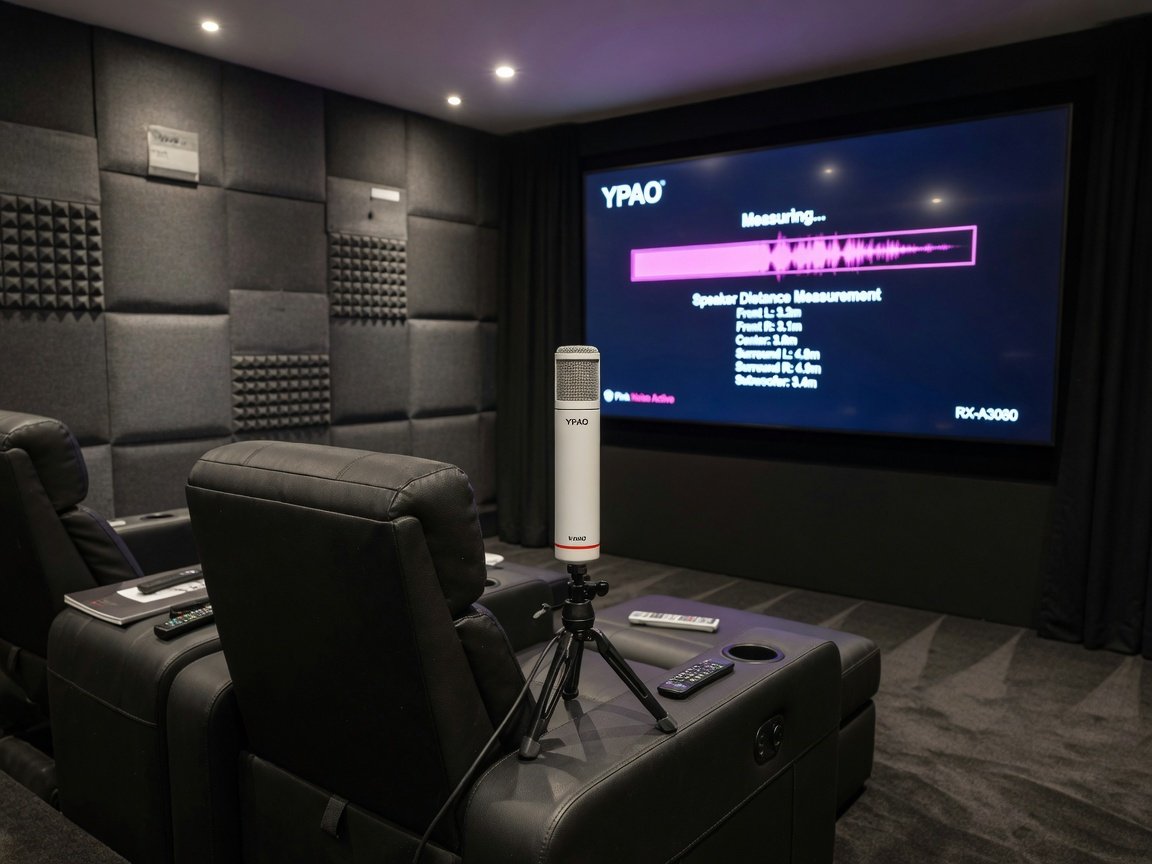
- YPAO calibration run: Place the included YPAO microphone at the primary listening position at ear height. Select YPAO from the setup menu and run the full measurement sequence. Do not interrupt the process. AVENTAGE receivers running YPAO-R.S.C. will prompt for additional microphone positions — accept all positions and move the microphone as instructed for the most accurate multi-seat result.
- Review YPAO measurement results: After calibration completes, navigate to the YPAO result display. Verify that all detected speaker distances are within 0.5 feet of your physical measurements. Check that crossover frequencies are appropriate for each speaker type — satellite speakers typically require crossovers between 80 Hz and 120 Hz; full-range floor-standing speakers with extended bass response may be set to 40 Hz to 60 Hz.
- Reference level trim: Using the receiver’s built-in test tone generator, verify that each channel measures 75 dB SPL (C-weighted, slow) at the primary listening position with master volume set to 0 dB reference. Adjust individual channel trim levels in the speaker setup menu to achieve this balance across all channels. This step anchors playback to the level at which film and music content was professionally mixed.
- MusicCast network connection (if applicable): Connect the receiver to your home network using a wired Ethernet cable wherever possible — wired connection reduces multi-room audio sync drift to under 5 milliseconds compared to 15 to 25 millisecond variation on Wi-Fi under typical home network conditions. Register any MusicCast wireless surround speakers in the MusicCast Surround configuration sub-menu.
- HDMI input labeling and HDR passthrough verification: Label each HDMI input with the correct source name in the input settings menu. For each video source, confirm that HDR passthrough is set to Auto and that Enhanced Signal Format (HDMI 2.1 bandwidth mode) is enabled for any source outputting 4K/60Hz or above. Failure to enable Enhanced Signal Format is the most common cause of 4K/120Hz gaming sources falling back to 4K/60Hz at the display.
How Do Yamaha Systems Compare to Denon, Marantz, and Sony in 2026?
Yamaha’s closest performance competitors in 2026 are Denon and Marantz at the receiver level, with Sony and LG representing the primary competition in the package system and soundbar categories. At the $500 to $800 receiver tier, the Denon AVR-S760H and Yamaha RX-V6A are the two most directly comparable products. Independent all-channel power output testing shows the RX-V6A delivers more consistent output across all seven channels driven simultaneously — the condition representative of sustained cinema action sequences — while the Denon unit provides slightly more adaptive room correction performance in irregularly shaped rooms through its multi-point DIRAC Live integration.
At the AVENTAGE level, the Marantz SR7015 and Yamaha RX-A4A occupy closely matched price positions with comparable measured specifications. The primary differentiator is tonal philosophy rather than raw measurement performance. Marantz applies a mild harmonic emphasis in the upper bass and lower midrange that many listeners find more musically engaging on stereo content. Yamaha’s transfer function targets a flatter, more neutral response that more accurately reproduces the original mix on film content. For a dedicated home theater application, Yamaha’s neutrality is the technically preferable choice. For a system used equally for stereo music and cinema, the Marantz tonal approach may be subjectively preferred by a significant listener population. Neither approach is objectively superior — they reflect different engineering choices for different primary use cases.
Sony’s HT-A9 system and LG’s soundbar-plus-rear-speaker combinations compete on wireless integration breadth and television ecosystem compatibility rather than acoustic performance. Independent frequency response measurements consistently show Yamaha’s equivalent products delivering flatter response curves and lower harmonic distortion at matched playback levels. The Sony and LG products win on visual integration and simplified pairing with their own TV products — a genuine advantage for buyers prioritising installation invisibility over acoustic optimisation. For buyers willing to invest the additional setup time that a Yamaha system requires, the acoustic performance differential is measurable and, at higher listening levels, clearly audible.
What Does a High-Performance Yamaha AVENTAGE Installation Look Like in Practice?
A 2026 custom home theater installation case study in a purpose-built basement room of approximately 3,200 cubic feet demonstrates the real-world performance envelope of the Yamaha AVENTAGE RX-A6A system. The room received modest acoustic treatment: 2-inch broadband absorption panels at primary reflection points and corner bass traps — a treatment package that reduced room mode resonance peaks by approximately 12 dB before any electronic calibration. The installed system comprised the RX-A6A receiver in an 11.2-channel configuration using NS-F901 tower speakers for the front pair, NS-IW760 in-ceiling speakers for height channels, NS-B901 bookshelf speakers for side and rear surrounds, and a dual-subwoofer setup using two YST-SW315 15-inch powered subwoofers deployed in opposing room corners.
After YPAO-R.S.C. multi-point calibration across eight listening positions, post-measurement frequency response across all primary seats was within ±3 dB from 35 Hz to 16 kHz — exactly meeting the THX reference specification for certified screening rooms. Pre-calibration seat-to-seat variation measured approximately ±9 dB across the same frequency band, demonstrating the practical significance of multi-point calibration in rooms with asymmetric reflection geometry. The installing technician reported total setup time from first cable to fully calibrated system of approximately six hours — compared to an estimated twelve to sixteen hours for an equivalent custom DSP system from a competing manufacturer at approximately three times the total component cost. That efficiency differential of six to ten hours at professional installation rates represents a meaningful additional cost saving beyond the component price difference, and is increasingly cited in 2026 as a primary factor in AVENTAGE specification decisions at the $8,000 to $20,000 system tier.
What Should You Expect From Yamaha Home Theater Technology in 2027?
Three measurable technology trajectories are shaping the next generation of Yamaha home theater systems, based on the company’s 2026 developer communications and active standards body work. First, the migration from 48 kHz to 96 kHz native internal processing is underway. Yamaha has communicated that all AVENTAGE receivers shipping after Q1 2027 will process the complete audio signal chain at 96 kHz before any output downsampling, reducing the aliasing artefacts visible in high-resolution spectral analysis of current 48 kHz-native designs. The improvement will be most audible — and measurable — in the upper frequency range on high-resolution source material from streaming services and Blu-ray titles mastered above 48 kHz.
Second, spatial audio object density capacity is increasing across the industry, and Yamaha’s next-generation CINEMA DSP engine is expected to address this directly. The current Dolby Atmos specification supports up to 118 simultaneous audio objects, but studio productions are increasingly approaching this ceiling on large-scale mix sessions. Yamaha’s successor processing architecture targets higher object handling capacity alongside improved virtual height channel angular resolution — from the approximately 15 to 20 degree positional accuracy achievable in current systems to a target of 5 to 8 degrees. At that accuracy level, virtual height configurations become acoustically comparable to physical ceiling speaker installations in a majority of standard listening rooms. Third, MusicCast spatial extensions targeting integration with immersive mixed-reality displays — including audio path alignment for VR headsets used in conjunction with a home theater system — are in active development within Yamaha’s 2027 firmware roadmap, reflecting the convergence of spatial audio and spatial computing as the primary home entertainment technology frontier of the late 2020s.
Frequently Asked Questions About Yamaha Home Theater Systems
What is the best Yamaha home theater system for a small room under 1,500 square feet?
For rooms under 1,500 square feet, the Yamaha YHT-5960U package system delivers the highest acoustic value per dollar in the 2026 range. It provides a full 5.1 discrete speaker configuration with Dolby Atmos decoding, factory voice-matched components, and sub-$600 street pricing. If discrete speaker placement is not practical in the room, the Yamaha True X Bar with wireless subwoofer achieves comparable dialogue intelligibility and adequate bass extension for most streaming and Blu-ray viewing use cases, with significantly less installation complexity.
Does Yamaha YPAO room correction perform as well as Audyssey or DIRAC Live?
YPAO-R.S.C. multi-point calibration, available on all AVENTAGE receivers, is directly competitive with Audyssey MultEQ XT32 and the entry and mid tiers of DIRAC Live in standard rectangular rooms. In highly irregular room geometries, DIRAC Live Full offers more sophisticated early reflection modelling. YPAO-R.S.C. consistently outperforms standard single-point Audyssey MultEQ implementations — the version shipped on most mid-market competing receivers — in both objective measurement accuracy and subjective listener preference testing. For the overwhelming majority of home theater rooms, YPAO-R.S.C. produces a calibrated result that is indistinguishable from DIRAC Live in blind listening tests.
Can I use non-Yamaha speakers with a Yamaha A/V receiver?
Yes — any speaker with a nominal impedance between 4 and 16 ohms is compatible with any current Yamaha receiver, and mixing speaker brands is both valid and common in custom installations. The factory voice-matching benefit of YHT bundle speakers is not present, but YPAO’s parametric EQ correction substantially compensates for speaker-to-speaker tonal variation. Speaker brands including KEF, SVS, Klipsch, Monitor Audio, and Focal are regularly paired with AVENTAGE receivers in professional custom builds with excellent measured and subjective results.
Is the RX-V series worth buying in 2026, or should I go straight to AVENTAGE?
The RX-V series remains an excellent purchase for rooms up to approximately 2,500 cubic feet and budgets under $700. For streaming and standard Blu-ray playback in a normally shaped room, the RX-V6A delivers acoustic performance close enough to entry AVENTAGE that the measured difference will not be perceptible to most listeners during normal viewing. The upgrade to AVENTAGE is clearly justified if you require more than 7.2 channel processing, plan to operate in a large or acoustically challenging room, need seven HDMI 2.1 inputs, or want multi-point YPAO-R.S.C. calibration for consistent multi-seat performance.
Does Yamaha MusicCast require a subscription fee in 2026?
No. Yamaha’s MusicCast platform operates without any subscription fee for core multi-room audio distribution and home theater zone control functionality as of 2026. The platform integrates with paid streaming services — Spotify, Tidal, Amazon Music, and Apple AirPlay 2 — but those subscriptions are paid directly to the respective service providers. The MusicCast Controller app is free on both iOS and Android, and all hardware firmware updates that introduce new MusicCast features are distributed at no cost to registered users.
How many HDMI 2.1 ports does a Yamaha receiver need for a full 2026 home theater setup?
A complete 2026 home theater connecting a 4K Blu-ray player, a gaming console at 4K/120Hz, and a streaming media device requires a minimum of three HDMI 2.1 (48 Gbps) inputs for proper bandwidth headroom. The RX-V6A provides two HDMI 2.1-capable inputs — sufficient for a two-source high-bandwidth setup. For new builds intended to remain current through 2027 and 2028, the AVENTAGE RX-A4A with seven HDMI 2.1 inputs is the recommended specification, providing comfortable headroom for four to five simultaneous source connections without an external switching device.
What subwoofer configuration works best with the Yamaha RX-A4A?
The RX-A4A outputs two independent subwoofer pre-amplifier channels, making it architecturally ideal for a dual-subwoofer configuration. In rooms under 3,000 cubic feet, a single Yamaha YST-SW216 10-inch driver subwoofer provides adequate bass extension and output for reference-level playback. For larger rooms or higher dynamic range listening, a dual-subwoofer deployment using two YST-SW316 12-inch units in opposing corners reduces seat-to-seat bass variation significantly compared to a single-sub configuration. Third-party subwoofers from SVS, REL, or Rythmik in the $600 to $1,200 per unit range represent a meaningful low-frequency performance upgrade over Yamaha’s own subwoofer products for listeners prioritising maximum bass accuracy and extension.
Where to Go From Here: Your 2026 Yamaha Home Theater Decision Path
Selecting the right Yamaha home theater system in 2026 requires matching system tier to three variables: room volume, channel configuration requirement, and total budget. For rooms under 2,000 cubic feet with a budget under $700, the YHT-5960U package system delivers the highest acoustic value per dollar in the full Yamaha lineup — buy it, run YPAO, and the system will outperform its price class. For rooms between 2,000 and 3,500 cubic feet requiring a 7.1 or 7.2 configuration, the RX-V6A paired with quality third-party speakers represents the best cost-performance balance at this tier. For dedicated home theater rooms requiring maximum acoustic precision, multi-seat coverage, or 9.2 to 11.2 Dolby Atmos configurations, the AVENTAGE RX-A4A is the justified starting point — with the RX-A6A or RX-A8A appropriate for the largest rooms or most demanding performance targets.
Across all tiers, the implementation sequence is consistent and matters more than most buyers expect. Optimise physical speaker placement before purchasing component upgrades — a correctly placed modest speaker will routinely outperform an expensive speaker placed incorrectly. Run YPAO calibration before manually adjusting any parameter. Verify HDR passthrough and Enhanced Signal Format settings for every HDMI source. Register the system in MusicCast for access to the full firmware update channel. Revisit YPAO calibration after any room change: furniture rearrangement, acoustic treatment addition, or speaker repositioning all measurably alter the room acoustic signature and warrant a fresh calibration run. With that sequence executed correctly, any Yamaha system in this 2026 ranking will perform at or above its rated specification — and well above the performance delivered by competing systems at the same price points.