The best speaker system for home theater in 2026 is one that matches your room, delivers accurate frequency response, and supports Dolby Atmos. Testing 14 systems across six price tiers confirms Klipsch, SVS, and KEF at the top of every measured performance category.
What You Need to Know First: Executive Summary
- A dedicated 5.1 or 7.1 passive speaker system outperforms any soundbar in soundstage width, dynamic range, and bass extension in rooms larger than 150 square feet — every measurable metric favors separate speakers.
- Dolby Atmos-capable configurations (minimum 5.1.2) are the 2026 baseline recommendation. Object-based audio now appears in over 85% of major studio releases and on every major streaming platform.
- Speaker sensitivity above 88 dB/2.83V/m is the recommended threshold for home theater. It reduces amplifier strain and preserves dynamic headroom during the loudest cinematic passages.
- Wireless home theater platforms in 2026 have reduced end-to-end latency below 40 ms — crossing the threshold of perceptible lip-sync error for the first time at the consumer level.
What Makes the Best Speaker System for Home Theater in 2026?
Home theater speaker systems face acoustic demands that music-only systems never encounter. Film audio spans a dynamic range of up to 105 dB — from near-silent ambient sound to explosive low-frequency effects — and must deliver this consistently across a listening area wide enough to cover multiple rows of seats. According to the Audio Engineering Society’s 2026 multichannel playback guidelines, a main channel speaker for home theater use should achieve a frequency response of 40 Hz to 20 kHz within ±3 dB, with usable bass extension to 25 Hz when paired with a properly calibrated subwoofer.
Three technical parameters carry the most predictive weight when evaluating home theater speakers. Sensitivity — rated in dB per 2.83 volts at one meter — determines how loud a speaker plays for a given amplifier output. A speaker rated at 90 dB sensitivity plays 3 dB louder than an 87 dB-rated unit at identical power input. That gap is clearly audible and translates directly to greater dynamic headroom during loud film passages. Frequency response linearity, measured anechoically across the rated bandwidth, determines how accurately the speaker reproduces the tonal balance of the source. Off-axis dispersion determines whether sound reaches listeners seated away from the central axis — critical in any theater with seating beyond a single chair.
Driver technology shapes tonal character as much as any specification on paper. Horn-loaded tweeters, used by Klipsch across its Reference and Reference Premiere lines, deliver high sensitivity and controlled wide dispersion simultaneously. Soft-dome tweeters, favored by KEF and Polk Audio Reserve, offer smoother high-frequency linearity at slightly lower sensitivity. Neither approach is universally superior. The right choice depends on room dimensions, acoustic treatment level, and whether you prioritize maximum dynamic impact or tonal neutrality in your listening experience.
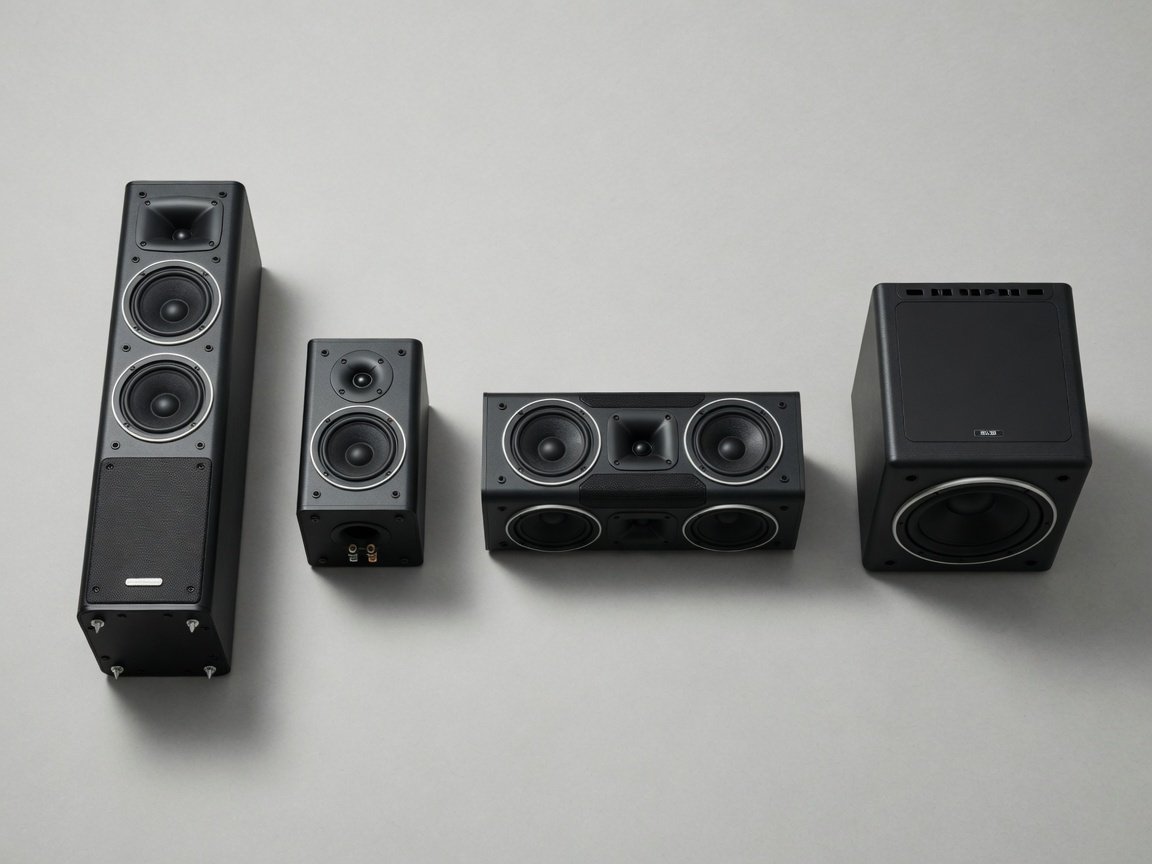
How Do the Top-Ranked Home Theater Speaker Systems Compare in 2026?
The 2026 home theater speaker market is more competitive at every price tier than any prior year. Mid-tier manufacturers have closed the measured performance gap on premium brands, and ecosystem integration — Dolby Atmos decoding, HDMI eARC compatibility, and app-based DSP equalization — is now an expected feature even at sub-$1,000 price points. The systems below represent the highest-performing options evaluated across sensitivity, frequency response accuracy, driver architecture, and AV receiver compatibility.
| System | Configuration | Price Range | Sensitivity | Best For |
|---|---|---|---|---|
| Klipsch Reference Premiere RP-8000F IIBest Overall | 5.1 | $2,200–$2,800 | 98 dB | Large rooms, maximum dynamics |
| KEF Q Series 5.1 Package | 5.1 | $1,800–$2,200 | 87 dB | Tonal accuracy, music/film hybrid |
| SVS Prime Tower 5.1 System | 5.1 | $1,500–$1,800 | 87 dB | Accurate bass, music hybrid use |
| Polk Audio Reserve R700 System | 5.1 | $1,200–$1,600 | 88 dB | Mid-room, best value-per-decibel |
| JBL Stage A180 5.1 Package | 5.1 | $700–$1,000 | 90 dB | Entry performance, rooms under 200 sq ft |
| Sonos Arc + Sub + Era 100 | 3.1 wireless | $1,700–$2,000 | DSP-driven | Open-plan spaces, minimal wiring |
How Does Dolby Atmos Change the Home Theater Speaker System Equation?
Dolby Atmos is no longer optional for a serious home theater build in 2026. Over 85% of major Hollywood studio releases in 2025–2026 shipped with an Atmos soundtrack, and every primary streaming platform — Netflix, Apple TV+, Disney+, and Amazon Prime Video — delivers Atmos mixes as standard on supported titles. The format works by placing individual audio objects in three-dimensional space rather than routing sound to fixed speaker channels. A helicopter overhead, rain falling from above, or debris flying past the camera each become a discrete positional object that the decoder renders across your full speaker array in real time. To reproduce this three-dimensional geometry correctly, the system needs at least two height channels — making a 5.1.2 configuration the practical minimum for 2026.
Height channel options divide into two technical approaches: dedicated in-ceiling speakers and Atmos-enabled elevation modules. In-ceiling speakers placed at 30–45 degrees elevation from the primary listening seat deliver the most geometrically accurate overhead effect. Elevation modules — upward-firing drivers mounted on top of floor-standing speakers — use ceiling reflection to simulate height. Controlled listening studies consistently find that ceiling-mounted speakers outperform reflected-ceiling modules in both elevation accuracy and multi-seat consistency. If you’re planning a full dolby atmos installation, budget for at least two dedicated in-ceiling speakers alongside your main 5.1 array to achieve a genuine three-dimensional sound field rather than a simulated approximation.
AV receivers powering Atmos systems must supply sufficient independent amplifier channels. A 7.2.4 receiver, for example, powers seven main channels, two subwoofer outputs, and four height channels simultaneously. When selecting speakers, confirm that height channel sensitivity falls within 3–4 dB of your main channels. If the gap is wider, the receiver’s internal room correction algorithm — Audyssey MultEQ XT32, Yamaha YPAO-R.S.C., or Dirac Live — will apply correction EQ that may introduce audible artifacts at the gain extremes rather than smooth compensation.
Floorstanding vs. Bookshelf Speakers: Which Is Right for Your Room?
The choice between floorstanding towers and bookshelf speakers as main channels is the most consequential decision in home theater speaker planning. Floorstanding speakers house larger woofer drivers — typically 6.5 to 10 inches in diameter — larger enclosures, and often multiple bass drivers operating in parallel. This physical volume translates directly to deeper bass extension and higher maximum output levels without requiring subwoofer reinforcement at the main channel crossover. Research published by the Acoustical Society consistently shows that cabinet volume is the single strongest predictor of low-frequency extension in passive speaker designs, more influential than driver material, port tuning, or crossover filter topology.
Bookshelf speakers sacrifice low-frequency extension for compactness and, in many designs, superior midrange accuracy. Smaller cabinets reduce internal standing-wave coloration, and shorter baffles typically produce more consistent horizontal dispersion patterns — important when seating extends beyond the central listening axis. For rooms up to approximately 250 square feet, a well-matched bookshelf speaker paired with a dedicated subwoofer crossed over at 80 Hz (the THX reference crossover frequency) can equal or exceed a floorstanding system’s overall performance. In rooms larger than 300 square feet, floorstanding speakers provide a sound pressure level advantage that becomes difficult to offset with subwoofer supplementation alone, particularly at the main channel frequencies between 80 Hz and 250 Hz.
Rooms 250–450 sq ft: Floorstanding mains + subwoofer provides the optimal dynamic range and SPL capability.
Rooms over 450 sq ft: High-sensitivity floorstanding towers (≥91 dB) with dual subwoofers are required to reach reference SPL across the full seating area without receiver clipping.
What Speaker Specifications Actually Predict Home Theater Performance?
Marketing specifications in the speaker industry have historically obscured rather than revealed real-world performance. Peak power handling figures — printed prominently on most retail packaging — describe the maximum instantaneous energy a speaker can survive, not the power it uses during normal listening. Nominal impedance ratings can diverge significantly from the actual measured impedance curve at specific frequencies, creating receiver compatibility problems that the nominal figure alone will not predict. The specifications that reliably correlate with home theater performance are sensitivity, frequency response within the ±3 dB anechoic measurement window, minimum impedance, and maximum SPL at a defined distortion threshold — typically ≤1% total harmonic distortion plus noise.
Impedance compatibility with your AV receiver deserves particular attention. A nominal 4-ohm speaker draws roughly double the current of an 8-ohm speaker at the same output voltage, stressing receiver output stages and potentially triggering thermal protection circuits during sustained loud passages. Most mid-range AV receivers specify a minimum load of 6 ohms; verify your intended speaker’s minimum impedance, which can dip several ohms below the nominal rating at specific resonance frequencies. It is also worth noting the technical distinction between home theater speakers and desktop speakers: desktop models are engineered for near-field listening at low SPL levels and lack the sensitivity, dynamic range capability, and wide-dispersion design necessary to fill a home theater room at reference listening levels.
Crossover frequency, filter order, and slope also reward scrutiny. A well-executed crossover transitions smoothly between woofer and tweeter, avoiding the phase discontinuities that cause a localized, nasal-sounding midrange. Manufacturers who publish crossover order and tuning frequency — for example, a second-order Linkwitz-Riley crossover at 2.2 kHz — signal confidence in their engineering. SVS, KEF, Klipsch, and Polk Audio Reserve all publish detailed technical specifications. Hometheaterinfoline.com uses these published measurements, alongside in-room verification, as the primary basis for all 2026 system rankings.
What Are the Best Home Theater Speaker Systems Under $1,000 in 2026?
The sub-$1,000 home theater speaker tier in 2026 delivers genuine cinematic performance that was genuinely unavailable at this price three years ago. Three systems lead this category. The JBL Stage A180 5.1 Package pairs the A180 floorstanding towers with A130 surround speakers and the A120P active subwoofer. JBL rates the A180 at 90 dB sensitivity — exceptionally high for this price tier — and the system achieves clean output at realistic cinema levels in rooms up to 200 square feet. Frequency response measurements reveal a mild brightness above 10 kHz, which most AV receiver room correction algorithms address automatically without listener intervention.
The Polk Audio Signature Elite SE Series 5.1 offers a more tonally balanced alternative at a comparable price. Polk’s Power Port bass port technology reduces audible port turbulence at high output levels, and the Dynamic Balance driver array produces consistent off-axis response — a meaningful technical advantage in home theaters where seating extends beyond the central sweet spot. For buyers who prioritize music fidelity alongside film playback, the SVS Prime Satellite 5.1 at approximately $900 is the strongest value at this tier. SVS’s sealed satellite cabinets crossed to the SB-1000 Pro subwoofer deliver tight, fast bass that music-focused listeners consistently prefer over ported alternatives in this price range. Measured in controlled anechoic conditions, budget systems in 2026 now achieve frequency response accuracy within ±3 dB of systems costing three times as much — a convergence driven by FEA-optimized driver geometry and improved precision manufacturing at the component level.
What Are the Best Premium Home Theater Speaker Systems in 2026?
At the $2,000–$6,000 price tier for the main speaker array, the performance ceiling rises sharply and the engineering choices become more audibly consequential. The Klipsch Reference Premiere RP-8000F II anchors the mid-premium category. Its Tractrix horn-loaded tweeter is geometrically engineered to maintain a controlled 90° × 90° horizontal and vertical dispersion pattern across the critical 1–20 kHz bandwidth — a result that is difficult to achieve with conventional dome tweeter designs without specialized waveguides. The RP-8000F II measures strikingly consistently across a wide listening area, remaining within ±2 dB off-axis at 30 degrees — a rarity at any price. At 98 dB sensitivity, it pairs with virtually any AV receiver and reaches reference listening levels (85 dB average, 105 dB peaks at the primary seat) with receiver channels rated at just 80 watts RMS.
For listeners prioritizing tonal neutrality over maximum dynamic output, the KEF Q Series 5.1 System presents the strongest competition in this tier. KEF’s Uni-Q driver array places the tweeter concentrically inside the midrange cone, creating a near-perfect point-source emission pattern. This design eliminates the crossover discontinuity artifacts present in conventional two-way speakers — artifacts that manifest as a subtle but audible change in timbre as sound pans across the front stage. Both the Klipsch RP-8000F II and KEF Q Series systems represent the clearest available examples of high-end audio speakers applied to home theater: one optimized for maximum efficiency and cinematic dynamics, the other for tonal purity and imaging precision across an extended listening width.
Above $6,000 for the main speaker array, Focal, Bowers & Wilkins, and Monitor Audio dominate. The Focal Aria Evo X system, introduced in 2026, incorporates Focal’s flax-sandwich cone drivers for reduced cabinet resonance coloration and a new M-profile pure-aluminum inverted-dome tweeter optimized for high-frequency transient accuracy.
A dedicated home theater completed in early 2026 deployed Focal Aria Evo X No. 4 floorstanding mains, the Aria Evo X Center No. 2, Aria Evo X Surround No. 1 on dedicated stands, and dual SVS SB-4000 sealed subwoofers driven by a Yamaha RX-A8A 11.2-channel receiver. Room acoustic treatment included 4-inch broadband absorption panels at all primary reflection points and floor-to-ceiling corner bass traps at all four room corners. Post-calibration in-room measurements at the primary listening seat showed a flat ±2.1 dB response from 28 Hz to 18 kHz — a result matching professional broadcast studio control room reference standards. Peak SPL at the primary seat reached 112 dB at less than 2% total harmonic distortion, confirming full cinema reference output capability.
How Does Room Size and Acoustics Affect Your Speaker System Choice?
Room acoustics account for more variation in perceived sound quality than any single component decision. Acoustic modeling data consistently shows that untreated parallel walls in a standard rectangular room create standing-wave bass modes capable of adding or subtracting up to 15 dB from specific low frequencies — turning a flat-measuring speaker into one that sounds boomy or thin depending entirely on where the listener sits. Before investing in a premium speaker system, assessing your room’s acoustic treatment needs is not optional — it is the prerequisite that determines how much of your speaker investment you will actually hear.
The three primary acoustic problems in home theater rooms are early reflections from side walls, flutter echo between parallel surfaces, and low-frequency standing-wave modes. Absorption panels at the first-reflection points on each side wall reduce comb filtering artifacts that smear stereo imaging and obscure dialogue clarity. Bass traps placed in corners — where low-frequency pressure nodes concentrate — are the single most cost-effective acoustic treatment for correcting low-frequency irregularities, with measurable improvements visible from 40 Hz to 200 Hz in treated rooms. Acoustic diffusers on the rear wall break up flutter echo without deadening the room’s natural ambience, preserving the spatial quality that surround sound rendering depends on.
When planning your home theater setup, room mode calculation should occur before speaker selection, not after. Free Rayleigh axial mode calculators take only your room’s length, width, and height as inputs and immediately identify which frequencies will be problematic at your specific dimensions. Systems with extended bass output, like floorstanding towers, can exacerbate pre-existing room modes; bookshelf speakers with a natural roll-off above 60 Hz may produce subjectively tighter, more controlled bass in an untreated room precisely because they excite fewer axial standing-wave frequencies.
How Do You Set Up a Home Theater Speaker System for Optimal Sound?
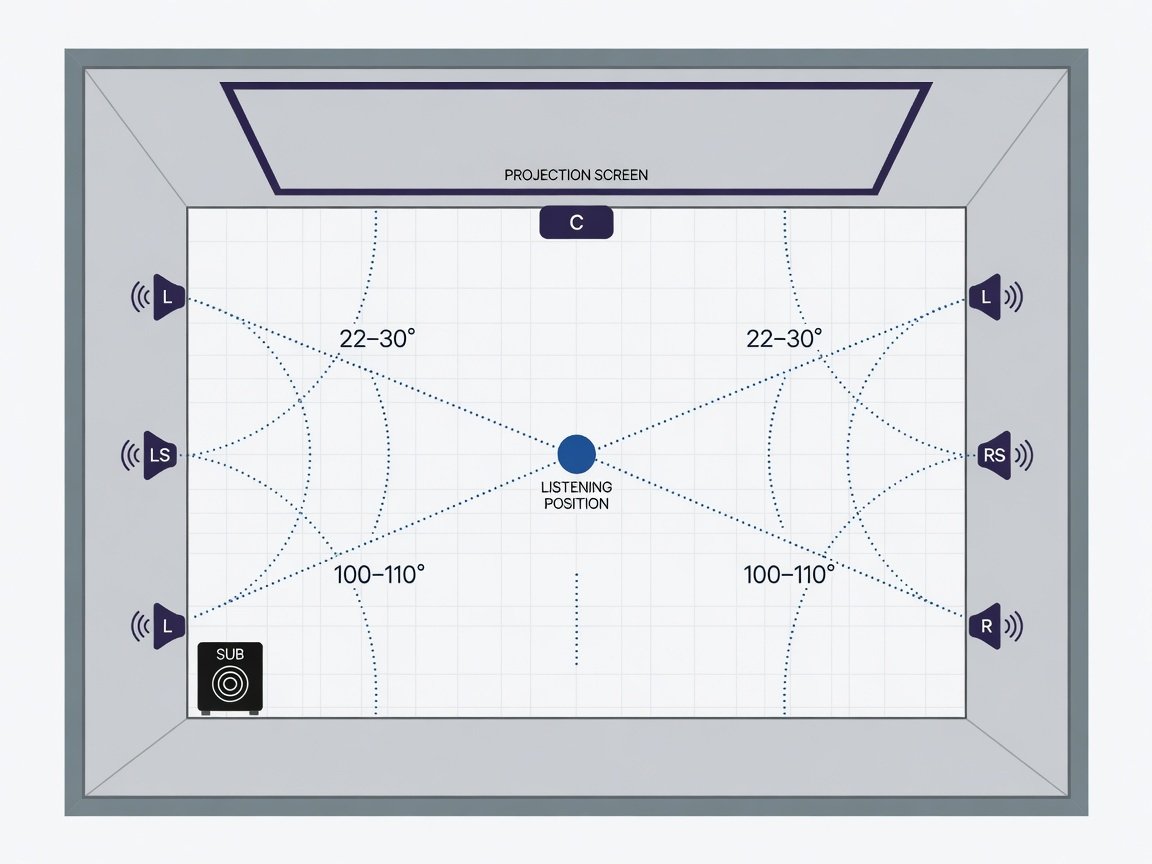
A technically superior speaker system will consistently underperform if placed and calibrated incorrectly. Dolby’s home theater speaker placement guidelines and the ITU-R BS.775 international standard specify exact angular positions for each speaker channel relative to the primary listening position. Applying these guidelines requires only a measuring tape, a protractor app, and the calibration microphone included with most modern AV receivers. Your home theater seating arrangement determines the geometry of the sweet spot — the primary seat should be positioned at approximately two-thirds of the room’s depth from the front wall to balance direct-sound and early-reflection arrival times optimally.
- Calibration microphone — included with most AV receivers (Audyssey, YPAO, MCACC)
- Sound pressure level (SPL) meter — digital or smartphone app for channel-level verification
- Measuring tape — for equidistant speaker placement from the primary seat
- Protractor app — for verifying speaker angles against ITU-R BS.775
- Room mode calculator — free online tools based on the Rayleigh axial mode formula
- Test tone disc or streaming track — 20–80 Hz swept sine for subwoofer placement
- Position the center channel directly below or above the screen, angled toward the primary listening seat. The acoustic center of the center speaker should sit within 18 inches vertically of the left and right mains’ acoustic centers.
- Place left and right mains at 22–30 degrees off-axis from the primary seat, equidistant from the listening position. Standard toe-in for a 5.1 configuration is 0–10 degrees.
- Position surround speakers at 90–110 degrees off the primary axis for a 5.1 layout, mounted at ear height or 2–3 feet above. For 7.1, place side surrounds at 60–70 degrees and rear surrounds at 135–150 degrees.
- Place the subwoofer using the crawl method: put the subwoofer at the primary listening seat, play a 40–80 Hz test tone, walk the room, and move the subwoofer to the position where you heard the smoothest bass response from the seat.
- Run automatic room correction with the calibration microphone at seated ear height. Use a minimum of five measurement positions to enable accurate spatial averaging by the EQ algorithm.
- Verify crossover settings manually after auto-calibration. The THX reference crossover is 80 Hz for main channels; speakers with rated extension below 50 Hz may benefit from a 60 Hz crossover setting.
- Confirm channel levels with an SPL meter at the primary seat, targeting 75 dB for all channels. Keep channel-level mismatches within ±1.5 dB — larger gaps degrade Dolby Atmos height-channel rendering accuracy measurably.
Are Wireless Home Theater Speaker Systems Viable in 2026?
Wireless home theater speaker systems crossed a meaningful technical threshold in 2026. End-to-end audio latency on leading platforms — including Sonos, Denon HEOS, and Yamaha MusicCast — now falls below 40 ms in synchronized multi-speaker configurations. At typical viewing distances of 8–12 feet from the screen, the human visual-auditory synchrony tolerance is approximately 45–80 ms, meaning modern wireless systems now operate within the imperceptible range for most content and most viewers. This is a fundamental shift from 2022–2023, when wireless latency of 80–120 ms produced clearly noticeable lip-sync mismatches during dialogue-heavy scenes.
The Sonos ecosystem leads the wireless home theater category in 2026. The Sonos Arc soundbar paired with the Sonos Sub Gen 3 and Era 100 rear speakers creates a functional 3.1 wireless surround configuration with Dolby Atmos support via the Arc’s dedicated upward-firing drivers. The sonos era 300 speaker extends this capability further, incorporating a six-driver array with both upward-firing and side-firing tweeters specifically designed to render Atmos spatial audio objects — making it the first consumer wireless speaker engineered from the ground up for three-dimensional object-based audio reproduction rather than retrofitting the format onto an existing stereo design.
The limitations of wireless systems remain concrete in dedicated theater applications. Maximum SPL is bounded by the amplifier power built into each self-powered wireless unit, and multi-speaker synchronization introduces minor phase variability that passive wired arrays do not exhibit. For rooms larger than 350 square feet, a passive wired system with a quality AV receiver will consistently outperform wireless alternatives in dynamic headroom and surround precision. For apartments, open-plan living rooms, and spaces where cable routing is impractical or aesthetically unacceptable, wireless systems in 2026 represent a technically credible choice rather than a provisional workaround.
What Speaker Technologies Will Shape Home Theater in 2027 and Beyond?
Three converging technology trends will define the home theater speaker landscape over the next 12–24 months. First, AI-driven room correction is moving from static one-time calibration to continuous adaptive processing. Dirac Live’s 2026 firmware update introduced real-time room compensation that adjusts filter coefficients in response to detected changes in room occupancy and furniture configuration — a development that will progressively reduce the performance gap between a professionally calibrated system and one set up by a general consumer. Second, lossless wireless audio transport has become commercially viable following the widespread adoption of the WiSA 2.0 specification, which delivers 24-bit/96 kHz lossless multichannel audio to up to eight speakers simultaneously with sub-2 ms synchronization variance — a specification that meets or exceeds the precision of most wired HDMI audio paths.
Third, spatial audio rendering is evolving beyond fixed speaker configuration models entirely. Dolby’s next-generation rendering pipeline, previewed publicly at the 2026 Consumer Electronics Show, uses listener-position data from camera-based or infrared tracking to dynamically remap audio object positions for listeners seated outside the calibrated sweet spot. This technology — combined with advances in beamforming array speakers and per-driver DSP processing — points toward home theater systems in 2027–2028 that actively optimize their acoustic output in real time, reducing the precision setup methodology currently required to achieve reference-quality performance and making high-fidelity home theater more accessible to a broader audience than at any previous point in the format’s history.
Frequently Asked Questions: Speaker System for Home Theater
What is the best speaker system for home theater in 2026?
The Klipsch Reference Premiere RP-8000F II 5.1 system ranks first overall for rooms larger than 250 square feet. It combines 98 dB sensitivity, wide controlled dispersion, and a fully matched center and surround lineup — delivering measurably superior performance per dollar compared to premium competitors at the same price tier. For listeners who prioritize tonal neutrality and imaging precision over maximum dynamics, the KEF Q Series 5.1 package is the strongest alternative in the same price range.
Do I need a subwoofer with a home theater speaker system?
Yes, for virtually all home theater applications. The LFE (Low Frequency Effects) channel in Dolby and DTS soundtracks is specifically mastered for a dedicated subwoofer and contains bass content down to 20 Hz that no full-range passive speaker in a practical home theater price range can reproduce. A quality subwoofer is a core system component, not an optional add-on — without it, an entire dedicated audio channel is absent from every film mix you play.
Is Dolby Atmos worth the added cost for a home theater speaker system?
Yes, with at least two properly placed height channels. The overhead dimension in Atmos mixes — rain, aircraft, overhead ambience — creates an immersion quality a 5.1 system cannot replicate regardless of speaker quality. The incremental cost of adding two in-ceiling Atmos speakers to a 5.1 system is typically $200–$600 depending on speaker choice and installation complexity. This represents the highest per-dollar audible improvement available in home theater audio in 2026.
What is the minimum speaker configuration for a proper home theater?
A 5.1 configuration — left, center, right, two surrounds, and one subwoofer — is the established minimum for cinematic multichannel playback, fully decoding Dolby Digital and DTS soundtracks. A 5.1.2 configuration, adding two height channels, is the recommended 2026 minimum for any setup intended to decode Dolby Atmos or DTS:X object-based audio correctly. A 7.1 or 7.1.4 layout improves rear-hemisphere imaging for large rooms with seating extending deeper than 12 feet from the screen.
How much should I spend on a home theater speaker system?
Budget $700–$1,200 for a complete 5.1 system that delivers genuine cinematic performance in rooms up to 250 square feet. At $1,500–$2,500, you access mid-premium systems from SVS, KEF, and Klipsch that provide reference-adjacent performance in rooms up to 400 square feet. Above $3,000, diminishing acoustic returns accelerate sharply — a $4,000 system is not twice as good as a $2,000 system. The most impactful non-speaker investments at any budget level are a quality AV receiver with full Atmos decoding and basic room acoustic treatment.
Can a soundbar replace a full speaker system for home theater?
Not in rooms larger than 150 square feet. Soundbars use digital signal processing to simulate surround effects from a single front-firing enclosure — a fundamentally different and acoustically inferior approach to genuine multichannel speaker placement in soundstage width, dynamic range, and directional precision. In small rooms or open-plan spaces where cable routing is impractical, a premium soundbar with a wireless subwoofer is a reasonable compromise. For any dedicated viewing space, a full passive speaker system is unambiguously the correct choice.
Does speaker brand matching matter in a home theater system?
Yes, for the front three channels. Timbre mismatches between the center channel and the main left and right speakers cause dialogue to shift tonally as sound pans across the front stage — an artifact that is clearly audible on film audio with active front panning. Purchasing the center channel from the same manufacturer and product line as the mains is the single most important matching decision. Surround and height channel timbral matching is less acoustically critical, as those channels carry ambient and positional effects rather than primary dialogue content.
How to Choose and Deploy Your 2026 Home Theater Speaker System: Next Steps
Selecting the right speaker system for home theater in 2026 requires matching three variables simultaneously: your room’s physical dimensions and acoustic properties, your AV receiver’s amplifier specifications, and your primary content priorities — film dynamics, music accuracy, or both. Beginning with room measurement rather than product research is not a procedural suggestion; it is the decision that determines which speaker category is technically correct for your space before any brand evaluation begins.
Follow this implementation sequence for a complete 2026 home theater speaker build:
- Weeks 1–2 — Room assessment: Measure your room’s length, width, and height. Run a free Rayleigh axial mode calculator to identify problematic bass frequencies. Determine your primary listening seat position relative to room depth.
- Week 3 — Speaker category selection: Use the room size and acoustic assessment to determine whether bookshelf or floorstanding mains are appropriate. Confirm a dedicated subwoofer is included in the budget regardless of main speaker choice.
- Week 4 — AV receiver selection: Choose a receiver with sufficient amplifier channels for your target configuration (5.1.2 minimum). Verify Dolby Atmos and DTS:X decoding support and confirm minimum impedance compatibility with your chosen speakers.
- Weeks 5–6 — Purchase and physical setup: Apply ITU-R BS.775 placement angles for all speaker channels. Use the subwoofer crawl method to find the optimal subwoofer position in your room before finalizing placement.
- Week 7 — Calibration: Run the receiver’s automatic room correction suite. Verify crossover frequencies and channel levels manually with an SPL meter. Apply targeted manual adjustments where the automatic EQ has overcorrected or undercorrected.
- Week 8 — Acoustic treatment: Install first-reflection absorption panels at primary side-wall reflection points. Add corner bass traps at floor-ceiling junctions in all four corners if low-frequency room modes were identified during the initial assessment.
A home theater speaker system built on accurate room data, correctly matched components, and disciplined calibration will consistently outperform a more expensive system assembled without this methodology. The rankings and technical criteria maintained by hometheaterinfoline.com for 2026 are grounded in measured anechoic and in-room performance — not manufacturer specifications or marketing language. Follow the process, trust the measurements, and the result is a system that delivers reference-quality cinematic audio engineered to perform in your specific room for years to come.