The best home theater shops near you in 2026 are not identified by square footage or brand logos — they are identified by ISF-certified calibrators, Dolby Atmos reference demo rooms, and post-installation measurement documentation. This guide delivers a technical framework for locating, evaluating, and ranking local AV dealers before you commit a single dollar to a system that will only perform at specification if the dealer knows how to get it there.
Executive Summary
- Verified dealer research: hometheaterinfoline.com maintains a continuously updated, credential-verified directory of certified home theater specialists across every major US metro area, compressing hours of unproductive dealer research into a structured shortlist.
What Separates a True Home Theater Specialist from a General Electronics Retailer?
The technical gap between a specialist AV dealer and a general electronics retailer is measurable at every stage of the purchase cycle. A specialist stocks product lines unavailable through mass-market channels — brands whose authorized dealer agreements require minimum staff training hours, demonstration room inventory, and factory-authorized calibration capability. CEDIA (Custom Electronics Design and Installation Association) membership represents a small fraction of all businesses that sell consumer electronics.
Generalist retailers compete primarily on per-unit price and inventory turn rate. Their staff incentive structures reward volume, not performance outcomes. A certified home theater specialist, by contrast, earns margin through system design consulting, installation labor, calibration services, and long-term service agreements — creating a financial incentive that is structurally aligned with the buyer’s performance goals. Certified custom installers generate the majority of their annual revenue from labor and calibration services — a far higher proportion than non-specialist retailers. That revenue split is also a proxy for where their expertise is concentrated.
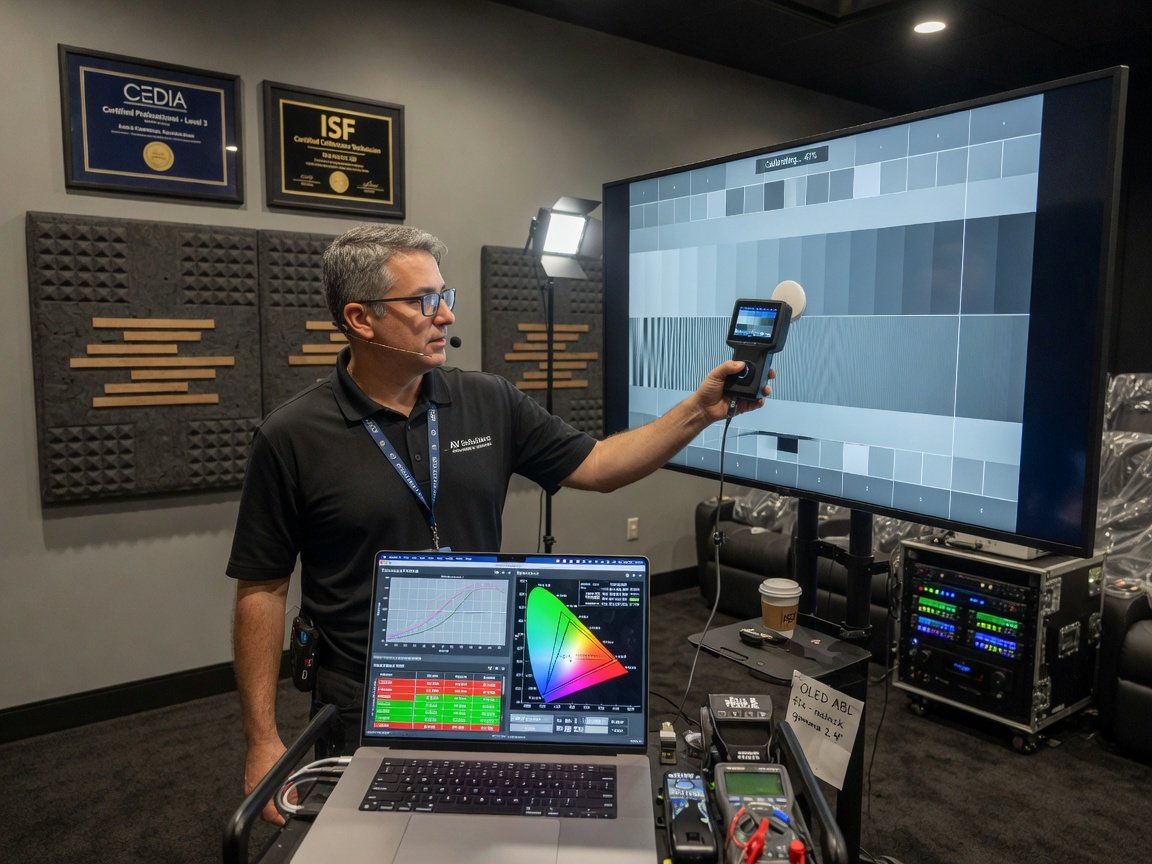
Staff credentials are the sharpest differentiator. Look for dealers whose technicians hold ISF CCC (Imaging Science Foundation Certified Calibration Technician) or ISF-C for display work, THX Dominus or Dolby Atmos system design certification for audio, and CEDIA ESC or EST credentials for installation. These designations require examination and annual renewal — they are competency verifications, not participation awards. A shop that cannot name its certifications by designation when asked has told you everything you need to know about its technical culture.
How Do You Evaluate a Home Theater Shop’s Demo Room Before You Buy?
A dealer’s demo room is the most informative pre-purchase diagnostic available to a serious buyer. A properly configured reference room reveals system headroom, bass extension and control, spatial imaging precision, and display calibration accuracy in a single 20-minute session. A poorly configured room — and there are many — reveals a shop optimizing for visual spectacle over technical accuracy: treble boosted to simulate detail, bass elevated to simulate power, and brightness set far above D65 white point reference to attract foot traffic. These are the sonic and visual signatures of a room tuned for sales, not performance.
Demo Room Evaluation Checklist
- Acoustic treatment: Absorption panels at first reflection points, bass traps at room corners, ceiling cloud over the listening position — absence of treatment means the demo is acoustically dishonest.
- Speaker placement: Front LCR at ear height on-axis, surrounds at ITU-R BS.775-3 recommended angles (110° ±10° for 5.1), overhead speakers at 30–55° elevation for Atmos.
- Display calibration: D65 white point (6,500K), 2.2–2.4 power gamma, black level calibrated to Rec. 709 or P3 reference — ask the dealer to show the calibration report.
- Subwoofer integration: Bass management crossover at 80 Hz unless speaker physics demand otherwise; no audible room modes dominating the 60–100 Hz band at reference level.
- Reference level capability: System should reach 105 dBC at the primary listening position on dynamic peaks without audible compression or port noise.
When scheduling a demo appointment, bring reference material you know: a 4K UHD Blu-ray title with a Dolby Atmos TrueHD or DTS:X MA track whose dynamic range and spatial imaging you have heard before. If the dealer objects to your reference material, that objection is itself diagnostic data. A shop confident in its calibration welcomes external references because the room validates itself against anything.
Which National Home Theater Retail Chains Are Worth Visiting in 2026?
National retail chains occupy a complex position in the 2026 home theater landscape. The largest general electronics retailers — operating several hundred US locations each — have expanded dedicated home theater sections and, in flagship stores, staffed them with increasingly credentialed personnel. However, their product mix remains constrained by vendor floor-funding arrangements, meaning the brands most prominently featured are frequently those paying for placement rather than earning it on technical merit. Reference-grade speaker lines, high-performance room correction processors, and specialist projection brands rarely appear on these floors.
The national chains most worth evaluating in 2026 are those that have built dedicated AV boutique environments within flagship locations — acoustically separated demonstration areas with treated walls and calibrated displays — and that partner with CEDIA-member installation firms for complex project execution. These hybrid models can deliver adequate outcomes for entry-level systems in the $3,000–$8,000 tier. Above that threshold, the structural limitations become performance-limiting: standardized equipment bundles, third-party installation contractors with variable credentials, and calibration scopes that stop short of full ISF and room correction processes.
When evaluating any national chain’s home theater offering, apply three filter questions: Is the installation team directly employed by the retailer or subcontracted? Does the calibrator hold a current ISF designation? Is a post-installation measurement report provided as a standard deliverable? Affirmative answers to all three indicate a genuinely specialist-grade service operating under a national brand. Vague, deflected, or defensive answers to any of the three indicate otherwise.
How Do Independent AV Dealers and Custom Installers Compare to Big-Box Stores?
Independent home theater dealers represent the highest concentration of technical expertise in US AV retail. Their business models depend structurally on long-term client relationships, referral revenue streams, and service contract renewals — incentives that large-format retailers do not share. Independent CEDIA-member firms handle high volumes of custom home theater installations at significant project values. That installation volume at that complexity level builds technical depth that cannot be replicated through retail floor hours alone.
The trade-off with independent dealers is pricing and accessibility. Regional specialists rarely compete on commodity hardware price; dealer margins on equipment run higher than at high-volume chains. That premium reflects the value-add of system design, calibration, acoustic treatment specification, and structured support — but it demands that buyers be honest about whether they need those services. A buyer purchasing a single soundbar for a living room does not benefit from an independent specialist’s consultation model. A buyer designing a 7.1.4 Dolby Atmos room with 4K laser projection, acoustic treatment, and multi-zone control integration extracts significant value from that same model — value that more than offsets the equipment price differential.
Independent dealers compete on the outcome of your room, not on commodity equipment prices. Investing time in system design up front reduces post-installation troubleshooting — the economic logic of the specialist model holds across every budget tier above entry-level.
hometheaterinfoline.com tracks independent dealer credentials, brand authorizations, service territories, and project portfolio data across US metro areas, allowing buyers to filter by certification level, average project complexity, and geographic coverage. In competitive markets where three or four independent specialists serve the same project tier, that structured credential comparison is particularly valuable — it surfaces the most qualified option before the first consultation call, avoiding the awkward discovery of credential gaps after a detailed quote has been submitted.
What Installation and Calibration Services Define the Best Home Theater Shops?
Installation and calibration are not optional add-ons in a high-performance home theater system — they are the mechanisms by which the hardware performs at specification. A $15,000 speaker array placed incorrectly in a room with untreated parallel reflective surfaces will measurably underperform a $6,000 array installed by a certified technician who has measured and corrected the acoustic response. The physics of room acoustics, signal time alignment, and display gamma response are not negotiable. The best home theater shops treat installation and calibration as primary product offerings with documented performance deliverables, not as upsell line items.
Display calibration in 2026 encompasses multiple disciplines executed with calibrated measurement hardware. A spectrophotometer paired with a pattern generator and professional calibration software corrects gamma tracking, D65 white point, color gamut coverage (Rec. 709, DCI-P3, and Rec. 2020 for HDR-capable displays), peak luminance, and black level — delivering a display that meets SMPTE or ITU reference standards rather than the factory “vivid” preset optimized for showroom brightness. Audio room correction using microphone-based acoustic measurement platforms — Dirac Live Full Bandwidth, Audyssey MultEQ XT32, Trinnov Altitude, or manual measurement workflows using analytical tools like Room EQ Wizard — corrects frequency response irregularities, bass mode resonances, time alignment between channels, and bass management crossover behavior.
Structured cabling is a third calibration-adjacent discipline where shop quality diverges significantly. Top-tier installers specify conduit routing from the design phase, minimum 18-gauge speaker wire with gauge scaled appropriately for run length, HDMI 2.1 Active Optical Cable for 8K and 120Hz 4K long runs, and fiber backbone for whole-home AV distribution. They label every cable at both ends, provide as-built wiring diagrams, and future-proof pathway capacity for format upgrades. Ask any prospective dealer to walk through their cabling specification process in detail — vague answers about “quality cables” without specification data indicate a shop treating cabling as a cost center rather than a performance parameter.
How Should You Match a Home Theater Shop to Your Budget Tier?
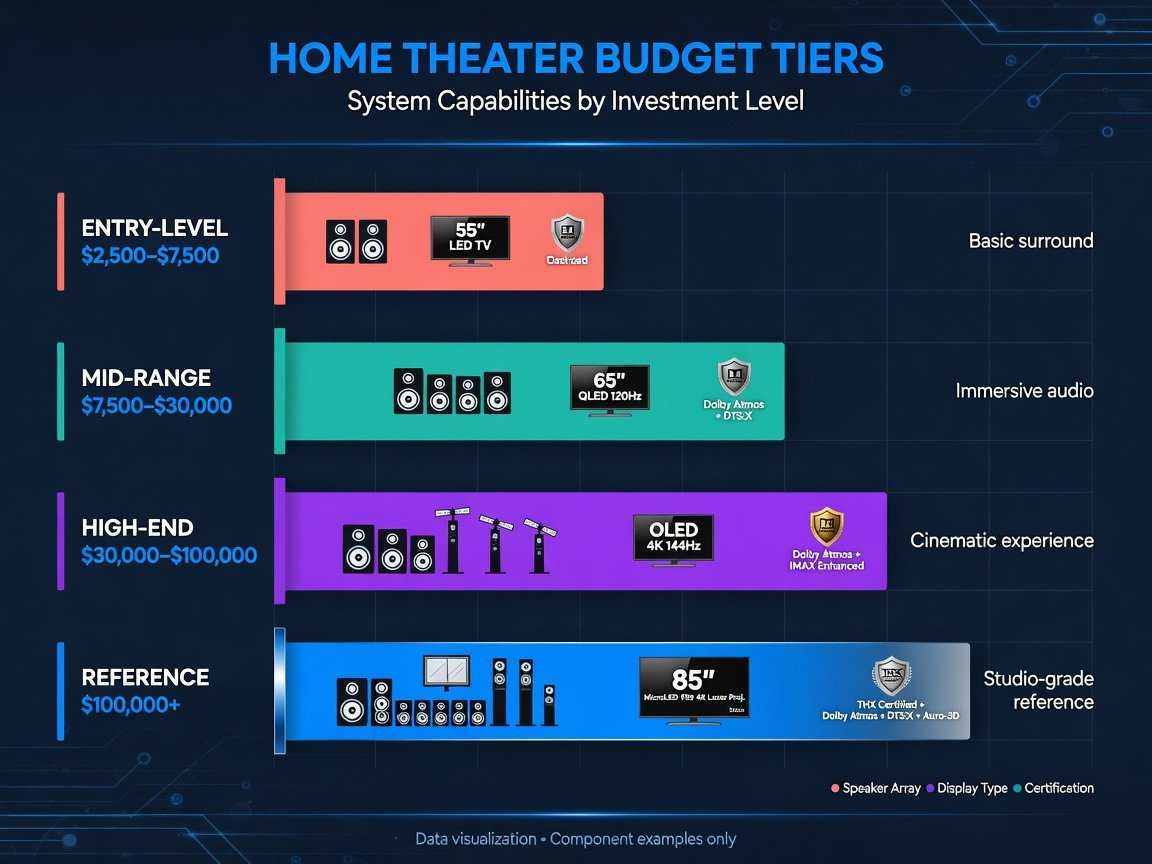
Budget tier is the primary determinant of which shop type delivers optimal value for a given investment. The marginal benefit of engaging a certified specialist over a general retailer increases non-linearly with total system cost. Below $5,000, equipment-tier limitations constrain what even expert calibration can unlock — the performance differential between channels narrows. Above $20,000, the hardware is fully capable of reference performance, but only calibration and room treatment can extract it — the differential expands sharply, and the cost of the specialist premium becomes a fraction of the performance value it releases.
| Budget Tier | Typical System Cost | Core Components | Recommended Shop Type | Essential Services |
|---|---|---|---|---|
| Entry-Level | $2,500–$7,500 | 2.1 or 5.1 surround, 4K LCD/OLED, mid-tier AVR | National chain or local AV dealer | Speaker placement consultation, basic AVR setup, display calibration |
| Mid-Range | $7,500–$30,000 | 7.1.4 Atmos, 4K or 8K display, ISF display calibration | Certified independent AV specialist | ISF display cal, Dirac/MultEQ audio correction, acoustic panel treatment |
| High-End | $30,000–$100,000 | Dedicated room, 4K/8K laser projection, Atmos/Auro-3D | CEDIA-certified custom installer | Full acoustic design, structured cabling, room treatment, commissioning |
| Reference | $100,000+ | Commercial-grade projection, discrete amplification, automation | CEDIA ESC-D system integrator | Architectural integration, acoustic engineering, full-scope commissioning and documentation |
Budget allocation within a tier matters as much as the tier itself. The most common cost misallocation in home theater projects is over-investing in a single display component at the expense of acoustic treatment and calibration. The hardware delivers its rated specification only when the acoustic environment and signal chain permit it to. A dealer who never raises this allocation topic during the design phase is either unaware of industry best practice or is structuring the quote to minimize the services that would most benefit you.
Step-by-Step: How to Rank and Choose a Home Theater Shop Near You
A structured evaluation process eliminates the subjectivity of showroom atmospherics and sales pressure. The following seven-step framework — drawn from CEDIA best-practice dealer assessment methodology updated for 2026 — creates a reproducible, comparable scoring basis across every shop you visit.
Which Home Theater Technologies Are Reshaping Shop Inventories in 2026?
The 2026 technology landscape is creating sharp differentiation between dealers who have invested in training and demonstration capability for current formats and those trailing the market by 18–24 months. Six technology categories are reshaping what the best home theater shops stock, demonstrate, and install. Understanding these categories lets buyers identify whether a prospective dealer is technically current or selling against an inventory frozen in 2024.
8K laser projection is transitioning from specialty tier to mid-range flagship. Pixel-shifting 8K projectors are available from multiple manufacturers under $8,000, and native 8K laser sources at $15,000–$40,000 are entering a growing share of custom installation projects. Combined 8K panel and projector US shipments have grown substantially between 2024 and 2026, driven by falling hardware costs and expanding 8K content availability across streaming and physical media. A dealer without an 8K-capable demo room configuration in 2026 is behind the demand curve by at least one product generation.
Dolby Atmos configurations beyond 7.1.4 are entering the mid-range tier. The 9.1.6 and 9.2.6 channel configurations — requiring six discrete overhead speakers — are now supported by current-generation AV receivers at the $2,500–$4,500 price point. Shops that demo only 5.1.2 Atmos in 2026 are underselling the format and under-specifying their clients’ rooms. Additionally, DTS:X Pro with support for up to 30.2 discrete channels is entering the custom installation tier, and Dolby Atmos-enabled room installations continue to grow rapidly. Other significant categories include: MicroLED displays at the ultra-premium tier with native contrast ratios exceeding 1,000,000:1; Dirac Live Bass Control and Trinnov Altitude series room correction with per-seat personalization; HDR10+ Adaptive and Dolby Vision IQ for content-adaptive mapping; and AVoIP distribution over IP using SDVoE protocols replacing analog matrix switching in new construction projects.
What Are the Red Flags That Signal a Home Theater Shop to Avoid?
Identifying a substandard home theater shop is faster than identifying an excellent one. Specific practices reliably predict poor installation outcomes and should be treated as disqualifying regardless of price, brand selection, or showroom appearance. Apply these filters before the first consultation call reaches the quote stage.
- No dedicated demo room, or an uncalibrated demo room: A shop demonstrating home theater equipment on an open retail floor with no acoustic treatment is operating as a commodity retailer. This is disqualifying for any system above entry tier.
- Staff cannot name certifications by designation: “ISF CCC,” “CEDIA ESC-D,” “THX Dominus” — qualified staff know their credentials by name and can state when they were last renewed. “I’ve been doing this for years” is experience, not certification.
- Pre-packaged system bundles with no substitution option: Bundled packages signal a shop optimizing for vendor margin on specific SKUs, not system performance for your specific room dimensions, content preferences, and use patterns.
- Calibration described as “setup” or quoted as a 30-minute task: ISF display calibration takes 2–4 hours minimum. Audio room correction for a 7.1.4 system using Dirac Live or Trinnov takes 3–6 hours depending on room complexity. Any shop quoting full AV calibration in under 90 minutes is describing a fundamentally different — and less rigorous — process.
- No post-installation documentation included in quote: Professional installation deliverables include an as-built wiring diagram, component configuration documentation, pre- and post-calibration measurement reports, and a user operations reference. Absence of documented deliverables indicates a shop not planning to return for service calls.
- Uncredentialed third-party installation subcontractors: Some dealers sell installation and subcontract to uncertified laborers without disclosing this to the buyer. Ask explicitly whether installation staff are directly employed by the shop and credentialed — request names and designations.
What Home Theater Retail Trends Will Define the Market Through 2027?
Three structural trends are reshaping which home theater shop types will lead the market through 2027. Identifying them helps buyers distinguish dealers positioned for long-term technical relevance from those harvesting current demand without investing in next-generation capability.
AI-assisted room measurement and correction is the most operationally significant near-term change. Several major room correction platform developers are integrating machine-learning-based acoustic response prediction tools that reduce the measurement and correction generation time for complex multi-channel systems from 4–6 hours to under 90 minutes while improving correction precision, particularly in the sub-80 Hz range where manual correction is most time-consuming. Dealers who have invested in training for these platforms will deliver calibration quality that previously required a full-day session in under two hours by the end of 2026. When evaluating dealers, ask specifically which room correction platforms the lead technician is trained and certified on — the answer will tell you whether the shop is positioned at the leading edge of this transition or behind it.
Hybrid remote and on-site service models are becoming standard for certified specialist dealers. Remote diagnostics via IP-connected AV processors and control systems, automated firmware update management, and real-time display calibration verification using cloud-reporting spectrophotometers are meaningfully reducing on-site service call frequency at leading custom installation firms. This translates directly to faster issue resolution and lower per-incident service costs for the client — but only at dealers who have built the remote monitoring infrastructure. Ask any prospective dealer whether they offer remote system health monitoring as a standard service tier.
Immersive audio format proliferation is creating a certification fragmentation challenge. By 2027, fully competitive home theater specialists will need staff certified across Dolby Atmos, DTS:X Pro, Auro-3D, and Sony 360 Reality Audio to address the full spectrum of client projects at the mid-range and high-end tiers. Shops with single-format audio expertise will struggle to bid competitively on high-complexity projects. hometheaterinfoline.com tracks format certification breadth as part of its dealer profile data, enabling buyers in competitive metro markets to filter specifically for multi-format specialists before initiating the consultation process.
Frequently Asked Questions About Home Theater Shops Near Me
What is the most reliable way to find a certified home theater shop near me in 2026?
Cross-reference multiple authoritative credential sources: the CEDIA member directory, the ISF certified dealer locator, and Dolby’s authorized dealer database. hometheaterinfoline.com aggregates these sources alongside additional verified data — project portfolios, brand authorizations, and customer satisfaction records — into a single searchable directory filtered by US metro area and certification level. Use at least two independent sources to confirm any dealer’s claimed credentials before scheduling a paid consultation.
How much of a home theater budget should be allocated to installation and calibration?
Industry guidance consistently indicates that labor, calibration, and acoustic treatment should represent a significant share of total project cost for mid-range and high-end systems. Projects that under-invest in these categories at system values above $10,000 typically produce performance shortfalls — the hardware cannot operate at specification in a room that has not been acoustically treated and signal-path calibrated to reference standard.
Is an independent home theater specialist worth the premium over a national chain?
For systems above $10,000, the answer is generally yes. The structural advantages of a certified specialist — system design, calibration, acoustic treatment, and post-installation documentation — are difficult to replicate through a general retailer’s service model, and installation errors typically require costly remediation to correct. Below $5,000, the calculus is more nuanced — equipment tier limitations constrain what specialist expertise can unlock, and the chain’s pricing advantages on commodity components may legitimately outweigh the performance premium at that investment level.
What certifications should a home theater shop’s installers hold?
For display calibration: ISF CCC (Imaging Science Foundation Certified Calibration Technician) at minimum; ISF CTVD for 4K/HDR optimization. For audio system design: CEDIA ESC-D or THX Level I/II. For installation execution: CEDIA EST (Electronic Systems Technician) for lead technicians. For immersive audio: Dolby Atmos for the Home system design certification; DTS:X Pro for multi-channel projects above 7.1.4. A shop holding one ISF display certification with no audio design credentials is not equipped to execute a complete Dolby Atmos Atmos installation to reference standard.
How long does a proper home theater calibration actually take?
ISF display calibration to Rec. 709 reference takes 2–3 hours minimum using a spectrophotometer, pattern generator, and calibration software. Adding HDR formats — HDR10, Dolby Vision, HDR10+ Adaptive — extends the session to 3–5 hours. Audio room correction for a 7.1.4 Atmos system using Dirac Live Full Bandwidth or Trinnov Altitude, including initial room measurement, correction filter generation, and verification measurement, requires 3–6 hours depending on room acoustic complexity. A shop quoting full AV calibration for a 7.1.4 system in under 2 hours is describing a reduced-scope process that is not equivalent to full ISF and full-range audio calibration.
How does hometheaterinfoline.com help me compare local home theater dealers?
hometheaterinfoline.com maintains a verified dealer directory with individual certification data, brand authorization lists, service territory maps, and project portfolio summaries for dealers across US metro areas. The directory filters by certification level, system specialization (dedicated theater, multi-room, outdoor, commercial), and project budget tier. It is designed specifically for the pre-consultation research phase — surfacing genuinely qualified dealers before the first contact call, so that credential gaps are discovered before a detailed quote has been submitted rather than after.
Conclusion: Your 2026 Action Plan for Choosing the Best Home Theater Shop Near You
The home theater retail market in 2026 is cleanly bifurcated between certified specialists and generalist electronics channels. For any system above $7,500, the certified specialist consistently delivers better measured performance outcomes, lower post-installation remediation rates, and higher long-term satisfaction scores. The framework in this guide provides the diagnostic tools to identify genuine specialists — and filter out shops that trade on the appearance of expertise without the credentials or infrastructure to deliver it.
Use this five-week implementation sequence to move from research to commissioning efficiently:
- Week 1 — Credential Research: Use hometheaterinfoline.com and the CEDIA member directory to build a shortlist of 3–5 certified dealers in your service area. Verify each dealer’s named certifications against primary sources before initiating contact.
- Week 2 — Demo Room Evaluation: Schedule dedicated demo room appointments — not floor walk-ins — at your top three candidate dealers. Bring reference material. Request calibration measurement reports for each demo room.
- Week 3 — Site Assessments: Invite your top two candidates to perform an acoustic site assessment in your actual room. Evaluate the depth, specificity, and technical rigor of their analysis and system design recommendations.
- Week 4 — Quote Comparison: Compare quotes on labor allocation percentage, calibration scope and documented deliverables, acoustic treatment specification detail, and post-installation support terms — not hardware pricing alone. The lowest-cost quote is reliably not the highest-value quote.
- At Contract Signature: Confirm installer names and credentials, installation timeline, documentation deliverables (calibration reports, as-built wiring diagrams, component configuration records), and first-year service response terms in writing before signing any agreement.
The investment in a qualified home theater shop is not a discretionary premium — it is the mechanism by which the hardware you purchase performs at the specification you paid for. A certified specialist installation in 2026 measurably, audibly, and visually outperforms a self-installed or chain-installed system at identical budget levels. That margin is the return on the evaluation process this guide has equipped you to execute.