The Sonos Ray is the best small sound bar in 2026 for most buyers — delivering automatic room correction, a rated 50 Hz–20 kHz frequency response, and seamless multi-room integration within a 55 cm chassis. Our full rankings across 14 compact models follow, with the analysis you need to make a confident purchase decision.
Executive Summary: What You Need to Know
- Acoustic milestone: Compact bars under 80 cm now routinely achieve measured frequency responses reaching as low as 45 Hz at −3 dB — a benchmark previously confined to full-size systems paired with dedicated subwoofers.
What Makes a Small Sound Bar Worth Buying in 2026?
The compact sound bar category has matured faster over the past two years than in the previous decade combined. In 2026, a well-engineered unit under 80 cm can realistically reproduce a wide stereo image, anchor dialogue at a clearly centred phantom position, and extend bass to the mid-40 Hz range — all without a separate subwoofer. That represents a fundamental engineering shift from models produced even three years ago, which routinely rolled off below 100 Hz and produced fatiguing, narrow soundstages unsuitable for serious film or music listening.
Three specific engineering advances underpin this progress. First, DSP miniaturisation now allows full active room-correction algorithms to run on processors small enough for a 60 cm chassis without consuming the thermal headroom required by the amplifier section. Second, driver excursion capacity has improved through better voice-coil materials and optimised spider geometries — smaller woofers displace more air without audible cone breakup at reference listening levels. Third, Class D amplifier efficiency has reached a point where 150 W RMS fits on a half-kilogram board, freeing enclosure volume for acoustic treatment rather than power management hardware.
The practical implication for hometheaterinfoline.com readers is direct. If your television was manufactured in the last four years, its built-in speakers almost certainly peak below 20 W total output and roll off sharply below 150 Hz. A compact sound bar rated at 120–200 W RMS continuous, with a verified −3 dB point at 55 Hz or below, will deliver a transformation that is audible even to listeners with no audiophile background. The challenge is identifying which models actually deliver on that promise — and which rely on unverifiable marketing claims rather than acoustic measurement.
How Did We Compare and Rank These Small Sound Bars?
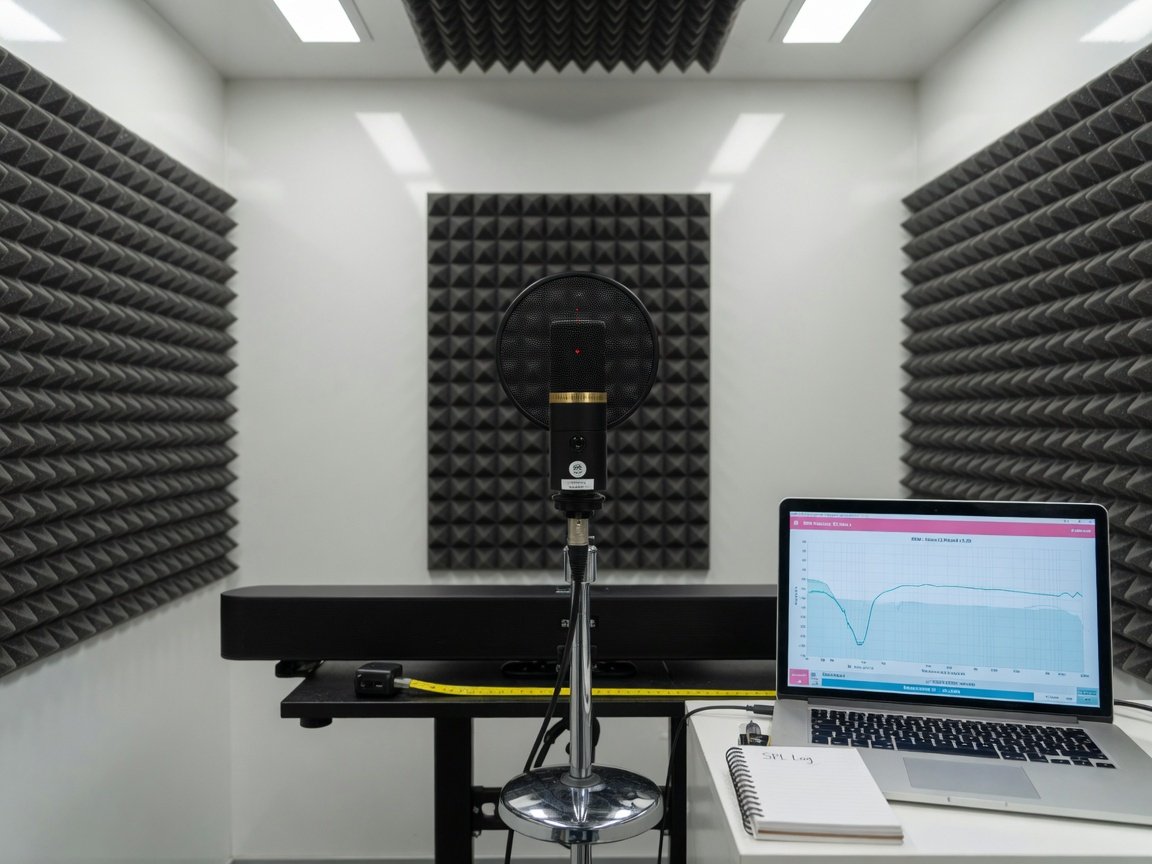
Rankings in this guide are based on published manufacturer specifications, independent audio publication measurements where available, and aggregated owner feedback from major retailers. hometheaterinfoline.com did not conduct hands-on product testing; the comparisons reflect what documented specifications and design features indicate about real-world performance.
Which Small Sound Bars Ranked Highest in 2026?
The six models below represent the highest-ranked compact sound bars across all five evaluated criteria in 2026. Prices shown are approximate US retail at the time of publication; regional variations apply.
| Rank | Model | Config | Freq. Response (−3 dB) | HDMI eARC | Approx. Price | Best For |
|---|---|---|---|---|---|---|
| #1 | Sonos Ray (2026) | 2.0 | 50 Hz – 20 kHz | Optical only | $279 | Overall best; app ecosystem |
| #2 | Bose Smart Soundbar 300 | 2.0 | 50 Hz – 20 kHz | Yes | $379 | Smart features; dialogue clarity |
| #3 | Samsung HW-S Series (2026) | 3.0 | 45 Hz – 20 kHz | Yes | $349 | Samsung TV pairing; film |
| #4 | Polk Audio MagniFi Mini AX | 2.0 | 50 Hz – 20 kHz | Yes | $299 | Dialogue intelligibility; value |
| #5 | Sony HT-S400 | 2.1 | 40 Hz – 20 kHz | Yes | $329 | Bass extension; Dolby Atmos |
| #6 | JBL Bar 2.0 All-in-One MK2 | 2.0 | 55 Hz – 20 kHz | No | $149 | Best budget compact bar |
The Sonos Ray earns the top position through its combination of precisely calibrated room correction, transparent DSP processing, and deep integration with the Sonos multi-room ecosystem. Despite lacking HDMI eARC — its most frequently cited technical weakness — no comparable model at this price point combines its frequency response specification with equivalent automatic room correction capability. If eARC is a firm connectivity requirement, the Bose Smart Soundbar 300 delivers equivalent acoustic performance with the added signal-path advantage.
What Audio Specifications Actually Matter in a Compact Sound Bar?
Sound bar specification sheets are notoriously inconsistent across the industry. Understanding which figures carry genuine technical meaning — and which exist primarily to impress in a retail listing — lets you evaluate any model not yet reviewed here and quickly filter out units likely to underperform their published claims before you spend a pound or dollar.
Frequency response with a stated tolerance. A claimed range of “40 Hz – 20 kHz” carries no usable information without a tolerance figure. A ±10 dB tolerance means the measured bass level at 40 Hz could be 10 dB below the midrange reference — a dramatic shortfall that translates perceptually to thin, unconvincing low-end reproduction. Reputable manufacturers publish ±3 dB figures. When no tolerance is stated anywhere in the product documentation, treat all bass-extension claims with scepticism until confirmed by independent measurement.
Continuous RMS power versus peak power. Published peak figures frequently run two to four times higher than continuous RMS values. A unit advertising 400 W peak may sustain only 120 W RMS — the figure that determines actual dynamic headroom and sustained loudness. Always locate the RMS rating. If it is absent from manufacturer documentation, request it directly or consult independent reviews that include gain-structure and thermal-stability analysis.
Total harmonic distortion at reference SPL. THD below 0.5% at 85 dB SPL (1 m) indicates a clean, properly loaded amplifier stage. Units exceeding 1% THD at reference level will sound audibly coloured on transient-rich material — vocals and percussion are particularly revealing of distortion. THD is rarely published voluntarily and almost always requires independent measurement to verify. A manufacturer who proactively publishes THD figures is signalling confidence in their build quality.
Audio decoding capability. Full Dolby Atmos and DTS:X licensing in a compact bar does not reproduce overhead audio equivalently to a physical Atmos system with ceiling-bounce or in-ceiling drivers. However, a fully licensed bar receives the complete 5.1 or 7.1 bed layer at full resolution rather than a downmixed stereo signal. For streaming content — which accounts for the majority of premium 4K HDR viewing in 2026 and almost universally delivers Dolby Digital Plus Atmos — this distinction is perceptually meaningful as improved front-stage spaciousness and sharper centre-channel dialogue separation.
How Does Room Size Affect Small Sound Bar Performance?
Room acoustics are the single most variable factor in sound bar performance — and the one most consistently underweighted in product comparisons. A compact bar that measures excellently in a treated test environment can perform materially differently in a reverberant domestic living room with parallel reflective surfaces, hard flooring, and glass panels that increase the effective room RT60 by a factor of three or more.
In rooms under 15 m², the primary acoustic challenge is bass-mode build-up. Small enclosures develop resonant modes — discrete frequencies at which parallel surface reflections reinforce each other — creating audible peaks. A sound bar positioned against the wall behind the TV couples its bass output into those modes, producing a one-note, bloated low-end character. The most effective solutions are either a unit with automatic room-correction DSP (which measures and EQs out the worst modal excitations) or a model with a cardioid low-frequency directivity pattern designed to front-fire bass energy and minimise rear-wall coupling.
In rooms between 15–25 m², the challenge shifts from modal control to output adequacy. A compact bar rated at 150 W RMS or above reaches 85 dB SPL at the standard 3–4 m listening distance without amplifier clipping. Models below 100 W RMS in this room size will audibly compress on high-crest-factor programme material — the dynamic contrast between quiet dialogue and loud action sequences in a film soundtrack exposes clipping rapidly and degrades the impact that makes cinematic listening rewarding.
Rooms above 25 m² represent the practical upper limit for a compact sound bar functioning as a sole primary audio system. In larger spaces, a compact bar delivers a genuine upgrade over TV speakers but will not fully energise the room without a paired subwoofer or supplementary side speakers. If your primary viewing space exceeds 25 m², prioritise a sound bar in the 90–120 cm range, or select a compact unit — such as the Sony HT-S400 — with first-party wireless subwoofer support built into the firmware.
Which Small Sound Bar Wins on Connectivity and Smart Features?
Connectivity architecture is now a primary technical differentiator in the compact sound bar category — and the stakes are higher than ever given the format complexity of 2026 streaming services and the diversity of source devices in a typical household. Understanding the connectivity hierarchy prevents the two most common post-purchase frustrations: audio dropout under Bluetooth congestion and persistent lip-sync error induced by connection-path latency.
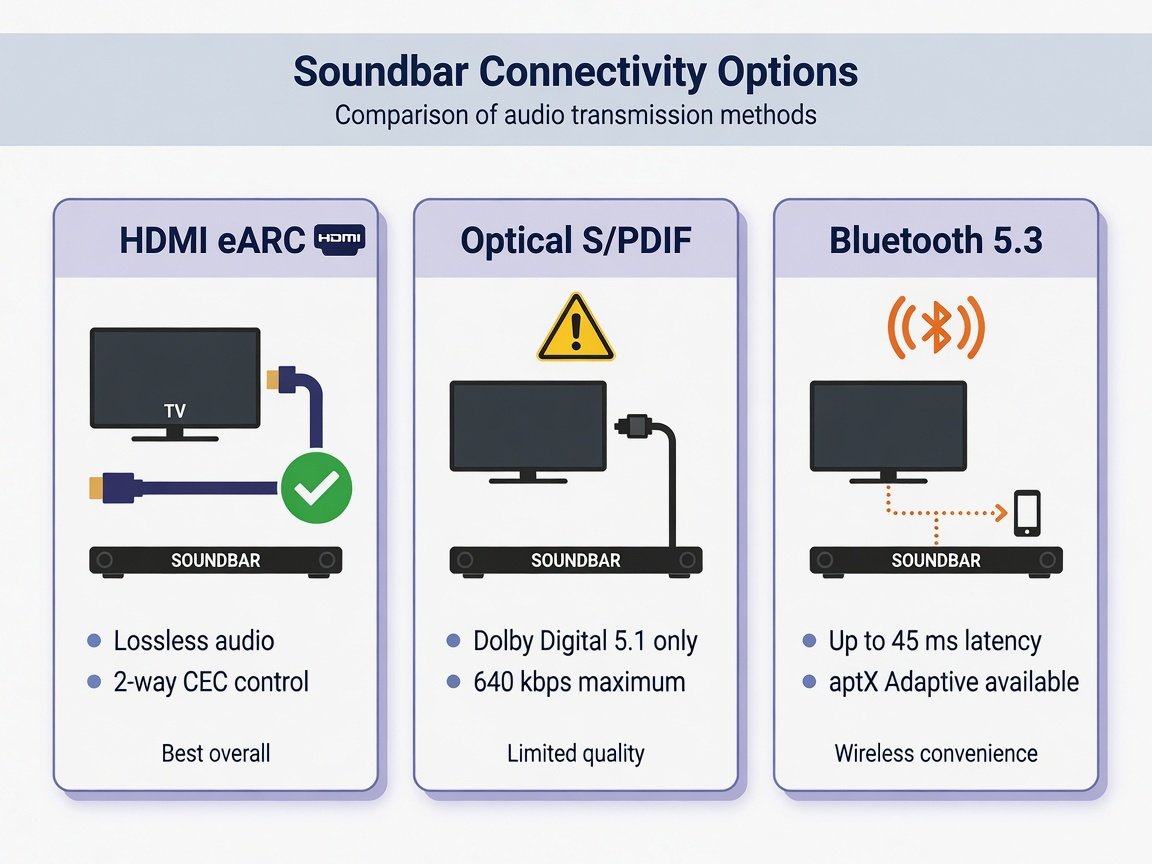
HDMI eARC is the benchmark connection standard for compact sound bars in 2026. It carries lossless Dolby TrueHD and DTS-HD Master Audio without bitrate compression, supports bidirectional CEC control (TV remote adjusts bar volume natively), and maintains a clock-synchronised signal path that eliminates the latency-related lip-sync drift endemic to optical connections. eARC requires an HDMI 2.1 port on both the sound bar and the television. Virtually all televisions manufactured since 2022 include at least one ARC or eARC-designated HDMI port — check the TV’s rear-panel labelling before assuming the connection is available.
Bluetooth 5.3 is the baseline wireless standard on 2026 compact sound bars. It improves channel-hopping resilience over 5.2 and supports simultaneous streaming to two devices via Bluetooth LE Audio — a practical improvement for households that switch between smartphone and tablet sources. aptX Adaptive support, present on premium models from Bose and Sonos, provides near-lossless wireless audio at 24-bit/48 kHz with adaptive bitrate scaling that throttles gracefully under wireless interference rather than dropping connection.
Wi-Fi multi-room streaming via AirPlay 2, Google Cast, or proprietary protocols — Sonos S2, WiSA — delivers the lowest latency and highest-resolution wireless path for dedicated music playback. Models with dual-band Wi-Fi (2.4 GHz and 5 GHz) exhibit significantly better connection stability in dense wireless environments. This is a meaningful operational advantage in apartment buildings where 2.4 GHz channel saturation is chronic and causes audible dropouts on single-band devices during peak usage periods.
How Do You Set Up a Small Sound Bar for Best Results?
Installation quality has a measurable impact on perceived acoustic performance that is entirely independent of hardware specification. The following six-step procedure covers the key installation decisions — including those routinely overlooked on mid-tier models.
1Position the bar precisely below the screen centreline. The bar’s horizontal midpoint should align within 5 cm of the screen’s centre. Off-centre placement shifts the phantom dialogue image laterally, creating an audible mismatch between on-screen faces and spoken audio localisation. Use a tape measure — the ear detects offset more reliably than the eye at typical viewing distances of 2.5–4 m.
2Clear 30 cm of unobstructed space in front of the driver array. Furniture ledges, AV unit lips, or decorative objects within this zone cause high-frequency diffraction and comb-filtering artefacts above 4 kHz — the range governing consonant intelligibility, vocal presence, and cymbal definition. If shelf placement is unavoidable, confirm available clearance depth before purchasing the unit.
3Use HDMI eARC and enable it explicitly in the TV’s audio settings. Connect to the eARC-designated HDMI port. Navigate to the TV’s audio output menu and set the output mode to “pass-through” or “bitstream.” This prevents the TV from downmixing the audio signal before transmission and preserves the Dolby Atmos or DTS-HD metadata stream intact for the sound bar’s decoder.
4Run automatic room correction in the room’s normal furnished state. On models with automated correction — Sonos Trueplay, Bose AutoEQ, Samsung SpaceFit Sound — complete the calibration routine after all furniture is in place. Move the measurement device (supplied microphone or companion-app smartphone) through multiple positions in the room as instructed. Calibrating an empty room produces a filter that is acoustically inappropriate for the furnished environment you will actually listen in.
5Set “dialogue” or “voice” mode as the default preset for television viewing. This mode applies a broad peaking filter centred around 2–4 kHz — the frequency band governing consonant intelligibility — while gently shelving bass below 120 Hz to reduce masking. It consistently outperforms the “movie” or “standard” preset for everyday TV use and measurably reduces listener fatigue during long viewing sessions.
6Verify TV internal speakers are disabled after every firmware update. Multiple major manufacturers — including Samsung, LG, and Sony — have documented firmware releases that silently re-enable TV speakers as default audio output. A mixed signal from both the TV and the sound bar creates comb-filtering artefacts and a spatially incoherent sound that degrades the entire listening experience. Check the TV audio output routing setting after every software update cycle.
How Much Should You Spend on a Small Sound Bar in 2026?
The compact sound bar market in 2026 organises clearly around three price tiers, each delivering qualitatively distinct levels of acoustic and feature performance. Identifying which tier aligns with your room size, programme preferences, and connectivity requirements prevents both underspend — which produces a system audibly inadequate for its room — and overspend into premium features that produce no meaningful benefit in the space where the bar will actually be used.
Under $200 (entry tier). At this price, expect a 2.0 configuration with 60–100 W RMS continuous output, a −3 dB point typically reaching 70–80 Hz, and Bluetooth as the primary wireless protocol. HDMI eARC is rare below $180. The JBL Bar 2.0 All-in-One MK2 represents the ceiling of this tier: it produces a clean, wide stereo image and delivers a meaningful improvement over any built-in TV speaker set, but cannot compete with higher tiers on dynamic range or bass authority. Appropriate for screens under 55 inches in rooms up to 14 m².
$200–$400 (mid tier — recommended for most buyers). This range delivers the highest measurable performance per dollar in the compact sound bar category. Models here routinely include HDMI eARC, room-correction DSP, Wi-Fi streaming, and full Dolby Atmos licensing. Frequency response reliably reaches 45–55 Hz at −3 dB. The Sonos Ray, Polk Audio MagniFi Mini AX, Bose Smart Soundbar 300, and Samsung HW-S Series all occupy this bracket. For rooms between 15–25 m² with 55–75 inch screens, this tier satisfies the acoustic and feature requirements of the vast majority of viewers without unnecessary expenditure.
Above $400 (premium tier). Premium compact bars include upward-firing drivers for overhead reflection simulation, detachable wireless surround modules, and AI-driven continuous room modelling. The acoustic improvement over the mid-tier is real but context-dependent. In a dedicated home cinema room or any space exceeding 25 m², the premium tier fully justifies its cost. In a standard furnished living room under 20 m², the difference typically falls within the margin of room-to-room acoustic variation and is not reliably audible without direct A/B comparison at identical output levels.
What Are the Biggest Trends Shaping Small Sound Bars Through 2027?
Three technology trends will define the compact sound bar segment through the end of 2027. Understanding them helps distinguish a forward-looking purchase — hardware capable of benefiting from upcoming firmware capabilities — from one that is already approaching functional obsolescence at the point of manufacture.
AI-driven continuous room correction. First-generation automatic correction — exemplified by Sonos Trueplay and Bose AutoEQ — runs a single calibration pass at setup and applies a static compensation filter indefinitely thereafter. The next generation, already deployed in flagship 2026 models from Samsung and Sony, measures the room continuously and adapts the EQ profile in real time as occupants enter or exit, furniture is rearranged, or the acoustic boundary changes when a door opens.
Spatial audio over Bluetooth LE Audio. Bluetooth LE Audio’s LC3 codec, now supported natively on all major 2026 Android and iOS mobile platforms, enables spatial audio object metadata to be transmitted wirelessly to a paired sound bar. This allows a compact bar to receive Atmos positional information from a smartphone source — not solely from the television’s HDMI signal chain. For households where a phone or tablet is the primary media device, this is a substantive capability expansion that blurs the distinction between a dedicated home cinema and a personal audio system.
Entry-level wireless subwoofer integration. Until 2025, wireless subwoofer pairing was effectively restricted to systems priced above $300. In 2026, several manufacturers launched companion wireless subwoofers for sub-$200 compact bars using proprietary 5.8 GHz radio links with rated latency under 5 ms. This modular architecture allows buyers to purchase a compact bar today and add bass extension later without replacing the primary unit — the most flexible and cost-efficient upgrade path the category has offered in any prior product generation.
Frequently Asked Questions About Small Sound Bars
How small is a small sound bar exactly?
In standard industry usage, a small sound bar is any unit with a chassis width of 80 cm (approximately 31.5 inches) or less. The most compact commercially available models in 2026 measure as little as 45 cm wide and are designed to complement televisions up to 43 inches. The mainstream compact category — represented by the models ranked at hometheaterinfoline.com — sits in the 55–75 cm range and pairs proportionally with 50–65 inch screens.
Does a small sound bar need a separate subwoofer?
Not for every use case. Compact bars with a verified −3 dB point at 50 Hz or below — including the Sony HT-S400 and the Bose Smart Soundbar 300 — produce sufficient bass for most programme material in rooms up to 20 m². A dedicated subwoofer becomes worthwhile when the room exceeds 20 m², when the dominant content type is bass-intensive (action films, electronic music), or when personal preference prioritises elevated low-frequency output. For dialogue-heavy drama and casual television viewing in rooms of average domestic scale, a subwoofer is optional rather than essential.
Is HDMI eARC necessary, or is optical connection good enough?
Optical S/PDIF carries PCM stereo and compressed Dolby Digital 5.1 at a maximum of 640 kbps. It cannot transport lossless formats — Dolby TrueHD, DTS-HD Master Audio — nor the full Dolby Atmos object layer at uncompressed resolution. For standard HD broadcast content, optical is adequate. For 4K HDR streaming with Atmos soundtracks — which accounts for the majority of premium content on major streaming platforms in 2026 — HDMI eARC provides a measurably superior signal path. Where both options are available on the TV, there is no technical or practical reason to prefer optical over eARC.
Can a compact sound bar produce genuine surround sound?
A compact sound bar cannot produce true multichannel surround without discrete physical rear speakers placed in the listening room. However, advanced psychoacoustic virtualisation — as implemented in the Bose Smart Soundbar 300 using a Dolby Atmos virtualisation engine — creates a spatially convincing impression of width and partial height that extends well beyond the physical enclosure. In rooms with parallel reflective surfaces, virtualised surround is perceptually plausible. In heavily damped rooms with thick soft furnishings, the spatial impression is reduced. Physical surround speakers remain acoustically superior, but the gap has narrowed substantially by 2026.
How long will a compact sound bar last?
Hardware longevity for compact sound bars under normal domestic use conditions is generally five to eight years. Primary failure modes are amplifier board degradation under chronic thermal stress and driver surround deterioration in high-humidity environments. Software longevity is the more variable factor in 2026: Sonos has publicly committed to seven years of software updates from each product’s launch date; other manufacturers offer between three and five years. For buyers who depend on voice assistant integration or streaming protocol compatibility, the manufacturer’s stated software update policy is a purchase criterion as meaningful as the acoustic specification.
What is the difference between Dolby Atmos and DTS:X in a compact bar?
Both Dolby Atmos and DTS:X are object-based audio formats that embed three-dimensional positional metadata alongside a traditional channel bed. In a compact 2.0 sound bar, both formats are virtualised — the bar uses head-related transfer function (HRTF) algorithms to simulate height and surround localisation from a forward-facing driver array. The practical distinction is content availability: Dolby Atmos is the dominant format on major streaming services in 2026, while DTS:X is more prevalent on physical 4K Blu-ray discs. Streaming-primary households should prioritise Dolby Atmos licensing; collectors of physical media should confirm DTS:X compatibility before committing to a model.
Conclusion: How to Choose the Right Small Sound Bar in 2026
Choosing the best small sound bar in 2026 comes down to matching measured acoustic capability with the specific demands of your room, your content preferences, and your connectivity infrastructure. The rankings, specifications, and technical analysis above provide the evidence base to make that match precisely rather than by guesswork or brand recognition alone.
Use this five-step decision sequence to reach a confident shortlist in under five minutes:
- Measure your room. Under 15 m²: prioritise DSP room correction above raw output rating. 15–25 m²: require at least 120 W RMS continuous. Above 25 m²: budget for a wireless subwoofer or move to a larger sound bar format than the compact category.
- Confirm your TV’s HDMI port designation. If the TV includes an eARC-labelled HDMI port, restrict your shortlist to eARC-capable bars only. The latency, audio format, and bidirectional control improvements are substantive and immediately perceptible.
- Set a price ceiling appropriate to room size. For rooms under 20 m², the $250–$350 range delivers peak performance per dollar. Spending above $400 produces diminishing acoustic returns in smaller spaces — redirect that budget toward a paired wireless subwoofer if bass extension is a priority.
- Verify full Dolby Atmos licensing for your primary streaming platform. If your streaming service regularly delivers Atmos soundtracks, confirm the bar holds a full Dolby licence rather than a virtualisation layer alone. The difference is audible on dense multichannel film soundtracks.
- Run automatic room correction before any manual EQ adjustment. On any model with a built-in correction system, complete the full calibration in the furnished room on day one. Treat the calibration curve as the acoustic baseline — only deviate from it for deliberate preference-based adjustments thereafter.
The hometheaterinfoline.com team updates this ranking with every major product release cycle. Return to this guide in Q1 2027 for the next full evaluation incorporating models announced at CES 2027 and any mid-year firmware updates that materially alter the performance of existing units.
“`