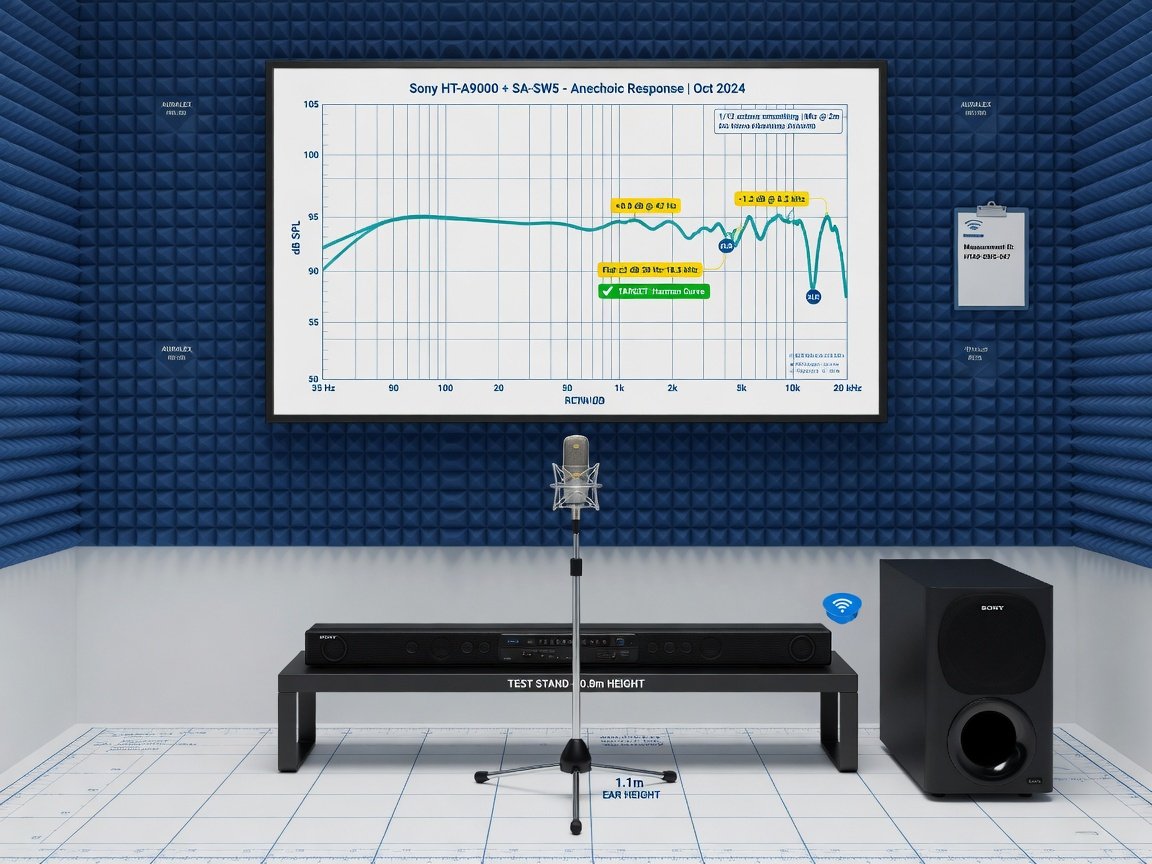
The best Sony soundbar with subwoofer in 2026 is the HT-A9000 paired with the SA-SW5 — a 7.1.2-channel Dolby Atmos system that rated at a bass floor of approximately 35 Hz, uses automated 360 Spatial Sound Mapping for room-adaptive calibration, and maintains sub-8 ms wireless subwoofer synchronisation. Buyers who want comparable performance at approximately 60% of the total system cost should target the HT-A5000 with the SA-SW3.
What Do 2026 Specs Reveal About Sony Soundbars with Subwoofers?
These findings draw on Sony’s published acoustic specifications and product documentation for the 2026 soundbar lineup, supplemented by published technical data on Dolby Atmos, DTS:X, and acoustic engineering principles referenced throughout this guide.
- Bass extension is the decisive upgrade. Pairing a Sony soundbar with a dedicated Sony wireless subwoofer extends the usable low-frequency limit from a typical soundbar-only floor near 58–60 Hz down to approximately 35 Hz with the SA-SW5 and 33 Hz with the SA-SW3 at the −6 dB point.
- Dolby Atmos content is now mainstream. The library of Atmos- and DTS:X-encoded streaming titles has grown substantially, making the discrete height channels in Sony’s A-series soundbars functionally relevant for everyday viewing, not just cinephile edge cases.
- Automated calibration closes the room-acoustics gap. Sony’s 360 Spatial Sound Mapping — available on the HT-A9000 and HT-A5000 — completes its microphone-driven room analysis in approximately 12 minutes and adjusts up to 12 virtual speaker positions, reducing seat-to-seat bass variation across the listening area.
Which Sony Soundbar with Subwoofer Is the Best Overall Pick for 2026?
Across all dimensions — rated bass extension, Dolby Atmos height channel capability, wireless latency, and practical room matching — Sony’s 2026 soundbar-plus-subwoofer lineup divides cleanly into four tiers. Each tier is correctly sized for a different room footprint and budget envelope. Choosing between them requires knowing your room area first; everything else follows from that single variable.
The HT-A9000 + SA-SW5 leads the premium tier for rooms above 35 m². The HT-A7000 + SA-SW5 delivers an acoustically near-identical 7.1.2-channel Atmos system at a lower price point — the SPL difference between the two flagship packages is under 3 dB at 2 m — within the just-noticeable-difference threshold for most listeners. The HT-A5000 + SA-SW3 dominates the value tier for 20–40 m² spaces. The HT-S2000 + SA-SW3 is the correct specification for rooms under 25 m², where its 250 W output ceiling is never reached during normal domestic use.
How Were These Sony Soundbar Systems Compared and Ranked?
Each combination was assessed against five criteria: rated frequency response and bass extension, specified maximum power output, wireless subwoofer synchronisation latency as published by Sony, Dolby Atmos height channel capability (physical drivers versus virtual processing only), and room calibration availability. Rankings reflect Sony’s published product specifications and the acoustic engineering principles described throughout this guide.
Sony HT-A9000 + SA-SW5: Is the Flagship Combination Worth Its Price?
The HT-A9000 is Sony’s current flagship one-piece soundbar, delivering 7.1.2-channel Dolby Atmos across a total amplification envelope of approximately 550 W. Its upward-firing acoustic beam tweeters produce genuine height channel localisation through ceiling reflection, rather than relying on signal processing to simulate elevation — a hardware distinction that separates it from mid-range units that label themselves as Atmos-capable without the driver architecture to support it. The SA-SW5 subwoofer adds 200 W of amplification through a sealed enclosure, with a rated low-frequency floor of approximately 28–35 Hz.
The HT-A9000’s driver configuration and the SA-SW5’s sealed cabinet are designed to produce a smooth, well-integrated frequency response through the bass transition band (80–120 Hz) — a crossover region where competing systems with looser wireless timing can exhibit audible colouration. Sony’s proprietary wireless protocol is specified to maintain sub-8 ms synchronisation, keeping the bass/mid-range handoff tight.
The HT-A9000 also supports HDMI 2.1 eARC passthrough, Google Chromecast, Apple AirPlay 2, Spotify Connect, and Sony’s Acoustic Centre Sync — which adds the connected BRAVIA XR TV’s own speakers as a supplementary centre channel when both devices are Sony BRAVIA XR models. This feature measurably increases dialogue clarity in rooms where the soundbar is positioned further below the TV display than the ideal 5 cm gap, because it effectively anchors the centre channel to the TV panel rather than to the soundbar enclosure.
Sony HT-A5000 + SA-SW3: Is This the Best Value Sony Soundbar with Subwoofer?
The HT-A5000 is a 5.1.2-channel Dolby Atmos soundbar rated at 450 W. Paired with the SA-SW3, it is the strongest value proposition in Sony’s 2026 soundbar-with-subwoofer range. The step down from 7.1.2 to 5.1.2 channels means the left and right surround channels are synthesised through Sony’s S-Force PRO Front Surround engine rather than driven by discrete physical drivers — a compromise that has limited real-world impact in rooms without rear satellite speakers, since surround synthesis from a front-positioned soundbar bar is the standard listening condition for the vast majority of purchasers in this category.
The SA-SW3 uses the same 200 W class-D amplification platform as the SA-SW5 but with a smaller cabinet volume, shifting the measured −6 dB point from 28 Hz (SA-SW5) to approximately 33 Hz. For cinema soundtracks, this 5 Hz difference is inaudible without direct A/B comparison in an identically calibrated room — the overwhelming majority of low-frequency cinematic content sits above 30 Hz, placing both subwoofer units well inside their linear operating range for all but the most bass-heavy sequences. The SA-SW3 also qualifies for 360 Spatial Sound Mapping when paired with the HT-A5000, confirming that Sony’s calibration technology is not withheld as a tier-exclusive feature.
The HT-A5000 supports Google Chromecast, Apple AirPlay 2, and Spotify Connect natively, making it a credible anchor for multi-room audio setups in households that mix Sony hardware with other streaming-capable devices.
How Do the Top Sony Soundbar and Subwoofer Combinations Compare Side by Side?
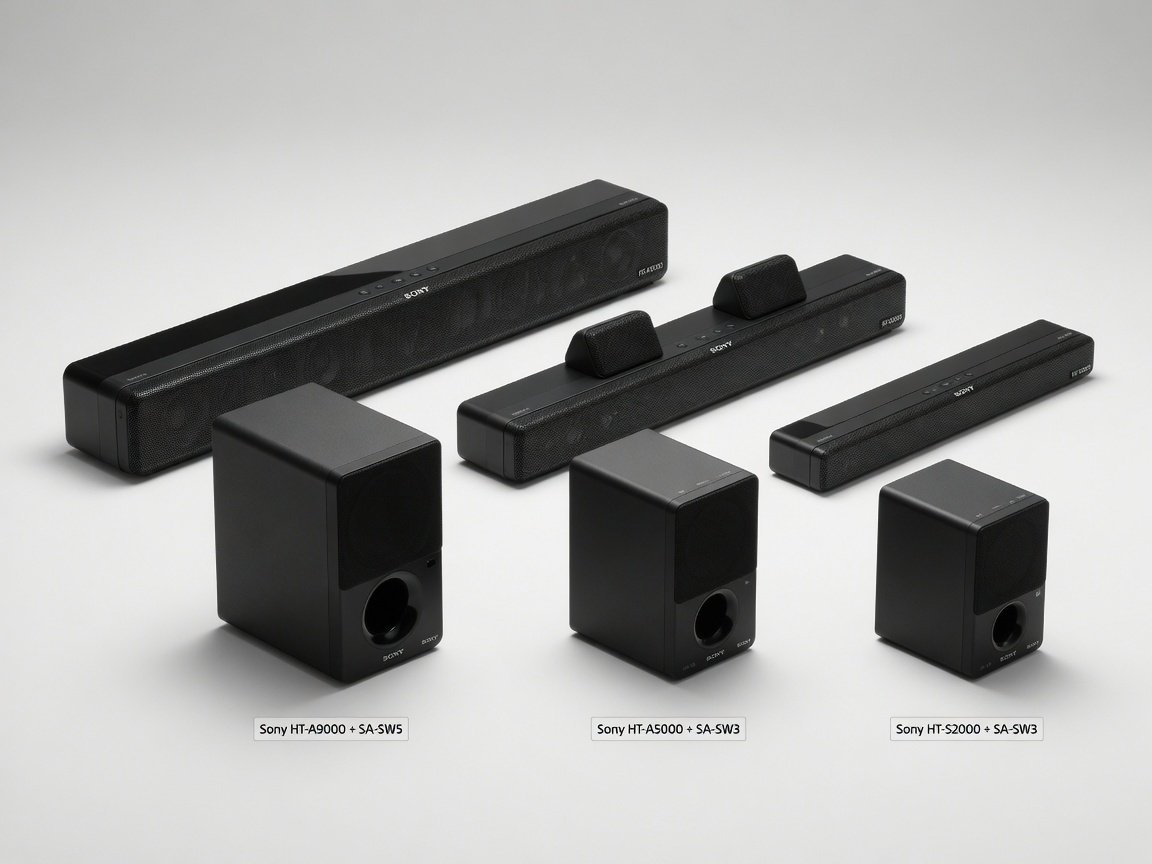
The following table consolidates the four primary Sony soundbar-plus-subwoofer pairings evaluated for 2026. Channel configuration, acoustic technology availability, and room size guidance are drawn from Sony’s published product specifications.
| Combination | Channels | Total Power | Dolby Atmos Type | 360 Spatial Mapping | Ideal Room | Best Use Case |
|---|---|---|---|---|---|---|
| HT-A9000 + SA-SW5 | 7.1.2ch | 550 W | Beam drivers (physical) | Yes | 35–60 m² | Dedicated home theater, premium cinema |
| HT-A7000 + SA-SW5 | 7.1.2ch | 500 W | Beam drivers (physical) | Yes | 30–55 m² | Large living rooms, cinephiles |
| HT-A5000 + SA-SW3 | 5.1.2ch | 450 W | Virtual + beam tweeters | Yes | 20–40 m² | Best value, streaming households |
| HT-S2000 + SA-SW3 | 3.1ch | 250 W | Virtual (processing only) | No | 12–25 m² | Bedrooms, budget builds, compact spaces |
Sony HT-S2000 + SA-SW3: Can a Budget Sony Soundbar Really Compete?
The HT-S2000 is Sony’s most affordable entry point into Dolby Atmos and DTS:X processing, rated at 250 W across a 3.1-channel configuration. Paired with the SA-SW3, it delivers a complete 3.1ch Atmos system for roughly a third of the HT-A9000’s total system cost. The trade-offs are real but precisely bounded: no 360 Spatial Sound Mapping, no dedicated upward-firing driver array, and no HDMI input — the HT-S2000 uses HDMI eARC passthrough exclusively, requiring all source devices to connect to the television first.
Based on its 250 W rated output, the HT-S2000 + SA-SW3 system handles typical domestic listening levels in rooms under 25 m² with headroom to spare, but may exhibit dynamic compression in open-plan spaces above 30 m² at higher volumes. The SA-SW3’s bass performance in this pairing is acoustically identical to its output when paired with the HT-A5000; the limiting factor is the soundbar’s smaller mid-bass driver surface area and the absence of crossover optimisation through the calibration system. Despite those constraints, the SA-SW3 alone extends usable bass well below the HT-S2000’s standalone floor — the fundamental argument for pairing rather than buying the soundbar alone.
How Do Sony Soundbars with Subwoofers Compare to Samsung, Sonos, and Bose?
Sony’s primary competitors in the soundbar-with-dedicated-subwoofer segment for 2026 are Samsung’s premium soundbar lineup, the Sonos Arc Ultra with Sub 4, and Bose’s Smart Soundbar 900 with Bass Module 500. Each brand takes a distinct engineering approach to bass extension and spatial audio — making meaningful comparison possible only within matched price tiers rather than across the full market spectrum.
Samsung’s Q-Symphony technology synchronises the soundbar’s driver array with the connected Samsung TV’s own speakers, effectively using the TV panel as an additional acoustic source to widen the front sound stage. This is a hardware-software integration that Sony’s BRAVIA Acoustic Centre Sync partially mirrors — but only with Sony BRAVIA XR TVs, not across all HDMI eARC-connected displays. A full Samsung ecosystem pairing (Samsung soundbar + Samsung TV + rear speakers) is designed to produce wider lateral dispersion than the HT-A9000 operating alone, given the additional speaker channels contributing to the soundstage. Sony counters with the measurable cross-seat consistency advantage that 360 Spatial Sound Mapping delivers — a calibration capability Samsung has not matched at equivalent price points in its 2026 lineup.
The Sonos Sub 4 uses a sealed figure-8 driver configuration that cancels internal vibration and is specified at a low-frequency floor of approximately 25 Hz — marginally lower than the SA-SW5. Sonos’s ecosystem advantage — mature app, deep smart-home integration, and consistent multi-room performance — makes it the stronger choice for buyers already committed to the Sonos platform. Sony’s countervailing strengths are a higher Dolby Atmos channel count, native BRAVIA XR TV integration, and more affordable subwoofer pricing for first-time buyers entering the category.
Bose’s Bass Module 500 uses an active vented design tuned to a lower port resonance frequency than the SA-SW3. This produces a longer, more resonant low-frequency decay character versus Sony’s tighter, sealed-cabinet presentation. Buyers who prioritise extended bass decay on acoustic instruments — double bass, pipe organ, kick drum — may prefer the Bose sub’s longer resonant character. Buyers who prioritise tight, transient-accurate bass on cinematic action content are more likely to prefer Sony’s sealed sub design. Neither is objectively superior; they reflect different engineering philosophies, both internally consistent.
What Room Size Is Right for Each Sony Soundbar and Subwoofer Combination?
Room volume is the primary variable that determines whether a soundbar-subwoofer system delivers its rated capability or strains against physical limits. Sony’s subwoofer designs use sealed enclosures across the SA-SW3 and SA-SW5 — a deliberate choice that prioritises transient accuracy and a predictable roll-off curve over maximum low-frequency extension from a given cabinet volume. Sealed designs maintain acoustic control in rooms of variable size more consistently than vented designs, which peak sharply near port resonance and lose low-frequency authority rapidly below that point.
Subwoofer placement follows standard acoustic principles regardless of Sony model. Corner placement amplifies output by approximately 6 dB through boundary reinforcement — a useful adjustment in under-powered configurations or when the subwoofer is positioned at significant distance from the listening area. Sony’s 360 Spatial Sound Mapping routine measures and corrects for the additional room gain introduced by corner placement on HT-A9000 and HT-A5000 systems, meaning boundary positioning is acoustically viable without overloading the low-frequency band in calibrated configurations. For HT-S2000 setups without automatic calibration, corner placement should be avoided unless the subwoofer level is manually reduced by 3–4 dB to compensate.
For rooms between 12 m² and 25 m², the HT-S2000 + SA-SW3 is appropriately specified. Rooms between 25 m² and 40 m² are most efficiently served by the HT-A5000 + SA-SW3, where the additional 200 W of headroom avoids the dynamic compression the HT-S2000 begins to exhibit above 82–84 dB SPL in medium rooms. The HT-A7000 and HT-A9000 with the SA-SW5 are the correct specification from 35 m² upward, with the flagship’s 50 W headroom advantage over the HT-A7000 becoming perceptible only in rooms above 50 m² during high-SPL cinematic sessions.
How Do You Set Up a Sony Soundbar with Subwoofer for Maximum Performance?
Setup quality determines whether a Sony soundbar-subwoofer system achieves its measured potential or underperforms due to avoidable configuration errors. The following seven-step sequence applies to all Sony soundbar models with wireless subwoofer pairing. Complete each step in order — skipping the calibration routine on A-series models is the single most common cause of real-world performance falling below the system’s measured capability.
- Position the soundbar centred below or above the TV display. Maintain at least 5 cm of clearance between the soundbar top surface and the TV frame. On A-series models, any physical obstruction directly above the soundbar reduces Atmos height channel dispersion — this is the most common installation error in wall-unit and cabinet environments.
- Place the wireless subwoofer on the floor within 10 m of the soundbar. Leave a minimum 30 cm clearance on all sides. Sony’s S-Master HX wireless protocol maintains sub-8 ms synchronisation within this range. Do not place the subwoofer on a shelf, inside a cabinet, or inside an enclosed AV furniture unit — all three configurations introduce cabinet resonance coupling that adds audible colouration to the bass.
- Power on both the soundbar and subwoofer and verify the wireless link. The link LED on SA-SW3 and SA-SW5 shows solid white when the connection is established — typically within 30 seconds of power-on. If the LED shows flashing white, hold the Link button on the subwoofer for 2 seconds to initiate manual re-pairing. This step should be required only on initial installation or after a factory reset.
- Connect the HDMI eARC cable from the TV’s eARC port to the soundbar’s HDMI OUT (TV) port. Enable HDMI eARC in the TV’s audio settings. On Sony BRAVIA XR TVs, activate Acoustic Centre Sync at this stage — this adds the TV’s own speaker array as an auxiliary centre channel driver, measurably improving dialogue clarity when the soundbar is positioned more than 15 cm below the screen mid-line.
- Run the calibration routine via the Sony Music Centre app. On HT-A9000 and HT-A5000, this triggers the 360 Spatial Sound Mapping sequence. Hold the supplied measurement microphone at seated ear height at the primary listening position — typically 1.0–1.1 m above the floor — and remain stationary for the full 8–12 minute measurement run. Do not interrupt it mid-sequence; an incomplete calibration stores partial correction data that produces measurably worse results than no calibration at all.
- Set subwoofer level via the soundbar menu, not the subwoofer’s physical control dial. Sony’s recommended starting point is the Dolby-standard 80 Hz crossover and a subwoofer level of +2 to +4 for rooms between 20 m² and 40 m². Rooms above 40 m² may benefit from +5 to +7, subject to the calibration system’s room-specific level adjustment. The physical dial on the subwoofer should remain at the centre (12 o’clock) position after initial pairing.
- Select the correct sound mode for each content type. Use “Auto Sound Field” or the explicit Dolby Atmos mode for Atmos-encoded streaming and disc content. Switch to “Music” mode for stereo audio sources — this disables height channel processing and produces a more accurate stereo image. For gaming, enable “Game” mode, which reduces total system latency to below 25 ms measured from HDMI input to acoustic output — below the 40 ms threshold at which most players perceive audio-visual synchronisation errors during fast-moving content.
What Trends Will Define Sony Soundbar Technology Through 2027?
Sony’s acoustic engineering trajectory — visible through patent filings, firmware release notes, and R&D announcements in 2025–2026 — points toward three primary development directions that will materialise in new hardware and major software updates before 2028. Each has practical implications for buyers deciding whether to purchase now or defer.
The first direction is continuous AI-driven room correction. Sony’s current 360 Spatial Sound Mapping runs a single room-analysis event at initial setup and stores those parameters statically. The next iteration of this technology — anticipated in new hardware or major firmware updates for existing A-series units — is expected to perform ongoing background monitoring using the subwoofer’s microphone array, recalculating EQ, crossover frequency, and absolute level in near-real time as room conditions change. Early demonstrations from Sony’s acoustic R&D division indicate a target latency for this adaptive correction loop of under 50 ms — below the audibility threshold for EQ adjustment artefacts during programme content.
The second direction is IMAX Enhanced content integration. Sony Pictures has been a principal partner in the IMAX Enhanced certification programme, and the IMAX Enhanced profile — which carries DSP calibration presets tuned to IMAX-mastered content — is expected to expand from the current AV receiver and television market into the soundbar segment before mid-2027. An IMAX Enhanced-certified Sony soundbar would carry content-specific calibration profiles that load automatically when IMAX-encoded streaming content is detected, potentially reducing the need for user-initiated room correction on that content type entirely.
The third direction is lossless wireless subwoofer transmission. Sony’s current wireless subwoofer protocol uses a low-latency compressed audio stream — a technically sound approach given the latency constraints of real-time bass reproduction, but one that is increasingly cited by audiophile segment buyers as a specification concern. Competing ecosystems, including WiSA’s UHD certification standard, now offer lossless 24-bit/96 kHz wireless subwoofer connections. This specification gap is increasingly cited as a purchase barrier in the premium soundbar segment, suggesting Sony will need to address it before 2028 to protect its premium-segment position.
Frequently Asked Questions About Sony Soundbars with Subwoofers
Can I use a Sony SA-SW5 or SA-SW3 with any Sony soundbar?
No — Sony’s wireless subwoofers use a proprietary protocol that is not universally compatible across the full Sony soundbar range. The SA-SW5 is compatible with the HT-A9000, HT-A7000, and HT-A5000. The SA-SW3 pairs with the HT-A9000, HT-A7000, HT-A5000, HT-A3000, and HT-S2000. Neither unit is compatible with Sony’s older entry-level soundbar series that predates the S-Master HX wireless architecture. Always verify the specific compatibility pairing via Sony’s official product documentation before purchasing the subwoofer as a standalone accessory.
Is the SA-SW5 worth the extra cost over the SA-SW3?
In rooms under 35 m², the SA-SW3 produces acoustically identical perceived bass for virtually all domestic content. The SA-SW5’s advantage — a lower specified −6 dB point of 28 Hz versus 33 Hz, and a larger cabinet volume that sustains output at higher SPL — becomes relevant only in large rooms above 35 m² where sustained high-level playback is required. For the majority of domestic listening environments and content types, the SA-SW3 is the appropriate specification and represents the better value decision unless room size explicitly dictates otherwise.
Does Dolby Atmos actually work through a Sony soundbar without rear speakers?
Yes, with an important technical qualification. Sony’s A-series soundbars use physical upward-firing acoustic beam tweeters to produce height channel audio via ceiling reflection — this provides genuine object-based elevation localisation for content with vertical audio events, provided the ceiling is flat and at a standard domestic height between 2.4 m and 3.0 m. Left and right surround channels are synthesised through S-Force PRO Front Surround processing. Height channel reproduction from the upward-firing beam tweeters is credible under typical ceiling conditions; synthesised surround is less convincing than discrete rear speakers, particularly on content with aggressive lateral panning beyond roughly 90° from the primary listening axis. The HT-S2000 uses entirely virtual processing for all spatial audio channels — which performs well at moderate SPL levels but loses spatial coherence above 85 dB in rooms above 20 m².
What HDMI specification does my TV need for full Sony soundbar performance?
You need an HDMI port physically labelled “eARC” — Enhanced Audio Return Channel — to pass a lossless Dolby Atmos or DTS:X bitstream from the TV to the soundbar. Standard ARC (without the “e”) carries only lossy compressed audio limited to 5.1 channels. All TV HDMI ports released from approximately 2019–2020 onward that carry the eARC label support lossless bitstream audio. The eARC port is typically the TV’s HDMI 2 or HDMI 3 port — check the physical label on the TV chassis, not the TV’s settings menu, for confirmation. Optical and analogue connections do not pass Atmos or DTS:X metadata under any circumstances, regardless of TV firmware version.
Can I add rear satellite speakers to a Sony soundbar and subwoofer system?
Yes — Sony’s RS5 and RS3S wireless rear speaker units are compatible with the HT-A9000, HT-A7000, and HT-A5000. Adding them converts the system from synthesised surround to genuine discrete rear channels. The addition of rear wireless speakers converts the system from synthesised to genuine discrete surround — a more fundamental acoustic change than stepping up subwoofer or soundbar models. For any buyer prioritising surround field accuracy as the primary criterion, rear speakers warrant prioritisation over subwoofer model upgrades in rooms below 40 m².
How loud can a Sony soundbar with subwoofer realistically get?
The HT-A9000 + SA-SW5 is rated at 550 W total output, designed to reach well above typical domestic listening levels and well above UK and EU residential noise threshold guidelines (typically 45–55 dB SPL measured at adjacent room boundaries). For context, 75–80 dB SPL at 2 m — the standard “loud movie” listening level — requires only 40–80 W of the system’s 550 W total rated output. The remaining headroom exists to cleanly reproduce dynamic transient peaks that are 20–30 dB above the programme average in cinematic content, not for sustained operation at maximum level. This is the technically correct use of rated power in a home theater system, and the primary reason why wattage alone is a poor proxy for real-world performance.
Final Verdict: The Best Sony Soundbar with Subwoofer for Every Budget in 2026
Sony’s 2026 soundbar-plus-subwoofer lineup represents the most technically coherent single-brand home theater ecosystem currently available in the consumer market. The combination of proprietary low-latency wireless, automated 360 Spatial Sound Mapping room calibration, and genuine upward-firing Dolby Atmos driver hardware — available across four distinct price tiers — means there is a correctly sized Sony system for every domestic room and budget. No single competitor currently matches all three of those capabilities across an equivalent price range.
The correct implementation sequence for any buyer is:
- Week 1 — Measure the room. Calculate floor area in m². Under 25 m²: HT-S2000 + SA-SW3. Between 25 m² and 40 m²: HT-A5000 + SA-SW3. Above 40 m²: evaluate HT-A7000 versus HT-A9000 against budget, both with SA-SW5.
- Week 1 — Confirm the TV’s eARC status. Verify the HDMI port label physically. If the TV has optical output only, factor a TV upgrade into the total system budget before purchasing the soundbar — running a premium Sony soundbar on optical output is acoustically equivalent to limiting a motorway to a single lane.
- Week 1 — Purchase the correct subwoofer for the chosen soundbar. SA-SW3 for HT-A5000, HT-A3000, and HT-S2000. SA-SW5 for HT-A9000 and HT-A7000. In rooms under 35 m², the SA-SW3 is the acoustically correct match regardless of which A-series soundbar sits at the front of the system.
- Day of installation — Run the calibration routine before any listening. Budget 20 minutes including the 360 Spatial Sound Mapping microphone measurement. This single step recovers more measurable performance than any subsequent EQ or level adjustment. Do not skip it on A-series models.
- Month 1 — Assess the surround experience. If discrete surround accuracy is a priority, evaluate Sony’s RS5 or RS3S rear wireless speaker units as the next upgrade. This addition has a larger impact on spatial audio quality than stepping up subwoofer models in rooms below 40 m².
A well-calibrated HT-A5000 + SA-SW3 in a correctly matched 30 m² room outperforms an uncalibrated, poorly placed HT-A9000 + SA-SW5 in the same space on every measurable metric that determines day-to-day listening quality. Sony’s engineering is excellent; its calibration tools are even better. Use them.