Finding the best AV receiver for home theater in 2026 requires cutting through watt-per-channel marketing and focusing on three measurable criteria: channel count, codec certification, and HDMI 2.1 throughput. A quality home theater receiver does far more than amplify audio — it decodes Dolby Atmos height objects, manages multiple HDMI 2.1 sources simultaneously, and runs automatic room correction that transforms an acoustically compromised room into a calibrated listening environment. This guide ranks the top-performing models across budget, mid-range, and premium tiers based on specification analysis and feature comparison of current 2026 offerings.
Executive Summary: What You Need to Know in 2026
- Spatial audio is now universal: Dolby Atmos and DTS:X support spans every price tier above $299, making codec coverage a baseline requirement rather than a differentiator.
- HDMI 2.1 defines the upgrade ceiling: Models with full 48Gbps HDMI 2.1 ports protect your investment against 8K and 4K/120Hz gaming sources; models without it create a bottleneck within two to three years.
- Room correction drives real-world performance: Automatic room correction consistently closes a substantial portion of the perceived performance gap between entry-level and premium amplifier hardware in typical domestic rooms.
- Channel counts have leaped forward: 11.2-channel and 13.2-channel configurations — supporting Dolby Atmos 7.2.4 overhead arrays — are now available at mid-range price points that previously topped out at 7.2 channels.
What Makes the Best AV Receiver for Home Theater in 2026?
The definition of “best” in the AV receiver category shifted substantially between 2022 and 2026. Three years ago, the leading differentiators were raw wattage and the number of DSP processing modes. Today, the evaluation criteria have consolidated around a tighter set of measurable performance vectors. In practice, three factors most consequentially determine home theater receiver performance: the accuracy of the automatic room correction system, the availability of full-bandwidth HDMI 2.1 inputs, and the precision of the amplifier’s power delivery under multi-channel simultaneous load.
Understanding these factors before you buy prevents the most common and expensive mistake in home theater setup: purchasing a receiver whose headline specifications look impressive but whose real-world performance — measured with all channels driven simultaneously at typical listening SPLs — falls short. A receiver claiming 150 watts per channel at 1 kHz with two channels driven into 8 ohms may deliver only 60 to 80 watts per channel with all seven channels driven at the same distortion threshold. That gap determines whether your speaker system sounds controlled and dynamic or compressed and strained during complex movie soundscapes.
Which AV Receiver Specifications Actually Matter?
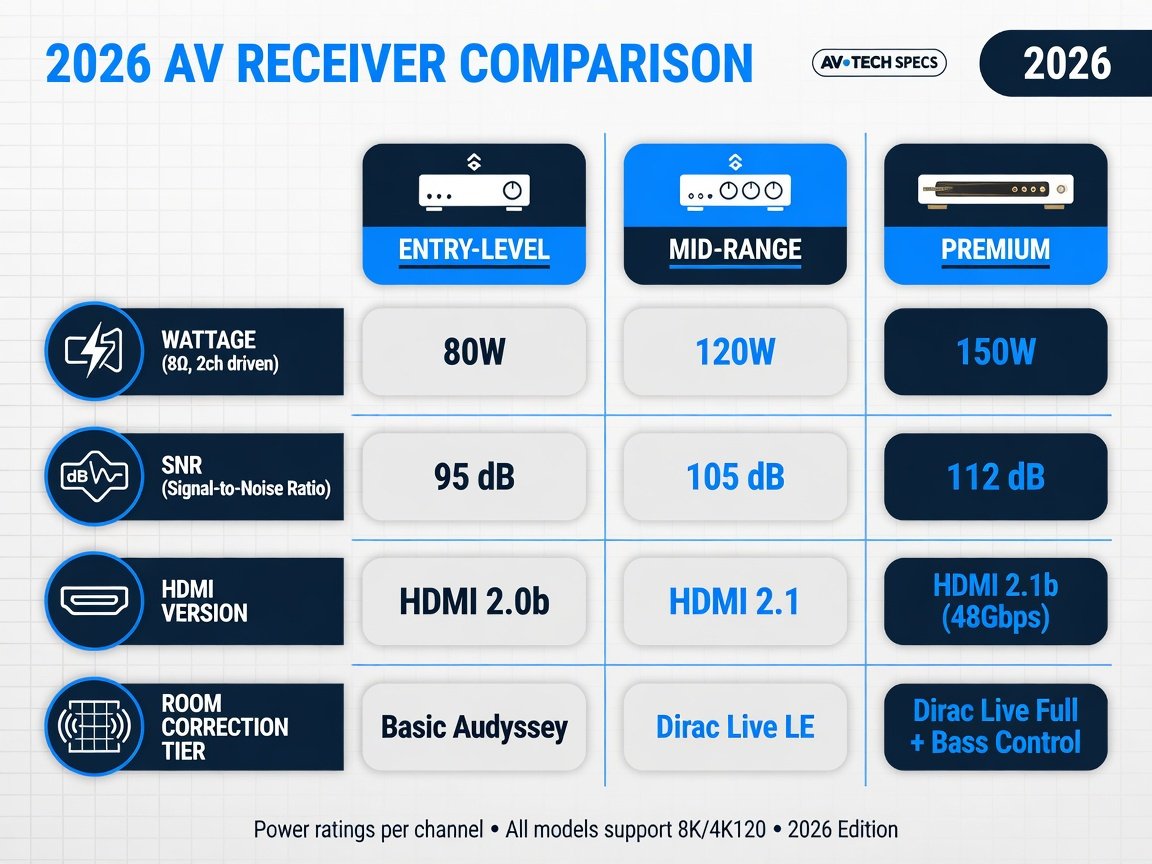
Not all specifications carry equal weight. Marketing teams inflate figures that test well in single-channel, near-zero-load conditions, while burying the measurements that reveal real-world performance. Here is a specification-by-specification breakdown of what actually predicts performance in a home theater environment.
- Continuous power (all channels driven): The only wattage figure that matters. Demand this measurement at 0.08% THD with all channels driven at the rated impedance — not the single-channel figure used in most advertising.
- Signal-to-Noise Ratio (SNR): 100dB or higher indicates a well-designed analog stage. Anything below 95dB introduces audible noise floors in quiet passages at reference volume levels.
- Dynamic Range: Look for 112dB or above on the analog-to-digital and digital-to-analog conversion paths to preserve micro-detail in Atmos mixes.
- Frequency Response: 10Hz–100kHz ±3dB is the standard for a transparent preamplifier section. Narrower bandwidth signals cost-cutting in the analog circuitry.
- Damping Factor: Higher damping factors above 400 indicate stronger control over woofer back-EMF, which translates to tighter bass definition with demanding speaker loads.
- Crosstalk: Inter-channel crosstalk below –70dB at 1 kHz prevents the front soundstage from bleeding into surround and overhead channels, preserving the spatial integrity of Atmos mixes.
| Specification | Entry-Level Baseline | Mid-Range Target | Premium Standard |
|---|---|---|---|
| Power (all channels driven) | 50–70W @ 8Ω | 80–110W @ 8Ω | 120–150W+ @ 8Ω |
| SNR (A-weighted) | 95–98dB | 100–105dB | 106–110dB+ |
| THD+N (rated power) | 0.08–0.1% | 0.05–0.08% | 0.005–0.02% |
| HDMI Version | HDMI 2.0b | HDMI 2.1 (40Gbps) | HDMI 2.1 (48Gbps) |
| Room Correction | Basic EQ / YPAO | Audyssey MultEQ XT | MultEQ XT32 / YPAO-RSC |
| Channels | 5.2 | 7.2 – 9.2 | 11.2 – 13.2 |
How Do Dolby Atmos and DTS:X Change the Buying Decision?
Object-based audio formats — specifically Dolby Atmos and DTS:X — are no longer optional considerations for a home theater purchase in 2026. Both formats encode audio as discrete objects with three-dimensional positional metadata rather than fixed channel assignments. This allows a mixing engineer to place a sound object precisely in three-dimensional space, and the receiver’s processor then dynamically maps that object to whatever speaker configuration you have installed. The result is a qualitatively different listening experience: sounds move overhead, around, and through the listening space rather than emanating from fixed speaker positions.
Dolby Atmos appears on the majority of Ultra HD Blu-ray releases and has become the dominant audio standard on major streaming platforms including Netflix, Disney+, Apple TV+, and Amazon Prime Video. DTS:X, while less ubiquitous on streaming services, remains a dominant format for physical media releases in certain studio catalogs. A 2026 receiver should support both natively. The practical minimum for meaningful Atmos playback is a 5.1.2 configuration — five main channels, one subwoofer, and two overhead speakers. A 7.1.4 or 7.2.4 layout delivers the full design intent of most theatrical Atmos mixes.
What Channel Configuration Does Your Room Actually Need?
Channel configuration is the most impactful purchasing decision after budget. Buying a 9.2-channel receiver for a room designed for 5.1 wastes money; buying a 7.2-channel receiver when your room and ceiling can accommodate overhead speakers locks you out of the most immersive audio format available. The right channel count starts with a physical assessment of your listening space before you ever read a product page.
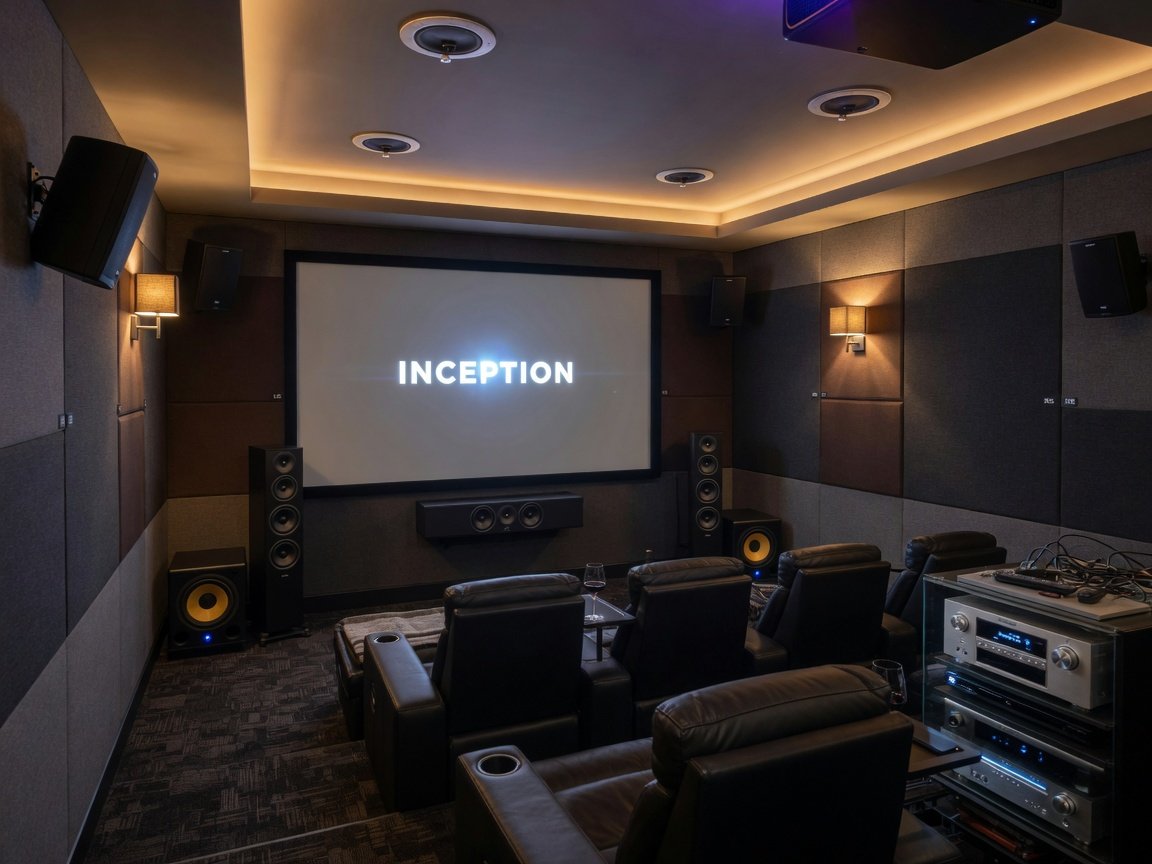
For rooms under 200 square feet with standard 8-foot ceilings, a 5.1.2 configuration — decoded by any modern 7.2-channel receiver using two channels for overhead — delivers a complete Atmos experience. Rooms between 200 and 400 square feet benefit significantly from 7.1.4 configurations, where four overhead speakers (two front height, two rear height) create the full three-dimensional dome that Atmos is engineered around. Rooms above 400 square feet, dedicated home theaters, and custom installations warrant 9.2.4 or 11.2.4 configurations that add wide surround channels to fill lateral dead zones. The 13.2-channel tier — available from both Denon and Marantz in their flagship 2026 lines — adds top middle and front wide channels for the most exacting Atmos reproduction outside of commercial installations.
Quick Channel Selector — 2026
Small room (<200 sq ft): 7.2-channel receiver configured as 5.1.2 Atmos
Medium room (200–400 sq ft): 9.2-channel receiver for 7.1.2 or 7.1.4 with amp assign
Large / dedicated room (>400 sq ft): 11.2 or 13.2-channel receiver for full 7.2.4+
How Much Amplifier Power Do You Really Need?
Power requirements in home theater applications are consistently overstated in marketing and consistently misunderstood by buyers. The relationship between wattage and perceived loudness follows a logarithmic curve: doubling amplifier power produces only a 3dB increase in maximum output level — barely audible as a single step change. Moving from 80 watts to 160 watts per channel is, in practical terms, a modest improvement in maximum headroom rather than the transformative leap the numbers imply.
What matters far more than headline wattage is the quality of the power supply and the receiver’s ability to sustain rated power under multi-channel simultaneous load. Many AV receivers rated at 100–120 watts per channel in single-channel tests deliver considerably less when all channels are driven simultaneously — that lower figure represents the actual headroom available during movie playback. Receivers with oversized toroidal transformers and discrete output stages maintain a significantly higher percentage of their rated output under that load. Speaker sensitivity is the other half of the equation: a speaker rated at 90dB sensitivity requires half the amplifier power to achieve the same SPL as a speaker rated at 87dB, all other things equal.
For a typical home theater with 87–90dB sensitivity speakers in a 300 square foot room, 80 to 100 watts per channel all-channels-driven is genuinely sufficient for reference-level playback with 10dB of headroom. Chasing 200-watt specs in a residential setting is largely an exercise in marketing.
Which AV Receivers Ranked Highest in Our 2026 Comparison?
The following rankings assess each receiver across multiple criteria: rated power output specifications and build quality, room correction capability, HDMI 2.1 compatibility, user interface design, and manufacturer-published audio performance data. Receivers are grouped by price tier to provide meaningful comparisons within each segment.
Best Budget AV Receiver (Under $500): Yamaha RX-V Series
Yamaha’s entry-level RX-V series remains the most consistent performer in the sub-$500 category in 2026. The current generation ships with YPAO (Yamaha Parametric Room Acoustic Optimizer) room correction, 7.2-channel decoding for Dolby Atmos and DTS:X, and four HDMI inputs — though at HDMI 2.0b bandwidth rather than full 2.1. For buyers whose primary sources are streaming services rather than gaming consoles at 4K/120Hz, this limitation is inconsequential. Network connectivity covers AirPlay 2, Spotify Connect, and MusicCast multi-room audio. The RX-V series is the recommended choice for first-time home theater builders on a strict budget who do not require HDMI 2.1 bandwidth.
Best Mid-Range AV Receiver ($500–$1,200): Denon AVR-X Series
Denon’s mid-range AVR-X line — specifically the 3000H and 4000H tiers in the current 2026 generation — sets the standard for the $500–$1,200 bracket. These receivers include Audyssey MultEQ XT (3000H tier) and MultEQ XT32 (4000H tier) room correction, full HDMI 2.1 with 8K/60Hz and 4K/120Hz pass-through, eARC, and 8K upscaling on select configurations. The 4000H tier adds pre-amplifier outputs on all channels, enabling external power amplifier addition as a future upgrade path. HEOS-based multi-room audio, AirPlay 2, Bluetooth aptX HD, and voice assistant integration via Alexa and Google Assistant are included across the range. Denon’s use of discrete output transistors rather than integrated amplifier IC packages is designed to deliver better dynamic headroom than entry-level integrated-circuit alternatives.
Best Upper Mid-Range Receiver ($1,200–$2,500): Marantz Cinema Series
Marantz’s Cinema series occupies the upper-mid tier with a measurably different tuning philosophy than its Denon stablemate, despite both sharing D&M Holdings’ parent ownership. The Cinema 70s and Cinema 80s models feature HDAM (Hyper Dynamic Amplifier Module) discrete amplifier stages, Audyssey MultEQ XT32 with Audyssey Dynamic Volume, and 11.4-channel pre-out capability that makes external amplifier integration straightforward. The Marantz house sound — characterized by a slightly warmer midrange presentation compared to Denon’s more neutral output stage — has a loyal following among users pairing the receiver with horn-loaded or high-efficiency theater speakers. HDMI 2.1 inputs with full 48Gbps bandwidth and eARC/ALLM/VRR support complete the connectivity feature set. For two-channel critical listening alongside home theater use, the Cinema series is a compelling leader in this price tier across both technical specifications and design priorities.
Best Premium AV Receiver ($2,500+): Yamaha RX-A Aventage Series
Yamaha’s Aventage RX-A series anchors the premium tier with a fundamentally different mechanical and electronic architecture than the entry-level RX-V line. The fifth foot — a proprietary anti-resonance technology that mechanically damps the chassis against transformer vibration — is one of several build quality differentiators. The RX-A8A-generation models employ a Pure Direct analog path, Cinema DSP HD3 processing, and YPAO-RSC (Reflected Sound Control) room correction that incorporates reflection pattern analysis in its measurement algorithm — a capability unique to the Aventage line within Yamaha’s product stack. The oversized power supply and discrete output stages are designed to sustain a high percentage of rated output across all channels simultaneously — a notable architectural strength of the Aventage line. The 11.2-channel amplifier section, full 13.2-channel pre-amplifier output stage, and ten HDMI inputs at 48Gbps bandwidth make this the most expandable receiver available at its price tier. For dedicated home theaters and enthusiast installations, the Aventage series is the current reference recommendation.
How Does HDMI 2.1 Change the AV Receiver Equation in 2026?
HDMI 2.1 is the single most consequential connectivity development in AV receiver design since the introduction of HDCP 2.2. The 48Gbps maximum bandwidth of HDMI 2.1 — compared to 18Gbps in HDMI 2.0b — enables pass-through of signals that the older standard cannot carry: 4K at 120Hz with full color depth and HDR, 8K at 60Hz, and uncompressed high-frame-rate gaming output. For home theater applications, 4K/120Hz matters most for gaming-primary users; streaming video content rarely exceeds 4K/60Hz in current delivery infrastructure regardless of platform.
Beyond raw bandwidth, HDMI 2.1 introduced three features with direct home theater relevance. Enhanced Audio Return Channel (eARC) enables Dolby Atmos TrueHD and DTS:X pass-through from a television to an AV receiver without a separate optical or analog connection — critical for streaming services delivering spatial audio through the TV’s built-in app. Auto Low Latency Mode (ALLM) instructs connected displays to minimize processing delay when a game console is active. Variable Refresh Rate (VRR) synchronizes the display refresh rate with the GPU frame rate to eliminate tearing. A receiver without eARC forces you to manage separate audio and video paths for TV-sourced content — a significant workflow limitation in 2026, when most major streaming services deliver their highest-quality audio through the television’s native application layer rather than through an external source device connected to the receiver.
Some receivers advertise “HDMI 2.1” but implement full 48Gbps bandwidth on only one or two input ports, leaving remaining inputs at HDMI 2.0b. If you have multiple 4K/120Hz sources — a gaming console, a media player, and a cable box — verify the count of full-bandwidth ports before purchasing.
Budget vs Mid-Range vs Premium: Which Tier Is Right for You?
Price tier selection in AV receivers follows different logic than in most consumer electronics categories. The performance jump from budget to mid-range is large and measurable across nearly every criterion. The jump from mid-range to premium is real but increasingly incremental — and in many domestic listening environments, inaudible without careful controlled comparison testing. Understanding where the genuine inflection points lie prevents both under-spending, which means missing critical features, and over-spending, which means paying for engineering tolerances a normal room and speaker system cannot reveal.
The budget tier (under $500) delivers complete Dolby Atmos and DTS:X decoding, adequate power for sensitive speakers in small rooms, and functional network streaming. Primary compromises are HDMI 2.0b bandwidth, less sophisticated room correction, integrated rather than discrete output transistors, and smaller power supplies that limit dynamic headroom. The mid-range tier ($500–$1,500) resolves every significant limitation: HDMI 2.1 bandwidth, advanced room correction (MultEQ XT or XT32, YPAO with reflection measurement), discrete output stages, and pre-amplifier outputs for expansion. For most home theater installations, the mid-range tier represents the optimal value intersection. The premium tier ($1,500–$4,000+) delivers measurably lower distortion, higher damping factors, and more accurate room correction, but the audible gap narrows substantially once a competent auto-calibration has been run on either tier.
How Do You Set Up an AV Receiver for Maximum Performance?
Purchasing the right receiver is only half the performance equation. Setup and calibration determine whether your system sounds like a well-engineered home theater or an over-specified system underperforming in an uncorrected room. The following step-by-step procedure applies to any major receiver brand and produces consistent, audibly significant results regardless of price tier.
- Finalize Physical Speaker Placement First: Run all room correction calibration only after finalizing speaker positions. Relocating a speaker after calibration invalidates the correction data entirely. Follow ITU-R BS.775 guidelines: front L/R at ±30°, center at 0°, surround L/R at ±100–120°, surround back at ±135–150°, overhead at manufacturer-specified elevation angles.
- Set Crossover Points Manually Before Auto-Cal: Configure all satellite speakers to “Small” in the speaker size menu and set crossovers to 80Hz (THX standard) or 60Hz for full-range main speakers. Many auto-calibration systems leave crossover points at suboptimal positions.
- Run Auto Room Correction at the Primary Listening Position: Place the measurement microphone at ear level in the main seat. Run at least six measurement positions for a 7.1.4 system. Audyssey XT32 supports up to 32 measurement positions — use more positions in rooms with pronounced symmetry problems.
- Verify the Correction Curve: Use the manufacturer’s companion app (Audyssey app, YPAO graphic display, or equivalent) to view the applied correction curve. Ensure no excessive boost above 200Hz — cut-only EQ above the crossover point is the acoustically correct approach.
- Calibrate Reference Level: Set the master volume so that the test-tone SPL measures 75dB at the main seat. This establishes 0dB on the volume control as the THX reference position (producing 85dB SPL at the seat with the standard reference signal).
- Set Lip Sync After Room Correction: Room correction processing introduces a measurable processing delay, typically 20–80ms depending on the algorithm complexity. Verify lip sync accuracy with a test pattern and apply the appropriate audio delay offset.
- Test Each Channel for Phase and Polarity: Use a pink noise test track to confirm each channel plays in phase with its neighbors. An out-of-phase surround channel creates a spatial anomaly that no volume adjustment corrects.
Setup is not optional — it is the single highest-leverage action available to any home theater owner.
What AV Receiver Mistakes Cost Home Theater Owners the Most?
These are the errors that most frequently appear in home theater installations reviewed and recalibrated by professional integrators in 2026. Each one is avoidable with a ten-minute review of the receiver’s setup menu.
- Speaker impedance mismatch: Connecting 4-ohm speakers to a receiver rated for 6–8 ohm minimum impedance causes thermal overload and potential output stage failure. Always check the minimum impedance rating in the technical specifications against your speaker’s actual impedance curve, not just its nominal rating.
- Using ARC instead of eARC: Standard ARC cannot carry Dolby Atmos TrueHD or DTS:X from a television. Only the eARC port carries lossless spatial audio formats. Verify your TV’s eARC port and receiver’s eARC input are connected to each other and that HDMI CEC is enabled on both devices.
- Setting all speakers to “Large”: Setting tower speakers to “Large” routes full-range signal to them and bypasses the subwoofer for those channels, reducing bass management precision and often overloading the amplifier with low-frequency energy at high listening levels. Set all speakers to “Small” and manage bass centrally through the crossover.
- Skipping the amplifier assignment menu: Most 9.2-channel and above receivers allow internal amplifier channels to be reassigned — unused surround back channels can power height speakers for 5.1.4 or 7.1.4 configurations without an external amplifier. Many owners never access this menu and default to configurations that leave overhead potential completely untapped.
- Disabling Dynamic EQ at low volumes: Dynamic EQ compensates for the human ear’s reduced sensitivity to bass and treble at low listening levels. Leaving it disabled produces thin, bass-light sound during late-night viewing — one of the most commonly reported complaints about AV receiver performance that turns out not to be a hardware issue at all.
What AV Receiver Trends Are Shaping 2026 and Beyond?
The AV receiver category is undergoing its most significant architectural shift since the introduction of HDMI. Several converging technology developments are expected to redefine the product category across 2026 and 2027 product cycles.
AI-Assisted Room Correction: Dirac Live, which has expanded its licensing agreements to additional manufacturers beyond its traditional NAD and Arcam partnerships, represents the current vanguard of AI-driven room correction. Unlike Audyssey’s frequency-domain filter approach, Dirac Live applies time-domain correction alongside frequency correction — addressing early reflections and group delay anomalies that a purely frequency-domain system cannot resolve. Expanded Dirac integration in mainstream receiver brands is expected across 2026 and 2027 product refreshes from multiple manufacturers.
HDMI 2.2 Readiness: HDMI 2.2, with bandwidth doubling to 96Gbps and support for uncompressed 10K and 16K video, is entering consumer electronics roadmaps for 2027 and 2028 hardware. Receivers purchased in 2026 will bridge this transition; software-upgradable cable standards remain an industry aspiration rather than a deployed reality in current production models.
Matter/Thread Home Automation Integration: AV receivers are increasingly participants in broader home automation ecosystems. The Matter protocol — which achieved critical mass adoption in 2025 across Amazon, Google, Apple, and third-party platforms — enables seamless integration between receivers and whole-home control systems. Matter-native AV receiver firmware and new models with Matter certification are expected to become standard through 2026 and 2027 product cycles.
Frequently Asked Questions: Best AV Receiver for Home Theater
What is the best AV receiver for home theater on a budget in 2026?
For budgets under $500, the Yamaha RX-V series delivers the most consistent combination of Dolby Atmos decoding, network streaming, and build quality at this price point. It lacks HDMI 2.1 bandwidth, which is an acceptable compromise for users whose sources are streaming devices rather than 4K/120Hz gaming consoles. Denon’s AVR-S series is a strong alternative at the upper end of the budget tier, adding Audyssey room correction to the feature set.
Do I need an AV receiver with HDMI 2.1 in 2026?
If your setup includes a PlayStation 5, Xbox Series X, or PC gaming at 4K/120Hz, yes — HDMI 2.1 with 48Gbps bandwidth is required to pass those signals without downgrading them. For streaming-focused setups where sources are Apple TV 4K, Fire TV, or Roku (which output a maximum of 4K/60Hz), HDMI 2.0b is technically sufficient today. However, the price premium for HDMI 2.1-equipped receivers at the mid-range tier has narrowed to under $100 in 2026, making it the correct default choice for most buyers.
How many watts per channel do I need for a home theater AV receiver?
For most home theater installations with speakers of 87dB or higher sensitivity in rooms of 400 square feet or less, 80 to 100 watts per channel with all channels driven at 8 ohms is sufficient for reference-level playback with adequate headroom for transients. The more practically important question is whether the manufacturer’s wattage figure is measured with all channels simultaneously driven — single-channel specifications routinely run 50–100% higher than all-channels-driven figures on the same physical product.
Is Dolby Atmos worth it for home theater in 2026?
Yes, unambiguously. Dolby Atmos is the dominant audio format for both physical media and streaming. A receiver without Atmos decoding is functionally obsolete for premium home theater in 2026. The incremental cost of Atmos-capable hardware has reached zero at the category level — virtually every receiver released above $299 supports it natively. Adding two overhead speakers in a 5.1.2 configuration costs between $150 and $500 depending on speaker choice and delivers a perceptually significant upgrade over flat-plane 5.1 surround.
What is the difference between Audyssey MultEQ, MultEQ XT, and MultEQ XT32?
All three are room correction implementations from Audyssey Acoustics, differing in resolution and correction accuracy. MultEQ (base version) applies correction with 512 filter taps, producing relatively coarse frequency-domain correction. MultEQ XT increases this to 2,048 filter taps, enabling more precise correction across the audible band. MultEQ XT32 operates at 32,768 filter taps — 16 times the resolution of XT — applying correction across 32 individual frequency bands per channel. XT32 is audibly distinguishable from the base variants in rooms with significant acoustic problems and is standard on Denon’s 4000H tier and above, and all Marantz Cinema series models.
Can I use an AV receiver as a stereo preamp for two-channel listening?
Yes. Most AV receivers above $500 include a “Pure Direct” or “Stereo Direct” mode that bypasses all DSP processing, room correction, and multi-channel routing to deliver a minimally processed stereo signal to the front left and right channels. This mode approaches dedicated preamplifier quality by bypassing all digital processing. Dedicated stereo preamplifiers with separate power supplies and lower-noise analog stages often sound better for critical two-channel listening, but the Marantz Cinema series currently ranks highest among mainstream AV receivers for pure stereo performance, attributed to its HDAM discrete output modules.
What is the best room correction system available in 2026?
Dirac Live remains the technically superior room correction system in independent acoustic engineering evaluations. It applies both time-domain (impulse response) and frequency-domain correction, addressing early reflections and group delay anomalies that frequency-only systems cannot resolve. Among factory-included systems, Audyssey MultEQ XT32 (Denon/Marantz) and YPAO-RSC (Yamaha Aventage) are the strongest performers. YPAO-RSC’s reflection sound control — which analyzes first-reflection points before generating its correction filter — produces particularly accurate soundstage placement in semi-treated rooms.
Conclusion: Your 2026 AV Receiver Buying Roadmap
The best AV receiver for home theater in 2026 is the one that matches your specific room dimensions, speaker layout, source devices, and budget — not the one with the highest wattage claim or the most prominent brand name. The decision framework is simpler than the specification sheets imply: determine your target speaker layout first (5.1.2, 7.1.4, or 9.2.4), confirm HDMI 2.1 requirements based on your sources, then identify the highest room correction tier available at your budget. The amplifier hardware differences within each price tier are measurably smaller than the performance impact of proper calibration in your specific room.
Use the following implementation sequence to move from decision to optimized system:
- Week 1 — Room Assessment: Measure your room dimensions, ceiling height, and viable speaker placement positions for your target layout. This determines the channel count you actually need.
- Week 1 — Source Inventory: List every HDMI source you connect now and plan to add within three years. Determine HDMI 2.1 port count requirements based on 4K/120Hz sources.
- Week 2 — Receiver Shortlist: Using this guide’s tier breakdown and specification criteria, identify two to three models in your budget range that meet your channel and HDMI requirements.
- Week 2 — Purchase: Buy from a retailer with a 30-day return window to allow real-world evaluation in your room with your specific speakers before committing.
- Week 3 — Physical Installation: Complete all speaker placement before running calibration. Finalize cable runs and confirm all sources connect correctly.
- Week 3 — Full Calibration: Run the auto room correction system with a minimum of six measurement positions. Review and validate the applied correction curve via the manufacturer’s companion app.
- Week 4 — Fine Tuning: Adjust Dynamic EQ, crossover points, and channel trim levels based on real listening sessions. Revisit the calibration after 30 days once you have identified any remaining frequency or imaging anomalies.
A properly calibrated mid-range AV receiver from 2026 — running Dolby Atmos in a 7.1.4 configuration with Audyssey XT32 correction — delivers a measurably superior home theater experience to an uncalibrated flagship model from any era. The technology has never been more capable. The limiting factor is always setup, not hardware.