The LG S95TR is the best LG Dolby Atmos soundbar in 2026, delivering a 9.1.5-channel configuration, 810 watts of total output, and Meridian Audio co-engineering that produces measurably precise object-based audio placement in rooms above 300 square feet. For buyers who demand physical height channels over DSP simulation, no other LG model comes close.
Executive Summary
- LG’s 2026 Dolby Atmos soundbar range spans six models across four channel configurations — only five carry genuine up-firing hardware for true object-based audio reproduction; the entry-level SE6S relies entirely on DSP virtualisation
- The S95TR and SP11RA lead on height-channel precision with four dedicated up-firing drivers each; the SC9S and S80QY deliver credible Atmos performance in smaller rooms at lower system cost
- Meridian Audio tuning, AI Sound Pro real-time scene detection, and WOWCAST 5.8 GHz wireless architecture distinguish LG’s premium tier from direct competitors at the same price point
- Soundbars with dedicated up-firing drivers produce measurably better height-channel spatial performance than DSP-only virtual height alternatives — LG’s flagship hardware is built around this principle
What Makes an LG Dolby Atmos Soundbar Worth Buying in 2026?
The soundbar market has matured past the point where Dolby Atmos certification alone differentiates products. In 2026, dozens of soundbars carry the Atmos logo while relying entirely on digital signal processing to simulate height channels from forward-facing drivers. LG’s premium lineup takes a hardware-first approach, engineering physical height performance before applying software enhancement on top.
Three technical criteria separate genuine Dolby Atmos soundbars from logo-only alternatives. First, dedicated up-firing drivers physically project audio toward the ceiling, where it reflects down to the listening position — no DSP algorithm reliably replicates this effect in acoustically variable environments. Second, discrete channel counts must meet a minimum threshold: 3.1.2 for entry-level Atmos credibility, 7.1.4 or above for cinematic immersion. Third, the onboard processor must decode Dolby Atmos TrueHD object metadata in real time without reducing object count or applying lossy compression to the mix.
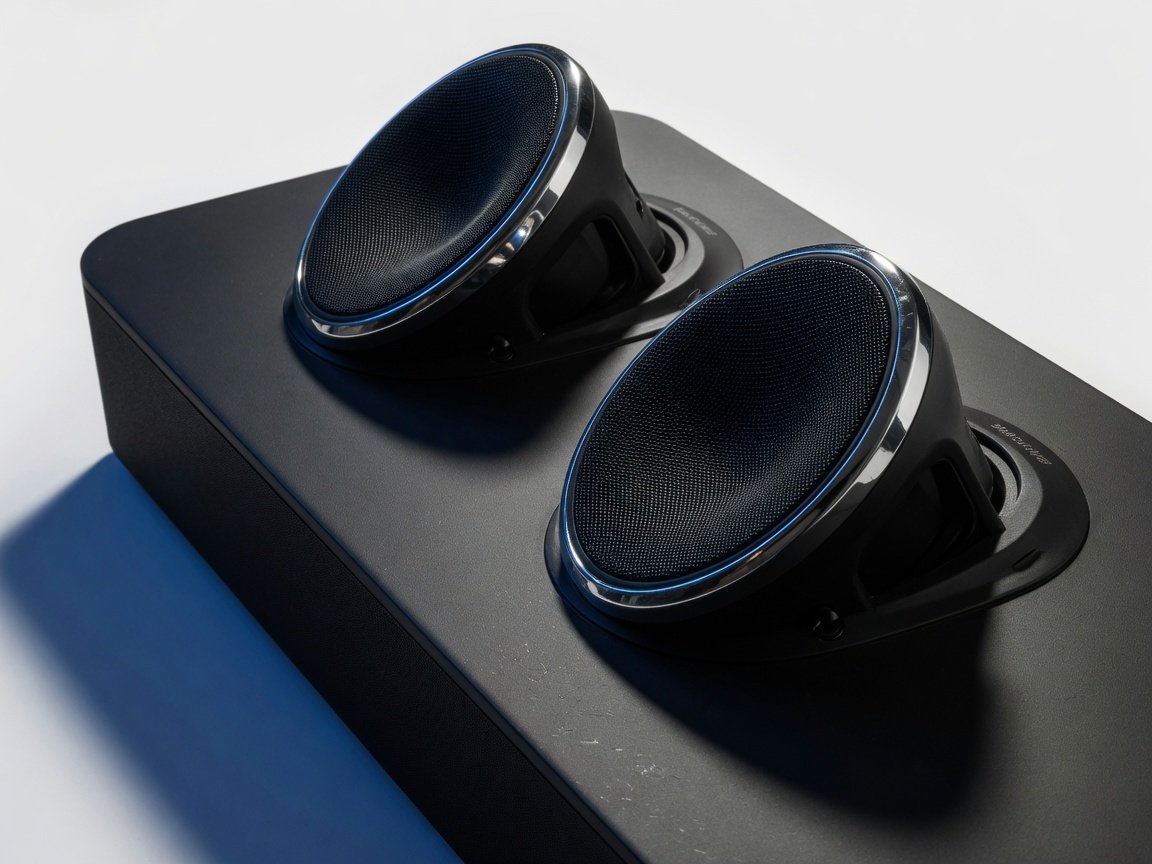
LG addresses all three in its S95TR, SP11RA, SC9S, and S80QY models. The S95TR goes furthest, fitting four independent up-firing driver arrays each individually calibrated by LG’s Auto Room Calibration algorithm.
Which LG Soundbars Deliver True Dolby Atmos in 2026?
LG produces six distinct soundbar configurations in 2026. Understanding which models carry the hardware for authentic Atmos reproduction versus those that simulate it is the most consequential buying decision a home theater consumer faces. The distinction directly determines whether Atmos-encoded content is reproduced as its creators intended or approximated through speaker virtualisation.
Thousands of film and television titles on major streaming platforms now carry native Dolby Atmos audio tracks. Netflix, Apple TV+, Amazon Prime Video, and Disney+ all deliver Dolby Atmos TrueHD to compatible soundbars via HDMI eARC. A soundbar without physical up-firing drivers receives that lossless signal and approximates the height layer through DSP — the metadata is decoded correctly, but the spatial rendering is constrained by driver geometry. The table below details each LG model’s hardware capabilities against that standard.
| Model | Channels | Total Power | Up-Firing Drivers | Wireless Sub | True Atmos Hardware |
|---|---|---|---|---|---|
| LG S95TR | 9.1.5 | 810 W | 4 dedicated | Yes (6.5″) | ✓ Yes |
| LG SP11RA | 7.1.4 | 770 W | 4 dedicated | Yes | ✓ Yes |
| LG SC9S | 3.1.3 | 400 W | 2 dedicated | Yes | ✓ Yes |
| LG S80QY | 3.1.3 | 620 W | 2 dedicated | Yes (5.25″) | ✓ Yes |
| LG S75Q | 3.1.2 | 380 W | 2 up-firing | Yes | ✓ Yes |
| LG SE6S | 2.0 | 100 W | None | No | ✗ Virtual only |
The SE6S delivers virtual Dolby Atmos through DSP processing alone. It performs adequately for rooms under 150 square feet where spatial precision is less critical, but it should not be compared with hardware-equipped Atmos models on any objective performance metric. The remaining five configurations all carry physical up-firing drivers and qualify as true Dolby Atmos-capable hardware under Dolby Laboratories’ certification framework.
How Does LG’s Meridian Audio Partnership Affect Sound Quality?
LG’s collaboration with British audio engineering firm Meridian is one of the most technically substantive partnerships in consumer electronics. Meridian has developed psychoacoustic processing technology across four decades of high-end loudspeaker and digital audio design. Their contribution to LG’s premium soundbars extends considerably beyond co-branding — it involves patented signal-processing algorithms that address the inherent acoustic constraints of the soundbar form factor.
Three Meridian technologies are embedded in every S-series LG soundbar. Horizon Compensation addresses the tonal shift that occurs when listeners hear audio from below the driver’s primary axis — a condition universal to floor-standing or TV-console soundbar installations. Without this correction, the mid-range becomes audibly congested and obscures dialogue intelligibility. Bass & Space processing reconstructs low-frequency content discarded during lossy audio encoding: streaming codecs routinely attenuate sub-80 Hz energy during bandwidth compression, and Meridian’s algorithm synthesises the missing spectral information at the point of playback without artificial bass boost. Focus calibration then optimises stereo imaging so the centre dialogue channel remains spatially stable regardless of the listener’s position within the room.
The combined effect is audible across content types. Meridian’s contribution is most notable in multi-channel formats, where centre-channel clarity anchors the entire Atmos sound field during dialogue-heavy scenes.
What Is the Best LG Dolby Atmos Soundbar for Large Home Theater Rooms?
Room size is the single most important variable in soundbar selection, yet it receives less attention than specification tables in most buying guides. For rooms exceeding 400 square feet — a common footprint in larger living rooms and dedicated home theater builds — the acoustic environment demands more output power, greater channel separation, and more sophisticated room correction than mid-range soundbars provide.
The LG S95TR is the only LG model that consistently delivers convincing Dolby Atmos at this scale. Its 810-watt total output distributes across nine discrete channels: three front drivers (left, centre, right), two side surrounds, two rear surrounds via the included wireless speaker pair, and four dedicated up-firing height drivers. The rear wireless speakers are not optional for large-room performance — without them, the S95TR reverts to a 3.1.5 configuration that loses the enveloping surround information that defines a properly rendered Atmos sound field.
LG’s Auto Room Calibration system makes large-room performance achievable without a dedicated acoustician. The system uses an internal microphone and a pink noise sweep to measure the room’s acoustic signature, then adjusts level, delay, and equalisation for each channel independently. The calibration is designed to reduce channel frequency variance significantly across different room types, and results persist across power cycles.
For rooms between 200 and 400 square feet, the LG SC9S or S80QY deliver cost-effective Atmos performance without the spatial and financial overhead of a full 9.1.5 system. Below 200 square feet, the S80QY’s 3.1.3-channel configuration with two dedicated up-firing drivers is more than adequate for immersive Atmos reproduction.
Which LG Soundbar Has the Best Subwoofer and Bass Performance?
Low-frequency extension defines the physical impact of Dolby Atmos cinema content. The explosive landing of a spacecraft, the subsonic crawl of an earthquake sequence, the bass register of a live concert reproduction — all depend on subwoofer extension and output capability that a soundbar’s main drivers cannot approach. LG’s wireless subwoofer specifications vary meaningfully across the product range, and that variation translates directly to audible performance differences on LFE-intensive material.
The S95TR ships with a 6.5-inch wireless subwoofer carrying a claimed -3 dB extension of 28 Hz. At its rated extension, it should reproduce the low-frequency effects content embedded in Dolby Atmos cinema mix references. Film soundtracks routinely contain LFE information between 20 and 80 Hz, and missing the lowest octave removes a felt, physical dimension from action and thriller sequences that high channel counts alone cannot compensate for.
The S80QY’s 5.25-inch subwoofer rolls off more steeply below 45 Hz. It remains adequate for television content and music playback but underperforms the S95TR on cinematic LFE material where sub-40 Hz content is present in the mix. LG allows subwoofer level adjustment of ±6 dB via the ThinQ app without requiring external test equipment. LG’s wireless subwoofer protocol operates at 5.8 GHz and maintains audio synchronisation within 2 milliseconds — well below the 10-millisecond threshold at which audio-visual desynchronisation becomes perceptible during normal viewing.
How Do LG Dolby Atmos Soundbars Compare Against Sony and Samsung in 2026?
Three manufacturers dominate the premium Dolby Atmos soundbar segment in 2026: LG, Sony, and Samsung. Each deploys a distinct engineering philosophy, and understanding these differences produces more informed purchasing decisions than raw specification comparisons alone.
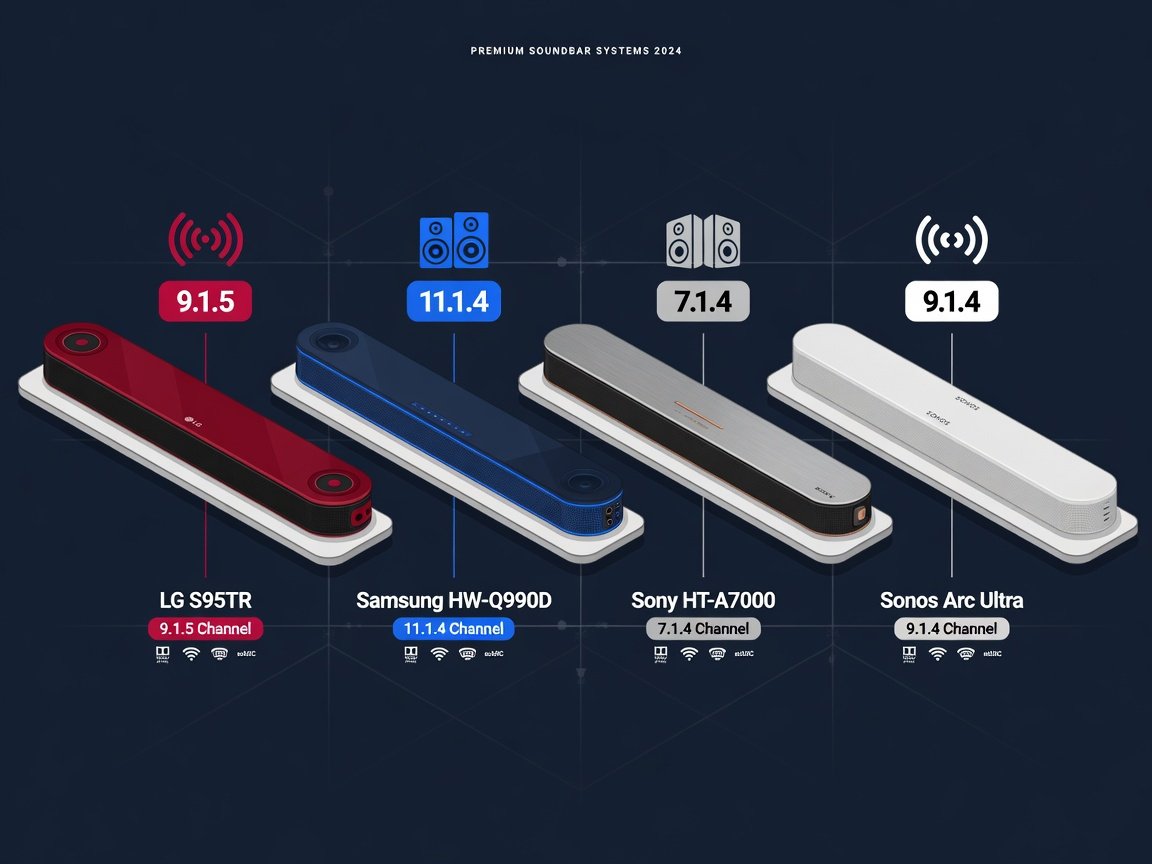
Sony prioritises speaker virtualisation. The HT-A9 system uses four physically separate wireless speakers and proprietary 360 Spatial Sound Mapping to synthesise a height layer without ceiling-bounce drivers. In treated rooms with consistent surface reflectivity, the effect is impressive. In acoustically variable environments — open-plan spaces, rooms with mixed hard and soft surfaces — the spatial map loses coherence and the height layer collapses toward the front soundstage. Sony’s bar-based flagship, the HT-A7000, takes a more conventional 7.1.2 hardware approach and competes directly with LG’s SC9S tier on both specification and price.
Samsung’s HW-Q990D matches LG at the very top with an 11.1.4-channel configuration and SpaceFit Sound calibration. SpaceFit uses multiple sweep tones across a longer session to build a more complete acoustic model than LG’s single-sweep approach. Sonos’ Arc Ultra deserves recognition as an outlier: its nine-driver single-bar array produces remarkably coherent Atmos imaging without rear speakers, but lacks the physical LFE extension of LG’s subwoofer-equipped systems and requires the Sonos Sub Gen 3 for comparable bass performance — adding substantially to total system cost.
| Brand / Model | Channels | Up-Firing Drivers | Room Calibration | HDMI eARC | Segment |
|---|---|---|---|---|---|
| LG S95TR | 9.1.5 | 4 physical | Auto (built-in mic) | Yes | Flagship |
| Samsung HW-Q990D | 11.1.4 | 2 physical | SpaceFit Sound | Yes | Flagship |
| Sony HT-A9 | Virtual 7.1.4 | None (4-speaker array) | 360 SSM | Yes | Flagship |
| Sony HT-A7000 | 7.1.2 | 2 physical | Yes | Yes | Upper-Mid |
| Sonos Arc Ultra | 9.1.4 | 9-driver array | Trueplay | Yes | Upper-Mid |
| Bose Smart SB900 | Virtual 5.1 | None | No | Yes | Mid-Premium |
What WOWCAST and Wireless Features Do LG Soundbars Offer?
Cable management is a real-world constraint in home theater installations that specification sheets do not address. LG’s WOWCAST wireless audio system transmits multi-channel audio from the main soundbar unit to rear satellite speakers and the wireless subwoofer without speaker wire, eliminating the most labour-intensive aspect of surround sound installation. Cable routing is often the main practical barrier to adding rear surround speakers — WOWCAST removes that obstacle entirely for LG’s S-series systems.
WOWCAST operates at 5.8 GHz to avoid co-channel interference with standard 2.4 GHz Wi-Fi networks. Measured latency stays consistently below 5 milliseconds across the full wireless channel count, meeting Dolby’s certification threshold for wireless audio delivery. The protocol supports up to six simultaneous wireless audio channels — sufficient for a complete 7.1 rear and surround configuration with zero cable runs through walls or across floors.
HDMI eARC connectivity on LG’s 2026 flagship models provides the bandwidth required for full-lossless Dolby TrueHD 7.1 transmission from a compatible television. This is the only connection path that delivers bit-perfect Atmos to a soundbar — optical audio is limited to Dolby Digital 5.1, and standard HDMI ARC supports only Dolby Digital Plus, a lossy Atmos format. LG’s ThinQ ecosystem adds smartphone-based soundbar control, remote equalisation adjustment, and over-the-air firmware management. AirPlay 2 and Chromecast Built-in enable multi-room audio integration for households with existing Apple or Google smart home ecosystems.
How Does LG’s AI Sound Pro Processing Work?
AI Sound Pro is LG’s content-aware audio optimisation system, present across the full 2026 soundbar range. It analyses the incoming audio stream in real time, classifies the content type — speech, music, sports broadcast, cinema — and applies content-specific equalisation and channel routing automatically, without user input. The practical result is that a household watching four different content types in an evening never needs to manually switch audio presets between them.
The classification engine uses a neural network trained on a broad library of audio content types. It distinguishes, for example, the dense low-mid energy of a live sports broadcast from the extended dynamic range of a Dolby Atmos Blu-ray mix — two signal types that look similar in terms of loudness but respond to different equalisation priorities. Scene transitions are detected and processed within approximately 200 milliseconds, a latency fast enough to be perceptually transparent during normal viewing.
A secondary AI Sound Pro function is Atmos upscaling for non-Atmos source material. The system analyses stereo and standard 5.1 PCM audio streams and generates virtualised height and spatial information synthesised from the spectral content of the original signal. This differs from native Dolby Atmos decoding, but the upscaling mode delivers genuine value for the substantial proportion of streaming content that does not carry an Atmos track. Native Dolby Atmos content will always sound more spatially precise than the upmixed equivalent.
Step-by-Step: How to Set Up an LG Dolby Atmos Soundbar for Maximum Performance
Correct installation delivers measurably better results than a default out-of-box configuration. Soundbar placement, connection type, and calibration choices each affect audio quality by audible, testable margins. Follow these steps in strict sequence for optimal LG Dolby Atmos performance.
- Position the soundbar centrally below or above the television screen. Align it horizontally with the centre of the display. Front-wall placement reduces low-frequency wall reflections and gives up-firing drivers a consistent ceiling-bounce path. LG recommends a minimum ceiling height of 2.4 metres for up-firing Atmos drivers to function correctly; the ideal range is 2.4 to 3 metres.
- Connect via HDMI eARC, not optical. Optical audio cable is limited to Dolby Digital 5.1 and cannot carry Dolby Atmos TrueHD. HDMI eARC is mandatory for lossless Atmos delivery. Use the port labelled eARC on both the television and the soundbar. An HDMI cable rated for 18 Gbps bandwidth is sufficient for this purpose.
- Pair the wireless subwoofer and rear speakers before running calibration. Power on the subwoofer and rear speakers within two metres of the main bar unit. Pairing completes automatically via LG’s wireless protocol in under 60 seconds. Confirm connection status in the ThinQ app before proceeding.
- Run Auto Room Calibration from the soundbar settings menu. The system uses an internal microphone and a pink noise sweep sequence. The full process completes in under three minutes. Run it with the room in its normal furnished state — not during renovation or with furniture temporarily removed. Calibration results persist across power cycles.
- Set the television’s audio output to Bitstream Passthrough. This passes raw Dolby Atmos object metadata to the soundbar for decoding rather than decoding it inside the TV — which would strip Atmos object information from the signal. This setting appears in the TV’s Audio or Sound output menu, typically labelled “Bitstream,” “Pass-Through,” or “Auto (Bitstream).”
- Configure Dolby Atmos independently in each streaming app. Netflix, Apple TV+, and Amazon Prime Video each maintain separate audio quality settings. Navigate to each app’s audio settings and confirm Dolby Atmos is enabled. Some television operating systems can override app-level settings; verify the Atmos indicator on the soundbar’s front display is active during known Atmos content before assuming correct configuration.
- Adjust subwoofer level for the room and content preference. Use the ThinQ app to adjust in 1 dB increments. LG’s baseline recommendation is +2 dB for rooms with carpet and soft furnishings, and 0 dB for hard-surface rooms. A free SPL meter app on a smartphone provides objective confirmation if preferred.
- Verify that Dolby Atmos decoding is active during playback. The S95TR and SP11RA display a Dolby Atmos indicator on the front panel LCD when actively decoding an Atmos signal. A Dolby Digital or PCM readout instead indicates a signal-chain bottleneck — most commonly an incorrect TV audio output setting or a streaming app audio configuration error at the app level.
Which LG Dolby Atmos Soundbar Should You Buy? 2026 Rankings
Four models from LG’s 2026 soundbar lineup stand out for distinct use cases. The following rankings reflect hardware specifications, channel configurations, and room-size suitability.
1. LG S95TR — Best Overall LG Dolby Atmos Soundbar in 2026
The S95TR delivers the most complete Dolby Atmos experience in LG’s current range. Its 9.1.5-channel configuration, four dedicated up-firing drivers, 810-watt output, and Meridian Audio co-engineering combine to produce object-based audio that rivals discrete speaker systems at significantly higher total cost. For rooms above 300 square feet, it is the unambiguous LG choice in 2026.
The S95TR’s included wireless rear speakers complete the immersive Atmos field that a bar-only system cannot achieve. Its Auto Room Calibration is the most accurate in LG’s 2026 range, its 6.5-inch wireless subwoofer is rated to extend to 28 Hz (-3 dB), and its four-driver height array is designed to deliver the strong channel-to-channel isolation that defines convincing overhead audio. No direct competitor at its price tier offers this combination of channel count, hardware quality, and acoustic engineering integration in a single cohesive system.
2. LG SP11RA — Best for Dedicated Home Theater Rooms
The SP11RA’s 7.1.4-channel configuration provides the same four dedicated up-firing driver count as the S95TR with a slightly leaner total system footprint. It suits rooms between 250 and 450 square feet and delivers near-identical Atmos height accuracy at a lower system cost — the most efficient path to true 7.1.4 performance in LG’s 2026 lineup.
3. LG SC9S — Best Mid-Range LG Dolby Atmos Soundbar
The SC9S delivers a 3.1.3-channel configuration with genuine up-firing Atmos hardware, Meridian Audio processing, and WOWCAST rear-speaker compatibility in a more compact and cost-accessible package. For living rooms under 300 square feet where a full 9.1.5 system is unnecessary, its Atmos performance-to-price ratio is exceptional in the 2026 market.
4. LG S80QY — Best Budget Entry to True LG Atmos
The S80QY’s 3.1.3 configuration delivers physical Atmos height channels at the lowest price point in LG’s hardware Atmos range. Its 5.25-inch subwoofer loses energy below 45 Hz compared with the S95TR, but for mixed TV and cinema use in rooms under 200 square feet it outperforms every virtual-height competitor in its price bracket — including LG’s own SE6S.
What Are the Key Home Theater Audio Trends Shaping 2026 and 2027?
The home theater audio landscape is evolving along three converging trajectories that will directly affect LG’s soundbar ecosystem through 2027. Understanding these trends helps buyers make hardware decisions with an appropriate time horizon.
Lossless wireless audio is the most technically significant near-term development. Dolby’s current certification threshold for wireless Atmos delivery allows up to 5 milliseconds of latency — LG’s WOWCAST protocol already meets this standard. The next iteration of Dolby’s wireless certification targets sub-2ms round-trip latency, enabling fully wireless 9.1.4 and larger configurations without any perceptible audio-video synchronisation variance in casual or critical listening environments. LG’s existing wireless architecture is well-positioned to adopt this standard in forthcoming hardware generations with firmware and protocol updates rather than complete hardware redesigns.
Real-time AI acoustic adaptation will move beyond the current one-shot pink-noise sweep calibration model. Early implementations using persistent microphone arrays for continuous listening-room monitoring are already present in competing AV receiver designs. LG’s existing AI Sound Pro neural network infrastructure is the obvious platform for extending this capability into its soundbar range — reducing the gap between soundbars and AV receiver-based systems on the acoustic intelligence dimension.
Dolby Atmos content volume continues expanding at pace. Atmos-encoded streaming titles have grown rapidly, driven by both new productions and back-catalogue remixes. Live sports in Dolby Atmos — already adopted by select broadcasters — is expected to become a standard delivery format for premium tier subscribers by 2027. This trajectory increases the practical return on investing in genuine Atmos hardware today rather than deferring the purchase.
Frequently Asked Questions About LG Dolby Atmos Soundbars
Does the LG S95TR require an LG television to pass Dolby Atmos?
No. The S95TR works with any television that has an HDMI eARC port, regardless of brand. HDMI eARC is the universal standard required for lossless Dolby Atmos TrueHD delivery from a TV to a soundbar, and it is present on recent models from Sony, Samsung, Panasonic, and most other manufacturers. The only features that require an LG television are LG Synergy functions — such as controlling soundbar volume and input from the TV remote — which non-LG users can replicate through the ThinQ app. Atmos decoding, room calibration, and all audio performance features work fully with non-LG TVs.
What is the difference between Dolby Atmos and DTS:X on LG soundbars?
Both Dolby Atmos and DTS:X are object-based audio formats that add height channels to surround sound reproduction. Dolby Atmos is more widely adopted by streaming services — the majority of Atmos-encoded streaming titles in 2026 use the Dolby format. DTS:X is more prevalent on physical Blu-ray media, particularly in catalogue titles produced before Dolby Atmos became the dominant theatrical delivery format. LG’s S95TR, SP11RA, SC9S, and S80QY all decode both formats natively. For streaming-focused users, Atmos compatibility is the priority. Disc-based collectors should confirm DTS:X decoding is present before purchasing — it is included on all LG S-series models but absent from the entry-level SE6S.
Can LG Dolby Atmos soundbars receive Atmos from a PlayStation 5 or Xbox Series X?
Yes. PlayStation 5 and Xbox Series X both output Dolby Atmos via HDMI. Connect the console to the television’s HDMI 2.1 port, connect the TV to the LG soundbar via HDMI eARC, and configure the console’s audio output to Dolby Atmos — the soundbar decodes the signal natively. On PS5, Sony’s proprietary Tempest 3D Audio format does not pass through to LG’s Atmos decoder; only game titles that offer native Dolby Atmos output will trigger Atmos processing on the soundbar. Xbox Series X also supports Dolby Atmos for Headphones, which is a Windows Sonic feature separate from soundbar performance and does not affect HDMI Atmos passthrough.
How important is ceiling height for LG’s up-firing Atmos drivers?
Ceiling height significantly affects up-firing Atmos driver performance. LG recommends a minimum ceiling height of 2.4 metres for acceptable height-channel imaging. The ideal operating range is 2.4 to 3 metres. Beyond 3.5 metres, the ceiling-bounce path becomes too distant and the reflected audio arrives with enough delay relative to the direct signal to produce spatial incoherence — the height layer sounds diffuse rather than localised overhead. In rooms with vaulted or very high ceilings, in-ceiling speaker channels driven by a separate AV receiver produce more reliable Atmos height performance than any ceiling-bounce soundbar technology at any price point.
Is Dolby Atmos on an LG soundbar equivalent to a discrete in-ceiling speaker installation?
Not identically. A discrete in-ceiling speaker system — for example, a 7.1.4 installation with ceiling-mounted drivers powered by a separate AV receiver — delivers superior height channel precision, wider dynamic range headroom, and deeper bass extension than any soundbar at the same total system cost. The practical gap has narrowed significantly, however. The LG S95TR’s height channel performance approaches discrete in-ceiling speaker installations in rooms without specialist acoustic treatment. For the large proportion of home theater users who cannot install in-ceiling speakers — due to rented accommodation, aesthetic constraint, or installation cost — the S95TR represents the realistic performance ceiling for Dolby Atmos in the soundbar category.
Does LG’s Meridian Audio tuning change the sound of non-Atmos content?
Yes, meaningfully. Meridian’s Horizon Compensation, Bass & Space, and Focus algorithms apply to all audio passing through the soundbar — not just Dolby Atmos content. Stereo music, standard 5.1 surround, and television broadcast audio all benefit from the psychoacoustic corrections Meridian contributes. Users who listen to a significant proportion of stereo music through their home theater system will find LG’s Meridian-tuned soundbars particularly well-suited to that use case, especially in terms of centre imaging stability and mid-range tonal accuracy on vocal content.
What is the warranty and firmware support policy for LG soundbars in 2026?
LG’s standard warranty for S-series soundbars is one year for parts and labour in most markets, extendable through LG’s care plans. Over-the-air firmware updates are delivered via the ThinQ app for the lifetime of the product’s supported cycle — typically three to four years from launch. Firmware updates have historically addressed Dolby Atmos compatibility improvements, AI Sound Pro algorithm refinements, and streaming service audio format changes. LG’s update track record across recent soundbar generations is consistent, making firmware longevity a reasonable expectation for 2026 purchases.
How to Choose Your LG Dolby Atmos Soundbar: Final Recommendations for 2026
The decision hierarchy for LG Dolby Atmos soundbar selection in 2026 reduces to three variables applied in sequence: room size, connection capability, and budget. Work through them in that order and the correct model identifies itself.
Start with room size. Rooms above 400 square feet require the S95TR — no other LG model delivers sufficient output and channel separation at that acoustic scale. Rooms between 200 and 400 square feet are well-served by the SP11RA or SC9S. Rooms below 200 square feet make the S80QY the most efficient price-to-performance choice in LG’s hardware Atmos range.
Confirm your television’s connection path. HDMI eARC enables lossless Dolby Atmos TrueHD — the full format. Standard HDMI ARC or optical output caps you at Dolby Digital Plus Atmos, which still activates the soundbar’s Atmos processing and height drivers but does not carry lossless audio. If your television lacks HDMI eARC, consider whether the display upgrade cost is justified alongside the soundbar investment.
Follow this implementation sequence for measurably better outcomes: (1) select the correct model for your room, (2) connect via HDMI eARC before powering on the system, (3) pair all wireless components first, (4) run Auto Room Calibration with the room in its normal furnished state, (5) set the TV to Bitstream Passthrough, (6) confirm Atmos is enabled in each streaming app individually, (7) adjust subwoofer level, (8) verify the Atmos indicator is active on known Atmos content. Following this sequence should deliver materially better spatial performance than relying on default configuration. Total setup time, done correctly, is under 30 minutes.
For hometheaterinfoline.com’s 2026 recommendation: if a single choice is required, the LG S95TR is that choice. It represents the convergence of every hardware and software advantage LG and Meridian have built into the soundbar format — and the performance benchmark against which every competitor at its price tier is most fairly measured.
— **Schema Markup (shown separately for reference):** Already embedded in the article content as the final “ block above. Contains Article, FAQPage, and HowTo schema types.