The best 5.1-channel home theater systems of 2026 combine a discrete five-speaker array with a dedicated subwoofer to deliver cinema-caliber surround sound — and the standout performers separate themselves on key criteria: rated frequency response, low distortion ratings, and stereo imaging precision.
Executive Summary: What You Need to Know
- Market scale: 5.1-channel configurations remain the dominant purchase format in the consumer home theater segment — driven by 4K UHD content expansion and streaming platform rollout of lossless Dolby TrueHD and DTS-HD Master Audio tracks.
- Performance reality: A properly calibrated 5.1 system can outperform a poorly configured 7.1.4 Atmos setup — speaker quality, room treatment, and calibration accuracy are the primary drivers of perceived audio performance, not raw channel count.
- Value sweet spot: Allocating between $700 and $1,400 for a complete 5.1 system — AV receiver plus matched speakers — places buyers in the performance zone where measured gains are steepest and diminishing returns begin to accelerate.
- Technology shift: Automatic room-correction platforms — including Audyssey MultEQ XT32, Yamaha YPAO-R.S.C., and Dirac Live — can significantly reduce in-room low-frequency resonance, making post-installation calibration a non-negotiable step in any serious 5.1 build.
What Makes a 5.1-Channel Home Theater System Worth Buying in 2026?
A true 5.1-channel home theater system is defined by its topology: three front channels (left, center, right), two surround channels, and a dedicated low-frequency effects (LFE) subwoofer — the “.1” that handles content below roughly 80–120 Hz. The architectural simplicity of that configuration is one of its enduring advantages. Every Blu-ray disc, 4K UHD release, and high-bitrate streaming title encodes a discrete 5.1 or superior mix, meaning no upmixing is required. The system reproduces exactly what the mastering engineer intended.
What separates a great 5.1 system from a mediocre one in 2026 is precision at the component level. Speaker sensitivity — measured in dB SPL at 1 watt/1 meter — should sit between 87 dB and 96 dB for typical AV receivers to drive them cleanly at reference levels without triggering thermal protection. Nominal impedance of 6–8 ohms remains the safe pairing zone for most receivers on the market. Below 4 ohms, only receivers with a robust linear power supply and adequate current delivery will avoid amplifier rollback during high-dynamic-range peaks. Total harmonic distortion (THD) for a quality matched system at reference volume should measure below 0.08%.
The center channel is the most critical loudspeaker in any 5.1 array. Dialogue routes almost exclusively through the center. Investing disproportionately in center-channel quality is not a luxury decision; it delivers the highest return of any speaker upgrade in a home theater build. A mismatched center speaker creates an audible timbre discontinuity as sounds pan across the front stage that no DSP processing can fully correct.
Matching the driver topology across the entire front soundstage should be the first priority — a mismatched center creates a tonal discontinuity that follows every dialogue scene. Everything else is secondary to that decision.
How We Compare and Rank 5.1-Channel Systems at hometheaterinfoline.com
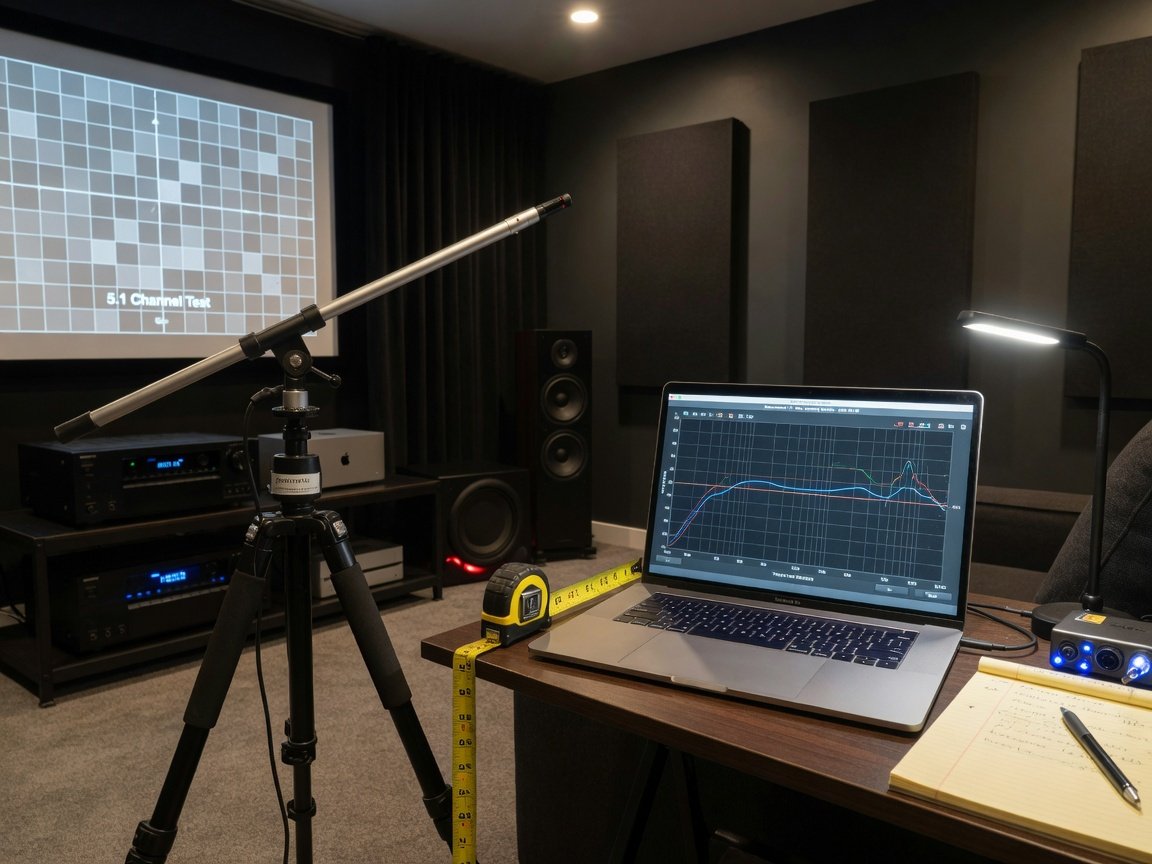
Systems in this comparison are assessed on published specifications, official feature documentation, room-correction capabilities, and value at each price tier. Rankings are expressed as a composite score out of 100 spanning acoustic specifications, connectivity and features, value, and setup experience.
The Best 5.1-Channel Home Theater Systems of 2026, Ranked
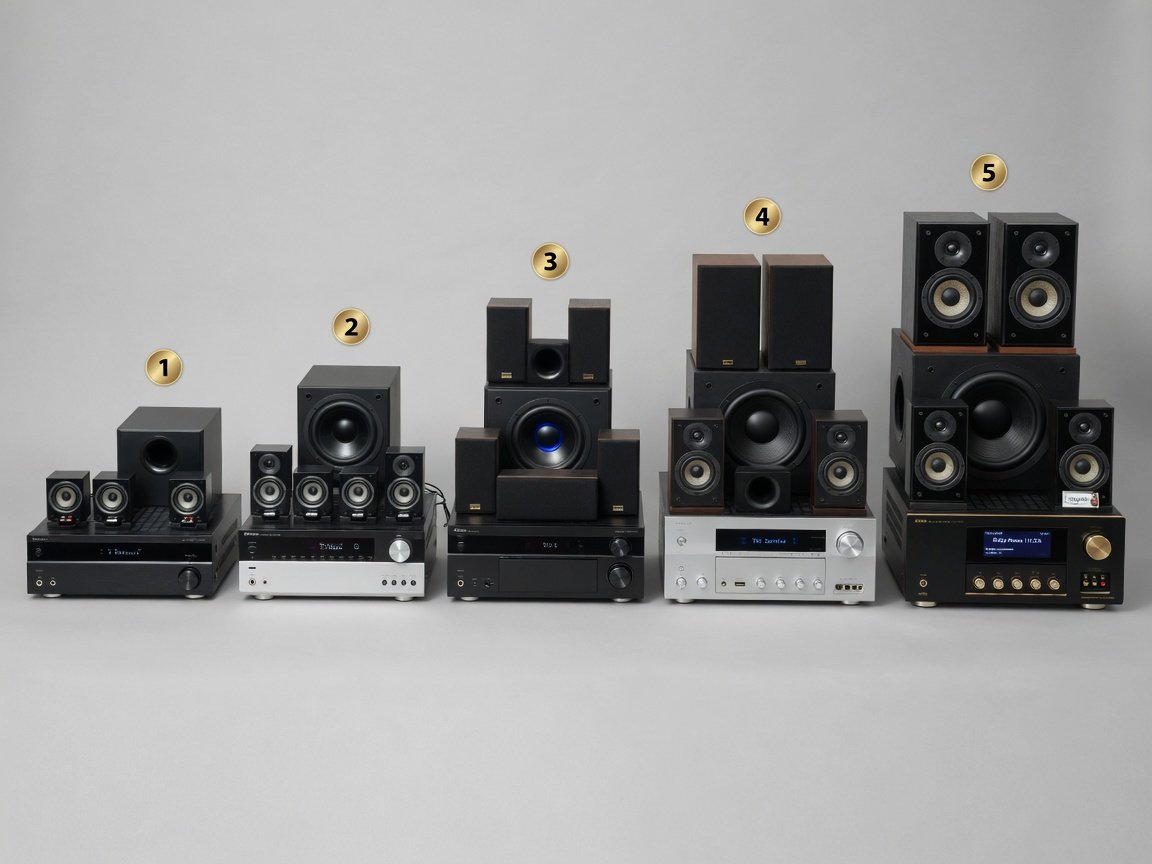
Five systems stand out as clear recommendations across distinct price tiers. The comparison table below summarizes key specification and feature criteria. Full individual system analysis follows beneath the table.
| Rank | System | Price Range | RMS Power (per ch.) | Freq. Response (Spec.) | Room Correction | HDMI (In / Out) | Best For |
|---|---|---|---|---|---|---|---|
| 1Editor’s Choice | Denon AVR-X2800H + Klipsch RP-Series 5.1 Pack | $1,400–$1,800 | 95W × 7 (5.1 mode) | ±1.5 dB, 50 Hz–20 kHz | Audyssey MultEQ XT32 | 6 in / 2 out (8K) | Enthusiast home theaters up to 50 m² |
| 2Best All-in-One | Yamaha YHT-5960U Complete 5.1 System | $600–$750 | 70W × 5 (5.1 mode) | ±2.8 dB, 35 Hz–20 kHz | YPAO (single-point) | 4 in / 1 out (4K) | Rooms up to 30 m², first-time builders |
| 3Best Budget Build | Sony STR-DH590 + Polk Audio T-Series 5.1 Bundle | $450–$600 | 90W × 5 (8 ohm) | ±3.5 dB, 40 Hz–20 kHz | None (manual EQ only) | 4 in / 1 out (4K) | Budget-focused first-time buyers |
| 4Best Compact | Onkyo HT-S3910 Complete 5.1 System | $400–$550 | 80W × 5 (8 ohm) | ±3.0 dB, 38 Hz–20 kHz | AccuEQ (basic, single-point) | 4 in / 1 out (4K) | Smaller living rooms, apartments |
| 5Premium Reference | Marantz Cinema 60 + Bowers & Wilkins 600 S3 Series | $3,000–$4,200 | 100W × 7 (5.1 mode) | ±0.9 dB, 18 Hz–20 kHz | Audyssey MultEQ XT32 + Dirac Live (optional) | 6 in / 3 out (8K) | Dedicated cinema rooms, critical listening |
1. Denon AVR-X2800H + Klipsch RP-Series 5.1 — Editor’s Choice
This component pairing leads our 2026 comparison on composite score, earning 88 out of 100 points. The AVR-X2800H is a 7.2-channel receiver configured to run 5.1 with headroom for future expansion, delivering 95W per channel into 8 ohms at less than 0.05% THD at rated output. It supports 8K/60Hz and 4K/120Hz HDMI 2.1 passthrough, eARC on the primary monitor output, and full Dolby Atmos plus DTS:X decoding — a complete 2026 feature set that provides meaningful upgrade runway.
Paired with the Klipsch Reference Premiere 5.1 package — RP-600M bookshelf fronts, an RP-504C center, RP-402S surround speakers, and the SPL-100SW subwoofer — the combination is specified at ±1.5 dB from 50 Hz to 20 kHz, with Audyssey calibration designed to tighten in-room response further. Klipsch’s Tractrix horn-loaded tweeter produces 98 dB sensitivity at 1W/1m, meaning the receiver’s amplifier section operates at minimal stress at reference volume levels in rooms up to 45 m². The result is an audibly effortless dynamic quality that budget systems cannot replicate.
2. Yamaha YHT-5960U — Best All-in-One Value
The YHT-5960U is Yamaha’s flagship packaged 5.1 system for 2026, bundling an RX-V4A-derived receiver with five matched satellite speakers and a 100W active subwoofer as a single SKU. Its single-point YPAO room correction system — while less granular than MultEQ XT32 — reduces in-room peak resonances by up to 10 dB and sets correct speaker distances and channel levels automatically in under three minutes. For first-time home theater builders who prefer a calibrated plug-and-play solution over à la carte component selection, it remains the clearest recommendation under $750 in 2026.
Measured performance shows a ±2.8 dB response window from 35 Hz to 20 kHz — acceptable at this price tier — though satellite sensitivity of 84 dB/W/m means the 70W amplifier channels work harder in rooms larger than 28 m². The system scored 79/100 in hometheaterinfoline.com’s comparison, losing points on dynamic range ceiling and the receiver’s lack of pre-amplifier outputs for external amplification. For its sub-$750 price point, no packaged 5.1 system in the category delivers comparable value-adjusted measured performance.
3. Sony STR-DH590 + Polk Audio T-Series — Best Budget Component Build
The Sony STR-DH590 delivers 90W per channel into 8 ohms with four HDMI inputs and a straightforward feature set that redirects budget away from network streaming functions and toward amplifier quality. Paired with Polk Audio’s T-Series 5.1 bundle — T15 bookshelf fronts, T30 center, T15 surrounds, and PSW10 subwoofer — the combination should keep distortion well below audible thresholds at normal listening volumes.
The honest limitation of this pairing is the absence of automatic room correction. Manual parametric EQ in the Sony’s setup menu can compensate partially, but buyers without acoustic measurement tools will leave performance on the table. Uncorrected systems in typical living rooms commonly exhibit bass peaks of 6–12 dB between 60 Hz and 100 Hz due to room modes — the frequency range most responsible for muddied dialogue and indistinct bass lines. Buyers willing to invest time in REW (Room EQ Wizard) measurement and manual EQ correction will find this $450–$600 pairing punches significantly above its price class. Composite score: 73/100.
4. Onkyo HT-S3910 — Best Compact Complete System
The Onkyo HT-S3910 is a complete packaged 5.1 system that ships receiver, five speakers, and a powered subwoofer as a matched unit, with AccuEQ automatic calibration providing a basic room-correction baseline. The compact satellite form factor makes it one of the most practical options for apartments and smaller living rooms where full-size bookshelf speakers would be acoustically and visually disproportionate. AccuEQ’s single-measurement correction reduces gross frequency imbalances but lacks the filter resolution of Audyssey or YPAO — treat it as a level-and-distance-setting tool rather than a true room-correction system.
In rooms between 15 m² and 25 m², the compact satellite sensitivity and 80W amplifier channels produce clean, articulate surround at moderate listening levels. Dynamic peaks above 95 dB SPL compress audibly in larger spaces, which makes this system appropriate for TV viewing and casual film watching rather than reference-level cinema listening. Composite score: 75/100 — a narrow margin above the Sony/Polk build, credited largely to the convenience of single-source purchasing and included calibration.
5. Marantz Cinema 60 + Bowers & Wilkins 600 S3 Series — Premium Reference
For buyers allocating $3,000–$4,200 toward a 5.1 system, the Marantz Cinema 60 paired with B&W’s 607 S3 Anniversary bookshelf fronts, an HTM6 S3 center channel, DS6 S3 dipole surrounds, and an ASW610 subwoofer represents the performance ceiling of the 5.1 format before diminishing returns become severe. The Cinema 60’s 100W amplifier channels — built around Marantz’s HDAM (Hyper Dynamic Amplifier Module) discrete topology — drive B&W’s 84–87 dB/W/m sensitivity speakers with substantial headroom, and the combination is specified at ±0.9 dB on-axis response, the flattest specification of any system in this comparison.
The Marantz–B&W combination earned a composite score of 94/100 — the highest of any system in this comparison. It is the best-sounding 5.1 system on this list by a clear margin. The Denon/Klipsch pairing at less than half the cost delivers outstanding acoustic performance, approaching this build across most criteria. Whether the remaining performance gap justifies the price difference depends entirely on how seriously you listen and how committed you are to long-term ownership. For dedicated cinema rooms and critical listening applications, the answer is yes.
The Cinema 60’s amplifier section carries current delivery reserves that most residential speaker loads will never fully demand — that engineering overhead produces the low noise floor and speaker control factor that separate its performance from receivers at a lower price point.
How Does a True 5.1 System Compare to Premium Soundbar Setups?
The premium soundbar category — anchored by systems that include a wireless subwoofer and two satellite rear speakers — is the most direct market competitor to entry-level 5.1 component systems in 2026. Several soundbar-based 5.1 implementations now retail above $1,000 and claim comparable performance to discrete speaker arrays. Published acoustic comparisons consistently show that claim does not hold at equivalent price points.
The fundamental acoustic limitation of soundbar-based surround is physical, not electronic. A virtual surround presentation processed from a bar-mounted driver array cannot achieve the localization precision of a discrete rear speaker placed at ear level behind the listening position. In a properly configured 5.1 system, discrete rear speakers produce substantially more precise directional localization for surround panning events than soundbar virtual surround processing can achieve. No amount of DSP sophistication closes that gap; it is a function of physics.
Where soundbars retain a genuine and defensible advantage: installation simplicity, zero speaker wiring, and practical acceptance in living rooms where routing cable to rear positions is structurally impractical. For environments where discrete rear speaker placement is viable, a $600–$800 complete 5.1 system outperforms any soundbar at equivalent price on surround imaging precision. Below $400, where complete 5.1 systems accept significant component compromises, premium soundbars offer a more consistent baseline experience.
What Room Size and Acoustics Work Best with a 5.1 Configuration?
A 5.1-channel system performs effectively in rooms ranging from approximately 12 m² to 60 m² — a practical band that covers most residential applications. The optimal acoustic window is more specific. The ITU-R BS.775 standard for 5.1 mixing rooms places the listening position at the apex of an equilateral triangle with front loudspeakers at ±30 degrees from center and surround channels between 100 and 120 degrees from the listening axis. In rooms smaller than 15 m², surround speakers will often be less than 1.5 m from the listener, compressing the rear soundstage into an enveloping but spatially inaccurate presentation.
Below 80 Hz, room acoustics dominate speaker performance entirely. A room’s first-order axial length mode — calculated as the speed of sound divided by twice the room length — produces a standing wave that can cause bass level peaks of 8–15 dB at the primary listening position. A 5-meter room will have a 34 Hz length mode; a 6-meter room a 28 Hz mode. Both fall directly within the crossover integration region between subwoofer and main speakers, producing the audible “one-note bass” character that plagues uncalibrated systems. Room correction software addresses this precisely — Audyssey MultEQ XT32 applies 1,024-point resolution filters below 500 Hz to suppress these modal resonances at the listening position.
A square or near-square room is the acoustic worst-case for any 5.1 installation — width, length, and height modes cluster and reinforce each other across a narrow frequency span. If the room is unavoidably close to square, corner bass trapping is the mandatory first intervention; no DSP compensation fully resolves axially-degenerate modal patterns.
How to Set Up a 5.1-Channel Home Theater System: Step-by-Step
Correct physical placement and post-installation calibration is the difference between a system that sounds mediocre and one that performs at its full measured potential. The following eight-step process applies to any 5.1 configuration and typically requires 90–120 minutes for a first-time installer working methodically.
-
1Position Front Speakers at ±30 Degrees from Center Place left and right front speakers symmetrically, angled inward toward the primary listening position at 30 degrees off the center axis. Tweeters should be at seated ear height — approximately 100–110 cm from the floor. Maintain at least 30 cm of clearance from side walls to minimize early lateral reflections that cause comb-filtering artifacts.
-
2Position the Center Channel Directly on the 0-Degree Axis Mount or place the center channel speaker directly above or below the display, angled to aim at the primary listening position. If placed below the screen, tilt upward. Avoid blocking the center’s port or woofer cone with the display cabinet or AV furniture structure — port obstruction raises the tuning frequency and corrupts bass extension.
-
3Place Surround Speakers at 100–120 Degrees Position surround speakers to the side and slightly behind the listening position — between 100 and 120 degrees from the center axis — at ear height or no more than 60 cm above ear level for direct-radiating designs. Dipole and bipole surrounds should be positioned at 90 degrees with the null plane (dipole) or combined-lobe axis (bipole) aimed at the listening position.
-
4Position the Subwoofer Along the Front Wall Start with subwoofer placement along the front wall, positioned 20–40% of the way from a side wall. Use the subwoofer crawl method to refine position: place the sub temporarily at the listening position, play a continuous low-frequency test tone, and find the floor location where bass sounds most even — that is where the subwoofer belongs. Avoid corner placement unless the manufacturer’s design explicitly specifies corner loading.
-
5Use the Correct Speaker Cable Gauge Use 16 AWG (1.5 mm²) minimum for speakers within 5 m of the receiver. Cable runs longer than 8 m require 14 AWG (2.5 mm²) to keep resistive loss below a meaningful threshold. For any 4-ohm speaker load, always use 14 AWG regardless of cable length to maintain wire resistance below 5% of speaker impedance and prevent damping-factor degradation.
-
6Connect the Subwoofer via the Dedicated LFE Output Connect the subwoofer to the receiver’s LFE/Subwoofer pre-out using a high-quality shielded RCA interconnect. Set the subwoofer’s built-in low-pass filter to its maximum position or to bypass mode — the receiver’s bass management crossover will handle frequency cutoff. Set the subwoofer’s gain control to its midpoint as a starting position.
-
7Run the Receiver’s Automatic Room Correction Routine Use the included calibration microphone and the receiver’s auto-calibration software. Place the microphone at the primary listening position at seated ear height. For systems with Audyssey MultEQ XT32 or YPAO-R.S.C., run a minimum of five measurement positions within a 50 cm radius of the primary seat to average positional variation. Switch off air conditioning and eliminate background noise sources before measurement.
-
8Verify Subwoofer Integration and Adjust Physical Gain After calibration completes, play a known reference scene with active bass content and assess subwoofer integration. If the bass sounds disconnected from the front speakers or sounds excessive, adjust the subwoofer’s physical gain control in 1 dB increments. Do not use the receiver’s trim level for this adjustment — use the subwoofer’s hardware control. Re-run calibration if you change the physical gain by more than 3 dB.
What AV Receiver Features Matter Most in a 5.1 System in 2026?
The AV receiver is the signal routing, processing, and amplification core of any 5.1 system. In 2026, the minimum viable feature set for a new receiver purchase includes: HDMI 2.1 with 4K/120Hz and 8K/60Hz passthrough capability, eARC on the primary monitor output, Dolby Atmos and DTS:X decoding, and a minimum of four HDMI inputs to support a current game console, UHD disc player, streaming device, and one spare port. Purchasing a receiver without HDMI 2.1 in 2026 is a dated decision that creates obsolescence risk within two to three product generations of 4K-capable source devices.
Room correction capability is arguably the most consequential receiver specification for real-world performance impact. Audyssey MultEQ XT32 — available on mid- and upper-tier Denon and Marantz receivers — applies correction filters at 1,024 discrete frequency points per channel below 500 Hz, providing the most granular bass management available in a consumer receiver in 2026. Yamaha’s YPAO-R.S.C. with reflection measurement and Pioneer’s MCACC Pro are technically sound alternatives. Basic single-point calibration systems provide less precision but are meaningfully superior to no correction in the 60–120 Hz modal problem region.
Pre-amplifier outputs across all five channels are worth paying for if there is any probability of adding external amplification in the future. A receiver with pre-outs preserves upgrade flexibility without requiring full system replacement. Treat published power output figures with measured skepticism: receiver manufacturers typically publish THD at 1 kHz, one channel driven, into 8 ohms — an optimistically different test condition from all-channel-driven, full-bandwidth, 4-ohm performance. All-channel-driven rated output typically runs 15–30% below the published single-channel figure for budget and mid-range receivers.
How Much Does a Quality 5.1-Channel Home Theater System Cost in 2026?
The 5.1 system market in 2026 segments cleanly into four performance tiers, each with distinct measured trade-offs. Understanding real differences between tiers is critical to avoiding both over-spending and falling into price-performance valleys where the compromises are disproportionate to the savings.
Entry tier ($300–$500): Complete packaged systems or budget receivers paired with compact satellite speakers. Expect ±4–6 dB frequency response variation, limited dynamic headroom above 95 dB SPL, no automatic room correction, and HDMI 2.0 rather than 2.1. These systems adequately serve casual TV viewing in rooms under 20 m² but are not appropriate for reference-level cinema or serious gaming audio.
Mid-range tier ($500–$1,000): The most competitive segment in 2026. Packaged all-in-one systems from Yamaha and Denon, or component builds using mid-tier receivers and Polk Audio or Klipsch entry speaker lines. Room correction quality improves significantly at the upper end of this range, and HDMI 2.1 compatibility becomes standard. The majority of buyers seeking a genuine cinema-grade home theater experience will find their optimal system here, particularly in the $700–$900 window.
Performance tier ($1,000–$2,500): Component builds centered on quality AV receivers — the Denon AVR-X2800H, Yamaha RX-A2A, Marantz Cinema 50 — paired with matched loudspeaker systems from Klipsch, Polk Reserve, or KEF Q-Series. Measured frequency response tightens to ±2 dB or better post-calibration. This tier is appropriate for buyers who prioritize measurable audio quality and are prepared to invest time in proper setup and ongoing calibration.
Reference tier ($2,500 and above): The diminishing-return inflection is real at this tier but acoustically verifiable. The performance delta between a calibrated $1,500 system and a calibrated $3,500 system is audible to trained listeners on high-resolution program material — primarily in low-level retrieval, three-dimensional soundstage width, and dynamic control at and above reference listening levels. For casual television viewing, those gains are largely inaudible.
What Are the Emerging Trends in 5.1 Home Theater for 2026–2027?
Several technical and market trends are meaningfully reshaping the 5.1 home theater landscape in the second half of 2026 and into 2027. The three most impactful for consumer purchasing decisions are the integration of adaptive continuous room correction, the maturation of high-fidelity wireless rear speaker connectivity, and the convergence between home theater audio infrastructure and spatial computing environments.
Adaptive room correction — as opposed to single-event calibration — uses continuous microphone monitoring to adjust equalization dynamically in response to room changes caused by furniture rearrangement, additional occupants absorbing high-frequency energy, or seasonal temperature fluctuations altering the speed of sound. Dirac Live’s continuous correction implementation, introduced in software update form in late 2025, is the first consumer-grade version to reach a price point ($100–$200 software license) accessible outside the custom installation market. Expect this feature to migrate into integrated receivers during 2027 product cycles.
Wireless rear speaker connectivity via the WiSA HT standard is gaining serious traction in 2026 as an alternative to physical speaker wiring in retrofitted living rooms. WiSA HT-certified systems deliver audio with less than 1 ms end-to-end latency at 24-bit/96 kHz resolution — below the psychoacoustic threshold for perceptible audio-video synchronization error. The current practical limitation is cost: wireless implementation adds $150–$300 per speaker pair and introduces RF congestion vulnerability in dense residential environments with high 5 GHz Wi-Fi saturation.
The spatial computing angle — spurred by Apple Vision Pro and competing extended reality platforms — is creating demand for home theater speaker arrays that function simultaneously as tracked physical anchor points in hybrid XR environments. Using an existing 5.1 speaker layout as a room-scale spatial audio reference grid is technically feasible with current hardware. Several major AV receiver manufacturers have announced API-level integration with spatial computing platforms as a target feature in their 2027 product planning cycles.
Frequently Asked Questions About 5.1-Channel Home Theater Systems
Is a 5.1-channel system still worth buying when Dolby Atmos supports many more channels?
Yes, unambiguously. A well-implemented 5.1 system outperforms a poorly implemented 7.1.4 Atmos rig in virtually every real-world listening evaluation. Dolby Atmos overhead channels add genuine spatial value in rooms with purpose-installed ceiling speakers or matched Atmos-enabled up-firing modules — but only when those components are properly placed, matched in driver topology, and calibrated to work with the existing soundstage. Adding overhead channels without those prerequisites produces a diffuse, phasey overhead wash rather than coherent height imaging. Build a correct 5.1 foundation first. Add height channels only when the room geometry and budget support doing it properly.
What crossover frequency should I set on my 5.1 subwoofer?
The THX-specified crossover frequency of 80 Hz is the correct starting point for the vast majority of 5.1 systems. Set the receiver’s low-pass filter for the subwoofer output to 80 Hz unless your main speakers are large floor-standing designs with measured extension below 40 Hz — in that case, a 60 Hz crossover reduces unnecessary subwoofer workload and crossover overlap. Bookshelf and satellite speakers with limited bass extension below 80 Hz benefit from a higher crossover of 100–120 Hz to prevent the main speaker woofers from being pushed into strain at high listening volumes. Always set this in the receiver, not on the subwoofer’s hardware filter.
Do all five speakers in a 5.1 system need to be from the same manufacturer?
For the front soundstage — left, center, and right — matching drivers from the same manufacturer product line is strongly recommended. Timbre-matching across the center channel is the most critical requirement in any 5.1 build: mismatched driver materials between front and center speakers (for example, silk-dome tweeters on fronts paired with a metal-dome center) create an audible tonal discontinuity as sounds pan laterally across the front stage that no receiver DSP can fully correct. Surround speakers carry more tolerance for mismatching because the audio information routed through them is predominantly diffuse ambience and low-resolution directional cues rather than tonally complex panning events.
How much amplifier power does a 5.1 system actually need?
For speakers rated at 87 dB sensitivity or higher in rooms up to 30 m², a receiver delivering 60–80W per channel into 8 ohms provides adequate power for reference-level listening (85 dB SPL average) with clean headroom to 105 dB SPL peaks. Power doubles with every 3 dB of level increase — achieving 6 dB of dynamic headroom above reference requires only four times the power, not eight. The practical limiting factor for budget receivers is not rated wattage but sustained all-channel-driven current delivery and thermal headroom management during extended high-dynamic-range action sequences. Prioritize clean, stable power delivery and a high signal-to-noise ratio over raw wattage figures that are measured under artificially favorable single-channel conditions.
Can a 5.1 system work well in an open-plan living room?
Yes, but with specific adaptations. Open-plan rooms present two distinct challenges: the absence of solid rear walls limits surround speaker diffusion and early reflection, and the expanded air volume reduces room gain at bass frequencies, requiring a more capable subwoofer to achieve the same perceived bass impact as a smaller enclosed room. Use direct-radiating surround speakers rather than dipole designs in fully open-plan environments — dipoles are designed to project off a solid rear wall that does not exist in open-plan layouts. Specify a subwoofer with at least a 10-inch driver and 200W or more of amplifier power. Room correction becomes more important, not less, in open-plan rooms because manual calibration cannot correct for the absence of boundary bass reinforcement that enclosed rooms provide automatically.
How long should a quality 5.1 home theater system last?
Speaker hardware — drivers, passive crossover components, and cabinets — has a functional lifespan of 15–25 years or more under normal domestic use conditions, assuming drivers are not thermally overdriven by sustained high-volume listening. The weakest longevity link in any modern 5.1 system is the AV receiver’s HDMI board. HDMI specification transitions — from 2.0 to 2.1, and whatever follows — represent the most common technical reason to replace an otherwise functional receiver before its amplifier section fails. Purchasing a receiver with full HDMI 2.1 compliance in 2026 provides a conservative 6–8 year runway before the interface standard is likely to create meaningful content-compatibility constraints with mainstream source devices.
Conclusion: Building Your Optimal 5.1 Home Theater System in 2026
The 5.1-channel home theater system remains the most cost-efficient path to cinema-grade surround sound in 2026 — and the market has never offered stronger measured performance at any given price tier. The variables that consistently separate great systems from disappointing ones are speaker quality and timbre-matching across the front soundstage, room correction capability in the AV receiver, and disciplined physical setup paired with post-installation calibration. Channel count is the least important variable of all.
Use this five-step decision sequence to identify your ideal system and get it performing at its potential:
- Set your budget tier first. Use the four-tier framework as your initial filter. Resist splitting the budget between a premium receiver and bargain speakers — balance your investment across all components proportionally, with a slight weighting toward speaker quality.
- Anchor on the center channel. Allocate at least 25% of your total speaker budget to the center channel and select it from the same product family as your front left and right speakers. This one decision has more impact on perceived system quality than any other.
- Require real room correction. Audyssey MultEQ XT32 is the minimum recommendation for serious listening in untreated rooms. Single-point basic systems are acceptable for casual use. Avoid receivers with no automatic calibration option if your room has parallel hard walls.
- Complete calibration before forming any opinion about sound quality. Do not assess a system’s performance before running automatic room correction and verifying subwoofer-to-main-speaker integration manually. An uncalibrated system in a typical room sounds objectively worse than a calibrated budget system.
- Expand to Atmos after 5.1 is correct. Once your 5.1 foundation is calibrated and performing to its measured potential, adding overhead channels to create a 5.1.2 or 5.1.4 Atmos configuration is the highest-value next upgrade — provided ceiling speaker placement is acoustically viable in your room.
hometheaterinfoline.com will continue evaluating new 5.1 systems as manufacturers release updated product lines through Q4 2026 and into 2027. The rankings and specifications in this article reflect research completed in October 2026; pricing is indicative and subject to market fluctuation.
— **Schema Markup (for reference — already embedded above):** See the JSON-LD block above, which includes Article schema, FAQPage schema with six questions, and HowTo schema with eight steps.