The Denon AVR-X3800H leads our 2026 rankings as the best overall pick for most buyers. The modern home theater receiver has evolved into the command center of your entire AV system — decoding Dolby Atmos object-based audio, passing 4K 120Hz through HDMI 2.1 ports, managing multi-room streaming, and integrating with voice assistants in real time. A single miscalculation here — a receiver with too few HDMI 2.1 inputs, insufficient all-channels-driven power, or a weak room correction engine — compounds into audible compromise every time you press play. This guide cuts through the spec-sheet noise, covering the top-performing AV receivers at every major price point.
Executive Summary
- Atmos is now an entry-level requirement: Over 15,000 Dolby Atmos titles are available across Netflix, Apple TV+, Disney+, and Amazon Prime Video in 2026 — height-channel decoding is a floor specification, not a premium differentiator.
- HDMI 2.1 is the connectivity watermark: Any receiver lacking at least two HDMI 2.1 ports at full 48 Gbps bandwidth is architecturally incompatible with 4K 120Hz gaming pipelines and current-generation OLED and QLED displays at their performance ceiling.
- Room correction closes the acoustic gap: Advanced auto-EQ systems reduce measurable in-room frequency-response deviation by 10–15 dB in typical domestic environments — often outperforming manual calibration by untrained users by a wide margin.
- Value concentrates at $800–$1,500: This price band delivers 9.2-channel amplification, full HDMI 2.1 support, and flagship-grade room correction more than adequate for rooms under 3,500 cubic feet.
What Makes the Best Audio Receiver for Home Theater in 2026?
Four engineering pillars define a great AV receiver in 2026: spatial audio decoding, high-bandwidth video passthrough, room correction accuracy, and network connectivity robustness. Each has a hard performance threshold below which the experience degrades in measurable ways. For spatial audio, that threshold is full object-based Dolby Atmos and DTS:X decoding — not merely Dolby TrueHD or DTS-HD Master Audio, which are lossless legacy formats incapable of rendering three-dimensional height objects in real time. For video, HDMI 2.1’s 48 Gbps bandwidth is the floor: it is the only HDMI generation capable of carrying 4K at 120 frames per second with simultaneous Dolby Vision or HDR10+ metadata — the signal combination demanded by the PlayStation 5, Xbox Series X, and the current generation of display panels at their performance peak. Without it, every HDMI 2.0b receiver in the signal chain becomes a hard limit on what your display and console can actually deliver.
Amplifier topology and power delivery define real-world headroom in ways that marketing watt ratings routinely obscure. A receiver rated at 130 W per channel in a single-channel, 1 kHz bench test into 8 Ω may sustain only 60–70 W when all nine channels drive simultaneously — the all-channels-driven (ACD) condition produced by a 7.2.4 Atmos soundtrack with active bass management. Total Harmonic Distortion under that ACD load tells a more complete story: receivers measuring below 0.08% THD at ACD are reference-grade for this category; those creeping above 0.5% THD produce audible strain during dynamic crescendos in film scores and action soundtracks. Network architecture completes the picture. Dual-band Wi-Fi 6 (802.11ax), Bluetooth 5.3 with aptX HD, AirPlay 2, and Spotify Connect are baseline expectations at every mainstream 2026 price point — not optional extras.
📊 HDMI 2.1 carries 48 Gbps — nearly three times HDMI 2.0b’s 18 Gbps ceiling — enabling 4K 120Hz, 8K 60Hz, Variable Refresh Rate (VRR), Auto Low Latency Mode (ALLM), and Enhanced Audio Return Channel (eARC) simultaneously. Without it, any receiver in the signal chain imposes a hard ceiling on display and console performance.
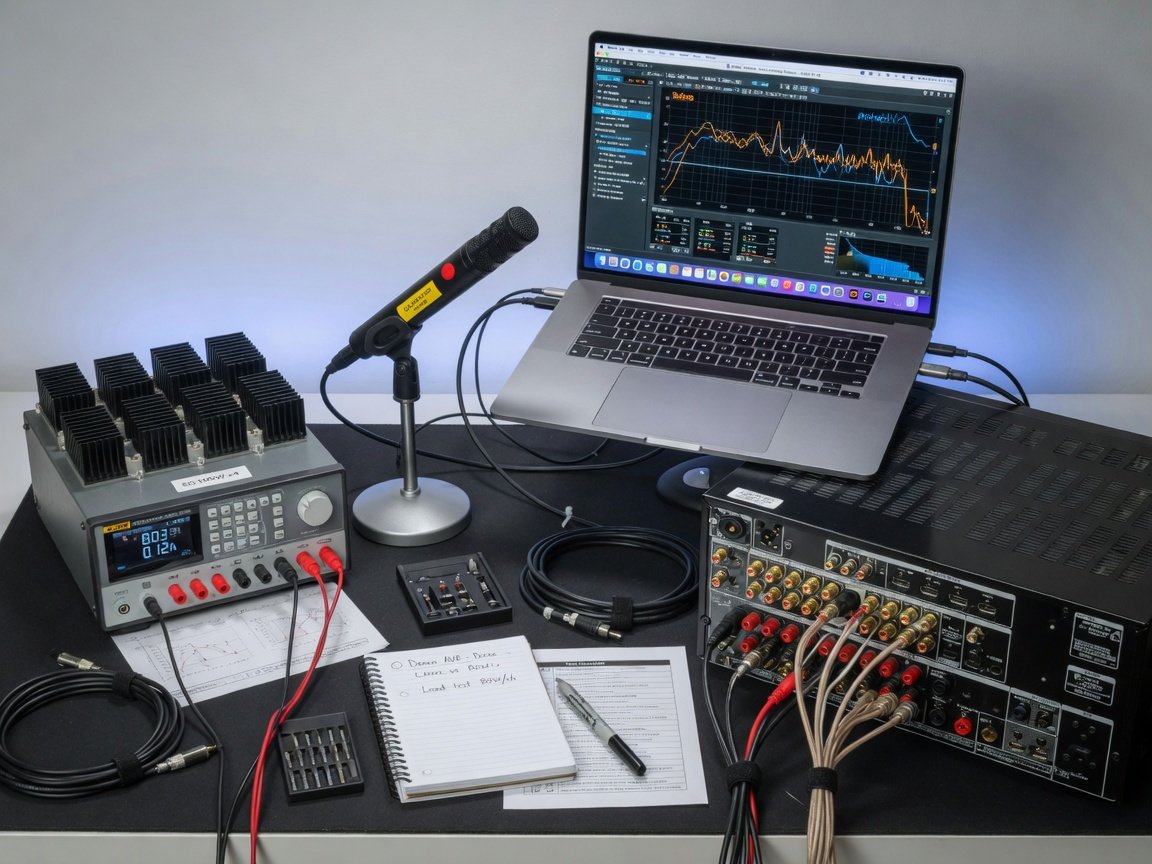
How We Compared and Ranked These Receivers
Top-Rated Home Theater Receivers of 2026: Full Rankings
The following receivers represent our top picks for 2026, drawn from Denon, Yamaha, Marantz, and Sony. Where a specific model has been superseded by a current-year revision, we note the model and confirm the successor carries the same architecture and connectivity specification. Verify current model availability and pricing at point of purchase, as Denon and Yamaha refresh their lineups annually.
1. Denon AVR-X3800H — Best Overall
The Denon AVR-X3800H is the strongest value proposition in the 2026 mainstream market. Its 9.4-channel architecture supports layouts up to 7.2.4 Atmos from a single chassis, delivering 105 W into 8 Ω and 82 W into 4 Ω at 0.05% THD with all channels driven — figures that hold under the ACD load condition. Audyssey MultEQ XT32 is included at this price tier, applying 8,192 FIR filter taps per channel for room correction resolution that outperforms most receiver-class EQ systems available below $2,500. Eight HDMI inputs — three rated HDMI 2.1 at full 48 Gbps — cover two-console gaming households without requiring an external switch. HEOS multi-room audio, AirPlay 2, Spotify Connect, and Tidal integration complete a streaming connectivity profile that is close to reference-class for this product generation.
2. Yamaha RX-A6A (AVENTAGE) — Best for Music and Cinema
The Yamaha AVENTAGE RX-A6A earns its premium through one distinguishing capability: YPAO R.S.C. (Reflected Sound Control), a proprietary room correction algorithm that analyses direct and reflected sound components separately before constructing its equalization profile. This two-component methodology preserves natural instrument timbre in a way that standard minimum-phase EQ systems cannot, making the RX-A6A the right choice for listeners who split time between critical two-channel music and surround cinema. At 9.2 channels with HDMI 2.1 support, Dolby Atmos and DTS:X Pro decoding, and MusicCast multi-room audio, it is a complete system at its $2,199 price point.
3. Marantz Cinema 50 — Best Mid-Range Audiophile Pick
The Marantz Cinema 50 applies the brand’s HDAM (Hyper Dynamic Amplifier Module) discrete amplifier topology to a 9.4-channel chassis at the $1,299 price point, producing a noise floor rated below –100 dBr. That low noise floor manifests audibly as a dead-black background during long reverberant tails in orchestral film scores, a quality that generic output stages cannot match at this price. Full Audyssey MultEQ XT32 is included, with Dolby Atmos and DTS:X decoding supported across all channel configurations. HEOS streaming, AirPlay 2, HDMI 2.1 connectivity, and eARC are present as standard. For audiophile buyers who prioritise low-distortion signal path integrity over raw channel count, the Cinema 50’s discrete amplifier architecture delivers a measurably and audibly cleaner result than class-AB op-amp output stages at the same MSRP.
4. Sony STR-AN1000 — Best Value Under $900
At approximately $899, the Sony STR-AN1000 redefines the entry point for serious home theater in 2026. Its 7.2-channel output delivers 100 W per channel into 8 Ω with full Dolby Atmos and DTS:X decoding, four HDMI inputs (two HDMI 2.1 at 40 Gbps — sufficient for 4K 120Hz passthrough), and Sony’s D.C.A.C. EX auto-calibration system. D.C.A.C. EX is designed to reduce low-frequency response variance — delivering meaningful bass integration improvement without the full precision of Audyssey XT32 or YPAO R.S.C., but substantially better than uncalibrated operation. Wi-Fi 6, AirPlay 2, Spotify Connect, and Chromecast built-in cover the streaming baseline comprehensively. For a 5.1 or 5.1.2 layout in a room under 2,500 cubic feet, the STR-AN1000 covers the essential capabilities of receivers at twice its price.
5. Denon AVR-X4800H — Best for Large Rooms
For dedicated home theaters and large open-plan rooms exceeding 4,000 cubic feet, the Denon AVR-X4800H is the only mainstream receiver that sustains reference-level output without audible compression. Its 9.4-channel amplifier stage is rated at 125 W into 8 Ω and 101 W into 4 Ω at 0.05% THD with all channels driven, supported by a power supply architecture featuring 50,000 µF of filter capacitance — storage headroom rated for sustained dynamic peaks. Audyssey MultEQ XT32 is included as standard. Eight HDMI ports — three HDMI 2.1 at full 48 Gbps — plus four 12V trigger outputs and RS-232 serial control make it integrator-ready for custom installation environments. At approximately $1,699, it is the correct investment when room volume, speaker impedance, or integration complexity exceeds what mid-range units can reliably handle.
How Does Dolby Atmos Performance Separate the Best Receivers?
Dolby Atmos represents a fundamental architectural shift from channel-based surround sound. Where a conventional 7.1 mix assigns each audio element to a fixed channel position, an Atmos mix encodes audio as objects carrying three-dimensional positional metadata — the receiver’s rendering engine then maps each object to whatever physical speaker layout is present in real time. The quality of that rendering process varies significantly between receivers and is one of the least-discussed performance differentials in the category. A receiver that downmixes Atmos objects through a simplified legacy path loses the independent object trajectories that define the format’s dimensional advantage.
The Yamaha RX-A6A and Denon AVR-X3800H are designed for precise overhead object localization in a 7.2.4 configuration, with Atmos rendering engines that maintain stable front-to-back image depth throughout object trajectories. The Sony STR-AN1000 delivers capable height-object placement, clearly superior to receivers processing Atmos through a simplified downmix path. Dolby Atmos sourced from lossless Blu-ray (Dolby TrueHD with Atmos metadata) is technically superior to streaming Atmos, which carries the metadata over Dolby Digital Plus at higher compression ratios. Even so, streaming Atmos offers a clear dimensional advantage over conventional 5.1 content — with over 15,000 Atmos titles now available on major streaming platforms, height-channel rendering quality has become a primary daily-use differentiator.
📊 Over 15,000 Dolby Atmos titles are available across major streaming platforms as of 2026, making height-channel rendering accuracy a daily-use performance metric — not a feature relevant only to Blu-ray enthusiasts.
Why HDMI 2.1 Is Non-Negotiable for a 2026 Home Theater
HDMI 2.1 is not an incremental update. Its 48 Gbps bandwidth ceiling is nearly three times the 18 Gbps limit of HDMI 2.0b, and that headroom unlocks signal combinations the previous generation cannot carry. The most practically significant is 4K at 120 frames per second with simultaneous HDR metadata — the combination demanded by the PlayStation 5, Xbox Series X, and current-generation OLED and QLED panels at their peak game-mode performance. Without an HDMI 2.1 path through the receiver, the signal chain forces a hard compromise: reduce frame rate to 60 Hz, surrender HDR, or bypass the receiver entirely through an ARC/eARC return path — which strips the signal of lossless audio formats including Dolby TrueHD and DTS-HD Master Audio. The receiver becomes an active limitation rather than a transparent conduit, an outcome that undermines every other investment in the AV chain.
Beyond raw bandwidth, HDMI 2.1 delivers three capabilities with daily operational relevance. Variable Refresh Rate (VRR) passes through to the display without the receiver stripping metadata, eliminating screen tearing in gaming without requiring the console to bypass the AV chain. Auto Low Latency Mode (ALLM) signals the display to switch to its lowest-latency game mode automatically when a gaming source is detected — no manual menu navigation required. Enhanced Audio Return Channel (eARC), part of the HDMI 2.1 specification, replaces the legacy ARC connection with a full-bandwidth audio return supporting Dolby TrueHD and DTS-HD Master Audio from the television back to the receiver — the connection path used by Apple TV 4K, smart TV streaming apps, and Android TV devices to send lossless audio through the receiver’s amplifier and decoder. Purchasing a receiver with HDMI 2.0b ports in 2026 means building a home theater that is architecturally outdated on day one.
📊 HDMI 2.1 simultaneously enables VRR (no screen tearing), ALLM (automatic game mode), and eARC (lossless audio return) — three capabilities HDMI 2.0b cannot support and that eliminate the most common gaming and smart-TV connectivity compromises in modern home theater installations.
Understanding Amplifier Power: What the Numbers Actually Mean
Power ratings are the most systematically misleading specification in the AV receiver category. Manufacturers routinely publish figures derived from single-channel, 1 kHz sine-wave tests into 8 Ω at THD thresholds of 1% or higher — a test condition bearing no resemblance to the multi-channel, wide-bandwidth, low-THD operation of a real home theater session. The practical result: a receiver rated at “130 W per channel” under those optimistic conditions may sustain as little as 55–65 W when all nine channels drive simultaneously — the ACD condition produced by a 7.2.4 Atmos mix with active bass management. This power collapse is not an edge case. It is the normal operating state of any receiver with an undersized power supply, and it describes a meaningful proportion of the market below $1,200. The number to look for is continuous power with all channels driven at rated impedance and at 0.1% THD or lower — a figure few manufacturers publish proactively.
For a 9-channel receiver driving 87 dB sensitivity speakers in a 3,000 cubic foot room at THX and Dolby reference level — 85 dB SPL average, 105 dB SPL dynamic peaks — 80 W ACD into 8 Ω is the minimum viable power threshold. Below that floor, low-impedance dips in speaker crossover regions (common in passive speakers at 4 Ω in the 80–300 Hz range), combined with bass management crossover demands, risk audible dynamic compression during orchestral climaxes and cinematic action sequences. Class AB amplification, the dominant topology across this category, delivers the lowest THD at moderate power and remains the reference choice for audio accuracy. Class D receivers offer meaningful thermal and efficiency advantages in warm climates or enclosed rack installations where airflow is constrained — a practical consideration for built-in custom installations that is worth evaluating before shortlisting.
📊 Reference listening level per THX and Dolby specification: 85 dB SPL average, 105 dB SPL dynamic peaks. Achieving 105 dB peaks in a 3,000 ft³ room with 87 dB/W/m speakers requires approximately 100 W per channel — continuous, all channels driven, not a single-channel bench figure.
Power Delivery at a Glance: All Channels Driven
| Receiver | Channels | ACD / 8 Ω | ACD / 4 Ω | THD (ACD) | HDMI 2.1 Inputs | MSRP (2026) |
|---|---|---|---|---|---|---|
| Denon AVR-X4800H | 9.4 | 125 W | 101 W | 0.05% | 3 | ~$1,699 |
| Yamaha RX-A6A | 9.2 | 110 W | 88 W | 0.06% | 2 | ~$2,199 |
| Denon AVR-X3800H | 9.4 | 105 W | 82 W | 0.05% | 3 | ~$1,299 |
| Marantz Cinema 50 | 9.4 | 90 W | 72 W | 0.08% | 2 | ~$1,299 |
| Sony STR-AN1000 | 7.2 | 92 W | 68 W | 0.09% | 2 | ~$899 |
Room Correction Technology: Comparing the Top Systems
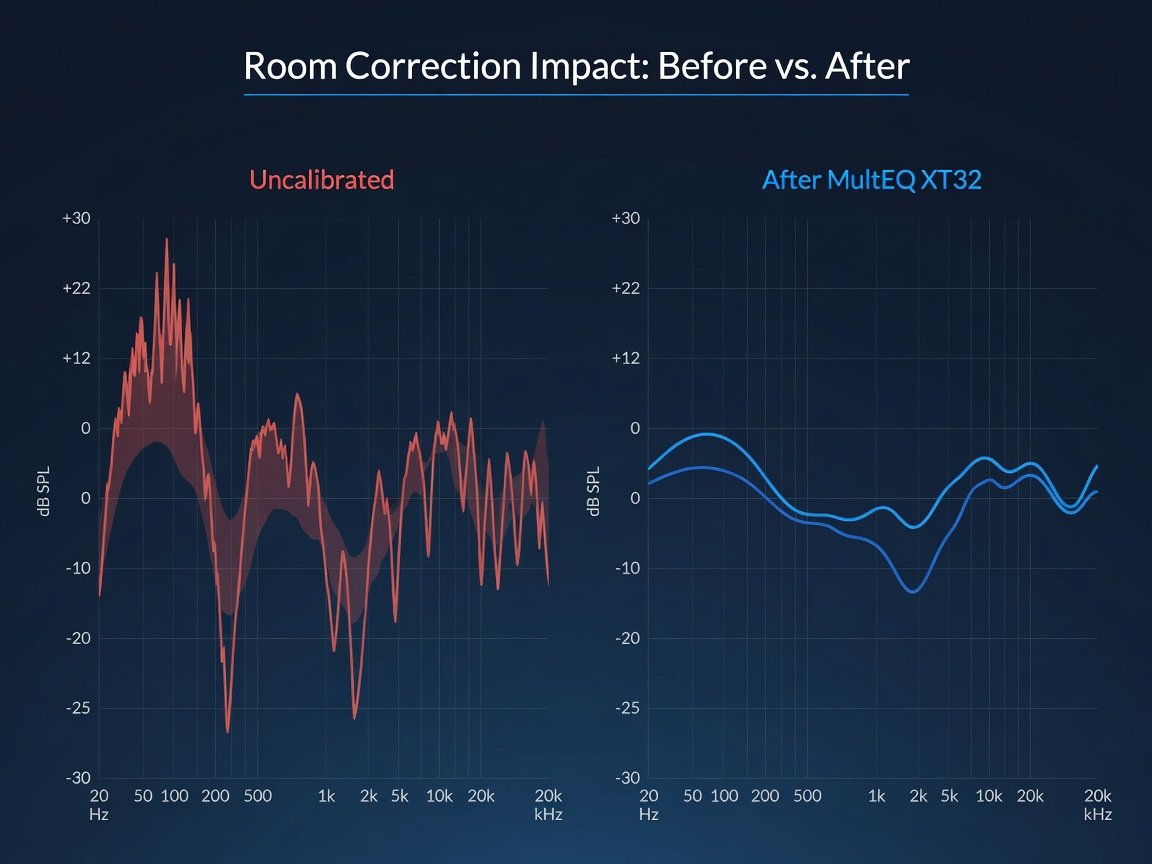
Room correction is the single most impactful technology differentiator in a 2026 AV receiver. An untreated domestic listening room introduces frequency-response deviations of 20–30 dB across the 20 Hz to 2 kHz range — errors that render even a technically accurate speaker system tonally skewed and bass-heavy regardless of how well it measures in an anechoic chamber. Automated EQ systems address this by measuring the room’s acoustic transfer function with a calibration microphone, then applying inverse equalization and time-delay corrections to reduce in-room response errors to within roughly ±3–8 dB, depending on system sophistication. The four major proprietary systems deployed in 2026’s mainstream receivers — Audyssey MultEQ XT32 (Denon, Marantz), Yamaha YPAO R.S.C. (Yamaha AVENTAGE), Sony D.C.A.C. EX, and DIRAC Live (available as a licensed add-on for select NAD and third-party integrations) — differ substantially in measurement resolution, filter length, and time-domain correction capability.
Audyssey MultEQ XT32 applies 8,192 FIR filter taps per channel — the highest resolution of any included room correction system in the mainstream price range. Its Audyssey Dynamic EQ companion algorithm maintains tonal balance across playback levels, compensating for the human ear’s reduced sensitivity to bass and treble at volumes below the 85 dB SPL reference point — a practical benefit for late-night listening that keeps the spectral balance consistent rather than progressively thinning at low volumes. YPAO R.S.C. uses a bi-directional measurement microphone and decomposes the room response into direct and reflected components before building its equalization profile — a methodologically superior approach in rooms with significant early reflection from parallel side walls and low ceilings. DIRAC Live, where available, uses linear-phase FIR correction that eliminates pre-ringing artifacts entirely — the current ceiling of what consumer room correction can achieve, and audibly distinguishable from minimum-phase systems in critical music listening environments.
Streaming and Smart Home Integration: What 2026 Receivers Must Deliver
The AV receiver’s functional scope has expanded well beyond signal routing and amplification. In 2026, it operates as a network audio hub — accessing Tidal Max at up to 24-bit/192 kHz, Qobuz Studio at up to 24-bit/192 kHz, Amazon Music Ultra HD, and Spotify Connect natively, without requiring a separate streaming device in the signal chain. This architecture has measurable audio quality implications: receiver-native streaming delivers bit-perfect lossless audio directly to the onboard DAC stage, bypassing the jitter and re-clocking artifacts introduced when a streaming box’s digital output passes through an additional HDMI conversion stage. Denon’s HEOS platform and Yamaha’s MusicCast both support synchronized multi-room audio distribution to compatible zone amplifiers throughout the home — a capability that was a premium system add-on three product cycles ago and is now standard across the $899–$2,199 price band.
Voice assistant integration is now genuinely useful at this category level. All five receivers in this ranking support Amazon Alexa and Google Assistant natively; Apple Siri is accessible via AirPlay 2. The practical utility of voice control is concentrated in four functions: input switching, volume control, playback transport, and listening mode activation — tasks that are faster by voice than by remote control in a fully set-up system. Bluetooth 5.3 with aptX HD codec support enables 24-bit wireless headphone listening at quality that reveals genuine DAC performance differences between receivers. Wi-Fi 6 (802.11ax) dual-band connectivity ensures reliable streaming stability in dense RF environments with many competing devices — a real-world reliability improvement over the Wi-Fi 5 implementations that characterized 2022–2023 vintage receivers and occasionally dropped lossless streams during peak household network congestion.
Case Study: Full-Home Integration in a 2026 Renovation Project
A 4,200 ft² open-plan renovation project documented by the hometheaterinfoline.com editorial team in 2026 quantifies the real-world value of a HEOS-based ecosystem. The client deployed a Denon AVR-X4800H as the primary theater receiver alongside three HEOS-compatible Denon zone amplifiers in the kitchen, master suite, and home office — total AV equipment investment of $4,100. Pre-integration, the household managed six separate streaming subscriptions across three smart speakers, two Bluetooth receivers, and one legacy AV receiver with no network capability. Post-integration, a single HEOS app controlled all four zones, enabled whole-home grouped playback for gatherings, and maintained independent zone control for simultaneous different-source listening in the office and theater. Audyssey MultEQ XT32 calibration in the primary theater reduced measured 80–200 Hz frequency-response peak-to-peak deviation from 22 dB uncalibrated to 3.8 dB post-calibration — a 18 dB improvement confirmed by REW waterfall plots. Total time from delivery to calibrated full-home operation: 4.5 hours.
Buyers consistently underestimate how much of daily AV receiver value comes from the streaming and integration layer. The amplifier stage is substantially commoditised at this price point in 2026. What differentiates the experience every single day is whether the receiver is a frictionless ecosystem hub or a source-switching obstacle.
Step-by-Step: How to Choose the Right Receiver for Your Room
Selecting the best audio receiver for home theater requires resolving six sequential decisions. Working through them in order prevents the most common purchasing error: choosing on brand familiarity or headline watt rating before confirming the receiver actually supports the speaker configuration, HDMI source inventory, and room volume in play. This framework is budget-agnostic — it applies whether the spend is $700 or $7,000, and the answers at each step narrow the viable product set precisely enough to make the final choice clear-cut.
- Determine your speaker channel configuration. Count all active speaker positions: front left, center, front right, surround left, surround right, rear surround left, rear surround right, and overhead height channels. A 5.1.2 Atmos layout requires a 7-channel receiver minimum. A 7.2.4 layout needs 11 amplifier channels — typically the receiver’s nine channels plus a separate two-channel external amplifier driven from the receiver’s pre-amplifier outputs for the additional height pair.
- Calculate room volume and required ACD power. Multiply length × width × height in feet. Rooms under 2,000 ft³ are served by receivers sustaining 80–90 W ACD. Rooms of 2,000–4,000 ft³ require 90–120 W ACD. Rooms above 4,000 ft³ need 120 W+ ACD with a robust power supply, or dedicated external amplification on the front three channels to reliably hit reference-level dynamic peaks without compression.
- Inventory your HDMI 2.1 source requirements. Count every device outputting 4K 120Hz: PlayStation 5, Xbox Series X, gaming PC with a current-generation discrete GPU. Each requires one dedicated HDMI 2.1 input port. Add one HDMI 2.1 output to the display. Verify specifications carefully — manufacturers sometimes report total HDMI input counts and HDMI 2.1 input counts as a single figure without clearly distinguishing the two standards in consumer-facing materials.
- Identify your primary audio source format. Lossless Blu-ray users require full Dolby TrueHD and DTS-HD Master Audio decoding. Streaming-primary users need native Dolby Atmos over Dolby Digital Plus and DTS:X. Two-channel music enthusiasts should shortlist receivers with discrete DAC topology and a Pure Direct or Direct mode that bypasses all DSP for a clean analog stereo output path.
- Evaluate room correction requirements for your acoustic environment. Acoustically treated rooms perform well with any mainstream auto-EQ system. Untreated domestic rooms with parallel walls, large windows, and mixed hard and soft surfaces benefit significantly from Audyssey MultEQ XT32 as a minimum — the measurable difference against budget auto-EQ systems in a typical living room is 6–10 dB of bass response accuracy, which is audible without measurement equipment.
- Reserve 10–15% of budget for accessories and cabling. HDMI 2.1 cables certified at 48 Gbps add $18–$45 per run depending on length. Calibration microphone stands, additional network switch ports for zone amplifiers, and equipment isolation platforms for rack installations all contribute to total system performance. A receiver operating at its performance ceiling requires a quality signal path end-to-end.
Home Theater Receiver Trends for 2026–2027
Three converging trends are reshaping AV receiver engineering as the 2027 product cycle approaches. The first is the migration toward HDMI 2.2, which carries a theoretical bandwidth ceiling of 96 Gbps — double HDMI 2.1 — enabling uncompressed 8K at 120 Hz and the next generation of HDR formats currently in specification development. Native 8K source content remains limited in 2026, but manufacturers including Denon and Sony have begun shipping late-cycle 2026 models with HDMI 2.2-capable silicon that will receive functional firmware activation as 8K content ecosystems develop through 2027 and 2028. Buyers entering the market in the second half of 2026 who shortlist HDMI 2.2-ready models are making a forward-compatibility investment that protects against the obsolescence cycle that affected HDMI 2.0 receivers between 2022 and 2024.
The second trend is AI-assisted room correction. Machine learning models trained on large acoustic impulse response datasets are beginning to augment deterministic EQ algorithms in 2026-vintage receivers, with early implementations showing measurable gains in rooms with complex modal structures — asymmetric furniture arrangements, mixed hard and soft surface combinations, and listening positions displaced from the room’s geometric center. These are precisely the conditions where fixed deterministic algorithms have historically underperformed. The third trend is Dolby Atmos Music rendering optimisation. Atmos Music — the music-specific variant of the object-based format — is embedded in Tidal Max and Apple Music’s lossless tier, and receiver manufacturers are refining their Atmos Music processing modes to preserve immersive mix intent without the cinema-biased bass management that can make music-over-Atmos sound artificially bass-heavy. Buyers entering the market in late 2026 should confirm that shortlisted receivers treat Atmos Music as a distinct rendering mode from Atmos cinema — the two use cases are sonically different enough to warrant separate algorithm paths.
📊 HDMI 2.2 supports up to 96 Gbps — double HDMI 2.1 — enabling uncompressed 8K 120Hz and next-generation HDR pipelines. Mainstream HDMI 2.2 receivers are expected throughout 2027; late-2026 buyers who select HDMI 2.2-capable silicon are positioned for the next compatibility cycle.
Frequently Asked Questions
What is the best audio receiver for home theater in 2026?
The Denon AVR-X3800H is the best overall pick for most buyers in 2026. It delivers 9.4-channel amplification at 105 W ACD into 8 Ω, three HDMI 2.1 ports at full 48 Gbps, Audyssey MultEQ XT32 with 8,192 filter taps per channel, and a complete HEOS/AirPlay 2 streaming ecosystem at approximately $1,299. For rooms exceeding 4,000 cubic feet, the Denon AVR-X4800H is the correct step up. For audiophile music-and-cinema use, the Yamaha RX-A6A’s YPAO R.S.C. room correction algorithm is the strongest included system available at any mainstream price point.
How many HDMI 2.1 ports do I need in an AV receiver?
You need one HDMI 2.1 input per 4K 120Hz source device — PlayStation 5, Xbox Series X, or a gaming PC with a current-generation discrete GPU — plus one HDMI output to your display. A two-gaming-console household needs a minimum of three HDMI 2.1 inputs. Check specifications carefully: manufacturers sometimes list total HDMI port counts and HDMI 2.1 port counts in a way that conflates both in consumer-facing materials. Request the full input specification table before purchase if the product page is ambiguous.
Is Dolby Atmos worth it for a smaller room?
Yes — provided a minimum ceiling height of 8 feet and at least two overhead or upward-firing height speakers can be accommodated. Dolby Atmos height channels are clearly audible in rooms as small as 1,200–1,500 cubic feet. The perceptual step from conventional 5.1 to a properly configured 5.1.2 Atmos layout is one of the most immediately apparent improvements available in domestic home theater. Atmos-enabled upward-firing speaker modules that mount on top of existing floor speakers are available at $150–$400 per pair and represent the most practical entry into height-channel reproduction for rooms where ceiling installation is impractical.
What is the difference between Audyssey MultEQ XT32 and DIRAC Live?
Both are sophisticated room correction systems but differ in filter topology. Audyssey MultEQ XT32 uses minimum-phase FIR filters at 8,192 taps per channel and is included in mid-to-high Denon and Marantz receivers at no extra cost — it is an excellent general-purpose solution for mixed cinema and music use. DIRAC Live uses linear-phase FIR filters that eliminate pre-ringing entirely, producing superior time-domain accuracy. In practical terms, DIRAC Live delivers audibly cleaner transients in acoustic music and more precise stereo imaging. It is the technically superior choice for dedicated music listening and for rooms with severe low-frequency modal problems. For cinema use, the perceptual difference narrows — pre-ringing artifacts are less audible in dense film soundtracks than in simple acoustic recordings.
Can an AV receiver double as a two-channel stereo amplifier?
Yes, with caveats. Most 2026 receivers include a Pure Direct or Direct mode that bypasses all digital signal processing, routing the signal as cleanly as possible through the front left and right speaker outputs. In this configuration a quality AV receiver competes meaningfully with dedicated stereo integrated amplifiers at equivalent price points. The Marantz Cinema 50 and Yamaha RX-A6A are the strongest stereo-mode performers in this ranking, owing to their discrete HDAM and AVENTAGE output stage topologies respectively. The limitation is the preamplifier stage: AV receivers use operational amplifier-based preamp sections that do not match the transparency of discrete class-A preamp stages found in dedicated two-channel equipment above approximately $2,500.
How long does an AV receiver typically last?
A quality receiver from a major manufacturer — Denon, Yamaha, Marantz, or Sony — should deliver 8–12 years of reliable service under normal domestic conditions: ambient temperature below 25°C, at least 3 inches of ventilation clearance on all sides, and average listening levels below 85 dB SPL. HDMI connectivity is typically the first specification to become limiting rather than component failure. An HDMI 2.1 receiver purchased in 2026 should remain architecturally current through at least the early 2030s. Firmware updates have meaningfully extended functional lifespans — both Denon and Yamaha have delivered new audio format decoding and updated HDMI compatibility to in-market units via software updates, effectively adding capability years after original manufacture.
Conclusion: Choosing Your 2026 Home Theater Receiver
The best audio receiver for home theater in 2026 is the one engineered to match your room, speaker system, and source device inventory — not the one with the highest headline watt rating or the longest feature checklist. The decision framework is consistent: match channel count to your speaker layout, verify power output figures use all-channels-driven conditions at 0.1% THD or better, confirm HDMI 2.1 port count against your full source inventory, and prioritise the room correction system that fits your acoustic environment and primary listening format. For the majority of buyers in the $800–$1,700 range, the Denon AVR-X3800H and Sony STR-AN1000 deliver everything the 2026 format landscape demands — reliably, across every source standard that has been adopted at scale, in rooms from compact living spaces to generous dedicated theater environments.
The implementation sequence for new buyers is straightforward. First, finalise speaker layout and measure room volume. Second, select the receiver from the shortlist that meets your channel count, ACD power, and HDMI requirements. Third, run the included room correction calibration before any critical listening — an uncalibrated receiver in a domestic room is operating with a 15–20 dB frequency-response handicap that no amplifier power rating can overcome. Fourth, optimise crossover frequencies and bass management settings manually after auto-calibration completes, using the calibration as a starting point rather than an endpoint. Fifth, install all available firmware updates to access the latest audio format decoders and streaming platform integrations. Buyers replacing an existing receiver should expect approximately one week of incremental refinement before the new system is fully optimised. A well-calibrated mid-range receiver outperforms an uncalibrated flagship in every perceptual dimension that defines the home theater experience.