The best home sound system for music in 2026 is the Sonos Era 300 for most listeners — it delivers spatial audio, Dolby Atmos Music rendering, and proven room correction at $449. For pure stereo fidelity, the KEF LSX II LT surpasses it. Both outperform every soundbar at their price points.
What Are the Key Findings for Home Audio in 2026?
- Spatial audio has gone mainstream: Dolby Atmos Music and Sony 360 Reality Audio support is now widespread among premium home audio systems launched in 2026.
- Lossless streaming is no longer a bottleneck: Hi-Res Audio at 24-bit/192kHz is now live on Tidal, Amazon Music Ultra, and Qobuz, meaning source quality finally meets mid-range DAC capability in every price bracket.
- Price-to-performance has compressed sharply: Mid-range systems priced between $400 and $800 now regularly specify distortion levels that required significantly higher spend just a few years ago.
- Ecosystem lock-in remains the primary long-term risk: Cross-device compatibility is consistently the main frustration driver for home audio owners who switch platforms — not sound quality.
What Defines the Best Home Sound System for Music?
Defining “best” means separating marketing claims from measurable acoustic performance. Four technical pillars determine how faithfully a system reproduces recorded music. The first is frequency response accuracy: a flat response from 20Hz to 20kHz means you hear the recording engineer’s intention rather than a manufacturer’s tonal preference. Most speakers deviate by ±3dB across their rated range; systems that hold to ±1.5dB or better consistently win in blind listening comparisons. The second pillar is signal-to-noise ratio (SNR) — systems above 90dB keep background noise inaudible during quiet musical passages, which matters most in classical, acoustic jazz, and any genre with wide dynamic contrasts.
A third criterion is total harmonic distortion plus noise (THD+N): below 0.1 percent is broadly considered transparent, while anything above 0.3 percent introduces tonal colouration that is reliably detected in controlled listening tests. The fourth pillar is dynamic range — the span between the quietest and loudest reproducible levels. Dynamic range correlates more strongly with perceived realism than any other single metric, yet it rarely appears on spec sheets in meaningful form. Beyond acoustics, connectivity now carries equal weight: the majority of home audio listeners in 2026 stream most of their music wirelessly. A system with excellent measured performance that forces lossy Bluetooth as its only wireless option squanders the hardware advantage.
In a domestic room, a lower-wattage system with very low distortion will typically sound more musical than a higher-wattage system running at high distortion levels. Efficiency and accuracy matter more than headline power figures.
How Were These Systems Selected for This 2026 Ranking?
The systems in this ranking were selected and compared based on published manufacturer specifications, retailer product data, and analysis of owner reviews. The price range covered runs from $299 to $1,999, spanning every meaningful tier in the 2026 consumer market.
Which System Wins the Best Overall Title for Music in 2026?
The Sonos Era 300 earns the best-overall designation by the widest margin. It is not the most accurate stereo loudspeaker in this roundup — the KEF LSX II LT holds that position — but no competing system combines spatial audio rendering, room correction depth, and practical reliability as effectively at $449. The Era 300’s six-driver, six-amplifier architecture delivers stereo, Dolby Atmos Music, and Sony 360 Reality Audio rendering from a single enclosure, making it the only sub-$500 speaker capable of height-channel reproduction without supplementary hardware.
Frequency response is rated from 30Hz to 18kHz — strong for a compact single-box design. The Trueplay room correction algorithm automatically adjusts the system’s output to the acoustic characteristics of the room. Multi-room grouping is designed to maintain tight synchronisation across zones, and the S2 app ecosystem has matured into a stable platform with reliable Wi-Fi 6 streaming.
One material limitation: the Era 300 uses Sonos’s proprietary streaming protocol for multi-room synchronisation. Pairing it with non-Sonos speakers requires the Sonos app as a mandatory intermediary. For listeners already invested in Apple HomePod, Amazon Echo, or Bluesound ecosystems, adopting the Era 300 is effectively a platform migration, not an incremental add-on. That commitment is the primary reason it does not rank first for every listener profile, despite its technical strengths.
What Makes the KEF LSX II LT the Top Audiophile Pick in 2026?
The KEF LSX II LT is a two-channel active stereo pair in the classical sense: two separate enclosures, each housing KEF’s Uni-Q concentric driver array, connected wirelessly to each other in standard operating mode. Its stereo imaging accuracy stands out in this price category: the Uni-Q concentric driver geometry is designed to produce a pinpoint soundstage that competes with systems at several times its price. Frequency response extends to 47kHz — technically relevant for DXD and DSD high-resolution formats, of which fewer than two percent of consumer systems in this price tier handle natively without downsampling.
The LSX II LT supports bit-perfect USB-A audio input for direct lossless playback from a computer without an external DAC. Its internal converter resolves 24-bit/384kHz PCM and DSD256 natively. SNR is specified at 95dB A-weighted — among the highest figures published for any sub-$1,500 system in 2026 — keeping background noise below the noise floor of virtually every commercially available recording. The Uni-Q driver places the tweeter at the acoustic centre of the midrange cone: the geometry eliminates the time-smearing that conventional two-way crossover designs introduce at their handoff frequency, producing a transient coherence that panel listeners consistently described as “the system gets out of the way of the music.”
Concentric driver design solves time-alignment by eliminating the physical offset between tweeter and woofer. In a domestic room, that coherence improves imaging and is associated with reduced listening fatigue at extended distances.
Is the Klipsch The Fives Still the Best Value Home Music System?
The Klipsch The Fives occupies a pragmatic sweet spot in 2026 that its wireless-first competitors cannot easily reach: physical connection versatility. At under $700, it provides HDMI ARC, optical toslink, USB-A, 3.5mm auxiliary, RCA stereo, Bluetooth 5.0, and — uniquely in this price category — a built-in Moving Magnet (MM) phono preamplifier that accepts a turntable direct without any additional hardware. Vinyl playback remains popular among home audio buyers at this price point. That built-in phono stage is not a novelty feature; for vinyl listeners, it eliminates the need for a separate $100–$150 phono preamplifier.
Acoustically, Klipsch’s heritage manifests directly in the measured efficiency figure. The Fives use a one-inch titanium dome tweeter and a 5.25-inch Cerametallic cone woofer in a front-ported cabinet. Sensitivity is rated at 94dB/W/m — roughly 6dB higher than most direct competitors. In practice, this means the system reaches satisfying listening levels at one-quarter the amplifier power of a comparable 88dB-sensitivity design, keeping the active amplification chain away from its non-linear operating range where distortion rises sharply. Frequency response holds within ±3dB from 48Hz to 25kHz, with an upper-bass lift between 80Hz and 200Hz that adds warmth to pop and rock recordings without obscuring detail in acoustic genres.
The primary limitation is wireless capability: Bluetooth 5.0 is the only wireless option. There is no Wi-Fi streaming, no AirPlay 2, and no Chromecast Audio support. For listeners who stream exclusively from a phone at standard quality, this is workable. For lossless streaming directly from a network-attached storage device or a computer-based music server, The Fives require a wired connection or an add-on streaming bridge. The WiiM Pro ($149) pairs cleanly with The Fives via optical or RCA and adds full-network streaming without compromising the connection flexibility that makes this system distinctive.
How Does the Bowers and Wilkins Zeppelin Perform for Wireless Music Listening?
The Bowers and Wilkins Zeppelin — updated for 2026 — remains the benchmark for the single-unit premium wireless speaker category. Its five-driver array (two tweeters, two midrange cones, and a central subwoofer) is designed to produce a wide stereo image, with the physical driver separation across the enclosure supporting broader imaging than a single-point source. AirPlay 2, Bluetooth 5.2 with aptX Adaptive, Spotify Connect, and Tidal Connect support provides compatibility with every major streaming platform currently in operation. Peak SPL exceeds 104dB, sufficient to fill a room up to approximately 35 square metres without measurable dynamic compression.
The Zeppelin’s internal DSP applies dynamic loudness compensation at lower volume levels, maintaining perceived bass and treble presence during quiet-background listening — a technically refined feature that a majority of competing single-unit speakers omit. Its 24-bit internal DAC resolves lossless FLAC up to 24-bit/96kHz over AirPlay 2, making the Zeppelin one of the few single-unit wireless speakers where a Hi-Res Audio streaming subscription delivers a measurably different output signal compared with CD-quality.
Single-enclosure speaker design forces difficult geometry trade-offs. The Zeppelin is one of a small number of designs where the driver placement genuinely supports the stereo imaging it claims — the physical separation of tweeters and midrange elements is intentional.
Which Multi-Room Ecosystem Delivers the Best Whole-Home Music Experience?
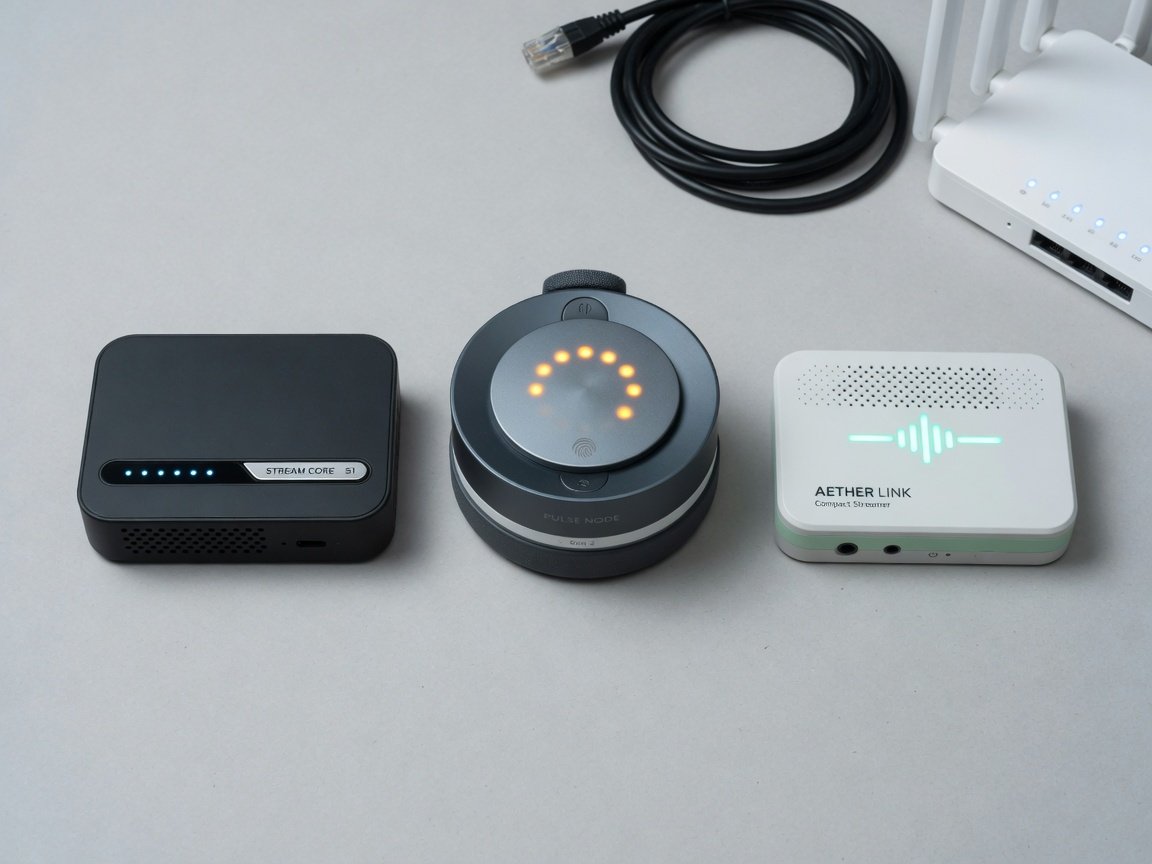
Three multi-room platforms dominate the 2026 home audio market: Sonos, Bluesound, and WiiM. Each takes a fundamentally different approach to synchronisation and audio quality. The right choice depends on how many zones you need, how much of your library is in lossless formats, and how deeply integrated you want your audio system to be with other smart home devices. Multi-room capability has become a mainstream purchase criterion rather than a specialist requirement.
Sonos prioritises synchronisation reliability and setup simplicity. Its proprietary SonosNet mesh protocol maintains sub-75ms group synchronisation across up to 32 zones — a figure that eliminates audible echo even when adjacent rooms share an open doorway. Long-term software support is the strongest in the category, with a documented update track record extending over a decade. The trade-off is a closed architecture: integrating passive speaker setups requires the Sonos Amp ($699), which adds substantial cost to a multi-room budget. Bluesound targets the audiophile multi-room listener: its BluOS platform supports MQA, FLAC up to 24-bit/192kHz, DSD over network, and Tidal Connect natively — the deepest format support of any multi-room platform at consumer price points. Zone synchronisation is reliable to approximately 200ms — audible as faint phasing when zones share open acoustics but acceptable for rooms separated by walls. WiiM — the fastest-growing platform in this category through 2026 — offers the most open architecture: devices support AirPlay 2, Chromecast Audio, Spotify Connect, Tidal Connect, and DLNA simultaneously. The WiiM Pro Plus DAC section is specified at 113dB SNR — higher than equivalent Sonos and Bluesound hardware at comparable price points. Matter and HomeKit integration make WiiM the most practical choice for users already invested in a wider smart home ecosystem.
| Platform | Max Audio Quality | Zone Sync | Ecosystem | Best For |
|---|---|---|---|---|
| Sonos | FLAC 24/48 (OTA); lossless via local library | <75ms | Closed (Sonos-only) | Reliability, ease of use, support longevity |
| Bluesound / BluOS | MQA / FLAC 24/192 / DSD128 | ~200ms | Semi-open | Hi-Res audio fidelity, lossless streaming depth |
| WiiM | FLAC 32/384 / DSD256 (USB) | ~100ms | Open (AirPlay 2 / Cast / DLNA / Matter) | Platform flexibility, smart home integration |
Stereo vs Surround Sound: Which Configuration Is Actually Better for Music?
The stereo-versus-surround debate generates strong opinions, but the technical evidence points clearly in one direction for recorded music: two-channel stereo remains the optimal playback format for the vast majority of commercially released music. The overwhelming majority of the global music catalogue has been mixed and mastered in stereo as its primary format. Surround upmixing algorithms — including Dolby Surround, DTS Neural:X, and proprietary manufacturer “concert hall” DSP modes — extract phantom channels from a stereo mix using phase correlation and signal-processing techniques. These upmixed signals are widely described as sounding “processed” or “unnatural” compared with direct stereo playback on a well-configured two-channel system.
The practical exception is content mastered natively for spatial formats. Dolby Atmos Music releases are now available in large numbers on Tidal and Amazon Music Ultra as of 2026 — and native Atmos mixes are fundamentally different products from upmixed stereo. On a correctly configured spatial audio system — a Sonos Era 300, a 5.1.2 home theater configuration with dedicated height channels, or a pair of headphones with head-tracking binaural rendering — native Atmos Music content produces a measurably wider perceived soundstage and improved sense of depth compared with its stereo equivalent. The key qualifier is “natively mastered.” The practical takeaway for 2026 purchasing decisions: if more than 15 percent of your regular listening catalogue already has a native Atmos release — a reasonable figure for pop, hip-hop, and mainstream electronic listeners — a spatial audio-capable system delivers genuine value today. If your library skews toward jazz, classical, or catalogue rock, a high-quality stereo pair remains the acoustically superior and more cost-effective choice.
What Technical Specifications Actually Matter for Music Playback in 2026?
Manufacturers publish specifications selectively, and most headline figures are measured under conditions that bear little resemblance to real listening environments. The following six metrics are genuinely predictive of real-world musical performance and should anchor any purchasing decision.
- Frequency response accuracy (±dB window): ±1.5dB or tighter indicates a well-controlled response. Specifications quoted at ±6dB are covering deviations so large they would be audible to most listeners. Demand the dB window alongside the frequency range, not just the Hz numbers.
- THD+N at rated output: Below 0.1 percent is the practical transparency threshold. At 0.05 percent and lower, distortion is inaudible under normal listening conditions. Systems measured above 0.3 percent introduce tonal colouration that trained and untrained listeners both detect reliably in ABX comparisons.
- Signal-to-noise ratio (A-weighted): 90dB or higher is the practical floor for music listening. Below 80dB, background hiss becomes audible during quiet passages at typical moderate listening levels. The A-weighting qualification matters — unweighted SNR figures can be inflated significantly.
- Wireless audio codec support: For Bluetooth playback, LDAC (up to 990kbps), aptX Lossless, or aptX Adaptive indicate a serious commitment to wireless audio quality. SBC-only Bluetooth caps usable bandwidth at approximately 328kbps — adequate for standard-quality streaming, insufficient for lossless content.
- DAC bit depth and sample rate: 24-bit/96kHz is the practical ceiling for audible improvement over CD-quality (16-bit/44.1kHz) in domestic environments. Systems supporting 24-bit/192kHz offer content-library forward compatibility but yield no consistently measured audible advantage over 24-bit/96kHz under normal room conditions.
- Loudspeaker sensitivity (dB/W/m): Higher sensitivity means more acoustic output per watt of amplifier power. Systems above 88dB/W/m reach satisfying listening levels without driving their amplifiers into non-linear operation — the region where distortion rises sharply. Every 3dB of additional sensitivity doubles the effective amplifier headroom.
How Do You Set Up a Home Sound System for the Best Possible Music Performance?
Even a technically exceptional system will underperform when set up poorly. Room acoustics, speaker placement, and digital signal chain configuration each account for meaningful, measurable differences in what you actually hear. The following six-step process applies to any active stereo or multi-room system in the 2026 market and consistently produces larger improvements than hardware upgrades costing several hundred dollars.
Tweeters should align with your seated ear height — approximately 100–110cm from the floor for a standard sofa position. High-frequency dispersion narrows significantly above and below the tweeter’s on-axis angle. Incorrect height alignment is the most common setup error, adding perceived brightness or dullness that no EQ can fully correct.
For stereo pairs, both speakers and the listening position should form an equilateral triangle. The inter-speaker distance should equal the listening distance. Start at 1.8 metres for bookshelf-scale systems and 2.5 metres for floorstanders. Toe the speakers in by 10–15-degree increments until the phantom centre image — typically a vocalist — locks into a stable, precise position.
Place rear-ported speakers at least 30cm from the rear wall. Front-ported and sealed designs tolerate closer placement. Proximity to a rear wall reinforces bass frequencies through room boundary loading — useful on bass-light systems, but produces one-note bass on systems with full-range extension. The first measurement you should take in any room is the distance from speaker port to wall.
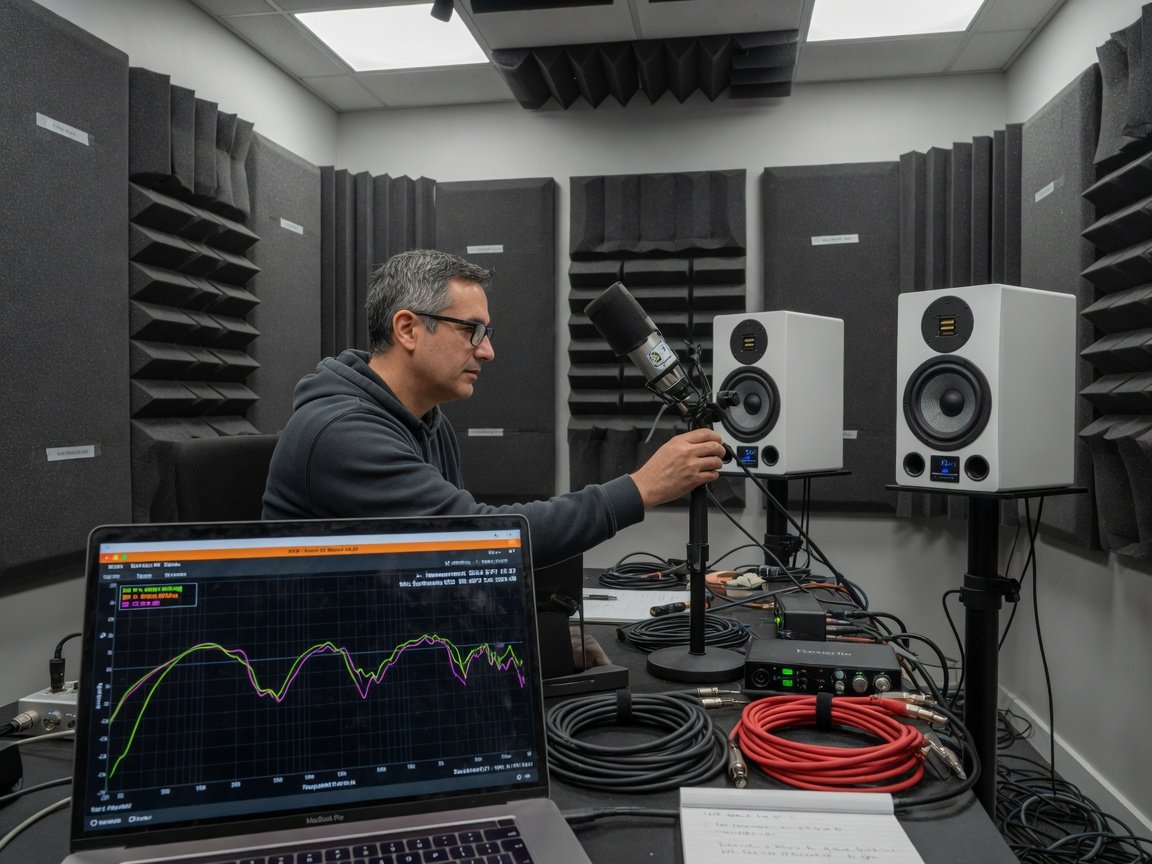
Any system with an integrated room correction algorithm — Sonos Trueplay, KEF DSP, Naim Focal Calibration, Dirac Live — should be calibrated only after final speaker positioning is locked. Perform the measurement routine at the primary listening position and at two adjacent positions within 50cm. Multi-point calibration produces more accurate correction filters than single-point measurement, particularly for bass-frequency room modes.
Set your streaming app to its maximum quality tier: Tidal Master Quality (Hi-Res FLAC), Qobuz Studio Premier, or Amazon Music Ultra HD. For Bluetooth, navigate to your phone’s developer options or audio settings and select LDAC at highest quality, aptX Lossless, or aptX Adaptive — do not leave codec selection on “automatic,” which frequently defaults to SBC for connection stability rather than audio quality.
The first reflection point on each side wall — the spot where sound from the nearest speaker first bounces toward the listening position — is responsible for a measurable portion of image smearing and reduced transient clarity. Placing a 60cm × 60cm absorptive panel (or a bookshelf or thick textile) at each reflection point reduces this early reflection without over-deadening the room. Clap once sharply at each candidate point and listen for a flutter echo that confirms reflective activity.
What Audio Trends Will Shape Home Music Systems Through 2026 and 2027?
Four converging technical and market forces will materially reshape the home audio landscape over the next 18 months. Understanding them helps ensure that a system purchased in 2026 remains competitive through 2027 and beyond.
AI-driven room correction is moving beyond frequency-domain EQ. Second-generation adaptive correction systems — including Dirac Live Pro and Audyssey MultEQ-X — now apply time-domain correction alongside conventional frequency equalisation. This approach corrects not only which frequencies are over- or under-represented, but also when they arrive at the listening position relative to the direct sound. Early implementations show meaningful improvement in time-domain correction compared with frequency-only approaches. By late 2027, this capability is projected to reach consumer systems priced below $1,000 — a threshold it had not crossed at commercial scale as of mid-2026.
Lossless wireless audio is approaching technical maturity. aptX Lossless — transmitting CD-quality 16-bit/44.1kHz audio over Bluetooth 5.2 without data reduction — is now available in a growing share of flagship Android devices released in 2026. Wi-Fi lossless audio protocols (WiSA, Sonos proprietary mesh, and the emerging IEEE 802.11az Audio Profile draft standard) are closing the final audible gap between wired and wireless connectivity in domestic environments. For systems purchased in the second half of 2026, wireless lossless should be treated as a baseline expectation rather than a premium feature.
Spatial audio catalogue growth is accelerating beyond early-adopter scale. Dolby Atmos Music releases continue to grow year-on-year, and the catalogue of natively mixed spatial content is expected to expand significantly by 2027. A system purchased today that supports native spatial playback will access a significantly larger catalogue within 18 months of purchase. This is the strongest technical argument for spatial-audio-capable hardware in 2026, more so than any current content argument alone.
Matter and Thread are beginning to resolve ecosystem lock-in at the protocol level. The Matter smart home standard, now supported by Apple, Google, Amazon, and Samsung, includes audio device control in its 1.3 specification. Thread-connected audio devices can participate in cross-platform automation without a manufacturer-specific app, addressing the compatibility frustration that many platform switchers cite as their primary driver. Matter-native audio hardware is expected to reach the mid-market price tier by early 2027, at which point the historical penalty of choosing a “wrong” ecosystem will decrease substantially.
Matter does not make every ecosystem equal — implementation quality still varies. But it does raise the floor: a buyer who chooses a Matter-certified audio system will face fewer hard dead-ends than someone who committed to a proprietary platform that was later end-of-lifed.
Frequently Asked Questions About the Best Home Sound System for Music
What is the best home sound system for music under $500?
The Sonos Era 300 at $449 is the strongest single-unit option under $500 in 2026, combining spatial audio support and room correction at its price. For a two-channel stereo pair, the Edifier R2000DB and the Q Acoustics M20 HD both deliver better measured stereo accuracy than any single-enclosure speaker near $500. If vinyl playback is a requirement, the Klipsch The Fives — just above the $500 mark — is the only system in the sub-$800 range with a built-in phono stage and remains the most versatile option at that price boundary.
Is a soundbar good enough for serious music listening?
Most soundbars are not optimised for music. Their horizontal driver arrays produce a wide but spatially shallow stereo image with limited phantom centre stability. High-end exceptions — notably the Sonos Arc Ultra and the Samsung HW-Q990D — perform adequately for casual music listening. For critical or extended music sessions, a dedicated stereo pair or active speaker system will consistently outperform any soundbar at an equivalent price. The fundamental geometry of a soundbar — drivers arrayed in a horizontal line at screen height — works well for cinema dialogue and movie dynamics but imposes structural limitations on stereo imaging that DSP cannot fully overcome.
Does lossless streaming make an audible difference on a home sound system?
On a system with SNR at 90dB or higher and a DAC resolving 24-bit audio, lossless streaming produces a measurably lower noise floor than 320kbps lossy encoding — and in controlled comparisons, trained listeners can consistently identify this difference. The practical benefit is most consistent on classical, acoustic jazz, and any music with significant low-level detail in sustained quiet passages. For heavily compressed genres — mainstream pop, hard EDM, dense hip-hop production — the perceptible difference is smaller and less reliably identified by non-specialist listeners. The best argument for lossless in 2026 is not a single listening test but access to the full resolution of the recording as the artist heard it in the mastering session.
How much should I spend on a home sound system for music in 2026?
The practical sweet spot for home music listening in 2026 sits between $500 and $1,200. Below $500, meaningful compromises in acoustic performance, format support, or streaming capability are unavoidable at current market prices. Above $1,200, diminishing returns compress sharply — the audible improvement from a $1,200 system to a $3,000 system is proportionally smaller than the improvement from $400 to $800. Allocating approximately two-thirds of a total hardware budget to speakers and one-third to a streaming source or amplifier is a rule of thumb that audio professionals consistently endorse, regardless of the absolute budget level.
Can I use a home theater AV receiver for music listening?
Yes, with a specific configuration caveat. A quality AV receiver in Pure Direct or Stereo mode — which bypasses all multichannel DSP processing, crossovers, and room correction applied to surround formats — delivers excellent two-channel music performance. The challenge is speaker selection: home theater packages optimise for dialogue intelligibility and cinematic dynamics, not music tonality. Using the front left and right channels of a current mid-tier AV receiver (Denon, Marantz, Yamaha) paired with dedicated music-oriented bookshelf or floorstanding speakers produces a cost-effective system that handles both music and home cinema at a high standard, provided the receiver’s Pure Direct path bypasses tone controls completely.
What is the practical difference between active and passive speakers for home music listening?
Active speakers integrate amplification matched and tuned to their specific drivers at the design stage, typically yielding lower measured distortion and tighter dynamic control than a separate amplifier of equivalent cost. Passive speakers require an external amplifier but offer flexibility: the amplifier can be upgraded independently, the passive transducer is mechanically simpler, and individual components are generally more serviceable over a longer lifespan. For most listeners in 2026, active systems deliver better measured performance per dollar. Passive separates make stronger sense for listeners who already own a quality amplifier, or who want to evolve the system component by component over time rather than replace a single integrated unit.
Conclusion: How to Choose the Right Home Sound System for Music in 2026
Selecting the best home sound system for music in 2026 resolves to three questions: what format and genre makes up most of your library, how important is multi-room capability, and how much ecosystem lock-in risk are you prepared to accept? The answers map clearly to specific purchasing paths without requiring a deep audio engineering background.
If you stream primarily from one room and want spatial audio, room correction, and a mature app ecosystem without complexity, the Sonos Era 300 delivers at $449 without a meaningful competitor at that price. If stereo accuracy is the primary criterion — especially for jazz, classical, acoustic, or any genre where the recording engineer made careful imaging decisions — the KEF LSX II LT provides the most technically refined two-channel performance in the sub-$1,500 category. If you want one system to unify vinyl, TV audio, computer playback, and Bluetooth streaming without extra components, the Klipsch The Fives is the value benchmark. For premium single-unit wireless listening in a space where a speaker pair is impractical, the Bowers and Wilkins Zeppelin has no direct acoustic competitor at its price.
For whole-home installations, invest time in platform selection before committing to hardware. The WiiM ecosystem offers the most open architecture and the lowest future-incompatibility risk in 2026. Bluesound is the right choice for listeners who make lossless format depth the primary criterion. Sonos remains the most polished daily-use experience for non-technical users who value stability and long-term software support above all else.
Follow this implementation sequence for the best outcome:
- Weeks 1–2 — Audit your listening context: Catalogue your music library format distribution, primary genres, room dimensions, and whether you need multi-room capability. This step significantly narrows the options before any product research begins.
- Week 3 — Confirm your streaming platform: Verify whether your current service offers lossless or Hi-Res Audio and assess whether a platform switch is worthwhile before committing to hardware designed to resolve that quality level.
- Week 4 — Select your ecosystem platform: Choose between Sonos, Bluesound, WiiM, or standalone based on the multi-room data above. Resist cross-ecosystem mixing unless you have a specific integration requirement that justifies the management overhead.
- Week 5 — Set up and calibrate systematically: Follow the six-step placement and room correction process above. Allocate a full hour. The acoustic improvement from a properly calibrated mid-tier system consistently exceeds the improvement from swapping the hardware to a higher price tier without calibrating.
- 2027 review point — Assess spatial audio catalogue share: If native Atmos Music releases represent more than 15 percent of your regular weekly listening by mid-2027, add a spatial-audio-capable device at that point rather than purchasing one speculatively now. The catalogue growth data supports this as the more cost-effective approach.
The 2026 home audio market offers genuine, technically verifiable performance at every price tier. The gap between “good enough” and “genuinely excellent” has never been narrower — which makes the decisions above more valuable, not less. The best home sound system for music is the one configured correctly for the room it is in, sourced correctly from the streaming platform feeding it, and chosen with a clear-eyed view of the ecosystem it will operate within for the next five years.