Bass is the physical foundation of every immersive home theater experience. Selecting the right subwoofer for home theater use is the single highest-impact upgrade available to any existing audio system. The low-frequency energy that makes an explosion feel tangible, that lets a film score move through your chest rather than simply enter your ears, is engineered directly into the bass speakers. In 2026, the technology behind dedicated home theater bass speakers has advanced further than at any previous point in the consumer market.
Executive Summary
- DSP-integrated bass speakers with onboard room correction reduce low-frequency response variance by up to 15 dB in typical domestic listening rooms, making calibrated performance accessible at mainstream price points in 2026.
- Dual bass speaker configurations consistently reduce seat-to-seat SPL variation by 8–10 dB compared to single-unit deployments in standard rectangular rooms — an improvement no driver upgrade alone can replicate.
- Dolby Atmos and DTS:X LFE channel content can extend to frequencies as low as 3 Hz; genuine infrasonic reproduction capability is now an audible differentiator in premium home theater builds.
What Makes Bass Speakers Essential for Home Theater Performance in 2026?
Home theater bass reproduction is a fundamentally different engineering challenge from two-channel music listening. Professional dubbing stages — the reference environment for every commercial film mix — are calibrated to peak SPL levels of 105 dB at the listening position on the LFE channel. Replicating this standard in a domestic room requires a combination of driver excursion capability, enclosure volume, and amplifier headroom working in precise coordination. Raw wattage alone solves nothing — and treating it as the primary purchasing criterion is the most common and most costly mistake in home theater speaker selection.
The LFE channel in Dolby Atmos and DTS:X object-based mixes carries content that can extend to frequencies as low as 3 Hz — well below the 20 Hz threshold of human pitch perception. At high SPL levels, these infrasonic frequencies produce physical pressure waves that are felt as tactile sensation rather than heard as tone. A bass speaker that rolls off steeply above 30 Hz will miss this sub-bass content entirely, eliminating the visceral impact that defines theatrical-grade reproduction. Understanding this distinction separates technically informed bass speaker selection from relying on headline wattage figures and marketing copy.
Room gain reinforces this dynamic: the progressive pressure buildup below the room’s lowest resonant frequency adds 12 dB or more per octave below the frequency corresponding to the room’s longest dimension, providing effective output reinforcement in the deep bass range for well-positioned speakers. A well-engineered bass speaker is designed to leverage room gain through deliberate DSP response shaping rather than fighting it with a flat anechoic target.
📊 Professional dubbing stages — the reference point for every commercial film mix — are calibrated to peak SPL levels of 105 dB at the listening position on the LFE channel. That is the output target every serious home theater bass system in 2026 is engineered to approach.
How Does Enclosure Design Determine the Quality of Home Theater Bass?
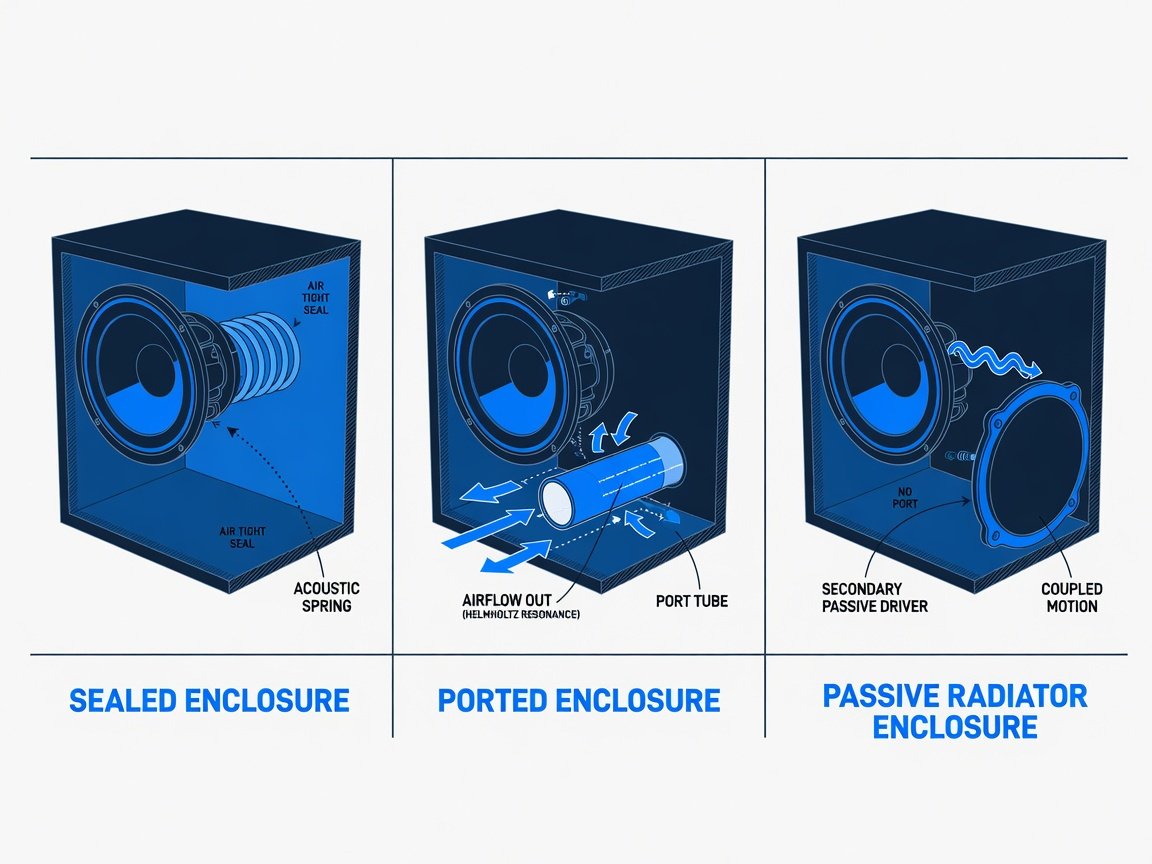
Three enclosure architectures dominate the home theater bass speaker market in 2026: sealed, ported (bass reflex), and passive radiator. Each imposes distinct engineering trade-offs that directly determine suitability for cinematic use cases, and understanding these trade-offs is essential before any purchasing decision. The choice of enclosure type has more influence on in-room low-frequency behaviour than any individual driver specification.
Sealed enclosures trap a fixed volume of air behind the driver, creating an acoustic spring that produces a gradual 12 dB per octave rolloff below the resonant frequency. This gentle slope integrates constructively with room gain and produces tight, well-controlled transients. The practical trade-off is amplifier efficiency: a sealed design requires substantially more power than a ported equivalent to reach the same SPL at the lowest frequencies. For home theater installations with capable AV receivers or separate amplification, this is rarely a limiting constraint and sealed designs remain the preferred choice wherever transient accuracy — the sharpness of percussive bass hits — is the primary priority.
Ported designs add a tuned resonator — a port tube — that harnesses the rear wave of the driver to augment output at a specific tuning frequency. At that frequency, a ported enclosure can deliver approximately 3–6 dB more output than a sealed equivalent of comparable volume. Below the tuning point, the rolloff steepens to around 24 dB per octave, and driver excursion increases rapidly as the port progressively loses acoustic control of the cone. Active high-pass filtering set at or slightly above the port tuning frequency is essential to prevent driver overload during extended reference-level home theater playback on low-frequency-dense soundtrack material.
Passive radiator designs substitute a second passive diaphragm for the port tube, eliminating port noise and compression artefacts while retaining much of the ported efficiency advantage. Loudspeaker engineering data consistently indicates passive radiator alignments offer better transient accuracy than ported equivalents in the 20–40 Hz range. Their growing prevalence in premium 2026 home theater bass speaker releases reflects this performance advantage at the frequencies most critical to cinematic reproduction. Driver technology has advanced in parallel: composite aluminium and glass fibre cone matrices now deliver the stiffness-to-mass ratios previously achievable only with exotic ceramic materials, while long-throw motor assemblies using dual opposing magnet structures cancel asymmetric flux modulation — reducing second-order harmonic distortion that is particularly audible on sustained musical bass passages.
| Enclosure Type | Rolloff Rate | Output Efficiency | Transient Accuracy | Port Noise Risk | Best Use Case |
|---|---|---|---|---|---|
| Sealed | 12 dB/octave | Moderate | Excellent | None | Music + cinema; maximum transient control |
| Ported | 24 dB/octave below tuning | High (+3–6 dB at tuning frequency) | Good | Moderate to high at reference levels | Pure cinema; maximum SPL output per cabinet volume |
| Passive Radiator | 18–22 dB/octave | High | Very good | None | Premium cinema; balanced deep extension and transient control |
What Technical Specifications Should You Prioritise When Buying Bass Speakers?
Published bass speaker specifications are among the most inconsistently presented figures in consumer audio. Frequency response claims quoted without reference to measurement conditions — anechoic versus in-room, ±3 dB versus ±6 dB tolerance window, free-standing versus corner-loaded — carry almost no comparative value between models from different manufacturers. Buyers who understand which specifications carry genuine predictive value will make substantially better purchasing decisions than those relying on headline marketing figures.
Usable low-frequency extension, expressed as the −3 dB anechoic point, is the first specification with real predictive value. A bass speaker rated at −3 dB at 20 Hz anechoically will typically reach 15 Hz or below in a room-loaded condition. Maximum SPL, measured to the CEA-2010 or CTA-2034 standard, is the most commonly inflated figure in manufacturer datasheets — independently verified CEA-2010 data is the only reliable basis for output comparisons across models and remains the professional reference for home theater subwoofer output assessment. Continuous RMS amplifier power at nominal driver impedance is far more informative than short-term peak ratings, which can be two to three times higher for marketing purposes.
Total harmonic distortion (THD) at rated output is a direct measure of driver quality at home theater SPL levels. Group delay, expressed in milliseconds, quantifies how much the speaker slows low-frequency transients relative to the direct wideband signal. Values below 20 ms at 40 Hz are generally inaudible in controlled double-blind listening tests; values above 50 ms at 40 Hz manifest as an audible looseness in the bass transients of percussion-heavy soundtrack material and recorded music.
How Does Room Acoustics Shape Bass Speaker Performance?
Most rectangular domestic listening rooms exhibit significant modal resonances below 200 Hz. These standing wave patterns create positions within the room where specific bass frequencies are boosted or cancelled by as much as 20 dB or more. No bass speaker — regardless of its intrinsic driver quality or amplifier output — can overcome a fundamentally adverse acoustic environment without active correction or physical treatment. The room is the instrument; the speaker provides the input signal. Treating the room and the speaker as separate problems leads to expensive hardware upgrades that deliver far less improvement than their cost suggests.
Room modes divide into three categories. Axial modes develop between parallel opposing surfaces — the floor and ceiling, and each pair of opposing walls — and produce the strongest resonances, often exceeding 15 dB above the surrounding response. Tangential modes involve four surfaces simultaneously and are approximately 3 dB weaker. Oblique modes involve all six surfaces and are weaker still but contribute to the dense modal structure in the 80–200 Hz range that affects the upper bass and lower midrange. The combined modal structure creates a highly position-dependent frequency response at the listening seat — a bass speaker measured flat at one position may exhibit ±15 dB variations just two metres away at the same seat height.
Physical bass trapping — rigid fibrous absorption panels or purpose-built porous foam corner blocks positioned at room boundaries — can attenuate axial mode resonances by 3–8 dB. Corner placement of bass traps is most effective because axial modes reach maximum particle velocity at the room boundaries where adjacent modes converge, making absorption most energetically efficient at those locations. A combination of physical treatment at the primary boundaries and DSP correction at the listening position consistently delivers the most stable and predictable bass response. For rooms that cannot accommodate substantial physical treatment, DSP room correction remains the single most cost-effective bass improvement at any price tier.
How Do DSP and Room Correction Systems Transform Home Theater Bass in 2026?
DSP-based room correction has transformed domestic bass performance since its integration into mainstream AV receiver platforms. Platforms such as Audyssey MultEQ XT32, Dirac Live Bass Control, and Pioneer’s MCACC Pro use swept frequency measurements from multiple listening positions, followed by minimum-phase and FIR (finite impulse response) filtering, to reduce residual low-frequency variation from peaks exceeding 20 dB to ±3–4 dB across most of the audible bass range. This improvement is not incremental — it is the difference between a system that sounds inconsistent and room-coloured and one that sounds like what the content creator intended.
Dirac Live Bass Control — introduced in 2024 and now standard across a significant portion of the 2026 AV receiver market — extends room correction to frequencies below 20 Hz using a mixed-phase FIR filter approach. Unlike minimum-phase parametric EQ, mixed-phase FIR correction can independently adjust both frequency response magnitude and group delay, eliminating the “one-fix-breaks-another” constraint that limits traditional parametric EQ at low frequencies. Receivers equipped with Dirac Live Bass Control are able to achieve genuinely flat, time-corrected bass response at the primary listening seat without any physical room treatment — a result that would have required a professional acoustic installation costing tens of thousands of pounds as recently as 2020.
Bass management integration within DSP platforms has also advanced significantly in 2026. Variable bass management now allows users to redirect low-frequency energy from multiple channels to any combination of bass speakers, rather than routing all LFE content to a single unit. The audible result is a more even bass distribution across the full width of the screen, reducing the spatial localisation of low-frequency events — a phenomenon that breaks cinematic immersion when bass from a soundtrack moment that should be perceived as centred or diffuse is clearly emanating from a single corner cabinet.
What Are the Best Bass Speaker Configurations for Different Room Sizes?
Room volume is the primary variable governing bass speaker configuration requirements. A single compact bass speaker can deliver reference-level performance in a room below approximately 30 cubic metres with a single primary listening position. Beyond that volume, SPL requirements begin to exceed the maximum output capability of most single-driver designs at 20 Hz under sustained cinematic playback — particularly on film soundtracks with extended LFE content at or near the professional reference level.
| Room Volume | Recommended Configuration | Driver Count | Min. Amplifier Power (RMS per unit) | Notes |
|---|---|---|---|---|
| Under 30 m³ | Single sealed or ported | 1 | 300 W | Corner placement preferred for room gain coupling |
| 30–55 m³ | Dual sealed or passive radiator | 2 | 500 W | Opposite-wall placement for modal cancellation |
| 55–70 m³ | Dual or triple high-output passive radiator | 2–3 | 700 W | DSP multi-subwoofer bass management essential |
| Over 70 m³ | Four-corner deployment (DUDE positioning) | 4 | 700 W | Professional calibration recommended; dedicated DSP processor advised |
Dual bass speaker configurations reduce seat-to-seat SPL variation by 8–10 dB in standard rectangular rooms compared to single-unit deployments. This improvement results from the partial cancellation of room modes that occurs when two identical bass speakers are placed at non-symmetric positions — typically offset from the room’s midpoint along the same wall, or at opposing walls along the longest axis. This technique, known as DUDE (Dual-Unit Distributed Endpoint) positioning, produces a more spatially uniform bass field across the seating width without requiring any changes to the hardware specification of the individual units.
📊 Dual bass speaker configurations consistently reduce seat-to-seat SPL variation by 8–10 dB versus single-unit deployments — an improvement that no single driver specification upgrade can match at an equivalent hardware cost.
For rooms above 70 cubic metres — the category that includes most purpose-built dedicated home theaters — four-unit corner deployment is increasingly standard in custom installation practice. Four-corner placement achieves near-optimal modal excitation coverage, simultaneously reducing the amplitude of all three room mode categories without requiring asymmetric driver positioning. The practical trade-off is increased complexity in bass management and calibration sequencing, which requires either a receiver with multi-subwoofer DSP capability or a dedicated hardware processor such as the miniDSP range.
How Do You Set Up Bass Speakers for Dolby Atmos and DTS:X Content?
Dolby Atmos and DTS:X home theater configurations rely on a precisely calibrated bass management system that routes low-frequency content from object-based audio channels to the bass speakers according to a channel crossover architecture. Correct setup requires deliberate attention to crossover frequency alignment, LFE trim level, and phase coherence between the bass speaker and the main speaker array. Misconfiguring any one of these three settings can negate the output improvement of a speaker upgrade entirely.
Crossover frequency is the first and most critical setting. Dolby’s reference recommendation for the main-channel low-pass crossover is 80 Hz — a compromise that works with full-range floorstanding main speakers but is generally too low for bookshelf or in-wall systems. For typical installations with bookshelf or surround speakers exhibiting a −3 dB rolloff above 80 Hz, setting the crossover to 100–120 Hz provides significantly cleaner bass extension from the main channels and reduces the output demands on the bass speaker below that range. In practice, the crossover frequency should be set 20 Hz above the −6 dB point of the main speaker to ensure smooth acoustic summation at the transition region.
Phase alignment between the bass speaker and main speakers at the crossover region is the parameter most frequently misconfigured and most audible when wrong. A 180-degree phase error at 80 Hz produces a measurable and audible cancellation null in the crossover region. Most AV receivers provide only a 0/180-degree phase toggle — if both positions produce audible cancellation, a small physical repositioning of the bass speaker (moving it 30–50 cm closer to or further from the primary listening position) is required to achieve correct alignment without additional DSP intervention. LFE trim level should be set last, after crossover and phase are confirmed. The reference level is 0 dB — elevating LFE trim above reference compresses dynamic range at precisely the moments of maximum cinematic impact.
What Is the Step-by-Step Process for Calibrating Bass Speakers at Home?
Systematic calibration is the single most effective improvement available to any home theater bass system, regardless of hardware specification. The following seven-step process applies to any system with a room-correction-capable AV receiver, supplemented by REW (Room EQ Wizard) for independent measurement verification. Each step builds on the previous — skipping ahead produces corrections that interact unpredictably and are difficult to reverse.
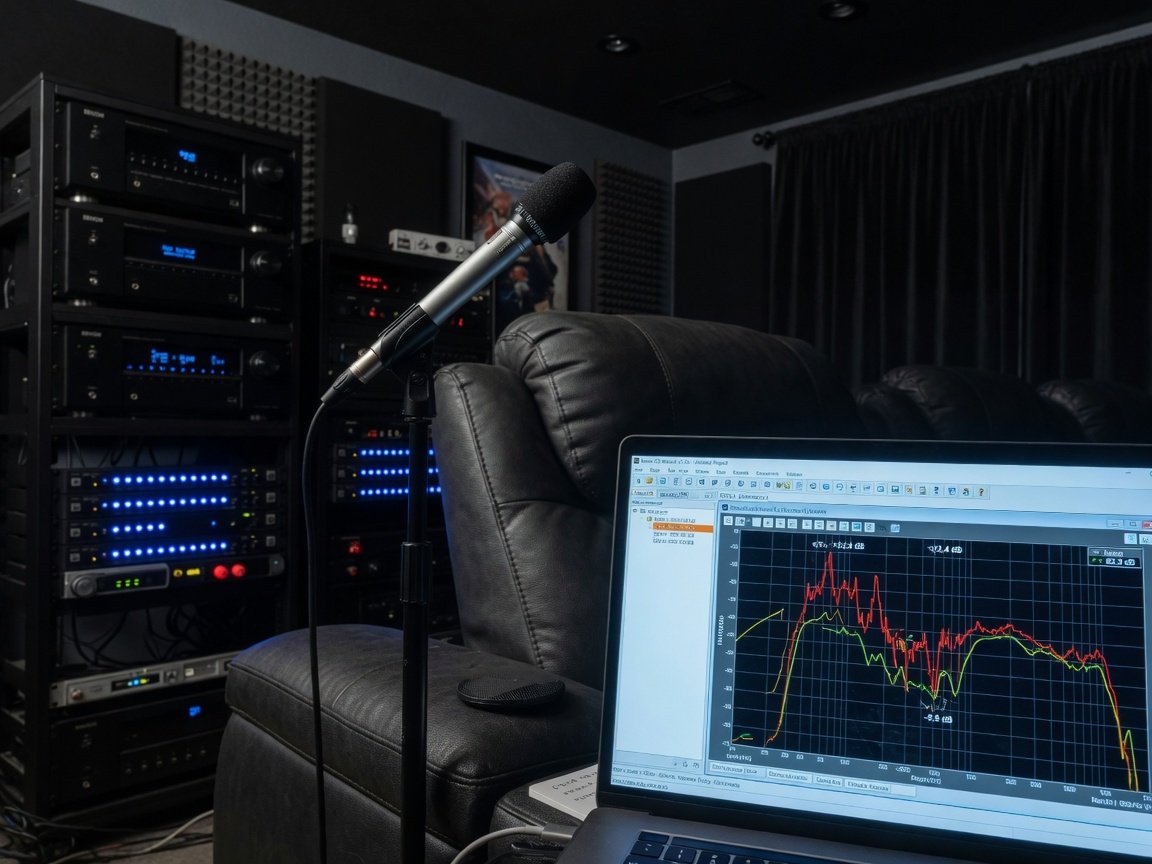
- Capture a pre-correction baseline measurement. Use a calibrated measurement microphone and REW at the primary listening position before running any automatic calibration. This documents the room’s native low-frequency response and gives you a quantitative reference for evaluating how much each subsequent step improves the measured output. Note the frequency and magnitude of the three to five strongest room mode peaks — these are your primary targets.
- Optimise bass speaker placement before any DSP work. Move the bass speaker to a corner or asymmetric position along one wall, away from the midpoint. Play a 40 Hz test tone and compare measured SPL at the listening seat across three or four candidate positions. The placement with the highest measured output at the listening seat is generally the most efficient coupling position for that room. Implement this before running any automatic calibration — the correction system will produce better results from an optimally placed speaker.
- Run the AV receiver’s automatic calibration routine with maximum microphone positions. Use all available measurement positions — typically five to eight within the primary seating area. Additional positions produce better spatial averaging across the seating width and improve the robustness of the correction filter at off-centre listening positions that the automatic routine otherwise underweights.
- Apply manual parametric EQ corrections to residual room mode peaks. Automatic correction systems consistently leave some room mode resonances partially unaddressed, particularly those with very high Q factors. Narrow-Q parametric cuts of 3–6 dB centred on residual peak frequencies — identifiable in a post-correction REW measurement — are the most effective supplementary correction tool and do not introduce the group delay artefacts associated with broader EQ curves.
- Verify group delay after all DSP corrections are applied. Re-measure with REW and check group delay across 20–100 Hz. Values above 40 ms at frequencies above 40 Hz indicate latency artefacts introduced by aggressive DSP correction that will affect bass transient quality in percussion-heavy content. If group delay is elevated, reduce the depth of the aggressive EQ cuts at the affected frequencies by 1–2 dB.
- Confirm crossover alignment at the transition region. Measure the combined acoustic output of the bass speaker and main speakers at the crossover frequency. The transition should be smooth, with no more than ±3 dB variation across the crossover region. A sharp dip at or near the crossover frequency indicates a phase error that must be corrected before setting the final calibration level.
- Set the final SPL calibration level using a calibrated SPL meter. 75 dB SPL at the primary listening position (C-weighted, slow response) is the standard Dolby Atmos reference calibration level for all channels. Setting the bass speaker level to match this reference ensures correct balance against the main channel array across all content at standard playback levels.
What Are the Key Tools and Resources for Optimising Home Theater Bass in 2026?
The following tools are directly applicable to home theater bass measurement, room correction, enclosure design, and multi-unit bass management at every price tier. Each is either freely available or represents an established standard in professional and enthusiast home theater practice.
- REW (Room EQ Wizard): Free acoustical measurement software for Windows, macOS, and Linux. Provides impulse response measurement, frequency response analysis, waterfall decay plots, and group delay calculation. Integrates directly with Dirac Live, Audyssey MultEQ Editor, and miniDSP platforms. The standard entry point for any systematic bass calibration workflow at any hardware price point.
- miniDSP 2x4HD: Four-channel hardware DSP processor supporting parametric EQ, crossover management, and time alignment. Widely deployed in dual and four-unit bass speaker configurations where the AV receiver’s built-in bass management lacks sufficient channel flexibility or filter resolution for multi-unit setups.
- UMIK-1 / UMIK-2 calibrated measurement microphones: Omnidirectional condenser microphones with individual factory calibration files downloadable at purchase. Essential for accurate REW measurements — an uncalibrated microphone introduces frequency response errors that make EQ corrections unreliable at low frequencies, where output variations are largest and most consequential.
- Dirac Live Bass Control: Software correction platform supported by a growing share of 2026 AV receivers. The Bass Control extension provides independent multi-subwoofer management and extended low-frequency correction to below 20 Hz, beyond the frequency range addressed by standard Dirac Live.
- Audyssey MultEQ Editor App: Subscription-based application enabling manual adjustment of Audyssey correction curves, individual speaker parametric EQ access, and mid-frequency correction filter editing beyond the automatic calibration results delivered by the receiver alone. Recommended for any Audyssey-equipped system where the automatic results leave residual room mode peaks above 6 dB.
- WinISD (enclosure design software): Free enclosure simulation tool for users building custom bass speaker enclosures. Models frequency response, maximum excursion limits, and port tuning behaviour across all three main enclosure architectures before any physical construction — an essential step that prevents the costly mismatch of driver and enclosure parameters.
What Bass Speaker Trends Will Define Home Theater Audio in 2027?
Several engineering developments currently at prototype or early commercial release stage in 2026 are expected to define the home theater bass speaker market in 2027. Each addresses a distinct limitation in the current best-practice framework, and each is expected to alter the hardware recommendation hierarchy in ways that will affect purchasing decisions at every price tier.
Beamforming bass arrays use multi-driver systems with high-speed onboard DSP to steer low-frequency energy towards the listening position and away from room boundaries, actively suppressing room mode excitation at the source rather than correcting its effects after the fact. The system is designed to adapt in real time using onboard accelerometer feedback from the room boundaries. Consumer releases from two major audio manufacturers are expected in the second half of 2027, with pricing expected to position the technology in the premium but not custom-installation tier of the market.
Wireless bass speaker networks with latency-corrected synchronisation are becoming standard in premium 2026 home theater ecosystems. Current implementations achieve sub-1 ms synchronisation accuracy between units — sufficient for inaudible timing coherence at 40 Hz and below, where wavelengths are metres in length and propagation-time differences of under 1 ms have no perceptible acoustic effect. The elimination of bass speaker cable routing challenges is accelerating multi-unit deployment adoption in retrofit installations where running dedicated speaker cables is structurally impractical.
Haptic bass transducer integration — purpose-built seat shakers calibrated to synchronise with the primary bass speaker output below 40 Hz — is increasingly specified in purpose-built home theater packages rather than added as aftermarket accessories. The tactile bass extension these systems provide below the 20 Hz threshold of auditory pitch perception creates a bimodal bass experience — both heard and physically felt — adding a dimension that acoustic-only reproduction at equivalent SPL levels cannot replicate. Expect haptic integration to become a standard checklist item in custom home theater specification by late 2027.
Frequently Asked Questions About Bass Speakers for Home Theater
What is the difference between a bass speaker and a subwoofer for home theater use?
In home theater terminology the terms are functionally interchangeable in the consumer market. A subwoofer is technically a dedicated single-driver bass reproduction unit designed to cover 20–120 Hz, while bass speaker is a broader term covering any speaker system with a specific low-frequency emphasis. In practice, a powered subwoofer with built-in amplification and DSP is the standard home theater form factor, and virtually all product specifications in 2026 use the terms synonymously without meaningful distinction.
How many bass speakers do I need for a home theater system?
A single unit is adequate for rooms under approximately 30 cubic metres with a single primary listening position. Two bass speakers are recommended for the 30–55 cubic metre range or any room with more than one listening seat — the dual configuration reduces seat-to-seat SPL variation by 8–10 dB. Four bass speakers at the room corners is optimal for purpose-built dedicated theaters above 55–70 cubic metres and is increasingly standard in custom installation practice for reference-level cinema rooms in 2026.
Where is the best placement for bass speakers in a home theater room?
Corner placement is the most efficient position for coupling bass speaker output to room gain, typically adding 3–6 dB of additional low-frequency output compared to free-standing midwall placement. For single-speaker setups, a front-wall corner adjacent to the main speaker array is standard. For dual setups, placing the two units at non-symmetric positions — such as front-left corner and mid-right wall — produces better modal cancellation and more consistent bass across the listening area than symmetrical front-wall placement at matched distances from the centre.
What crossover frequency should I set for home theater bass speakers?
Dolby’s reference is 80 Hz for main channels paired with full-range speakers. For bookshelf, in-wall, or satellite main speakers with limited bass extension, 100–120 Hz is more appropriate and produces better integration. The practical rule is to set the crossover frequency approximately 20 Hz above the −6 dB point of the main speakers — this creates smooth acoustic summation at the transition region rather than a coverage gap or an overlap that adds unwanted colouration to male vocals and lower-octave instruments.
Can I run two bass speakers in stereo rather than a single mono subwoofer for home theater?
Stereo bass deployment — running separate left and right bass speakers fed with full-range low-frequency information rather than a single mono LFE channel — is supported by most 2026 AV receivers through the bass management system. The acoustic benefit is improved bass localisation coherence with the main speaker array at and above the crossover frequency. Both units must be matched in specification, time-aligned to the main speakers, and calibrated to the same output level. Stereo bass deployment is distinct from dual-mono deployment and requires a receiver that supports independent bass management per channel.
How do I verify whether my bass speaker has sufficient output for my room?
Run a swept sine measurement using REW (Room EQ Wizard) at the listening position and check room-loaded output at 20 Hz. The professional reference target for home theater is at least 105 dB SPL at 20 Hz at the primary listening seat. If measured output falls more than 6 dB below this target before room correction EQ is applied, the bass speaker is likely underpowered or undersized for the room volume. A second bass speaker at a non-symmetric position is the correct next step — it will deliver greater improvement per pound spent than upgrading the single unit to a higher-specification model.
Conclusion: Building the Best Bass Foundation for Your Home Theater in 2026
The best bass speakers for home theater in 2026 are not defined by the highest headline wattage or the most expensive enclosure finish. They are defined by their ability to deliver controlled, low-distortion output at frequencies as low as 20 Hz in the acoustic environment of your specific room — calibrated precisely to the crossover and SPL reference standards of your audio format. Every technical specification matters only in the context of the room and the DSP correction system working around it. Driver quality, enclosure architecture, amplifier headroom, and group delay are all input variables; the listening seat measurement is the only output that counts.
The recommended implementation sequence for 2026 is structured in three phases. In the first 30 days: measure the current bass response with REW, identify the strongest room mode resonances by frequency and magnitude, optimise bass speaker placement to the best coupling position the measurement identifies, and run the AV receiver’s automatic room correction routine. Verify the improvement with a second REW measurement before moving on. In days 30–90: apply targeted parametric EQ corrections to any residual room mode peaks above 6 dB, confirm crossover alignment and phase coherence with the main speaker array, and set the final SPL calibration level to the Dolby Atmos 75 dB reference. After 90 days: evaluate whether maximum output at 20 Hz approaches the 105 dB reference target under extended playback. If not, adding a second bass speaker at a non-symmetric room position is the correct next step — ahead of any single-unit hardware upgrade at equivalent cost.
This sequence consistently prioritises the variables that have the largest measurable effect on home theater bass in real rooms — placement, correction, and multi-unit configuration — before any investment in higher-specification hardware. Following it produces reference-grade bass reproduction in domestic rooms of any size, at price points that no previous generation of home theater audio hardware could approach.