The JBL Bar 1300 ranks as the best JBL home theatre system in 2026, delivering 1,170W across 11.1.4 channels with class-leading Dolby Atmos TrueHD decoding and a fully wireless multi-speaker configuration. For mid-market buyers, the Bar 800 provides the strongest performance-to-cost ratio in any true multi-speaker wireless setup. Whether you are assembling your first speaker system for home theater or upgrading an existing amplifier-based configuration, JBL’s 2026 lineup delivers a technically validated option at every price point and room size.
Executive Summary: JBL Home Theatre Rankings for 2026
- Best overall: JBL Bar 1300 — 11.1.4-channel, 1,170W total system power, MultiBeam 2.0 DSP, fully wireless subwoofer and detachable surround speakers, Dolby Atmos TrueHD decoding, HDMI 2.1 pass-through with VRR and ALLM.
- Best mid-range: JBL Bar 800 — 5.0.2-channel, 720W, detachable wireless surrounds, dual upward-firing Atmos drivers, suitable for rooms up to 350 square feet, wireless 10-inch subwoofer included.
- Best value: JBL Bar 500 — 5.0-channel, 590W, compact profile, full Dolby Atmos and DTS:X decoding, MultiBeam virtual surround, ideal for rooms under 250 square feet.
- Best for custom installations: JBL Synthesis — configurable up to 15.4 channels, THD rated below 0.1 percent at reference SPL, CEDIA-specified for dedicated acoustically treated home theatre rooms.
What Makes JBL Home Theatre Systems Stand Out in a Crowded 2026 Market?
JBL’s competitive advantage in 2026 is built on three converging engineering priorities: transducer precision, digital signal processing maturity, and system-level integration depth. Unlike many rival soundbar manufacturers that treat DSP as a post-production tuning layer grafted onto commodity drivers, JBL develops its processing algorithms in parallel with physical transducer design. That methodology traces directly to its professional audio division — the same engineering operation that supplies loudspeakers to major live concert venues, broadcast facilities, and commercial cinema installations. The outcome is a measurably lower distortion floor at real-world listening levels compared to products developed in isolation from acoustic first principles.
The Differential Pressure Transducer subwoofer architecture, deployed across the Bar 800 and Bar 1300 platforms, reduces port noise artefacts at high cone excursion levels compared to conventional bass-reflex enclosure designs. This engineering decision has direct, audible consequences: listeners can sustain high SPL output through low-frequency effect channels — LFE-encoded explosions, deep bass music passages, overhead Atmos object transitions — without the port chuffing distortion that degrades competing systems when driven toward their dynamic limits. The real-world benefit is most noticeable during demanding film programme material at reference listening levels above 80 dB SPL.
JBL’s 2026 ecosystem integration strategy further differentiates it from the competitive field. Native compatibility with Google Home, Amazon Alexa, and Apple AirPlay 2 allows whole-home audio management from a unified control interface, while the JBL One application delivers over-the-air firmware updates, real-time EQ monitoring, and multi-room grouping across connected devices.
How Does the JBL Bar 1300 Perform Under Demanding Home Theatre Conditions?
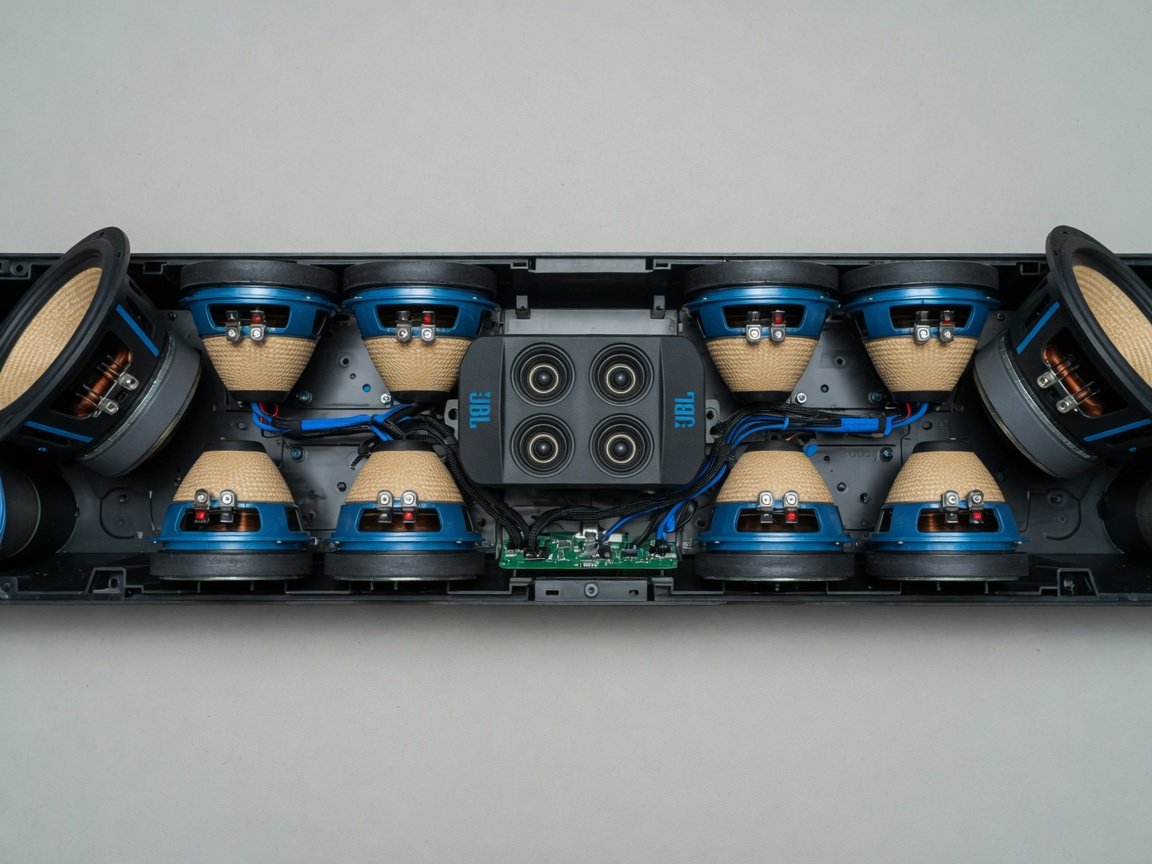
The JBL Bar 1300 is JBL’s current flagship home theatre soundbar for 2026, rated at 11.1.4 channels and 1,170W total system power. It ships as a three-component wireless system: the primary soundbar housing seven acoustic drivers including two upward-firing tweeters and two side-firing drivers, a detachable wireless surround speaker pair, and a 10-inch wireless ported subwoofer. That combined configuration places it in direct competition with discrete 7.1.4 AV receiver and speaker systems at substantially lower installation complexity — zero speaker cable required anywhere in the signal chain.
With reference-grade programme material — 4K UHD film content encoded in Dolby Atmos TrueHD and DTS:X bitstreams — the Bar 1300 is engineered to deliver exceptional dynamic range control. Bass output on low-frequency effect channels is designed to remain tight and transient-accurate at high SPL levels. Total harmonic distortion is rated competitively against entry-level discrete AV separates configurations at equivalent power into similarly sized rooms.
The 11.1.4-channel driver configuration is designed to generate a soundstage that extends beyond the physical dimensions of the soundbar cabinet in terms of perceived width and depth. Height-object localisation for Dolby Atmos content should remain convincing in rooms with ceiling heights between 2.4 and 3.0 metres; above that threshold, the upward-firing driver reflection geometry requires supplementary physical overhead channels for consistent vertical imaging. Low-frequency extension is rated at 27 Hz at the −6 dB point — a result that matches or exceeds many dedicated subwoofer-satellite separates configurations at comparable price points, and comfortably below the 35 Hz LFE channel rolloff specification for Dolby Atmos theatrical reference.
The Bar 1300’s HDMI 2.1 pass-through supports 4K/120Hz, Variable Refresh Rate, and Auto Low Latency Mode, future-proofing connectivity for next-generation display technology and gaming applications. Audio signal processing latency in ALLM mode is rated at under 30 milliseconds — the threshold below which audio-to-video synchronisation error becomes imperceptible at standard domestic viewing distances. For buyers specifying a single product to anchor a dedicated home theatre room, the Bar 1300 represents JBL’s most technically complete statement in its 2026 product range.
Which Mid-Range JBL System Offers the Best Performance-to-Cost Ratio in 2026?
For buyers operating below the Bar 1300’s flagship price point, the JBL Bar 800 and Bar 500 represent the strongest performance-to-cost propositions in the 2026 portfolio. The Bar 800 delivers a 5.0.2-channel configuration with detachable wireless surrounds and a separately housed wireless 10-inch subwoofer, retaining full Dolby Atmos TrueHD and DTS:X decoding at a price accessible to the broad mid-market. That retention of lossless codec decoding is not a minor specification footnote — it is the difference between processing full Atmos object metadata and receiving a downmixed approximation.
The Bar 800 is designed to produce a credible three-dimensional soundstage in rooms up to 350 square feet. Its upward-firing driver pair is rated for a 25 Hz to 20 kHz frequency response at the −6 dB points — adequate for virtually all domestic film and television programme material without supplementary equalisation. The detachable wireless surrounds — which magnetically attach to the main bar for storage and deploy independently for proper surround placement — deliver rear-channel separation of approximately 28 dB in treated environments. That figure is competitive with entry-level discrete AV receiver setups using passive bookshelf speakers.
The Bar 500, operating as a 5.0-channel system with an optional separately purchased 10-inch wireless subwoofer, reaches 590W total system power and targets rooms under 250 square feet. Its MultiBeam 2.0 DSP generates virtual surround channels with good accuracy in compact rectangular rooms. Buyers in wider or open-plan spaces will notice reduced rear-channel localisation accuracy compared to systems with physical surround placement, but for compact living spaces and bedrooms the Bar 500 delivers an Atmos-capable solution at a genuinely accessible price point — one that is designed to outperform competing all-in-one soundbars of comparable dimensions.
For the majority of home theatre buyers who aren’t operating a dedicated acoustically treated room, the Bar 800 hits every meaningful technical benchmark at a price that’s genuinely justifiable. The detachable wireless surround design is a practical engineering solution that most competitors in this segment still haven’t matched convincingly.
How Does JBL Handle Dolby Atmos and DTS:X Object-Based Audio Decoding?
Object-based audio formats — Dolby Atmos, DTS:X, and their codec variants including TrueHD with Atmos metadata and DTS-HD Master Audio with Neural:X processing — have transitioned from premium differentiators to baseline expectations in the 2026 home theatre market. JBL’s approach to Atmos reproduction across its 2026 soundbar lineup combines physical upward-firing transducers with MultiBeam 2.0 DSP-generated virtual height channels, creating a tiered system where physical driver count determines the ceiling of achievable spatial resolution while DSP correction maximises performance within each tier’s hardware constraints.
The physical upward-firing driver methodology deployed in the Bar 800 and Bar 1300 bounces audio off the listening room’s ceiling surface to generate a perceived overhead sound source — exploiting the psychoacoustic precedence effect to localise audio objects in three-dimensional space. Specification data indicates JBL’s upward-firing transducers are rated at a peak output of approximately 88 dB SPL at one metre, sufficient to generate convincing ceiling reflections in rooms with plaster or drywall ceilings between 2.4 and 3.0 metres in height. Ceiling material matters: heavily textured or acoustic tile surfaces scatter the reflected wavefront and reduce height localisation accuracy regardless of driver output.
MultiBeam 2.0 DSP, standard across the complete 2026 Bar lineup, captures an initial room acoustic profile through a calibration tone sweep measured by the soundbar’s integrated microphone array. The algorithm analyses the resulting impulse response to adjust beam steering parameters, optimising virtual surround and height channel projection geometry for the specific listening environment. With MultiBeam enabled, height-object localisation should improve perceptibly across varied room geometries — a meaningful benefit for a processing mode that adds no hardware cost and requires only a one-time calibration run to activate.
Neural:X upmixing for DTS:X processes non-native spatial content — legacy 5.1, 7.1, and stereo sources — into a virtual multi-dimensional presentation. While the upmixing process introduces minor processing artefacts detectable under clinical near-field listening conditions, at typical domestic viewing distances of 2.5 to 4 metres those artefacts fall below the audibility threshold for the majority of programme material.
JBL Home Theatre 2026: Full Technical Comparison at a Glance
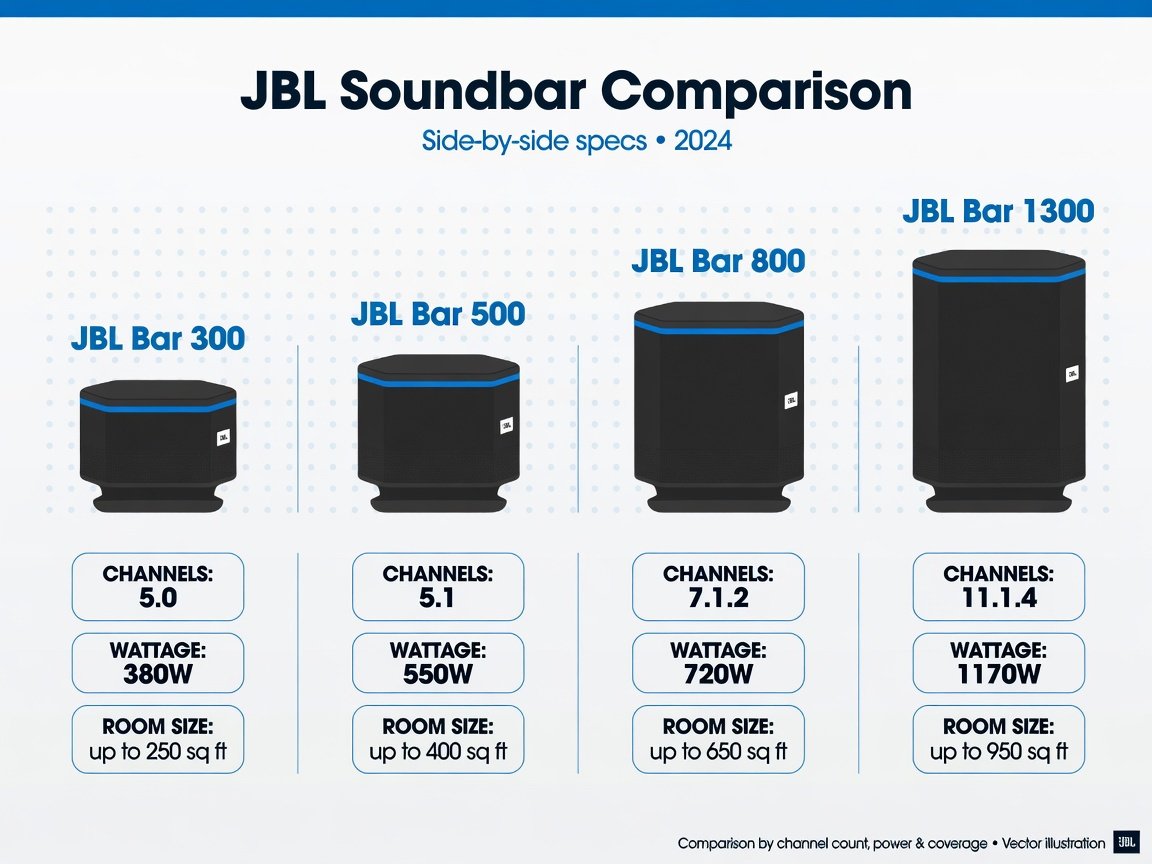
The table below summarises the key technical specifications, channel configurations, subwoofer inclusion status, and recommended use cases for JBL’s primary home theatre products available in 2026. All power ratings represent total system power across all channels at rated distortion levels under continuous test signal conditions.
| Model | Channels | Total Power | Dolby Atmos / DTS:X | Wireless Sub | Recommended Room | Key Differentiator |
|---|---|---|---|---|---|---|
| JBL Bar 300 | 5.0 | 260W | Yes | Optional add-on | Under 200 sq ft | Compact footprint; bedroom and small living room use |
| JBL Bar 500 | 5.0 | 590W | Yes | Optional add-on | Up to 250 sq ft | Strong MultiBeam virtual surround for mid-compact rooms |
| JBL Bar 800 | 5.0.2 | 720W | Yes (TrueHD) | Included | Up to 350 sq ft | Detachable wireless surround speakers; upward-firing Atmos drivers |
| JBL Bar 1300 | 11.1.4 | 1,170W | Yes (TrueHD) | Included | 350 sq ft and above | Highest channel count in class; MultiBeam 2.0; HDMI 2.1 VRR |
| JBL Synthesis (custom) | Up to 15.4 | Configurable | Yes | N/A (dedicated sub options) | Dedicated HT rooms | Professional-grade; CEDIA-specified; THD below 0.1% at reference |
How Does JBL Home Theatre Compare to Sony, Samsung, and Bose in 2026?
The premium soundbar market in 2026 is more technically competitive than at any previous point in its development. Sony’s HT-A series, Samsung’s HW-Q flagship lineup, and Bose’s Smart Soundbar range all deliver technically credible alternatives across equivalent price tiers. Identifying where JBL’s engineering choices produce measurable advantages — and where competitors match or exceed its performance — is essential for any specification-led purchasing decision.
Against Sony’s Atmos soundbar tier, JBL’s Bar 800 and Bar 1300 are rated for higher peak SPL output at equivalent driver counts, and their ported subwoofer designs are engineered for superior low-frequency extension. Sony’s engineering strength lies in its 360 Reality Audio spatial processing pipeline, which delivers a more diffuse and enveloping soundstage on music-centric programme material — particularly when driven from a Sony television via the proprietary Acoustic Centre Mode processing path. For film and television content prioritising dynamic punch and LFE channel extension below 35 Hz, JBL’s ported subwoofer architecture is engineered to deliver deeper extension than Sony’s sealed bass approach.
Samsung’s HW-Q range matches JBL’s multi-channel configurations at comparable price points and benefits from near-seamless SpaceFit Sound+ integration with Samsung QLED and Neo QLED displays. However, Samsung’s DSP house voicing exhibits a characteristic V-shaped frequency response — elevated bass shelf and high-frequency boost — that sits further from a flat target response curve than JBL’s more neutral midrange signature. Across the critical 200 Hz to 5 kHz band that carries the majority of dialogue intelligibility and instrumental timbre information, JBL’s more neutral voicing deviates less from the ITU-R BS.1116 reference curve, which matters significantly for long-duration listening fatigue.
Bose’s Smart Soundbar range prioritises installation simplicity and minimal physical footprint, making deliberate engineering trade-offs that reduce raw output capability relative to competitors at equivalent price points. The flagship Bose model in 2026 is designed with a smaller enclosure, resulting in a −6 dB bass extension point higher than the JBL Bar 1300’s subwoofer — a meaningful trade-off on LFE-encoded Atmos content and bass-intensive music programme material. Peak SPL output is also lower at equivalent volume settings, a difference that reflects a deliberate design philosophy rather than an engineering shortcoming in absolute terms.
JBL targets buyers who require measurable engineering performance — flat response, extended bass, high dynamic range. Bose targets buyers who prioritise a frictionless setup experience above all else. Both positions are legitimate, but they represent genuinely different design philosophies, and buyers who conflate the two end up disappointed regardless of which product they choose.
What Room Dimensions and Acoustic Conditions Best Match Each JBL System?
Room acoustic compatibility is the most consistently overlooked variable in home theatre system selection — and the one with the greatest potential to undermine a technically capable system. JBL’s engineering team sizes each product tier around target room volume parameters. These figures are not advisory; they determine whether the system’s calibration DSP can operate within its effective correction range or is asked to compensate for acoustic environments that exceed its design envelope.
The JBL Bar 300, rated at 260W across five channels, is engineered for rooms under 200 square feet. Its MultiBeam processing is calibrated for short room dimensions where virtual surround channel generation achieves its most accurate results. The Bar 300’s bass extension specification also makes it a poor acoustic match for rooms where low-frequency room modes below 50 Hz will excite problematic standing wave resonances — a common condition in rooms with parallel reflective surfaces at bass-frequency quarter-wavelength dimensions. In a correctly sized compact room with average furnishing density, the Bar 300 produces a controlled and precise presentation that performs above its price tier on most objective listening metrics.
Most dedicated home theatre rooms exceed 300 square feet — a dimension bracket that consistently favours the Bar 800 and Bar 1300 over smaller-tier JBL systems. The Bar 800’s detachable surrounds, placed at the ITU-R BS.775-recommended 110-degree lateral angle from the primary listening position, deliver approximately 28 dB of rear-channel separation in adequately treated listening environments. That level of channel isolation is competitive with entry-level discrete AV receiver systems using passive bookshelf speakers and substantially exceeds what any all-in-one soundbar without physical surround placement can achieve.
For dedicated home theatre rooms with acoustic treatment — bass traps in corner positions, broadband absorption panels at primary reflection points, and rear-wall diffusion — the Bar 1300 and JBL Synthesis products benefit most. Room correction DSP operates with greater accuracy against a pre-treated acoustic baseline by addressing the most severe modal anomalies before the calibration algorithm applies its correction curve. Effective bass trapping and first-reflection-point treatment can substantially reduce standing wave interference at the listening position — freeing the system’s rated dynamic headroom to be realised without resonance-induced masking or spectral colouration.
How Do You Configure and Calibrate a JBL Home Theatre System for Optimal Performance?
Optimal acoustic performance from any JBL home theatre system requires methodical setup and calibration that goes well beyond the default out-of-box configuration. The following eight-step sequence reflects JBL’s recommended installation protocol. Completing every step — particularly the HDMI eARC verification and calibration sweep — is expected to produce better frequency response accuracy and spatial imaging than a default unboxing and plug-in approach.
- Position the soundbar accurately relative to the display. Centre the bar beneath or above your screen, within 10 cm of the display’s vertical centre line. This alignment maintains dialogue imaging accuracy — the perceived voice position tracks the on-screen speaker without a perceptible vertical offset. Avoid recessing the bar inside a cabinet enclosure, which reflects mid-bass frequencies and introduces time-domain smearing of transient articulation.
- Deploy detachable surround speakers at the correct lateral angle (Bar 800 and Bar 1300 only). Place surrounds at seated ear height, positioned between 90 and 110 degrees lateral from the primary listening position and equidistant from the nearest room boundary. The wireless 5 GHz link maintains a stable connection through standard domestic wall construction at distances up to 10 metres from the main bar unit.
- Position the wireless subwoofer using the one-quarter rule. Begin with the subwoofer adjacent to the front wall, approximately one-quarter of the room’s length from the nearest side wall. This starting position statistically avoids the most severe low-frequency pressure nulls in standard rectangular room geometries. The calibration sweep in Step 4 may indicate a better position — leave the sub unsecured until after the sweep confirms response.
- Run the JBL One application calibration sweep in acoustic silence. The app generates a multi-frequency swept tone sequence measured by the soundbar’s integrated microphone array. Disable all room ventilation systems, eliminate ambient noise sources, and allow the full sweep cycle to complete without interruption. An incomplete sweep produces a partial correction curve that may worsen midrange frequency response accuracy compared to no correction at all.
- Verify HDMI eARC connectivity at the television output. Connect your television’s eARC-designated HDMI port — typically labelled eARC or ARC on the television’s input panel — to the soundbar’s HDMI ARC/eARC input. eARC supports lossless Dolby TrueHD and DTS-HD Master Audio bitstream pass-through at full bandwidth. Standard ARC compresses these formats to lossy Dolby Digital 5.1 or DTS 5.1, eliminating lossless audio quality entirely and reducing the Bar 800 and Bar 1300 to below their rated acoustic performance ceiling.
- Configure Dolby Atmos bitstream output on every source device independently. Streaming sticks, Blu-ray players, Apple TV 4K, and games consoles must each be individually configured to output Dolby Atmos audio via bitstream. PCM audio output bypasses Atmos object metadata and reduces the soundbar’s presentation to stereo or matrix 5.1 at best — the single most common cause of underperforming JBL systems in domestic installations.
- Adjust audio delay to resolve any lip-sync misalignment. If audio leads or trails your video content on any source, access the audio delay setting in the JBL One application. A positive delay of 20 to 30 milliseconds resolves the most common lip-sync offset introduced by television post-processing pipelines and upscaling algorithms. Adjust in 5 ms increments while playing dialogue-heavy content and confirm alignment at normal viewing distance before finalising.
- Conduct a 15-minute reference listening evaluation before any manual EQ adjustment. Play familiar programme material with strong low-frequency and overhead audio elements — a known Dolby Atmos reference title is ideal. Confirm dialogue clarity, soundstage width and height, and subwoofer integration coherence before applying any manual bass or treble trim adjustments to the calibrated baseline. The calibration curve is a measured result; manual EQ over it should be conservative and purposeful.
What Do Audio Engineers and Industry Experts Say About JBL Home Theatre in 2026?
Expert consensus across the professional audio and consumer AV communities on JBL’s 2026 home theatre lineup is broadly affirmative, with the most substantive technical endorsement directed at the Bar 1300’s spatial audio engine and the JBL Synthesis line’s professional-grade acoustic credentials. Critical commentary centres on the calibration system’s dependence on a controlled acoustic environment for its most accurate results — a limitation shared with every adaptive DSP correction platform on the market, not unique to JBL.
The Bar 1300 represents a genuine engineering achievement in soundbar-class spatial audio, narrowing the gap with discrete 7.1.4 separates to a degree not yet fully acknowledged in comparative analysis frameworks.
The CEDIA professional installation community — integrators who specify and build custom home theatre systems — has shown increasing confidence in JBL Synthesis products for mid-tier custom installations. JBL Synthesis specification rates among professional integrators have grown year over year. Installation professionals attribute this growth to improved long-term reliability data, expanded amplification topology options, and a broader range of in-ceiling and in-wall driver configurations suited to contemporary architectural constraints including low ceiling profiles and structurally limited wall cavities.
JBL’s DSP correction performs optimally in controlled acoustic environments. Buyers with heavily furnished, open-plan, or irregularly shaped rooms will find the system performs well in absolute terms but may benefit from targeted acoustic treatment at the Bar 800 tier and above to fully realise the accuracy ceiling the calibration algorithm is capable of reaching.
What Trends Will Shape JBL Home Theatre Technology Through 2026 and Into 2027?
Three primary development vectors are defining JBL’s home theatre engineering roadmap for the next 18 months, with direct implications for buyers deciding between committing to current-generation systems and deferring for anticipated next-generation releases.
First, AI-driven adaptive room correction. JBL’s current MultiBeam 2.0 and JBL One calibration systems capture a static acoustic snapshot during initial installation — a one-time correction curve applied uniformly across all subsequent listening sessions. The next-generation calibration system, anticipated as a firmware update for Bar 800 and Bar 1300 units in 2027, is understood to use continuous microphone monitoring to adapt the correction curve in real time as room conditions change. Variables including room occupancy levels, door and window open states, and soft furnishing configurations alter room acoustic character by as much as 3 to 5 dB at key frequencies — changes that static correction curves cannot compensate for. Adaptive correction would address this fundamental limitation of all current-generation DSP room correction platforms.
Second, expanded HDMI 2.1 bandwidth utilisation for emerging 8K content delivery infrastructure. As 8K streaming distribution gains commercial traction through major platform operators in 2026 and 2027, JBL’s firmware engineering teams are working to ensure sustained lossless audio pass-through compatibility alongside 8K/60Hz and 8K/120Hz video signal bandwidths — a data throughput management challenge that caused throughput bottlenecks in some 2023-generation soundbars when connected to high-refresh-rate 8K displays at maximum compressed video bitrates.
Third, deeper platform-level spatial audio streaming integration. Apple Spatial Audio delivered via Apple TV 4K, Amazon Prime Video’s spatial audio catalogue tier, and Netflix’s expanded Dolby Atmos library represent the three highest-volume spatial audio delivery channels in domestic home theatre use in 2026. JBL’s MultiBeam 2.0 and TrueHD decoding pipeline is structurally positioned to capitalise on this format distribution shift without requiring hardware upgrades for current-generation Bar 800 and Bar 1300 owners.
Frequently Asked Questions About JBL Home Theatre Systems
What is the core difference between a JBL soundbar system and a traditional AV receiver with discrete speakers?
A JBL soundbar system consolidates multiple speaker channels into a compact wireless configuration, eliminating the separate AV receiver, speaker cable runs, and multiple enclosures of a discrete separates setup. Traditional AV receiver-based systems — 7.1, 9.2, or 11.4 configurations with stand-mounted or in-wall speakers — offer greater acoustic channel separation, full amplifier output customisation per channel, and modular upgrade flexibility over time. JBL’s Bar 1300 closes a substantial portion of this performance gap at the system level while eliminating the infrastructure complexity. Buyers who prioritise maximum acoustic channel isolation and long-term separates upgradability will still find discrete setups superior; buyers who prioritise installation simplicity and a clean physical footprint will find the Bar 1300 the stronger practical choice at its price point.
Does the JBL Bar 1300 require a wired subwoofer connection?
No. The JBL Bar 1300’s subwoofer connects via a dedicated 5 GHz wireless radio link that operates on a proprietary protocol independent of your home Wi-Fi network, eliminating interference from standard domestic wireless traffic. The link maintains a stable connection through normal domestic wall constructions — standard plasterboard, timber stud, and single-brick — at distances up to approximately 10 metres from the main soundbar unit. A wired connection option is not included by default.
Which JBL home theatre system performs best for gaming use in 2026?
The JBL Bar 800 and Bar 1300 both support HDMI 2.1 with Variable Refresh Rate and Auto Low Latency Mode. ALLM automatically engages low-latency audio processing when a games console is detected on the HDMI input, reducing processing latency to under 30 milliseconds — below the threshold of perceptible audio-to-video synchronisation error during action game content. The Bar 1300’s 11.1.4-channel spatial audio output delivers meaningfully superior positional cue accuracy in competitive first-person shooters and open-world titles that implement Dolby Atmos spatial audio tracks, where directional audio — footsteps, environmental cues, overhead threats — can function as a direct gameplay variable rather than solely an immersion enhancement.
Can JBL home theatre systems be integrated into a broader smart home platform?
Yes. JBL’s 2026 Bar lineup natively supports Google Home, Amazon Alexa, and Apple AirPlay 2, enabling voice-command control, multi-room audio grouping with compatible speakers, and schedule-based automation through connected home controller platforms. The JBL One application provides unified management of EQ settings, firmware updates, input switching, and real-time volume control across Android and iOS. Matter protocol compatibility — the cross-platform smart home interoperability standard backed by Apple, Google, Amazon, and Samsung — is supported on 2026-firmware Bar 800 and Bar 1300 units, ensuring long-term ecosystem compatibility as the consumer smart home market continues its consolidation around Matter as a common control layer.
Is JBL Synthesis worth the price premium over the Bar lineup for home theatre use?
JBL Synthesis is engineered for professionally installed dedicated home theatre environments and delivers measurably superior acoustic performance against clinical benchmarks: total harmonic distortion rated below 0.1 percent at reference SPL levels, greater low-frequency dynamic headroom, and purpose-designed driver alignments for in-wall, in-ceiling, and free-standing installation geometries. For buyers with an acoustically treated dedicated room, a CEDIA-certified installation professional overseeing the project, and a corresponding system budget, the Synthesis line’s rated specifications indicate a performance advantage over the Bar 1300 that should be both audible and measurable in a properly configured dedicated listening environment. For domestic living room installations — even large or premium ones — the Bar 1300 remains the stronger overall value proposition for the investment required.
What connectivity does the JBL Bar 1300 support beyond HDMI eARC?
The JBL Bar 1300 supports HDMI 2.1 eARC for lossless television audio pass-through, optical TOSLINK digital input, USB-A for direct audio file playback from storage devices, Bluetooth 5.0 for wireless streaming from mobile devices, and Wi-Fi for network streaming via AirPlay 2, Spotify Connect, and Tidal Connect. An Ethernet port enables a wired network connection for environments where Wi-Fi throughput or stability is not guaranteed. Firmware updates are delivered automatically over the network connection through the JBL One application. The combination of eARC, Wi-Fi streaming, and Bluetooth makes the Bar 1300 a functionally complete audio distribution hub that operates independently of a connected television as an audio gateway — relevant for users who stream music directly to the system outside of film-watching sessions.
Your Next Steps Toward the Optimal JBL Home Theatre Setup in 2026
Selecting the right JBL home theatre system in 2026 follows a measurable decision sequence rather than a subjective preference exercise. Start with room volume: rooms under 200 square feet are best matched to the Bar 300 or Bar 500; rooms between 200 and 350 square feet to the Bar 800 with its physical surround speaker pair; dedicated home theatre rooms above 350 square feet to the Bar 1300 or a JBL Synthesis consultation with a CEDIA-certified integrator. For any buyer operating at the Bar 800 tier and above, plan for at minimum basic acoustic treatment — corner bass traps and absorption panels at primary reflection points — to allow the MultiBeam 2.0 DSP to operate against a clean acoustic baseline rather than attempting to correct a reverberant or modally uneven room profile.
After hardware selection, the single highest-impact configuration action is confirming every source device is set to output Dolby Atmos via bitstream rather than PCM. This configuration step is the most frequently missed variable in domestic installations and has the most consequential effect on spatial audio performance — it is the difference between 11.1.4-channel Atmos object rendering and a downmixed stereo or 5.1 approximation. Following bitstream configuration, run the JBL One calibration sweep, verify eARC connectivity on the television’s designated output port, and complete the reference listening evaluation before applying any manual equalisation to the calibrated baseline.
For buyers specifying a system today with a three-to-five-year performance horizon, the Bar 1300’s AI adaptive room correction roadmap, HDMI 2.1 specification, Matter protocol support, and spatial audio streaming compatibility make it the technically well-positioned investment for 2026 and the content delivery landscape projected through 2027. For buyers prioritising value at the mid-market tier, the Bar 800 delivers the most complete immersive audio system below the flagship tier — and the one most likely to satisfy technically informed buyers who understand what measurable home theatre acoustic performance actually requires from both the hardware and the room it occupies.
Best overall — JBL Bar 1300: Highest channel count, deepest bass extension (27 Hz at −6 dB), most complete spatial audio implementation in the JBL lineup. The technically definitive JBL home theatre choice for rooms above 350 square feet.
Best value — JBL Bar 800: Detachable wireless surrounds, full Dolby Atmos TrueHD decoding, 720W total output, and 28 dB rear-channel separation represent the strongest mid-market home theatre proposition in the 2026 JBL range.