Dolby Atmos speakers transform a conventional surround sound system into a three-dimensional audio environment by adding dedicated overhead height channels above the traditional horizontal speaker plane. Whether you are designing a new home theater or upgrading an existing 5.1 system, understanding how Dolby Atmos speaker configurations, placement requirements, and AV receiver compatibility interact is the essential first step before purchasing any equipment. This guide covers every critical variable — from entry-level 5.1.2 layouts to 9.1.6 flagship configurations — for 2026 home theater systems.
Executive Summary
- Dolby Atmos supports up to 128 simultaneous audio objects, each carrying independent three-dimensional position metadata that AV receivers render to physical speakers in real time.
- The minimum practical Dolby Atmos configuration is 5.1.2 — five main speakers, one subwoofer, and two height channels — with four height channels (5.1.4 or 7.1.4) recommended for full front-to-rear overhead movement.
- According to Dolby Laboratories’ published placement specifications, ceiling-mounted height speakers must be positioned at 30–55 degrees of elevation from the primary listening seat for accurate spatial rendering.
- Every Dolby Atmos system requires an AV receiver with onboard Atmos decoding and HDMI 2.0 or HDMI 2.1 input capability; analog passthrough alone cannot reconstruct object-based spatial metadata.
What Exactly Are Dolby Atmos Speakers and How Do They Work?
The term “Dolby Atmos speaker” does not describe a proprietary driver technology or a specific enclosure design. It describes a functional role in a spatially layered playback system. Any passive loudspeaker filling a height channel position in a Dolby Atmos-calibrated setup qualifies, provided it meets minimum sensitivity and frequency response requirements for its designated position in the array.
Standard surround sound formats — 5.1 and 7.1 — distribute audio across speakers arranged in a single horizontal plane around the listener. Dolby Atmos breaks that constraint by adding a vertical dimension. Height speakers mounted in or near the ceiling, or upward-firing drivers using ceiling reflection, create a hemispherical listening envelope. According to Dolby Laboratories’ technical documentation, the format can simultaneously render up to 128 independent audio objects, each assigned x, y, and z coordinates that the renderer maps to the physical speaker array in real time.
The Dolby Atmos renderer is the software engine inside the AV receiver that performs this spatial mapping calculation. It reads position metadata embedded in the incoming audio stream — whether from a lossless Dolby TrueHD source on Blu-ray or a Dolby Digital Plus stream from a video service — and determines which speakers reproduce each object and at what level and timing. This renderer-side calculation is the defining technical difference between Atmos and legacy channel-based surround formats. The speaker layout no longer dictates what the mix can contain; any Atmos-capable system decodes the same content. The spatial resolution of moving audio objects scales with speaker count, but the underlying object metadata is always present in the stream.
What Types of Dolby Atmos Height Speakers Are Available?
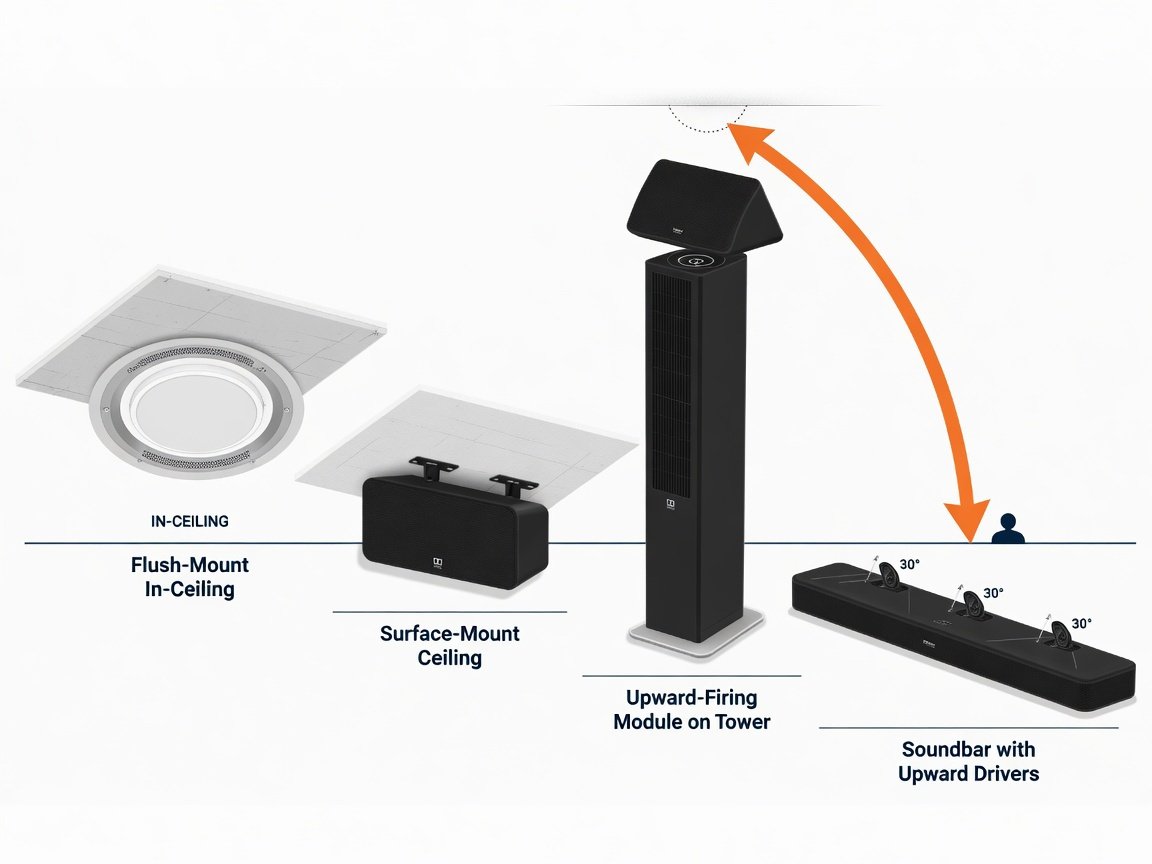
Four hardware categories serve the height channel function in a Dolby Atmos system. Each involves a different installation approach, acoustic performance profile, and practical constraint. Selecting the correct type for a given room is one of the most consequential decisions in the entire system design process — more so than brand or budget tier for the height positions specifically.
In-Ceiling Flush-Mount Speakers
Flush-mount in-ceiling speakers are installed directly into the ceiling cavity, with the driver baffle flush with the drywall surface. They provide the most direct overhead sound delivery with minimal reflective coloration. Dolby Laboratories designates in-ceiling flush-mount speakers as the reference standard for height channel reproduction. Installation requires ceiling access — typically a 4–6 inch round or rectangular cutout — and a cable run to the AV receiver’s amplifier output. These are the correct choice for any room where ceiling modifications are permitted. Coaxial drivers with pivoting tweeters allow angular compensation when precise positioning above the Dolby-recommended angles is not architecturally feasible.
Surface-Mount Ceiling Speakers
Surface-mount designs attach to the ceiling surface without requiring a cavity cutout. They are practical when cutting into the ceiling is not feasible — concrete slabs, rented spaces, or basement ceilings with limited access above. Acoustic performance is comparable to flush-mount designs in most controlled listening evaluations. The enclosure protrudes 2–4 inches from the ceiling plane depending on driver diameter, which is a minor aesthetic compromise for the installation flexibility gained. Cable management remains identical to flush-mount designs.
Upward-Firing Dolby Atmos Modules
Upward-firing modules are passive cabinets placed on top of existing floor-standing or bookshelf speakers. The driver fires vertically toward the ceiling; the listener perceives the reflected sound as arriving from above. Dolby certifies upward-firing designs as Dolby Atmos-enabled speakers. Their effectiveness is governed by ceiling height and surface properties in a way that direct-radiating designs are not. Dolby’s published guidelines recommend flat, smooth ceilings between 8 and 11 feet for reliable reflection-based height imaging. Rooms with vaulted ceilings, exposed beam structures, or heavily textured surfaces scatter reflected energy across multiple angles, reducing the directional coherence of the perceived overhead image.
Dolby Atmos-Enabled Soundbars
All-in-one soundbars with upward-firing drivers and onboard Dolby Atmos decoding provide height virtualization from a single chassis. These are appropriate for small rooms or spaces where discrete speaker placement is impractical. Height imaging accuracy is substantially lower than discrete overhead speaker arrays because the system generates height cues from a fixed horizontal position using digital signal processing and ceiling reflection, rather than physical overhead placement. They represent an entry point to the Atmos ecosystem, not a reference implementation of it.
How Many Height Channels Does a Dolby Atmos System Actually Need?
Height channel count in Dolby Atmos notation is expressed as the third digit: 5.1.2, 7.1.4, 9.1.6. Two height channels provide basic vertical differentiation and enable front overhead imaging. Four height channels add rear-overhead speakers, enabling full front-to-rear overhead sound object movement. This is the configuration Dolby recommends for dedicated home theater installations. Six height channels introduce a third overhead pair — middle or wide height positions — that primarily benefits large rooms where four points leave audible gaps in the overhead soundfield during complex spatial sequences.
Adding discrete front and rear overhead positions produces clearly perceivable front-to-rear overhead movement in any Atmos content containing height-panned objects — raindrops, aircraft, atmospheric ambience. The four-to-six step is subtler; it benefits rooms above approximately 350 square feet where the four-point overhead array begins to feel spatially coarse. In rooms under 350 square feet, four height channels are perceptually sufficient in controlled listening evaluations.
Dolby Atmos consumer configurations reach a practical ceiling of 9.1.6 for home theater installations as of 2026. Flagship AV receivers from Denon, Marantz, Yamaha, and Anthem support 11- and 13-channel processing, enabling 9.1.6 layouts or alternative configurations using wide and voice-of-god overhead positions. These configurations are primarily relevant to purpose-built dedicated theaters rather than general living room installations, where physical room constraints make positioning six discrete height channels at correct angles geometrically impossible.
Height Channel Configuration Reference
5.1.2 / 7.1.2 — Rooms under 200 sq ft. Basic front overhead imaging. Entry-level Atmos experience with two height channels.
5.1.4 / 7.1.4 — Rooms 200–350 sq ft. Full front-to-rear overhead movement. Dolby’s recommended configuration for dedicated home theaters.
9.1.4 / 9.1.6 — Rooms over 350 sq ft. Maximum spatial resolution, wide height positions, flagship receiver required.
What Is the Correct Placement for Dolby Atmos Height Speakers?
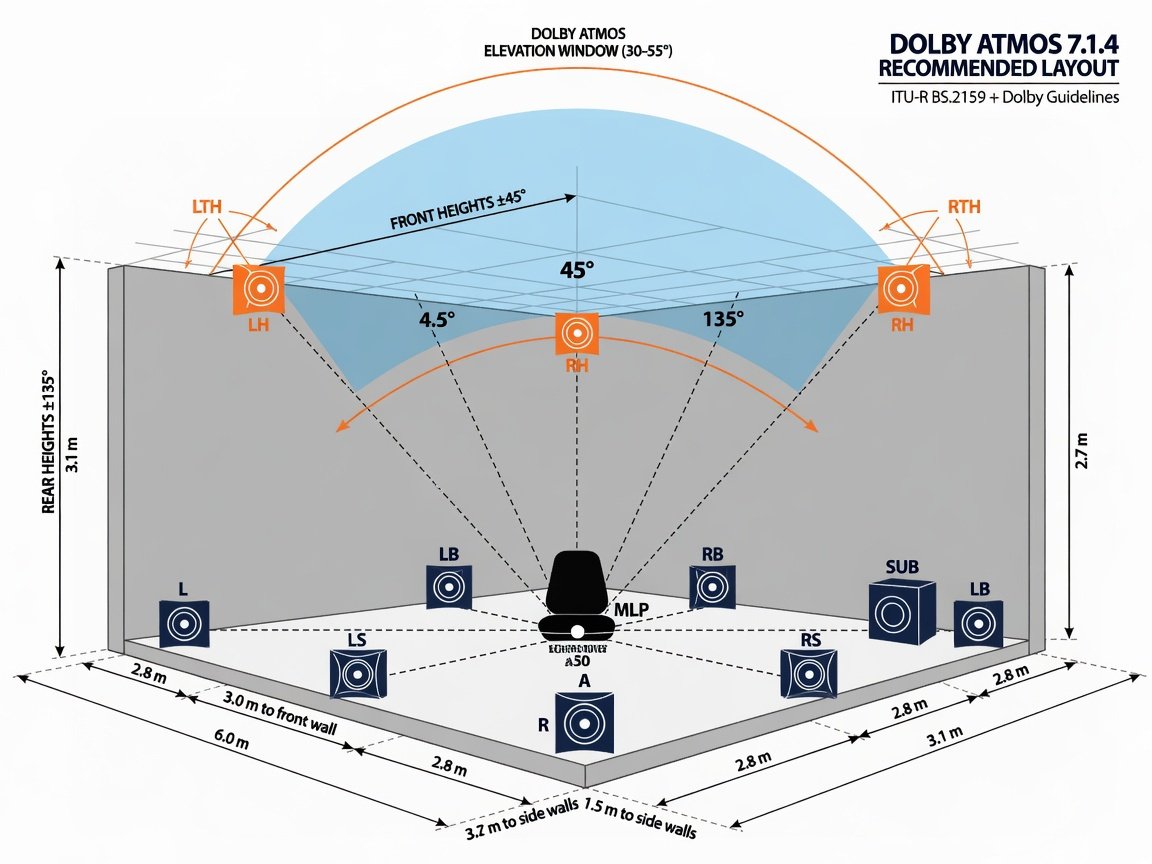
Placement accuracy is the single largest performance variable in a Dolby Atmos system. The Atmos renderer calculates object positions assuming speakers occupy the angles registered during calibration. Physical deviation from Dolby’s recommended geometry introduces a systematic spatial offset into every audio object the renderer processes. Deviating more than 15 degrees from the recommended elevation angle measurably degrades spatial localization accuracy in blind listening evaluations and produces audible positional incoherence during height-panned sequences.
According to Dolby Laboratories’ published placement specifications, front height speakers should sit at 30–55 degrees of elevation above ear level, horizontally aligned above or slightly inward of the main front left and right speakers. Rear height speakers follow the same 30–55 degree elevation rule, positioned directly above or slightly behind the primary listening seat. Side surround speakers in 7.x configurations should be placed at 90–110 degrees from the listener’s forward axis at ear level, with a permissible upward tilt of 10–15 degrees when side-wall mounting at precise ear level is architecturally constrained.
| Speaker Position | Horizontal Angle | Elevation Angle | Key Notes |
|---|---|---|---|
| Front Left / Right | 22–30° from center axis | Ear level | Reference position — all other placements derived from this pair |
| Center Channel | 0° (center axis) | Ear level ±15° | Vertical offset above ear level degrades dialogue intelligibility |
| Side Surround | 90–110° | Ear level ±15° | Slight upward tilt (10–15°) permissible in small rooms |
| Rear Surround | 135–150° | Ear level +15–30° | Angled slightly above ear level improves envelopment |
| Front Height (Atmos) | 45° from center axis | 30–55° above ear level | Align horizontally with or slightly inward of front L/R |
| Rear Height (Atmos) | 135° from center axis | 30–55° above ear level | Directly above or slightly behind primary listening seat |
| Middle Height (Atmos) | 0–90° from center axis | 30–55° above ear level | Used in .6 configurations; positioned between front and rear height pair |
Which AV Receivers Support Dolby Atmos Decoding?
A Dolby Atmos-capable AV receiver must contain a licensed Dolby Atmos decoder — a software rendering engine that reads object metadata from the incoming bitstream and calculates speaker-level assignments across all connected channels simultaneously. This decoder is distinct from the amplifier section and the HDMI switching hardware. A receiver that receives a Dolby TrueHD bitstream and routes it to an external processor or display without decoding it is not performing Atmos rendering; the object-based spatial metadata is discarded at that point and cannot be recovered.
HDMI 2.0, with 18 Gbps bandwidth, was the first interface specification capable of carrying lossless Dolby TrueHD with Atmos metadata at full Blu-ray quality — up to 24-bit audio alongside 4K/60Hz HDR video on a single cable. HDMI 2.1’s 48 Gbps bandwidth extends this to 4K/120Hz and 8K/60Hz video formats without reducing audio quality. As of 2026, HDMI 2.1 is universal on new AV receivers and display devices from every major manufacturer, eliminating the bandwidth conflict that previously forced consumers to choose between high-frame-rate gaming and lossless Atmos on the same source path.
Amplifier channel count determines the maximum Atmos configuration the receiver can directly power. A 7.2-channel receiver can drive a 5.1.2 Atmos layout — five main channels plus two height channels across seven amplifier outputs. Expanding to 7.1.4 requires a 9.2-channel receiver. Moving to 9.1.4 or 9.1.6 requires an 11.2- or 13.2-channel receiver, or supplementing internal amplification with an external power amplifier on the height channel outputs. In 2026, 9.2-channel receivers sit at the mid-tier price point across Denon, Marantz, Yamaha, and Sony’s full AV receiver lines — this configuration is no longer premium-exclusive.
Do Upward-Firing Atmos Speakers Actually Deliver Accurate Height Imaging?
Upward-firing Dolby Atmos-enabled modules are a Dolby-certified approach to height channel reproduction, and they deliver adequate spatial performance under the right acoustic conditions. Their critical limitation is that performance depends on ceiling geometry and surface properties in ways that direct-radiating in-ceiling speakers are entirely immune to. Understanding that dependency is essential before committing to upward-firing modules for a permanent installation.
The physics of reflection-based height localization require several conditions to be simultaneously satisfied. The ceiling must be flat and smooth to produce a specularly coherent reflection with a well-defined angle of incidence. Ceiling height must place the reflected arrival within a perceptually useful delay window. Reflections arriving within 5 milliseconds of the direct signal tend to fuse perceptually with it — the auditory system interprets them as part of the direct sound rather than as a spatially distinct overhead source. At an 8-foot ceiling height with typical speaker placement, the reflection path adds approximately 4–6 milliseconds, placing the performance directly on that perceptual boundary.
Heavily textured ceilings, exposed timber beams, and vaulted geometries scatter reflected energy across multiple angles, reducing the coherence of the overhead image to the point where height localization becomes imprecise regardless of calibration. Room calibration systems can correct level and timing irregularities in the reflected arrival, but cannot reconstruct a spatially coherent overhead image from a diffuse scattered reflection — that is a physical constraint, not a software limitation. The practical recommendation: upward-firing modules work reliably in rooms with 8–10 foot flat, smooth ceilings. For rooms outside those parameters, in-ceiling direct-radiating speakers consistently and measurably outperform reflection-dependent upward-firing designs.
How Do You Calibrate a Dolby Atmos System Correctly?
Room calibration is not an optional final step — it is a core component of the acoustic system. Without it, the Atmos renderer calculates object positions using nominal speaker angles that bear no relationship to the acoustic reality of the room. Every speaker in a height channel array introduces unique frequency response irregularities, inter-channel timing offsets, and level mismatches relative to the listener’s position. Calibration software measures and corrects all three variables simultaneously, aligning the acoustic performance of the physical array with the geometric model the renderer depends on.
The four dominant calibration platforms in 2026 are Audyssey MultEQ XT32 (Denon, Marantz), Yamaha YPAO with Reflected Sound Control, Dirac Live (available as firmware on a growing list of compatible receivers), and Pioneer/Onkyo MCACC Pro. Dirac Live applies full-range linear-phase correction filters with sub-millisecond timing alignment between channels — the highest-precision consumer calibration platform available. Audyssey MultEQ XT32 uses spatially averaged multi-point measurements with minimum-phase correction and is the most broadly deployed system across mid-to-upper-tier AV receivers from two of the industry’s highest-volume brands.
Complete the following calibration sequence for any Dolby Atmos system:
- Position the calibration microphone at seated ear height at the primary listening seat using a stand, not by hand. Floor reflection and body absorption from hand-held measurements introduce systematic frequency response errors.
- Run a single-point verification sweep to confirm all speakers are producing signal and all height channels are registering correctly in the calibration software before multi-point collection begins.
- Run multi-point measurements distributed across a one-meter radius around the primary seat — 5–8 positions for Audyssey XT32, up to 17 positions for Dirac Live advanced mode.
- Apply correction filters and examine frequency response plots for each height channel individually. Confirm the software is not applying excessive bass boost to small-diameter upward-firing modules, which can exceed their excursion limits at high listening levels under heavy correction.
- Adjust crossover frequencies manually after automated calibration. Default 80 Hz crossovers suit most height speakers. Small upward-firing satellite modules often benefit from 100–120 Hz crossover points given their driver diameter and bass extension limitations.
- Run a final verification measurement and confirm height channel response is within ±3 dB of the target curve from 100 Hz to 10 kHz across all measured positions.
What Dolby Atmos Configurations Work Best for Different Room Sizes?
Room volume and dimensions determine which Dolby Atmos speaker configuration delivers the intended spatial experience. The renderer assumes speaker positions follow Dolby’s published geometry; physical constraints in smaller rooms often require angular compromises that affect rendering accuracy. Matching configuration to room size from the outset avoids over-specifying hardware the room cannot accommodate, or under-specifying a layout that leaves its acoustic potential unrealised.
Rooms under 200 square feet are best served by a 5.1.2 configuration. The primary acoustic challenge at this scale is bass mode management, not height channel count. Parallel walls in small rectangular rooms produce strong standing wave patterns at low frequencies, and the calibration system must apply significant correction below 200 Hz. A single capable subwoofer, competent main speakers, and two ceiling-mount height channels provide a complete and acoustically appropriate Atmos system for this room size.
Medium rooms from 200–350 square feet are the ideal scale for a 7.1.4 configuration. This layout provides full front-to-rear overhead movement with discrete imaging, pairs naturally with 9.2-channel AV receivers in the mainstream 2026 price tier, and keeps speaker count manageable without requiring external amplification. In a correctly installed 7.1.4 system at this room scale, all four height channels contribute meaningfully to the overhead soundfield — none are acoustically redundant.
Large rooms over 350 square feet, particularly those with multiple seating rows, benefit from 9.1.4 or 9.1.6 configurations. The additional height positions extend the overhead soundfield to secondary listening positions that fall outside the primary sweet spot of a 7.1.4 system. In large rooms with more than one listening row, the front-height speakers that provide excellent overhead imaging for the front row contribute diminished height impression for rear-row listeners; adding middle or rear-height positions at correct angles for the room’s depth corrects this deficit.
What Dolby Atmos Speaker Trends Are Shaping Home Theater in 2026 and 2027?
Several converging technology directions are reshaping the Dolby Atmos speaker market heading into 2027. Understanding them helps buyers avoid purchasing hardware that will require early replacement as content delivery and decoding standards continue to evolve.
HDMI 2.1 is now universal. All new AV receivers ship with HDMI 2.1 inputs as standard in 2026. This eliminates the bandwidth conflict that previously forced consumers to choose between 4K/120Hz gaming input and full-bandwidth lossless Atmos audio on the same source path. Any AV receiver purchased new in 2026 will not create HDMI bottlenecks for audio or video quality regardless of source combination.
Wireless height channel systems are approaching mainstream viability. Multiple manufacturers have introduced certified wireless rear and height speaker systems using proprietary low-latency radio protocols targeting sub-2ms latency — below the perceptible audio-visual synchronisation threshold. These eliminate the cable runs that represent the most significant installation barrier for height channels in living room environments. Battery endurance and charging logistics remain the principal adoption friction, but the category is transitioning from early-adopter hardware to mainstream mid-tier through 2026 and 2027.
Neural-network upmixing has improved substantially. AV receivers in 2026 offer AI-based upmixing algorithms that generate convincing height channel content from legacy stereo and 5.1 source material. These algorithms are trained on large datasets of native Atmos mixes to produce height channel outputs perceptually consistent with authorial intent rather than relying on simple frequency-steering or psychoacoustic decorrelation. Non-Atmos source material — including music, legacy DVDs, and broadcast content — now benefits measurably from height channels on calibrated Atmos systems running these algorithms.
Dolby Atmos Music is expanding rapidly. Apple Music has expanded its Dolby Atmos Music catalog significantly in 2026, driven by native spatial mixing across new releases across all major genres. This content growth makes height channel investments increasingly relevant beyond home theater to serious music listening environments that have added overhead positions. The distinction between a home theater Atmos system and a music-optimised Atmos system is narrowing as the content library grows.
Dirac Live Bass Management is expanding calibration accuracy. Dirac Live Bass Control — managing the individual contribution of each subwoofer to the room response as a separately corrected variable — is available across a growing number of AV receiver firmware platforms in 2026. For multi-subwoofer Dolby Atmos systems, this extends accurate bass coverage across the entire listening area rather than optimising LFE performance only at the primary measurement seat, which has always been the practical limitation of single-point bass calibration on multi-subwoofer arrays.
Frequently Asked Questions About Dolby Atmos Speakers
Can I add Dolby Atmos to an existing 5.1 system?
Yes. The most common upgrade path is adding two upward-firing Atmos-enabled modules on top of your existing front left and right speakers, connected to height channel outputs on an Atmos-capable AV receiver. If your current receiver does not support Dolby Atmos decoding, replacing it is a prerequisite — without onboard Atmos decoding, height channel outputs carry no spatial metadata and the height speakers produce nothing but an upmixed signal with no object-based content.
Do Dolby Atmos speakers need to be the same brand as the main speakers?
No. Dolby Atmos has no brand-matching requirement. The AV receiver’s calibration system corrects for level, frequency response, and timing differences between dissimilar speakers across all positions. However, a significant tonal mismatch — pairing a bright-sounding satellite as a height channel with warm-voiced floor-standers — remains partially audible even after calibration. Matching sensitivity within 3 dB nominal and maintaining similar tonal character between height and main speakers reduces the correction load and produces a more seamless spatial blend.
What is the difference between Dolby Atmos and DTS:X for speaker requirements?
There is no hardware difference. Both Dolby Atmos and DTS:X are object-based audio formats using identical physical speaker positions. A speaker serving a height channel in a Dolby Atmos configuration performs the same function in a DTS:X configuration on the same system. The distinction is purely in codec packaging: Dolby Atmos uses Dolby TrueHD or Dolby Digital Plus; DTS:X uses DTS-HD Master Audio. All major AV receivers manufactured since 2019 support both formats simultaneously on the same hardware and speaker array.
How many subwoofers does a Dolby Atmos system need?
A single correctly integrated subwoofer is fully compliant with the Dolby Atmos specification. The LFE channel in Atmos notation is a single channel regardless of subwoofer count. Adding a second subwoofer at a different room position distributes bass energy across two locations, measurably reducing standing wave modal peaks and improving frequency response consistency across multiple seats. A single subwoofer in a room over 200 square feet typically exhibits 6–12 dB of modal variation across the listening area before calibration; two subwoofers in opposing positions reduce this substantially before any DSP correction is applied.
What impedance should Dolby Atmos height speakers be?
Most AV receivers are designed for speaker loads between 4 and 16 ohms. Nominal 6 or 8 ohm speakers are the standard choice for all positions, including height channels. Speakers presenting nominal impedance below 4 ohms should be avoided for height channel use. AV receivers have substantially less current headroom than dedicated power amplifiers, and sustained low-impedance loads can trigger thermal protection shutdown at elevated listening levels — an issue that is easily avoided by confirming driver impedance before connecting.
Does Dolby Atmos work with stereo music, or is it only for movies?
Dolby Atmos works with both movies and music. Dolby Atmos Music is a distinct spatial format available on Apple Music and Tidal, providing natively authored object-based mixes on a growing catalog. For standard stereo or 5.1 music files without embedded Atmos metadata, modern AV receivers apply upmixing algorithms — Dolby Surround or AI-based neural upmixers — that generate synthesized height content from the existing channels. These algorithms have improved significantly through 2025–2026 and produce a noticeably more spatially coherent presentation than earlier DSP-based upmixing modes.
How to Build Your Dolby Atmos Speaker System: Actionable Next Steps
Building a Dolby Atmos speaker system is a sequenced process where each decision constrains the next. Skipping steps — particularly placement verification and multi-point calibration — leaves measurable spatial performance unrealised regardless of hardware investment. Follow this sequence for any room size or budget tier in 2026:
- Measure your room. Calculate floor area and note ceiling height before selecting any configuration. This single variable determines appropriate height channel count and whether upward-firing modules are acoustically viable in your specific space.
- Select configuration. Under 200 sq ft: 5.1.2. 200–350 sq ft: 7.1.4. Over 350 sq ft: 9.1.4 or 9.1.6. Default to four height channels if room dimensions and budget allow — the front-to-rear overhead movement it enables is the single most impactful improvement over a two-channel height array.
- Choose height speaker type based on ceiling access. Accessible flat ceiling: in-ceiling flush-mount. No ceiling access with an 8–11 foot flat ceiling: upward-firing modules. Complex or low ceiling geometry: surface-mount direct-radiating ceiling speakers. Rental or temporary installation: Atmos soundbar as an interim solution.
- Select an AV receiver with sufficient amplifier channels for your configuration, confirmed Dolby Atmos decoding, and HDMI 2.1 inputs. Verify the channel count matches your speaker count including all height positions before purchasing.
- Install and position speakers per Dolby’s published angular specifications before running cables permanently. Use a digital angle gauge or measurement app at the primary listening seat to verify 30–55 degrees of elevation for all height positions before finalising mounting hardware.
- Run room calibration with the microphone at seated ear height using a stand. Complete multi-point measurements. Review all height channel correction plots individually and manually adjust crossover frequencies after the automated cycle rather than accepting all defaults.
- Verify Atmos decoding. Play a reference Dolby Atmos Blu-ray title and confirm the receiver’s display indicates “Dolby Atmos” — confirming object-based decoding is active and the system is not falling back to a standard TrueHD 7.1 down-mix.
At hometheaterinfoline.com, every step in this process has dedicated coverage — from AV receiver channel count guides and in-ceiling installation walkthroughs to acoustic treatment fundamentals and multi-point calibration tutorials. A correctly designed and calibrated Dolby Atmos speaker system, built to Dolby’s geometric specifications, is the most technically complete spatial audio reproduction environment available to consumers at any price point in 2026.
Pingback: Dolby Atmos: The Complete 2026 Guide to Immersive Home Theater Audio - Home Theater InfoLine