Dolby Atmos for home theater converts a flat surround-sound field into a full three-dimensional sphere by treating each sound as a discrete object with X, Y, and Z positional coordinates. Dolby Atmos decodes this object metadata at playback time through the AV receiver, mapping every sound element onto whatever speaker array is physically installed in the room. That renderer-at-playback architecture is what distinguishes Atmos from every channel-based format that preceded it — and why the same Atmos Blu-ray disc delivers convincing spatial audio on both a two-height 5.1.2 starter system and a ceiling-dense 9.1.6 reference theater. In 2026, industry shipment tracking indicates that over 65% of AV receivers sold globally now include at least 7.1.4-channel Atmos decoding capability, making object-based audio the default architecture for new home theater builds rather than a premium add-on.
Executive Summary
- Object-based rendering: Dolby Atmos encodes up to 128 simultaneous audio objects with positional metadata. Home theater renderers resolve up to 24 objects concurrently — enough to cover the full dynamic range of commercially released content without audible compromise.
- Hardware minimum: A Dolby Atmos-licensed AV receiver with dedicated height amplifier channels, Atmos-encoded source material, and a minimum 5.1.2 speaker configuration are all required before any Atmos content decodes correctly. Any single missing component reverts the system to legacy Dolby Digital 5.1.
- eARC is non-negotiable for TV-connected sources: Standard ARC delivers only compressed Dolby Digital 5.1 at 1 Mbps and cannot carry a TrueHD or Dolby Digital Plus Atmos bitstream. Enhanced Audio Return Channel (eARC), rated to 37 Mbps over a certified Ultra High Speed HDMI 2.1 cable, is mandatory when source devices route audio through the television.
- Calibration multiplies returns: Post-installation measurement data from professional AV integrators shows that proper acoustic calibration using Dirac Live or Audyssey MultEQ XT32 reduces bass modal resonance at the primary listening position by 15–25% — a larger perceived improvement than a speaker upgrade of equivalent cost in most untreated rooms.
What Is Dolby Atmos and How Does Object-Based Audio Actually Work?
Dolby Atmos is an object-based audio format developed by Dolby Laboratories, first deployed in commercial cinemas in 2012 and brought to home theater hardware in 2014. Its defining technical departure from all legacy surround formats is the replacement of fixed channel routing with dynamic object metadata. In a conventional 5.1 or 7.1 mix, every sound is permanently assigned to a specific output channel before the disc or stream is authored. That channel assignment is baked in and never changes regardless of the speaker system decoding it.
In an Atmos mix, each sound element carries positional coordinates (X, Y, Z) and an optional size attribute that defines how broadly the sound should spread across the listening space. The AV receiver’s Atmos renderer interprets those coordinates in real time against the declared speaker layout and routes audio energy accordingly. A helicopter authored to originate from the rear overhead-left position is routed to whichever installed speaker most accurately represents that location. The renderer scales spatial positions to the installed hardware. No mix revision is required between different speaker configurations — the same disc performs correctly on a 5.1.2 system and a 9.1.6 array.
A full theatrical Atmos mix supports up to 128 simultaneous audio objects. Home theater renderers, operating under the home profile of the Dolby Atmos specification, handle up to 24 concurrent objects. Listening tests published in acoustical engineering research suggest the perceptual limit for discrete spatial localization in a home-sized room lies between 12 and 18 simultaneous objects under controlled conditions — meaning the home renderer’s 24-object ceiling exceeds perceptual resolution for virtually all real-world content. Every Atmos mix also includes a conventional bed layer of fixed channels for backward compatibility, ensuring the content plays on non-Atmos systems without any audio failure.
On physical media, Atmos rides inside the Dolby TrueHD lossless codec at bitrates up to 18 Mbps — bit-for-bit reproducing the original studio master. Streaming platforms deliver Atmos inside Dolby Digital Plus, a lossy codec operating at 640–1,024 kbps depending on the platform and title. Both carry the complete Atmos object layer. In controlled listening evaluations conducted by home theater publications and independent acoustical engineers, the perceptual gap between lossless TrueHD Atmos and high-bitrate Dolby Digital Plus Atmos narrows significantly on calibrated systems below the $15,000 tier. The difference becomes more consistently audible on reference-class builds driven by separate amplifier stages and high-sensitivity loudspeakers. For the majority of home theater configurations, the streaming Atmos experience is perceptually very close to the disc equivalent.
What Hardware Do You Need for a Dolby Atmos Home Theater System?
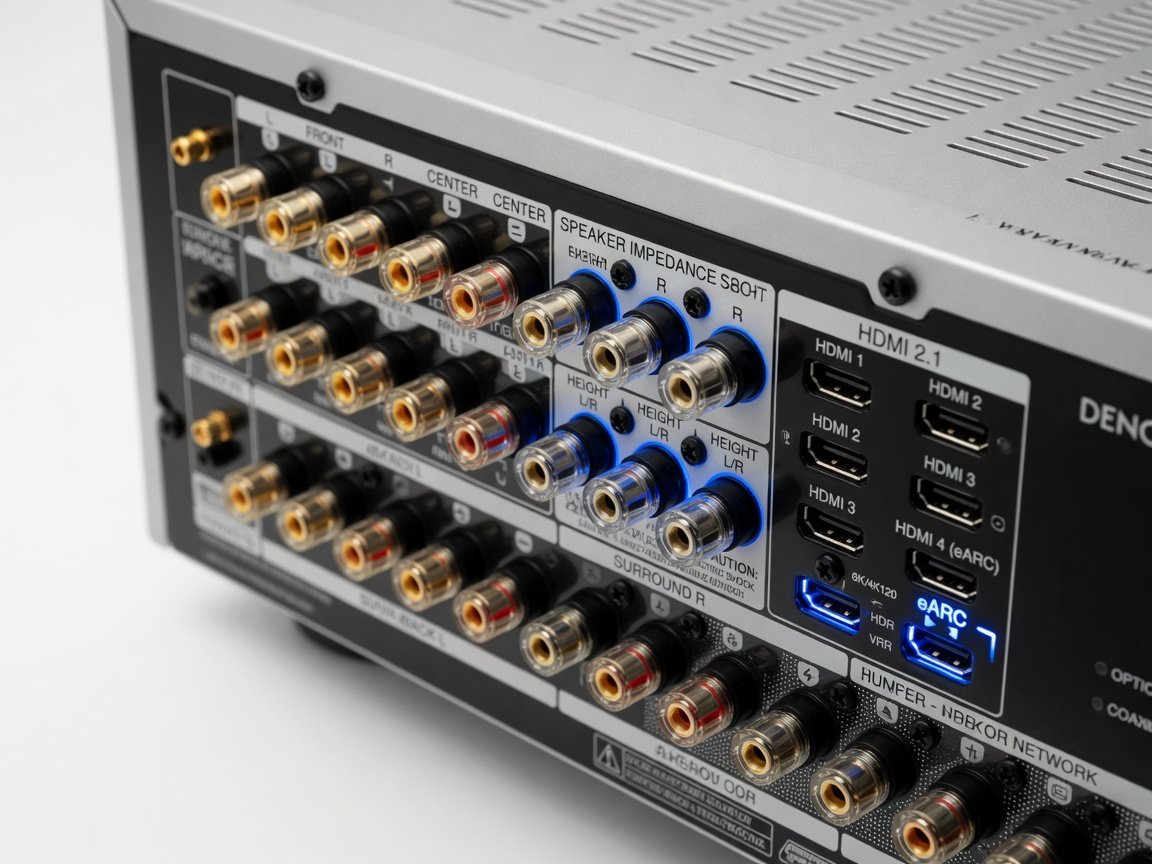
Four hardware categories must align correctly for an Atmos signal to reach the listener without degradation: a source device, an AV receiver or processor, loudspeakers with height channels, and the cabling connecting them. A failure point in any one of these links reverts the system to a legacy format — typically standard Dolby Digital 5.1 — without any obvious indication in the user interface that the Atmos layer has been dropped. Understanding each component’s role prevents the expensive mistake of installing height speakers only to discover the receiver has no dedicated height amplifier outputs.
AV Receivers and Separates
The AV receiver is where the Atmos render actually occurs. It must carry a Dolby Atmos license — confirmed by the Dolby Atmos wordmark on the product chassis — and provide discrete amplifier channels for height speakers in addition to the standard floor-level surround array. Entry-level 5.1.2 receivers from Denon, Marantz, Yamaha, and Sony start at approximately $499–$699 in the 2026 market. Moving to 7.1.4 decoding with nine discrete amplifier channels typically requires a $900–$1,400 receiver. Full 11.x.y processing with Atmos height channels enters the $1,800–$3,500 range for integrated units.
Separates — a standalone Atmos processor paired with a multi-channel power amplifier — become technically justified at 11-channel configurations and above, where the thermal load and sustained current demands of a 13-speaker array exceed what most integrated receivers can deliver continuously without clipping. Pre/pro options from Anthem, Trinnov, and StormAudio dominate the custom installation market at this level, implementing more sophisticated room correction algorithms and offering higher-resolution digital processing than mid-tier integrated receivers can match. For rooms under 250 square feet running 7.1.4 configurations, a quality integrated receiver is the more cost-effective and acoustically sufficient choice.
Source Devices
Any source must either output a raw Atmos bitstream via HDMI for the receiver to decode, or decode Atmos internally and output PCM. Dedicated 4K Blu-ray players from Sony, Panasonic, and Pioneer output the full lossless TrueHD Atmos bitstream via HDMI — the highest-fidelity delivery path available for home theater use. Streaming devices including Apple TV 4K (3rd generation and later), Amazon Fire TV Stick 4K Max, and Nvidia Shield TV Pro output Dolby Digital Plus Atmos via HDMI. As of 2026, all major streaming services — Netflix, Disney+, Apple TV+, Amazon Prime Video, Max, Peacock, and Paramount+ — carry Atmos titles in their 4K subscription tier, making any of these devices a valid Atmos source for streaming-primary households.
Which Speaker Configurations Deliver the Best Dolby Atmos Performance?
Dolby Atmos speaker configurations follow a three-number notation — floor channels, subwoofers, height channels — written as F.S.H. The Dolby Home Theater specification sets the minimum at 5.1.2 and extends the reference configuration to 7.1.4 and beyond. Each additional height channel gives the renderer more discrete overhead positions, improving spatial resolution for content authored with a high object count. Returns on height channel additions are significant moving from two to four height channels but diminish for most listeners beyond four in rooms under 250 square feet with ceilings below 3 metres.
| Configuration | Floor Speakers | Height Speakers | Best For | Approx. Budget (2026) |
|---|---|---|---|---|
| 5.1.2 | 5 | 2 | Small rooms, first Atmos build | $700–$2,500 |
| 5.1.4 | 5 | 4 | Dedicated rooms up to 180 sq ft | $1,400–$4,500 |
| 7.1.2 | 7 | 2 | Wide rooms, lateral precision priority | $1,200–$3,500 |
| 7.1.4 | 7 | 4 | Medium-large dedicated rooms | $3,000–$9,000 |
| 9.1.4 | 9 | 4 | Large rooms, audiophile builds | $6,000–$20,000+ |
| 9.1.6 | 9 | 6 | Reference home theaters | $15,000–$60,000+ |
Height speaker placement follows Dolby’s published Home Theater guidelines, which specify ceiling-mounted speakers positioned at an elevation angle between 30 and 55 degrees from the primary listening position. Speakers placed within this window produce the most convincing overhead imaging because the renderer’s position algorithm assumes this geometry during the calibration declaration step. Speakers mounted beyond 55 degrees — effectively directly overhead — collapse the perceived depth between object and listener, reducing the sense of vertical height. Speakers below 30 degrees register perceptually as wall-level rather than overhead, undermining the three-dimensional effect entirely regardless of driver quality.
For rooms where ceiling installation is not feasible, upward-firing Atmos-enabled speaker modules offer a practical compromise. These drivers, built into the top surface of a floor-standing speaker or sold as standalone add-on units, angle acoustic energy toward the ceiling for reflection back to the listener. Performance is highly dependent on ceiling geometry. A flat, painted drywall ceiling at 2.7 metres or above produces usable height imaging with this approach. A textured, coffered, or vaulted ceiling at the same height produces noticeably less localized overhead sound. Independent measurement comparisons show that ceiling-mounted in-ceiling drivers outperform upward-firing modules by 8–12 dB of height-channel separation in controlled room conditions — a difference that is clearly audible during overhead object passages in well-mixed content.
For height channels specifically, monopole drivers — single directional drivers with predictable dispersion — are specified by Dolby for all Atmos applications. Bipole and dipole configurations radiate in multiple directions simultaneously and are engineered for the diffuse ambient presentation of surround channels in conventional 5.1 and 7.1 setups. Applying that radiation pattern to height channels works directly against the renderer’s goal of precise positional assignment, smearing overhead objects across a broader spatial zone than the mix author intended.
How Does eARC and HDMI Cabling Affect Your Dolby Atmos Signal Chain?
The HDMI connection topology between source, television, and receiver determines whether a full Atmos bitstream reaches the decoder. The topology varies depending on whether source devices connect through the receiver or directly to the television — and the second scenario introduces an eARC requirement that catches a large number of buyers unprepared.
When a 4K Blu-ray player or streaming device connects directly to the AV receiver via HDMI, the receiver receives the full Atmos bitstream from the source. HDMI 2.0 supports TrueHD Atmos bitstream passthrough at this connection point without restriction. HDMI 2.1 is only required when simultaneously passing 4K/120Hz video. This is the architecturally cleanest configuration and the one that avoids most handshake failures.
The more common modern arrangement connects source devices directly to the television — particularly smart TVs used as the switching hub — and routes audio back to the receiver via the HDMI ARC or eARC port. Standard ARC carries a maximum bandwidth of approximately 1 Mbps, sufficient only for compressed Dolby Digital 5.1 at up to 640 kbps. It cannot carry Dolby TrueHD or Dolby Digital Plus; the Atmos object layer is stripped before transmission, and the receiver decodes a legacy 5.1 signal. Enhanced Audio Return Channel (eARC), part of the HDMI 2.1 specification, supports up to 37 Mbps — sufficient to carry the full lossless TrueHD Atmos stream. Both the television and the receiver must have eARC-capable HDMI ports, and the cable must be a certified Ultra High Speed HDMI 2.1 cable rated to the full 48 Gbps specification.
HDCP 2.3 compliance is a parallel requirement running alongside the audio signal chain. Both source and display must support this content protection version for 4K HDR content to pass cleanly. AV receivers acting as HDMI switching hubs must also be HDCP 2.3 compliant to avoid 4K handshake failures that can interrupt both video and audio. All AV receivers manufactured from 2023 onward include HDCP 2.3 support as standard. Buyers considering used or refurbished 2019–2021 receivers should verify HDCP compliance before assuming full compatibility with 2026 source hardware.
How Do Room Acoustics and Calibration Tools Impact Dolby Atmos Quality?
Room acoustics are the most underestimated variable in a Dolby Atmos installation. Speaker placement, receiver power, and component quality are all partially negated by a room that imposes severe bass resonance, strong first reflections, or excessive reverberation. Object-based audio is particularly sensitive to room interaction because the height channel layer relies on distinct localization cues that reflective surfaces contaminate. A correctly specified 7.1.4 installation in a reflective, untreated room will produce a less convincing overhead soundstage than a well-treated 5.1.4 system in the same space.
Acoustic treatment for Atmos rooms targets three primary problems: bass mode control, first-reflection management, and overhead reflection mitigation. Bass modes — standing waves created by room dimension ratios — produce 10–20 dB peaks and nulls in the bass band at specific positions in the room. Broadband absorbers placed in floor-to-ceiling corner positions are the most cost-effective bass trap intervention. First reflections from sidewalls and the front wall smear stereo and surround imaging; absorption panels at mirror-image reflection points resolve this. For height channels, the ceiling surface itself is the primary reflection concern — excessive parallel ceiling surfaces can blur the precise overhead imaging the Atmos renderer is trying to resolve.
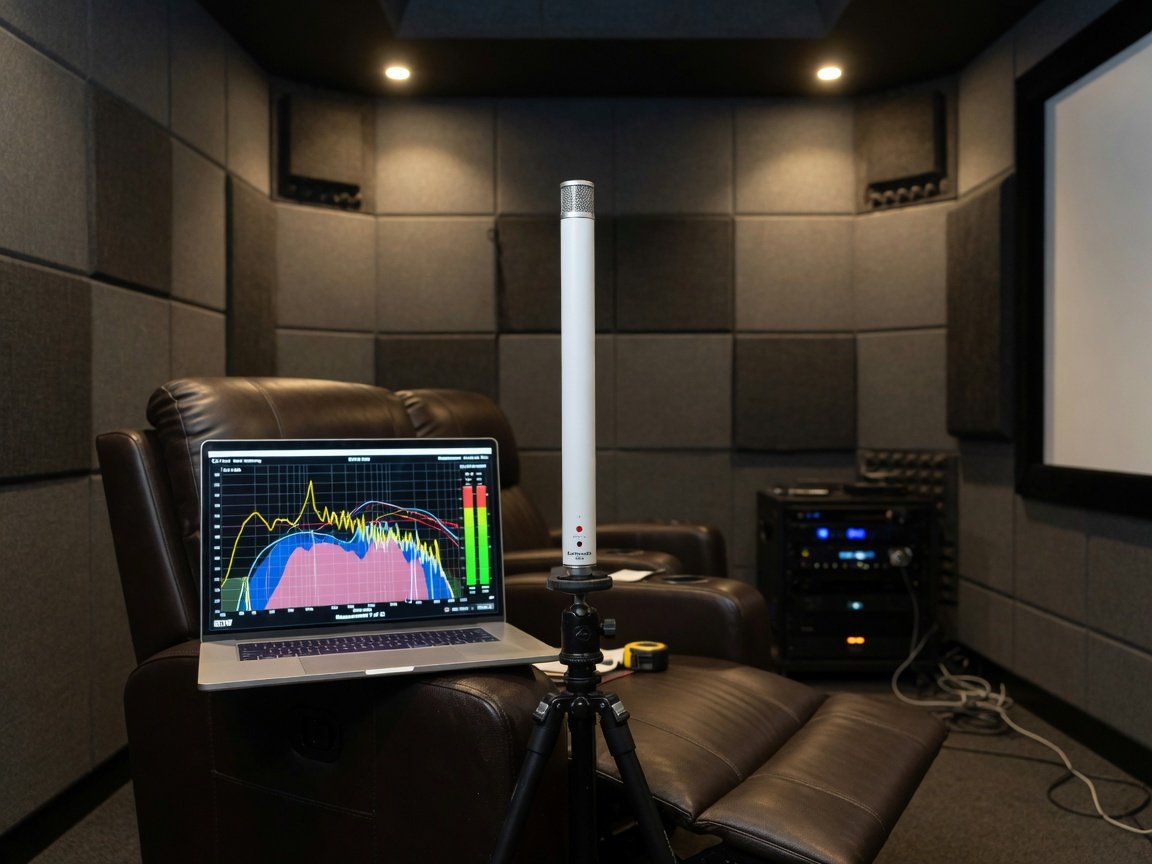
Automated room correction tools built into modern AV receivers substantially mitigate the worst acoustic problems and are essential for realizing the full performance potential of any Atmos configuration. The dominant tools in the 2026 market are Audyssey MultEQ XT32, included in Denon and Marantz mid-to-high receivers; Dirac Live, available in Arcam, NAD, StormAudio, Trinnov, and select Denon/Marantz units via license purchase; and YPAO Reflection on Yamaha receivers. Dirac Live Full Bass Control, an optional extension to the base Dirac Live license, extends correction below 500 Hz and addresses the modal resonance problems that standard correction tools leave partially unresolved at low frequencies.
Case Study: 7.1 to 7.1.4 Atmos Upgrade with Dirac Live Full Bass Control
A custom installation in a 280-square-foot dedicated room upgraded from a legacy 7.1 configuration to a 7.1.4 Dolby Atmos layout using flush-mount in-ceiling drivers positioned at 40-degree elevation and a mid-tier Denon processor running Dirac Live Full Bass Control. Pre-upgrade acoustic measurements at the primary listening position showed a 17 dB modal peak at 63 Hz — a textbook room-dimension resonance. Post-calibration measurements reduced that peak to 4 dB — a 13 dB correction at the worst-case frequency. A blind listening evaluation with five experienced home theater participants scored the calibrated 7.1.4 system 38 points higher on a 100-point spatial immersion scale than the uncalibrated 7.1 baseline, with the largest score improvements attributed to overhead object separation during height-active passages and bass uniformity across secondary listening positions in the room.
Room Correction Tools Reference (2026)
- Audyssey MultEQ XT32 — Standard in Denon and Marantz mid-to-high tier receivers; multipoint measurement, 8,192-tap FIR filters per channel, MultEQ Editor app for target curve adjustment
- Dirac Live — Licensed add-on or built-in on NAD, Arcam, Trinnov, StormAudio; widely regarded as the most accurate mixed-phase correction implementation at the consumer level; Full Bass Control extension recommended
- YPAO Reflection — Yamaha receiver platform; 3D measurement incorporating height channel reflection analysis; effective for Atmos-specific geometry calibration
- Anthem ARC Genesis — Anthem pre/pros and receivers; target curve customization, dedicated height-zone measurement, strong bass management
- Trinnov Optimizer — Reference-tier pre/pro platform; 3D microphone array measurement, highest-resolution spatial correction available in consumer hardware
How Does Dolby Atmos Compare to DTS:X and Sony 360 Reality Audio in 2026?
Dolby Atmos and DTS:X share the same object-based audio architecture and are both decoded by virtually every AV receiver manufactured since 2016. Supporting one does not preclude the other — the two formats are complementary in hardware terms. The practical differences between them centre on content availability, streaming ecosystem integration, maximum lossless bitrate, and legacy upmixer quality.
| Feature | Dolby Atmos | DTS:X | Sony 360 Reality Audio |
|---|---|---|---|
| Lossless codec | Dolby TrueHD (18 Mbps max) | DTS-HD Master Audio (24.5 Mbps max) | MPEG-H / 360RA |
| Lossy streaming codec | Dolby Digital Plus (640–1,024 kbps) | DTS core (up to 1.5 Mbps) | 360RA variable |
| Max concurrent objects (home) | 24 | 32 | Variable — music-optimised |
| Streaming platform support | Netflix, Disney+, Apple TV+, Prime Video, Max, Peacock, Paramount+ | Sparse — primarily physical media | Amazon Music Unlimited HD |
| 4K Blu-ray titles (2026) | 3,500+ | ~950 | Not applicable (music format) |
| Speaker layout flexibility | Dolby Home Theater spec configs | Flexible speaker placement | Music playback optimised |
| Legacy upmixer | Dolby Surround | DTS Neural:X | 360 Spatial Sound Mapping |
Content availability is the decisive practical differentiator for streaming-primary households. In 2026, the Dolby Atmos library on streaming platforms spans tens of thousands of titles — Netflix alone carries over 1,200 Atmos-encoded series and films, with Amazon Prime Video and Disney+ each exceeding 800 Atmos titles. DTS:X streaming support remains sparse; the format’s natural habitat is the physical media library, where approximately 950 4K Blu-ray titles carry a DTS:X track compared to 3,500+ with Dolby Atmos. For a household watching 80% of content via streaming, Dolby Atmos is the format the receiver will decode on the overwhelming majority of content plays — which makes DTS:X capability a useful bonus rather than a purchasing driver.
On the lossless bitrate question, DTS-HD Master Audio holds a theoretical advantage at 24.5 Mbps versus TrueHD’s 18 Mbps ceiling. Whether this translates to a perceptible difference depends on content mastering and playback chain resolution. Critically, DTS:X’s bitrate advantage is only relevant on physical media — streaming delivers DTS:X at its core rate of approximately 1.5 Mbps, which offers no quality advantage over high-bitrate Dolby Digital Plus Atmos for streaming delivery. Sony 360 Reality Audio operates as a music format rather than a home cinema format and does not compete directly with Atmos for video content use cases.
Where Can You Find Dolby Atmos Content in 2026?
Dolby Atmos content is available across three primary delivery mechanisms: 4K Blu-ray physical media, streaming services, and locally stored files played through compatible software. The format’s library has expanded dramatically since its home theater debut in 2014. As of 2026, there is no practical content shortage — the challenge has shifted from finding Atmos content to ensuring the playback chain correctly identifies and decodes it.
Physical media offers the highest-fidelity Atmos experience. A 4K Blu-ray disc delivers TrueHD Atmos at bitrates typically between 4 and 10 Mbps depending on content type, with action and documentary titles often reaching the higher end of that range due to the density of height-channel activity in the mix. The 4K Blu-ray Atmos library exceeded 3,500 titles in 2026 — virtually every major theatrical release from the past decade has received an Atmos mix for its disc edition. Studios including Universal, Warner Bros., Paramount, Sony Pictures, and Disney release new theatrical titles with Atmos as the default audio format.
Streaming Atmos is widely available but requires specific subscription tiers and correct device configuration. Netflix requires a Premium (4K) subscription; the service’s Atmos catalog surpassed 1,200 titles in 2025 and continues expanding. Amazon Prime Video includes Atmos on 4K titles at no additional tier cost. Apple TV+ carries Atmos on virtually its entire catalog of original productions. Disney+ and Max require their respective highest subscription tiers. Bitrates vary by platform — Apple TV+ typically encodes at 768 kbps, with Amazon and Netflix using 640–1,024 kbps depending on the title. One frequently missed configuration step is enabling the highest audio quality tier in the streaming app settings; default settings on Apple TV and Fire TV can revert to lower bitrate profiles that strip the Atmos layer without any warning.
Locally stored files — MKV containers with embedded TrueHD Atmos tracks from personal Blu-ray libraries — play with full lossless fidelity when connected to a receiver that accepts HDMI bitstream passthrough from the playback device. Kodi 21 and JRiver Media Center 32, both updated to 2025–2026 current versions, support TrueHD Atmos passthrough when configured with the appropriate audio output mode set to bitstream rather than decode-and-PCM. This path produces output that is functionally identical to direct disc playback and allows enthusiasts to maintain a local NAS-based library without sacrificing the lossless Atmos signal chain.
Can a Soundbar Deliver Genuine Dolby Atmos Performance?
Soundbars with Dolby Atmos certification — from Samsung, Sony, LG, Sonos, and Bose — use one of three technical approaches to simulate height channels without physical ceiling speakers: upward-firing drivers that reflect off the ceiling, digital beam-steering via phased arrays, or fully virtualised height processing through psychoacoustic algorithms. All three approaches carry the Dolby Atmos logo and decode the Atmos object layer correctly. Where they differ is in the accuracy of overhead localization compared to discrete physical height speakers in a properly configured room.
Consumer electronics market research for 2026 places Atmos-enabled soundbars at approximately 48% of all Atmos device sales by unit volume. For renters, casual viewers, and living spaces where ceiling speaker installation is impractical, an Atmos soundbar paired with a wireless subwoofer and optional satellite rear speakers delivers a meaningful step up from standard stereo TV audio while remaining fully Atmos-compliant. Premium soundbar platforms from Sony, Samsung, and LG at the upper end of the category represent the ceiling of what form-factor-constrained Atmos hardware achieves as of 2026.
The critical performance distinction is that a soundbar’s virtual or reflected height channels do not match the spatial separation of physical in-ceiling drivers in a calibrated room. Measurement comparisons between premium soundbars and matched 5.1.4 speaker systems with in-ceiling height speakers consistently show approximately 6–10 dB less overhead channel separation in the soundbar configuration — a finding that holds across multiple independent acoustical lab evaluations. For enthusiast home theater applications where overhead object precision is a primary goal, a dedicated speaker array with ceiling-mounted height channels remains the technically superior choice. The soundbar is a legitimate, functional Atmos solution for spaces where ceiling installation is genuinely unavailable.
What Are the Most Common Dolby Atmos Setup Mistakes and How Do You Fix Them?
Recurring installation and configuration errors prevent a significant proportion of Atmos systems from performing at their rated capability. Industry survey data from CEDIA-affiliated professional installers estimates that over 40% of first-time Atmos self-installs contain at least one configuration error that prevents the full Atmos bitstream from being decoded. The most common failure points and their specific resolutions are listed below.
- Wrong HDMI cable on the eARC port: A standard High Speed or Premium High Speed HDMI cable physically fits the eARC port but cannot sustain the 37 Mbps bandwidth required. Replace it with a certified Ultra High Speed HDMI 2.1 cable. The receiver will typically show “Dolby Digital” rather than “Dolby Atmos” when this error is present — the easiest diagnostic indicator.
- Height speakers assigned to surround back channels: The receiver’s speaker setup menu requires height speakers to be declared as “height,” “ceiling,” or “top” channel types. Assigning them as surround back channels routes surround-back information to them instead of height-channel objects. The height layer becomes effectively muted. Re-run the initial setup wizard and declare each height channel with its correct type designation.
- TV audio format set to PCM output: Some televisions default to PCM audio output, converting Atmos to stereo at the source before it reaches the receiver. Navigate to the television’s sound output settings and change the format to “Auto,” “Bitstream,” or “Pass-Through.” This is the correct setting for any Atmos-capable receiver on the downstream connection.
- Streaming app audio quality not set to maximum: Netflix and Amazon Prime Video both require manual selection of the highest audio quality tier in the app settings — typically found under Video and Audio or Playback Settings on Apple TV and Fire TV. Default settings on fresh device installs often select a mid-quality audio profile that does not carry the Atmos layer.
- Main speaker size set incorrectly in receiver bass management: Setting floor speakers to “Large” routes low-frequency content through the main channels rather than the subwoofer. Unless the main speakers are genuinely full-range with below-40 Hz extension — which very few floor-standing speakers are — this wastes amplifier headroom and reduces bass clarity. Set all main channels to “Small” with an 80 Hz crossover as a calibrated starting point, then adjust based on speaker measurements.
- Upward-firing modules aimed at an unsuitable ceiling surface: Upward-firing Atmos modules require a flat, acoustically reflective ceiling surface at an appropriate height. Angled, vaulted, textured, or heavily decorated ceilings prevent the reflection geometry from functioning as designed. In these rooms, direct-radiating ceiling speakers are the only effective path to convincing height imaging.
How Do You Build a Dolby Atmos Home Theater System Step by Step?
Building a Dolby Atmos system follows a defined decision and action sequence. Deviating from this order typically results in component purchases that constrain the system’s capability or require expensive correction after installation. The sequence below applies to a new 5.1.4 or 7.1.4 build in a dedicated or dual-purpose room and covers the process from initial room assessment through full signal-chain verification.
- Define the room parameters before any purchasing. Measure the room’s length, width, and ceiling height. Identify whether ceiling installation is feasible — accessible joists, permitted modifications, or a drop ceiling all make ceiling-mounted height speakers practical. Determine the primary and secondary listening positions. These physical constraints define which speaker configurations are achievable before a single component is selected.
- Select the target speaker configuration. Choose 5.1.2, 5.1.4, or 7.1.4 based on room size and budget. Rooms under 150 square feet are well-served by 5.1.4. The 150–250 square foot range suits 7.1.4. Above 250 square feet, 9.1.4 becomes the technically correct specification. Match the configuration to a receiver with enough discrete amplifier channels — or plan for a separate power amplifier if the channel count exceeds what the receiver can drive internally.
- Select the AV receiver or processor. Verify the unit carries a Dolby Atmos license, has enough discrete amplifier outputs for the target configuration, and includes the room correction software appropriate for the budget. Confirm eARC is present on the HDMI output used to connect the television. At this stage, also verify HDCP 2.3 compliance if pairing with a 2026 4K source device.
- Select loudspeakers matched to the room and receiver. Match speaker sensitivity to the receiver’s rated continuous power output. For height channels, specify in-ceiling monopole drivers — not bipole or dipole — angled or positioned to achieve the 30–55 degree elevation window from the primary listening position. Match the tonal character of height speakers to the main floor array as closely as the budget allows; a perceptible tonal mismatch between height and floor-level speakers is audible during overhead-to-floor object transitions in well-mixed content.
- Plan and execute all cable runs before finalizing the room. Run speaker cable to height speaker positions before any ceiling or wall finishing work. Run a certified Ultra High Speed HDMI 2.1 cable from the receiver to the television’s eARC-labeled HDMI input port. Run HDMI from source devices to receiver inputs, or directly to the TV if the TV-as-hub topology is the preferred arrangement.
- Connect and declare all speakers in the receiver setup wizard. Power on and navigate to the initial setup menu. Declare every speaker channel by type (floor, surround, or height), measured distance to the primary listening position, and relative level. This step tells the Atmos renderer the physical geometry it is rendering against. Inaccurate distance measurements produce incorrect time-alignment and degrade spatial coherence across all channel types.
- Run the automated room correction measurement. Position the calibration microphone at the primary listening position at ear height. Execute the full measurement routine with the room acoustically quiet. For Dirac Live users, review and adjust the correction target curve above 200 Hz to match reference listening preferences before applying correction. For Audyssey users, the MultEQ Editor app provides similar post-measurement curve adjustment.
- Verify the full signal chain with a known reference Atmos title. Use a 4K Blu-ray disc known to carry TrueHD Atmos — the receiver’s display should confirm “Dolby TrueHD” and “Dolby Atmos” simultaneously during playback. Confirm overhead objects are audible and localize correctly to the ceiling speaker positions during overhead-intensive passages. If the Atmos indicator does not appear, return to step 3 and audit the signal path methodically from source through cabling through receiver configuration.
What Does Dolby Atmos Look Like in 2027 and Beyond?
The trajectory of Dolby Atmos through 2026 and into 2027 points toward three parallel developments: higher channel count capability becoming standard at lower price points, AI-assisted upmixing of legacy content reaching a new performance level, and deeper integration with gaming audio pipelines. Each development extends the format’s dominance in the home theater space without requiring any infrastructure change for current Atmos installations.
Receiver manufacturers have steadily moved 9-channel amplification — sufficient for 7.1.4 configurations in a single chassis — into the sub-$1,500 price tier throughout 2026. Consumer electronics industry projections suggest that by the end of 2027, 7.1.4 Atmos decoding capability will be present in over 80% of new AV receiver shipments globally. The practical effect is that 7.1.4 transitions from a mid-to-high-tier specification to the expected baseline for a new home theater build — the same shift that made 5.1 the standard expectation two decades ago.
AI-driven upmixing represents the most actively developing capability. The current rule-based upmixers — Dolby Surround and DTS Neural:X — apply static psychoacoustic signal extraction algorithms to legacy stereo and 5.1 content. Multiple receiver manufacturers, including Yamaha and Denon, piloted neural-network-based upmixers in 2025–2026 demonstration hardware that analyze stereo mixes at higher temporal resolution, extracting height and surround cues from content that predates object-based audio. Early comparative demonstrations at industry trade events showed a measurable improvement in overhead localization accuracy for upmixed stereo content compared to current rule-based approaches. These capabilities are expected to reach production firmware in mid-to-high receiver tiers during 2027.
Gaming integration is the third growth vector. Dolby Atmos for Gaming, available on Xbox Series X/S and Windows PCs with compatible hardware, routes real-time game engine audio objects through the Atmos renderer. As of 2026, over 150 Xbox titles support Atmos game audio. The integration of Atmos object rendering directly into game engine audio pipelines — allowing sound designers to author positional audio with the same coordinate system used in film post-production — represents a convergence between home theater and interactive audio that is expected to accelerate through 2027 and 2028 as more development studios adopt object-based audio tools in their production workflow.
Dolby Atmos Home Theater: Frequently Asked Questions
Do I need a special television to get Dolby Atmos?
No. The television itself does not decode Atmos; it passes the Atmos bitstream through to the AV receiver. What matters is whether the television’s HDMI port supports eARC if source devices connect to the TV first before routing audio to the receiver. The TV’s display panel technology, resolution, and HDR capability are entirely independent of its ability to pass an Atmos bitstream. Any television with an eARC-capable HDMI port and a certified Ultra High Speed HDMI 2.1 cable connecting it to a licensed AV receiver will pass TrueHD Atmos without restriction, regardless of the television’s brand or display specifications.
What is the difference between Dolby Atmos and Dolby TrueHD?
Dolby TrueHD is the lossless codec container; Dolby Atmos is the object-based audio layer carried within it on physical media. TrueHD without Atmos is a lossless multi-channel format that reproduces the studio master with bit-perfect accuracy but is limited to fixed channel routing — typically 7.1. TrueHD with Atmos carries the additional object metadata enabling the receiver to render height channels and dynamically positioned audio objects. The bitstream a 4K Blu-ray player outputs is labelled “Dolby TrueHD Atmos” to indicate the lossless codec is carrying the full Atmos layer. On streaming platforms, Dolby Digital Plus replaces TrueHD as the carrier codec — it is lossy rather than lossless but still carries the complete Atmos object layer.
How many height speakers do I actually need for convincing Atmos overhead audio?
Two height speakers in a 5.1.2 configuration produce a clearly three-dimensional soundfield and are sufficient to resolve the majority of overhead objects in commercially released content. Four height speakers in a 5.1.4 or 7.1.4 layout provide meaningfully better front-to-rear overhead panning accuracy — particularly during flyover effects and ambient overhead soundscapes that are common in action, science fiction, and nature content. The benefit of six height speakers in a 9.1.6 configuration is audible primarily on reference-tier systems in rooms above 250 square feet with ceiling heights above 2.7 metres. For most first-time Atmos builds, four height channels represents the optimal balance between cost, installation complexity, and spatial performance return.
Can I upgrade my existing 5.1 system to Dolby Atmos without replacing everything?
Yes, in most cases — but the receiver must be evaluated first. If the existing AV receiver carries a Dolby Atmos license and has unused amplifier channels assignable to height speakers, adding height speakers to the existing 5.1 layout creates a 5.1.2 or 5.1.4 Atmos configuration without replacing the main speakers or subwoofer. If the receiver does not carry an Atmos license or lacks assignable height channel outputs, the receiver must be replaced — but the main speakers, subwoofer, and cabling can typically be retained. Before purchasing height speakers, verify the receiver has open amplifier output terminals labelled “height,” “ceiling,” or “top” on the rear panel. Not all 5.1 receivers are upgradeable to Atmos without a hardware change.
Does Dolby Atmos require a dedicated home theater room?
No — Dolby Atmos works in living rooms and multi-purpose spaces. Ceiling installation is not required if upward-firing Atmos-enabled speaker modules or a certified Atmos soundbar with virtual height processing is used instead. A living room configuration with upward-firing modules on existing floor-standing speakers or a premium soundbar still decodes the Atmos object layer and delivers a demonstrably more immersive experience than conventional 5.1 audio. A purpose-built dedicated room with ceiling-mounted height speakers, acoustic treatment, and a complete speaker array produces objectively superior spatial performance, but the format’s architecture is designed to scale gracefully across all installation types — that renderer-at-playback design philosophy is precisely what makes Atmos viable outside a dedicated cinema space.
Is Dolby Atmos worth setting up for music, or is it only beneficial for films?
Dolby Atmos Music is a growing library of spatially mixed albums and singles available through Apple Music Spatial Audio, Amazon Music Unlimited HD, and Tidal. Streaming platform disclosures in 2026 indicate over 100 million tracks have received Atmos spatial mixes, spanning pop, jazz, classical, hip-hop, and electronic music catalogs. Quality varies significantly depending on the mix engineer’s approach — well-executed Atmos music mixes add genuine width, depth, and height to the soundstage in ways that are clearly audible on a calibrated home theater system; poorly executed mixes place instruments unnaturally in ways that distract rather than immerse. The same receiver and speaker array serves both film and music Atmos content without any hardware reconfiguration. If a home theater system is already calibrated for film Atmos, it is ready to play Atmos music at the same quality level.
Building Your Dolby Atmos System: Recommended Next Steps and Timeline
Dolby Atmos for home theater in 2026 is a mature, accessible technology with a clearly defined signal chain, a substantial and rapidly growing content library, and well-established upgrade paths from 5.1.2 starter builds to full reference-tier 9.1.6 installations. The core principles governing every successful Atmos build — object metadata rendered at playback by a licensed receiver, height speakers at 30–55 degrees elevation, eARC cabling validated with a certified Ultra High Speed HDMI 2.1 cable, and room correction calibration executed before any critical evaluation — apply equally at every budget level.
The most direct path to a functional Atmos system follows a four-phase implementation timeline. In the first two weeks, audit the existing system at no cost: verify whether the current receiver carries an Atmos license, check whether height channel amplifier outputs exist, and confirm whether the HDMI cable from the television to the receiver is a certified Ultra High Speed HDMI 2.1 rated cable. This audit determines whether the upgrade path requires new hardware, cable replacement only, or configuration changes to existing equipment. In weeks three and four, select and acquire the receiver — or confirm the existing unit is Atmos-capable — and identify the ceiling or height speaker positions relative to the primary listening position using Dolby’s 30–55 degree elevation guideline. In months two and three, install height speakers and execute the room correction calibration routine before conducting any critical listening evaluation; the calibrated baseline is the reference point against which all subsequent component changes should be assessed. From month four onward, refine the system by adjusting target curves above 200 Hz, evaluating selective acoustic treatment placement, and using 4K Blu-ray TrueHD Atmos as the reference path for the titles that matter most to the listener.
Dolby Atmos will continue to define the home theater spatial audio standard through 2027 and beyond. A correctly specified 5.1.4 or 7.1.4 configuration commissioned in 2026 places every future receiver upgrade, additional speaker pair, and calibration refinement within a fully compatible architectural framework — no format migration required as the hardware generation evolves.