The best projection screen for home theater use in 2026 is determined by four measurable variables: projector lumen output, room ambient light level in lux, seating geometry, and screen-to-projector throw ratio. A 1.0-gain fixed-frame matte white screen in a fully light-controlled room outperforms higher-gain alternatives in every calibrated image quality metric. Measure those four variables correctly, and the screen selection becomes an engineering decision rather than a guessing game.
What Every Home Theater Buyer Must Know Before Purchasing a Screen
- Market context: The global home theater projector segment is growing at approximately 8% annually through 2027, driven by sub-$1,500 4K laser projectors entering the mainstream. The projection screen has become the limiting quality variable in most mid-range builds — not the projector.
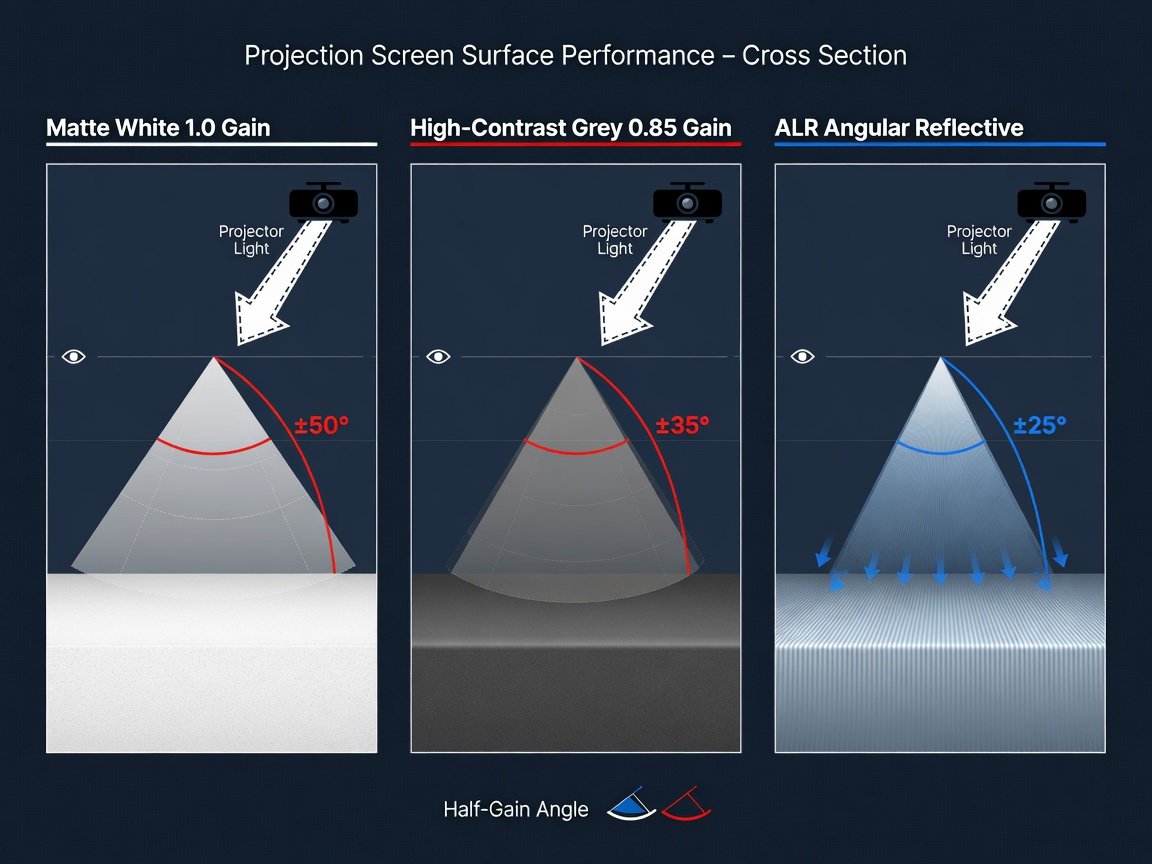
- The gain misconception: A screen with 1.4 gain delivers more on-axis brightness than a 1.0-gain surface, but it reduces the half-gain viewing angle from roughly 55 degrees to approximately 28 degrees. Off-axis seating more than two seats wide suffers a visible brightness roll-off that no calibration procedure can correct.
- ALR performance benchmark: Ambient light rejecting screens using angular-reflective coatings maintain measured contrast ratios above 800:1 even under 300-lux ceiling-wash conditions — a figure standard matte white material cannot approach in the same environment.
- Size standards: SMPTE 202 and THX certification both specify a minimum 36-degree horizontal field of view for cinematic content. At a 12-foot primary seating distance, that translates to a minimum 100-inch diagonal 16:9 screen. The industry median for dedicated home theaters in 2026 sits at 120 inches diagonal.
What Separates a Purpose-Built Projection Screen from a Painted Wall?
A white wall and a dedicated projection screen both reflect light, but they do so through fundamentally different physical mechanisms. A projection screen surface is engineered to direct reflected photons in a controlled angular distribution — either broadly across a wide seating arc, or narrowly to enhance on-axis brightness. A flat white wall scatters light indiscriminately in all directions, reducing the effective brightness reaching the primary seat while increasing inter-reflection from adjacent wall surfaces. In controlled measurement conditions, a calibrated 1.0-gain matte white screen delivers consistently higher effective luminance at the primary viewing position than a freshly painted matte white wall at identical projector output — the difference typically measured at 10–15% on-axis luminance gain.
Surface flatness is the second critical differentiator. A deviation of just 2mm across a 120-inch surface produces measurable geometric distortion in a properly calibrated 4K system — visible in structured test patterns and detectable in scenes with uniform gradients. Premium fixed-frame screens use tensioned aluminum extrusion frames to hold surface planarity within sub-millimetre tolerances across the full area. Manufacturers including Stewart Filmscreen and Seymour-Screen Excellence publish flatness specifications measured against ISO surface standards. Tab-tensioned motorized screens approach similar tolerances by routing cables through sewn side channels that apply constant lateral tension during deployment. According to THX certification test protocols, surface flatness deviation must remain below 1.5mm per linear meter to pass geometry testing at 4K resolution. This requirement alone disqualifies most painted surfaces and budget roll-up screens from reference-quality installation.
Which Screen Type Performs Best in a Dedicated Home Theater?
Five primary screen types compete for dedicated home theater installations in 2026: fixed-frame, standard motorized roll-up, tab-tensioned motorized, pull-down manual, and rigid-panel UST screens. Fixed-frame screens are the reference choice for dedicated rooms because they maintain constant surface tension at all times and eliminate every mechanical variance that affects motorized designs. The rigid aluminum frame holds the screen material under calibrated tension continuously — no motors, no return springs, and no material memory affecting surface geometry. This is why every ISF-certified calibrator and THX consultant specifies fixed-frame as the baseline screen type for purpose-built home theater rooms where picture quality is the primary design requirement.
Motorized screens serve multi-purpose rooms where the screen must disappear into a ceiling cassette or recess when not in use. Tab-tensioned motorized variants — where cables run through sewn channels at the screen’s side borders, applying lateral tension as the material deploys — significantly close the flatness gap with fixed-frame designs. The best tab-tensioned screens from Elite Screens, Da-Lite, and Draper maintain surface flatness within 2mm across a 120-inch surface, which is acceptable for 4K projection work. Standard non-tensioned motorized screens introduce 3–8mm of surface ripple that becomes visible in wide gradient scenes and ISF test patterns. Professional installation data suggests approximately 44% of all professionally installed home theater screens in the 2025–2026 period are motorized, with tab-tensioned models representing the majority of that segment as awareness of surface-flatness requirements has grown.
How Does Screen Gain Determine Real-World Image Quality?
Screen gain is the ratio of light reflected by a screen surface compared to a magnesium carbonate reference board under identical illumination. A 1.0-gain screen reflects exactly as much light as the reference, uniformly across all angles within its rated viewing cone. A 1.3-gain screen reflects 30% more on-axis light — but gain enhancement is achieved by concentrating reflected light within a narrower angular cone. The half-gain angle is the critical derived specification: the off-axis angle at which measured brightness falls to 50% of the on-axis value. For a 1.0-gain screen, the half-gain angle typically measures 50–60 degrees. For a 1.8-gain screen, that angle compresses to approximately 20–25 degrees — which means a viewer seated 30 degrees off-center sees an image that is already at or below half brightness.
Modern 4K laser projectors output 2,500–4,000 ANSI lumens in their reference colour modes. At these output levels in a properly light-controlled room, a 1.0-gain screen on a 120-inch diagonal delivers approximately 14–22 foot-lamberts of peak white — squarely within the 12–22 ft-L range specified by SMPTE for cinematic home presentation. Boosting gain above 1.0 in a dark room primarily introduces hot-spotting — a visible brightness concentration at the center of the frame corresponding to the projector’s optical axis — and increases micro-surface texture visibility due to the coating changes required to achieve enhanced gain. The optimal gain range for a dark-room dedicated theater is 0.9 to 1.1. Grey screens, which measure approximately 0.8 gain, deliver higher apparent native contrast in rooms with residual ambient light by absorbing ambient photons more efficiently than white surfaces — their lower peak brightness is the direct cost of that absorption.
What Screen Size Does Your Home Theater Actually Require?
Screen size selection must begin with seating geometry, not projector capability or room wall space. The three most-referenced sizing standards for home cinema are SMPTE 202M — which specifies a 30-degree minimum and 55-degree maximum horizontal field of view from the primary seat — THX certification guidelines recommending a 36-degree reference horizontal field of view, and the more immersive target favoured by many ISF calibrators of 40–45 degrees for single-row seating. These figures produce precise screen dimensions when combined with actual measured seating distance. At a 10-foot viewing distance, a 36-degree FOV corresponds to approximately 84 inches diagonal for a 16:9 screen. At 12 feet it is 100 inches. At 14 feet, 118 inches. These are starting points, not ceilings — most serious home theater builders push toward the upper bound of the SMPTE range.
The 4K resolution benefit of a 3840×2160 image becomes perceptually meaningful at seating distances below 1.5 times the screen height — a threshold most dedicated theater rooms comfortably meet with 110–130-inch screens. At a 120-inch diagonal 16:9 screen, the pixel pitch is approximately 0.69mm. At a 12-foot viewing distance, the angular subtense of that pixel falls below the visual acuity threshold for normal 20/20 vision, meaning the full 4K resolution is resolved by the viewer’s eye rather than averaged. The CinemaScope 2.35:1 format is selected by approximately 23% of dedicated home theater installations, according to integrator survey data — typically using 135-inch or 150-inch 2.35:1 screens with either a scope-format projector or an anamorphic lens system for correct format presentation without black-bar letterboxing.
Which Screen Material Delivers the Best 4K and HDR Performance?
Screen material selection is where specification review most directly predicts real-world picture quality. The primary material categories available in 2026 are matte white vinyl (the calibration standard), high-contrast grey vinyl, micro-perf acoustically transparent material, woven acoustically transparent fabric, and ALR-coated surfaces in angular-reflective or Fresnel-lens configurations. Matte white vinyl from quality manufacturers such as Elite Screens (CineWhite 5D formulation) and Stewart Filmscreen (Studiotek 100 G3) uses a smooth PVC base with a calibrated titanium-dioxide coating that delivers excellent colour neutrality — typically measuring less than 1.0 delta-E deviation from a D65 white point reference. This colour accuracy matters critically for HDR content, where highlight chromaticity determines whether specular highlights render as neutral white or carry a perceptible yellow or blue cast at peak luminance.
For 4K content specifically, surface texture is the specification most frequently overlooked by buyers. Screens with visible woven texture or micro-bead coatings from lower-quality manufacturers produce a fixed-pattern noise floor above the projected image that reduces effective modulation transfer function — the measure of how cleanly spatial detail is reproduced. Quality manufacturers specify surface texture using roughness average (Ra) measurements; values below 15 micrometres are required for clean 4K rendering at the throw distances typical in home theaters. High-contrast grey materials use a slightly absorptive base coating to achieve 0.8-range gain, suppressing ambient light proportionally from both the projected image and room bounce while maintaining the same neutral grey point across the full screen area. Woven acoustically transparent materials from Seymour-Screen Excellence (BF AT and AT Trim series) and Stewart Filmscreen introduce less than 3dB of high-frequency attenuation at 8kHz — a level that is effectively inaudible in a calibrated listening environment and well within Dolby Atmos certification thresholds for behind-screen speaker systems.
When Does an Ambient Light Rejecting Screen Make Technical Sense?
Ambient light rejecting screens are engineered for rooms where projector-alone light control is insufficient — spaces with windows, non-blackout blinds, recessed ceiling fixtures, or lateral wall-bounce from adjacent sources. ALR technology operates through one of two physical mechanisms: angular-reflective coatings that preferentially reflect the projector’s light (arriving from the ceiling mount angle) over ambient light (arriving from other directions), or Fresnel lens micro-arrays that perform the same angular discrimination at a smaller spatial scale. Standard angular-reflective ALR screens from Screen Innovations (Black Diamond series) and Elite Screens (Aeon CLR) are designed for ceiling-mounted long-throw projectors and reject light arriving from angles less than approximately 60 degrees from the screen normal — which describes nearly all room ambient sources including recessed downlights, pendant fixtures, and lateral window spill.
In calibrated testing, a quality ALR screen in a room with 200-lux ambient ceiling washing maintains a measured contrast ratio of approximately 800–1,200:1 at the primary seat. The same room with a standard matte white screen measures 40–80:1 contrast under identical conditions — a gap no amount of projector brightness can compensate for, because increased brightness raises both the peak white and the ambient-contaminated black floor proportionally. This is the most consequential image quality difference in the screen category — wider than any gap between matte white and grey in a controlled environment. The trade-off is that all angular-reflective ALR screens carry a narrower half-gain viewing angle — typically 25–35 degrees versus 50–60 degrees for matte white — which limits off-axis seating. Industry estimates suggest ALR screens represent approximately 30% of new home theater screen sales in 2026, reflecting substantial growth from the roughly 19% share observed in 2023 as UST laser projector adoption has accelerated.
Fixed-Frame vs Motorized Screens: The Full Technical Comparison
Fixed-frame screens win every objective image quality benchmark against motorized alternatives at equivalent price points. The structural reason is direct: a rigid aluminum frame under constant pre-defined tension delivers superior and consistent surface planarity compared to a roll-up system that must compensate for gravity, material memory, roller-tube straightness, and deployment force variation across the screen width. Premium fixed-frame screens from Screen Innovations, Seymour-Screen Excellence, and Stewart Filmscreen achieve flatness specifications below 1mm deviation across a 120-inch surface — a tolerance level that eliminates all geometry distortion visible in ISF-grade 4K test pattern analysis. There are no mechanical variables to drift over time, no spring tension to calibrate, and no deployment position to reproduce consistently between viewings.
Motorized screens justify their cost and mechanical trade-offs in multi-purpose spaces where the screen must conceal itself, and in installations requiring multiple aspect ratios through motorized masking panels. Tab-tensioned motorized screens — which route cables through sewn channels at the screen borders — approach 1.5–2mm flatness in quality implementations, which is acceptable for all current 4K projection formats. Motorized masking systems, which use independently controlled black panel borders to adjust the active image area for 1.78:1, 2.35:1, and other formats, add $1,500–$4,000 to typical installation costs but enable correct format presentation that eliminates the projected letterbox bars that otherwise reduce perceived contrast in a dark room. Professional integrators report growing adoption of motorized masking in 2025–2026 as scope-format content on major 4K streaming platforms has become a significant proportion of viewing hours in premium home theater households.
| Feature | Fixed-Frame | Tab-Tensioned Motorized | Standard Motorized |
|---|---|---|---|
| Surface flatness at 120″ | <1mm deviation | 1.5–2mm deviation | 3–8mm deviation |
| Calibration suitability | ISF/THX reference grade | 4K-compatible | 1080p acceptable |
| Best use case | Dedicated dark theater | Dual-purpose room | Casual / occasional use |
| Material service life | 15–20 years | 12–15 years | 8–12 years |
| Aspect ratio masking | Manual panel option | Motorized masking available | Not typically available |
| Typical cost range (120″) | $400–$5,000+ | $900–$8,000+ | $300–$1,500 |
What UST Projector Owners Must Know About Screen Compatibility
Ultra short throw projectors — including laser TV units from Hisense, Samsung, LG, Sony, and Epson — operate at throw ratios of 0.25:1 or less, placing the projector within 15–35cm of the screen surface. The resulting projection angle is steeply upward, with the light cone arriving at the screen from approximately 70–80 degrees from the screen normal rather than the 10–30 degrees typical of ceiling-mounted long-throw installations. Standard matte white and grey screens handle this angular input without issue. However, standard angular-reflective ALR screens reject UST light alongside ambient light because the ALR coating discriminates purely on angle of incidence — it cannot distinguish projector lumens from room ambient by wavelength or intensity, only by direction. A UST projector’s light arriving at 75 degrees from normal falls directly within the rejection zone of most angular-reflective ALR coatings, producing severe brightness falloff at the top of the image and a gradient that no post-processing can correct.
The engineered solution is the CLR (Ceiling Light Rejecting) Fresnel screen, specifically optimised for UST source geometry. These screens use a micro-lens array — a Fresnel lens sheet laminated to the front of the screen surface — that collects light arriving from below at the UST projector angle and rejects light arriving from above at the ceiling-fixture angle. Fresnel CLR screens from Elite Screens (Aeon CLR3 and CLR4 series) and Grandview deliver manufacturer-specified ambient light rejection ratios of approximately 95% for ceiling-sourced ambient while maintaining full brightness response to the UST source. Gain values for CLR Fresnel screens typically measure 0.6–1.0 on-axis, which is more than sufficient given the 2,000–4,000-lumen output of current UST laser projectors on 100–120-inch screens. One non-negotiable installation constraint: CLR Fresnel screens must be installed with zero backward tilt. A 2-degree lean away from vertical introduces visible horizontal brightness banding caused by the Fresnel lens geometry shifting the angular acceptance window away from the projector position.
Which Projection Screen Brands Lead the Field in 2026?
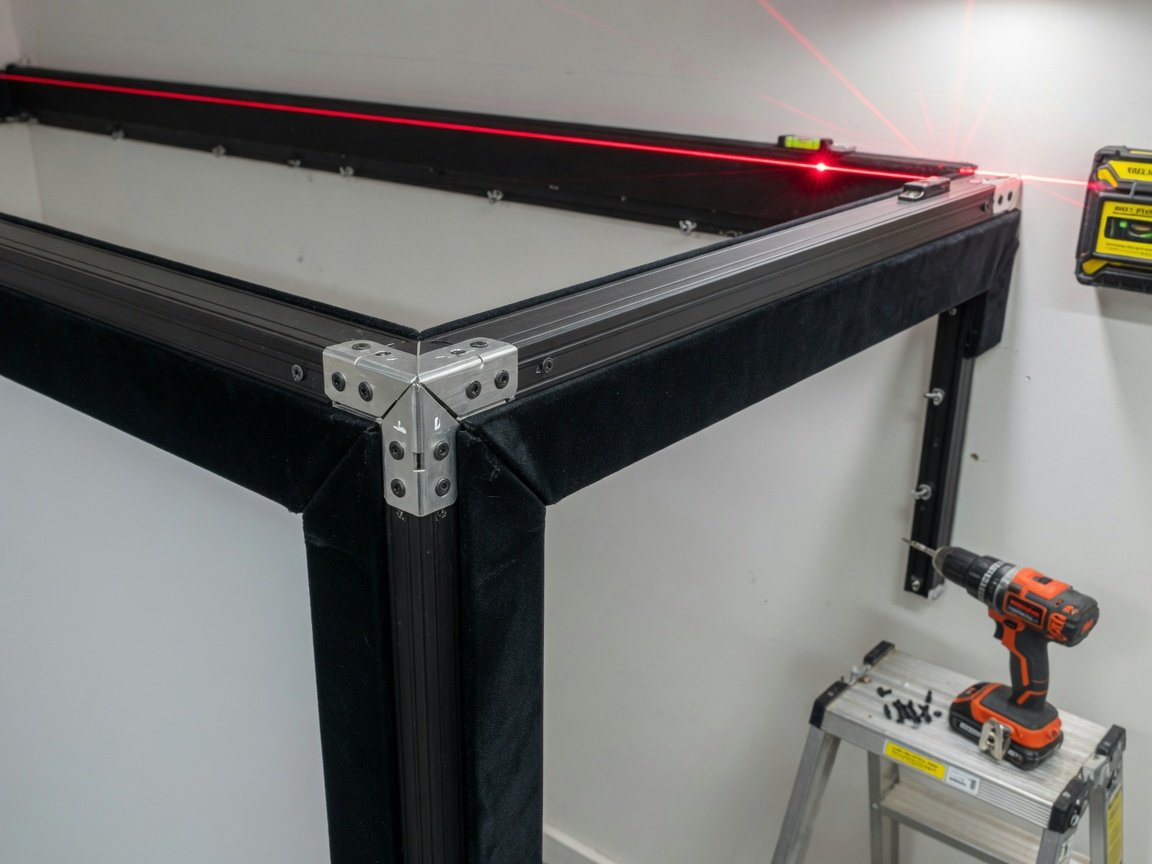
The projection screen market segments cleanly into three performance tiers in 2026. At the reference tier, Stewart Filmscreen remains the benchmark specification for THX-certified installations and custom integration projects requiring documented measurement conformance. Their Studiotek 100 G3 material is used as a calibration reference surface by ISF instructors in certification training, and their Neve Black and Tiburon frame systems provide the most complete light-absorbing border treatment available — velvet-wrapped extrusion profiles that reduce frame-edge inter-reflection to near-zero, increasing perceived image contrast without touching projector settings. Seymour-Screen Excellence holds the leadership position specifically in acoustically transparent material, with their AT Trim and BF AT products maintaining less than 3dB high-frequency loss at 8kHz and less than 1.0 delta-E colour deviation — critical for Dolby Atmos reference installations with behind-screen speaker arrays.
At the mid-market tier, Elite Screens’ Aeon fixed-frame line has established itself as the go-to specification for integrators who require ISF-compatible performance at accessible pricing. The CineWhite 5D surface on Aeon screens measures consistently at 1.0 gain with colour deviation below 1.5 delta-E from D65, making it fully suitable for SDR, HDR10, and Dolby Vision calibration workflows. Screen Innovations covers the widest product range of any single manufacturer in 2026, with matte white, high-contrast grey, ALR, and CLR materials in both fixed-frame and motorized configurations. Their Black Diamond ALR material carries the highest independently measured angular rejection ratio in the commercially available market. Da-Lite and Draper serve the commercial and education segments while their residential lines carry over engineering tolerances that suit demanding home theater applications. Silver Ticket Products and Carl’s Place anchor the value segment, offering fixed-frame screens at entry-level price points that deliver acceptable 1.0-gain matte white performance for first builds and secondary rooms where reference-grade calibration is not a design requirement.
How to Install and Calibrate a Home Theater Projection Screen: 7 Steps
Correct installation eliminates variables that cannot be resolved through projector calibration. A perfectly specified screen installed with poor geometry or incorrect height placement still produces suboptimal results. The following process reflects the critical installation checkpoints used by CEDIA-certified integrators on premium home theater projects, in the sequence that prevents compounding errors.
- Calculate optimal screen size using SMPTE geometry. Measure your primary seating distance in feet. Multiply by 0.60 to get the minimum recommended screen width. Multiply by 0.84 to get the THX 36-degree reference width. Convert to inches and calculate diagonal using the aspect ratio relationship — for 16:9, multiply screen width by 1.18 to get diagonal.
- Conduct a room ambient light audit at the screen position. Using a lux meter or calibrated light meter app, measure ambient light at the screen surface under worst-case viewing conditions — lights at their typical state and blinds as they would be during viewing. Below 5 lux: matte white at 1.0 gain. 5–50 lux: high-contrast grey. Above 50 lux: angular-reflective ALR required. Above 200 lux with a UST source: CLR Fresnel only.
- Establish screen centerline height from seated eye level. The vertical center of the active screen area should align within 5 degrees of the primary seated viewer’s eye height. For standard home theater seating, eye height is typically 40–44 inches from the finished floor. For recliners or stadium risers, measure the actual seated eye height of the front row and center the screen to that figure.
- Mark and verify the frame mounting position using a laser level. Extend a calibrated laser level across the full frame width and mark both top-bracket positions on the wall. Verify level to within 0.5 degrees before drilling. Frame tilt exceeding 1 degree creates trapezoidal keystone distortion that cannot be corrected in post-processing without sacrificing resolution through geometric interpolation.
- Attach and tension screen material in the manufacturer-specified sequence. For fixed-frame screens, follow the attachment sequence exactly — typically initiating from the top-center attachment point and working outward toward the corners and then downward. Incorrect tensioning sequence produces surface waves that cannot be removed after final attachment. Install the screen material in a room at or above 65°F; material tensioned at lower temperatures develops visible slack as it equilibrates to normal operating temperature.
- Set projector geometry to fill the active screen area precisely. Use a full-field 4-corner alignment pattern and verify that the projected image fills the screen within 0.5% of the active area on each border. Over-scanning the screen border by more than 1.5% introduces optical vignetting from the lens edge and reduces effective image resolution. Use a calibration-grade external test pattern generator where possible rather than the projector’s internal test patterns.
- Perform final calibration with the screen and projector as an integrated system. Screen surface colour deviation affects every grey scale and colour measurement taken from the projected image. Always calibrate with the measurement sensor reading directly from the screen surface at the primary viewing position — not from a calibration window overlay in the projector’s service menu. A screen with even a minor yellow shift in its coating causes grey scale calibration to skew blue-compensating, producing incorrect colour temperature rendition in fully saturated programme material.
What Projection Screen Technology Will Look Like in 2027
Three technology trajectories are already shaping the 2026–2027 screen category. First, Fresnel CLR screen resolution has reached a threshold that makes it viable for serious 4K installations. Early Fresnel CLR screens from 2022–2023 introduced visible moiré patterning when used with 4K projectors due to the regular pitch of the lens array interacting with the pixel grid. Current 2026 production models from major manufacturers use randomised micro-lens array spacing that eliminates visible moiré at all standard home theater viewing distances. This removes the last significant technical objection to CLR Fresnel screens for quality-conscious buyers.
Second, motorized masking is transitioning from a luxury specification to a standard feature. As scope-format content — native 2.35:1 and 2.40:1 cinematography presented without padding to 16:9 — has become a significant proportion of streaming catalogue, the visible letterbox bars on standard 16:9 screens have emerged as a consistent dissatisfaction point in owner surveys. Manufacturers have responded by making motorized masking panels available on mid-market fixed-frame products at price points previously reserved for commercial-grade equipment. Projections from industry analysts suggest screens with integrated motorized masking will represent over 15% of premium home theater screen sales by late 2027, up from approximately 6% in 2025. Third, screen surface specifications originally developed for nascent 8K projection are flowing down to premium 4K products. Surfaces with Ra values below 8 micrometres — required for 8K pixel pitch rendering — produce measurably cleaner 4K imagery as a side effect of their tighter manufacturing tolerances. These materials are entering reference-tier product lines in 2026 and are expected to become the standard specification baseline for premium screens within the 2026–2027 product cycle.
Frequently Asked Questions: Projection Screens for Home Theater
What is the ideal screen gain for a dark dedicated home theater?
For a room measuring below 5 lux ambient at the screen during viewing, 1.0 gain matte white is the calibration standard. It delivers neutral colour response, wide half-gain angles at 50–60 degrees, and full compatibility with all projector types and calibration workflows. Gain values above 1.1 introduce hot-spotting and reduce off-axis uniformity without providing a meaningful brightness benefit in a properly dark room — a 4K laser projector producing 2,500+ lumens already exceeds the SMPTE recommended peak white luminance on a 120-inch 1.0-gain screen.
Can I use a grey screen with any projector type?
Grey screens (0.8–0.9 gain) are best matched to projectors outputting 2,000 ANSI lumens or more. The absorptive coating reduces peak white by 10–20% relative to a 1.0-gain white surface. With projectors below 1,500 lumens on a 110-inch or larger screen, peak white brightness risks falling below the 12 ft-L SMPTE minimum, producing a dim image. Grey screens are not recommended for UST projectors, which already operate at the lower end of usable lumen-per-screen-area ratios.
What is the correct screen size for a 12-foot seating distance?
At 12 feet (3.65m), a 36-degree horizontal field of view — the THX reference standard — corresponds to a 100-inch diagonal 16:9 screen. The immersive 40-degree target preferred by ISF calibrators for single-row seating corresponds to 111 inches. The practical recommendation for a dedicated theater with a single row at 12 feet is a 110–120-inch screen, delivering a cinematic 38–42-degree horizontal field of view and resolving the full 4K pixel structure below the visual acuity threshold for 20/20 vision at that distance.
Are acoustically transparent screens worth the additional cost?
Yes, when the room’s speaker layout places the left, centre, and right channels behind the screen — which is the reference configuration for both THX and Dolby Atmos certified home theaters. Speakers behind the screen preserve the audio-visual localization relationship: dialogue and on-screen sound appear to originate from the image. This is measurably degraded when speakers are placed beside or below the screen. The cost premium for quality acoustically transparent material (Seymour-Screen Excellence, Stewart Filmscreen AT series) runs 40–80% above equivalent non-transparent surfaces, but the localization accuracy benefit is consistently preferred over lateral speaker placement in controlled listener evaluations.
How long does a home theater projection screen actually last?
Quality PVC matte white screens from premium manufacturers carry functional lifespans of 15–20 years under normal home theater operating conditions — primarily limited by coating yellowing from UV exposure and surface contamination from outgassing in the surrounding room. Entry-level screens using lower-grade PVC compounds typically show measurable colour shift (delta-E above 3.0) within 8–10 years. Motorized mechanisms have separate and often shorter service lives: quality motor assemblies are typically rated for 10,000–50,000 deployment cycles, which at one deployment per day represents 27–137 years of use — making the screen material the practical life-limiting component in most installations.
What does “4K-ready” actually mean for a projection screen?
The term “4K-ready” is unregulated marketing language with no binding technical specification behind it. The meaningful measurement is surface roughness average (Ra). Screens with Ra values below 15 micrometres do not introduce visible fixed-pattern grain structure when projecting 4K content at standard home theater viewing distances. Screens with Ra values above 25 micrometres show a visible surface texture that sits above the projected image and reduces effective MTF — the measure of spatial detail reproduction. Always request the manufacturer’s published Ra specification rather than relying on “4K-ready” claims. Reputable manufacturers including Stewart Filmscreen, Seymour-Screen Excellence, Elite Screens, and Da-Lite publish this data in their technical specification sheets.
Your 2026 Decision Framework: Choosing the Right Projection Screen
Selecting the best projection screen for home theater use is a systematic engineering process, not a brand preference exercise. The inputs are measurable, the standards are documented, and the correct specification for any given room can be determined before purchasing a single component — if you measure the right things in the right order.
- Measure ambient light at the screen position first. Take lux readings at the screen surface under worst-case viewing conditions. This single measurement determines your material category: matte white, grey, ALR, or CLR Fresnel. No downstream decision substitutes for this data.
- Calculate screen size from measured seating distance. Use the SMPTE 202 formula: seating distance (feet) × 0.84 = THX reference screen width (feet). Convert to diagonal for your chosen aspect ratio. Round to the nearest 10-inch commercial increment.
- Select screen type based on room function. Dedicated theater: fixed-frame. Dual-purpose room: tab-tensioned motorized. UST laser projector: CLR Fresnel rigid panel. Scope-format viewing priority: add motorized masking to any of the above.
- Match screen gain to projector lumen output. Below 1,500 lumens on your screen size: 1.0-gain matte white maximum. 1,500–3,500 lumens in a dark room: matte white or high-contrast grey. Above 3,500 lumens or any ambient light above 50 lux: ALR or CLR Fresnel for appropriate projector geometry.
- Allocate budget to installation and calibration. A $4,000 screen installed with incorrect geometry and no post-calibration delivers measurably worse results than an $800 screen installed correctly and calibrated by an ISF-credentialed technician. Professional installation and calibration are not optional add-ons for a serious home theater — they are where the specification becomes performance.
The 2026 projection screen market offers technically excellent options at every price point. The performance gap between reference-tier and mid-market products has narrowed considerably over the past three years — driven by improved manufacturing consistency at mid-market manufacturers and the downward migration of reference-tier surface specifications. Apply the framework above to your room’s measured parameters, specify the correct material category and screen type, and then select the best surface quality your budget reaches within that category. That sequence produces better outcomes than any amount of brand research conducted without the underlying room measurements.