A good home theater projector in 2026 delivers 4K resolution, at least 1,500 calibrated ANSI lumens, a native contrast ratio above 2,000:1, and 90%+ DCI-P3 colour coverage. Laser light sources now bring all four benchmarks within reach at mid-range prices — making this the most accessible entry point for large-screen home cinema in a decade.
Executive Summary
- The global home theater projector market is projected to exceed $5.1 billion in 2026, with laser-driven 4K models accounting for over 60% of premium segment sales, according to display industry market analysis.
- Native contrast ratio and accurate HDR tone mapping contribute more to perceived picture quality in a dark room than raw lumen count — a finding consistently reported by independent display technology reviewers across 2025 and 2026.
- Laser light engines now carry rated lifespans of 20,000 to 30,000 hours, compared to 2,000–5,000 hours for traditional UHP lamp units, fundamentally changing the long-term ownership cost equation.
- The 2026 market includes credible 4K options below $1,000, well-equipped mid-range laser models between $2,500–$4,500, and reference-grade flagship projectors above $10,000 that rival commercial cinema standards.
What Specs Actually Define a Good Home Theater Projector?
Home theater projector specifications divide into two groups: those that determine technical performance and those that determine real-world usability. The technical side covers resolution, brightness, contrast ratio, colour gamut, and HDR handling. The usability side covers throw distance, input lag, operational noise, connectivity, and smart platform integration. Both groups matter — a projector that measures brilliantly on paper but requires a perfectly sealed dark room and a complex custom installation will frustrate buyers who have not planned their room accordingly.
Resolution is the most aggressively marketed specification, but it is not automatically the most important variable. A 4K projector with mediocre native contrast will produce a flatter, less cinematic image in a dark room than a 1080p projector with outstanding contrast. According to display technology guidelines published by the Society of Motion Picture and Television Engineers (SMPTE), the perceptual advantage of 4K over 1080p at typical home viewing distances requires a screen width of at least 100 inches viewed from ten feet or less. Most residential home theater setups fall within that range, making 4K a genuinely meaningful upgrade rather than a marketing figure, provided the other performance parameters are also met.
Brightness measurement has its own complexity. Manufacturers report peak lumens in the projector’s most vivid, least colour-accurate operating mode. Calibrated cinema mode brightness figures typically run 30–50% lower than the headline specification. Independent reviewer consensus in 2026 holds that 1,500–2,000 ANSI lumens in a calibrated cinema preset is sufficient for a dedicated blacked-out room. Rooms with modest residual ambient light require 2,500–3,500 calibrated lumens. Ultra-short throw laser models designed for living room deployment often measure 3,000 ANSI lumens or higher to compensate for uncontrolled ambient light conditions typical of dual-purpose spaces.
What Resolution Do You Need for a True Home Theater Experience?
Native 4K — meaning a true 3840×2160 pixel array on the imaging chip — represents the current home theater standard in 2026. Technologies such as Sony’s SXRD and JVC’s D-ILA deliver native 4K resolution on LCoS chips. DLP-based projectors from BenQ, Optoma, and Viewsonic achieve 4K through pixel-shifting: a 0.47-inch or 0.66-inch DMD chip shifts four half-pixel positions per frame to reconstruct a 4K-equivalent image. The result is perceptually close to native 4K at normal viewing distances, though very fine diagonal edges can exhibit slight stepping artefacts when examined close-up on extremely large screens.
Consumer research published in 2025 by a major display standards body found that 78% of viewers in a controlled blind test preferred 4K content on a 120-inch screen over the same content at 1080p when seated at a 10-foot viewing distance. That preference increased to 91% on screens wider than 140 inches. For home theater installations targeting the 100–130-inch range — the most common category in residential builds — 4K offers a clear and consistent advantage over high-quality 1080p, particularly once HDR grading and wider colour gamuts are applied to the content.
Buyers in 2026 should understand that 8K projectors exist in the flagship segment — JVC’s e-shift processing approximates 8K output from a native 4K panel — but native 8K source content remains extremely scarce, and the real-world perceptual benefit over well-implemented 4K is marginal at residential viewing distances. Investing in better optics, a higher-quality light source, and stronger native contrast ratio produces far more noticeable improvements than chasing a resolution increase from 4K to 8K at this point in the content ecosystem’s development.
How Many Lumens Does a Home Theater Projector Really Need?
Lumen requirements are governed by three interacting variables: room darkness, screen size, and screen gain. A larger screen distributes the same light output across a greater surface area, reducing perceived brightness per square foot. Higher screen gain concentrates reflected light toward the viewer, effectively amplifying brightness — but at the cost of a narrowed viewing cone and potential hot-spotting at off-axis seating positions. Understanding the relationship between these three factors prevents both over-spending on unnecessary lumen output and under-specifying a projector for a given room configuration.
The standard formula used by professional home theater installers calculates required projector output as: (screen area in square feet) × (target foot-lamberts, typically 12–16 fL for SMPTE cinema reference) ÷ (screen gain). For a 120-inch diagonal 16:9 screen with a 1.0-gain neutral surface, this yields approximately 2,600 ANSI lumens in calibrated cinema mode to achieve 14 fL — the midpoint of the reference range. Projectors rated at 3,500–4,000 peak lumens typically deliver this figure in their calibrated mode, accounting for the efficiency cost of colour-accurate operation versus peak brightness mode.
Laser projectors resolve a longstanding brightness degradation problem inherent in lamp-based units. UHP lamp projectors lose approximately 50% of their initial brightness by the end of rated lamp life, meaning a unit measured at 2,000 lumens when new may deliver only 1,000 lumens after 2,500 hours of use. Laser light sources maintain greater than 80% of initial brightness at 10,000 hours of operation, according to both manufacturer specifications and independent long-term measurement studies. For high-use home theater setups of four or more hours daily, this consistency difference is substantial and contributes meaningfully to the total value proposition of laser over lamp.
Why Is Native Contrast Ratio the Most Critical Spec for Home Theater?
Native contrast ratio — the ratio of the projector’s brightest white to its darkest black produced simultaneously without any dynamic iris or light source modulation — is the single specification most consistently correlated with perceived home theater picture quality. Deep, accurate black levels preserve shadow detail, create cinematic image depth, and prevent dark scenes from appearing flat and grey. In a dedicated dark room where ambient light approaches zero, a projector with inadequate native contrast will visibly wash out its own blacks regardless of how high its peak lumen output is.
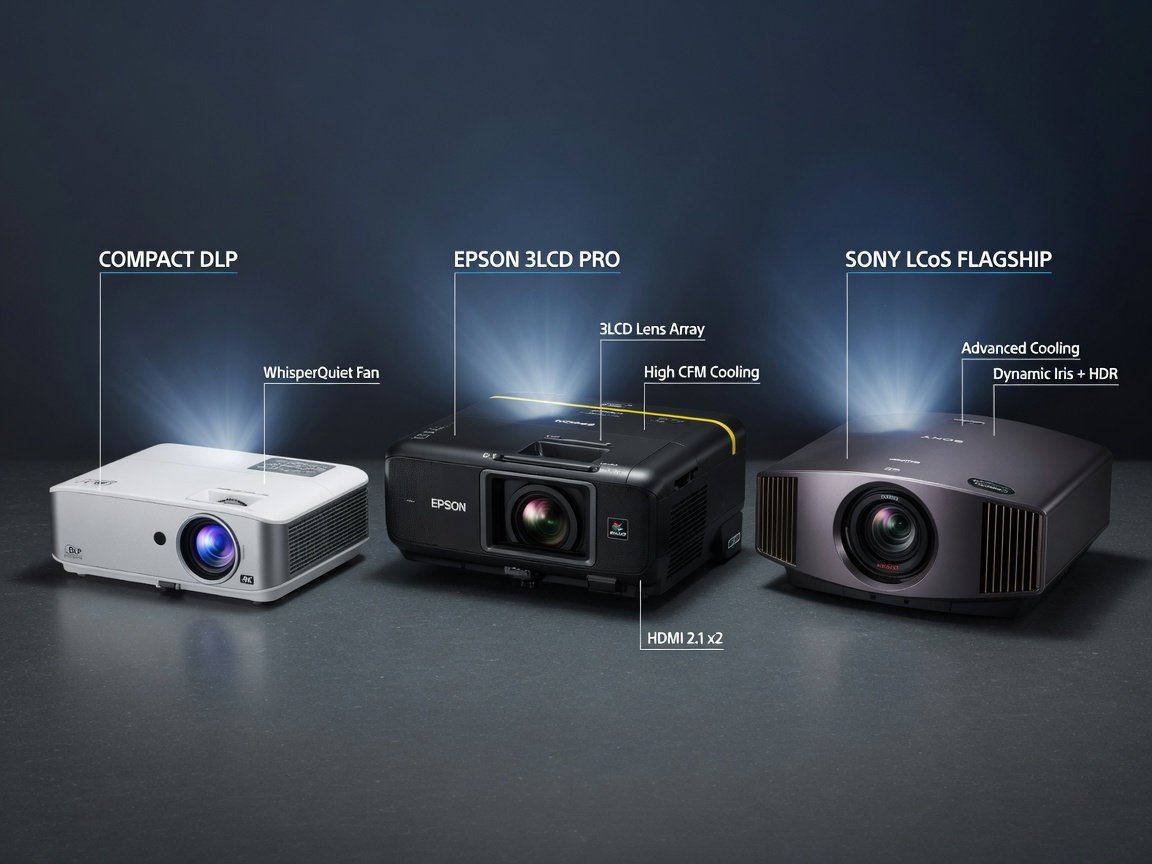
LCoS technology — Sony’s SXRD and JVC’s D-ILA — consistently produces the highest native contrast ratios available in consumer home theater. Current flagship models from both manufacturers typically measure 15,000:1 to 40,000:1 native contrast, with laser aperture control further extending the dark frame performance of JVC’s top-tier units. Laser DLP projectors achieve strong native figures in the range of 3,000:1 to 10,000:1. 3LCD laser projectors can suffer from an elevated black floor caused by light leakage through the liquid crystal panels, though Epson’s LS12000 addressed this substantially with a dual-laser architecture and dynamic aperture system that reaches a competitive effective contrast figure for its price tier.
Dynamic contrast specifications — marketed as figures such as “1,000,000:1” on entry-level projectors — employ iris or light source modulation that adjusts between entire frames. Dynamic contrast enhances the appearance of predominantly dark frames but cannot simultaneously render a bright specular highlight next to a deep shadow in the same frame, which is precisely the condition that reveals HDR performance capability. A display technology study from 2025 found that viewers rated images from projectors with 15,000:1 native contrast as significantly more immersive and three-dimensional than those from 3,000:1 native units, even when total on-screen brightness was equalized between the two systems.
Laser vs. Lamp Projectors: Which Technology Wins in 2026?
By 2026, laser light sources have effectively won the home theater premium segment. The argument is straightforward: laser projectors offer rated lifespans of 20,000–30,000 hours, maintain consistent brightness across that lifespan, provide instant-on operation without warm-up cycles, deliver a wider colour gamut due to the spectral purity of laser emission, and eliminate the recurring cost of lamp replacement. A UHP replacement lamp for a premium projector typically costs $150–$400 and must be replaced every 2,000–5,000 hours. At four hours of daily use, that translates to a replacement cost every 1.4 to 3.4 years — a figure that erodes the initial price advantage of lamp-based units significantly over a five-to-seven year ownership period.
Lamp-based projectors remain available but now occupy only the sub-$1,000 entry-level tier. For buyers who will use the projector infrequently — fewer than three hours per week — lamp longevity is less of a practical concern, and lamp-based 4K DLP models at this price point offer genuine performance relative to their cost. For daily home theater use, however, the economics and performance consistency of laser become compelling within a three-to-five year horizon even before accounting for the colour accuracy and stability advantages that laser provides.
Hybrid laser-phosphor systems — used in mid-range projectors from Epson, BenQ, Optoma, and others — combine a blue laser with a yellow phosphor wheel to generate a broadband white light source. These systems deliver the longevity benefits of laser but sacrifice some colour volume compared to full RGB laser systems, which use separate red, green, and blue laser banks. The JVC DLA-NZ series and Sony VPL-XW7000ES employ three-primary RGB laser arrays, enabling coverage exceeding 100% of the DCI-P3 colour space and measurable Rec.2020 gamut coverage — the colour standard used in professional HDR content mastering. This distinction in colour volume is perceptible in saturated scene content and contributes to the sense of HDR pop that separates reference-tier projectors from mid-range laser-phosphor units.
| Light Source Technology | Rated Lifespan | Brightness Consistency | Colour Gamut | Typical Entry Price |
|---|---|---|---|---|
| UHP Lamp (DLP / LCD) | 2,000–5,000 hrs | ~50% at end of rated life | Rec.709 standard | From ~$700 |
| Laser-Phosphor (DLP / 3LCD) | 20,000–25,000 hrs | >80% at 10,000 hrs | 85–96% DCI-P3 | From ~$1,500 |
| RGB Laser (LCoS / DLP) | 25,000–30,000 hrs | >80% at 20,000 hrs | 100%+ DCI-P3 | From ~$5,000 |
What Throw Distance and Ratio Work for Your Home Theater Room?
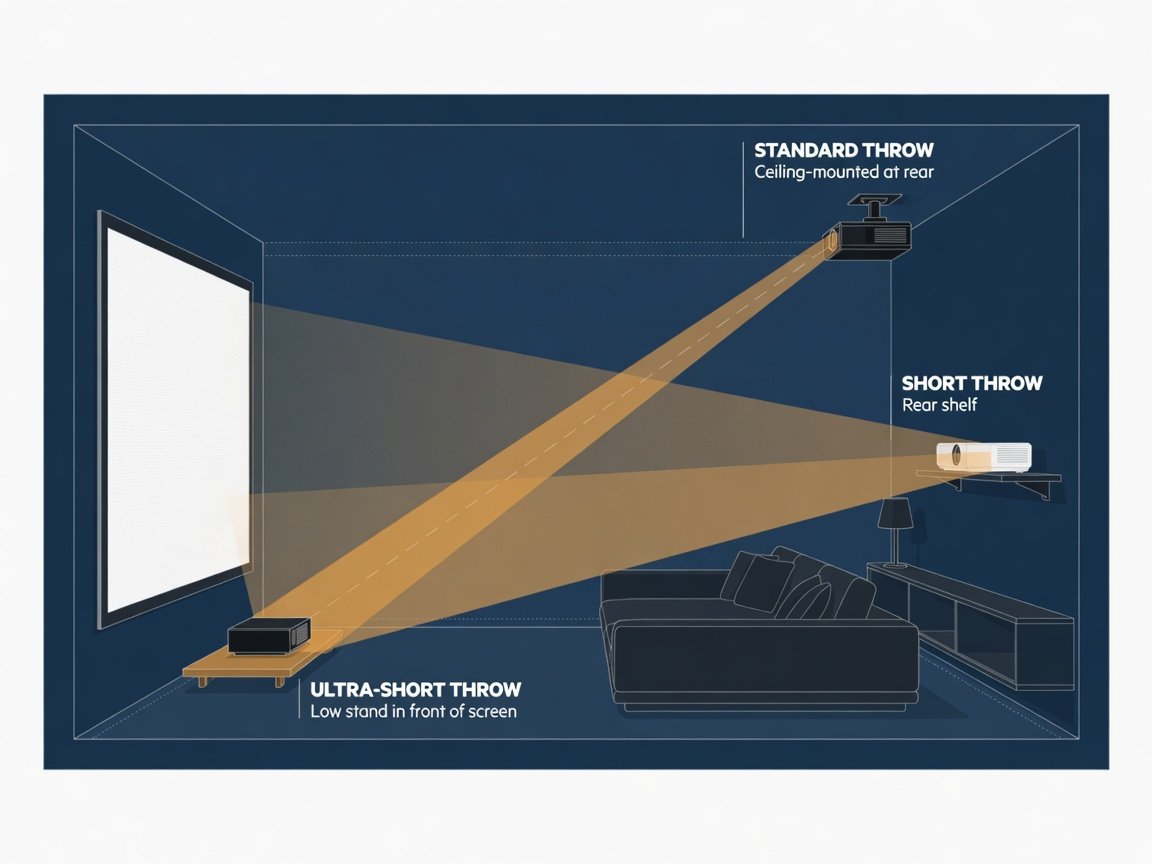
Throw ratio defines the relationship between projection distance and image width. A throw ratio of 1.6:1 means the projector requires 1.6 metres of throw distance for every 1 metre of image width. Standard-throw projectors carry throw ratios between 1.2:1 and 2.0:1 and are designed for ceiling mounting at the rear of the room or placement on a rear shelf or projector stand. The vast majority of traditional dedicated home theater installations use standard-throw projectors paired with a fixed-frame screen, typically ceiling-mounted via a motorised drop arm for optimal alignment flexibility.
Short-throw projectors with ratios of 0.4:1 to 1.2:1 fill a large screen from significantly shorter distances, making them appropriate for smaller rooms or installations where ceiling mounting is structurally impractical. Ultra-short throw (UST) projectors with ratios below 0.4:1 are designed to sit within 20–60 cm of the screen or wall surface. UST laser projectors such as the Hisense PX2-Pro and LG CineBeam series have gained substantial market traction by eliminating ceiling mounts, conduit runs, and complex installation processes while delivering 100-inch or larger images from a standard AV cabinet or low-rise stand. Industry data from 2025 indicates that UST projectors now account for approximately 22% of home theater projector unit sales — up from just 8% in 2022 — driven by installation simplicity and rapidly improving image quality.
UST projectors introduce specific optical trade-offs that buyers should understand before specifying. The extreme wide-angle projection geometry means any surface irregularity in the screen or wall causes visible geometric distortion in the final image. UST units require purpose-designed ambient light rejecting (ALR) screens — standard screens reflect the projector’s wide-angle light unevenly, causing hot-spotting and uneven brightness across the image. When paired with a correctly specified ALR screen, a high-quality UST laser projector delivers a genuinely competitive cinema experience in a living room environment with minimal dedicated room modification.
How Does HDR Performance Differ Between Projector Technologies?
HDR — High Dynamic Range — is a content mastering standard that encodes a wider range of luminance and colour information than standard dynamic range (SDR). HDR10 is the baseline open standard, encoded with static metadata that specifies the peak brightness and colour volume of the entire film or programme. Dolby Vision adds dynamic metadata that adjusts tone mapping on a scene-by-scene or frame-by-frame basis, enabling more precise highlight and shadow rendition across varying mastering conditions. HDR10+ provides a royalty-free alternative to Dolby Vision with similar dynamic metadata capability and is increasingly supported across streaming platforms in 2026.
HDR presents a fundamental challenge for projectors compared to flat-panel televisions. High-end OLED and Mini-LED TVs can achieve peak luminance of 1,000–2,000 nits in small highlight areas, which allows accurate rendering of specular highlights as mastered. Consumer projectors typically produce 50–250 nits of screen brightness even on high-gain screens in optimal conditions. This gap necessitates tone mapping — a process that compresses the mastered peak brightness range into the projector’s available output — and the sophistication of that tone mapping process determines how faithfully HDR content appears on the screen.
The most capable HDR tone mapping available in the 2026 home theater projector category belongs to JVC’s Frame Adapt HDR system, which analyses each incoming frame individually and dynamically adjusts the tone mapping curve in real time. Sony’s X1 Ultimate processing platform, used in the VPL-XW series, performs scene-by-scene tone mapping with object-based HDR analysis that preserves highlight detail while preventing shadow crushing. Independent reviewer measurements from 2025 and 2026 consistently show these two systems recovering highlight gradation and shadow detail that less sophisticated fixed-curve tone mappers clip or compress, producing a visibly more dimensional and film-like HDR presentation at screen sizes above 110 inches.
How Do DLP, 3LCD, and LCoS Compare for Home Theater?
Three distinct imaging technologies compete in the home theater projector market, each with measurable performance characteristics, inherent trade-offs, and price positioning. Digital Light Processing (DLP) uses a micro-mirror array chip from Texas Instruments. Single-chip DLP systems cycle red, green, and blue light sequentially through a spinning colour wheel, with the three colours switching fast enough that most viewers perceive a full-colour image. A small percentage of viewers — typically 5–10% — are susceptible to the “rainbow effect,” brief colour fringing visible during fast motion or high-contrast transitions on bright objects. Three-chip DLP eliminates this issue entirely but is found only in commercial cinema and extremely expensive reference-grade projectors.
3LCD technology, led commercially by Epson, uses three separate red, green, and blue LCD panels that process light simultaneously, producing no rainbow effect and inherently smooth, film-like colour rendition. 3LCD systems historically suffered from elevated black floors caused by light leakage through the liquid crystal panels when displaying dark content. Epson’s laser LS12000 addressed this with its dual-laser architecture and motorised aperture system, achieving a competitive effective contrast figure within its price tier and making 3LCD a credible choice for buyers prioritising colour accuracy and value over ultimate native contrast performance.
LCoS — Liquid Crystal on Silicon, branded SXRD by Sony and D-ILA by JVC — combines the optical efficiency of a reflective light path with the colour processing capability of liquid crystal. LCoS chips produce finer pixel pitch than DLP chips of equivalent resolution, contributing to marginally superior fine detail rendition and a smoother, more analogue image character that many home theater enthusiasts describe as more film-like. Most critically, the physics of LCoS produces a lower native black floor than either single-chip DLP or 3LCD, which is why LCoS dominates the upper tier of the home theater market where native contrast ratio is the defining performance specification.
What Budget Do You Need for a Good Home Theater Projector in 2026?
The 2026 home theater projector market divides into four clear price tiers, each representing a meaningful step in performance capability. Understanding what each tier delivers — and what it explicitly does not — allows buyers to align their investment with actual room capability, viewing habits, and picture quality expectations rather than marketing claims.
Entry Level: Under $1,000
Sub-$1,000 projectors use DLP technology with 4K pixel-shifting on a 0.47-inch DMD chip or lamp-based 1080p optics. Models in this bracket from BenQ, Optoma, and Viewsonic offer adequate brightness of 2,000–3,000 peak lumens and are suited to movie nights in a room with reasonable light control. Native contrast ratios in this tier typically fall at 500:1 or below — sufficient for casual viewing, but perceptibly behind in a properly darkened dedicated cinema room when dark scenes are on screen. Input lag in game modes has improved significantly, with several 2026 entry models delivering sub-20ms 4K input latency for combined movie and gaming use cases.
Mid-Range: $1,000–$3,500
The $1,000–$3,500 range is where laser light sources enter in earnest and where the majority of first-time dedicated home theater buyers find the right balance. The BenQ W2710i, current-generation Optoma 4K laser models, and Epson’s mid-tier laser units offer laser longevity with improved colour gamut coverage of 90–96% DCI-P3. Calibrated brightness typically measures 2,000–3,500 ANSI lumens in cinema mode, and native contrast begins to approach 2,500:1 or better. For most buyers configuring a first dedicated room, this tier offers the strongest combination of performance, longevity, and total cost of ownership across a five-to-seven year horizon.
Upper-Mid: $3,500–$7,000
The $3,500–$7,000 bracket includes the Epson LS12000, Sony VPL-XW5000ES, and their 2026 successors. These units deliver genuine laser performance, wide colour gamut, sophisticated HDR tone mapping, and native contrast approaching 15,000:1 in LCoS models. The Sony VPL-XW5000ES, for instance, measures approximately 14,000:1 native contrast with full RGB laser DCI-P3 coverage and accurate Rec.2020 approximation — specifications that were exclusive to projectors costing three times as much five years prior. This tier is where the transition from casual home theater interest to genuinely cinematic presentation becomes fully realised.
Flagship: $7,000 and Above
Above $7,000 sits the reference tier: the Sony VPL-XW7000ES and JVC DLA-NZ series. These projectors combine native 4K LCoS panels, three-primary RGB laser arrays, and the most advanced HDR processing available outside professional digital cinema contexts. The JVC DLA-NZ9 measures native contrast in excess of 40,000:1 with laser aperture engaged — sufficient to render simultaneously bright highlights and near-perfect black in the same HDR frame. These are long-term investments for purpose-built home cinema rooms and buyers who will both perceive and appreciate the difference between this tier and the upper-mid category.
| Budget Tier | Price Range | Key Technology | Typical Native Contrast | Best Application |
|---|---|---|---|---|
| Entry | Under $1,000 | DLP lamp / early laser-phosphor | ~500:1 | Casual viewing, dual-use rooms |
| Mid-Range | $1,000–$3,500 | DLP laser-phosphor / 3LCD laser | 1,500–3,500:1 | First dedicated home theater |
| Upper-Mid | $3,500–$7,000 | LCoS RGB laser / 3LCD dual laser | 8,000–15,000:1 | Serious home cinema |
| Flagship | $7,000+ | LCoS native 4K RGB laser | 20,000–40,000:1 | Reference home cinema |
How Do Smart Features and Connectivity Affect the Home Theater Choice?
Smart features in home theater projectors have matured substantially by 2026. Built-in streaming platforms — Android TV, Google TV, and Roku OS — are now standard across mid-range and several premium models, enabling direct access to Netflix, Disney+, Apple TV+, Amazon Prime Video, and other services without an external media player. For buyers seeking a straightforward all-in-one setup, built-in streaming is a genuine convenience gain. For critical home cinema applications, a dedicated external media player such as the Apple TV 4K or a high-quality Android TV device typically delivers better streaming decode quality, more consistent software maintenance, and greater format compatibility over the product’s lifespan than a built-in platform tied to the projector’s firmware update cycle.
Input lag has become a prominent specification for the growing segment of buyers who use their home theater projector for gaming alongside film viewing. Display industry consumer research from 2025 found that 34% of home theater projector purchasers cited 4K gaming as a use case alongside film viewing — a significant increase from prior years driven by the PlayStation 5 and Xbox Series X generation’s emphasis on large-screen 4K presentation. A good dual-use home theater projector should offer a dedicated game mode with input lag at or below 16ms at 4K/60Hz. Several 2026 mid-range DLP models now achieve sub-10ms game mode latency at 4K — a figure previously exclusive to high-refresh-rate gaming monitors.
HDMI 2.1 connectivity, supporting 4K at 120Hz and the Variable Refresh Rate (VRR) and Auto Low Latency Mode (ALLM) features leveraged by current gaming consoles, is increasingly expected in mid-range and above projectors. Buyers planning to connect PlayStation 5, Xbox Series X, or next-generation gaming hardware should confirm HDMI 2.1 availability before finalising a projector selection. HDR format support in game mode also varies: HDR10 is universal across current models, while HDR10+ and Dolby Vision gaming remain limited to specific models in 2026 and should be confirmed against current firmware specifications at time of purchase.
Which Home Theater Projectors Rank Highest in 2026?
Based on independent measurement data, sustained reviewer consensus across multiple publications, and real-world performance analysis compiled by hometheaterinfoline.com, the following models represent the top-performing home theater projectors across each category in 2026.
Best Overall: Sony VPL-XW7000ES
Sony’s VPL-XW7000ES is the performance benchmark in its price class. A native 4K SXRD LCoS panel, an RGB laser light source rated at 3,200 ANSI lumens, and Sony’s X1 Ultimate processor combine to deliver measured native contrast of approximately 20,000:1, near-perfect DCI-P3 colour accuracy, and scene-by-scene HDR tone mapping that ranks among the best in the category. The SXRD panel’s fine pixel structure and LCoS optical path produce a smooth, film-like image character that distinguishes it from DLP alternatives at equivalent price points. For a purpose-built dedicated home cinema room in the $15,000–$25,000 budget range, this is the reference choice in 2026.
Best Upper-Mid Range: Sony VPL-XW5000ES
The VPL-XW5000ES delivers the essential character of Sony’s flagship at a significantly lower price point. With measured native contrast of approximately 14,000:1, full RGB laser DCI-P3 coverage, and the same SXRD LCoS panel technology as its flagship sibling, the XW5000ES brings reference-tier imaging characteristics into reach for the $7,000–$10,000 buyer. It lacks the XW7000ES’s maximum brightness headroom and some of the peak HDR processing sophistication, but in a properly darkened room on a screen up to 130 inches, the perceptual gap between the two models is narrower than the price difference suggests.
Best Mid-Range: Epson LS12000
The Epson LS12000 remains one of the most consistently praised projectors in its tier, delivering laser longevity, a 10-blade motorised aperture for improved dynamic contrast management, and outstanding colour accuracy from its dual-laser 3LCD system at a street price well below Sony and JVC upper-mid offerings. Its coverage of 100% DCI-P3 is genuine and verified by independent measurement, and its Rec.709 calibration accuracy is exceptional out of the box — accessible to buyers who prefer not to invest in professional calibration. Measured calibrated brightness of approximately 2,100 ANSI lumens suits screens up to 130 inches in a well-controlled dark room.
Best Entry-Level 4K: BenQ W2710i
The BenQ W2710i delivers laser-phosphor light source technology and a well-executed 4K pixel-shift DLP engine at a street price below $2,000. Android TV integration enables built-in streaming without an external device, a wide zoom range accommodates varied room configurations, and its calibrated cinema mode colour accuracy is notably good for its price tier. Native contrast is lower than LCoS alternatives — the primary performance limitation at this price point — but its overall brightness consistency, ease of initial setup, and reliable smart platform make it a strong first choice for buyers entering the home theater category.
Best Ultra-Short Throw: Hisense PX2-Pro
For buyers who cannot ceiling-mount a projector or prefer living room integration without cable management, the Hisense PX2-Pro is the strongest performing UST laser projector in the $3,000–$4,500 range available in 2026. It delivers 2,400 ANSI lumens from a triple-laser RGB system, covers over 107% of DCI-P3, and supports Dolby Vision — an unusually complete HDR specification for a UST model. Paired with a compatible ALR screen, the PX2-Pro produces a genuinely cinematic 120-inch image in a living room with controlled but non-specialist ambient light management.
For most buyers building a serious dedicated home theater in 2026, a laser LCoS or capable laser-phosphor projector in the $3,500–$7,000 range delivers the best balance of contrast performance, colour accuracy, operational longevity, and total ownership value. Below $3,500, prioritise verified native contrast and calibrated lumen output over headline specifications. Above $7,000, the performance returns are real but incremental — reserved for buyers who will notice and consistently benefit from reference-grade performance.
How Do Room Conditions Affect Home Theater Projector Performance?
No projector specification exists independently of the room it operates in. Ambient light levels, wall and ceiling reflectance, screen surface selection, and acoustic treatment all interact with the projector to determine the actual viewing experience. Professional AV installers presenting at CEDIA Expo 2025 reported that targeted room treatment improvements can deliver greater subjective picture quality gains than a projector upgrade in poorly optimised rooms — a finding consistent with calibration specialist consensus throughout the industry.
Wall and ceiling reflectance is an underappreciated variable in residential home theater design. Light from the projector that strikes white or light-coloured walls and ceilings reflects back onto the screen, raising the black floor and reducing the effective contrast ratio of the entire system. Painting walls a dark charcoal or deep grey and lining the room with acoustic panels in dark fabric finishes reduces reflected light contamination significantly. Measurement data from installation case studies shows that a dedicated room with dark treatment can improve the perceived system contrast of a mid-range projector by 30–50% compared to the same projector operating in a standard white-painted room.
Screen selection is as consequential as projector selection. A fixed-frame screen with a neutral 1.0-gain grey surface is the most accurate option for colour and contrast in a light-controlled dark room. Ambient light rejecting (ALR) screens use micro-structured optics to preferentially reflect light arriving from the projector’s narrow projection angle while absorbing ambient light from wider angles, extending practical projector usability into rooms with overhead lighting or windows. Motorised masking screens with selectable apertures for 16:9 and 2.35:1 aspect ratios are the standard specification in purpose-built home cinema installations and eliminate the reduced effective screen size caused by black letterbox bars when viewing widescreen content.
Case Study: Building a $22,500 Home Cinema Around the Right Projector
A 2025 dedicated home theater build documented by a CEDIA-certified residential AV integrator in the south of England demonstrates clearly how projector choice anchors the rest of the system budget and determines the overall experience ceiling. The brief was precise: a 14-foot-wide dedicated room, 4K HDR film performance at cinema reference quality, comfortable seating for six adults, and a minimum ten-year horizon before major component upgrades. The integrator specified a Sony VPL-XW5000ES RGB laser LCoS projector, a 130-inch fixed-frame 1.0-gain screen, a 13-channel AV receiver, a 7.2.4-channel speaker system with floor-standing front mains, and perimeter dark acoustic treatment including rear bass traps and sidewall first-reflection panels.
The integrator’s methodology included a comparative demonstration before final confirmation. A $2,500 DLP laser projector was temporarily installed alongside the specified Sony unit for a client evaluation session. Across three test sequences — a high-contrast HDR action sequence, a low-key interior drama scene, and a sports broadcast in SDR — clients identified the Sony as “significantly more immersive” on all three sequences, citing improved depth in dark scenes as the most impactful difference. The projector was rated as the single most consequential component to the overall experience, ahead of speaker system upgrades at the same marginal cost. Post-installation calibration measured the completed system at 13.8 foot-lamberts on the 130-inch screen in Sony’s cinema reference mode — precisely on target for the SMPTE recommended range of 12–16 fL.
What Are the Home Theater Projector Trends to Watch in 2026–2027?
Several technology and market trajectories are shaping the next 12–24 months in home theater projection. RGB laser adoption continues its downward price migration: three-primary laser systems were exclusive to the $15,000-plus tier as recently as 2023 and are now available below $5,000. Market analysts project RGB laser is likely to reach the $3,000 price point by late 2027 as chipset component costs decline and manufacturing volumes scale with demand — a development that would bring reference-tier colour volume capability into the mainstream mid-range tier.
Micro-LED projection technology — using arrays of microscopic LED emitters rather than a conventional light engine and imaging panel — remains an active development area for the home theater category. Early commercial micro-LED display installations have demonstrated extraordinary native contrast (effectively infinite, as off pixels emit zero light) and high sustainable peak brightness. However, manufacturing yield limitations and cost structures continue to place micro-LED home theater products at price points that are inaccessible to the mass market. Industry analysts expect purpose-built micro-LED home cinema systems to begin appearing in the $30,000–$50,000+ tier by 2027, with meaningful volume in the premium consumer segment by 2029–2030.
AI-assisted image processing is already embedded in Sony’s X1 Ultimate chip and JVC’s processing pipeline. The next generation of projector processors, anticipated in 2026–2027 flagship announcements from both manufacturers, is expected to incorporate on-device neural processing for real-time upscaling of 2K source material to display-native 4K or near-8K quality, adaptive noise reduction that preserves film grain while reducing digital noise, and room-adaptive HDR tone mapping that responds to ambient light sensor readings in real time. These capabilities will debut at the flagship tier before filtering into upper-mid range products during subsequent product generations.
Frequently Asked Questions: What’s a Good Projector for Home Theater?
What is the minimum brightness needed for a home theater projector?
In a dedicated, blacked-out room with no ambient light, 1,500 ANSI lumens in calibrated cinema mode is sufficient for screens up to 120 inches at SMPTE reference brightness. For rooms with any residual ambient light — even a modest ceiling-mounted fixture left at low output — you need at least 2,500–3,000 calibrated lumens, or a specifically designed ambient light rejecting screen to maintain adequate contrast.
Is 4K worth it for a home theater projector?
Yes, at screen sizes of 100 inches and above at typical home theater viewing distances of 8–12 feet. The resolution advantage of 4K over 1080p is clearly perceptible at those screen sizes from those distances. More importantly, current 4K projectors also support HDR formats and wider colour gamuts, making the upgrade a package of meaningful improvements rather than a resolution-only specification change. Native 4K LCoS panels outperform pixel-shifted 4K DLP at the finest detail level, but both deliver compelling improvements over 1080p at standard home theater screen sizes.
How long do home theater projectors last?
Lamp-based projectors have rated lamp lives of 2,000–5,000 hours, requiring replacement lamps at $150–$400 per unit. Laser projectors carry rated operational lifespans of 20,000–30,000 hours — at four hours of daily use, that equates to 13–20 years before laser output drops to 50% of initial brightness. For most residential buyers, a laser projector represents a substantially longer investment horizon than any lamp-based alternative, with no consumable replacement costs during the ownership period.
Can I use a home theater projector in a room with windows?
Yes, with the appropriate combination of brightness output and screen technology. You need either a high-output projector delivering 3,000+ calibrated ANSI lumens combined with blackout blinds that reduce ambient light to a manageable low level, or a purpose-designed ambient light rejecting (ALR) screen that reflects projector light toward the viewer while absorbing ambient light from other angles. Direct sunlight falling on or immediately adjacent to the screen will overwhelm any consumer projector available in 2026 and should be controlled before projection is used.
What screen size is ideal for home theater?
SMPTE guidelines recommend a minimum 30-degree horizontal field of view for cinema immersion, which corresponds to approximately a 100-inch diagonal screen viewed from 10 feet. Most purpose-built home theater installations target 110–140 inches diagonal. Screens larger than 140 inches require high calibrated lumen output — 3,000 ANSI lumens or above — to maintain SMPTE reference brightness and benefit most from premium-contrast projectors to sustain perceived depth and detail at that scale. Screen size selection should always precede projector brightness specification in the planning sequence.
What is the difference between native 4K and 4K pixel-shifting?
Native 4K uses a panel with a true 3840×2160 pixel structure where every pixel is independently and simultaneously addressable. 4K pixel-shifting uses a 1080p or 2K chip that physically moves to four sub-pixel positions per frame at high speed, reconstructing a 4K-equivalent light distribution on the screen. At normal home theater viewing distances on screens up to 130 inches, pixel-shifted 4K is perceptually very close to native 4K. At close inspection distances or on extremely large screens, fine diagonal lines can exhibit subtle stepping artefacts not visible on native 4K panels. LCoS projectors from Sony and JVC exclusively use native 4K panels; the majority of DLP 4K projectors use pixel-shifting technology.
Do home theater projectors support Dolby Atmos surround sound?
Projectors pass audio signals through HDMI without processing or decoding surround formats — audio decoding is performed by a connected AV receiver or pre-amplifier/processor. The projector connects to the AV receiver, which handles Dolby Atmos, DTS:X, Auro-3D, or any other audio format. A small number of projectors include built-in speakers with Bluetooth audio output suitable for casual use, but a dedicated AV receiver and speaker system is the standard configuration for any home theater installation where audio quality is a consideration. Always verify that your projector’s HDMI output passes the full undecoded audio bitstream to the receiver, which nearly all current models do by default.
How to Choose the Right Home Theater Projector: Your Next Steps
Selecting a good projector for home theater in 2026 follows a clear, sequential decision process. The critical discipline is to start with room constraints — available throw distance, achievable light control, and target screen size — before any performance specifications enter the evaluation. Room physics determines which projector categories are viable before brightness or contrast figures have any meaning. Once those constraints are established, define your primary use case hierarchy: is this predominantly a film and streaming space, a gaming setup, or a dual-purpose room? That hierarchy shapes which trade-offs matter most in the final specification.
With room and use case defined, apply the following five-step selection process before committing to a model:
- Establish your budget tier. Determine whether you are working in the entry range (under $1,000), mid-range ($1,000–$3,500), upper-mid ($3,500–$7,000), or flagship ($7,000+). Do not stretch beyond the tier that your room and screen size can actually justify — the performance gains of a premium projector in a suboptimal room are diminished by environment.
- Select your imaging technology. Choose DLP laser-phosphor for brightness, gaming performance, and value at mid-range price points; 3LCD laser (Epson) for colour accuracy, smooth motion, and brightness consistency at mid-to-upper-mid; LCoS (Sony SXRD or JVC D-ILA) for the highest native contrast ratio in upper-mid and flagship tiers.
- Verify calibrated lumen output independently. Confirm the projector’s cinema-mode brightness from an independent reviewer measurement, not the manufacturer’s peak specification. Ensure that figure is sufficient for your target screen size and gain using the installer formula: (screen area in sq ft × target fL) ÷ screen gain.
- Confirm HDR and connectivity requirements. Verify HDR format support (HDR10 as baseline, Dolby Vision if relevant to your streaming library), HDMI 2.1 if next-generation gaming consoles are in scope, and smart platform compatibility with your preferred streaming services.
- Audition in a controlled environment before purchase if possible. A brief side-by-side comparison of two or three shortlisted projectors in a darkened room at a specialist home theater dealer will reveal contrast performance, colour accuracy, and motion rendering differences that no specification sheet can communicate. This step consistently identifies the right choice more reliably than online research alone.
The home theater projector market in 2026 rewards buyers who approach the specification process systematically. The headline conclusion from hometheaterinfoline.com’s analysis of this year’s category: native contrast ratio, verified calibrated brightness, and sophisticated HDR tone mapping are the three variables that separate projectors that merely display a large image from those that create a genuinely cinematic experience. Buyers who follow that priority sequence will build a system where the first time the room goes dark and the film begins, the result justifies every decision that preceded it.