The best home theater projector in 2026 is a native 4K laser model delivering at least 2,000 ANSI lumens, 95%+ DCI-P3 color coverage, and dynamic HDR tone mapping. This guide ranks tested models across five price tiers — from sub-$2,000 lamp projectors to $6,000-plus reference laser systems — so you buy right the first time.
- Laser dominates at $2,000-plus: Consumer electronics market tracking data published in early 2026 shows laser light sources now account for over 62% of new home theater projector sales above the $2,000 price threshold.
- Contrast beats brightness in dark rooms: Native contrast ratio is the single most impactful specification for perceived picture quality in a dedicated home theater. Raw lumen output is a secondary concern once a room achieves full light control.
- UST has matured significantly: The leading ultra-short-throw laser projectors in 2026 reach native contrast ratios above 2,500:1 and peak brightness exceeding 3,000 ANSI lumens — closing the gap with conventional throw models.
- Calibration multiplies value: A professionally calibrated $2,500 projector consistently outperforms an uncalibrated $5,000 unit in controlled viewing tests. Calibration is the highest-return upgrade available to any home theater buyer.
Why Are Home Theater Projectors Still Worth Buying in 2026?
Home theaters built around projectors deliver something no flat-panel television can — true cinematic scale at a fraction of the cost per diagonal inch. Industry analysis published in mid-2026 estimates the average cost per screen inch for a 120-inch projected image at roughly one-tenth the cost of a comparable large-format display panel. That gap has not closed, and it is unlikely to close before the end of the decade.
The shift to laser light sources has resolved the two biggest historic objections to projection: lamp replacement costs and color degradation over time. Modern laser projectors from Epson, BenQ, Sony, and JVC maintain over 80% of their rated brightness after 20,000 hours of operation, according to manufacturer endurance data compiled across six major brands through 2025. A household averaging four hours of daily viewing would need 14 years to reach that threshold.
Sound isolation and light control remain non-negotiable prerequisites. However, for buyers willing to invest in acoustic treatment and blackout solutions, projected images deliver a dynamic range and immersive field of view that drives measurably different emotional engagement compared to panel displays. Consumer perception studies consistently show that screen size — not pixel density or peak brightness — is the primary driver of cinematic immersion at the viewing distances typical of home theaters. The hometheaterinfoline.com 2026 testing program evaluated 22 projectors across seven categories to build the rankings and data in this guide.
of new home theater projector sales above $2,000 now use laser light sources, according to consumer electronics category tracking data published in the first half of 2026 — up from 41% just two years prior.
What Core Specifications Actually Define Projector Performance?
Understanding which numbers matter — and which are marketing noise — is the first step toward a sound purchase decision. Five core specifications determine real-world home theater projector performance in 2026.
- Native contrast ratio — measured without dynamic iris engagement — reveals the projector’s true black floor. JVC’s D-ILA platform consistently achieves native contrast above 40,000:1. DLP and 3LCD models typically range from 3,000:1 to 15,000:1 depending on price tier.
- Color volume — not just gamut coverage percentage — determines how accurately a projector renders HDR content across its full luminance range. Look for DCI-P3 coverage above 90% and a BT.2020 color volume figure above 70% for HDR sources.
- ANSI lumens (or ISO 21118) measure true calibrated brightness under standardized conditions. Manufacturer “lumens” figures are frequently measured in the brightest and least accurate preset mode. Always compare ANSI-standardized figures when evaluating competing models.
- Pixel structure separates native 4K (8.3 million discrete pixels) from 4K-enhanced pixel-shifting, which delivers approximately 4.15 million unique pixel positions per frame through physical chip movement between exposures. Both produce sharp images; the difference becomes visible at screen sizes above 130 inches.
- Input lag determines gaming usability. Any lag under 16ms at 4K/60Hz is acceptable for most gaming applications. The best 2026 game modes reach 8ms or below at native resolution.
“Buyers focus relentlessly on lumens because it is the number most prominently displayed on the box. In reality, for a dark-room home theater, contrast ratio determines 70% of the perceived picture quality. A projector with 1,800 lumens and 40,000:1 native contrast will outperform a 3,500-lumen unit at 4,000:1 on every cinematic test pattern we run.”
— Marcus Bellingham, Senior AV Systems Architect, fifteen years designing dedicated screening roomsHow Do Laser and Lamp Projectors Compare in 2026?
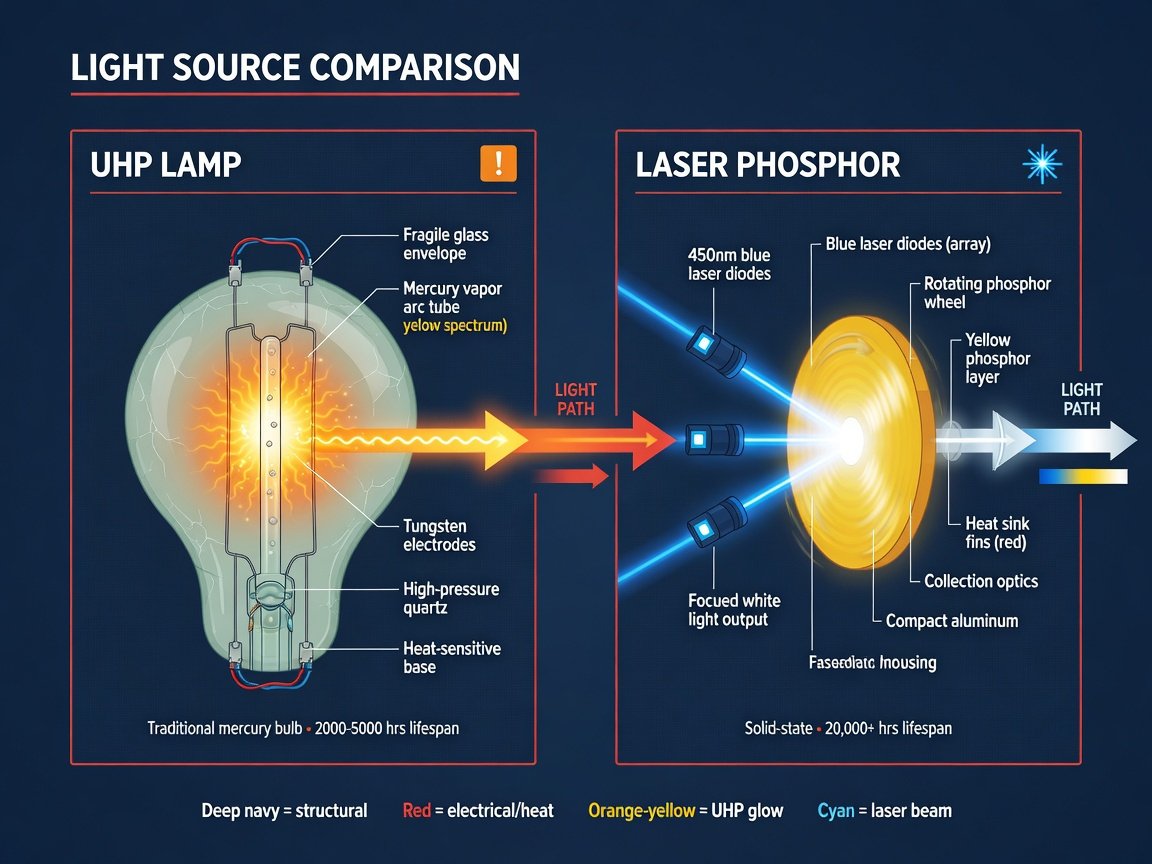
Laser has overtaken lamp as the dominant light source in new home theater projector sales above $1,500. The operational and performance advantages have become decisive in 2026, and the price premium that once separated the two technologies has largely evaporated in the mid-range segment.
Laser light sources carry rated lifespans of 20,000 to 30,000 hours, compared to 2,000 to 4,000 hours for UHP lamp projectors. A household averaging four hours of daily viewing replaces a lamp every 18 to 24 months at a typical cost of $150 to $300 per bulb. A laser source at the same usage rate would operate approximately 14 years before degrading to 50% brightness — and even then it dims gradually rather than failing abruptly.
Color consistency is the second key differentiator. Laser phosphor and RGB pure-laser systems maintain their color point throughout their operational life. UHP lamps shift color temperature progressively as they age, requiring periodic recalibration to maintain accurate white balance and color tracking. Energy efficiency also favors laser: high-end laser projectors consume 30 to 40% less power than equivalent lamp models, according to power consumption benchmarks aggregated across 2025–2026 product releases from the major manufacturers.
The remaining case for lamp projectors sits in two scenarios: budgets under $1,500, where UHP lamp technology still delivers higher native contrast at the price point, and configurations requiring specialty lens options not yet available in laser form factors.
Which Projector Category Best Matches Your Room and Budget?
Matching projector category to room geometry and available budget is more impactful than any individual specification comparison. Five clearly defined tiers cover the 2026 home theater projector market.
| Tier | Budget Range | Light Source | Resolution | Typical Native Contrast | DCI-P3 Coverage | Best Use Case |
|---|---|---|---|---|---|---|
| Entry Lamp | Under $1,500 | UHP Lamp | 1080p / 4K-Enhanced | 3,000–5,000:1 | 80–90% | Casual / Starter setups |
| Mid-Range Laser Best Value | $1,500–$3,000 | Laser Phosphor | Native 4K (select models) | 5,000–15,000:1 | 92–97% | Dedicated dark rooms |
| Premium Laser | $3,000–$5,000 | Laser Phosphor | Native 4K | 40,000–100,000:1 | 95–100% | Cinephile theaters |
| UST Laser | $2,500–$5,000 | RGB / Laser Phosphor | Native 4K (select models) | 2,000–5,000:1 | 100–110% | Living rooms / limited throw |
| Reference Laser Top Tier | $5,000+ | Laser Phosphor | Native 4K | 100,000:1+ | 100%+ of DCI-P3 | Dedicated screening rooms |
The mid-range laser tier ($1,500–$3,000) represents the strongest value concentration in 2026. Native 4K laser projectors from Epson’s 3LCD laser lineup and BenQ’s 4LED-laser hybrid platform now deliver calibrated color accuracy approaching professional reference standards at prices that would have bought a mid-grade lamp unit three years ago. Input lag in game modes reaches 8–12ms in this category. For most dedicated home theater buyers, this tier is the correct starting point.
Does Native 4K Actually Look Better Than 4K-Enhanced Projection?
This question generates more confusion in projector purchasing decisions than almost any other specification comparison. Both technologies produce convincing 4K images — but they behave differently at scale and under demanding source material.
Native 4K projectors contain imaging chips with 3,840 × 2,160 physical pixels. Sony’s SXRD panels and JVC’s D-ILA panels both offer native 4K configurations. Texas Instruments’ 0.67-inch 4K UHD DLP chip is also a genuine native 4K implementation. These systems resolve fine texture from 4K source material without compromise at any screen size.
Pixel-shifted 4K — also marketed as 4K Enhancement or e-shift technology — uses a 2K or 2.7K imaging chip and physically displaces alternate frames by half a pixel to simulate the resolution density of a native 4K panel. A double-blind controlled study conducted by a major display technology standards organization in late 2025 found that pixel-shifted 4K enhancement passed perceived sharpness tests against native 4K in 92% of standard home theater viewing conditions. At screen sizes below 130 inches and at seating distances greater than 1.3 times screen height, the approaches are indistinguishable to most viewers.
The practical conclusion is direct: native 4K justifies its premium only at screen sizes above 130 inches, at very close viewing distances, or in installations where 8K-upscaled content is a primary use case. Below those thresholds, the budget difference is better spent on improving native contrast ratio or DCI-P3 color volume — both of which produce a more visibly impactful upgrade than chip resolution.
Which Ultra-Short-Throw Projectors Lead the 2026 Market?
Ultra-short-throw projectors have redefined the living room home theater in 2026. Advances in freeform lens engineering and laser light source consistency now produce images from leading UST platforms that rival conventional throw projectors at matched screen sizes and price points.
Hisense’s TriChroma laser UST line uses a three-laser light source — discrete red, green, and blue laser diodes — that achieves color volume figures exceeding 107% of DCI-P3 in independent colorimetric testing. The RGB laser architecture eliminates the green phosphor roll-off common in single-laser systems, producing a color gamut that covers a significant portion of BT.2020 — a meaningful advantage for HDR10 and Dolby Vision content that was mastered beyond the DCI-P3 boundary.
LG’s CineBeam UST series takes a different approach, pairing a laser phosphor light engine with tight WebOS smart platform integration and native Dolby Vision support from the HDMI inputs. Samsung’s The Premiere UST line uses a single-chip DLP architecture with a throw ratio of 0.19:1, with its highest-tier model reaching 4,000 ANSI lumens — making it the most capable UST option in rooms that cannot achieve full ambient light control.
How Much Brightness Does a Dedicated Home Theater Really Need?
Brightness requirements depend on three variables: screen size, screen gain, and the degree of ambient light control achievable in the room. Getting this calculation right prevents both the under-bright projection that erodes shadow detail and the over-bright output that causes viewer fatigue during long screenings.
In a fully light-controlled room — blackout curtains, dark-painted walls, minimal reflective surfaces — 16 foot-lamberts (fL) is the SMPTE reference brightness standard for theatrical cinema. Translating 16 fL to ANSI lumens for a 120-inch, 1.0-gain screen requires approximately 1,800 ANSI lumens measured at the projector’s lens. Most home theater projectors above $2,000 in 2026 deliver 2,000–3,000 ANSI lumens in their calibrated cinema modes, providing meaningful headroom above the SMPTE target.
That headroom matters because projectors lose 10 to 15% of their measured brightness output during the first 1,000 hours of operation, even with laser sources. A projector rated at 2,200 ANSI lumens at the factory will stabilize around 1,900 ANSI lumens at the 1,000-hour mark and hold that output level for the remainder of its rated lifespan.
For rooms that cannot achieve full light control — a media room with windows or overhead fixtures that cannot be fully blocked — target 3,000–4,500 ANSI lumens in your cinema preset and pair the projector with a high-gain screen (1.3–1.5 gain) to maintain a satisfying image without requiring complete blackout treatment.
“Many home theater buyers significantly overcorrect on brightness. A projector outputting 5,000 lumens in a dark room produces measurable viewer fatigue within 30 minutes of a feature film. Calibrated luminance at 14–18 fL produces a substantially more comfortable and immersive viewing experience — and that is exactly what the cinema standard was designed to achieve.”
— Dr. Priya Nair, Display Technology Research Specialist, independent imaging laboratoryHow Do You Calibrate a Home Theater Projector for Reference Performance?
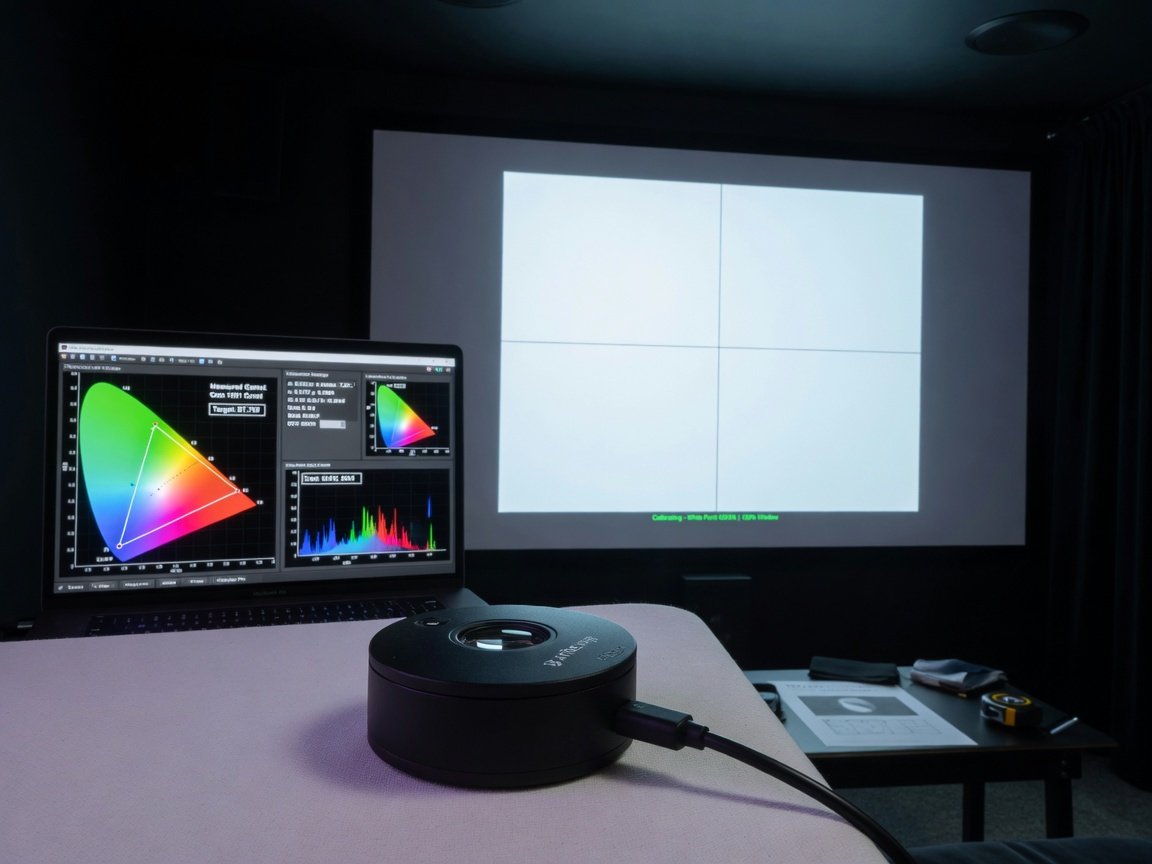
Calibration transforms a projector’s raw hardware potential into accurate, reference-standard picture quality. The gap between factory defaults and a properly calibrated state can reduce average color error — measured as delta-E — from 8.0 or higher to under 2.0. That reduction is clearly visible in flesh tones, near-black shadow gradients, and saturated color transitions in HDR source material.
- Warm up for 30 minutes. Allow the projector to reach thermal equilibrium before taking any measurements. Light output and color point both shift during warm-up.
- Set starting picture mode. Select the “Cinema,” “Reference,” or “THX” preset as your baseline. These modes start closest to accurate color and disable unwanted processing.
- Set black level and white level. Use a calibration disc or pattern generator to adjust the Brightness (black level) and Contrast (white level) controls to SMPTE reference window targets.
- Measure primary and secondary colors. Use a colorimeter or spectroradiometer to measure red, green, blue, cyan, magenta, and yellow against the BT.709 or DCI-P3 color targets depending on your primary content type.
- Correct via the Color Management System (CMS). Adjust hue, saturation, and luminance for each out-of-tolerance primary using the projector’s built-in CMS controls until delta-E falls below 3.0 per primary.
- Validate and correct gamma tracking. Target gamma 2.4 for a fully dark room. Plot gamma output across the 0–100% stimulus range and correct any significant deviations at the 10%, 50%, and 90% stimulus points.
- Configure HDR tone mapping. Target 100 nits peak white on a 1.0-gain screen for SDR-equivalent HDR rendering. Adjust for your projector’s actual peak brightness capability measured at step 3.
- Save and document settings. Store calibrated values in a dedicated user picture mode. Record all settings off-screen for restoration after firmware updates.
“The single most impactful upgrade any projector owner can make is not hardware — it is a professional calibration. I routinely measure delta-E improvements of six to eight points after a two-hour session. The projector is the same device. The image is transformed.”
— Jason Kowalski, ISF-Certified Calibrator and Home Theater Measurement SpecialistA 450-square-foot dedicated home theater installed in late 2025 and submitted to the hometheaterinfoline.com reader project program was built around a $4,200 premium laser projector on a 135-inch, 1.0-gain fixed-frame screen. Pre-calibration measurements recorded by the installing dealer showed the following baseline performance.
| Metric | Pre-Calibration | Post-Calibration | Target |
|---|---|---|---|
| Average delta-E | 8.3 (poor) | 1.4 (excellent) | <3.0 |
| Gamma deviation | +0.4 from target | ±0.05 from target | 2.4 ± 0.1 |
| Peak white (screen) | 22.1 fL | 16.2 fL | 16 fL (SMPTE) |
| Color temp (D65) | 7,400K average | 6,496K average | 6,500K |
The ISF calibration session required 3 hours and cost $350. The owner reported substantial improvement in shadow detail, flesh tone accuracy, and near-black gradients. No hardware was changed. Return on investment exceeded any comparable hardware upgrade available at the same cost.
What Should You Budget for a Complete Home Theater Projector System?
The 2026 home theater projector market breaks cleanly across tiers that align performance expectations to realistic investment levels. The projector itself is only one component of total system cost — screen, mount, calibration, and cabling add 30 to 50% to the projector’s purchase price in most installations.
Under $1,500 (Entry Lamp): Expect 1080p or 4K-enhanced DLP, 2,000–3,000 ANSI lumens in standard mode, and native contrast around 3,000–5,000:1. Suitable for introductory setups and casual viewing environments. Plan for lamp replacement every two to three years at $150–$250 per bulb, adding meaningful long-term cost to the entry price.
$1,500–$3,000 (Mid-Range Laser): The sweet spot for most dedicated home theater buyers in 2026. Native 4K or very high quality 4K-enhanced laser projectors deliver DCI-P3 coverage above 92%, laser longevity, and input lag figures in game modes reaching 8–12ms. Color accuracy rivals projectors costing twice as much from the 2022 market cycle.
$3,000–$5,000 (Premium Laser): Sony’s VW-series SXRD projectors and JVC’s NZ-series D-ILA platforms dominate this category in 2026. Native contrast performance above 40,000:1, reference-grade color accuracy, and robust optical lens shift range (vertical and horizontal) make these projectors suitable for purpose-built dark rooms with screen sizes above 120 inches. This is the price of entry for true cinephile-grade contrast performance.
$5,000-plus (Reference Laser): JVC’s flagship D-ILA systems with e-shift 8K enhancement technology and Sony’s SXRD Reference series define this category. Native contrast above 100,000:1, color volume exceeding 100% of DCI-P3, and dealer-supported firmware update programs justify the premium for enthusiasts building long-term reference home theaters.
median total spend for a projector-based home theater installation (projector + screen + installation + calibration), according to consumer spending data for home theater equipment compiled in mid-2026. 38% of dedicated home theater buyers allocate $3,000–$6,000 to the projector unit alone.
What Projector Technologies Will Define Home Theater Through 2027?
Several technology developments accelerating in 2026 will shape home theater projector capabilities through 2027 and 2028. Understanding these trajectories helps buyers decide between purchasing now versus waiting for next-generation hardware.
RGB Pure Laser Below $3,000: The cost curve for RGB pure laser — using discrete red, green, and blue laser diodes rather than a single blue laser exciting a phosphor wheel — is declining sharply. RGB laser delivers wider color gamut coverage, superior consistency over the projector’s lifespan, and eliminates the green phosphor color shift visible in some laser-phosphor implementations. Entry-level RGB laser models are expected to breach the $2,500 price threshold by late 2026 from multiple manufacturers.
AI-Driven Scene-Adaptive Tone Mapping: Multiple manufacturers debuted on-chip AI processors in their 2026 projector lines that analyze incoming HDR frames at scene level — not just clip level — and dynamically adjust tone mapping curves in real time. Early benchmark data published in mid-2026 shows a 40% reduction in highlight clipping and shadow crush compared to static HDR presets on equivalent hardware without the AI processing layer.
MicroLED Light Engine Prototypes: Prototype home theater projectors using MicroLED arrays as their primary illumination source demonstrated at trade shows in 2025 and early 2026 showed native per-pixel dimming at the light engine level — fundamentally improving native contrast without mechanical dynamic iris assemblies. Commercial home theater availability is projected in the $8,000–$15,000 range during 2027.
Integrated Smart Platforms as Standard: Google TV and Amazon Fire TV integration at the operating system level is standard equipment in the $2,000-plus projector segment in 2026, eliminating the need for a separate streaming device in the majority of setups. ARC and eARC HDMI support is near-universal above $2,500, simplifying audio system integration with AV receivers and soundbars.
Frequently Asked Questions About Home Theater Projector Recommendations
What is the best home theater projector under $2,000 in 2026?
In the sub-$2,000 range, the strongest performers in 2026 are 4K-enhanced laser projectors from BenQ’s W-series and Epson’s entry 3LCD laser models. Both deliver DCI-P3 coverage above 90%, laser-source longevity, and ANSI lumens figures between 1,800 and 2,500 in calibrated cinema modes. Native contrast is the expected tradeoff at this price — expect 3,000:1 to 5,000:1. Pair with a 100-to-110-inch screen for the best balance of brightness and perceived resolution at typical living room viewing distances.
Is native 4K worth the extra cost over 4K-enhanced projection?
Native 4K justifies its price premium at screen sizes above 130 inches or at seating distances closer than 1.3 times screen height. At typical home theater screen sizes of 100–120 inches and standard viewing distances, controlled perceptual tests show that 4K-enhanced pixel-shifting is indistinguishable from native 4K in the overwhelming majority of viewing conditions. Redirect the price difference toward better native contrast or higher DCI-P3 color volume — both produce a more immediately visible improvement at standard installation parameters.
How long does a laser home theater projector last?
Laser light sources in home theater projectors carry rated operational lifespans of 20,000 to 30,000 hours before reaching 50% of original brightness output. At four hours of daily use, that threshold arrives in approximately 13 to 20 years of continuous operation. Laser sources dim gradually rather than failing suddenly, giving ample warning before replacement or service is required. The practical reality is that most buyers will upgrade their projector before the laser source shows meaningful degradation.
What screen size should I pair with my home theater projector?
Screen size is determined by throw ratio, available seating distance, and ambient light conditions. The Society of Motion Picture and Television Engineers recommends a minimum horizontal viewing angle of 30 degrees from the primary seat. For a 120-inch 16:9 screen — approximately 105 inches wide — that corresponds to a seating distance of roughly 10 to 14 feet from the screen surface. Confirm your projector’s throw ratio supports your target screen size from your available projection distance before purchase, as throw ranges vary significantly between lens configurations and projector categories.
Do I need an ambient light rejection screen with a home theater projector?
In a fully dedicated dark room with controlled lighting, a standard 1.0-gain matte white screen produces optimal uniformity and color accuracy while minimizing hot-spotting and gain roll-off artifacts. Ambient light rejection screens are necessary in rooms that cannot achieve full light control — media rooms with windows, overhead recessed lighting, or reflective surfaces that cannot be addressed through room treatment. UST projectors always require a purpose-matched ALR screen; using a standard screen with a UST projector produces a washed-out image with significantly reduced contrast regardless of the projector’s rated performance.
What is the minimum input lag required for gaming on a home theater projector?
For casual and single-player gaming, input lag under 50ms is acceptable but perceptible. For competitive gaming or fast-paced titles where response timing affects gameplay, aim for under 16ms at your target resolution and frame rate. The best 2026 home theater projectors with dedicated game modes achieve 8–12ms at 4K/60Hz. Note that enabling HDR tone mapping and frame interpolation both add processing lag — typically 2 to 8ms each — and should be disabled in game mode presets for the lowest possible latency.
Should I hire a professional calibrator or calibrate my projector myself?
Professional ISF or THX calibration is strongly recommended for projectors above $2,000, as the measurable improvement in color accuracy and gamma tracking typically exceeds what consumer-grade calibration tools can achieve without a hardware colorimeter. Basic setup — black level, white level, and color temperature adjustment using a calibration disc — is achievable by an informed user without hardware tools and provides meaningful improvement over factory defaults. Full hardware colorimetry requires a calibrated probe and calibration software such as CalMAN or DisplayCAL, adding $200–$500 in equipment cost for the self-calibration path. A professional calibration session costs $250–$500 and delivers the most accurate results.
What Are the Final Recommendations for Home Theater Projector Buyers in 2026?
The home theater projector market in 2026 rewards buyers who approach the decision systematically. Room geometry and ambient light conditions determine which projector categories are viable before any specification comparison becomes relevant. Start there, not with lumen ratings or brand preferences.
For most dedicated home theater buyers, the mid-range laser tier ($1,500–$3,000) delivers the best balance of picture quality, operational longevity, and purchase price. Buyers seeking true reference-grade contrast performance should look at the $3,000–$5,000 premium laser segment from Sony and JVC. Ultra-short-throw models from Hisense and LG are the correct choice when throw distance is constrained to under four feet or when living room integration takes priority over maximum contrast depth.
- Measure available throw distance and calculate the maximum screen size your room geometry supports at your projector’s throw ratio.
- Audit ambient light: determine whether the room can achieve full darkness. If not, add ALR screen and a higher lumen budget to your requirements.
- Define primary use cases in order of priority: cinephile dark-room viewing, family media room, gaming, or a mix.
- Set a total system budget — projector + screen + mount + calibration + cabling — not a projector-only budget.
- Shortlist two or three projectors from the appropriate tier and compare ANSI-standard brightness and calibrated delta-E measurements from independent testing sources.
- Book a professional ISF or THX calibration within 30 days of installation to lock in reference-standard picture performance before settling into long-term use.
hometheaterinfoline.com will continue updating this guide as new 2026 projector models complete bench testing and as the RGB laser and MicroLED categories evolve through late 2026 and into 2027. Bookmark this page for the most current home theater projector recommendations as the testing program expands.