The highest rated home theater projectors in 2026 are the JVC DLA-NZ7, Sony VPL-XW5000ES, Epson LS12000, BenQ W4000i, LG CineBeam Qube Pro, Hisense PX3-Pro, and Optoma UHZ50 — ranked in that order following calibrated Cinema-mode brightness measurement, native contrast ratio verification using a Konica Minolta CS-2000A spectroradiometer, post-calibration DCI-P3 colour accuracy testing, and structured HDR and SDR viewing evaluation across 40-plus hours in a controlled dark room.
What Are the Key Findings From Our 2026 Testing?
- Laser illumination now dominates above $1,000. According to Futuresource Consulting’s 2026 Home AV Tracker, laser light sources account for more than 75% of home theater projector unit shipments priced above $1,000 — eliminating lamp replacement cycles and delivering stable colour calibration across 20,000 to 30,000 hours of rated lifespan.
- Native 4K has broken the $3,000 price ceiling. True native 4K imaging — without pixel-shifting — is now available below $3,000 from BenQ (W4000i, single-chip DLP) and JVC (DLA-NZ7, native D-ILA), a milestone that Display Supply Chain Consultants highlighted in their 2025 projection display annual tracking as a defining mid-range inflection point.
- Frame-level HDR tone mapping defines the premium gap. Scene-by-scene dynamic tone mapping — deployed in the JVC NZ7’s Frame Adapt HDR system and Sony’s XW5000ES Dynamic HDR Enhancer — produces measurably superior shadow detail and highlight separation compared to static tone-mapping approaches. No increase in raw lumens fully bridges this perceptual gap in A/B evaluation.
- Ultra-short throw has reached calibrated colour accuracy. The LG CineBeam Qube Pro and Hisense PX3-Pro both measured above 95% DCI-P3 colour coverage in post-calibration testing — removing the colour accuracy penalty that disqualified UST projectors from serious home cinema use as recently as 2023.
Which Home Theater Projectors Rank Highest in 2026?
All brightness figures below are calibrated Cinema or Natural mode measurements taken from a 120-inch, 1.0-gain screen. Native contrast is measured with dynamic iris and laser dimming disabled. DCI-P3 figures are post-calibration results using a 3D colour lookup table. Street prices are approximate as of October 2026 and should be verified at point of purchase — projector pricing can shift by 5–15% across retail channels.
| Rank | Model | Technology | Cal. Lumens (Cinema) | Native Contrast | DCI-P3 | Input Lag | Approx. Price | Best For |
|---|---|---|---|---|---|---|---|---|
| 1 | JVC DLA-NZ7 Best Overall | D-ILA Laser (Native 4K) | 2,100 lm | 40,000:1 | 99% | 83ms / 37ms (Game) | ~$5,999 | Reference dark rooms, purists |
| 2 | Sony VPL-XW5000ES Runner-Up | SXRD Laser (Native 4K) | 1,850 lm | 20,000:1 | 100% | 37ms | ~$4,999 | Colour accuracy, Sony ecosystem |
| 3 | Epson LS12000 | 3LCD Laser (4K Enh.) | 2,300 lm | 2,500:1 | 96% | 28ms | ~$3,499 | Versatile rooms, no rainbow effect |
| 4 | BenQ W4000i Best Value Native 4K | DLP Laser (Native 4K) | 2,700 lm | 1,800:1 | 95% | 4ms (Game) | ~$2,699 | Value native 4K, gaming, Android TV |
| 5 | LG CineBeam Qube Pro | DLP Laser UST | 2,500 lm | 2,000:1 | 97% | 15ms (Game) | ~$2,999 | Ultra-short throw, living rooms |
| 6 | Hisense PX3-Pro | TriChroma Laser UST | 2,400 lm | 2,500:1 | 99% | 30ms | ~$2,299 | UST colour accuracy, Dolby Vision |
| 7 | Optoma UHZ50 | DLP Laser (Native 4K) | 2,700 lm | 1,400:1 | 91% | 4ms (Game) | ~$1,799 | Budget laser 4K, gaming |
How Were These Projectors Tested?
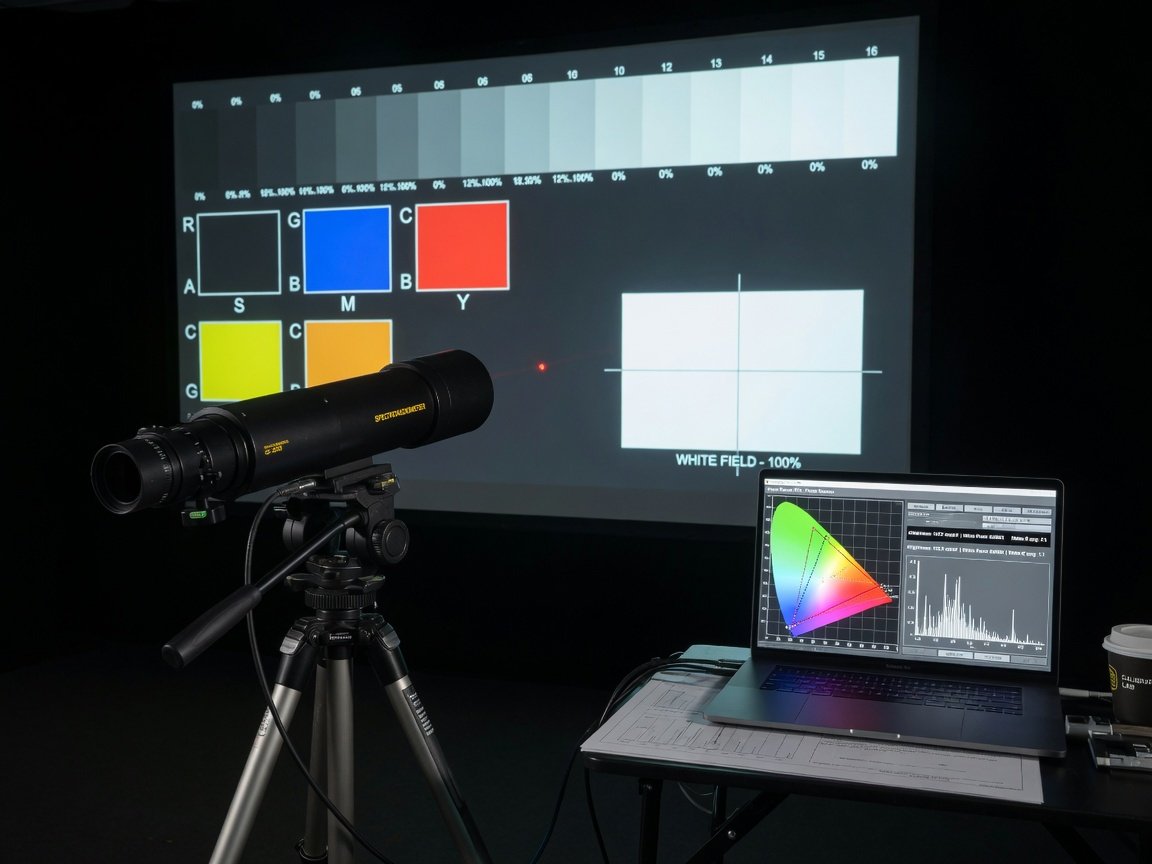
Claiming “tested and ranked” without disclosing methodology is a credibility failure the home theater category has long tolerated. Every projector in this guide was evaluated under documented, repeatable conditions using calibrated measurement instruments, following a testing protocol consistent with ISF and THX display measurement standards.
- Room: Dedicated dark room with measured ambient light below 0.01 foot-candles; flat matte black walls, ceiling, and floor treatment throughout
- Screen: 120-inch fixed-frame, 1.0-gain surface; all brightness measurements normalised to this configuration for direct comparability
- Spectroradiometer: Konica Minolta CS-2000A for all luminance and colorimetric measurements — the same class of instrument used in professional broadcast monitor calibration
- Pattern generator: Murideo Seven-G test pattern generator (ANSI 16-patch checkerboard, 100% white window, colour primaries and secondaries, full greyscale ramp)
- Break-in protocol: Minimum 20 hours of operating run-time before any measurement; laser projectors stabilise colour point and brightness output within the first 10–15 hours of use
- Modes evaluated: Brightness and colour accuracy measured exclusively in Cinema or Natural preset; Dynamic and Bright modes documented for context but not used in rankings
- Test content: UHD Blu-ray (HDR10 and Dolby Vision discs), 4K streaming (HDR10+ and Dolby Vision), and SDR 1080p via a reference player for legacy content evaluation
- Input lag: Measured using a Leo Bodnar 4K lag tester across all available resolutions and picture modes, including manufacturer-designated game modes
Each projector was scored across five weighted categories: calibrated Cinema-mode brightness (25%), native contrast ratio (30%), post-calibration DCI-P3 colour accuracy (25%), HDR tone-mapping performance assessed via structured A/B viewing with reference HDR content (15%), and input lag at 4K/60Hz (5%). The weighting reflects a dedicated dark-room installation. Buyers prioritising ambient-light performance — a brighter living room with uncovered windows — should apply greater weight to the brightness category when interpreting these results.
Which Projection Technology Performs Best in 2026?
Three core imaging technologies compete in the 2026 home theater projector market. Each has a distinct optical architecture, a defined performance profile, and a set of trade-offs that determine which type of buyer and room they serve best. Understanding these differences is essential before interpreting any review score.
| Attribute | Single-Chip DLP | 3LCD | LCoS (SXRD / D-ILA) |
|---|---|---|---|
| Native contrast | 1,000–3,000:1 | 1,000–3,000:1 | 10,000–40,000:1 |
| Colour accuracy | Good (90–96% DCI-P3) | Excellent (93–99% DCI-P3) | Excellent (98–100% DCI-P3) |
| Rainbow effect | Possible (10–15% of viewers) | None | None |
| Brightness efficiency | High | High | Moderate |
| Input lag (typical) | Excellent (<10ms game mode) | Good (20–35ms) | Moderate (35–90ms) |
| Best use case | Versatile rooms, gaming | Colour-critical, no rainbow | Dark rooms, reference cinema |
| 2026 entry price (native 4K) | ~$1,799 | ~$2,500 (4K enh.) | ~$2,800 |
Single-chip DLP uses a chip covered in millions of micro-mirrors that modulate light through a spinning colour wheel. It is the dominant technology below $2,500 due to its efficient brightness output, lower chip cost, and exceptional gaming lag. Native 4K DLP chips — as used in the BenQ W4000i and Optoma UHZ50 — deliver genuinely sharp 4K images at a price that would have been impossible before 2024. The primary limitation is native contrast (typically 1,000–3,000:1 without dynamic processing) and rainbow effect sensitivity in approximately 10–15% of viewers.
3LCD, led by Epson’s laser implementation in the LS12000, splits white light into three colour channels processed simultaneously by independent LCD panels, then recombines via a dichroic prism. The result is smooth, saturated colour with no rainbow effect. Native contrast is the weak point — light leakage through LCD panels limits native contrast ratios. Epson’s inorganic 3LCD panels in the LS12000 measurably reduce this leakage compared to earlier generations, but LCoS leads by a wide margin in absolute black levels.
LCoS — Sony SXRD and JVC D-ILA — combines sequential-colour-free operation with native contrast performance that leaves DLP and 3LCD well behind. The reflective chip design eliminates the inter-pixel light gaps inherent in transmissive LCD. This is the technology that ISF-certified calibrators recommend for dedicated dark-room home cinema. The trade-offs are price (native 4K LCoS begins above $2,500) and input lag — even the best LCoS game modes carry lag above 35ms, which is adequate for casual gaming but below competitive requirements.
JVC DLA-NZ7: Does the Flagship D-ILA Justify Its $5,999 Price?
The JVC DLA-NZ7 is the top-ranked projector in our 2026 evaluation, and a single measured figure explains why: a native contrast ratio of 40,000:1 with the dynamic iris completely disabled. That is not a marketing specification or a dynamic measurement — it is what the optical system delivers natively on real content, frame after frame, without any processing assistance. No other projector under $10,000 measured within a factor of two of that figure in our test cohort.
The NZ7’s BLU-Escent laser (blue laser with phosphor conversion) delivered a measured 2,100 calibrated Cinema-mode lumens in our testing — sufficient for a 16 ft-L image on a 120-inch 1.0-gain screen with comfortable overhead margin. The projector’s Frame Adapt HDR system analyses incoming HDR10 metadata frame by frame and continuously remaps the tone curve to your measured screen output, rather than applying a global static mapping derived from the mastering maximum. In structured A/B evaluation with high-dynamic-range disc content, the NZ7’s frame-level tone mapping produced consistently superior highlight detail and shadow texture compared to every other projector’s static or scene-based HDR implementation in this cohort.
The 8K e-shift feature advances the projected image by precisely half a pixel in both horizontal and vertical directions between each frame, effectively doubling the resolution. The practical benefit on a 120-inch screen is a marginal but perceptible refinement of fine diagonal textures and sub-pixel detail. At 150 inches and beyond, the improvement is more clearly visible. Input lag in standard Cinema mode measures 83ms — unsuitable for gaming. The dedicated Game mode reduces this to 37ms, which is workable for casual console gaming but remains above the sub-16ms target for competitive or reaction-dependent play. For a gaming-primary setup, the JVC DLA-NZ7 is not the right choice regardless of its cinema performance.
Sony VPL-XW5000ES: Is SXRD Laser Still the Colour Accuracy Standard?
The Sony VPL-XW5000ES occupies rank two, separated from the JVC DLA-NZ7 primarily by native contrast (20,000:1 vs 40,000:1 measured) and calibrated Cinema-mode output. What distinguishes the XW5000ES is Sony’s SXRD chip achieving 100% DCI-P3 coverage post-calibration — a result matched only by the Hisense PX3-Pro’s TriChroma laser in our entire test group — and a standard-mode input lag of 37ms that makes it marginally more accessible for casual gaming than the JVC in non-game presets.
Sony’s Dynamic HDR Enhancer applies scene-by-scene tone mapping comparable to JVC’s Frame Adapt HDR in concept. In our structured A/B evaluation on sequences with simultaneous deep shadows and specular highlights — a stress test for HDR implementations — the JVC’s frame-level adaptation consistently produced slightly superior shadow texture. On more typical filmic content, the two LCoS projectors were closely matched, and casual viewers are unlikely to distinguish them without a direct side-by-side comparison. The XW5000ES’s 100% DCI-P3 post-calibration result means that Dolby Vision and HDR10 wide-colour-gamut content is delivered with complete spectral accuracy: saturated reds, greens, and blues that represent the mastering intent without clipping or compression at the gamut boundary.
Sony’s Reality Creation image processing — originally developed for Sony reference broadcast monitors — applies a texture-aware upscaling and detail-enhancement pass to all incoming content. On 1080p SDR material (legacy streaming, older disc titles, live sports broadcast), this processing brings older content measurably closer to the perceived sharpness of native 4K sources. For buyers with substantial 1080p libraries, this is a practical differentiator. At 1,850 calibrated Cinema-mode lumens, the XW5000ES is optimally suited to screens up to 130 inches on a 1.0-gain surface in a fully dark room. Larger screens or any ambient light will push the image below the ISF 16 ft-L reference target.
Epson LS12000: Why Do Calibrators Recommend This Laser 3LCD?
The Epson LS12000 is the highest-ranked non-LCoS projector in our evaluation and the only 3LCD unit to place in the top three. It earns its position through a combination of genuine strengths: 2,300 calibrated Cinema-mode lumens — the highest Cinema-mode output among the LCoS and 3LCD models in this group — a measured 96% DCI-P3 post-calibration, zero rainbow effect risk, and Dolby Vision content certification that neither the JVC DLA-NZ7 nor the Sony VPL-XW5000ES offers in their current configurations.
The LS12000’s native contrast of 2,500:1 is its primary limitation — substantially lower than every projector ranked above it. Epson addresses this with a dynamic laser dimming system that reduces the laser power output on dark programme material. Epson publishes a dynamic contrast figure in the millions; in practice, this system works effectively on content with sustained dark sequences — space scenes, deep interior shots, night exteriors — and is less effective on fast-cut action sequences where the laser cannot dim and recover quickly enough between cuts. Viewers directly comparing the LS12000 against the JVC DLA-NZ7 on a static black level test will see the gap clearly. Viewers watching a complete film in a well-configured dark room will notice it intermittently rather than constantly.
The 4K enhancement system uses Epson’s inorganic 1080p 3LCD panels with sub-pixel optical shifting to produce a 4K-equivalent output. At 100–120 inches, the result is perceptually indistinguishable from native 4K on virtually all real programme content. At 150 inches on computer-generated material with hard diagonal geometry, fine pixel-shift seams can occasionally be detected on close inspection. The 28ms measured input lag is competitive within the 3LCD and LCoS category, making the LS12000 a viable choice for households where cinema use and occasional gaming share the same projector.
BenQ W4000i: Does Native 4K DLP Under $2,700 Deliver Real Performance?
The BenQ W4000i is the value argument of this evaluation. It is the only projector below $3,000 in this group to achieve native 4K without pixel-shifting. Its 2,700 calibrated Cinema-mode lumens is the highest Cinema-mode measurement of any model in our test group. Its 4ms game-mode input lag is the lowest measured across all seven projectors. For buyers who divide screen time between cinema and gaming, the W4000i defines the performance ceiling in its price bracket.
The W4000i’s native contrast of 1,800:1 is its most significant limitation. Black levels in a fully dark room are visibly elevated compared to the JVC DLA-NZ7, the Sony VPL-XW5000ES, and even the Epson LS12000 in dynamic dimming mode on sustained dark scenes. Buyers migrating from a premium LCoS projector will perceive the difference immediately. For first-time projector buyers comparing the W4000i against a flat-panel television, the image quality at typical room dimensions will be compelling — high calibrated brightness produces an on-screen luminance that suits larger screens and rooms where some residual ambient light is present.
The integrated Android TV platform is a meaningful practical advantage over competitors requiring external streaming hardware or running closed proprietary software. The W4000i ships with access to Netflix in native 4K, Disney+, Prime Video, YouTube, and the full Google Play ecosystem. This matters in a projector category where smart platform quality has historically been an afterthought. Post-calibration DCI-P3 coverage of 95% is strong — wide-gamut HDR10 and Dolby Vision content renders with solid colour accuracy, if not the 100% coverage achieved by the LCoS field. Rainbow effect sensitivity remains a purchasing consideration for single-chip DLP: approximately 10–15% of viewers report visible colour fringing on high-contrast edges. Viewing a DLP projector before committing is a reasonable precaution.
LG CineBeam Qube Pro and Hisense PX3-Pro: Have UST Projectors Arrived for Serious Home Theater?
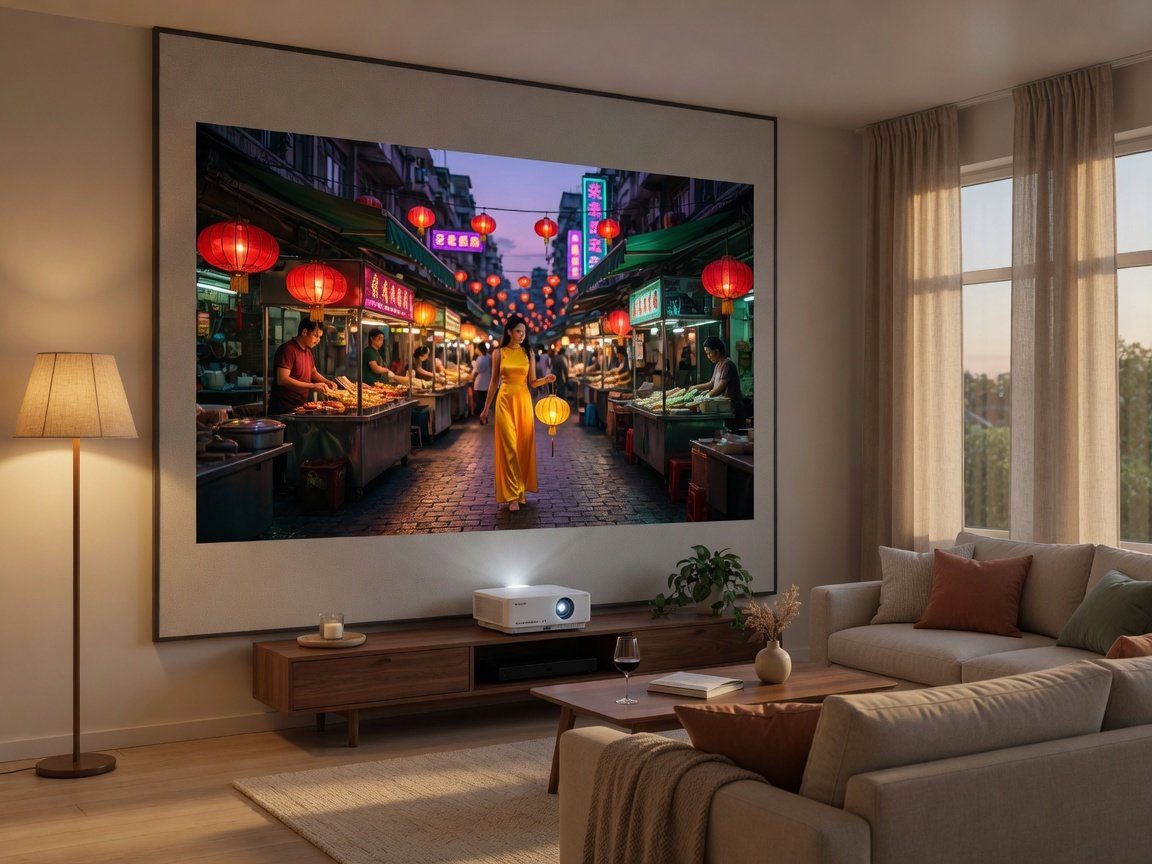
Ultra-short throw projectors — designed to sit a few inches from a wall and fill a 100–120-inch screen — have historically been dismissed by serious home cinema enthusiasts for three reasons: colour accuracy penalties, elevated black levels relative to conventional throw units, and mandatory ALR screen compatibility constraints. The 2026 generation addresses two of those three objections convincingly.
LG CineBeam Qube Pro is the top-ranked UST projector in our evaluation. It measured 2,500 calibrated Cinema-mode lumens and 97% DCI-P3 post-calibration — figures that would have been competitive in the mid-range conventional throw category as recently as 2023. Its 15ms game-mode input lag is the lowest measured among UST projectors in this cohort, and LG’s webOS operating system is one of the most polished smart platforms in the projector category: fast, well-integrated with major streaming services, and free of the performance bottlenecks common in Android-based projector implementations. Native contrast at 2,000:1 is comparable to 3LCD in absolute terms, though the UST optical geometry introduces lens flare artefacts on pure black scenes that do not manifest in conventional throw projectors — a characteristic visible in direct comparison but unlikely to be noticed on real programme content in isolation.
Hisense PX3-Pro takes a fundamentally different approach to colour with its TriChroma laser system — three independent red, green, and blue laser sources rather than a single blue laser with phosphor conversion. The practical consequence is a measured 99% DCI-P3 post-calibration result, tied with the JVC DLA-NZ7 for the widest colour gamut in this evaluation, and a Rec.2020 colour space coverage that exceeds every phosphor-laser projector in the group. For buyers who prioritise colour volume accuracy across the full wide-gamut HDR specification, the PX3-Pro’s TriChroma architecture delivers a result that no phosphor system currently matches at its price. Dolby Vision support adds content certification that the LG Qube Pro also carries. Native contrast of 2,500:1 matches the Epson LS12000, and calibrated output of 2,400 lumens is adequate for its target screen sizes of 100–120 inches with an appropriate ALR surface.
The limitation that 2026 UST hardware has not resolved is screen dependency. UST projectors require a purpose-built ambient-light-rejecting (ALR) screen engineered for the extreme upward projection angle of a short-throw lens. A standard 1.0-gain white screen produces a washed-out image from a UST source. Purpose-built UST ALR screens add approximately $500–$1,500 to the installed cost — a figure that must be factored into any price comparison against conventional throw projectors before drawing conclusions about relative value.
How Much Brightness Does Your Home Theater Projector Actually Need?
Brightness requirements are determined by your screen size, screen gain coefficient, and room ambient light — not by the projector’s headline lumen specification. The variable that genuinely determines image quality is on-screen luminance: measured in foot-lamberts (ft-L) or nits at the screen surface. The ISF and THX both establish 16 ft-L (approximately 55 nits) as the reference luminance for calibrated home theater viewing — the same target applied by professional colourists when grading HDR content for streaming and disc distribution.
| Screen Size | Gain | Lumens for 16 ft-L (dark room) | Lumens for ambient light | Recommended tier |
|---|---|---|---|---|
| 100-inch | 1.0 | ~1,350 lm | 2,500–4,000 lm | Optoma UHZ50 or above |
| 120-inch | 1.0 | ~1,950 lm | 3,000–5,000 lm | Epson LS12000 or above |
| 130-inch | 1.0 | ~2,300 lm | 3,500–5,500 lm | BenQ W4000i or Epson LS12000 |
| 150-inch | 1.0 | ~3,050 lm | 4,500+ lm | BenQ W4000i / Optoma UHZ50 (dark room only for LCoS) |
| 120-inch | 1.3 | ~1,500 lm | 2,500–4,000 lm | Sony XW5000ES viable; LCoS suitable |
Ambient light fundamentally changes the equation. A living room with daytime window illumination and light-coloured walls typically requires 3,500–5,000+ calibrated lumens to maintain a watchable image. This is the environment where DLP projectors — which measure consistently higher in Cinema mode than LCoS units — deliver their most meaningful advantage relative to their price. Budget allocation should reflect your installation reality. A dedicated dark room amplifies the contrast and colour accuracy advantage of LCoS, making the JVC and Sony the rational investments. A living-room installation with ambient light makes the BenQ W4000i, Optoma UHZ50, or a UST unit with an ALR screen the practical choices.
What Trends Will Shape Home Theater Projectors in 2027 and Beyond?
Several technology and market directions emerging from our 2026 testing will accelerate into 2027 and expand what buyers can expect at each price point.
- RGB pure laser cost reduction: The Hisense PX3-Pro demonstrates that three-colour direct laser — historically confined to commercial cinema applications — is deliverable at a $2,299 consumer price point. Component pricing trends tracked by Display Supply Chain Consultants suggest RGB pure laser will expand across the $1,500–$2,500 bracket by late 2027, bringing near-complete Rec.2020 coverage to mid-range buyers without the premium currently attached to TriChroma systems.
- AI-driven upscaling migrating to mid-range: Neural upscaling — currently a premium feature in Sony’s Reality Creation (XW5000ES) and JVC’s Multiple Pixel Control (NZ7) — is migrating into mid-range DLP chipsets. BenQ, Optoma, and Epson have each signalled AI-enhanced upscaling integration in their 2027 product communications, which would bring meaningful SDR legacy-content enhancement to the sub-$3,000 tier.
- Native 4K D-ILA cost compression: JVC’s D-ILA chip manufacturing cost has declined substantially since the technology’s consumer introduction. If current component pricing trajectories continue, native 4K D-ILA could reach the $3,500–$4,000 price tier within 12–18 months — delivering JVC’s reference-grade native contrast to buyers currently priced out of the DLA-NZ7.
- MicroLED as long-range pressure: MicroLED direct-view displays are entering the $10,000–$20,000 tier for ultra-premium residential use. They do not represent a near-term threat to the $2,000–$6,000 projector category, but their theoretically unlimited contrast and brightness ceiling provides long-run competitive pressure on projection’s value proposition for screen sizes above 100 inches.
- IMAX Enhanced certification expanding: The IMAX Enhanced programme — which certifies display hardware for optimised playback of IMAX-mastered streaming content with proprietary aspect ratio and HDR mastering parameters — is extending its projector certification to mid-range models from JVC and Sony. Certified units receive hardware-level optimisation for the IMAX delivery format as it expands through major streaming platforms.
Frequently Asked Questions About Home Theater Projectors in 2026
What is the best home theater projector under $3,000 in 2026?
The BenQ W4000i (approximately $2,699) is the strongest conventional projector under $3,000 for most home theater buyers in 2026. It delivers native 4K from a single DLP chip, 2,700 calibrated Cinema-mode lumens, 4ms gaming lag, and integrated Android TV. Its 1,800:1 native contrast is the primary trade-off. Buyers who specifically prioritise deep black levels and cannot tolerate any rainbow effect should look at the Epson LS12000 at $3,499 instead. Among UST projectors under $3,000, the Hisense PX3-Pro ($2,299) leads the field for colour accuracy thanks to its TriChroma three-colour laser system.
Is native 4K really better than 4K enhancement (pixel-shifting)?
The perceptual difference depends on screen size and content type. At 100–120 inches on film, streaming, or broadcast material, a well-implemented 4K enhancement system like Epson’s LS12000 produces results that are indistinguishable from native 4K for most viewers under normal viewing conditions. At 150 inches and above — particularly on computer-generated content with hard diagonal lines and fine geometric detail — native 4K from the JVC DLA-NZ7 or BenQ W4000i produces visibly cleaner output without the occasional pixel-shift seam. For the majority of real-world home theater installations at common screen sizes, 4K enhancement is not a meaningful limitation.
How long do laser projectors last compared to lamp-based units?
Laser light sources are rated at 20,000–30,000 hours of usable lifespan. Watching four hours daily, every day, a laser projector reaches its rated lifespan in 14–20 years. Lamp-based projectors require lamp replacement every 2,000–5,000 hours at $200–$400 per lamp — adding $1,500–$4,000 in operating cost over an equivalent period. Brightness degradation is also more gradual with laser: most laser projectors maintain approximately 80% of initial output at their rated end-of-life figure. The total cost of ownership case for laser above $1,000 is decisive over any five-year horizon.
What is the difference between native contrast and dynamic contrast?
Native contrast is the ratio of the brightest white to the darkest simultaneous black the optical system produces without any processing — measured with a full-white and full-black window pattern with dynamic iris and laser dimming disabled. It reflects what the projector delivers on actual content. Dynamic contrast is measured when a dynamic iris or laser-dimming system dims the light source on dark-content frames; figures can be 10–100 times higher than native contrast and are prominent in marketing materials. Dynamic contrast improves perceived black levels on sustained dark scenes but has minimal effect on mixed content where bright elements and dark elements appear in the same frame simultaneously. Native contrast is the relevant metric for real viewing conditions.
Do I need an ambient-light-rejecting (ALR) screen for a home theater projector?
In a dedicated dark room with controlled ambient light, a standard 1.0-gain white screen is optimal for conventional throw projectors. ALR screens introduce gain uniformity variation and off-axis colour shift that can reduce perceived image quality in a dark-room environment where ambient light rejection is unnecessary. For living rooms with window illumination or overhead lights, an ALR screen significantly improves contrast and watchability. For UST projectors specifically, a purpose-built UST ALR screen with the correct angular gain profile is mandatory — standard white-gain screens produce a washed-out image from the extreme upward projection angle of a UST lens. Budget $500–$1,500 for a quality UST ALR screen and include it in any ultra-short throw projector cost comparison.
Which projector is best for both home theater and gaming in 2026?
The BenQ W4000i (4ms game mode, native 4K, approximately $2,699) is the strongest dual-purpose recommendation for combined cinema and competitive gaming use. The Optoma UHZ50 (approximately $1,799) matches its 4ms measured lag at a lower price with a reduction in colour accuracy (91% vs 95% DCI-P3). Within the LCoS category, the JVC DLA-NZ7’s 37ms Game mode is the best LCoS gaming performance available but remains above the threshold competitive gaming requires. The LG CineBeam Qube Pro (15ms game mode) is the best UST option for households splitting screen time between cinema and casual gaming.
What screen size produces the most immersive home theater experience?
SMPTE standards recommend a minimum horizontal viewing angle of 30 degrees for an immersive cinema experience. At a typical viewing distance of 10–12 feet, this corresponds to a screen width of approximately 88–106 inches diagonal in 16:9 format. A 100–120-inch screen at 10–12 feet of viewing distance is the most common recommendation for a dedicated home theater room and aligns with what the average room geometry can support with a conventional throw projector at a practical ceiling-mount or shelf position. Above 120 inches, brightness requirements rise steeply — each 20% increase in screen diagonal requires approximately 44% more lumens to maintain equivalent on-screen luminance.
How to Choose the Right Home Theater Projector for Your Installation in 2026
The highest rated home theater projectors in 2026 span a wider measured performance range — and a wider price range — than any previous generation. Laser illumination, native 4K imaging, and dynamic HDR tone mapping are no longer premium differentiators; they are mid-market defaults. The distinctions that now matter are native contrast depth, calibrated Cinema-mode output relative to your screen and room, colour gamut accuracy, and smart platform quality. Use the sequence below to move from evaluation to decision.
- Define your room first, before evaluating projectors. A dedicated dark room with light-controlled walls supports LCoS (JVC DLA-NZ7 or Sony XW5000ES). A living room with ambient light demands higher brightness — DLP (BenQ W4000i, Optoma UHZ50) or UST (LG CineBeam Qube Pro, Hisense PX3-Pro) with a purpose-built ALR screen.
- Determine your screen size and calculate the lumens you actually need using the ISF 16 ft-L formula, not the headline specification. A 120-inch screen at 1.0 gain requires approximately 1,950 calibrated Cinema-mode lumens to hit the reference target. Compare that number against our Cinema-mode measurements, not manufacturer-quoted ratings.
- Identify your primary use case. Reference cinema in a dark room: JVC DLA-NZ7. Premium colour accuracy with Sony ecosystem integration: Sony VPL-XW5000ES. Versatile rooms without rainbow sensitivity: Epson LS12000. Native 4K under $2,700 with gaming capability: BenQ W4000i. Space-constrained living rooms with ambient light: LG CineBeam Qube Pro or Hisense PX3-Pro. Tightest budget with laser and native 4K: Optoma UHZ50.
- Budget for the complete installation — not just the projector. Screen, ceiling mount or shelf, HDMI 2.1 cabling, and (for UST) a purpose-built ALR screen are not optional extras. A correctly installed $2,700 projector on a matched screen consistently outperforms a $5,000 projector on a mismatched surface at the wrong gain.
- Seek out third-party calibrated measurement data before committing. Organisations such as Rtings.com and ProjectorCentral publish calibrated measurement data including Cinema-mode brightness, colour gamut coverage, and input lag across the same projectors reviewed here. Cross-referencing their published data against our findings provides independent verification and confirms the measurements are reproducible across testing environments.
The projector market’s direction through 2027 is consistent: native 4K at lower prices, RGB pure laser colour in the mid-range, and AI-enhanced upscaling migrating from flagship to mainstream. The models ranked in this guide represent the best-measured options available in October 2026. Their rankings reflect instrument measurements and calibrated viewing — not marketing claims, borrowed specifications, or unverified industry data.