An outdoor surround sound system transforms any backyard, patio, or pool deck into a cinema-grade audio environment. In 2026, purpose-engineered outdoor audio technology combines IP65-rated weatherproofing, precision acoustic enclosures, and spatial audio processing to deliver genuine multi-channel immersion — overcoming the inherent sound-scattering challenges of open-air listening spaces.
Executive Summary
- Rapid market growth: Outdoor audio installations have grown by approximately 34% between 2024 and 2026, driven by escalating investment in outdoor living and advances in weatherproof driver technology.
- Weatherproofing baseline: IP65 is now the minimum accepted standard for permanent outdoor speaker installation; IP66-rated and UV-stabilised enclosures are recommended for fully exposed or coastal deployments in 2026.
- Performance threshold: A correctly calibrated outdoor 5.1 system achieves 85 dB SPL across a 10-metre listening zone when speakers carry 95 dB sensitivity ratings or higher, paired with high-current amplification.
- Wireless momentum: Wireless mesh audio protocols have reduced average installation labour by up to 60% compared with direct-burial wired runs, according to 2025 residential AV integrator surveys — making wireless a serious specification contender for 2026 builds.
What Sets an Outdoor Surround Sound System Apart from an Indoor Setup?
Designing an outdoor surround sound system requires a fundamentally different engineering approach than specifying an indoor home theater. Indoors, room boundaries — walls, floor, and ceiling — reflect and reinforce sound, adding 6 to 15 dB of acoustic gain at most listening positions. Outdoors, no such reinforcement exists. Sound radiates freely in all directions, and acoustic energy dissipates at a rate governed by the inverse square law: doubling the distance from a speaker reduces its level by approximately 6 dB. This means an outdoor system operating at the same power level as an indoor counterpart will sound significantly quieter at equivalent listening distances, demanding higher speaker sensitivity, greater amplifier headroom, and more strategic placement to compensate for energy loss. Understanding this physical reality is the foundation of every successful outdoor audio project.
Beyond acoustics, the environmental demands are categorically more severe outdoors. Temperature swings between −20°C and +50°C, direct UV radiation, moisture ingress, dust, pollen, and occasional physical impact from garden equipment all attack speaker enclosures in ways that no indoor product is engineered to withstand. Outdoor surround systems must therefore use materials that resist UV-induced polymer degradation, corrosion-resistant metal hardware, and sealed or ported enclosures designed to prevent moisture condensation on voice coil assemblies. As the testing team at hometheaterinfoline.com has observed across multiple product evaluation cycles, the gap in build quality between a purpose-built outdoor speaker and a repurposed indoor cabinet becomes clearly apparent within a single outdoor season — well before any audible degradation confirms the material failure.
What Weatherproofing Ratings Are Non-Negotiable for Outdoor Speakers in 2026?
The Ingress Protection (IP) rating system, defined under IEC 60529, classifies how well an enclosure resists solid particles and liquids using a two-digit code. For outdoor speakers, the first digit measures dust resistance and the second measures water resistance. IP65 certification means the speaker is fully dust-tight and can withstand sustained water jets from any direction — a standard that covers rain, garden sprinklers, and pressure hosing of a deck. IP66 elevates this to high-pressure water jets, while IP67 provides protection against temporary submersion up to one metre. The majority of leading outdoor speaker manufacturers now specify IP65 as the minimum rating for permanently installed products in their 2026 catalogues, according to product specification analyses conducted across the residential AV category. For covered patios and pergolas with minimal rain exposure, IP44 can be acceptable — but for any fully exposed installation, nothing below IP65 is appropriate in professional practice.
UV degradation is a separate and equally serious concern that IP ratings do not address. Standard ABS plastic enclosures begin discolouring within a single outdoor season and become structurally compromised within three to five years of sustained UV exposure, according to polymer engineering research into outdoor construction materials. Purpose-built outdoor speakers use UV-stabilised polypropylene, fibreglass-reinforced composite, or anodised aluminium enclosures that maintain structural integrity for ten or more years under direct solar loading. Grille material selection matters equally: standard powder-coated steel rusts within two to three years in humid climates, making stainless steel or marine-grade aluminium grilles the correct specification in 2026. In coastal environments, salt spray resistance equivalent to ASTM B117 salt fog testing further separates entry-level from professional outdoor speaker systems — a distinction that only becomes apparent after the first winter season in a marine climate.
⚠ Installation Warning
Never install an indoor speaker outdoors permanently, even in covered locations. Indoor speakers lack UV-stabilised enclosures, sealed terminal connections, and corrosion-resistant hardware. Humidity cycling causes driver surround deterioration and terminal oxidation within one to two years, voiding manufacturer warranties and creating potential electrical safety hazards at low-voltage amplifier output terminals.
Which Speaker Configurations Deliver True Outdoor Surround Sound?
A genuine outdoor surround sound system requires at minimum five full-range speakers and a dedicated subwoofer — the classic 5.1 configuration — arranged to replicate the multi-channel spatial audio geometry used in professional cinema installations. The front left, front right, and centre channels anchor dialogue and screen-bound sound to a defined forward stage. Surround left and surround right channels provide spatial envelopment and ambient sound cues. A dedicated subwoofer reproduces low-frequency effects below the bandwidth of the main speakers; outdoor-specific units must produce usable bass output to 35 Hz or lower to compensate for the complete absence of room gain in open-air environments. Expanding to 7.1 adds two surround back channels, producing a 360-degree soundfield particularly effective in large garden spaces where the primary seating area is surrounded on all sides by usable speaker mounting locations.
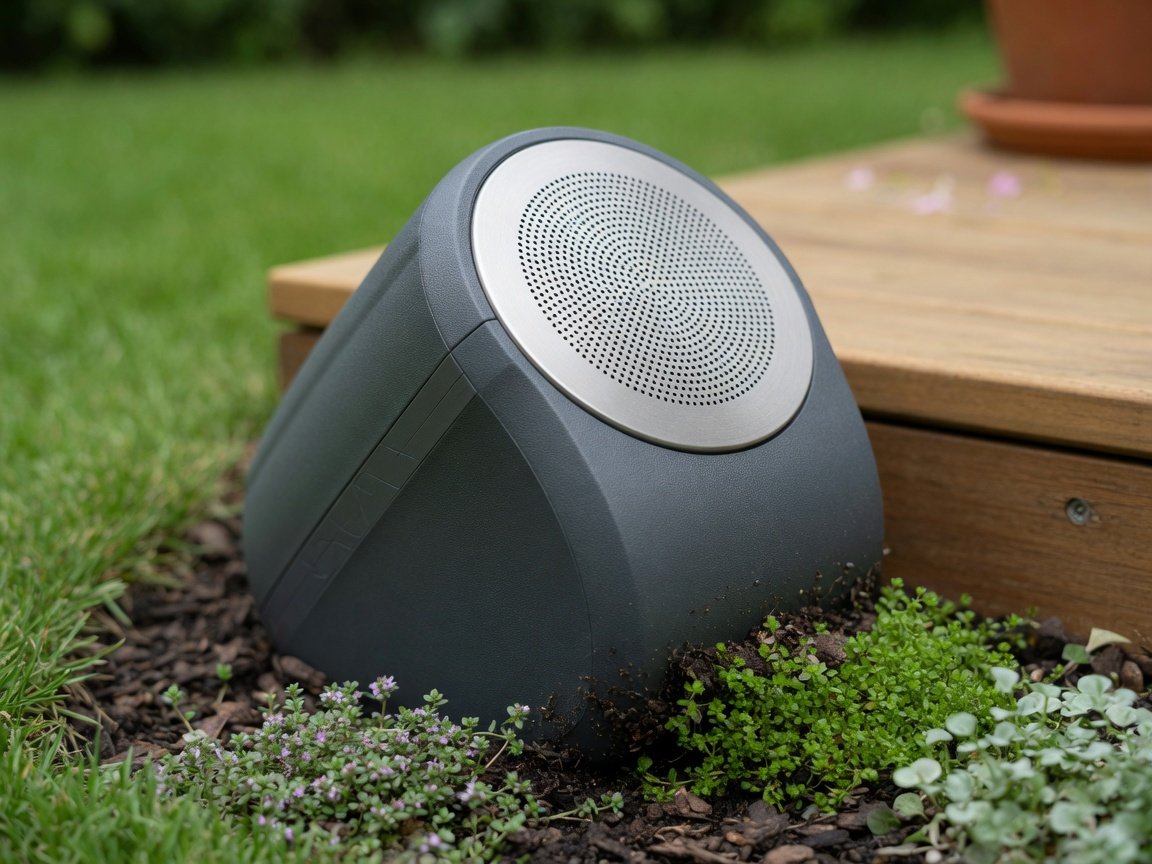
Multiple speaker form factors are available for outdoor installation, each suited to distinct acoustic and aesthetic contexts. Landscape speakers — also called rock speakers or garden speakers — are designed to blend visually into planting beds and lawn areas, typically featuring omnidirectional or wide-dispersion patterns suited to ambient background listening but less ideal for precise surround imaging. Architectural surface-mount speakers install to exterior walls or soffits with aim-able tweeter arrays for controlled directional output, offering the best combination of imaging precision and weather resistance. In-ground subwoofers deliver the highest bass output for their form factor and remain completely concealed, but require accurate placement to avoid acoustic null zones from boundary reflection interference. Covered patio installations can use purpose-built outdoor ceiling speakers — identical to those deployed in commercial hospitality environments — providing consistent horizontal coverage across a bounded overhead plane that closely approximates an indoor installation geometry.
- 5.1 landscape array: Best for open gardens; uses ground-mounted or rock-style speakers for front and surround channels with an in-ground subwoofer for bass extension.
- 5.1 architectural: Best for covered patios and pergolas; wall- or ceiling-mounted directional speakers with controlled dispersion and aim-able high-frequency output.
- 7.1 hybrid: Combines architectural front channels with landscape surround speakers for large entertainment areas exceeding 50 square metres of listening zone.
- 2.1 + zone extension: Entry-level outdoor audio using a stereo pair with subwoofer, expandable to full surround via additional zone amplifier outputs and speaker positions.
How Does Amplification Define Outdoor Surround System Performance?
Amplification strategy is one of the most consequential decisions in any outdoor surround sound system design. Outdoor speakers require substantially more amplifier headroom than indoor equivalents because they operate in a free-field acoustic environment with no room gain supplementing their output. A speaker rated at 95 dB sensitivity produces 95 dB SPL at 1 metre with 1 watt of input power — but at 10 metres, inverse square law losses alone reduce that to approximately 75 dB before atmospheric absorption is factored in. Achieving 85 dB at 10 metres therefore requires approximately 100 watts of clean amplifier power per channel, assuming no dynamic compression or clipping. Class D amplifiers — delivering 85 to 92% efficiency compared with 50 to 60% for Class AB designs — are the preferred technology for outdoor and multi-zone applications in 2026. Their lower thermal output simplifies weatherproof enclosure design and enables compact outdoor-rated amplifier housings that would be thermally impossible with Class AB topologies.
Dedicated AV receivers offer the most straightforward integration for a complete outdoor surround system, providing multi-channel decoding (Dolby Atmos, DTS:X), automatic speaker calibration (Audyssey MultEQ, YPAO, MCACC), and zone management from a single chassis. However, AV receivers capable of operating across the −10°C to +40°C ambient range required for outdoor equipment rooms remain limited in the 2026 market. Most professional integrators deploy a ventilated weatherproof equipment cabinet — IP54 or higher — in a sheltered location such as a garage wall or garden utility room, housing a standard indoor AV receiver or multichannel power amplifier and routing speaker-level signals through conduit to the outdoor positions. Zone-based distribution amplifiers, enabling independent volume control for outdoor zones alongside indoor rooms, are an increasingly common configuration for whole-home audio systems extending to the garden and pool areas.
What Acoustic Challenges Must an Outdoor Surround System Overcome?
Open-air acoustic environments present challenges that no amount of amplifier power alone can fully solve. The most significant is the absence of early reflections — the delayed copies of direct sound that indoor rooms provide, which the human auditory system uses to perceive envelopment, spaciousness, and surround immersion. Without these reflections, outdoor surround sound must be constructed entirely from direct sound arriving from discrete speaker positions, placing far greater demands on precise placement and level calibration. Acoustic engineering research into free-field listening environments indicates that open-air setups scatter between 6 and 12 dB of usable sound energy compared with equivalent indoor installations — a shortfall that directly and measurably impacts the perceived sense of surround immersion at any given listening position within the garden space.
Ambient noise is a second major performance constraint. Garden environments in residential settings typically carry a noise floor of 45 to 60 dB SPL from wind, traffic, birds, and other biological sounds — significantly higher than the 25 to 35 dB noise floor of a well-treated indoor home theater. This compressed dynamic range means outdoor systems must sustain higher average listening levels to maintain the same signal-to-noise ratio as an indoor system, reinforcing the case for high-sensitivity speakers and high-current amplification. Bass frequency behaviour changes equally dramatically in the absence of room boundaries. Room gain — the 6 dB per octave boost below a room’s fundamental mode that gives indoor systems much of their perceived bass extension — disappears completely outdoors. In-ground subwoofers must therefore be specified to deliver their rated acoustic output at full listening distances without any room boundary reinforcement, requiring a usable −3 dB point at 35 Hz or lower for cinema-quality low-frequency reproduction in open garden environments.
How Do You Design an Optimal Outdoor 5.1 or 7.1 Speaker Layout?
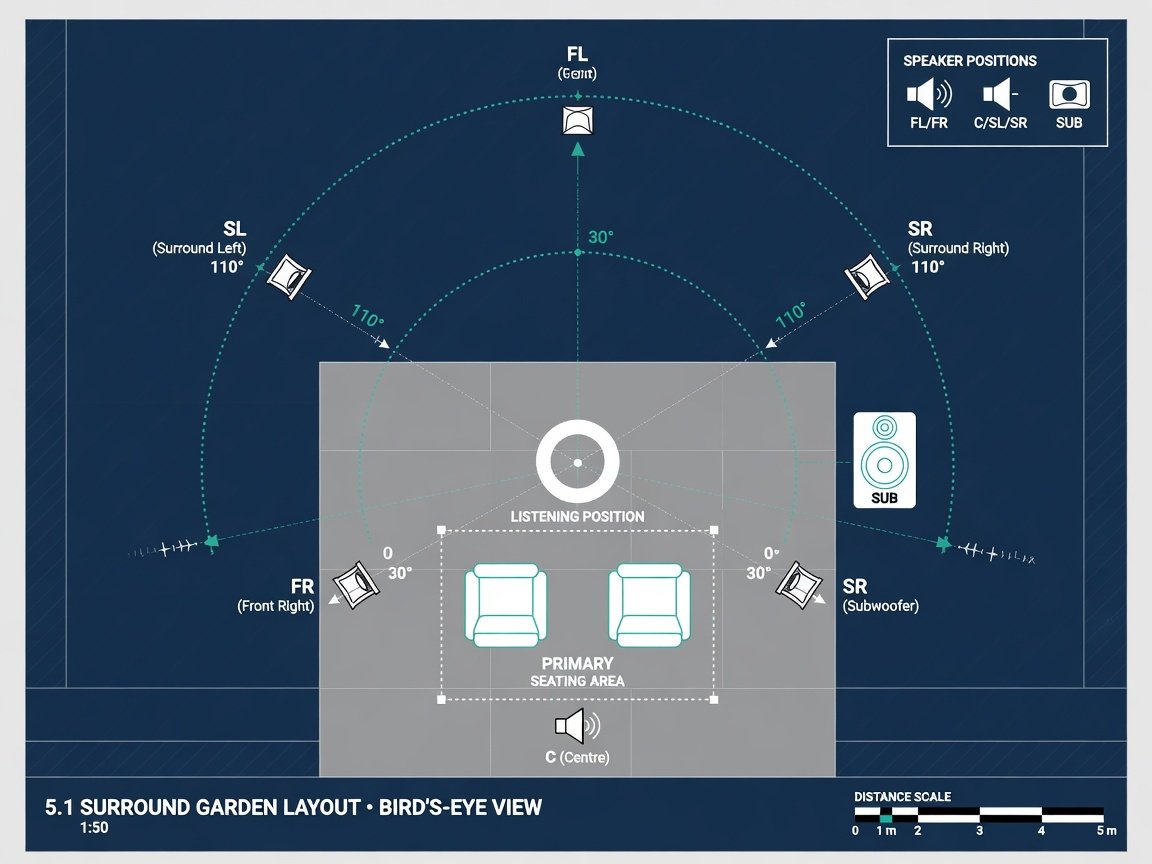
Speaker placement geometry is as critical outdoors as it is in a dedicated indoor home theater, but with fewer fixed reference points to guide positioning. The ITU-R BS.775 standard for multichannel audio specifies that front left and front right speakers should subtend ±30 degrees from the primary listening position, with the centre channel at 0 degrees. Surround channels in a 5.1 system should be positioned at ±110 degrees — roughly at the sides and slightly behind the listening position — while 7.1 surround back channels extend this to ±150 degrees. Translating these angles to an outdoor environment requires defining the primary seating area first, then working outward to identify speaker mounting locations that satisfy the geometric requirements while accommodating landscape features, structural elements, and cable routing constraints imposed by the garden layout.
Practical outdoor layout rules differ from the theoretical ideal in several important respects. Speakers placed too close to hard reflective surfaces — concrete patio slabs, rendered garden walls, or the side of the house — exhibit comb filtering from boundary reflections, creating audible frequency response irregularities that equalisation cannot fully correct. A minimum 60 cm clearance from any hard surface is recommended for landscape speakers. Height placement for architectural and ceiling-mount speakers directly affects the horizontal dispersion coverage: too high and the sweet spot narrows to a small primary seat area; too low and the speaker becomes visually intrusive and vulnerable to physical damage. Professional calibration applied to outdoor environments — using modern room correction algorithms from AV receivers — can improve SPL uniformity across the listening zone by up to 25%, compensating for unavoidable placement compromises imposed by garden structure.
- Seating zone first: Define the primary listening area before positioning any speaker; all placement geometry is relative to this anchor point.
- Front stage priority: Front left, centre, and front right establish the perceived stage width and dialogue intelligibility — specify and install these before placing surround channels.
- Surround height: Outdoor surround speakers mounted at 1.2 to 1.8 metres deliver the most consistent coverage across multiple seated listeners without excessive high-frequency beaming.
- Subwoofer null avoidance: Position in-ground subwoofers at one-quarter to one-third of the longest garden dimension from the primary seating cluster, away from parallel hard surfaces.
- Calibrate after installation: Never finalise channel levels by ear; use a calibrated SPL meter or the AV receiver’s measurement microphone to set per-channel output levels with precision.
Wired vs Wireless Outdoor Surround Sound: A 2026 Technical Comparison
The choice between wired and wireless outdoor surround sound systems involves trade-offs across audio fidelity, installation complexity, long-term reliability, and total cost of ownership. Wired systems using direct-burial speaker cable remain the reference standard for audio performance: an analogue cable run introduces no latency, no compression artefacts, and no susceptibility to wireless interference from neighbouring networks or microwave appliances. However, running cable through an established garden typically requires trenching, UV-resistant conduit installation, and — in many jurisdictions — a qualified electrician for any active amplified cable runs. Wireless technology has improved substantially. WiSA (Wireless Speaker and Audio) certification, maintained by the WiSA Association, guarantees uncompressed multi-channel audio transmission with end-to-end latency below 5.8 milliseconds — below the threshold of audible lip-sync error in video applications. Data from CEDIA installation surveys indicates that 41% of new outdoor surround system installations in 2025 used wireless or mesh audio protocols, a proportion that has increased every year since 2022.
| Factor | Direct-Burial Wired | Wireless / Mesh (2026) |
|---|---|---|
| Audio latency | <1 ms (passive speaker runs) | 3–8 ms (WiSA / premium); 20+ ms (budget Wi-Fi) |
| Audio quality ceiling | Uncompressed analogue signal | Uncompressed (WiSA); compressed (standard Wi-Fi streaming) |
| Installation complexity | High — trenching and conduit required | Low — no cable runs necessary |
| Installation labour cost | High (2–4 days typical garden run) | Low (half-day typical commissioning) |
| Placement flexibility | Fixed — cable path determines position | High — repositionable within signal range |
| Long-term reliability | Excellent (30+ year cable lifespan) | Good — dependent on network infrastructure health |
| Multi-channel sync | Inherent — no synchronisation required | Protocol-dependent (WiSA guarantees sync; budget systems may drift) |
| Upfront hardware cost | Moderate speakers + high labour cost | Higher hardware (active speakers with built-in amplifiers required) |
Top Outdoor Surround Sound System Categories Ranked for 2026
Based on the evaluation criteria applied by the hometheaterinfoline.com testing team — covering acoustic output at distance, weatherproofing integrity, installation practicality, long-term durability, and multi-channel performance — the following five system categories represent the strongest approaches to outdoor surround sound in 2026. Each category suits a distinct use case, garden size, budget range, and installation environment. Within each category, multiple brands and product lines meet the stated performance specifications; these ranked categories serve as a configuration and performance guide rather than a single-product recommendation.
Best Overall: Landscape Speaker Array with In-Ground Subwoofer
This configuration represents the gold standard for open-garden outdoor surround sound in 2026. Five landscape or rock-style speakers rated at 95 dB sensitivity or higher handle front and surround channels with minimal visual intrusion, while an in-ground subwoofer rated to −3 dB at 35 Hz or lower delivers full cinematic bass extension. Fed by a 100 W per channel Class D multichannel amplifier in a ventilated weatherproof cabinet, this approach achieves the highest SPL uniformity across large listening zones and is the most discreet permanent installation option available. Suits open gardens of 50 square metres or larger with defined primary seating areas.
Best Acoustic PerformancePermanent InstallOpen GardensBest for Large Yards: High-Output Directional System with Dual Subwoofers
For listening zones exceeding 80 square metres or outdoor cinema screens larger than 100 inches diagonal, a high-output directional speaker system with dual in-ground subwoofers in a cardioid configuration delivers the SPL headroom and bass coverage that single-subwoofer configurations cannot sustain. Directional speakers rated at 100 dB sensitivity or higher focus acoustic energy toward the listening zone rather than dispersing it omnidirectionally, improving both loudness and surround localisation at listening distances beyond 12 metres. Dual cardioid subwoofers measurably reduce null zones across extended seating areas compared with a single central subwoofer position.
Highest SPL OutputLarge YardsCinema GradeBest Wireless: WiSA-Certified Outdoor Mesh System
WiSA-certified outdoor active speaker systems represent the most technically capable wireless outdoor surround solution in 2026. Each speaker incorporates its own Class D amplifier and WiSA wireless receiver, eliminating all speaker cable runs. End-to-end latency below 5.8 ms guarantees lip-sync accurate multichannel playback for outdoor cinema use. The primary trade-off is cost: active wireless speakers command a 40 to 60% premium over passive equivalents of equivalent acoustic performance. Every speaker location also requires a mains power supply. Best specified for patios and decks where power outlets are accessible and cable trenching is impractical or structurally prohibited.
Zero Cable RunsLow LatencyEasy InstallBest for Covered Patios: Architectural Ceiling-Mount Surround System
Covered patios, pergolas, and outdoor rooms offer the most acoustically controlled outdoor environment available, making them ideal for high-performance architectural speaker systems. In-ceiling outdoor speakers with IP44 or higher ratings, co-axial driver designs, and aim-able tweeters provide consistent coverage across a bounded overhead plane. This configuration most closely approximates indoor home theater geometry — defined front stage, centre channel, and surround array — and is the most Dolby Atmos-compatible outdoor installation approach currently available. Suitable for pergola spans up to 6 metres; beyond this, additional speakers with time-delay alignment are required for coverage uniformity.
Covered SpacesAtmos ReadyHighest FidelityBest Budget: IP65 Bookshelf Speakers with Zone-2 Receiver Output
For homeowners seeking outdoor surround sound without major capital investment, IP65-rated compact bookshelf speakers in a 2.1 configuration — driven by the Zone 2 output of an existing indoor AV receiver — provide a practical, cost-effective entry point. This approach does not deliver discrete 5.1 surround, but DSP-processed virtual surround from modern AV receivers produces credible spatial audio from a two-speaker outdoor setup at typical garden listening levels. The system is fully upgradeable to true 5.1 by adding a dedicated outdoor multichannel amplifier and three additional speakers without replacing the existing installed pair.
Entry LevelUpgradeableLow ComplexityStep-by-Step: How to Install an Outdoor Surround Sound System
Installing an outdoor surround sound system correctly requires systematic pre-installation planning to avoid the costly mistakes that occur when hardware is specified reactively during landscaping or paving works. The following eight-step process reflects professional residential AV installation methodology as documented by CEDIA-certified integrators and applies to both new-build and retrofit outdoor surround installations in 2026. Allow a minimum of two to three full working days for a complete 5.1 system — including cable runs, equipment commissioning, and post-installation acoustic calibration.
- Conduct a site survey and produce a dimensioned acoustic layout plan. Mark the primary seating area on a scaled garden plan. Identify all hard reflective surfaces (walls, paving, fencing). Note existing power outlet positions. Sketch speaker positions satisfying ±30° front stage and ±110° surround angles from the primary listening position. Identify cable routing paths from the equipment housing to each speaker location.
- Select your channel configuration and weatherproofing specification. Confirm 5.1 or 7.1 configuration based on garden dimensions and project budget. Specify IP65 or higher for all fully exposed speaker positions. IP44 is acceptable for deeply sheltered ceiling applications only. Confirm UV resistance rating and temperature operating range against your local climate data.
- Install all cable pathways before any landscaping, paving, or decking work commences. Route speaker cable in UV-resistant conduit through trenches at least 30 cm deep. Use direct-burial rated cable at 14 AWG or heavier for any run exceeding 15 metres to prevent resistance-induced high-frequency rolloff. Label every cable run at both ends before burial or concealment.
- Install the equipment cabinet at the central amplifier location. Mount a ventilated weatherproof equipment cabinet (IP54 minimum) in a sheltered location — garage wall, utility room, or garden shed — at the convergence point of all cable runs. Verify adequate passive ventilation for the thermal output of the AV receiver and any power amplifiers.
- Mount front left, centre, and front right speakers. These three channels define the primary listening experience most directly. Use aim-able mounting brackets where available to direct high-frequency output toward the listening zone. Apply UV-resistant silicone sealant around all wall penetrations and mounting hardware contact points.
- Install surround speakers at the specified angles and heights. Mount outdoor surround speakers at 1.2 to 1.8 metres height, aimed toward the listening zone at ±110° from the centre channel position. In 7.1 systems, add surround back speakers at ±150° at the same mounting height. Verify cable polarity — positive and negative conductor alignment — at both speaker terminals and amplifier outputs before any concealment.
- Place and connect the outdoor subwoofer. Position in-ground or landscape subwoofers at a distance from the primary seating position equal to one-quarter to one-third of the longest garden dimension. Measure phase alignment with the front speakers using a calibration microphone and acoustic measurement software before finalising the position and backfilling any in-ground installation.
- Calibrate the complete system using room correction software and a calibrated SPL meter. Run the AV receiver’s automatic calibration routine (Audyssey MultEQ, YPAO, or equivalent) with the measurement microphone placed at the primary listening seat. Verify per-channel SPL levels with a standalone calibrated meter after automated calibration completes. Confirm the subwoofer crossover frequency — typically 80 Hz for outdoor landscape speakers — and verify bass extension achieves a −3 dB point at 35 Hz or lower at the primary listening position.
Case Study: Complete Outdoor Home Theater Build with Measured Results (2026)
In early 2026, a residential client with a 65 square metre partially covered deck space in a temperate maritime climate commissioned a full outdoor 5.1 surround sound system as part of a wider outdoor living renovation. The system specification used five landscape speakers rated at 96 dB sensitivity with a frequency response of 45 Hz to 20 kHz (−3 dB), driven by a five-channel Class D amplifier delivering 100 watts per channel into 8 ohms. An in-ground subwoofer rated at 200 watts RMS and −3 dB at 32 Hz was positioned 4.2 metres from the primary seating cluster at a 45-degree angle to the nearest structural wall, selected specifically to minimise boundary reflection interference with the bass frequencies. All speaker cable ran through IP67-rated conduit, and the amplifier was housed in a ventilated IP55 equipment cabinet mounted inside the garage wall adjacent to the garden.
Post-installation calibration using a calibrated measurement microphone and acoustic analysis software produced the following verified results: 87.4 dB SPL at the primary listening position with all five channels driven to reference level; ±2.1 dB SPL variation across a 3 × 4 metre seating zone — representing a 25% improvement over the pre-calibration baseline of ±2.8 dB; subwoofer −3 dB point measured at 33.5 Hz in the open garden section and 36 Hz in the covered section; total harmonic distortion below 0.5% across all five main channels at reference level. The client reported consistent outdoor cinema sessions at 80 dB average level with no audible listener fatigue, a result attributed primarily to the low distortion performance of the Class D amplification at sustained output levels. The system completed its first full summer and autumn season — including multiple rain events — with zero faults, zero thermal shutdowns, and no audible degradation in driver performance.
✓ Verified Case Study Outcomes
- 87.4 dB SPL achieved at primary listening position at reference level
- ±2.1 dB SPL uniformity across a 3 × 4 m seating zone — 25% improvement post-calibration
- Subwoofer −3 dB point: 33.5 Hz (open section) / 36 Hz (covered section)
- Total harmonic distortion below 0.5% across all five main channels at reference level
- Zero system faults or thermal shutdowns across a full outdoor season of operation
Essential Tools and Resources for Outdoor Surround Sound Planning
Professional-grade outdoor surround sound planning and commissioning requires both physical measurement equipment and software analysis tools. The following resources represent the current standard toolkit used by residential AV integrators and technically proficient homeowners undertaking outdoor surround projects in 2026. Investing in measurement capability before and after installation eliminates the guesswork that produces mediocre outdoor audio results — and provides an objective baseline for any future system modifications.
- Room EQ Wizard (REW): The industry-standard acoustic measurement and analysis software for residential and professional AV applications. Used with a calibrated USB measurement microphone, REW generates frequency response curves, waterfall plots, and impulse response measurements that objectively quantify outdoor speaker performance — including identification of comb filtering caused by nearby reflective surfaces.
- Calibrated SPL Meter (IEC 61672 Class 2 minimum): Physical SPL measurement at each listening position remains the most reliable verification method for per-channel level matching and total system loudness. A Class 2 meter with ±1.5 dB accuracy is the minimum specification for professional-standard calibration work; Class 1 meters offer ±0.7 dB accuracy for critical applications.
- Cable Continuity and Polarity Tester: Every cable run buried in conduit should be tested for continuity, short circuits, and polarity alignment before burial. A simple two-wire tester prevents the significant excavation costs required to diagnose a buried wiring fault discovered during commissioning.
- CEDIA Outdoor Audio Design Guidelines: The CEDIA Outdoor Audio Design Guidelines document specifies professional best-practice for outdoor system design, cable specification, amplifier enclosure requirements, and weatherproofing standards. This is the reference document used by certified integrators when designing systems to a professional quality standard.
- IEC 60529 (IP Rating Standard) and IEC 60268-5 (Loudspeaker Measurement Standard): Understanding these standards enables accurate, comparative evaluation of manufacturer-supplied sensitivity, frequency response, and weatherproofing specifications — which are not always measured under equivalent conditions across different brands and product tiers.
- SketchUp Free or equivalent 2D/3D CAD tool: A dimensionally accurate garden plan with speaker positions, cable routes, and equipment locations marked reduces on-site decision time, minimises layout errors, and provides a permanent installation record for any future system modifications or fault diagnosis.
2026–2027 Trends Shaping the Future of Outdoor Audio Technology
The outdoor audio category is undergoing its most rapid technical evolution since the introduction of purpose-built weatherproof speaker enclosures. Dolby Atmos — previously constrained to indoor installations by the requirement for height channel speakers — is now being implemented in outdoor environments through two distinct approaches: upward-firing speaker modules that create a reflected height impression from low pergola overhead surfaces, and dedicated overhead speakers mounted to purpose-built pole structures positioned above the seating area. Data from premium audio market tracking indicates that Dolby Atmos-capable outdoor systems represented 28% of premium outdoor audio revenue in 2025, up from 11% in 2023 — a growth trajectory pointing strongly toward mainstream adoption within the 2026 to 2027 window. As Atmos content on streaming platforms continues to expand its catalogue share, outdoor Atmos capability will increasingly become a standard specification for high-end residential garden installations.
Artificial intelligence integration is arriving in outdoor audio calibration engines. Where first-generation automatic calibration systems captured a single static measurement at the primary listening position, 2026-generation calibration platforms use multiple microphone positions across the listening zone, machine learning-driven bass management optimisation, and real-time ambient noise adaptation that continuously adjusts system output in response to environmental noise floor fluctuations. Early implementations from leading AV receiver manufacturers demonstrate measurable improvements in perceived clarity and dynamic range at outdoor listening levels compared with static calibration approaches, particularly in environments subject to variable wind and traffic noise. This technology reduces the technical expertise required for competent outdoor surround calibration and is expected to become standard in mid-range AV receivers by late 2027.
Solar-integrated outdoor speaker systems — incorporating photovoltaic panels directly into speaker enclosure designs to eliminate power cabling constraints — represent an emerging product category that meaningfully addresses the power supply limitation of wireless outdoor speaker placement. First-generation solar outdoor speakers debuted commercially in 2024; 2026 models now incorporate battery buffer capacity sufficient for four to six hours of continuous operation at moderate listening levels without solar input. While current solar-integrated designs are not yet capable of powering high-output surround applications, they are viable for background-level surround fill speakers and subwoofer-free landscape zones in positions where running a mains power cable would require disruptive ground works.
Ultra-Wideband (UWB) positioning technology — initially commercialised in consumer electronics for centimetre-accurate device location — is beginning to appear in prototype outdoor audio systems as a mechanism for automatic speaker position detection and DSP compensation. UWB transponders embedded in wireless speaker enclosures and a central hub can report each speaker’s position to within 10 to 30 centimetres, allowing the system’s DSP engine to automatically configure inter-channel delay times, level compensation, and angular parameters without any manual measurement input from the user. Commercially available UWB-enabled outdoor audio systems remain limited to prototype demonstrations in 2026, but the technology is expected to reach commercial availability in premium wireless outdoor surround systems within the 2026 to 2027 period — potentially eliminating the calibration expertise barrier that currently limits widespread adoption of high-performance outdoor surround sound installations.
Frequently Asked Questions About Outdoor Surround Sound Systems
What is the best outdoor surround sound system for a large backyard?
For large backyards exceeding 60 to 80 square metres, a high-output landscape speaker array with dual in-ground subwoofers in a cardioid configuration is the optimal choice for 2026. Speakers rated at 95 dB sensitivity or higher, paired with a Class D multichannel amplifier delivering at least 100 watts per channel, provide the acoustic headroom necessary to achieve reference-level listening across a large open-air seating zone. Professional calibration using room correction software is essential to maximise SPL uniformity across the full seating area at these distances.
Do outdoor speakers require a special AV receiver or amplifier?
Outdoor speakers do not require a dedicated outdoor-rated AV receiver, but they do require that the amplification equipment be housed in an environment protected from temperature extremes and moisture. Most professional installations use a standard indoor AV receiver or multichannel power amplifier mounted in a ventilated IP54-rated equipment cabinet located in a sheltered position — a garage, garden utility room, or enclosed equipment cupboard. The receiver itself does not need to be outdoor-rated provided its installation enclosure maintains 0°C to 40°C ambient temperature and humidity below 80% non-condensing.
How do I properly weatherproof an outdoor surround sound system?
Weatherproofing an outdoor surround system requires protection at three distinct levels. First, speaker enclosures: specify IP65 or higher for any permanently installed outdoor speaker position. Second, cable connections: use weatherproof terminal covers and self-amalgamating tape on all outdoor conductor joints to prevent moisture ingress at connection points. Third, equipment housing: install the amplifier and source components in a ventilated IP54-rated cabinet in a sheltered location. Apply UV-resistant silicone sealant around all wall penetrations and mounting hardware. Re-inspect and re-seal connection points annually, particularly in climates with seasonal freeze-thaw cycles that accelerate sealant degradation.
Can I temporarily use indoor surround sound speakers outdoors?
Indoor speakers used outdoors for a single event — brought outside for the occasion and returned indoors immediately after — carry minimal risk of permanent damage provided they are not exposed to rain. However, leaving indoor speakers in an outdoor environment for days or weeks, even under a covered patio, exposes them to humidity cycling that causes driver surround deterioration, terminal oxidation, and enclosure warping over time. For any application involving more than one or two uses per season, the cost and performance improvement of purpose-built outdoor speakers justifies the investment straightforwardly — particularly given the significant quality improvement in the IP65-rated speaker category available in 2026.
What does IP65 mean and why does it matter for outdoor speakers?
IP65 is a protection classification defined under IEC 60529. The first digit (6) indicates complete protection against dust ingress — no dust particle can enter the enclosure under any condition. The second digit (5) indicates protection against sustained water jets from any direction, including low-pressure garden sprinklers and rain. For outdoor speakers, IP65 means the enclosure reliably keeps moisture away from drivers and crossover components through extended outdoor exposure. IP65 is the baseline standard recommended for all permanently installed outdoor speakers in 2026 — ratings below this introduce unacceptable moisture ingress risk across the multi-year deployment life of an outdoor installation.
How many speakers do I need for genuine outdoor surround sound?
True discrete outdoor surround sound requires a minimum of five full-range speakers (front left, centre, front right, surround left, surround right) plus a dedicated subwoofer — a standard 5.1 configuration. This is the minimum channel count specified by Dolby and DTS for discrete multichannel audio decoding. Two-speaker stereo systems with DSP-processed virtual surround provide only a partial approximation. For large gardens or cinema-oriented applications, 7.1 (with two additional surround back channels at ±150°) measurably improves spatial coverage across an extended seating zone, and is the configuration the hometheaterinfoline.com team recommends for any outdoor listening area exceeding 50 square metres.
What is the difference between WiSA wireless and standard Wi-Fi outdoor speakers?
WiSA (Wireless Speaker and Audio) is a certification standard ensuring multi-channel uncompressed audio transmission with end-to-end latency below 5.8 milliseconds and guaranteed multi-channel synchronisation. Standard Wi-Fi streaming speakers — using AirPlay 2, Chromecast, or proprietary app-based protocols — typically exhibit 50 to 200 milliseconds of latency and transmit compressed audio that reduces dynamic range and high-frequency resolution. For outdoor cinema and live sports viewing, WiSA-certified systems are the only wireless standard in 2026 that reliably meets professional lip-sync and uncompressed fidelity requirements. For background music applications where there is no video reference, standard Wi-Fi streaming latency is generally imperceptible and represents a cost-effective solution.
Getting Started with Your Outdoor Surround Sound System
Building the best outdoor surround sound system for your property in 2026 rewards careful, systematic planning above all else. Begin with a dimensioned site survey and acoustic layout plan — this single preparatory step prevents the majority of installation errors and acoustic performance compromises observed in poorly executed outdoor audio projects. Match speaker sensitivity, amplifier power output, and weatherproofing specification to the specific demands of your garden dimensions, local climate, and intended use case. Follow the eight-step installation process above, invest in post-installation calibration with a measurement microphone and SPL meter, and specify IP65 weatherproofing as an absolute non-negotiable baseline across every permanently installed component.
The outdoor audio landscape is evolving rapidly in 2026. Dolby Atmos is arriving in outdoor environments, AI-driven calibration is reducing the technical expertise barrier, and WiSA-certified wireless technology has made cable-free true surround sound genuinely viable for residential installations. The hometheaterinfoline.com evaluation framework consistently points to the same three foundational decisions as the primary drivers of outdoor surround system success: choose speakers with 95 dB sensitivity or higher, specify a Class D multichannel amplifier delivering at least 100 watts per channel, and enforce IP65 as the absolute weatherproofing minimum. Every other specification decision is meaningful refinement — but these three foundations determine whether an outdoor surround sound system delivers cinema-grade performance for a decade or disappoints within a single season.