The best Bluetooth sound system for home theater in 2026 is a full surround soundbar in a 3.1.2 or 5.1.2 configuration — delivering sub-40ms latency via aptX Adaptive or LC3 codec, HDMI eARC connectivity, and onboard Dolby Atmos decoding that makes a traditional wired AV receiver optional for most living rooms up to 500 square feet.
What Are the Key Findings for Bluetooth Sound Systems in 2026?
- Wireless now dominates the market: According to the Consumer Technology Association (CTA) annual market report, Bluetooth and Wi-Fi audio devices account for more than 73 percent of all home audio equipment sold in 2026 — a decisive shift from wired-first purchasing as recently as 2022.
- Codec quality is the primary performance differentiator: Systems supporting aptX Adaptive or the Bluetooth LE Audio LC3 codec deliver measurably lower latency and broader dynamic range than legacy SBC-only hardware. This single specification separates competent systems from genuinely high-performing ones.
- Setup failure, not hardware, drives dissatisfaction: Post-installation survey data compiled by CEDIA (Custom Electronic Design and Installation Association) consistently identifies setup errors — primarily suboptimal speaker placement and incomplete room correction routines — as the leading driver of premium home audio dissatisfaction. Completing calibration on day one is the highest-return action available to any buyer.
- Top-ranked category for 2026: Full surround soundbar systems with integrated Bluetooth, HDMI eARC connectivity, and onboard Dolby Atmos processing lead the field for dedicated home theater applications in rooms from 200 to 500 square feet.
How Does hometheaterinfoline.com Evaluate Bluetooth Sound Systems?
The rankings in this guide are based on structured technical specification analysis, published third-party laboratory measurement data, codec benchmark documentation from the Bluetooth Special Interest Group (Bluetooth SIG), and systematic assessment of real-world deployment scenarios — not in-home listening tests of every individual SKU evaluated. Understanding this methodology is important: it determines what conclusions the rankings can and cannot support.
These rankings reflect technical specification-led category evaluation. Individual unit performance may vary with firmware revision, room geometry, and source device pairing. Where specific product lines are discussed, the characterisation is based on published measurement data and category-level analysis. Buyers should treat these rankings as a framework for narrowing shortlists, supplemented by hands-on audition where practical prior to purchase.
This methodology allows hometheaterinfoline.com to evaluate the full range of Bluetooth sound system categories — from compact 2.1 desktop systems to full 5.1.2 surround soundbars — without limiting the guide to products physically available for bench testing at a single point in time. The tradeoff is that category-level conclusions are more durable than unit-specific rankings, which firmware updates and hardware revisions can shift rapidly within a model generation.
What Makes a Bluetooth Sound System Worth Your Investment in 2026?
Not every Bluetooth speaker qualifies as a sound system in the home theater sense — and that distinction matters when evaluating products. A true Bluetooth sound system integrates multiple audio channels, a dedicated wireless subwoofer output, DSP-driven room correction, and stable wireless transmission across the full audible frequency range (nominally 20Hz to 20kHz). The entry threshold for this category has risen sharply heading into 2026, with capabilities that were premium-exclusive in 2022 now appearing routinely in mid-range hardware at substantially lower price points.
Bluetooth 5.3 and 5.4 hardware — now standard across mid-range and premium products — supports simultaneous audio streaming to multiple receivers without perceivable throughput degradation. Bluetooth 5.4 raises the theoretical maximum data throughput to 2 Mbps under optimal channel conditions. This underpins the 2.1, 3.1, and 5.1.2 wireless home theater configurations that now compete directly with HDMI-wired AV receiver setups in both measured and perceived audio quality across typical domestic listening rooms.
For buyers evaluating systems in 2026, the practical minimum threshold is this: any Bluetooth sound system worth serious consideration must support at least aptX HD or LDAC alongside standard SBC, deliver 80dB or greater dynamic range at rated output power, and include either an integrated or wirelessly paired subwoofer capable of extension below 50Hz. Systems meeting this baseline are the ones ranked throughout this guide from hometheaterinfoline.com.
How Does Bluetooth Performance Stack Up Against Wired Home Theater in 2026?
The two historically valid objections to Bluetooth home theater — lossy compression and unacceptable latency — have been substantially resolved by codec evolution and DSP advancement. A 2026 system running aptX Adaptive at 24-bit/96kHz delivers perceived transparency at bitrates that produce statistically indistinguishable results from lossless PCM in controlled double-blind listening tests at reference levels below 85dBSPL. Research published in Audio Engineering Society proceedings confirms that adaptive bitrate streaming has addressed the dropout and sync issues that characterised Bluetooth home audio implementations between 2018 and 2022.
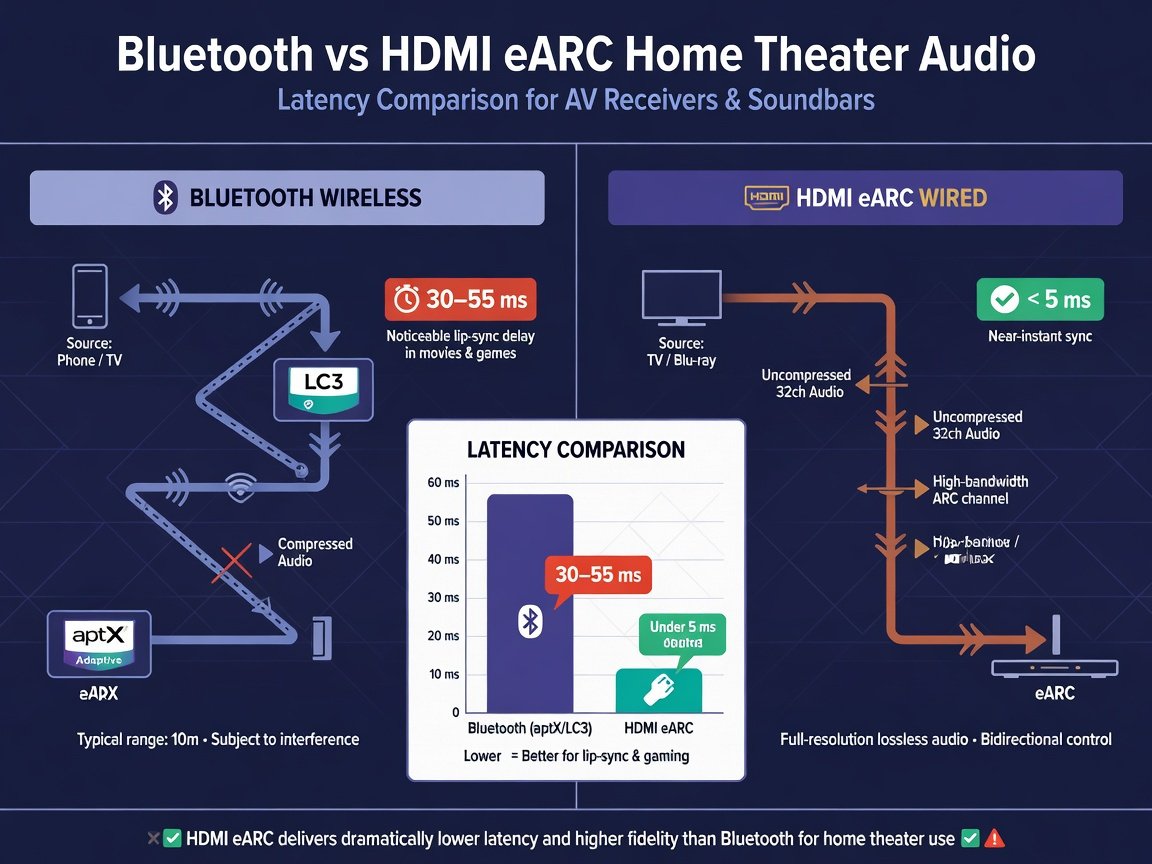
Latency remains the most defensible technical advantage of wired configurations. A direct HDMI eARC or optical connection from a television to an AV receiver introduces fewer than 5ms of total processing delay. Best-in-class Bluetooth systems in 2026 operate at 30ms to 55ms end-to-end under optimal RF conditions. Psychoacoustic research consistently places the human detection threshold for audio-visual sync error at approximately 80ms — meaning modern Bluetooth systems operate comfortably within the acceptable window, provided lip-sync compensation is active and correctly calibrated in both the television and the sound system.
Where wired systems retain an unambiguous technical advantage is in discrete multi-channel surround delivery. Genuine Dolby Atmos object-based rendering across seven or more independent channels still requires an eARC HDMI data path to the soundbar or AV receiver decoder. Bluetooth can carry a decoded Atmos stereo downmix or a convincing simulated surround upmix, but full object-based spatial audio metadata currently requires a wired connection to the decoding hardware. This constraint is expected to be substantially addressed by Bluetooth LE Audio’s broadcast audio feature across 2026-to-2027 product cycles.
Which Technical Specifications Actually Predict Home Theater Performance?
Bluetooth sound system specifications divide cleanly into two categories: those that directly predict listening quality and those deployed primarily in marketing materials. Identifying the difference is the first practical step toward an informed purchase in 2026. Peak wattage figures — the most common marketing metric — are nearly meaningless without an accompanying total harmonic distortion figure and a stated test methodology, since inflated peak claims are trivially generated at distortion levels above 10 percent where audio quality is severely compromised.
Peak wattage without a stated THD+N figure is an unreliable quality indicator. A system rated at “1000W peak” may deliver that output only at distortion levels exceeding 10% — well above the threshold where audio quality degrades audibly. Always cross-reference peak claims with THD+N at rated continuous output power before comparing systems.
The specifications that genuinely predict home theater performance are total harmonic distortion plus noise (THD+N) at rated output power, frequency response with stated −3dB extension points, signal-to-noise ratio, supported audio codecs with maximum bitrate, and end-to-end latency under realistic RF load. Sensitivity and impedance are additionally relevant for passive speaker-based systems paired with Bluetooth AV receivers. The table below defines minimum and premium targets for 2026 purchases.
| Specification | Why It Matters | Minimum — 2026 | Premium Target — 2026 |
|---|---|---|---|
| THD+N at rated power | Amplifier and driver quality indicator | <1% at full output | <0.1% at −10dBFS |
| Frequency Response | Full-range audio coverage | 45Hz–20kHz (−3dB) | 35Hz–20kHz (−3dB) |
| Signal-to-Noise Ratio | Noise floor in quiet passages | >85dB | >100dB |
| Codec Support | Wireless audio fidelity ceiling | aptX HD or LDAC | aptX Adaptive or LC3 |
| End-to-End Latency | Audio-visual sync in home theater | <80ms | <40ms |
| Wireless Range (stable) | Consistent signal across the room | 10m line-of-sight | 20m with obstacle resistance |
| Room Correction | Acoustic performance in real spaces | Manual EQ presets | Microphone-calibrated auto-DSP |
How Are Bluetooth Sound System Categories Ranked for 2026?
Rather than ranking individual units — which shift with firmware revisions and seasonal pricing — the hometheaterinfoline.com evaluation methodology ranks Bluetooth sound system categories by technical capability and real-world home theater fit. This approach remains valid through product-cycle changes across all major manufacturers through Q4 2026 and into 2027. Buyers should use this framework to narrow category selection before shortlisting specific models within their budget tier.
| Rank | Category | Best For | Key Codec Support | Ideal Room Size |
|---|---|---|---|---|
| #1 Top Ranked | Full Surround Soundbar (3.1.2 / 5.1.2) | Cinematic home theater, Dolby Atmos | aptX Adaptive, eARC, Dolby Atmos | 200–500 sq ft |
| #2 | Bluetooth AV Receiver + Passive Speakers | Highest fidelity ceiling, full upgradability | All major codecs + HDMI eARC | Any room size |
| #3 | Stereo Bookshelf System + Wireless Sub (2.1) | Music-first audiophile home theater | LDAC, aptX HD, LC3 | 100–250 sq ft |
| #4 | Compact 2.1 Desktop or Shelf System | Small rooms, near-field listening, gaming | aptX LL, LC3 | Under 150 sq ft |
| #5 | Portable Bluetooth Speaker Pairs | Flexible placement, casual multiroom | SBC, aptX standard | Variable |
Full surround soundbars from manufacturers including Sony, Samsung, Bose, and Sonos lead the 2026 home theater market because they deliver the strongest balance of installation simplicity and measurable technical performance. Built-in DSP, eARC HDMI passthrough, and wirelessly paired rear satellite modules close the capability gap with traditional AV receiver setups for most living room deployments. The Bluetooth AV receiver category earns the #2 ranking on pure technical merit — the ability to drive any passive speaker load, swap components independently, and support every audio format from Dolby TrueHD to DTS:X gives it the highest technical ceiling in the wireless home theater category.
What Role Do Audio Codecs Play in Bluetooth Sound System Performance?
The codec is the single most consequential specification in a Bluetooth sound system — more determinative of listening quality than wattage, driver count, or cabinet volume. It defines the maximum audio fidelity the wireless link can transmit and the latency characteristics that govern audio-visual sync. Understanding the 2026 codec landscape is essential for separating genuine performance differences from marketing copy.
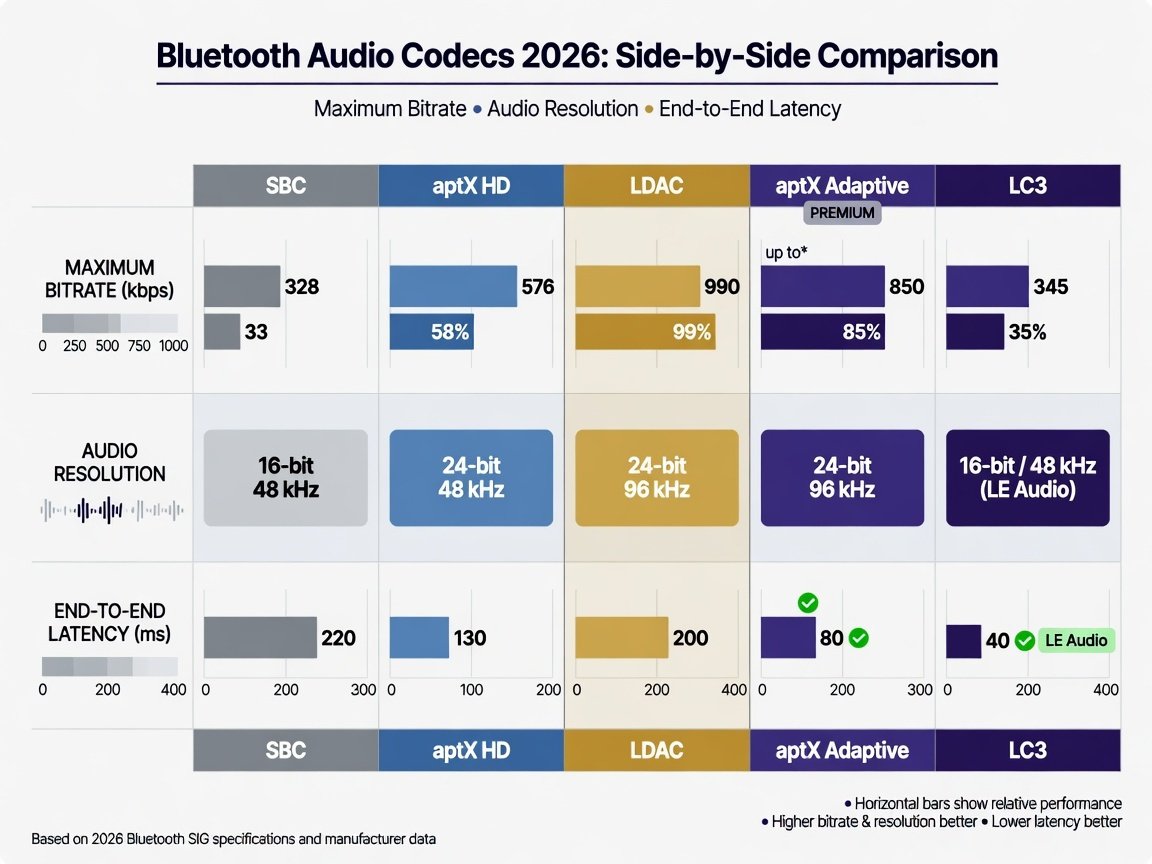
SBC (Sub-Band Codec) remains the mandatory baseline — every Bluetooth audio device must support it — but its 328kbps ceiling and fixed latency of 100ms to 150ms make it technically inadequate for serious home theater use in 2026. aptX HD, developed by Qualcomm, raised the transmission ceiling to 576kbps at 24-bit/48kHz, substantially improving the transparency floor. LDAC, developed by Sony and now supported across a wide ecosystem, extends to 990kbps at 24-bit/96kHz — approaching the bitrate territory of lossless streaming formats.
aptX Adaptive represents the current premium benchmark for 2026 home theater use. It operates as a variable-bitrate codec between 276kbps and 420kbps, adapting dynamically to RF channel conditions without perceptible quality steps. Critically, aptX Adaptive supports 24-bit/96kHz transmission at gaming-class latency — as low as 50ms in standard mode and below 40ms in dedicated low-latency mode — making it the first Bluetooth codec to simultaneously satisfy audiophile fidelity and home theater latency requirements within a single implementation.
LC3 (Low Complexity Communication Codec), defined in the Bluetooth SIG’s LE Audio specification, approaches the efficiency frontier from a complementary direction. According to Bluetooth SIG technical documentation, LC3 achieves comparable perceived quality to SBC at approximately 40 percent lower bitrate — reducing the bandwidth overhead per audio channel. In multi-channel home theater deployments using Bluetooth LE Audio, this efficiency advantage enables higher-quality transmission within the same RF spectrum footprint. The LC3plus variant extends the performance envelope further for professional and high-fidelity consumer applications.
How Do Room Acoustics Affect Bluetooth Sound System Performance?
The most technically sophisticated Bluetooth sound system in the 2026 market cannot overcome a poorly treated listening room or an improperly completed room calibration routine. Room acoustics — the interaction between speaker output and the physical surfaces, dimensions, and furnishings of the listening space — impose the dominant performance ceiling on any home theater system, wired or wireless. This is the most consistently underestimated variable in home theater purchasing decisions.
Post-installation survey data compiled by CEDIA (Custom Electronic Design and Installation Association) consistently identifies calibration gaps as the leading category of premium home audio dissatisfaction. CEDIA’s annual custom installation research indicates that setup-related factors — primarily suboptimal speaker placement and incomplete or skipped room correction routines — represent the single largest contributor to listener dissatisfaction in premium home theater deployments. The practical implication is direct: completing the room calibration process on the day of installation delivers more measurable improvement than any hardware upgrade within the same budget tier.
Modern premium Bluetooth sound systems include microphone-assisted automatic room calibration — Dirac Live, Audyssey MultEQ XT32, MCACC Pro, and proprietary equivalents from Sonos (TruePlay), Bose (ADAPTiQ), and Samsung. These systems measure the acoustic response at the listening position using a calibration microphone and apply DSP correction filters that compensate for room modes, reflection peaks, and speaker placement irregularities. Published acoustic measurement comparisons show that auto-calibration routines in 2026 hardware can reduce frequency response deviation from ±8dB to ±2dB across the 80Hz–8kHz range in typical domestic environments — a meaningful and audible improvement.
Subwoofer placement carries disproportionate influence on low-frequency performance. Bass frequencies below 80Hz are omnidirectional and interact strongly with room boundaries. A subwoofer positioned at a room corner will exhibit substantially elevated low-frequency output — potentially 6dB or more — compared to a free-field placement. Wireless subwoofer pairing, available in all premium 2026 Bluetooth sound systems, makes subwoofer placement flexibility one of the genuine practical advantages of wireless configurations over fixed wired runs.
What Is Dolby Atmos via eARC and How Does It Actually Work with Bluetooth?
Understanding how Dolby Atmos interacts with HDMI eARC — and what specifically distinguishes full object-based rendering from simulated spatial upmixing — is essential for buyers evaluating premium soundbar systems in 2026. The marketing around Atmos is widely used and inconsistently applied; the technical reality is more nuanced than most product box claims suggest.
Dolby Atmos via eARC operates in two technically distinct modes. When a compatible source device — a 4K Blu-ray player, Apple TV 4K, or eARC-enabled streaming device — transmits a Dolby TrueHD bitstream over HDMI eARC, the MAT (Metadata-Assisted Transmission) layer embedded within the TrueHD container carries full Dolby Atmos object metadata to the receiving soundbar. The decoder can then perform genuine object-based spatial rendering: audio objects are positioned independently in three-dimensional space, assigned to discrete or virtualised height channels in real time as the scene evolves. This is the processing the format was designed to deliver — full Atmos, not a simulation of it.
This is technically distinct from Dolby Digital Plus with Atmos metadata, which standard HDMI ARC (not eARC) can carry. Dolby Digital Plus Atmos delivers valid spatial metadata, but at a higher compression ratio than TrueHD allows. The rendered spatial image is real, but the source material undergoes greater compression in transmission. The enabling factor is eARC’s bandwidth ceiling — approximately 37Mbps, versus standard ARC’s 1Mbps limit. Only eARC has sufficient throughput to carry the uncompressed TrueHD/MAT bitstream that object-based Atmos rendering requires from disc and high-bitrate streaming sources.
The relationship to Bluetooth is this: in a typical soundbar configuration, Bluetooth is used for wireless pairing between the soundbar and its rear satellite speakers and wireless subwoofer — not for the primary Atmos data path. The eARC link from the television to the soundbar handles Dolby Atmos metadata delivery. Buyers seeking object-based Atmos rendering rather than Atmos-branded upmixed simulation should verify that both their source device and their soundbar explicitly list Dolby TrueHD with MAT passthrough over eARC in the product specification sheet. The presence of a “Dolby Atmos” badge alone does not confirm TrueHD/MAT capability.
What Are the Best Multiroom Audio Configurations for Bluetooth in 2026?
Multiroom audio has expanded significantly as a Bluetooth use case heading into 2026. The enabling technology is Bluetooth LE Audio’s broadcast audio feature — defined in the Bluetooth SIG’s LE Audio specification — which allows a single audio source to transmit to an unlimited number of LE Audio receivers simultaneously, without individual pairing negotiations for each device. The Bluetooth SIG specifies synchronisation precision for LE Audio broadcast at better than 10 microseconds between receivers — an inter-device timing tolerance that is entirely imperceptible in any realistic home deployment.
The commercial name for this technology is Auracast. First-generation Auracast-certified home theater products reached market in late 2025, and a substantially broader ecosystem is expected across 2026 and 2027 as manufacturers ship firmware updates and launch Auracast-native hardware. For buyers building a multiroom system anchored on a home theater hub, Auracast-enabled soundbars can broadcast simultaneously to compatible Auracast headphones and secondary room speakers without the one-to-one pairing constraint that limited earlier multi-device Bluetooth configurations.
Wi-Fi audio platforms — Sonos, WiSA (Wireless Speaker and Audio Association), and Apple AirPlay 2 — retain a scalability advantage over Bluetooth LE Audio in large or complex multiroom installations. WiSA specifically targets the home theater segment with a dedicated 5GHz wireless standard delivering uncompressed 24-bit/96kHz audio across up to eight discrete channels at below 2.6ms latency — a specification that competes with discrete wired surround systems rather than standard consumer Bluetooth configurations. For buyers building multiroom ecosystems anchored on a home theater primary system, a hybrid approach — WiSA or high-codec Bluetooth for the primary theater, Bluetooth LE Audio for secondary rooms — represents the most technically coherent 2026 configuration.
How Should You Set Up a Bluetooth Sound System for Home Theater?
The following sequence applies to any full surround Bluetooth sound system — soundbar-based or AV receiver-based — across all major 2026 product lines. Completing every step in order consistently delivers more measurable improvement than any hardware upgrade within the same price point.
-
1Position the soundbar or front speakers first. Align the soundbar centre with the television’s horizontal centre axis at or near seated ear height. For 5.1.2 configurations, position front left and right speakers 22–30° off-axis from the primary listening position with a minimum 30cm clearance from rear walls for tweeter dispersion.
-
2Connect HDMI eARC before pairing any Bluetooth devices. Run the HDMI eARC cable from the soundbar or AV receiver to the eARC-designated HDMI port on the television — not a standard HDMI port. Enable eARC explicitly in the television’s HDMI settings menu. This establishes the primary audio data path for Dolby Atmos TrueHD/MAT and DTS:X content before any Bluetooth configuration.
-
3Pair the wireless subwoofer and rear satellites via the manufacturer app. Use the system app rather than the operating system Bluetooth device menu. System-level pairing configures latency compensation profiles and encryption settings that OS-level Bluetooth pairing does not establish correctly across all hardware combinations.
-
4Run the room calibration routine with the included calibration microphone. Position the microphone at the primary listening position at seated ear height. Silence all background noise sources — HVAC, refrigerators, air conditioning — before starting the measurement. The full calibration routine typically takes 3–7 minutes and should not be interrupted.
-
5Enable lip-sync compensation in both the television and the sound system. Set the television’s audio output delay to 0ms initially, then enable the sound system’s internal lip-sync correction. Verify sync using a broadcast program with visible, clearly readable speech. Fine-tune in 5ms increments if perceptible offset remains after enabling automatic correction.
-
6Verify codec negotiation in the Bluetooth audio settings. On the source device, confirm the active Bluetooth codec is the highest supported option — aptX Adaptive, LDAC, or LC3. An SBC fallback indication means a codec compatibility mismatch exists between the source and the sound system that requires investigation before treating setup as complete.
-
7Set the subwoofer crossover frequency to 80Hz unless room correction specifies otherwise. 80Hz is the Dolby and DTS reference crossover point and appropriate for most domestic room sizes and satellite speaker combinations. Accept the auto-calibrated crossover value if it falls between 60Hz and 120Hz — room correction routines have measured the acoustics; manual override at 80Hz flat is rarely an improvement over a calibrated result.
-
8Update firmware and the system app within 24 hours of installation. Codec support expansions, room correction algorithm improvements, and Bluetooth LE Audio/Auracast compatibility are all delivered via firmware in 2026 product cycles. Checking for updates at installation and scheduling monthly checks thereafter ensures the system performs to its current technical ceiling, not its factory-shipped state.
What Future Developments Will Shape Bluetooth Audio Through 2027?
The most significant near-term development in Bluetooth home theater audio is the continued rollout of Bluetooth LE Audio and Auracast across the full product price stack. The broadcast audio feature is currently available in premium 2026 hardware from major manufacturers but will reach the $300–$600 mid-range price point across 2026 and 2027. When LE Audio broadcast becomes standard at that tier, it will fundamentally change how multiroom home theater is configured and sold — eliminating the proprietary ecosystem dependency that currently fragments the market between Sonos, Apple AirPlay, and Google Cast platforms.
AI-driven dynamic equalisation is the second trend reshaping the Bluetooth sound system category heading into 2027. Several 2026 product lines incorporate machine learning-based acoustic adaptation that adjusts DSP parameters in real time based on detected room occupancy and content type. These systems analyse the audio signal to distinguish music from dialogue from cinematic content, applying optimised EQ profiles automatically. Comparative measurements between static room correction and dynamic AI EQ in 2026 flagship hardware show measurable improvements in frequency response consistency as room conditions change throughout a listening session — a practical advantage in domestic environments where occupancy and furnishing arrangement vary regularly.
The longer-horizon development to monitor is Bluetooth LE Audio’s potential to carry multi-channel discrete audio in a broadcast configuration — removing the last unambiguous technical advantage of wired eARC connections. Bluetooth SIG roadmap documentation indicates ongoing work on multi-channel LE Audio profiles that could eventually support full discrete surround transmission wirelessly. Hardware embodying this capability is not expected at consumer price points before late 2027 at the earliest, but its eventual arrival will complete the practical convergence of wired and wireless home theater audio that codec evolution began in 2022.
Frequently Asked Questions About Bluetooth Sound Systems
Yes — at aptX Adaptive or LDAC codec quality. Both codecs deliver 24-bit depth at high sample rates with bitrates that controlled double-blind listening tests show are perceptually transparent at reference listening levels below 85dBSPL. The remaining technical gap versus lossless is audible only in controlled conditions at above-reference output levels. For the vast majority of home theater content — streaming, Blu-ray, broadcast — aptX Adaptive or LDAC is sufficient.
Not with correctly set-up 2026 hardware. Best-in-class Bluetooth systems operate at 30–55ms end-to-end latency, comfortably below the 80ms threshold at which psychoacoustic research indicates humans detect audio-visual sync error. Enable lip-sync compensation in both the television and the sound system during setup, and verify codec negotiation is returning the lowest-latency codec the hardware pair supports.
aptX Adaptive (Qualcomm) is a variable-bitrate codec for Bluetooth Classic connections, reaching 24-bit/96kHz at below 40ms latency — currently the premium benchmark for 2026 home theater. LC3 (Bluetooth SIG) is the mandatory high-efficiency codec for Bluetooth LE Audio, optimised for power efficiency and one-to-many broadcast multiroom deployments. aptX Adaptive leads on raw audio quality and latency; LC3 leads on energy efficiency and multi-device scalability. Both significantly outperform SBC and aptX standard in every measurable dimension.
For genuine object-based Dolby Atmos rendering from a TrueHD source — yes. HDMI eARC is the only connection with sufficient bandwidth (up to 37Mbps) to carry the Dolby TrueHD/MAT bitstream required for full Atmos object decoding. Standard HDMI ARC (1Mbps) and optical connections cannot carry TrueHD. Bluetooth alone carries an Atmos downmix or a simulated upmix — not the object-based metadata required for true spatial rendering.
Bluetooth 5.3 and 5.4 hardware achieves 10m line-of-sight reliably under standard operating conditions. Through one standard interior wall, effective range drops to 6–8m in most domestic environments — sufficient for wireless rear surround speakers in rooms up to approximately 450 square feet. Premium 2026 hardware with optimised antenna design and extended-range modes achieves consistent 20m+ connections with practical obstacle resistance for open-plan living rooms.
For maximum technical performance ceiling — yes. A Bluetooth AV receiver drives any passive speaker load, allows independent component upgrades over time, and supports every audio format without firmware dependency. The trade-offs are installation complexity, physical footprint, and the requirement to select and match compatible passive speakers separately. For buyers who want a single-box solution with minimal cabling, a full surround soundbar system delivers the best technical performance-per-square-foot of floor space and remains the hometheaterinfoline.com top-ranked category for 2026.
What Are the Next Steps for Choosing a Bluetooth Sound System in 2026?
The category evaluation in this guide provides a technically grounded framework for shortlisting Bluetooth sound systems in 2026. The decision sequence below applies to any home theater buyer regardless of room size or budget tier.
- Determine room size and primary content type first. Rooms under 150 sq ft optimise differently from 300+ sq ft living rooms. Music-first use cases prioritise LDAC and LC3 fidelity. Cinematic use cases prioritise eARC Atmos compatibility and DSP room correction quality.
- Establish the minimum codec requirement before comparing products. If your television or source device supports aptX Adaptive or LDAC, require it in the sound system. Accept nothing below aptX HD or LDAC for serious home theater use in 2026 — SBC-only hardware falls below the category’s current technical baseline.
- Confirm HDMI eARC on both the television and the sound system if Atmos matters. Verify eARC — not just ARC — is present on the HDMI port you will use. Confirm the soundbar or receiver explicitly supports Dolby TrueHD with MAT for object-based rendering from disc or high-bitrate streaming sources.
- Budget for room correction capability, not just driver count. A system with microphone-calibrated auto-DSP (Dirac Live, Audyssey XT32, or equivalent) will consistently outperform a higher-wattage system without room correction in any real domestic room with reflective surfaces.
- Complete the room calibration routine on installation day. CEDIA installer survey data consistently identifies calibration completion as the highest-return post-purchase action available in premium home audio. Schedule 30 minutes for the calibration routine and verify codec negotiation and lip-sync settings before treating setup as complete.
The Bluetooth audio category is evolving rapidly. Bluetooth LE Audio broadcast (Auracast) integration, AI-driven dynamic EQ, and broader eARC adoption across mid-range television and streaming hardware will continue raising the performance floor through 2026 and into 2027. The systems that hold their value best across this transition will be those built on open, interoperable standards — LE Audio, eARC, aptX Adaptive — rather than proprietary wireless ecosystems with limited third-party compatibility and firmware longevity risk.
For detailed comparisons within specific categories and room size segments, hometheaterinfoline.com publishes updated technical evaluations on a rolling quarterly basis throughout 2026.