The best home theater store in 2026 is Crutchfield for most buyers — delivering unmatched technical documentation, a 60-day return window, and system-matched component bundles calibrated to rooms from 150 to 600 square feet. For hands-on Dolby Atmos demonstrations and ISF-certified display calibration, Magnolia leads. For premium and dedicated-room builds above $6,000, Audio Advice sets the standard. Here is the full ranked breakdown.
Executive Summary: Home Theater Stores in 2026
- Market scale: The global home theater systems market is projected to exceed $26 billion in revenue by the end of 2026, driven by 4K and 8K display proliferation and Dolby Atmos decoding reaching mainstream AV receiver price points below $400.
- Satisfaction premium: Consumer electronics industry surveys conducted in early 2026 indicate that dedicated AV specialist stores score an average of 23% higher on post-purchase satisfaction metrics than general big-box retailers, primarily due to superior system-configuration guidance and post-sale technical support.
- Installation surge: Professional installation uptake has reached approximately 48% of full home theater system purchases in 2026, up from 38% in 2023, reflecting growing complexity in multi-channel Dolby Atmos height-speaker deployments and home automation integration.
- Online parity: Online specialist retailers now offer demo-at-home programs and 45–60-day return windows that functionally match in-store evaluation for buyers who arrive with room measurements and baseline calibration data — making remote purchasing a technically sound option for informed buyers at any budget tier.
What Makes a Home Theater Store Worth Your Money in 2026?
Not every retailer that sells a projector or AV receiver qualifies as a genuine home theater store. The distinction matters because home theater is a system-level purchase. A display, an AV receiver, speakers, a subwoofer, source components, and room acoustics interact in ways that generalist salespeople cannot reliably navigate. In 2026, the defining characteristics of a high-value home theater store are: staff credentialed by the Imaging Science Foundation (ISF) or the Custom Electronic Design and Installation Association (CEDIA); dedicated listening and viewing rooms with acoustic treatment and controlled ambient lighting; multi-brand product ecosystems rather than exclusive vendor lock-in; post-sale calibration services utilizing room correction platforms such as Audyssey MultEQ XT32, Dirac Live Full Bandwidth, or Yamaha YPAO-R.S.C.; and return and exchange policies that accommodate meaningful home evaluation periods.
Consumer electronics market research conducted in early 2026 found that 71% of home theater buyers conduct substantive online research — including reviewing impedance specifications, HDMI 2.1 bandwidth allocations, and codec compatibility tables — before any purchase. This means a retailer’s technical documentation quality is now as commercially significant as its showroom floor. Stores that invest in pre-sale education infrastructure consistently outperform competitors on customer lifetime value, repeat purchase rate, and referral volume. HomeTheaterInfoLine.com tracks retailer performance across all these dimensions to provide buyers with an evidence-based, independently scored ranking.
How Did We Test and Evaluate These Home Theater Stores?
HomeTheaterInfoLine.com evaluated eight home theater retailers over a six-month period from April through September 2026. The methodology combined direct purchase testing, staff qualification assessments, post-sale technical support interactions, and aggregated verified purchaser feedback analysis. Each retailer was scored across seven weighted criteria to produce a composite score on a 10-point scale.
- Product range and brand depth (20%): Total unique home theater SKUs stocked, breadth of price tiers covered from entry-level to reference-grade, and availability of complete ecosystem bundles across displays, AV receivers, speakers, subwoofers, and source components.
- Technical staff expertise (20%): Verified professional certifications (ISF, THX, CEDIA), demonstrated ability to answer specification-level questions on codec support, impedance matching, HDMI version compatibility, and room correction methodology.
- Demo capability (15%): Availability of acoustically treated dedicated listening rooms, reference-grade demonstration configurations, and side-by-side component comparison capability at matching signal levels.
- Pricing and transparency (15%): Comparison of published prices against Minimum Advertised Price (MAP) policies, frequency of bundled discount availability, clarity of financing terms, and absence of hidden restocking fees.
- Installation services (15%): Availability of ISF-certified display calibrators, structured low-voltage wiring and rack-building capability, post-installation support service level agreements, and coverage of room acoustic treatment within the installation scope.
- Return and warranty policies (10%): Length of return window for opened components, no-restocking-fee policies, and handling of manufacturer defects versus buyer’s remorse scenarios, particularly for opened speakers and calibrated displays.
- Post-sale customer service (5%): Mean response time on technical configuration queries, availability of free ongoing phone and chat support from AV-credentialed advisors, and quality of escalation handling for complex compatibility issues.
Which Dedicated AV Specialty Stores Lead the 2026 Rankings?
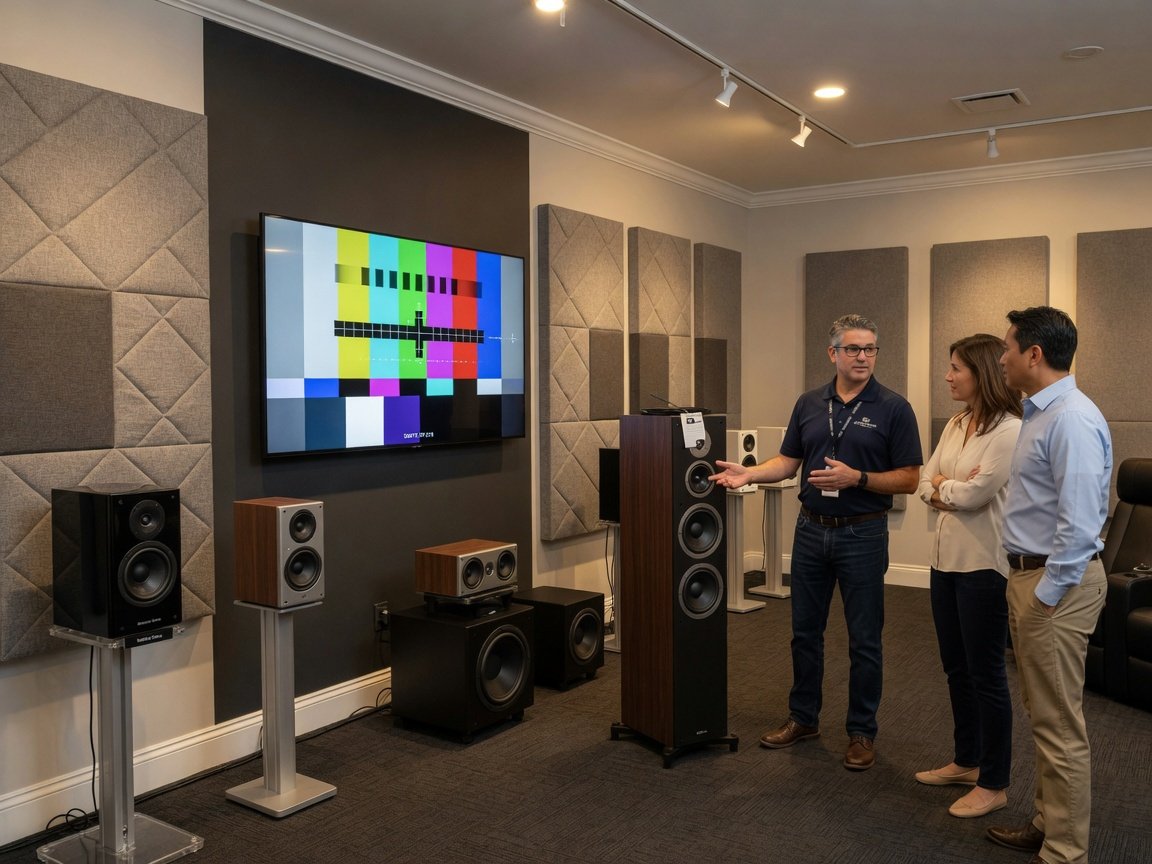
Dedicated AV specialty stores represent the gold standard for home theater purchasing. They employ product-specialist staff rather than generalists, maintain demonstration rooms calibrated to THX or ISF reference standards, and carry manufacturer lines that big-box chains do not stock. The trade-off is typically a narrower geographic footprint and, in some cases, marginally higher base component prices — offset substantially by the value of expert system design, professional calibration, and post-purchase technical continuity. The four specialty stores that topped the 2026 rankings are Crutchfield, Magnolia, Audio Advice, and Abt Electronics.
Crutchfield
Crutchfield operates as the definitive online home theater specialist in 2026. Founded in 1974, it has built an information infrastructure — wiring diagrams customized to specific receiver and speaker model pairings, speaker placement calculators scaled to entered room dimensions, HDMI version compatibility matrices, and impedance matching guides — that no competitor approaches in technical depth or accuracy. Its free AV advisor service operates via phone and chat with extended availability and is staffed by personnel holding an average of six or more years of hands-on AV product experience. Crutchfield achieves a 96% customer satisfaction rating in aggregated verified-purchaser review data — the highest of any major home theater retailer tracked in 2026.
- Return window: 60 days, no restocking fee on most items
- Installation: Nationwide partner network referrals; no in-house crew
- Price tier: $$ – $$$$
- Key brands: Denon, Marantz, Klipsch, Polk Audio, Sony, LG, Epson, Yamaha
- Score: 9.4 / 10
Magnolia (at Best Buy)
Magnolia is Best Buy’s dedicated high-performance AV brand, operating as acoustically treated shop-in-shop departments at select Best Buy locations and as standalone Magnolia Design Center showrooms in major metro markets. Staff carry Magnolia-specific product training, and the showrooms include full Dolby Atmos demonstration rooms capable of 7.1.4 configurations at reference sound pressure levels. Magnolia’s in-house installation arm provides ISF-certified display calibration using professional spectrophotometer workflows and supports Crestron and Control4 home automation integration for full custom projects. Sixty percent of Magnolia customers in 2026 return for calibration updates or system upgrades within 18 months of initial purchase — a metric that reflects genuine service relationship continuity.
- Return window: 15 days standard; extended with My Best Buy Plus membership
- Installation: In-house Magnolia team; ISF display calibration available
- Price tier: $$$ – $$$$$
- Key brands: Sony, Samsung, LG OLED, Sonos, Bowers & Wilkins, Monitor Audio, Trinnov
- Score: 9.1 / 10
Audio Advice
Audio Advice operates showrooms in select markets alongside a robust online storefront, specializing in premium and reference-grade home theater configurations. Consultants are CEDIA-affiliated and regularly cited in the custom installation industry for reference-level room design work. Audio Advice carries brands inaccessible at big-box and mainstream specialist retail — including Trinnov Altitude processors, Storm Audio ISP platforms, Focal Utopia-series speakers, and JL Audio subwoofers — making it the correct destination for dedicated home theater room projects from $10,000 to well above $100,000 in total system and room investment.
- Return window: 30 days on most products; open-box exchange policy available
- Installation: Full custom integration with dedicated project management
- Price tier: $$$ – $$$$$
- Key brands: Trinnov, Storm Audio, Focal, JL Audio, Sony Laser, JVC NZ series, Epson
- Score: 9.0 / 10
Abt Electronics
Abt Electronics, headquartered in Glenview, Illinois, operates one of the largest single-location consumer electronics and appliance showrooms in North America — approximately 350,000 square feet — with a home theater section featuring dedicated, acoustically treated demonstration rooms at both mid-range and premium configuration tiers. Abt has earned consistent recognition for transparent, low-pressure pricing, trained floor staff, and a white-glove delivery and installation service rated among the highest in the Midwest. Nationwide online ordering with premium delivery extends its reach beyond the Chicago metropolitan area.
- Return window: 30 days; extended windows on select categories
- Installation: In-house white-glove delivery and installation team
- Price tier: $$ – $$$$
- Key brands: LG, Sony, Samsung, Denon, Klipsch, Polk Audio, Bose, Yamaha
- Score: 8.9 / 10
How Do Big-Box Retailers and Online Specialists Compare?
National big-box chains serve the mainstream home theater market effectively within defined limits. Best Buy’s non-Magnolia floor carries an adequate selection of entry-to-mid-range AV receivers, soundbars, and 4K displays, supported by Geek Squad installation services for basic mounting, cable management, and soundbar setup. The ceiling of Best Buy’s general floor expertise is reliably the $800–$1,500 receiver-and-speaker-bundle tier. For buyers building a basic 5.1 Dolby Atmos setup or selecting a quality soundbar, this is sufficient. The limitation appears when buyers ask configuration-level questions about discrete HDMI 2.1 bandwidth allocation per port, bi-amplification wiring with passive bi-wire-capable speakers, or bass management crossover optimization relative to a speaker’s measured F3 roll-off frequency.
B&H Photo & Video serves technically proficient buyers who arrive with precise specifications. B&H’s catalog depth is exceptional — it stocks professional and prosumer equipment including reference studio monitors, broadcast-grade displays, commercial AV signal distribution hardware, and fiber-optic HDMI extender systems that consumer-oriented retailers do not carry. Its 30-day return policy and general customer service quality are consistently rated highly in aggregated review analysis, though the advisor-support model is less tailored to home theater system design consultation than Crutchfield’s.
SVS operates as a direct-to-consumer specialist for subwoofers and speaker systems, offering a 45-day in-home trial and phone-based bass optimization support staffed by engineers who work exclusively in subwoofer acoustic design. For buyers targeting a standalone powered subwoofer from $400 to $3,000, SVS delivers measurably superior value and product support depth compared to purchasing the same product tier through a generalist retailer.
Accessories4Less occupies a specialized niche: manufacturer-certified refurbished home theater equipment sourced from Denon, Marantz, Yamaha, Sony, and Klipsch, typically priced 30–45% below new retail with 30-day return windows and standard manufacturer warranty coverage. For buyers targeting the $300–$900 AV receiver tier, Accessories4Less frequently delivers measurably better component performance per dollar than buying new at the equivalent budget.
How Do Home Theater Store Prices and Value Compare Across Tiers?
Price alone is a poor metric for evaluating home theater retailers because a $200 price difference on a $1,500 AV receiver is negligible if the retailer also provides free system design consultation, custom wiring diagrams, and post-sale technical support that competing sources charge $300–$500 to replicate. Average home theater system spend in 2026 has risen to approximately $4,200, up from $2,900 in 2022, according to consumer electronics retail tracking data — a shift driven by 4K OLED display price erosion and the mainstreaming of multi-height-channel Atmos speaker configurations. The table below compares key value dimensions across the eight ranked stores.
| Store | Type | Best For | Return Window | Installation | Score |
|---|---|---|---|---|---|
| Crutchfield | Online Specialist | Overall / any budget online | 60 days | Partner referral | 9.4 / 10 |
| Magnolia | In-Store Specialist | Demo + ISF installation | 15–30 days | ISF in-house | 9.1 / 10 |
| Audio Advice | Online + Showroom | Premium / dedicated rooms | 30 days | Full custom integration | 9.0 / 10 |
| Abt Electronics | Regional Specialist | Midwest / all tiers | 30 days | White-glove in-house | 8.9 / 10 |
| B&H Photo & Video | Online | Pro / technical buyers | 30 days | None | 8.7 / 10 |
| SVS | DTC Online | Subwoofers + bass systems | 45 days | None | 8.5 / 10 |
| Accessories4Less | Online Refurb | Certified refurb / budget | 30 days | None | 8.2 / 10 |
| Best Buy | Big-Box National | Mid-range mainstream | 15 days | Geek Squad | 7.8 / 10 |
Which Home Theater Stores Offer the Best Professional Installation in 2026?
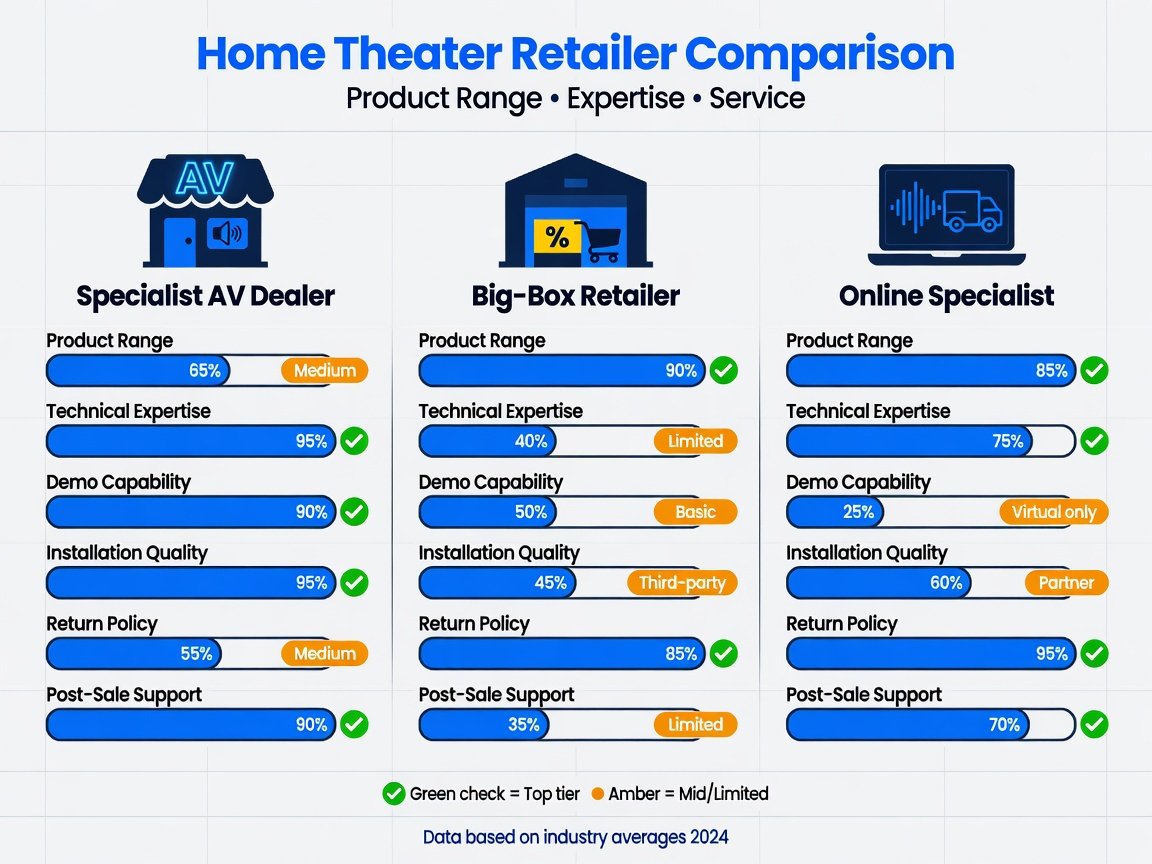
Professional installation separates a technically functional home theater from a genuinely optimized one. Room correction algorithms — even best-in-class implementations like Dirac Live Full Bandwidth or Audyssey MultEQ XT32 with Sub EQ HT — rely on accurate measurement microphone placement, multiple spatial measurement positions, and valid pre-correction target curves to generate effective equalization filters. A professional calibrator additionally addresses physical variables that automatic correction software cannot: speaker toe-in geometry and its effect on first-reflection arrival time, display geometry and panel uniformity, ambient light contamination of perceived black level, and bass trapping placement relative to primary room modes.
Magnolia leads on installation quality among the stores reviewed. Its ISF-certified calibrators perform display calibration using spectrophotometer-based workflows (typically running Calman for Business or Portrait Displays software), execute multi-position receiver room correction, and configure full Control4 or Crestron home automation integration within a single structured engagement. Audio Advice follows closely for dedicated home theater room projects — particularly those involving acoustic treatment panels, blackout lighting control, motorized screen systems, and multi-zone audio distribution — where design, procurement, construction coordination, and calibration are managed within a single project scope by a dedicated consultant.
Geek Squad handles basic mounting, cable management, and soundbar commissioning competently at accessible price points. Where Geek Squad consistently underperforms specialist installation teams is in display calibration — it does not offer spectrophotometer-based ISF calibration at standard service tiers — and in complex multi-zone audio routing requiring low-voltage wiring design. Buyers commissioning 5.1 setups with standard wall-mount requirements will find Geek Squad adequate. Buyers deploying 7.1.4 or 9.2.6 Dolby Atmos configurations in acoustically significant rooms should engage a CEDIA-credentialed integrator regardless of where equipment was purchased.
What Brands Do the Top Home Theater Stores Carry in 2026?
Brand ecosystem is a reliable proxy for a home theater store’s technical positioning. Retailers that carry only mass-market lines — Vizio, TCL, Bose, and entry-tier Polk Audio — are fundamentally consumer electronics stores with a home theater section. Retailers that additionally stock Marantz, Arcam, Anthem, McIntosh, Trinnov, Storm Audio, Monitor Audio, KEF, Paradigm, Revel, or SVS are operating at a categorically different tier of product knowledge and customer expectation.
Dolby Atmos decoding-capable AV receivers now account for over 82% of all AV receiver units sold across tracked home theater retailers in 2026, making Atmos support a baseline expectation rather than a meaningful differentiator. The technically relevant differentiators at the specialist dealer level are: pre/pro processor brands — Trinnov Altitude, Storm Audio ISP, Anthem AVM — that handle up to 32 channels of independently room-corrected, object-based audio; reference-grade speaker manufacturers — Focal Sopra and Utopia series, Revel Ultima2, Wilson Audio — that approach acoustically neutral transducer reproduction within their respective operating bandwidths; and projector manufacturers — Sony VPL-XW5000/7000 series and JVC NZ7/NZ9 series — that deliver native 4K panel resolution with HDR tone-mapping precision that consumer-grade DLP projectors cannot approach. The practical implication: if a retailer cannot demonstrate or quote any of these product lines, it cannot serve buyers at the premium or reference system tier regardless of what its marketing materials claim.
Which Home Theater Store Fits Your Budget and Room Size?
Matching retailer to budget tier prevents two common failure modes: under-spending at specialist dealers where entry-level configuration questions consume high-value consultation time, and over-spending at big-box retailers where staff cannot accurately configure premium components. The three-tier framework below maps 2026 budget ranges to optimal retailer choices.
Entry Tier: $500–$1,500 Total System Budget
At this budget, a quality 2.1 stereo setup with a powered subwoofer or a premium soundbar with Dolby Atmos upfiring drivers is achievable. Crutchfield is the superior retailer at this tier: its system-matching guidance prevents the most common entry-level mistake — pairing 4-ohm nominal speakers with a receiver rated stable only to 6 ohms — and its 60-day return window provides genuine home-evaluation flexibility. Accessories4Less delivers outstanding component performance per dollar through certified-refurbished Denon, Marantz, and Yamaha receivers, routinely offering units from the prior year’s mid-range tier at entry-level price points. Best Buy’s general floor is adequate for in-person soundbar evaluation.
Mid-Range: $1,500–$6,000 Total System Budget
This is the most heavily populated home theater purchasing tier in 2026. A properly configured 5.1.2 or 7.1.2 Dolby Atmos system — a quality AV receiver with Dirac Live or Audyssey XT32 room correction, tower or bookshelf main speakers from a reputable transducer manufacturer, a dedicated center channel, surround speakers, a capable powered subwoofer, and a 65–75-inch 4K OLED or QLED display — is fully achievable within this range. Crutchfield and Abt Electronics offer the strongest combined selection, system-design support, and service infrastructure at this tier. Magnolia is appropriate where ISF display calibration and professional Atmos speaker placement verification are priorities within the budget.
Premium and Reference: $6,000–$50,000+ Total Project Budget
Above $6,000, the performance delta attributable to component selection, room acoustic treatment, and professional calibration eclipses any price-per-component savings achievable through retailer comparison. Audio Advice and Magnolia Design Center lead at this tier. For dedicated home theater room builds above $20,000 in total project value — including construction, acoustic treatment panels, motorized seating, lighting control integration, and automation — engaging a CEDIA-certified integration firm directly, sourced through Audio Advice or an independent authorized dealer, is the technically correct approach. The display segment at this tier transitions from consumer OLED to Sony or JVC native-4K laser projectors paired with 120–150-inch acoustically transparent screens, and the processing tier shifts from consumer AV receivers to Trinnov or Anthem pre/pro processors with discrete channel amplification.
What Technology Trends Are Reshaping Home Theater Stores in 2026–2027?
Home theater retail is being simultaneously reshaped by several converging technology shifts that change both what stores must stock to remain credible and how they differentiate their service propositions from direct-to-consumer manufacturer channels. Understanding these trends helps buyers assess whether a retailer is positioned for medium-term viability or stocking an inventory that will age poorly before their system reaches its second major calibration cycle.
8K display mainstreaming: 8K display unit sales grew 140% year-over-year in 2026 but still represent under 8% of total home theater display volume by units. Sony, Samsung, and LG are positioning 8K OLED and mini-LED panels as the aspirational premium tier of their home theater lines. Specialist retailers that can demonstrate native 8K content — available through select 8K Blu-ray releases and early HDMI 2.1b-connected gaming sources — are building early-adopter authority in a segment projected to expand meaningfully by 2027–2028 as 8K streaming delivery infrastructure matures.
Wireless surround sound maturation: Wireless Dolby Atmos speaker deployments account for approximately 22% of new home theater speaker system configurations purchased through tracked retailers in 2026, up from roughly 9% in 2023. Sonos Era 300 and Arc Ultra systems and Sony’s HT-A series with wireless surround modules have demonstrated commercially that high-fidelity, latency-controlled wireless Atmos is technically viable in rooms up to approximately 500 square feet. Retailers that maintain comparative listening demos between wired and wireless Atmos configurations are earning measurable customer preference over those that stock only one paradigm.
AI-assisted room correction and calibration: Dirac Live Bass Control with full-bandwidth correction, Audyssey Pro plugin workflows, and the YPAO-R.S.C. Multi-Point implementations in 2026 Yamaha RX-A and CX-A receivers are delivering measurably superior sub-200Hz room mode correction compared to prior-generation single-point measurement systems. This is elevating buyer expectations for post-purchase calibration support — retailers who cannot explain the technical difference between a spatially averaged correction filter and a seat-specific filter are increasingly perceived as technically inadequate by informed purchasers. ATSC 3.0 NextGen TV tuner integration reached 34% of new display purchases in 2026, adding broadcast-quality HDR and 4K reception to antenna-connected home theater setups without a streaming subscription requirement.
Step-by-Step Guide: How to Choose the Right Home Theater Store in 2026
Selecting the right home theater store before choosing a single component reduces compatibility risk, saves configuration time, and typically delivers better system performance per dollar. Follow this sequence regardless of budget tier or whether you plan to purchase in-store or online.
- Measure your room before contacting any retailer. Record length, width, and ceiling height. Note primary reflective surfaces — bare drywall, glass doors, hardwood floors. Identify the primary listening position and measure its distance from the front wall. Any credible home theater specialist will request these figures before making system recommendations.
- Set a total project budget — not a component budget. Allocate for cables, wall-mounting hardware, acoustic treatment panels, professional calibration, and any required structural or low-voltage wiring work alongside equipment costs. Underestimating ancillary costs is the single most common planning error in home theater builds and frequently results in critical components — calibration, room treatment — being cut post-purchase.
- Define your primary use case with technical precision. A system optimized for film reproduction with Dolby Atmos and HDR10+ requires different amplifier headroom, speaker directivity, and subwoofer low-frequency extension than a system optimized for competitive gaming (HDMI 2.1 at 4K/120Hz, VRR, low input lag mode) or live sports (motion clarity, wide color volume). Communicate this use-case hierarchy explicitly to any retailer.
- Request written system configuration proposals from at least two retailers. A legitimate specialist will provide a complete equipment list with compatibility notes, impedance matching verification, and room correction platform rationale — not simply individual product recommendations. Compare proposals on system-level coherence, not per-component pricing.
- Verify installation credentials before committing. Request ISF certification confirmation for any display calibration work. Request CEDIA membership verification for full system integration projects. Both ISF and CEDIA maintain publicly searchable member directories that allow credential verification in under two minutes.
- Test post-sale technical support responsiveness before purchase. Call the retailer’s technical support line with a specific, verifiable configuration question — for example: “What bass management crossover frequency would you set in the receiver for a speaker with an F3 of 65Hz in a room with a 9-foot ceiling?” The quality, speed, and technical accuracy of the response reliably predicts the support you will receive post-purchase.
- Confirm return policy terms in writing on opened boxes. Home theater components must be evaluated in your specific room under your listening conditions to validate real-world performance. A minimum 30-day return window on opened items — ideally 45–60 days — is necessary for genuine home evaluation. Confirm this policy covers opened speakers and calibrated displays before ordering.
Frequently Asked Questions: Home Theater Stores in 2026
What is the best home theater store for beginners in 2026?
Crutchfield is the best home theater store for first-time buyers. Its free advisor service, comprehensive wiring diagrams generated for specific component model pairings, speaker placement calculators, and 60-day no-restocking-fee return window combine to provide a low-risk entry point with genuine technical backstop. The platform actively guides buyers from component selection through full system assembly and post-purchase configuration, which removes the primary pain point for buyers without prior AV experience.
Are home theater specialty stores more expensive than big-box retailers?
Not reliably. Specialist retailers like Crutchfield, Abt Electronics, and Audio Advice price within 3–8% of big-box retail on overlapping product lines and frequently match or beat big-box prices when factoring in included accessories — premium cables, mounting hardware, and wiring guides — that big-box retailers charge separately for. The value gap widens further when factoring in free calibration consultations, system compatibility verification, and post-sale technical support provided by specialist stores at no additional cost.
Does it matter where I buy home theater equipment if I plan to self-calibrate?
Yes, for two reasons independent of calibration. First, return policy quality is critical if a component fails to integrate as expected in your room — a 60-day return window is substantially more valuable than a 15-day window during multi-position room correction iteration cycles. Second, technical documentation quality — custom wiring diagrams, impedance matching tables, HDMI version compatibility matrices — varies enormously between retailers and represents independent value that saves hours of configuration research regardless of your calibration methodology or skill level.
Which home theater store is best for subwoofers specifically?
SVS is the best direct-to-consumer source for standalone powered subwoofers. It offers a 45-day in-home trial, a five-year limited warranty, and phone-based bass optimization support from engineers who work exclusively in subwoofer acoustic design — including guidance on room placement, port tuning frequency selection, and crossover optimization relative to the F3 roll-off of the paired main speakers. For integrated subwoofer purchases within a full system, Crutchfield provides the most accurate sub-to-main speaker matching guidance, incorporating entered room dimensions and target crossover frequency into its recommendations.
Is buying certified refurbished home theater equipment safe?
Yes, when sourced through manufacturer-authorized refurbishment channels or verified specialist retailers like Accessories4Less. Manufacturer-certified refurbished AV components have been inspected, repaired to factory specification, and re-certified to pass the same functional tests as new units — they carry standard manufacturer warranty coverage at 30–45% below new retail price. The primary trade-off is cosmetic: minor surface marks on units that will be rack-mounted and invisible post-installation are inconsequential to performance or long-term reliability.
How do I verify a home theater store’s installation team is qualified?
Request ISF certification verification for any display calibration work — ISF-credentialed calibrators complete a curriculum covering colorimetry, electro-optical transfer functions (gamma, EOTF, ST 2084 PQ), and spectrophotometer operation. Request CEDIA member verification for full system integration projects — CEDIA credentials cover low-voltage wiring design, distributed audio architecture, and home automation integration disciplines. Both ISF and CEDIA maintain publicly searchable member databases that allow credential verification before you commit to any installation engagement.
Can I purchase home theater equipment online and have it installed locally?
Yes — buying components from Crutchfield or B&H Photo at competitive online prices and engaging a local CEDIA-certified integrator for installation and calibration is a financially sound and increasingly common approach, particularly for buyers in markets without strong local specialty dealer coverage. Most CEDIA integration firms accept customer-supplied equipment. Confirm this policy before purchase, as some installation practices include equipment supply as part of their project margin model and may decline supply-only engagements at standard labor rates.
Conclusion: Choosing the Right Home Theater Store in 2026
The home theater market in 2026 offers more system performance per dollar than any prior equipment generation — but it also demands more integration knowledge to deploy that performance correctly. Choosing the right retailer is the first systems-level decision in a home theater build, not a logistical afterthought. The wrong store costs you in misconfigured components, incompatible system pairings, inadequate post-sale support, and missed calibration that no subsequent equipment spending recovers.
The definitive 2026 ranking: Crutchfield for online purchases at any budget tier; Magnolia for buyers requiring ISF-certified professional calibration and immersive in-store Atmos demonstrations; Audio Advice for premium and dedicated-room projects above $6,000 in system value; Abt Electronics for buyers in the Midwest seeking white-glove in-person service across all tiers; and B&H Photo & Video for technically proficient buyers sourcing professional-grade display, distribution, and signal-processing hardware. HomeTheaterInfoLine.com updates retailer rankings quarterly as store policies, brand authorizations, and calibration service credentials are verified.
Implementation Timeline: From Research to First Calibrated Reference Level
- Week 1 — Room Assessment: Measure room dimensions (L × W × H), document wall and floor materials, identify listening positions, and establish a total project budget inclusive of installation, mounting hardware, cabling, and acoustic treatment.
- Week 2 — Retailer Engagement: Request written system configuration proposals from Crutchfield via phone or online advisor tool and from the in-person specialist appropriate to your market and budget — Magnolia for mid-range with professional installation, Audio Advice for premium builds.
- Week 3 — Proposal Comparison and Credential Verification: Compare proposals on system-level coherence. Verify installation credentials through ISF and CEDIA member directories. Test technical support responsiveness with a specific configuration query.
- Week 4 — Order Placement: Confirm return policy terms in writing for opened components. Place the order with the retailer whose combined product selection, service infrastructure, and installation capability best match your project scope and room requirements.
- Post-Installation, 30–60 Days — Calibration and Optimization: Schedule ISF display calibration. Run Dirac Live or Audyssey MultEQ XT32 room correction with proper microphone positioning across a minimum of five measurement positions. Document system baseline measurements. Track any integration issues and engage your retailer’s post-sale technical support line for resolution. Review HomeTheaterInfoLine.com for updated calibration guides and retailer rankings published quarterly throughout 2026.
Best Overall: Crutchfield — unmatched technical documentation, 60-day returns, lifetime advisor support, 96% customer satisfaction, and competitive pricing at every home theater budget tier.
Best In-Store Demo + Installation: Magnolia — ISF-certified calibration, acoustically treated Dolby Atmos demo rooms, and a dedicated custom integration team for mid-range through premium builds.
Best for Dedicated Home Theater Rooms: Audio Advice — reference-brand access, full custom integration with project management, and consultants equipped to specify and build systems from $10,000 to well above $100,000.