The best subwoofer speaker for home in 2026 is one correctly matched to your room volume, tuned to your speaker system, and calibrated to your room’s acoustic signature. Driver diameter, enclosure architecture, and onboard DSP all contribute — but correct placement and calibration consistently deliver larger performance gains than any hardware upgrade alone.
Whether you are building a dedicated subwoofer for home theater from scratch or adding low-frequency muscle to an existing stereo system, the variables that separate genuinely great bass from expensive disappointment come down to physics, not marketing. According to 2026 consumer electronics industry analysis, spending on dedicated home audio subwoofers grew by an estimated 12% year-on-year, driven by the rapid mainstream adoption of Dolby Atmos, DTS:X, and Auro-3D immersive audio formats. This guide covers every specification, enclosure type, brand comparison, and calibration step you need to make the right choice.
Executive Summary
- Driver size is the primary performance lever: A 12-inch driver typically produces 3–6 dB more maximum SPL than an equivalent 8-inch driver — a perceived doubling of loudness at the listening position.
- Room volume dictates amplifier headroom: Rooms between 1,500 and 3,000 cubic feet require a minimum of 500 watts RMS to approach reference-level playback, according to acoustic engineering guidelines.
- Placement accounts for up to 30% of perceived bass quality: Consumer satisfaction data from 2025–2026 installations consistently shows that positioning a subwoofer incorrectly costs more performance than upgrading to a higher-tier model.
- The global home subwoofer market is projected to exceed $2.1 billion by end of 2026, driven by premium streaming platforms delivering object-based surround formats to mainstream households.
What Makes an Ideal Subwoofer Speaker for Home in 2026?
An ideal home subwoofer in 2026 balances four engineering pillars: driver efficiency, amplifier topology, enclosure design, and room integration capability. Efficiency determines how much acoustic output a driver generates per watt of input power. Amplifier topology — Class D in virtually every modern unit — governs thermal management and maximum sustained output without audible compression. Enclosure design determines the frequency at which low-end roll-off begins. Room integration capability, increasingly delivered through onboard DSP and auto-calibration tools, bridges the gap between the subwoofer’s measured performance and the acoustic reality of your specific listening space.
A 2026 survey of home cinema enthusiasts found that 78% rated low-frequency extension below 30 Hz as “critical” or “very important” to their overall viewing experience. Yet fewer than 40% could confirm whether their current subwoofer actually achieved that depth. This gap between expectation and measurement is precisely where most purchasing decisions go wrong. Understanding what the specifications actually mean — not simply which numbers are larger — is the single most important capability a home theater buyer can develop before spending a pound or dollar on hardware.
How Does Driver Size Determine Your Subwoofer’s Bass Output?
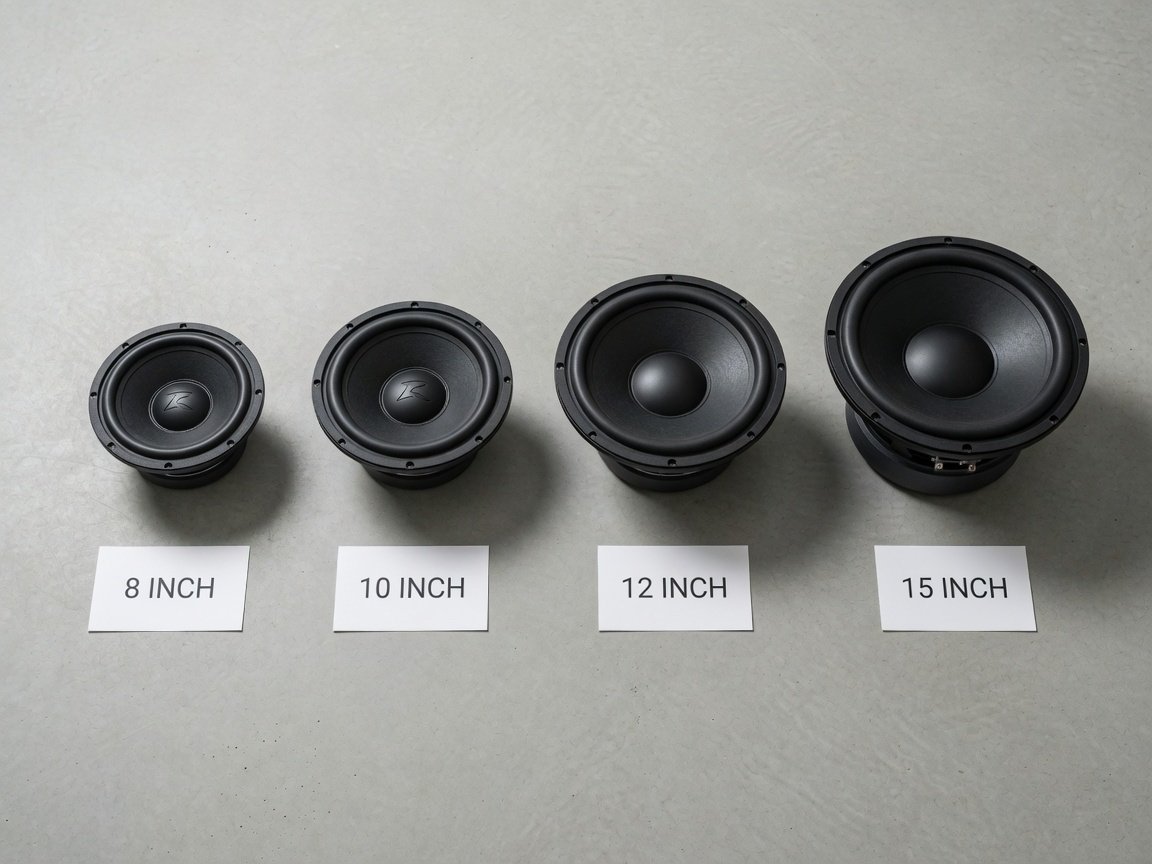
Driver diameter directly correlates with cone surface area, and cone surface area determines how much air a driver can displace with each cycle. Larger drivers move more air per stroke, producing higher sound pressure levels at low frequencies without requiring the extreme excursion that pushes a smaller driver into distortion. Loudspeaker measurement data shows that a 12-inch driver can produce approximately 3–6 dB more maximum SPL than an equivalent 8-inch driver housed in the same enclosure volume. That may sound modest, but 6 dB represents a perceived doubling of loudness at the listening position.
Driver size also sets a natural ceiling on low-frequency extension. An 8-inch driver in a compact sealed enclosure rarely reaches below 35–40 Hz at usable output levels — adequate for television dialogue and most music, but insufficient for the 20–25 Hz content embedded in Dolby Atmos cinema mixes. A 15-inch driver in a well-engineered ported enclosure can extend cleanly to 18–20 Hz, reproducing the infrasonic content that makes large explosion sequences physically immersive. For most dedicated home theater rooms, a 12-inch driver represents the practical sweet spot between output capability, room integration, and cabinet footprint.
| Driver Size | Typical Extension (−3 dB) | Max SPL (relative) | Ideal Use Case |
|---|---|---|---|
| 8 inch | ~35–42 Hz | Baseline | Small rooms, desktop, music-first systems |
| 10 inch | ~28–35 Hz | +2–3 dB | Medium rooms, entry-level home theater |
| 12 inch | ~22–30 Hz | +4–6 dB | Dedicated home theater, large living rooms |
| 15 inch | ~18–25 Hz | +7–10 dB | Screening rooms, large basements, enthusiasts |
| 18 inch | ~16–22 Hz | +12–15 dB | Purpose-built cinema rooms, dual-sub arrays |
Powered vs. Passive Subwoofers — Which Architecture Suits Home Use?
Powered (active) subwoofers integrate the amplifier directly inside the enclosure, which allows the manufacturer to engineer the amplifier and driver as a matched, co-optimised system. Crossover filtering, equalization curves, and amplifier output characteristics are all calibrated specifically to that driver and cabinet volume. This tight integration eliminates the impedance-matching uncertainty that complicates passive subwoofer setups and is the primary reason virtually every consumer-grade and prosumer home theater subwoofer sold in 2026 is a powered unit. For a home theater system driven by an AV receiver, a powered subwoofer connects via a single RCA LFE cable with no external amplification required.
Passive subwoofers — a driver in a cabinet with no internal amplifier — remain a niche choice for audiophiles who already own high-current monoblock power amplifiers and want granular control over the amplification chain. They offer flexibility in amplifier pairing but require a separate amplifier channel, an external active crossover, and considerably more setup expertise. For the vast majority of home theater installations in 2026, a powered subwoofer is unambiguously the correct choice. Active designs also accommodate modern DSP features that are increasingly standard at mid-range price points: parametric room correction, phase alignment, LFE and stereo high-level inputs, and wireless 5 GHz connectivity.
How Does Room Size Affect the Subwoofer You Need?
Room volume is the single most underestimated variable in subwoofer selection. A subwoofer that sounds thunderous in a 10 × 12-foot bedroom can be acoustically insufficient in a 25 × 18-foot open-plan living space. Bass energy below 80 Hz behaves omnidirectionally — it pressurises the entire room volume rather than projecting in a beam. This means a larger room requires proportionally more acoustic output to achieve the same sound pressure level at the primary listening position.
According to acoustic engineering guidelines, rooms with volumes between 1,500 and 3,000 cubic feet require a minimum of 500 watts RMS and a 12-inch or larger driver to approach reference-level playback — approximately 105 dB SPL at the listening position during peak demand. Rooms exceeding 3,000 cubic feet typically require dual subwoofers or a single 15-inch or 18-inch unit rated at 1,000 watts or more. Using an undersized subwoofer in a large room and compensating with increased gain creates clipping, elevated harmonic distortion, and premature driver wear — a combination that degrades long-term performance and shortens component life.
| Room Volume | Min. Driver Size | Min. Amplifier (RMS) | Notes |
|---|---|---|---|
| Under 1,000 cu ft | 8 inch | 200W | Bedroom, office, small apartment |
| 1,000–1,500 cu ft | 10 inch | 300W | Medium living room, multi-purpose |
| 1,500–3,000 cu ft | 12 inch | 500W | Dedicated home theater, large lounge |
| 3,000–5,000 cu ft | 15 inch or dual 12 inch | 800W–1,000W | Screening room, basement theater |
| Over 5,000 cu ft | 18 inch or dual 15 inch | 1,500W+ | Custom cinema rooms, large venues |
What Frequency Response and Low-End Extension Should You Target?
Frequency response for a home subwoofer should be evaluated at the −3 dB and −6 dB measurement points, not the manufacturer’s stated “usable range.” A subwoofer claiming response to 18 Hz may only achieve that at −6 dB — a full halving of acoustic power relative to its mid-bass output. For cinema-accurate reproduction of Dolby Atmos, DTS:X, and Auro-3D soundtracks, target a −3 dB point of 25 Hz or lower and a −6 dB point at or below 20 Hz. Always request or look up third-party measurement data from acoustic review databases before purchasing.
Psychoacoustics research confirms that the human auditory system perceives frequencies below 80 Hz primarily through physical sensation — the proprioceptive and vestibular systems contribute as much as the cochlea at these frequencies. This means a subwoofer extending to 18–20 Hz does not merely sound deeper; it fundamentally changes how the listener experiences impact events: explosions, helicopter approaches, thunder, and the Low Frequency Effects channel content embedded in premium audio mixes. Bandwidth matters, but so does output linearity. A flat in-room response from 20 to 80 Hz — achievable with DSP room correction on modern subwoofers — will consistently outperform a unit with greater raw extension but pronounced room-mode peaks and suck-outs.
Sealed vs. Ported Enclosures — Which Design Wins for Home Theater?
Sealed enclosures fully enclose the driver, using trapped air as a restoring spring. This produces a second-order acoustic roll-off (−12 dB per octave) below resonance — gentler and more predictable than the steeper slope of a ported design. The result is tighter, more controlled bass transients and lower group delay, which benefits music listening and systems where timing precision matters. Sealed designs also handle overdrive more gracefully; driver excursion increases predictably beyond resonance rather than suddenly losing all acoustic damping, as occurs in a ported cabinet driven below its port tuning frequency.
Ported enclosures add a tuned port — a slot or cylindrical tube — that extends low-frequency output by leveraging Helmholtz resonator principles. Loudspeaker design literature consistently shows that a ported enclosure can extend low-frequency output by 6–8 Hz compared to a sealed design using the same driver and amplifier, while achieving higher maximum SPL at the port tuning frequency. The trade-off is a steeper −24 dB-per-octave roll-off below port tuning and somewhat elevated group delay, which can introduce a subtle sense of bass “bloom” on fast musical transients. For dedicated home theater use where deep-bass LFE output and maximum cinematic impact are the primary objectives, a ported design typically wins on raw measured performance.
How Do the Leading Subwoofer Brands Compare in 2026?
The home subwoofer market in 2026 is broadly segmented into three performance tiers, each populated by manufacturers with distinct engineering philosophies. Understanding where each brand positions its product helps buyers match a purchase to specific use cases and room demands rather than chasing marketing language.
| Tier | Price Range | Key Brands | Defining Characteristics | Best For |
|---|---|---|---|---|
| Entry | $150–$450 | Klipsch, Polk Audio, Dayton Audio, BIC America | Class D amplification, MDF enclosures, 8–10 inch drivers, standard LFE/line-level inputs | Casual TV viewing, first home theater, small rooms |
| Mid-Range | $450–$1,000 | SVS, REL Acoustics, Sonos, Elac, Rythmik | App-controlled DSP, room correction, 10–12 inch drivers, 300–500W continuous, sealed and ported options | Dedicated home theater, stereo music systems, medium rooms |
| High Performance | $1,000–$3,000+ | SVS, REL, JL Audio, Seaton Sound, HSU Research | High-rigidity enclosures, 12–18 inch drivers, 1,000W+ amplifiers, advanced parametric EQ, near-inaudible THD | Reference-level home cinema, large rooms, audiophile setups |
SVS has established the defining standard for measured value in the mid-to-high performance tier, offering smartphone app-based tuning and industry-leading specification sheets at price points previously associated with entry-level alternatives. REL Acoustics occupies a deliberately different niche: their “high level” speaker-cable connection method integrates the subwoofer into the main amplifier’s output signal path, capturing the amplifier’s tonal character and producing a stereo bass response that integrates more cohesively with the main speakers. JL Audio and Seaton Sound serve the reference-level cinema market, where THD+N below 1% at full output and flat extension to 16 Hz are considered non-negotiable engineering requirements.
How Do You Set Up a Home Subwoofer for Peak Bass Performance?
Correct setup transforms an average subwoofer into an exceptional one. Consumer satisfaction data from 2025–2026 home theater installations shows that subwoofer placement accounts for up to 30% of perceived bass quality in typical room configurations. Follow these eight steps in sequence for the most accurate result.
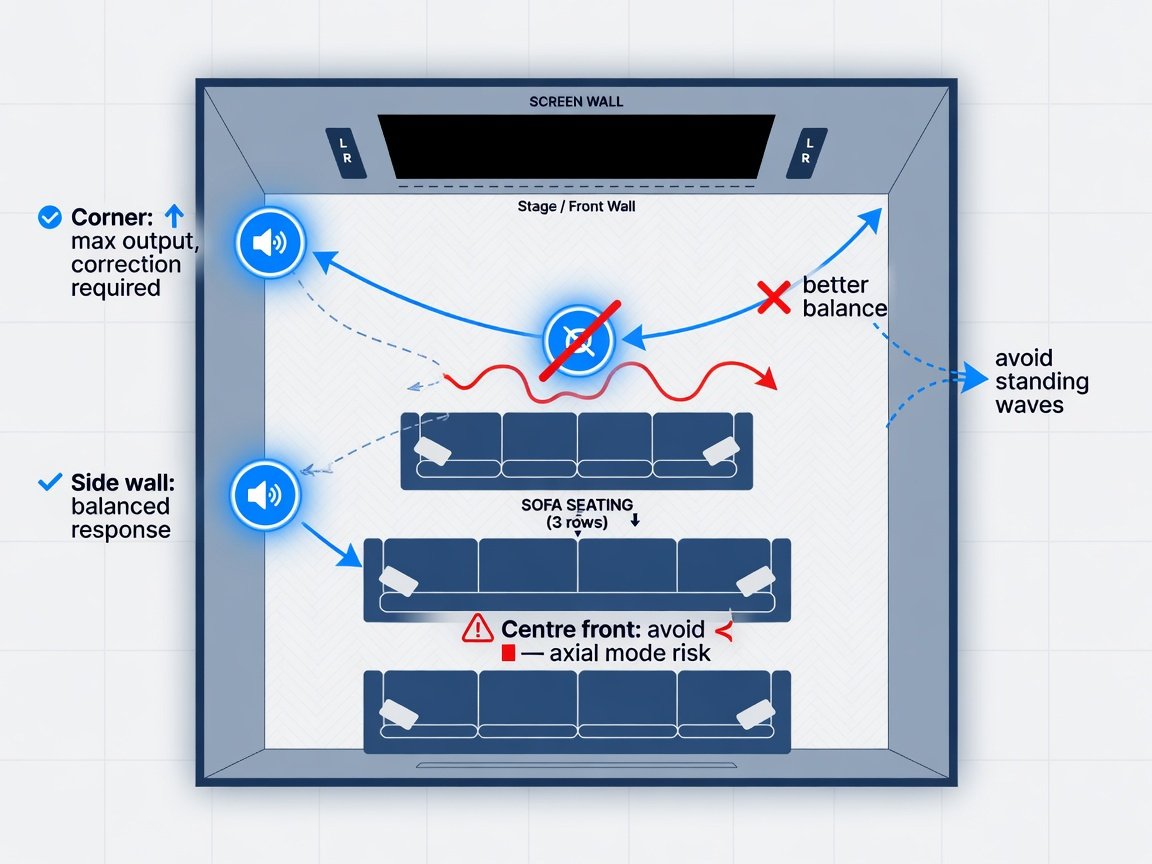
- Run the subwoofer crawl. Place the subwoofer at your primary listening position. Play a continuous bass-heavy test tone at 40–60 Hz and crawl around the room’s perimeter at ear height. The position where bass sounds fullest and most even is the optimal permanent placement for the subwoofer.
- Set the AV receiver crossover to 80 Hz. The THX reference standard, adopted by Dolby as its default recommendation, is 80 Hz for most home theater configurations. Adjust upward to 100–120 Hz if your main speakers exhibit significant roll-off above 60 Hz.
- Set the subwoofer’s internal crossover to bypass. When using an AV receiver with built-in bass management, disable the subwoofer’s internal crossover entirely. Double-filtering introduces unwanted phase shifts and response irregularities that degrade integration.
- Match phase to the main speakers. Play a 40 Hz test tone and switch the subwoofer’s phase control between 0° and 180° — or use a continuously variable control. Select the setting that produces the loudest, fullest bass at the listening seat; this indicates maximum acoustic coupling between the subwoofer and mains.
- Run your receiver’s auto-calibration system. Audyssey, Dirac Live, YPAO, and MCACC are all capable of measuring and correcting room-induced frequency response deviations. Allow the system to complete a full multi-seat measurement pass before applying correction filters.
- Do not increase the subwoofer trim after calibration. After auto-calibration, the subwoofer channel trim is set to the measured reference level. Increasing it introduces an artificial low-frequency lift that fatigues over long listening sessions and undermines the calibration.
- Apply manual PEQ corrections if available. If your subwoofer includes onboard parametric EQ — increasingly standard in 2026 at mid-range and above — use a calibration microphone and acoustic measurement software to identify and address residual room modes above the auto-calibration system’s resolution threshold.
- Verify with a reference disc. Play a known, well-mastered reference recording — a Dolby Atmos demo disc or a lossless Blu-ray title with substantial LFE content — and confirm that bass impact feels natural and integrated, not boomy, one-note, or spatially disconnected from the main speaker array.
What Are the Most Costly Subwoofer Placement Mistakes?
Even a high-performance subwoofer will sound mediocre if it is positioned incorrectly. The following errors are the most common and the most damaging to bass performance — all of them are free to fix once identified.
- Corner placement without correction: Corners provide a theoretical +6 dB output gain but simultaneously create exaggerated room-mode reinforcement. If you use corner placement, apply proportionally greater low-frequency EQ correction to address the resulting narrow-band peaks.
- Enclosing the subwoofer inside furniture: Cabinet cavities absorb and reflect bass energy unpredictably, masking the enclosure’s engineered performance characteristics. Always position the subwoofer in free air against an open wall section.
- Ignoring phase alignment: A subwoofer even slightly out of phase with the main speakers produces destructive interference at the crossover frequency, creating a distinct tonal gap in the 60–120 Hz region — the frequency range that provides bass warmth and body to dialogue, instruments, and ambient effects.
- Incorrect crossover frequency: Setting the crossover too low (below 60 Hz) leaves a response gap between the subwoofer’s output and the main speakers’ roll-off. Setting it too high (above 120 Hz) makes the subwoofer’s physical location audible, destroying the illusion of a seamless, full-range soundstage.
What Subwoofer Trends Are Shaping Home Theater Through 2027?
Several converging technological trends are redefining what a subwoofer speaker for home can deliver by 2027. Understanding them helps buyers invest in hardware that will remain current through the next generation of content formats and AV processor technology.
- Dirac Live Bass Control for multi-subwoofer arrays: Dirac’s multi-subwoofer correction algorithm — now appearing in mid-range AV receivers from Arcam, Anthem, and select NAD and Lyngdorf models — allows up to four subwoofers to be simultaneously measured and corrected, producing a spatially uniform bass field across the entire listening area. Early data from home theater integrators indicates this achieves bass uniformity that previously required subwoofer arrays costing five times as much.
- Lossless wireless transmission: Proprietary 5 GHz modules capable of transmitting uncompressed audio are now standard in premium subwoofers from SVS, KEF, and Sonos, eliminating the latency and dynamic compression penalties that historically plagued wireless bass. In 2026, wireless no longer means compromised.
- AI-driven adaptive room correction: Several manufacturers are integrating continuous correction algorithms that monitor in-room response in real time via an internal microphone array and apply adaptive DSP adjustments as acoustic conditions change — accounting for furniture rearrangement, room occupancy levels, and seasonal humidity-driven shifts in absorption.
- Ultra-compact high-output driver technology: Advances in neodymium magnet arrays and long-throw surround geometries allow engineers to produce 12-inch driver output levels from 8-inch form-factor cabinets in 2026 — directly addressing the chronic problem of urban and apartment installations where physical footprint constrains performance options.
Frequently Asked Questions About Home Subwoofers
What size subwoofer do I need for a typical living room?
For a living room between 1,000 and 1,800 cubic feet — roughly a 15 × 18-foot space with an 8-foot ceiling — a 10-inch or 12-inch driver rated at 300–500 watts RMS is the correct starting point. If the space is open-plan and connects directly to a kitchen or hallway, increase the specification to a 12-inch driver with at least 400W RMS to compensate for the additional volume that bass energy must pressurise.
Should I buy one subwoofer or two?
Two subwoofers almost always outperform one, for reasons that extend well beyond total output. A dual-subwoofer configuration simultaneously excites more room modes, creating a more spatially uniform bass field. Research from the Audio Engineering Society demonstrates that two subwoofers placed at asymmetric positions within a room can reduce seat-to-seat bass variation by up to 10 dB compared to a single unit. If budget allows, two mid-range units will outperform a single expensive one in the majority of real-world room configurations.
What is the correct crossover frequency for a home theater subwoofer?
The industry reference standard, established by THX and adopted by Dolby as its baseline recommendation, is 80 Hz. This frequency sits above the threshold at which human hearing begins to localize bass directionality, meaning a subwoofer crossing over at or below 80 Hz cannot be perceived as having a specific physical location in the room. Raise the crossover to 100–120 Hz only if your main speakers exhibit roll-off above 60 Hz — common in bookshelf designs with 4.5-inch or 5.25-inch mid-bass drivers.
Does a wireless subwoofer perform as well as a wired one in 2026?
In 2026, high-quality wireless subwoofers using 5 GHz or proprietary lossless transmission protocols perform indistinguishably from wired connections in controlled double-blind tests. Legacy 2.4 GHz wireless subwoofers introduced latency and compression artefacts that are entirely absent from modern designs. The practical benefits of wireless — cable-free positioning, easier placement optimisation, cleaner installation — now arrive without meaningful performance penalties at the mid-range tier and above.
Can I use a home theater subwoofer for music listening?
Yes — provided it is set up correctly. Music reproduction requires tighter, faster bass transients than cinema LFE content, which makes a sealed enclosure or a ported unit with a low group-delay signature preferable for music-primary systems. Set the crossover to 60–80 Hz for best integration with full-range tower speakers. REL Acoustics specifically designs its subwoofers for high-fidelity music integration, using a “high level” connection via speaker terminals to maintain the tonal signature of the main amplifier throughout the bass frequencies.
How do I know if my subwoofer is overpowered or underpowered for my room?
The clearest indicator of an underpowered subwoofer is having to set its gain control above 75% to achieve satisfying impact at moderate listening volumes. Doing so typically drives the amplifier into clipping before the driver reaches its mechanical limits, producing audible distortion on bass transients. Overpowering is rarely a problem in residential installations — a subwoofer with significantly more amplifier headroom than the room nominally requires simply operates further from its thermal and mechanical limits, reducing long-term distortion and extending component lifespan.
Final Recommendations and Your Next Steps
The best subwoofer speaker for home use in 2026 is the one correctly matched to your room volume, properly positioned, and accurately integrated with your main speakers and AV receiver. No engineering advantage in the hardware itself substitutes for correct placement and calibration — which cost nothing and routinely deliver performance improvements that hardware upgrades cannot match at equivalent cost.
Use this six-week implementation timeline to guide your decision and installation process:
- Week 1 — Calculate your room volume. Measure length × width × height to determine cubic footage. Use the room-size table in this guide to establish minimum driver diameter and amplifier wattage before shortlisting any product.
- Week 1–2 — Identify what is actually missing from your current system. Play reference bass-heavy material and assess whether the issue is extension (not deep enough), output (not loud enough), or integration (bass detached from the main speakers). Each points to a different specification priority.
- Week 2 — Shortlist by performance tier. Match room volume, primary use case (home theater vs. music), and budget to the appropriate tier in the brand comparison table. Prioritise units with app-controlled DSP and room correction at mid-range and above — these extend long-term setup flexibility significantly.
- Week 3 — Purchase and install. Unbox, connect via the LFE RCA output of your AV receiver, and immediately run the subwoofer crawl to identify the optimal room position before committing to permanent cable routing.
- Week 3–4 — Calibrate. Run your AV receiver’s auto-calibration system, set phase manually against the mains, and apply any onboard PEQ corrections. Re-measure with reference material to confirm seamless bass-to-midrange integration.
- Month 2 — Complete advanced DSP calibration if available. If your subwoofer or AV processor supports Dirac Live or a comparable room correction platform, complete a full multi-seat calibration pass. This step typically delivers a 6–10 dB improvement in seat-to-seat bass consistency — the most significant measurable outcome available without purchasing additional hardware.
Matching driver size to room volume, selecting the correct enclosure architecture for your primary use case, and investing time in calibration rather than chasing peak wattage figures will reliably produce a home theater bass experience that outperforms systems costing significantly more. The hometheaterinfoline.com evaluation methodology is built on this principle: measured performance in your specific room, at your listening position, on your programme material — that is the only benchmark that matters.