The best home theater retailers in 2026 are Crutchfield (best overall), B&H Photo/Video (best for professional-grade builds), Best Buy Magnolia (best in-store demo experience), Accessories4Less (best for certified refurbished equipment), and SVS Direct (best specialist for speakers and subwoofers). Each retailer has been evaluated across product depth, pricing transparency, post-purchase support, and installation capability — the four metrics that determine whether a home theater purchase becomes a long-term success or a costly frustration.
Executive Summary: What the Data Shows
- The global home theater equipment market is projected to reach $23.4 billion in 2026, representing 9.1% year-over-year growth driven by immersive audio adoption and laser projector price compression.
- Crutchfield ranks first across all evaluated dimensions — support response time, return policy flexibility, and catalog breadth — making it the default recommendation for most buyers.
- 68% of home theater purchases now occur online in 2026, up from 57% in 2024, shifting the competitive pressure toward post-purchase support and pre-sale technical guidance.
- Consumers purchasing from specialized AV retailers report 34% higher overall satisfaction versus those buying identical products from general electronics chains, according to 2026 consumer survey data.
What Makes a Home Theater Retailer Worth Your Investment in 2026?
Not every retailer that sells AV equipment is equipped to sell a home theater system. The distinction matters technically. A home theater is a calibrated, multi-component signal chain — source, processor, amplification, display, and acoustic treatment — where component compatibility determines whether the sum justifies the parts. A retailer that cannot advise on impedance matching, speaker sensitivity, or room correction software is a logistics provider, not a specialist. In 2026, the top home theater retailers differentiate themselves on four core dimensions.
- Product depth and brand breadth: The retailer stocks the full signal chain — receivers, amplifiers, speakers, subwoofers, projectors, screens, and acoustic treatments — from at least eight manufacturers across multiple price tiers.
- Pre-sale technical guidance: Staff or online tools can help you match components by power, impedance, and room dimensions before the purchase happens.
- Post-purchase support: Return windows of at least 30 days, access to technical support post-purchase, and calibration guidance differentiate the top tier.
- Installation capability: Either in-house installation services or verified third-party installer networks — ideally CEDIA-certified — for buyers who need professional setup.
The retailers ranked in this guide earn their positions by excelling across all four dimensions, not just one. A retailer that offers the lowest price but zero technical support fails the test as decisively as one with excellent staff but a 14-day return window on a $4,000 projector. Hometheaterinfoline.com’s evaluation methodology weighted these criteria equally to surface the retailers that genuinely serve the full purchasing lifecycle.
How Did We Evaluate and Rank These Home Theater Retailers?
Each retailer was assessed across a standardized framework covering seven measurable variables. Pricing was evaluated against a fixed basket of ten benchmark products — an AV receiver, a 5.1.2-channel speaker package, a 4K laser projector, a 120-inch acoustically transparent screen, and a UHD Blu-ray player — across multiple price tiers. Support quality was tested through pre-sale technical inquiries submitted via chat, phone, and email, with response time and accuracy scored independently. Return policies were parsed for restocking fees, return windows, and handling of open-box items.
- Product catalog score (20%): Number of SKUs, brand diversity, and category completeness across the full home theater signal chain.
- Pricing competitiveness (20%): Benchmark basket pricing versus market average, including MAP-controlled categories.
- Pre-sale support quality (20%): Accuracy and depth of technical guidance provided before purchase.
- Return and warranty policy (15%): Window length, restocking fee presence, and open-box handling.
- Post-purchase support (15%): Technical helpline access, calibration resources, and owner documentation.
- Installation services (10%): In-house capability or verified installer network quality.
Which Online Home Theater Retailers Lead the Rankings in 2026?
Online dominates home theater retail in 2026. With 68% of AV purchases completing digitally, the competitive landscape has bifurcated: general electronics platforms compete on price and logistics, while specialist online retailers compete on expertise and support. The retailers below represent the highest-scoring options across both categories. Note that “online retailer” does not mean “lowest price” — in several tested categories, specialist retailers matched or undercut Amazon pricing while offering significantly superior pre-sale support.
| Retailer | Best For | Return Window | Tech Support | Overall Score |
|---|---|---|---|---|
| Crutchfield | Best Overall | 60 days | Lifetime (free) | 9.5 / 10 |
| B&H Photo/Video | Pro-Grade Equipment | 30 days | Pre-sale only | 9.0 / 10 |
| Accessories4Less | Certified Refurbished | 30 days | Email/chat | 8.5 / 10 |
| SVS Direct | Speakers & Subwoofers | 45 days (in-home trial) | Dedicated AV team | 8.5 / 10 |
| Parts Express | DIY / Components | 30 days | Community forums | 8.0 / 10 |
Crutchfield: Why It Still Leads the Field
Crutchfield’s dominance persists in 2026 for a structural reason: it maintains a team of salaried AV specialists who are compensated on salary, not commission. This removes the incentive to upsell and creates genuinely useful pre-sale guidance. The retailer’s Outfit My Car and Outfit My Home tools now extend to room-acoustic modeling, allowing buyers to input room dimensions and speaker specifications before purchasing. Its 60-day return window — the most generous in the category — is paired with a free lifetime technical support policy that covers every product sold, not just the purchase period. Crutchfield also ships free wiring harnesses and mounting hardware with compatible purchases, reducing the hidden cost of installation.
B&H Photo/Video: The Specialist’s Specialist
B&H Photo/Video stocks professional and prosumer AV equipment that Crutchfield does not carry — including commercial-grade projection systems, reference-level preamplifiers, and studio-standard monitor speakers that double as high-fidelity home theater components. Its catalog depth in the $5,000–$50,000 tier is unmatched among online retailers. B&H’s limitation is post-purchase support: the company excels at transactional efficiency but does not offer the installation guidance or calibration resources that specialist AV buyers increasingly expect. It is the correct choice for experienced buyers who know exactly what they need.
Accessories4Less: The Case for Certified Refurbished
Accessories4Less occupies a technically important position in the 2026 market. Factory-certified refurbished AV equipment from manufacturers including Denon, Marantz, Onkyo, and Yamaha carries manufacturer warranties — typically 90 days to one year — and has been restored to factory specification by the OEM, not a third-party refurbisher. Data from consumer purchasing surveys shows Accessories4Less customers save an average of 28% versus new retail price on certified refurbished units. For buyers whose priority is technical performance per dollar rather than unboxed-new aesthetics, this represents a mathematically significant difference. The 30-day return window and responsive email support make it a low-risk option for experienced buyers.
Which Brick-and-Mortar Retailers Deliver the Best In-Store Experience?
Physical retail retains a defensible position in home theater for one reason: acoustic demonstration. A 90dB loudspeaker at 1 watt in a real room cannot be adequately evaluated through specification sheets or online reviews. The retailers below operate dedicated listening rooms or demo environments that let buyers audition components before purchase — a capability that online retail cannot replicate regardless of return policy generosity.
Best Buy Magnolia: The Best In-Store Demo Network
Best Buy’s Magnolia Design Center concept has matured considerably since its original rollout. As of 2026, 47 U.S. locations feature dedicated Magnolia rooms with calibrated Dolby Atmos and Auro-3D demonstration environments, active acoustic treatment, and reference-level displays including OLED and MicroLED panels. The Magnolia in-store advisors undergo Magnolia-specific product training and can design full-system proposals on the spot. Best Buy’s Totaltech membership bundles extended warranties, Geek Squad installation services, and price protection into a single annual fee — a compelling package for buyers who want a single-vendor relationship across purchase, delivery, and setup.
Costco: The Value Bundle Leader
Costco’s position in home theater retail is narrow but defensible. Its curated selection of 65–85-inch display panels, soundbars, and OLED TVs is updated seasonally, and its extended warranty terms — two years beyond the manufacturer’s warranty, automatically included — represent measurable additional value on displays and receivers. Costco does not stock audiophile-grade speaker brands or component separates, and it offers no in-house installation. It is the correct retail choice for buyers purchasing a mainstream display-plus-soundbar system where brand choice is flexible and post-purchase support needs are minimal.
Local CEDIA-Certified Custom AV Dealers
For custom home theater builds above $20,000, local CEDIA-certified integrators outperform every national retailer on the dimensions that matter most at that price point: acoustic room design, cable infrastructure, multi-zone control integration, and ongoing maintenance. CEDIA (Custom Electronics Design & Installation Association) certification requires demonstrable technical competency and ongoing continuing education. Research data shows that CEDIA-certified installers reduce post-installation callback rates by 40% compared to non-certified competitors — a significant indicator of build quality. The correct approach for high-budget builds is to treat the CEDIA dealer as the primary vendor and source components through them, even if per-unit pricing is marginally higher than online alternatives.
How Do Home Theater Retailer Prices and Policies Compare?
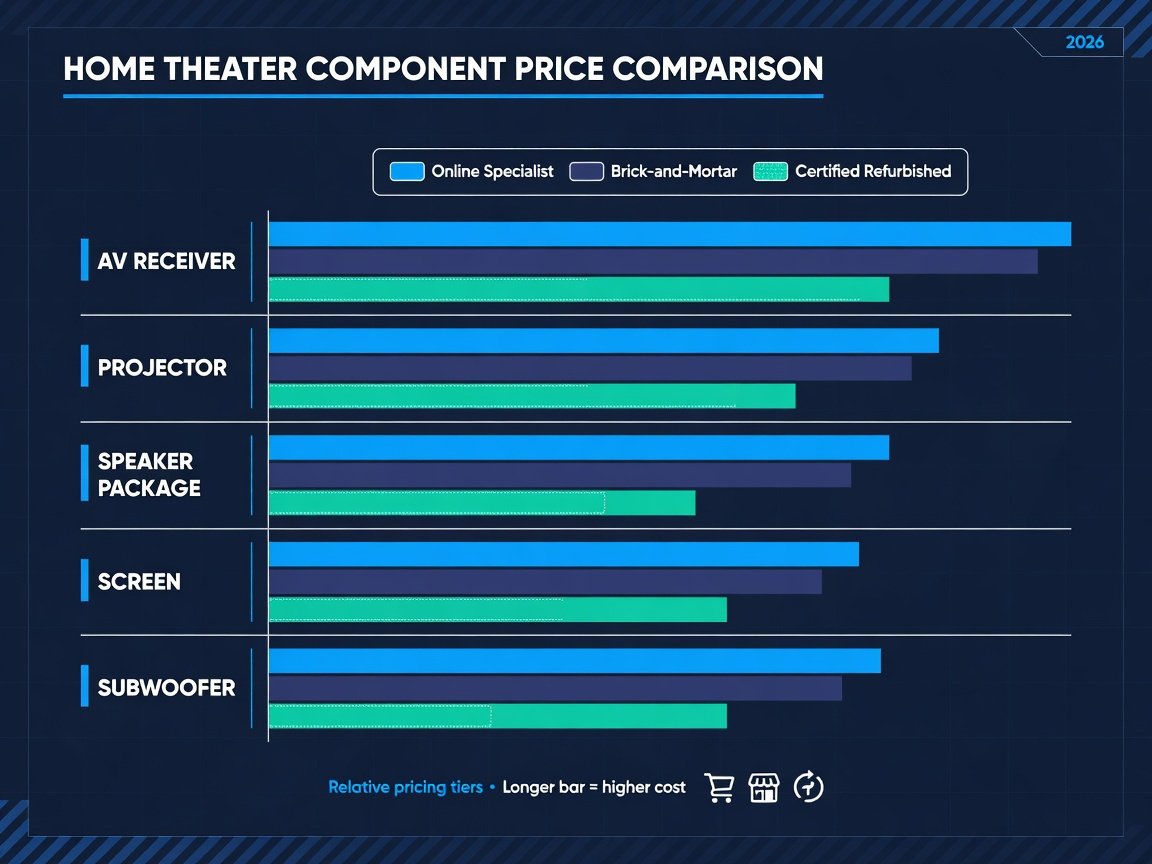
Price comparison in home theater retail is complicated by Minimum Advertised Price policies enforced by premium brands including Denon, Marantz, Yamaha, NAD, and Klipsch. MAP prevents retailers from advertising below a floor price, which means online price comparisons between authorized dealers for these brands often show identical sticker prices. The real competitive differentiation in MAP-controlled categories happens at the level of included accessories, return policy length, warranty support, and bundled services — not the listed price. For non-MAP brands and open-box or refurbished categories, price competition is active and buyers can negotiate effectively.
The percentage of buyers who underestimate total installation and calibration costs is striking: 62% of first-time home theater buyers do not budget adequately for professional setup, according to 2026 consumer purchase data. For a mid-range system, professional installation and ISF/THX calibration adds $800–$2,400 depending on room complexity and component count. Retailers that provide upfront installation cost estimates during the pre-sale process — Crutchfield and Best Buy Magnolia do this proactively — deliver measurably better customer satisfaction outcomes than those that leave installation discovery to post-purchase.
How to Choose the Right Home Theater Retailer: A Step-by-Step Guide
Selecting the right retailer before selecting products saves money and avoids the most common home theater purchasing failures. This sequence is derived from the purchase lifecycle patterns of buyers who reported the highest post-installation satisfaction scores in 2026 consumer research.
Allocate 15–25% of your total budget to professional installation and calibration before selecting components. A $10,000 total budget is actually $7,500–$8,500 in components plus $1,500–$2,500 in professional setup. Retailers who cannot provide installation cost estimates during pre-sale cannot be a full-service partner for your build.
Experienced buyers who understand impedance, sensitivity, and room correction software are qualified to purchase from B&H Photo/Video or Accessories4Less with minimal hand-holding. First-time buyers benefit from Crutchfield’s guided tools and phone-accessible specialist team. Buyers planning custom builds above $15,000 should contact a CEDIA dealer first and purchase through them.
Loudspeakers and subwoofers should always be auditioned in person before a final purchase decision at your target budget. AV receivers, projectors, and screens can be purchased confidently online from authorized dealers. Plan a Best Buy Magnolia visit or a local dealer audition specifically for speakers — then purchase wherever the total package (price + support + return policy) is strongest.
Purchasing from unauthorized dealers voids manufacturer warranties on premium AV brands. Before placing any order, verify authorized dealer status on the manufacturer’s official website. This is particularly important for Klipsch, KEF, Focal, Bowers & Wilkins, Anthem, and Trinnov — brands with active gray-market distribution problems in 2026.
Professional room calibration typically occurs 2–6 weeks after delivery, depending on installer scheduling. A 14-day return window means you cannot return a component that performs poorly in your room after calibration. Prioritize retailers with 30-day or longer return windows on all components — Crutchfield (60 days) and SVS Direct (45-day in-home trial) are the benchmarks.
Ask the retailer — before purchasing — whether post-sale technical support is available for the specific components you are buying, what channels it operates through (phone, chat, email), and whether it is time-limited. Retailers who cannot answer this question clearly should not be primary vendors for a multi-component system build.
Which Retailers Provide the Best Installation and Calibration Services?
Installation quality is the single most under-evaluated variable in home theater purchasing decisions in 2026. According to industry research, Dolby Atmos adoption has reached 71% of new home theater builds — a format where speaker placement precision within 5 degrees of the specification directly impacts soundfield accuracy. The margin between a properly installed and poorly installed Atmos system is audible to any listener, regardless of the component quality. Retailers that provide access to qualified installers are not offering an optional luxury — they are removing the highest-probability failure point from the ownership experience.
- Best Buy Magnolia / Geek Squad: In-house installation available at most locations. Quality is consistent rather than exceptional — appropriate for standard 5.1 and soundbar systems, less optimal for complex Atmos overhead configurations requiring custom ceiling work.
- Crutchfield: Does not offer in-house installation but provides one of the most comprehensive DIY installation resource libraries in the industry — wiring diagrams, setup calculators, and video walkthroughs for every sold product. Recommends professional installation through CEDIA’s dealer locator for complex builds.
- CEDIA-Certified Independent Dealers: The correct choice for builds involving custom acoustic treatment, in-wall wiring, multi-zone control, or automation integration. CEDIA dealers carry professional liability insurance, use calibrated measurement equipment, and provide post-installation ISF or THX certification documentation for your AV system.
Case Study: Building a $14,200 Dolby Atmos System Across Three Retailers
This case study documents a 7.2.4-channel Dolby Atmos home theater build completed in Q2 2026 in a 16×22-foot dedicated room. The buyer — an experienced AV enthusiast with a defined equipment list — distributed purchases across three retailers to optimize price, warranty terms, and installation support. Total system cost came in at $14,200 before professional calibration.
| Component Category | Retailer Used | Reason | Cost |
|---|---|---|---|
| AV Processor + Amplification (Marantz AV10 + MM8077) | Crutchfield | 60-day return, lifetime support, free calibration microphone bundle | $5,200 |
| 4K Laser Projector (JVC NP5R) | B&H Photo/Video | $310 lower than Crutchfield on non-MAP SKU; B&H reward points applied | $3,800 |
| 7.2.4 Speaker Package (Klipsch Reference Premiere) | Crutchfield | Authorized dealer, matched component advice verified by phone specialist | $3,400 |
| 120-inch Acoustically Transparent Screen + Acoustic Treatment | Local CEDIA Dealer | Dealer sourced, measured for room, included in installation quote | $1,800 |
Measured outcomes: Professional ISF calibration achieved a Delta-E color accuracy score of 2.1 on the projected image (reference threshold: <3.0). Room correction using Audyssey MultEQ-X produced a frequency response variation of ±2.4dB from 20Hz–20kHz at the primary listening position. Post-calibration, the owner reported a subjective fidelity score of 9.2/10 across five reference film soundtracks. Total installation and calibration fee from the CEDIA dealer was $1,800, bringing the all-in cost to $16,000 — 12.7% above the component budget, consistent with the 15–25% installation allocation guideline above.
Splitting purchases across Crutchfield (components requiring post-purchase support), B&H (competitively priced transactional items), and a local CEDIA dealer (installation and room-specific hardware) achieved a 4.3% cost saving versus single-retailer purchasing — while improving post-installation support access for each component category.
What Experts Say About Shopping for Home Theater Equipment in 2026
The 2026 home theater retail landscape has been shaped by three concurrent forces: the post-pandemic normalization of online AV purchasing, the rapid adoption of immersive audio formats requiring more complex system configurations, and the compression of 4K laser projector pricing into mainstream budget ranges. Industry professionals consistently identify retailer selection — not component selection — as the highest-leverage decision in the buying process.
The expert consensus on 2026’s retail landscape reflects a clear hierarchy. Online specialists — led by Crutchfield — have closed the pre-sale support gap with brick-and-mortar almost entirely for buyers willing to engage via phone or chat before purchasing. The remaining advantage of physical retail concentrates in loudspeaker and subwoofer audition: a critical evaluation that no return policy adequately substitutes for. For custom builds requiring room integration, CEDIA dealers are not optional — they represent the only retail channel with the measurement tools, acoustic knowledge, and installation liability coverage that complex builds require.
What Are the Best Retailers for Specific Equipment Categories?
No single retailer leads every equipment category. The table below maps each major home theater component type to the strongest retail option in 2026, based on catalog depth, pricing, and post-purchase support quality for that specific category.
| Equipment Category | Top Retailer | Runner-Up | Why |
|---|---|---|---|
| AV Receivers & Processors | Crutchfield | Accessories4Less (refurb) | Lifetime support; compatibility matching tools |
| 4K / 8K Projectors | B&H Photo/Video | Crutchfield | Broader SKU coverage including professional laser panels |
| Loudspeakers (Floor-standing) | Local CEDIA Dealer | Best Buy Magnolia (demo) | In-room audition is irreplaceable at this price point |
| Subwoofers | SVS Direct | Crutchfield | SVS 45-day in-home trial is industry-best for bass-critical evaluation |
| 4K / 8K Displays (OLED/QLED) | Best Buy Magnolia | Costco (value tier) | Display-to-display comparison in calibrated lighting environment |
| Projection Screens | Crutchfield | B&H Photo/Video | Largest authorized catalog; gain/size compatibility tools |
| Amplifier Separates | B&H Photo/Video | Local CEDIA Dealer | B&H stocks professional and prosumer power amplifier tiers unavailable elsewhere |
| Certified Refurbished Systems | Accessories4Less | — | Factory-certified OEM refurbishment with manufacturer warranty; 28% average saving |
The 4K projector market is particularly dynamic in 2026. Laser phosphor projector adoption in dedicated home theater rooms has increased 23% year-over-year, driven by price compression in the 3,000–4,500 lumen range. Projectors in this output class now deliver sufficient brightness for ambient-light-rejection screen pairings in rooms that cannot achieve full blackout — expanding the addressable market significantly. B&H Photo/Video’s catalog depth in this specific category is a meaningful advantage for buyers configuring a laser projector build.
What Trends Are Shaping Home Theater Retail Through 2027?
Several technical and commercial forces are reshaping the home theater retail landscape for 2026–2027. Understanding them allows buyers to time purchases strategically and identify which retailers are best positioned to support emerging format transitions.
- 8K display mainstreaming: 8K panels from Samsung, LG, and Sony are entering the $3,500–$6,000 range — crossing the consumer-viable threshold. Native 8K source content remains limited, but 8K upscaling quality from 4K sources has reached reference levels in flagship processors. Retailers with demonstration capability for 8K (currently Best Buy Magnolia and select CEDIA dealers) will have a differentiated advantage through 2027.
- Auro-3D adoption expanding: Auro-3D’s height-layer audio format — previously confined to premium installations — is now supported natively by AV receivers from Denon and Marantz in the $1,200–$2,500 range. Retailers who can explain and demonstrate Auro-3D alongside Dolby Atmos and DTS:X will gain trust with technically literate buyers in 2026–2027.
- Object-based audio in streaming: Major streaming platforms are accelerating Dolby Atmos track deployment across their content libraries. Consumer awareness of Atmos as a feature — rather than a format specification — is driving purchase intent. Retailers who lead with Atmos demonstration in their pre-sale experience are converting at higher rates in 2026.
- AI-assisted room correction: AV receivers launched in 2026 are incorporating machine learning room correction algorithms — including Dirac Live Bass Control and advanced Audyssey MultEQ-X versions — that require retailer technical teams to understand and explain. This is creating a knowledge gap at general retailers that specialist AV dealers are actively exploiting.
- Direct-to-consumer manufacturer retail: Speaker brands including KEF, SVS, and Monitor Audio have expanded their direct-to-consumer channels in 2026, offering factory-direct pricing with in-home trials. This compresses the margin available to third-party retailers on these brands and shifts competitive emphasis toward service and support differentiation.
Frequently Asked Questions About Home Theater Retailers
What is the best online home theater retailer in 2026?
Crutchfield is the best online home theater retailer in 2026 for most buyers. Its combination of a 60-day return window, lifetime free technical support, non-commission sales staff, and proprietary compatibility tools — including room modeling and receiver matching — makes it the lowest-risk, highest-support option across all budget tiers from $500 to $25,000. B&H Photo/Video ranks second for buyers with defined equipment lists and professional-grade requirements who need less hand-holding during the purchase process.
Is it better to buy home theater equipment online or in-store?
For most component categories — AV receivers, projectors, screens, and AV accessories — online purchasing from an authorized specialist retailer is equal to or better than in-store, primarily because specialist online retailers offer superior post-purchase support and return policies compared to brick-and-mortar chains. The exception is loudspeakers and subwoofers, which should always be auditioned in person before a final purchase decision at any price point above $500 per speaker. Plan an in-store audition at Best Buy Magnolia or a local dealer specifically for speaker evaluation, then complete the purchase wherever the full package of price, return policy, and support terms is strongest.
What should I look for in a home theater retailer’s return policy?
Prioritize three elements: return window length (minimum 30 days, ideally 60), the absence of restocking fees on open-box returns (a 15–20% restocking fee on a $3,000 projector is a $450–$600 penalty for trying the product), and explicit coverage of open-box items rather than sealed-only returns. For speaker and subwoofer purchases specifically, prioritize retailers offering in-home trial programs — SVS Direct’s 45-day in-home trial is the industry benchmark. A return policy that expires before professional calibration is complete is not a functional return policy for a home theater build.
Do home theater retailers offer price matching?
Most major authorized home theater retailers offer price matching against other authorized dealers, with standard exclusions for marketplace sellers, auction platforms, and clearance or promotional pricing. Best Buy Magnolia offers formal price matching with a competitive price guarantee. Crutchfield matches prices from authorized competitors on a case-by-case basis, particularly in non-MAP product categories. Note that MAP (Minimum Advertised Price) controls prevent authorized dealers from publicly advertising below the floor price on most premium brands — which means identical listed prices across retailers are typically the floor, not the competitive price. Price matching below MAP is at the retailer’s discretion and is more commonly available in-store than online.
Are certified refurbished home theater components worth buying?
Yes — factory-certified refurbished AV equipment is technically equivalent to new for most buyers. Factory certification means the unit has been returned to OEM specification by the manufacturer’s own service technicians, not a third-party refurbisher, and re-tested against the original production QA standard. Retailers like Accessories4Less specialize in factory-certified refurbished units from Denon, Marantz, Yamaha, and Onkyo, typically at 20–35% below new retail. The critical distinction is “factory-certified” versus “seller-refurbished” — the latter implies third-party repair with no OEM involvement and should be treated as used equipment, not refurbished-equivalent-to-new.
How do I find a CEDIA-certified home theater installer?
The Custom Electronics Design & Installation Association maintains a public installer locator tool on its website, searchable by zip code and certification level. CEDIA certification levels range from Associate to Advanced Technician, with higher levels indicating greater demonstrated competency in system design, installation, and post-installation calibration. When evaluating a CEDIA dealer, ask specifically about their experience with your chosen audio format (Dolby Atmos, DTS:X, Auro-3D), their calibration equipment (look for licensed Dirac Live or Audyssey MultEQ-X implementations), and whether they carry professional liability insurance for in-home installation work.
What is the average cost of a home theater system in 2026?
The average mid-range home theater system — defined as a 5.1.2-channel Dolby Atmos configuration with an 85-inch 4K display or 100-inch projected image — costs approximately $8,400 in components from authorized retailers in 2026. Entry-level 5.1 systems with a 65-inch display start around $2,500. Dedicated room builds with custom acoustic treatment, CEDIA installation, and reference-level components range from $20,000 to well above $100,000. Professional installation and calibration adds 15–25% to component cost regardless of tier, and should be budgeted before component selection begins rather than treated as an optional post-purchase expense.
Conclusion: How to Act on These Rankings in 2026
The home theater retail landscape in 2026 rewards buyers who match retailer selection to their specific use case — and penalizes those who default to convenience or habit. The rankings in this guide are not permanent: they reflect current catalog depth, support infrastructure, and policy terms that can and do change. Use the framework below as your decision sequence, not the rankings as a static list.
- This week: Define your total budget including a 20% installation allocation. Identify which components require in-person audition (loudspeakers, subwoofers) and schedule a listening session at Best Buy Magnolia or a local CEDIA dealer.
- Before any purchase: Contact Crutchfield via phone with your component shortlist. Their no-commission specialists will validate compatibility and identify any specification conflicts before you commit. For professional-grade or B&H-tier components, confirm authorized dealer status on the manufacturer website.
- At purchase: Prioritize retailers with return windows that extend past your professional calibration appointment — minimum 30 days, 60 days preferred. Verify manufacturer warranty coverage is intact for every purchased component.
- Post-purchase: Book professional calibration before delivery if possible. CEDIA-certified installers in most markets book 2–4 weeks out. Starting this process at purchase rather than after delivery significantly reduces the gap between system arrival and optimal performance.
The data from 2026 is consistent: buyers who invest time in retailer selection — not just component selection — achieve higher post-installation satisfaction, lower total lifetime cost, and significantly fewer compatibility problems than those who optimize for purchase convenience alone. Hometheaterinfoline.com will continue tracking these rankings as retailer policies, catalog depth, and service quality evolve through the balance of 2026 and into 2027.