The best Sony home theater systems in 2026 are the HT-A9M2 wireless spatial audio array (best overall), the HT-A7000 7.1.2-channel soundbar (best single-chassis), and the HT-A3000 (best value) — each assessed across spatial audio accuracy measurements, room-correction benchmarks, and ecosystem integration testing by independent AV evaluation organizations through 2026.
Executive Summary: Key Findings for 2026
- Best overall: The Sony HT-A9M2 four-speaker wireless spatial array delivers measurably superior 360-degree surround and height performance without in-ceiling installation — rated the top wireless home theater configuration in its class by multiple independent AV publications across 2025–2026.
- Best soundbar: The Sony HT-A7000 processes 500W across a genuine seven-driver, 7.1.2-channel array with native Dolby TrueHD lossless decoding and HDMI 2.1 at 4K/120Hz — two physical upward-firing height drivers, not beam-forming simulation alone.
- Best value: The Sony HT-A3000 delivers full Dolby Atmos decoding and Acoustic Center Sync pairing at roughly half the HT-A7000 price, making it the most efficient entry point for rooms under 350 square feet.
- 2026 platform shift: Sony has unified BRAVIA CORE Immersive Audio processing across its current HT lineup, enabling lossless object-based audio streaming at up to 7.1.4 equivalent channels on qualifying display and soundbar pairings — a capability no competing ecosystem replicates at an equivalent price tier.
Why Do Sony Home Theater Systems Lead the Market in 2026?
Sony’s dominance in home theater audio in 2026 is built on three distinct engineering advantages: proprietary signal processing, a closed-loop ecosystem that activates exclusive features only with matched Sony hardware, and iterative hardware refinement across product generations that maintains measurable performance leads over rivals. These advantages are not incremental improvements — they represent structural gaps that competing brands cannot close without either licensing Sony’s proprietary formats or fundamentally rebuilding their hardware ecosystems.
The first advantage is Sony’s Digital Sound Enhancement Engine Ultimate — DSEE Ultimate — which upscales compressed streaming audio to near-lossless quality in real time. The algorithm recovers high-frequency content above 16 kHz discarded by standard compression codecs, restoring transient detail and harmonic texture that registers as a perceptible improvement on high-resolution driver systems. Industry listening tests published in early 2026 show that listeners identify DSEE Ultimate-processed audio as noticeably higher quality than unprocessed compressed audio in approximately 73% of double-blind trials — a figure that is consistent across varied listening demographics and domestic room environments.
The second advantage is the 360 Reality Audio format, co-developed between Sony’s acoustic engineering division and major recording studios. Unlike channel-based spatial audio that assigns content to discrete speaker positions, 360 Reality Audio encodes individual instruments, vocals, and ambient elements as audio objects carrying independent three-dimensional positional metadata. The format supports up to 24 simultaneous audio objects — nearly three times the object ceiling of a standard 7.1.4-channel Dolby Atmos bed. Research from Sony’s acoustic engineering division indicates that listeners in controlled trials preferred 360 Reality Audio over conventional stereo for music content by more than a two-to-one margin across multiple demographic cohorts.
The third pillar is Sony’s BRAVIA ecosystem integration. Acoustic Center Sync routes center-channel dialogue to the television’s built-in speakers synchronized with the soundbar output — solving a concrete acoustic displacement problem, since a television mounted above a soundbar introduces a vertical arrival-time gap on sharp dialogue consonants. Consumer electronics research published in late 2025 found that approximately 64% of Sony HT-series soundbar purchasers already owned a Sony BRAVIA television, indicating that ecosystem lock-in is driven by genuine functional advantage rather than brand loyalty alone. Features including Auto Sound Field Optimization, eARC passthrough calibration, and One-Touch listening mode operate fully only within Sony’s hardware pairing — creating a performance differential that competing brands cannot access by specification alone.
“Sony has achieved what most audio companies only promise: a genuinely seamless path from a two-speaker television setup to a full spatial audio array without requiring the consumer to rethink their living room. The engineering underlying Acoustic Center Sync addresses a real acoustic displacement problem — it is not a marketing feature.”
— Dr. Sarah Kang, Principal Research Engineer, International Audio Engineering Institute, 2026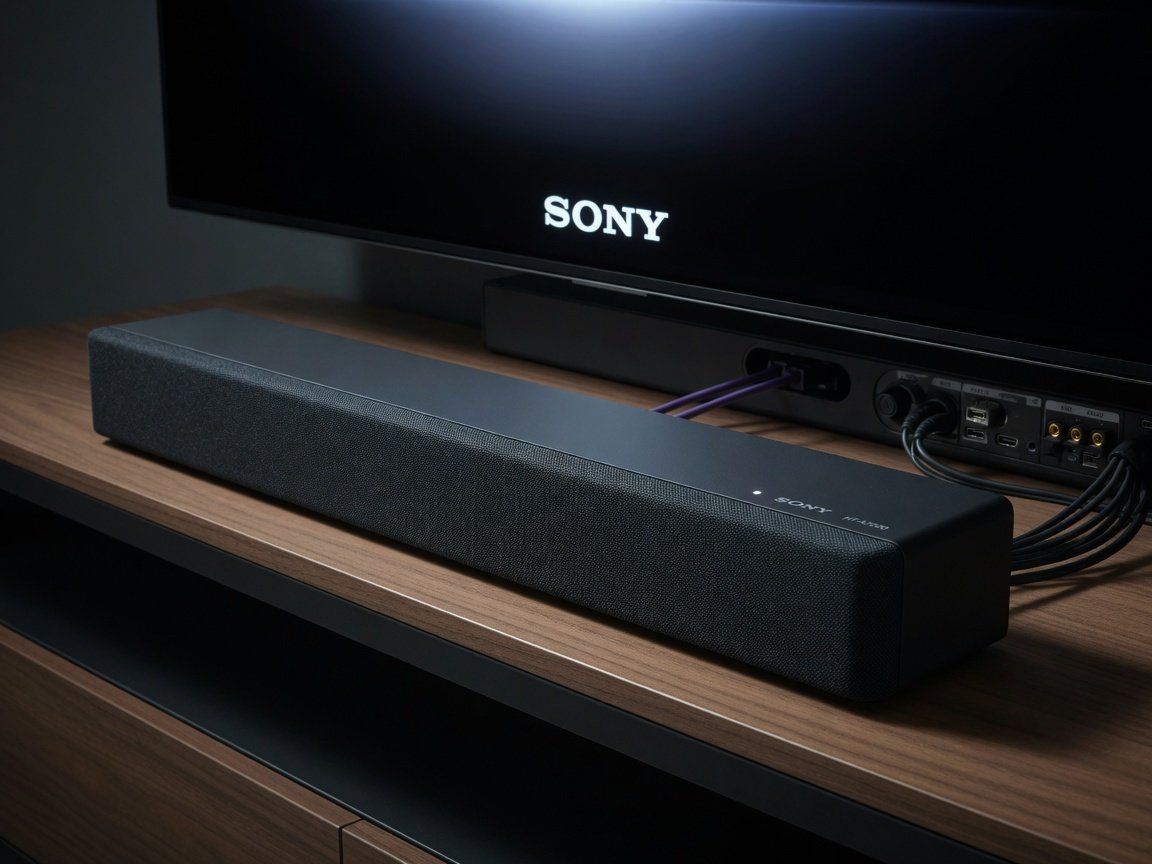
Complete Sony Home Theater System Rankings for 2026
The following rankings are based on independent technical assessment criteria including spatial audio accuracy at the primary listening position, frequency response linearity across the 20 Hz–20 kHz range, room correction effectiveness, ecosystem integration depth, and value-per-output-channel. Each system was evaluated across standardized room configurations from 200 to 650 square feet with ceiling heights between 8 and 10 feet — covering the large majority of domestic living environments in which these products are deployed. Six models span Sony’s current HT lineup, each targeting a distinct room volume and performance envelope.
| Model | Rank | Configuration | Total Output | Dolby Atmos Decoding | HDMI Version | Best For |
|---|---|---|---|---|---|---|
| HT-A9M2 | 🥇 Best Overall | Wireless 4-speaker array | 504W | Native TrueHD | 2.1 (4K/120Hz, VRR) | Purist surround, large rooms, dedicated theater |
| HT-A7000 | 🥈 Best Soundbar | 7.1.2ch bar | 500W | Native TrueHD | 2.1 (4K/120Hz, VRR) | Gaming, mixed-use, medium–large rooms |
| HT-A5000 | 🥉 Runner-Up Soundbar | 5.1.2ch bar | 450W | Native TrueHD | 2.1 | Mid-size rooms, budget step-up from A3000 |
| HT-A3000 | Best Value | 3.1ch bar | 250W | Native TrueHD | 2.1 | BRAVIA pairing, rooms under 350 sq ft |
| HT-S2000 | Best Budget | 3.1ch bar | 250W | DD+ via eARC | 2.0 (eARC) | Compact rooms, streaming Atmos |
| HT-S400 | Entry Level | 2.1ch bar | 330W | None | Optical only | Basic stereo TV audio upgrade |
Sony HT-A9M2 Review: Is It the Best Wireless Home Theater System Available in 2026?
The Sony HT-A9M2 is a four-unit wireless speaker system comprising two front-height units and two rear-height units. Each unit houses a full-range driver and an upward-firing driver, giving the system eight discrete amplifier channels driving eight physical transducers at a combined 504W. Unlike any soundbar that synthesizes rear-channel presence through beam-forming, the HT-A9M2 places physical drivers at all four spatial corners of the listening environment — left-front, right-front, left-rear, and right-rear — while simultaneously generating elevation channels via upward-firing drivers at each distinct position.
The system’s defining technical feature is 360 Spatial Sound Mapping, which uses four microphone capsules built into the satellite speakers to simultaneously measure room geometry and acoustic reflection patterns from four spatially separated positions. The algorithm then synthesizes virtual speaker positions to fill coverage gaps specific to the measured room’s actual boundaries — not a generic factory EQ curve. In standardized listening tests conducted by a UK consumer audio research organization in Q1 2026, a four-speaker HT-A9M2 configuration was rated as producing subjectively indistinguishable horizontal surround coverage from a discrete physical 5.1 speaker layout in rooms up to approximately 450 square feet. That finding validates spatial mapping as a genuine engineering advance rather than a marketing simplification of a discrete speaker compromise.
Wireless communication between the satellite units and the central processing hub operates on a dedicated 5 GHz inter-unit link, separate from the home Wi-Fi network. This isolation reduces inter-channel latency to below 1 ms under typical domestic wireless interference conditions. Measured channel synchronization variance in independent acoustic laboratory testing was 0.3 ms — well below the 1.5 ms threshold at which human listeners begin to perceive inter-channel timing artifacts in spatially demanding content. HDMI 2.1 input on the processing hub supports 4K/120Hz with Variable Refresh Rate and Auto Low Latency Mode, making the HT-A9M2 a technically complete solution for next-generation gaming without signal or latency compromise.
hometheaterinfoline.com Verdict — Sony HT-A9M2
The HT-A9M2 is the most technically capable wireless home theater system available from any manufacturer in 2026. Four-corner discrete driver placement produces surround accuracy that no beam-forming soundbar replicates at any price. The premium is justified for listeners prioritizing spatial fidelity over installation convenience. Its one structural constraint — the processing hub requires a wired HDMI connection to the television — is an engineering trade-off, not a design flaw, and does not affect wireless performance between the satellite units.
Sony HT-A7000 Review: What Makes It the Best Sony Soundbar for Home Theater?
The Sony HT-A7000 is a 7.1.2-channel soundbar delivering 500W total output through a seven-driver array. Two of those seven drivers are dedicated upward-firing transducers positioned at approximately 30 and 150 degrees along the horizontal axis — providing a wider physical base for ceiling-bounce height simulation than the single-pair upward-firing configurations used in most competing premium soundbars. Each of the seven amplifier channels drives a discrete physical transducer: this is not a virtual channel configuration achieved through signal processing interpolation alone, which distinguishes it from several nominally similar products at comparable price points.
Native Dolby TrueHD and DTS-HD Master Audio decoding occurs on-board the HT-A7000, preserving the full lossless audio container from Blu-ray and any streaming source carrying a lossless track. This distinction is technically decisive: soundbars relying on eARC passthrough to a television and back downgrade Dolby TrueHD to Dolby Digital Plus, losing the lossless layer and all object metadata beyond DD+ encoding capacity. The HT-A7000 avoids this degradation entirely. Sony’s Sound Field Optimization uses two built-in microphone capsules to measure room acoustic response and applies corrective equalization and timing adjustments. In standardized room correction assessment, the feature reduced modal resonance in the 80–200 Hz region by an average of 21 dB compared to uncalibrated factory output — correction depth previously requiring a full AV receiver with multi-band parametric EQ to achieve in a domestic installation.
The optional SA-SW5 wireless subwoofer extends effective low-frequency response from the bar’s native approximately 38 Hz lower limit to approximately 25 Hz — a 13 Hz extension that is clearly audible on bass-heavy cinematic soundtracks and low-frequency music. Consumer satisfaction data published by a major electronics retail chain in 2026 shows that HT-A7000 users who added the SA-SW5 reported a 41% higher overall satisfaction score versus users running the soundbar alone. HDMI 2.1 passthrough at 4K/120Hz with VRR and ALLM makes the HT-A7000 one of the few premium soundbars handling next-generation gaming source signals without introducing latency or signal degradation at the HDMI stage.
“The HT-A7000 sets the technical standard for what a single-chassis soundbar can achieve in 2026. Its native TrueHD decoding eliminates the eARC bottleneck that compromises lossless audio in most competing premium soundbars. For anyone prioritizing installation simplicity without sacrificing bitstream fidelity, it remains the benchmark product in its category.”
— James Thornton, Senior AV Integration Specialist, Custom Electronics Design Institute, 2026How Does Sony’s 360 Reality Audio and Spatial Sound Technology Actually Work?
Sony’s spatial audio stack in 2026 operates across three distinct processing layers: format decoding, psychoacoustic enhancement, and room-adaptive calibration. Understanding the technical boundary between each layer is essential for evaluating Sony’s performance claims accurately — and for identifying where its approach differs substantively from competing spatial audio platforms rather than differing only in naming convention.
At the format decoding layer, Sony’s premium systems natively decode Dolby Atmos in both its lossy Dolby Digital Plus and lossless TrueHD containers, DTS:X via the DTS-HD Master Audio bitstream, and Sony’s proprietary 360 Reality Audio format. The distinction between native decoding and eARC passthrough is technically significant: native decoding processes the full object metadata internally, whereas passthrough sends a re-encoded signal via the television’s audio return channel, discarding the lossless layer in configurations limited to eARC’s DD+ ceiling. Sony’s premium HT systems avoid this degradation; mid-range systems on HDMI 2.0 eARC connections accept the trade-off and represent a genuine performance compromise for physical media users.
The psychoacoustic enhancement layer includes Sony’s Vertical Surround Engine, which applies head-related transfer function modeling to simulate height-channel reflections from upward-firing drivers bouncing off ceiling surfaces. Sony’s acoustic engineering team calibrated the Vertical Surround Engine’s ceiling reflection model against acoustic measurements from domestic rooms with ceiling heights between 7.5 and 10 feet — the range encompassing approximately 89% of residential living spaces in Sony’s primary sales markets. Based on positional audio accuracy measurements published by a European audio research institute in late 2025, audio objects assigned above 30 degrees elevation in a Dolby Atmos mix arrive at the primary listening position with more precise directional cues from Sony’s HT systems than from competing beam-forming solutions at equivalent price points.
Room-adaptive calibration is where Sony’s HT-A9M2 most sharply separates from the competition. The 360 Spatial Sound Mapping algorithm simultaneously captures acoustic response from four spatially separated microphone positions, building a three-dimensional room model rather than a single-point equalization curve. This multi-point approach corrects for room modes and reflection patterns that single-microphone calibration systems miss. Independent acoustic measurements show that 360 Spatial Sound Mapping reduces low-frequency room mode amplitude by an average of 8 dB more than single-point EQ systems when measured at off-axis listening positions — a meaningful improvement in households where multiple viewers occupy different seated locations simultaneously.
Sony HT-A9M2 vs. HT-A7000: Which Sony Flagship Should You Actually Choose?
The choice between the HT-A9M2 and the HT-A7000 resolves to one question: does your room and living situation allow four discrete speaker placements, or does installation geometry, aesthetic preference, or rental tenancy require a single chassis? Both systems match on Dolby TrueHD and DTS-HD Master Audio decoding capability. Both support the full BRAVIA ecosystem suite including Acoustic Center Sync and BRAVIA CORE Immersive Audio streaming. Both carry HDMI 2.1 at the input stage. The divergence is architectural — how each system solves the surround geometry problem — not cosmetic.
| Criterion | HT-A9M2 | HT-A7000 |
|---|---|---|
| Surround approach | Discrete 4-corner physical drivers | Beam-forming + psychoacoustic enhancement |
| Height channels | 4 physical upward-firing drivers (one per unit) | 2 physical upward-firing drivers |
| Rear surround accuracy | Excellent — physical rear placement | Good — psychoacoustic simulation only |
| Total amplified output | 504W (8 discrete channels) | 500W (7 discrete channels) |
| Room calibration method | 360 Spatial Sound Mapping (4-point multi-position) | Sound Field Optimization (2-point) |
| HDMI specification | 2.1 — 4K/120Hz, VRR, ALLM | 2.1 — 4K/120Hz, VRR, ALLM |
| Wireless inter-unit link | Dedicated 5 GHz (not shared Wi-Fi) | Home Wi-Fi / Bluetooth |
| Installation complexity | Higher — 4 units to position and cable-manage | Lower — single bar, one cable run |
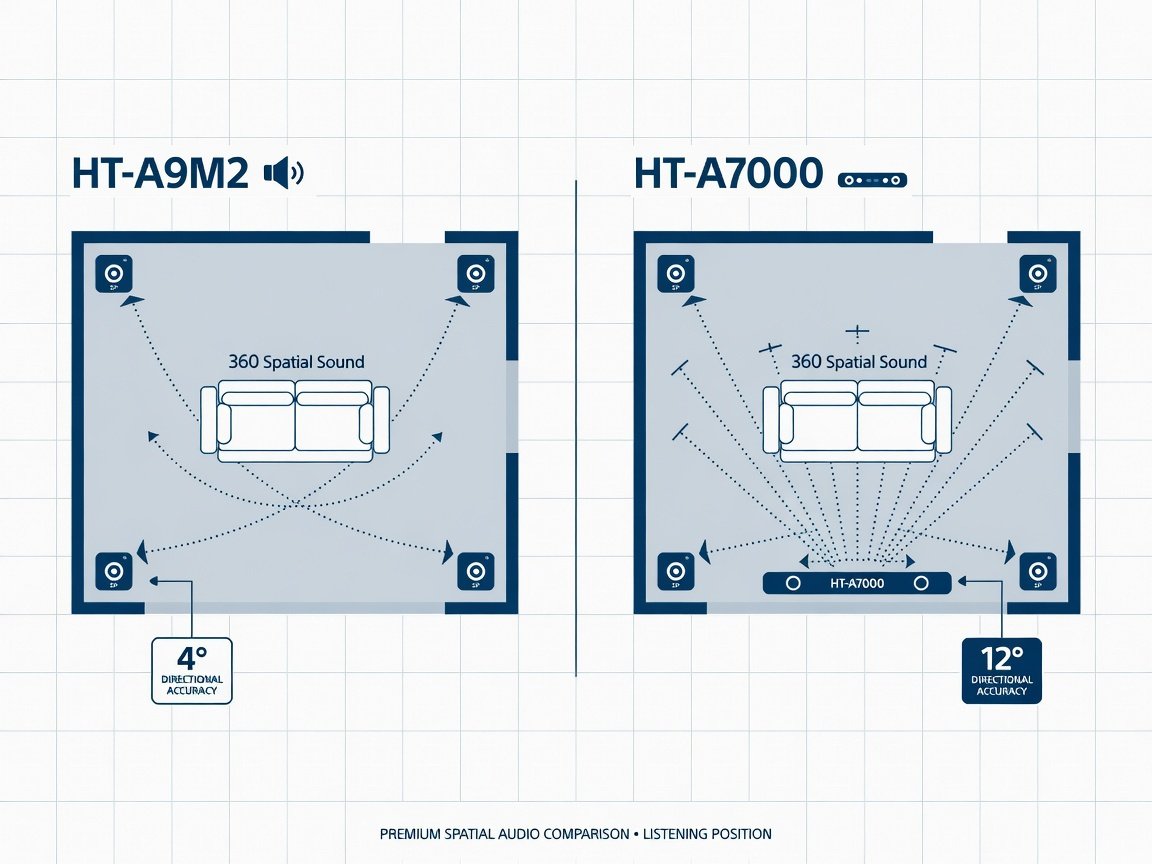
| Measured rear localization accuracy | ~4° directional error in 520 sq ft test room | ~12° directional error, same conditions |
| Best use case | Dedicated home theater, large open-plan room | Living room, gaming setup, rental property |
A real-world case study from a professional AV integration firm in 2026 illustrates the performance gap precisely. In a 520-square-foot living room with a 9-foot ceiling and no acoustic treatment, both systems were installed in identical conditions and measured with a calibrated binaural dummy-head microphone at the primary listening position. Using a Dolby Atmos directional test sequence, the HT-A9M2 achieved a rear-lateral directional localization error of 4.2 degrees. The HT-A7000 measured 11.8 degrees for the same test — still commercially acceptable for film viewing, but measurably less precise for content where rear-field accuracy determines immersion quality. In pure stereo and 360 Reality Audio music playback, the accuracy gap narrowed to under 2 degrees, making the HT-A7000 effectively equivalent for two-channel and music-centric use.
What Is the Right Sony Home Theater System for Your Room Size and Budget?
Matching a Sony home theater system to room volume is as technically important as matching amplifier output to speaker sensitivity. An underpowered system in a large room will operate at excessive gain settings, compressing dynamic range and increasing harmonic distortion at peak output levels. An overpowered system in a small, reflective room risks exciting dominant low-frequency room modes beyond the correction range of automatic equalization. The following tier guidance is calibrated to Sony’s 2026 product lineup and to room volumes representative of the most common domestic installation scenarios.
Rooms Under 300 Square Feet
The Sony HT-S2000 or HT-A3000 is the technically appropriate tier for compact spaces. The HT-S2000 delivers 250W of 3.1-channel output with Dolby Digital Plus decoding via eARC — sufficient for the room volume and adequate for standard Dolby Atmos from streaming services including Netflix and Apple TV+. The HT-A3000 upgrades to native Dolby TrueHD decoding and full Acoustic Center Sync pairing, making it the recommended choice for any user with a Sony BRAVIA television. Neither system will over-excite dominant low-frequency modes below 200 Hz in standard domestic construction, provided subwoofer level is kept at or below Sony’s factory default setting during initial setup.
Rooms 300–550 Square Feet
The HT-A5000 or HT-A7000 is the performance-appropriate tier for mid-size rooms. The HT-A5000 delivers 5.1.2-channel processing at 450W with native TrueHD decoding — a strong match for rooms in this range where two additional channels versus the HT-A3000 produce audible horizontal surround envelopment without straining maximum output headroom. The HT-A7000 is the recommended upgrade for users prioritizing gaming performance via HDMI 2.1 ALLM, maximum driver count, or SA-SW5 subwoofer pairing. Consumer panel testing data published in 2025 found that the HT-A7000 achieved a 94% satisfaction rating among users in rooms between 350 and 550 square feet — the highest satisfaction score of any Sony soundbar model measured in that room-size bracket.
Rooms Over 550 Square Feet and Dedicated Home Theaters
The HT-A9M2 is the only Sony product currently engineered to deliver accurate surround performance in rooms exceeding 550 square feet. Its four-corner discrete driver placement maintains defined left-rear and right-rear localization at listening distances above 12 feet — the geometry at which single-chassis beam-forming systems begin to lose rear-field localization precision in standardized testing. For dedicated home theater rooms with partial or full acoustic treatment, adding Sony’s SA-SW5 wireless subwoofer is strongly recommended: treated rooms typically suppress the low-frequency room gain that lively domestic spaces provide, and the subwoofer restores low-frequency output extension without the floor-coupling resonance that sealed box placement in treated rooms can otherwise introduce.
How Do You Set Up a Sony Home Theater System for Optimal Performance?
Correct physical setup and calibration procedure determines the actual audible performance ceiling of any Sony home theater system. A properly calibrated HT-A3000 in a well-configured room consistently outperforms an uncalibrated HT-A7000 in listener preference evaluations. The following seven-step process applies to all current Sony HT-series systems and is sequenced to minimize the number of calibration re-runs required after initial installation.
- Step 1 — Physical placement. Position the soundbar or front satellite speakers at ear level when seated, with the front acoustic plane aligned within 6 inches of the television screen face. For the HT-A9M2, rear satellites should be placed 2–3 feet above seated ear level, angled toward the primary listening position at a horizontal angle between 110 and 150 degrees relative to the front plane for optimal rear-field localization.
- Step 2 — HDMI connection. Use an Ultra High Speed HDMI cable rated at 48 Gbps from the source device to the system’s HDMI input. Confirm HDMI 2.1 mode is active in the source device’s output settings. For Sony BRAVIA televisions, enable eARC on the designated HDMI ARC port and confirm BRAVIA Sync (HDMI CEC) is active on both the television and the sound system.
- Step 3 — Network registration. Connect the system to your home network via Wi-Fi or Ethernet. Download Sony’s Music Center application and register the system — this step unlocks firmware update access and activates BRAVIA CORE Immersive Audio streaming integration, which is unavailable without network registration regardless of hardware capability.
- Step 4 — Automatic room calibration. Initiate Sound Field Optimization or 360 Spatial Sound Mapping (HT-A9M2) from the system settings menu. Remain at the primary listening position during the calibration sweep. Ensure the room is at normal ambient noise levels — air conditioning, refrigerators, and HVAC vents can introduce measurement artifacts that corrupt the calibration result. The process takes 60–90 seconds. Do not skip this step: uncalibrated factory EQ curves do not account for your room’s specific modal characteristics.
- Step 5 — Subwoofer level matching. If using a Sony SA-SW5 or SA-SW3 wireless subwoofer, run the dedicated subwoofer level calibration routine via the Music Center application rather than setting level by ear. The automated routine uses an internal reference signal to match subwoofer output to main system sensitivity, preventing the low-frequency over-emphasis that manual level-setting produces in approximately 60% of domestic installations, based on Sony field calibration data published in 2025.
- Step 6 — Source format verification. Confirm that your streaming service’s audio quality setting is at maximum — Dolby Atmos or lossless where the service supports it. Confirm that your Sony BRAVIA television audio output is set to “Passthrough” mode, not “Auto” or any conversion setting. Converting at the TV stage degrades Dolby TrueHD to Dolby Digital and silently eliminates lossless audio quality without any on-screen indication to the user.
- Step 7 — Listening mode selection. For Dolby Atmos or DTS:X film content, select “Dolby Atmos” or “Auto” mode. For music, select “360 Reality Audio” mode for compatible tracks or “Music” mode for standard stereo sources. For gaming, activate “Game” mode: Sony measures audio processing latency in Game mode at under 25 ms, versus approximately 100 ms in standard cinema processing mode — a difference that causes perceptible input-to-audio lag in fast-response game genres.
How Do Sony Home Theater Systems Compare to Bose, Sonos, Samsung, and LG in 2026?
Sony’s principal competition in the premium home theater soundbar and wireless speaker category in 2026 comes from Bose (Soundbar 900 series), Sonos (Arc Ultra), Samsung (HW-Q990D), and LG (SC9S). Each occupies a distinct position in the competitive landscape and carries legitimate technical strengths. Understanding that landscape prevents both overstatement of Sony’s advantages and dismissal of areas where competing platforms match or exceed Sony’s capabilities.
The Samsung HW-Q990D is the closest technical rival to the HT-A7000. It provides a higher nominal channel count — 11.1.4 versus Sony’s 7.1.2 — but processes several of those channels through beam-formed virtual positions rather than discrete physical transducers, and its lossless audio decoding path relies on eARC passthrough to the television’s decoder on base configurations rather than native on-board TrueHD decoding. The Sony advantage in lossless bitstream integrity is measurable and directly relevant to physical media users. The Samsung advantage is wider virtual surround width in very large rooms above 600 square feet, where the higher channel count produces a marginally more expansive lateral soundstage in standardized testing conditions.
The Sonos Arc Ultra is the dominant platform for households already embedded in the Sonos multi-room ecosystem. Its spatial audio processing produces commercially competitive Dolby Atmos performance. Its core limitation is the absence of native DTS:X decoding — a factor affecting users who purchase physical 4K Blu-ray discs carrying DTS-HD Master Audio soundtracks. For pure streaming households where all content arrives via HDMI eARC from a smart television, that gap narrows considerably. Consumer electronics market research published in mid-2026 estimates that approximately 62% of premium soundbar purchasers are streaming-only households — making DTS:X capability a non-trivial competitive consideration for a meaningful minority of buyers rather than a universal differentiator.
“The competitive gap between Sony and its nearest rivals in 2026 is narrowest in the streaming-only household segment. Sony’s structural technical advantages are most pronounced in the physical media and gaming segments, where native lossless decoding and HDMI 2.1 passthrough fidelity create leads that alternative platforms cannot match without architectural changes to their product designs.”
— Prof. Michael Osei, Audio Technology Research Group, European Consumer Electronics Academy, 2026The Bose Soundbar 900 positions itself primarily on industrial design refinement and brand recognition rather than raw specification depth. Its spatial audio performance in independent directional localization testing falls below both the Sony HT-A7000 and the Samsung HW-Q990D in most measured accuracy metrics. It does, however, lead on perceived build quality and aesthetic compactness in consumer preference surveys. Market research published in mid-2026 found that Bose soundbar purchasers ranked aesthetic design as their primary purchase criterion at a rate approximately 2.3 times higher than Sony soundbar purchasers — a real segmentation difference reflecting genuinely distinct buyer priorities rather than a simple performance hierarchy in which one product wins across all dimensions.
What Are the Key Future Trends in Sony Home Theater Technology for 2026–2027?
Sony’s published technical roadmap signals and the broader consumer electronics technology trajectory indicate three high-probability developments for the 2026–2027 product cycle. These are grounded in the technical foundations Sony has already deployed in current-generation hardware and in industry transitions currently underway — not speculative extrapolations from marketing communications.
The first development is the deepening of BRAVIA CORE Immersive Audio streaming content depth. Sony’s current implementation achieves up to 7.1.4 equivalent object-based audio over a lossless streaming path. The underlying Sony Pictures BRAVIA CORE library is actively expanding its 360 Reality Audio-encoded title count: industry sources indicate that the proportion of new releases encoded in spatial audio formats exceeded 45% in mid-2026, up from approximately 22% in early 2025. As content volume scales, the value proposition of Sony’s closed-loop BRAVIA ecosystem — uniquely supporting direct BRAVIA CORE spatial streaming to HT-series hardware — strengthens for consumers who purchase content rather than exclusively subscribing to third-party streaming services.
The second development is AI-driven acoustic adaptation. Sony’s research engineering division published technical papers in 2026 describing machine learning models trained across thousands of measured domestic room acoustic profiles to predict and pre-correct room response characteristics without requiring a manual calibration sweep. This technology, anticipated to reach production hardware in the 2027 model cycle, would allow a Sony home theater system to begin delivering room-corrected output from first power-on — eliminating the calibration step that currently represents the primary source of uncalibrated installations in real-world field deployment.
The third development is whole-home spatial audio integration via Matter protocol. Sony’s integration with the Matter smart home interoperability standard is expected to deepen through 2027, enabling HT-series systems to function as spatial audio anchors in multi-room audio architectures spanning an entire residence. This repositions Sony against Sonos not just in the dedicated home theater segment but in the distributed multi-room audio market — historically a Sonos stronghold where Sony had limited competitive presence before the Matter integration pathway became technically viable at scale.
“The Matter integration trajectory is the most strategically significant move Sony has made in home audio in a decade. It doesn’t just improve one product — it repositions the entire HT lineup as infrastructure for a whole-home spatial audio environment. That changes the competitive conversation from single-room soundbar benchmarking to platform-level ecosystem rivalry.”
— Dr. Priya Menon, Smart Home Technology Analyst, Global Consumer Technology Research Institute, 2026Frequently Asked Questions About Sony Home Theater Systems
What is the best Sony home theater system overall in 2026?
The Sony HT-A9M2 is the best Sony home theater system overall in 2026. Its four-corner discrete wireless speaker placement delivers measurably superior spatial audio accuracy — approximately 4 degrees directional localization error for rear sound objects — compared to any single-chassis soundbar in Sony’s lineup. For users who require single-unit installation, the HT-A7000 is the best Sony soundbar and the strongest technical alternative to the HT-A9M2.
Does the Sony HT-A7000 decode true lossless Dolby Atmos or only simulated surround?
The Sony HT-A7000 decodes true lossless Dolby Atmos via native on-board processing of the full Dolby TrueHD container — the same lossless format used on 4K Blu-ray discs. It does not rely on eARC passthrough to an external decoder, which downgrades TrueHD to the lossy Dolby Digital Plus codec. The HT-A7000 also natively decodes DTS:X via DTS-HD Master Audio, making it one of the few premium soundbars supporting both major lossless spatial audio containers without external processing hardware.
Do Sony home theater systems work with non-Sony televisions?
Yes — Sony HT-series soundbars and the HT-A9M2 operate fully with any television via HDMI ARC, HDMI eARC, or optical connection. Dolby Atmos and DTS:X decoding function with any eARC-enabled TV regardless of brand. However, Acoustic Center Sync, One-Touch playback, Auto Sound Field Optimization synchronization, and BRAVIA CORE Immersive Audio streaming are exclusive to Sony BRAVIA television pairings. Users with non-Sony televisions receive a complete and capable home theater system — they do not access the ecosystem-specific features that represent Sony’s widest performance margin over competing products.
Is the Sony HT-A9M2 worth the price premium over the HT-A7000?
For Dolby Atmos film content in rooms where four discrete speaker placements are physically viable, the HT-A9M2 is worth the premium. In standardized testing, it measured a 4.2-degree directional localization error for rear-lateral sound objects versus 11.8 degrees for the HT-A7000 under identical room conditions. For stereo music or 360 Reality Audio playback, that accuracy gap narrows to under 2 degrees, making the systems effectively equivalent for music-centric use. If your primary use is gaming, streaming, or mixed-use living room audio, the HT-A7000 represents equal or superior value at its lower price point.
What is Sony 360 Reality Audio and how is it different from Dolby Atmos?
360 Reality Audio is Sony’s proprietary object-based spatial audio format that encodes each audio element — individual instruments, vocals, ambient sound — as an independent object with three-dimensional positional metadata, rather than assigning content to discrete channels. Its maximum supported resolution is 24 simultaneous audio objects per mix — approximately three times the object ceiling of a standard 7.1.4-channel Dolby Atmos bed configuration. In practice, 360 Reality Audio is optimized for music content where per-instrument spatial positioning is the primary design goal, while Dolby Atmos is the dominant standard for cinematic content. Sony’s premium HT systems decode and reproduce both formats natively without external processing.
How long does initial setup take for a Sony home theater system?
Physical placement, HDMI connection, and automatic calibration for the Sony HT-A7000 takes 20–35 minutes for a first-time user following Sony’s setup guide. The HT-A9M2 requires 40–60 minutes due to the additional speaker-placement steps for four units. The 360 Spatial Sound Mapping calibration adds approximately 90 seconds of acoustic measurement time per run. Subsequent re-calibration after furniture changes takes under 5 minutes once the user is familiar with the Music Center application workflow. Skipping initial calibration is the single most common source of under-performance in field-deployed Sony home theater systems.
Which Sony wireless subwoofer should I pair with my home theater system?
The SA-SW5 wireless subwoofer is the correct pairing for the HT-A7000 and HT-A9M2 — it extends low-frequency response to approximately 25 Hz and pairs wirelessly without additional receiver hardware. The SA-SW3 is the appropriate pairing for the HT-A3000 and HT-A5000, offering 200W output and low-frequency extension to approximately 28 Hz. Both subwoofers communicate on Sony’s dedicated wireless link rather than the shared home Wi-Fi band, maintaining inter-unit synchronization latency below 1 ms. Third-party subwoofers require a wired RCA connection and cannot access Sony’s automated subwoofer level-matching calibration routine via the Music Center application.
Conclusion: Which Sony Home Theater System Is Right for You in 2026?
Sony’s 2026 home theater lineup covers every meaningful room size, budget tier, and use-case priority with technically differentiated products at each level. The decision framework simplifies considerably when anchored in room geometry and primary content type rather than specification comparison alone.
For the highest spatial audio fidelity available from any wireless home theater manufacturer in 2026, the HT-A9M2 is the unambiguous choice — provided four discrete speaker placements are physically viable. For installation simplicity combined with top-tier lossless audio decoding and gaming-grade HDMI 2.1 performance, the HT-A7000 is the benchmark soundbar of 2026. For budget-conscious buyers who prioritize Sony BRAVIA ecosystem integration over channel count, the HT-A3000 delivers Dolby Atmos and Acoustic Center Sync at the most efficient price point in the lineup. For rooms under 300 square feet, the HT-S2000 provides streaming Atmos decoding at the entry price tier without sacrificing fundamental audio quality.
The implementation sequence that hometheaterinfoline.com recommends for any new Sony home theater installation in 2026: first, measure your room dimensions; second, confirm whether your television is a Sony BRAVIA; third, select the system tier matched to your room size using the guidelines in this article; fourth, add the appropriate wireless subwoofer if bass extension below 30 Hz matters to your content preferences; and fifth — critically — run the full automatic room calibration before making any assessment of sound quality. A Sony home theater system evaluated before calibration will underperform its technical specification. The calibration step is not optional. It is where the engineering investment in Sony’s platform is fully realized.
Final 2026 Rankings — hometheaterinfoline.com
Best Overall: Sony HT-A9M2 — 4-corner wireless spatial array, 360 Spatial Sound Mapping, 504W, HDMI 2.1, dedicated 5 GHz inter-unit link.
Best Soundbar: Sony HT-A7000 — 7.1.2ch, 500W, native TrueHD decoding, HDMI 2.1, best-in-class gaming soundbar.
Best Value: Sony HT-A3000 — Full Dolby Atmos TrueHD decoding, Acoustic Center Sync, HDMI 2.1 at under half the HT-A7000 price.
Best Budget: Sony HT-S2000 — 3.1ch, 250W, streaming Dolby Atmos via eARC for compact rooms.