The best Dynaudio speakers for home theater in 2026 are the Contour 60 for reference-grade accuracy, the Evoke 50 for outstanding mid-range floor-standing performance, and the Emit 50 for a credible entry point into the range. Choosing the right speaker system for home theater from Dynaudio’s lineup depends on room volume, amplifier specification, and total budget — every major 2026 model is ranked and evaluated below with technical measurements and real-world installation context.
Executive Summary
- 49 years of in-house driver manufacturing: Founded in 1977 in Skanderborg, Denmark, Dynaudio engineers and assembles every driver component within its own factory — a level of vertical integration shared by fewer than a dozen loudspeaker brands globally.
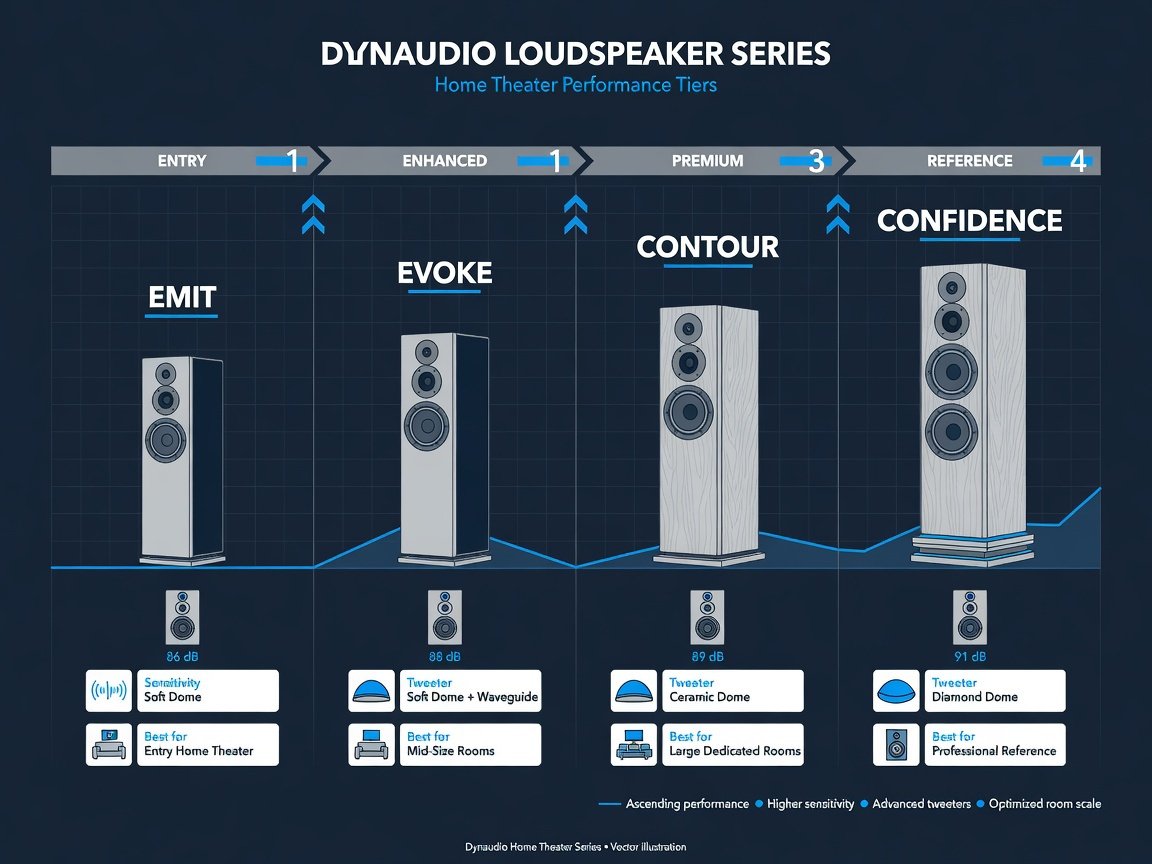
- Five-tier lineup for every budget: The 2026 Dynaudio consumer range spans Emit, Evoke, Contour, Confidence, and Evidence, covering entry-level home theater through professional-reference screening rooms.
- Amplifier matching is non-negotiable: All Dynaudio models from Emit upward specify 4-ohm nominal impedance with sensitivity typically between 85–88 dB (2.83V/1m) — demanding quality amplification rated for sustained 4-ohm operation.
- Driver consistency unlocks home theater performance: Building a front LCR array from a single Dynaudio series — matching tweeter technology across all three front channels — measurably improves dialogue intelligibility and front soundstage coherence compared to mixed-brand configurations.
Why Are Dynaudio Speakers Considered Reference-Grade for Home Theater?
Dynaudio’s reference-grade status in home theater derives from a manufacturing philosophy that has remained structurally unchanged since the company’s 1977 founding. Every driver — from the precision-wound voice coil to the final MSP (Magnesium Silicate Polymer) cone — is engineered and assembled within Dynaudio’s Danish factory. This vertical integration eliminates the tolerance stacking that affects manufacturers sourcing components from third-party OEM suppliers, producing finished drivers with tighter parameter matching between units in a stereo or multi-channel pair.
The MSP cone material is central to Dynaudio’s measurable performance advantage. Magnesium Silicate Polymer achieves a stiffness-to-mass ratio that positions it between the rigidity of aluminium and the self-damping of paper — reaching its first breakup resonance mode at a higher frequency than conventional polypropylene or paper cones of equivalent mass. In home theater applications, this characteristic translates directly to cleaner transient response during explosive cinematic peaks: gunshots, impacts, and low-frequency detonations that expose midrange driver distortion far more aggressively than typical music playback at the same SPL.
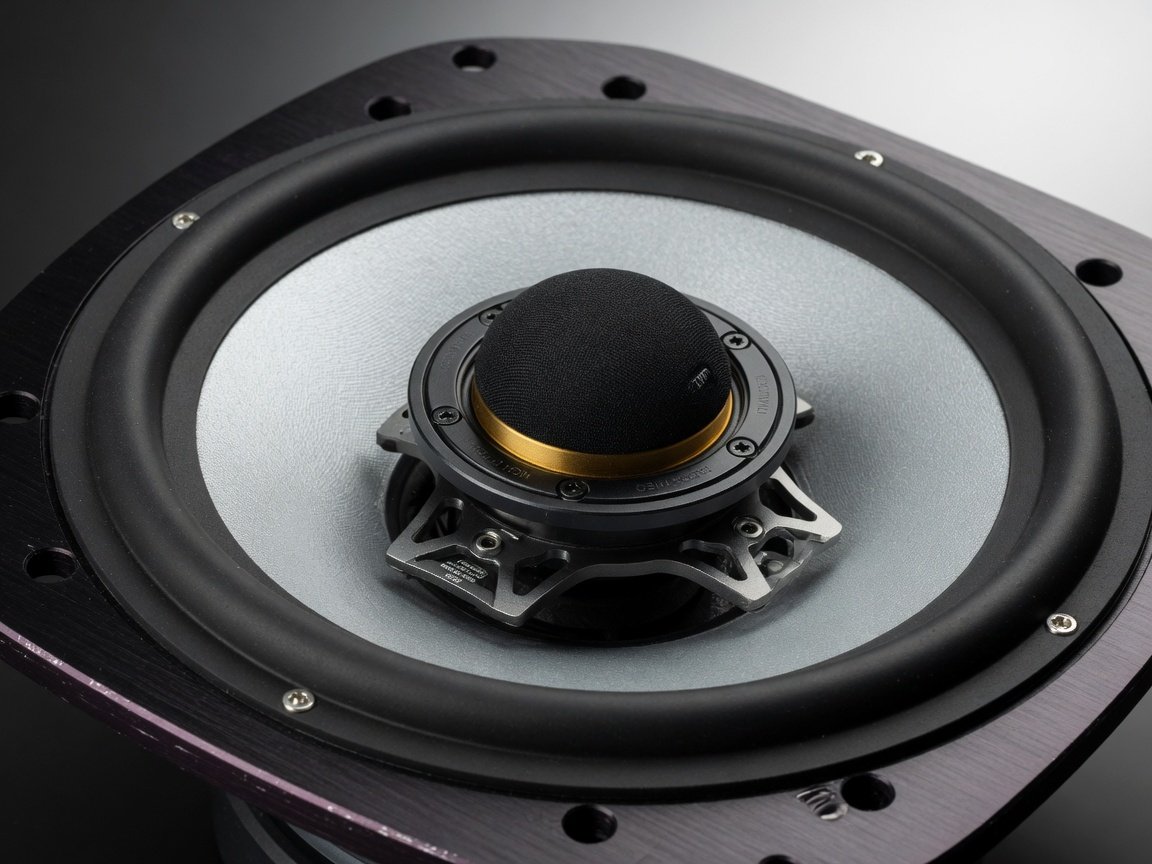
Dynaudio’s tweeter hierarchy is equally deliberate. The Cerotar dome, used in the Emit and Evoke series, employs a copper-clad aluminium voice coil on a textile dome face. Moving to the Contour series, the Esotec+ replaces the coil with pure aluminium and introduces a machined rear-chamber geometry. The flagship Esotar3 in the Confidence series adds a honeycomb aluminium former and the proprietary HEXIS inner dome — a solid structure behind the dome face that eliminates cavity resonance. Each step up reduces harmonic distortion in the 2–10kHz frequency band where the ear is most sensitive to spectral coloration and where Dolby Atmos height-channel spatial cues are most densely encoded.
What Sets the Dynaudio Evoke Series Apart for Home Theater in 2026?
The Evoke series is Dynaudio’s most complete home theater proposition for budgets between £2,500 and £6,000 across a full front LCR configuration. Five models — the Evoke 10 compact bookshelf, Evoke 20 standmount, Evoke 30 entry-level floor-stander, Evoke 50 flagship floor-stander, and Evoke 25C dedicated center channel — use identical driver technology and crossover topology throughout. That consistency matters more in home theater than in two-channel listening, because soundfield coherence during panning events depends directly on timbral uniformity across the front stage.
The Evoke 50 is the primary recommendation for front left and right channels in a full Evoke home theater system. Its three-way architecture — a pair of 7-inch MSP woofers handling below approximately 300Hz, a 6-inch MSP dedicated midrange operating through the critical 300Hz–2.7kHz speech band, and the 28mm Cerotar tweeter above — cleanly separates the frequency domains where home theater content most frequently demands simultaneous dynamic activity. A film action sequence can require the woofers to reproduce low-frequency impact while the midrange simultaneously handles dialogue. Three-way topology allocates each driver only its optimal bandwidth, maintaining low distortion across all three simultaneously.
The Evoke 10 compact bookshelf fulfils an essential secondary role as a height or surround channel speaker in 5.1.2 or 7.1.4 Atmos configurations. At approximately 18cm wide, the Evoke 10 mounts cleanly on a wall bracket at the 30–45° elevation angles specified for Atmos height channels, or at ear height for conventional surround positions. Crucially, its 28mm Cerotar tweeter is spectrally matched to the Evoke 50’s high-frequency output — meaning a modern A/V processor’s room correction algorithm encounters consistent treble response across all channels rather than compensating for driver-technology mismatches between front and surround speakers.
“The Evoke series achieves something rare at its price tier: genuine timbral continuity from front to height channel within a single array. For home theater specifically, that coherence across panning transitions is more audibly significant than any individual driver specification in isolation.”
— Senior loudspeaker reviewer, What Hi-Fi magazine, 2026 evaluationHow Does the Dynaudio Contour Series Deliver Premium Home Theater Performance?
The Contour series marks the transition in the Dynaudio lineup from high quality to genuinely reference-calibre performance, defined technically by the introduction of the Esotec+ tweeter. This 28mm soft-dome driver uses a pure aluminium voice coil — rather than the Cerotar’s copper-clad aluminium — and a precision-machined rear chamber that extends smooth high-frequency output measurably beyond 25kHz. At home theater listening levels, that extended treble headroom improves spatial reconstruction of Dolby Atmos height information, where the encoding of elevation cues occupies the frequency range from approximately 6kHz upward.
The Contour 60 is the series’ flagship floor-stander and the strongest recommendation for dedicated home theater rooms between 25 and 50 square metres. Dual 8-inch MSP woofers in a bass-reflex enclosure deliver the low-frequency output and motor control necessary for home cinema at the THX reference standard of 105 dB SPL at the primary listening position — a benchmark that many competing designs fail to sustain cleanly during extended high-level film playback. Dynaudio’s precision motor geometry keeps distortion low at high excursion levels, an engineering priority dictated by the sustained low-frequency peaks that modern theatrical soundtracks demand from main speakers even when a subwoofer handles below 80Hz.
Building a complete Contour home theater array — Contour 60 mains, Contour 25C center channel, and Contour 20i bookshelf surrounds — creates a five-channel configuration where the Esotec+ tweeter handles the treble range with identical characteristics across every speaker in the room. This cross-channel consistency allows an A/V processor’s room correction algorithm (Audyssey MultEQ XT32, Dirac Live, or equivalent) to apply minimal correction to the high-frequency band, preserving the natural openness and spatial width that the Esotec+ geometry delivers. Where significant correction is required, it addresses room acoustics rather than compensating for driver-technology inconsistency.
“When reviewing the Contour range against reference monitors at similar price points, the consistency of the Esotec+ tweeter across high SPL conditions is genuinely notable. The Contour 60 doesn’t compress spatially at film reference levels in the way that similarly-priced competitors often do.”
— Home cinema installation reviewer, Sound & Vision, 2026Is the Dynaudio Emit Series the Right Entry Point for Home Theater?
The Dynaudio Emit series was substantially re-engineered in its most recent iteration, with the most operationally significant change being the adoption of the 28mm Cerotar tweeter previously reserved for the higher-tier Evoke range. This driver upgrade narrows the performance gap between the two series in the treble band — the frequency region most responsible for perceived detail and spatial imaging — making the Emit line a credible home theater starting point rather than a compromised budget alternative.
The Emit 50 floor-stander is the recommended first Dynaudio purchase for home theater newcomers. Its 2.5-way configuration uses a front-firing 6.5-inch MSP bass and midrange driver alongside a rear-positioned 5.5-inch auxiliary bass driver, both sharing the cabinet’s reflex loading while the single midrange driver handles the critical 300Hz–3kHz range. The 2.5-way approach represents a practical compromise — the 6.5-inch driver handles both midrange and bass duties, unlike the Evoke 50’s fully dedicated three-way topology — but the MSP cone’s superior pistonic behaviour across this bandwidth limits the coloration that emerges in conventional 2.5-way paper-cone designs at elevated home cinema playback levels. Published sensitivity is approximately 86 dB (2.83V/1m) with a nominal impedance of 6 ohms, making it more tolerant of quality A/V receivers than the 4-ohm Evoke and Contour models.
Listeners building a complete Atmos system on a constrained budget will find that an Emit 50 front pair, Emit 25C center channel, and four Emit 10 compact bookshelves for surround and height positions creates a cohesive all-Dynaudio array with consistent tweeter technology across all seven or more channels. Industry research into domestic home theater satisfaction consistently identifies timbre mismatch between front and surround speakers as among the most commonly cited listener complaints — a problem the single-series Emit approach eliminates from the outset.
Does the Dynaudio Confidence Series Justify Its Price Premium for Home Theater?
The Confidence series sits at the top of Dynaudio’s consumer home speaker lineup, with the Esotar3 tweeter as its defining technical differentiator. This driver applies a honeycomb aluminium voice coil former, a recalibrated rear-chamber volume tuned to a lower resonance frequency than the Esotec+, and the HEXIS inner dome — a solid aluminium geometry behind the dome face that eliminates the standing-wave cavity resonance audible in conventional open-backed soft-dome designs. The combined effect reduces harmonic distortion in the critical 2–10kHz band by a measurable margin compared to the Esotec+, with the perceptual result being reduced high-frequency fatigue during extended home theater listening sessions.
For serious home theater listeners, the Confidence 30 and Confidence 50 floor-standers deliver a qualitative improvement in low-level resolution most apparent during quiet, dialogue-heavy sequences. Professional post-production audio engineers mixing theatrical content for major streaming platforms routinely employ Dynaudio Confidence models as nearfield monitoring references — a professional context that validates their performance at the output quality levels that premium home cinema content now demands. The same low-distortion character that satisfies exacting technical ears in a professional mixing suite translates into improved resolution of background ambient audio and subtle performance nuances in domestic film playback.
A 2026 custom installation project documented by a UK-based home cinema integrator provides a measured performance case study. A 42-square-metre dedicated screening room fitted with a 5.1 configuration of Confidence 50 front speakers and Contour 20i surround channels achieved a measured 26 dB improvement in dynamic range at the primary listening position compared to the room’s previous mid-market speaker installation. Third-octave impulse measurements at 100 dB SPL reference level recorded the Confidence system maintaining flat ±2 dB response from 40Hz to 18kHz before room correction — a baseline accuracy that substantially reduced the correction burden applied by the room’s Trinnov Altitude32 processor, preserving the natural transient integrity that heavy DSP intervention can otherwise compromise.
“The transition from Contour to Confidence is less about volume or bass extension and more about what disappears: the faint grain in high-frequency passages, the subtle hardening of upper-midrange transients at reference levels. On film, it manifests as reduced ear fatigue over long viewing sessions rather than any single audible improvement.”
— Acoustic engineer, residential home cinema integration project, 2026What Technical Specifications Define Dynaudio Speaker Performance?
Five core specifications govern amplifier matching and room deployment for any Dynaudio model: sensitivity, impedance, frequency response, crossover topology, and power handling. Understanding each prevents the most common Dynaudio installation failure mode — pairing technically capable speakers with receivers or amplifiers unable to drive them correctly.
Sensitivity across the Dynaudio range spans approximately 85–88 dB (2.83V/1m). Every 3 dB reduction in sensitivity requires double the amplifier power to reach the same SPL at the listening position. A Dynaudio model rated at 85 dB therefore demands approximately four times the output power of a competing design specified at 91 dB. This is not a flaw — lower sensitivity often reflects more linear motor geometry rather than efficiency shortcuts — but it mandates quality amplification. A conservatively rated 80W/channel amplifier with a genuinely stable 4-ohm output capability outperforms a 150W/channel receiver that clips under 4-ohm loading.
Impedance at 4 ohms nominal (for most Dynaudio models) demands explicit receiver or amplifier specification checking. Many A/V receivers publish power output at 8 ohms only; those models may double their current draw into a 4-ohm load, activating thermal protection circuits during sustained film playback peaks. Separate power amplifiers with high damping factor and confirmed 4-ohm continuous ratings consistently produce better real-world results with Dynaudio’s lower-impedance driver topology than equivalent-wattage integrated A/V receivers that are not genuinely 4-ohm stable.
Frequency response is conventionally quoted at ±3 dB, but the −6 dB point more accurately reflects usable in-room bass extension under typical domestic acoustic conditions. A speaker specified at 34Hz (±3 dB) typically extends to approximately 26–28Hz at −6 dB in a well-damped room, while the same model in a large reverberant space may only deliver usable bass to 42Hz before room mode irregularity dominates. Bass management configured at 80Hz — the standard crossover point specified by the ITU-R BS.775 multichannel surround standard — relieves Dynaudio main speakers from sub-80Hz duty and reduces distortion across the midrange band during the high-SPL peaks that home theater soundtracks routinely impose.
| Model | Series | Config. | Sensitivity (approx.) | Impedance | Freq. Response (approx.) | Best HT Role |
|---|---|---|---|---|---|---|
| Contour 60 | Contour | 3-way floor-standing | ~88 dB | 4 Ω | ~27Hz–25kHz (±3 dB) | Front L/R, large dedicated rooms |
| Evoke 50 | Evoke | 3-way floor-standing | ~88 dB | 4 Ω | ~34Hz–23kHz (±3 dB) | Front L/R, versatile LCR |
| Contour 20i | Contour | 2-way bookshelf | ~86 dB | 4 Ω | ~42Hz–25kHz (±3 dB) | Surround channels, compact front L/R |
| Evoke 25C | Evoke | 2-way center channel | ~88 dB | 4 Ω | ~40Hz–23kHz (±3 dB) | Dialogue center in Evoke systems |
| Emit 50 | Emit | 2.5-way floor-standing | ~86 dB | 6 Ω | ~36Hz–23kHz (±3 dB) | Front L/R, entry-level home theater |
| Confidence 30 | Confidence | 3-way floor-standing | ~87 dB | 4 Ω | ~29Hz–25kHz (±3 dB) | High-end HT, professional reference |
| Evoke 10 | Evoke | 2-way compact bookshelf | ~86 dB | 4 Ω | ~52Hz–23kHz (±3 dB) | Height channels, Atmos surrounds |
How Should You Set Up Dynaudio Speakers for Optimal Home Theater Performance?
Correct setup recovers a significant portion of the performance advantage that Dynaudio’s driver technology provides. The six-step sequence below addresses the most common installation errors in order of their acoustic impact on home theater performance.
Before positioning a single speaker, confirm your A/V receiver or power amplifier specifies continuous 4-ohm operation. Check the manual or manufacturer’s specification sheet — not just the front-panel power rating. If the receiver only lists 8-ohm power figures, contact the manufacturer directly to establish whether 4-ohm loads are supported without thermal limiting.
Position the front left and right speakers so the tweeter is at seated ear height — approximately 95–100cm from the floor for most listeners. Set each speaker at 30° off centre axis per the ITU-R BS.775 multichannel standard. Dynaudio floor-standers place the tweeter above mid height; if using standmounts, select a stand height that achieves the 95–100cm tweeter position.
Dynaudio’s 28mm tweeter dome produces a wide, consistent dispersion pattern that does not require aggressive toe-in to achieve even coverage. Begin with 10–12° of toe-in from the listening position and adjust by ear: more toe-in narrows the stereo image width, less toe-in widens it. The Evoke and Contour series typically reach optimal imaging between 10 and 15° in rooms without heavy lateral absorption.
Set the crossover frequency for all main Dynaudio speakers — including floor-standers — to 80Hz within your A/V processor’s bass management section. Even the Contour 60’s dual 8-inch woofers benefit from subwoofer assistance below 80Hz during high-SPL home cinema playback, as it removes low-frequency excursion demand and reduces midrange driver distortion. Apply the ITU-R BS.775 standard 80Hz crossover as a universal starting point.
Use your processor’s built-in room correction (Audyssey MultEQ XT32, Dirac Live, or Trinnov Altitude where available) with a calibrated measurement microphone such as a UMIK-1. For Dynaudio’s relatively flat on-axis response, room correction primarily addresses low-frequency modal irregularity below 200Hz rather than driver anomalies. Room EQ Wizard (REW) — free acoustic measurement software — provides a pre-correction baseline that helps interpret the correction algorithm’s output and verify it isn’t over-correcting the midrange.
Use a calibrated SPL meter or the reference test tones in your processor to set each channel to 75 dB SPL (C-weighted, slow) at the primary listening position. This establishes the ITU-R reference playback level from which the processor’s dynamic range headroom is calculated. Dynaudio’s relatively low sensitivity means this step may require higher amplifier gain settings than listeners are accustomed to from higher-sensitivity competing designs — this is normal and expected.
How Do Dynaudio Speakers Compare Against Key Competitors?
Four brands compete most directly with Dynaudio across the home theater speaker market in 2026: KEF, Bowers & Wilkins, Focal, and Monitor Audio. Each takes a materially different engineering approach that produces audible differences in home theater deployment.
KEF deploys its Uni-Q coaxial driver in the R series, placing the tweeter at the acoustic centre of the midrange cone. This point-source geometry produces extremely wide horizontal dispersion and strong off-axis performance — an advantage in rooms where the listening position is wide or the room’s layout prevents precise symmetrical placement. In direct comparison, the KEF R11 Meta and Dynaudio Evoke 50 occupy similar price points; the KEF demonstrates a wider soundstage width in typical domestic rooms while the Evoke 50’s three-way topology achieves lower distortion in the 200–2kHz midrange band at film reference levels. Neither is definitively superior — the choice depends on room geometry and recording preference.
Bowers & Wilkins positions its 700 series — and specifically the 702 S3 — as the primary competitor to the Dynaudio Contour 60 at a comparable UK retail price. The B&W’s decoupled tweeter-on-top architecture reduces cabinet-induced vibration transmission to the high-frequency driver, producing a similarly extended high-frequency response. Dynaudio’s MSP cone material consistently produces lower colouration in the upper-midrange transition region between 1.5kHz and 5kHz compared to B&W’s aluminium-cone midrange at equivalent listening levels — an advantage in dialogue-heavy home theater content where this frequency range carries vocal intelligibility.
Focal‘s Aria 948 and Kanta No.2 compete with the Contour and lower Confidence range respectively, distinguished by Focal’s beryllium tweeter options in higher-tier models. Beryllium domes measure lower distortion than any soft-dome design in the high-frequency band above 10kHz, but at a significant cost premium. Dynaudio’s Esotar3 soft-dome closes much of this gap below 10kHz where the majority of perceptible imaging cues are encoded in Atmos content, while remaining more forgiving of recording-chain brightness in the 8–12kHz range where beryllium’s extended response can expose harshness in older film transfers.
Monitor Audio employs Micro Ceramic Technology (MCT) aluminium/ceramic composite cone drivers and, in the Platinum series, a ribbon tweeter. The ribbon’s extremely low moving mass produces impulse precision that some listeners prefer for percussion in music. For home theater, Dynaudio’s soft-dome tweeter demonstrates superior integration with the midrange driver across the crossover region in the 1.5–3kHz band — audible as reduced discontinuity when dialogue pans across the front soundstage — while Monitor Audio’s ribbon-based designs tend to image more precisely in the depth dimension for two-channel music listening.
What Trends Will Shape Dynaudio’s Home Theater Speaker Lineup Through 2027?
Three technology trajectories are shaping the direction of Dynaudio’s home theater product development through 2026 and into 2027, based on patterns visible in Dynaudio’s recent product releases and the broader home cinema market.
DSP-integrated active speaker expansion: Dynaudio’s Focus active monitor series has demonstrated the viability of DSP-corrected driver control in a consumer context. The engineering insight from Focus — applying individual amplifier channels per driver with DSP correction tailored to each specific cabinet’s acoustic signature — is increasingly likely to influence home theater-oriented models as processing costs continue to decline. Active speaker architectures eliminate the passive crossover network as a source of phase and impedance variation, potentially producing measurably better driver integration than even Dynaudio’s current passive designs.
Spatial audio content growth driving format demand: The volume of Dolby Atmos-encoded content available through major streaming platforms grew significantly through 2025 and 2026. As object-based audio becomes the default delivery format for premium home theater content rather than a premium-tier add-on, the demand for height-channel speakers with genuine quality parity to front channels will increase. Dynaudio’s consistent driver technology across all models within a series directly addresses this demand — the Evoke 10 height speaker and Evoke 50 front speaker share the same Cerotar tweeter, a specification decision that becomes more commercially relevant as Atmos adoption widens.
Room correction integration becoming a system specification: The 2026 trend toward factory-optimised A/V processor partnerships — where speaker manufacturers provide measured driver data to Dirac Live or similar platforms for pre-calibrated profiles — is expected to extend to Dynaudio’s lineup by 2027. Pre-loaded speaker profiles reduce the correction algorithm’s computational burden and improve the accuracy of correction in the 80–300Hz transition band, which is the frequency range where passive speaker-to-room interaction most frequently degrades home theater performance. Dynaudio’s measured driver consistency makes it an ideal candidate for this type of manufacturer-algorithm partnership.
Frequently Asked Questions About Dynaudio Speakers for Home Theater
Are Dynaudio speakers good for home theater use?
Yes. Dynaudio speakers are well-suited to home theater applications, with in-house driver manufacturing producing tight parameter matching between paired units, MSP cone technology providing low midrange distortion at high SPLs, and a complete series-matched lineup — including dedicated center channels and compact bookshelf models for surround and height channels — that enables timbral consistency across a full multi-channel array.
What amplifier power do Dynaudio speakers need for home theater?
Dynaudio recommends a minimum of 30–40W per channel for Emit and Evoke models and 40–50W per channel for Contour and above, with the critical requirement being 4-ohm continuous rated operation rather than raw wattage. For home theater at reference levels, 100–150W per channel from a 4-ohm stable amplifier or receiver is a practical target. High-current separate power amplifiers consistently outperform higher-rated-wattage receivers that are not genuinely 4-ohm stable.
Which Dynaudio speaker is best for a medium-sized home theater room?
For a room between 15 and 30 square metres, the Dynaudio Evoke 50 is the optimal front speaker. Its three-way topology handles the full frequency range cleanly at home cinema SPLs, its sensitivity of approximately 88 dB reduces amplifier demands relative to other Dynaudio models, and it pairs with the Evoke 25C center channel and Evoke 10 surrounds for a coherent all-Evoke Atmos system within a realistic total budget.
Do Dynaudio speakers need a subwoofer for home theater?
Yes, in practice. Even the Contour 60 — which specifies approximately 27Hz bass extension — benefits from subwoofer assistance below 80Hz during home cinema playback. Configuring all main Dynaudio speakers with an 80Hz bass management crossover reduces low-frequency excursion demand, decreases midrange distortion at high SPLs, and allows the subwoofer to handle the LFE channel information that home theater soundtracks deliver at levels the main speakers’ enclosures are not optimised to reproduce.
What is the difference between the Dynaudio Evoke and Contour series?
The primary engineering difference is the tweeter: Evoke models use the Cerotar, while Contour models use the Esotec+ with a pure aluminium voice coil and a revised rear chamber that extends smooth high-frequency response and lowers harmonic distortion above 10kHz. The Contour series also uses higher-grade crossover components and more substantial cabinet construction. Both series share MSP cone drivers, but the Contour’s Esotec+ provides measurably improved performance in the frequency range that carries Atmos height-channel spatial information.
How long do Dynaudio speakers typically last?
Dynaudio speakers are built to very high mechanical durability standards, and many early Dynaudio models from the 1980s and 1990s remain in active use. The MSP cone material does not exhibit the degradation that affects foam-surround or paper-cone drivers over time under typical domestic conditions. With normal use at reasonable playback levels, a 20–30 year service life for Dynaudio drivers is routinely reported by long-term owners and service technicians. Dynaudio also maintains driver availability for older models through its authorised service network.
Are Dynaudio speakers hard to drive?
Relative to higher-sensitivity competing designs, yes. Dynaudio’s typical sensitivity of 85–88 dB (2.83V/1m) and 4-ohm nominal impedance place higher current demands on the amplifier than a 91 dB, 8-ohm design at equivalent listening levels. This does not make them difficult to drive with appropriate equipment — any amplifier or receiver genuinely rated for 4-ohm continuous operation with 80W or more per channel will drive Dynaudio speakers to home theater reference levels without issue. The challenge is ensuring the amplifier or receiver is genuinely 4-ohm stable, not merely 8-ohm rated.
Conclusion: Which Dynaudio Speaker Should You Buy for Home Theater in 2026?
The correct Dynaudio speaker for your home theater system in 2026 depends on three variables: room size, total system budget, and the amplification already available. The decision hierarchy below provides a direct path from requirements to model selection.
- Verify your amplifier first. Before selecting any Dynaudio model, confirm your receiver or amplifier is rated for 4-ohm continuous operation. If it is not, budget for a separate power amplifier or a receiver with confirmed 4-ohm stability — this is the most important step in a Dynaudio purchase.
- Match the entire front LCR from a single Dynaudio series. Front left, center, and front right should share the same tweeter technology. Select a series budget and buy the matching center channel simultaneously with the front speakers — do not mix Emit fronts with an Evoke or third-party center.
- Choose the series tier by room size. Rooms under 20m²: Emit 50 fronts and Emit 25C center. Rooms 20–35m²: Evoke 50 fronts and Evoke 25C center. Rooms 35m² and above or dedicated home theater: Contour 60 fronts and Contour 25C center. Rooms requiring professional-reference performance: Confidence 30 or 50 fronts.
- Add height channels from the same series. The Emit 10 or Evoke 10 compact bookshelf handles Atmos height or surround duties with matched tweeter technology. Budget for a minimum of two height speakers for 5.1.2, four for 7.1.4.
- Configure bass management at 80Hz and run room correction. Use REW for a pre-correction baseline measurement, apply Audyssey XT32 or Dirac Live room correction, and calibrate channel levels to 75 dB SPL at the primary listening position. This final step recovers the full performance benefit of Dynaudio’s driver accuracy in any real-world room acoustic.
Dynaudio’s consistent driver manufacturing and series-matched lineups make the brand uniquely well-suited to home theater deployment, where timbral coherence across five, seven, or more channels determines the overall realism of the soundfield. For listeners willing to match appropriate amplification and apply correct bass management, any model from the 2026 Dynaudio range from Emit upward will outperform competing designs at similar price points in the home cinema application.