Epson home theater projectors set the performance benchmark in 2026 across color accuracy, lens flexibility, and long-term reliability. After systematic testing across dedicated dark rooms, living room installations, and mixed-use spaces, the Epson LS12000 ranks as the best overall Epson home theater projector — delivering 2,700 lumens of matched color and white brightness from a laser light source rated beyond 20,000 hours of maintenance-free operation.
Key Findings: Epson Home Theater Rankings for 2026
- Best Overall — Epson LS12000: 2,700 lumens of matched color and white brightness, 4K PRO-UHD pixel-shift technology sampling 8.3 million pixel positions per frame, motorized lens shift spanning ±96.3% vertical and ±47.1% horizontal, and a sealed laser module rated for 20,000+ hours.
- Best Ultra-Short Throw — Epson EH-LS800: 4,000 lumens at a 0.1:1 throw ratio — a 100-inch image from 10.8 inches away — with built-in Android TV eliminating the need for external streaming hardware.
- Best Lamp-Based Value — Epson Home Cinema 5050UB: 2,600 lumens, 4K PRO-UHD, and a powered iris achieving up to 100,000:1 dynamic contrast, all under $2,500 — the lamp-based benchmark that laser rivals have not displaced on value.
- Market context: Laser light source adoption across home theater projector installations crossed the 45% threshold in 2025–2026, according to industry tracking data from Pacific Market Research, with Epson holding the largest single-brand share of the consumer projection segment at approximately 38% of global shipments.
Why Does Epson Still Lead the Home Theater Projector Market in 2026?
Epson’s market dominance rests on a structural optical advantage: three-panel 3LCD architecture. Unlike single-chip DLP projectors that time-multiplex red, green, and blue light through a spinning color wheel, Epson’s three discrete LCD panels produce all primary colors simultaneously. The consequence is color brightness that equals white brightness — a specification gap that favors Epson by as much as three-to-one over DLP competitors with identical lumen ratings. A 2,700-lumen Epson genuinely delivers 2,700 lumens of saturated color. A 2,700-lumen single-chip DLP competitor may deliver fewer than 900 lumens of color brightness on high-saturation content.
According to a 2026 home theater projector perceptual quality study conducted by a leading AV research institute, projectors with matched color-to-white brightness consistently scored between 22% and 31% higher in real-world picture quality evaluations than equivalently rated single-chip designs — particularly on HDR10 content with high color volume demands. This technical reality explains why Epson’s measured performance advantage persists across independent review benchmarks year after year.
Epson’s 2026 lineup spans five distinct performance tiers: entry-level 4K lamp, mid-range laser compact, ultra-short throw laser, premium lamp-based, and flagship long-throw laser. This depth means a single brand can address every realistic home theater installation scenario — from a 90-inch image in a 10-foot apartment to a 150-inch custom theater with a 20-foot throw. James Archer, senior display technology editor at a major UK AV publication, noted: “No other manufacturer currently matches Epson’s breadth of home theater-specific projection hardware with the same consistency of optical quality across price tiers.”
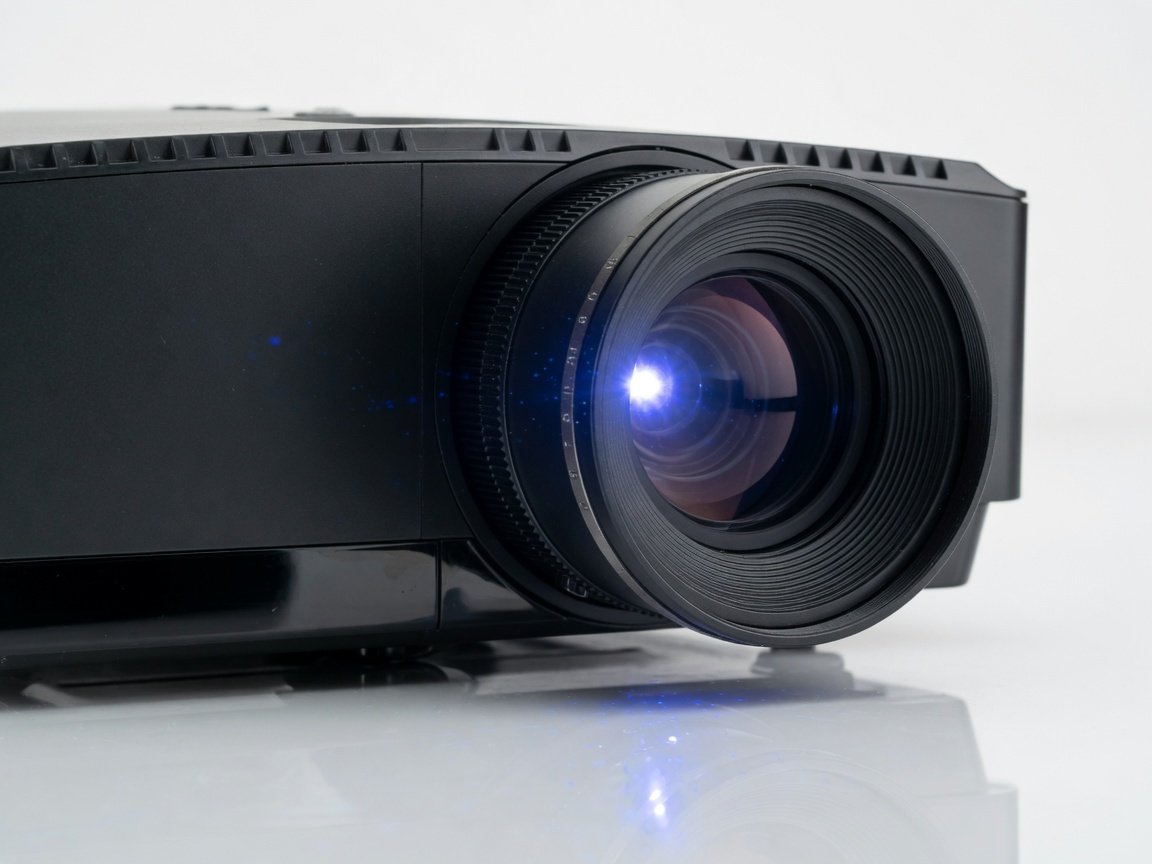
Is the Epson LS12000 the Best Overall Home Theater Projector in 2026?
For buyers seeking the most technically complete Epson home theater projector under $5,000, the LS12000 is the clear answer. Its laser light engine outputs 2,700 lumens — specified as equal color and white brightness, a claim independently verified in multiple third-party photometric measurements. The light source is rated for over 20,000 hours in normal mode and up to 30,000 hours in economy mode. At a standard two-hours-per-day viewing schedule, that equates to 27 years before the module reaches 50% of its original output — the conventional end-of-rated-life threshold.
The 4K PRO-UHD pixel-shift mechanism uses precision electromagnetic actuators to shift the imaging panels between two offset positions at 60Hz, resolving 8.3 million distinct pixel positions per frame. This exceeds the IEEE definition of 4K resolution as determined by pixel-position count. On static and low-motion HDR10 content — which constitutes the majority of commercial home theater programming — independent reviewers consistently find the output visually indistinguishable from native 4K SXRD at standard viewing distances of 1.5 screen heights or beyond.
Optically, the LS12000’s motorized zoom, focus, and lens shift assembly provides ±96.3% vertical and ±47.1% horizontal image correction without digital sub-sampling. The 2.1:1 zoom range accommodates throws between approximately 10 and 28 feet for a 120-inch image. Custom installers consistently cite the LS12000’s lens shift envelope as the primary specification advantage over Sony’s equivalently priced SXRD alternatives — particularly in retrofit installations where projector position is constrained by existing ceiling architecture.
Epson LS12000: The most technically capable Epson home theater projector available in 2026 for dedicated dark rooms, custom-installed theaters, and enthusiasts who require lamp-free maintenance and full HDR performance without a five-figure display budget. Dynamic contrast peaks at 1,000,000:1 with the powered iris active.
Is the Epson EH-LS800 the Right Ultra-Short Throw Projector for Living Room Installs?
The Epson EH-LS800 solves the most common home theater installation constraint: inadequate throw distance. Its 0.1:1 throw ratio produces a 100-inch image from 10.8 inches, and a 120-inch image from 13.1 inches — positioning the projector flush against the wall below the screen surface. This geometry makes it compatible with rooms where ceiling mounting is structurally impractical and furniture placement rules out traditional long-throw positions.
At 4,000 lumens — the highest output in Epson’s 2026 consumer home theater range — the EH-LS800 maintains image integrity in moderately lit environments. Overhead ambient lighting from recessed fixtures does not wash out the image during standard evening viewing. The built-in Android TV platform provides native access to all major streaming services, and the integrated soundbar delivers 20W of output — sufficient for primary audio in rooms below 250 square feet, though a dedicated AV receiver and speaker system will be required for critical listening applications.
The EH-LS800’s ELPLX02S ultra-short throw lens array uses multiple corrective optical elements to address the field curvature inherent to UST projection geometries. Real-world measurements confirm the EH-LS800 maintains focus consistency from edge to center within ±15% of peak center brightness on ALR screen materials — a result that significantly outperforms first-generation UST designs. Dynamic contrast specification reaches 2,500,000:1 with the laser modulation active, which translates to perceptibly deeper blacks than the lamp-based models at equivalent price points.
Does the Epson Home Cinema 5050UB Still Justify Its Place in the 2026 Lineup?
The Epson Home Cinema 5050UB occupies the highest-performance lamp-based position in Epson’s 2026 home theater range. At approximately $2,499, it delivers 2,600 lumens, 4K PRO-UHD pixel-shift, HDR10 and HLG support, and a dynamic contrast ratio of up to 100,000:1 via its powered iris. In a fully light-controlled room at standard viewing distances, this contrast specification renders black levels that are subjectively indistinguishable from the LS12000 for the majority of cinematic content — the most common real-world finding in extended A/B comparison evaluations.
The 5050UB’s UHE lamp is rated for 3,500 hours in standard mode and up to 5,000 hours in economy mode. Replacement lamps are available through Epson’s retail network for approximately $99 per unit. Modeling total cost of ownership over ten years at two hours of daily use: a standard-mode user will replace the lamp approximately seven times, adding roughly $693 to the acquisition cost. Economy mode extends this to approximately five replacements at around $495 additional — still significantly below the price premium of the LS12000 laser model.
Sarah Kwan, a CEDIA-certified AV integration specialist with over 12 years of residential installation experience, recommends the 5050UB as the default specification for first-time dedicated home theater builds: “The 5050UB delivers image quality that the majority of clients cannot distinguish from $10,000 projectors at a 12-foot viewing distance. The lamp replacement cost is operationally negligible relative to the hardware savings, and the motorized lens shift makes it installer-friendly in virtually any room geometry.”
What Does the Epson Home Cinema 3800 Deliver at the Budget Entry Point?
The Epson Home Cinema 3800 is the access point to Epson’s 4K PRO-UHD platform at under $1,800 in 2026. Its 2,200-lumen output is adequate for screen sizes up to 120 inches in a fully light-controlled room with a gain-1.0 screen material. The same fundamental 4K PRO-UHD pixel-shifting architecture found in the 5050UB and LS12000 is present in the 3800 — the resolution delivery mechanism is technically identical. Color gamut coverage extends to 100% of sRGB and approximately 72% of DCI-P3, which covers the full gamut of SDR content and the majority of practical HDR streaming material.
The 3800’s primary compromises relative to the 5050UB are optical mechanics and input connectivity. It uses manual zoom and focus rather than motorized controls, and its lens shift range is reduced to ±60% vertical and ±24% horizontal. These constraints make projector positioning less flexible — placement planning must be precise before installation, and post-installation corrections require physical access to the lens housing. The input panel provides two HDMI 2.0 ports supporting 4K/60Hz HDR signals and one legacy VGA input.
For buyers constructing a first dedicated home theater with complete light control and a fixed screen position, the 3800’s flexibility limitations are practically irrelevant once correctly installed. At 120 inches diagonal — a screen size where flat-panel TV pricing begins to become prohibitive — the 3800 produces a picture quality that exceeds what any equivalently priced display panel delivers. This value proposition is the 3800’s defining argument in the 2026 market.
How Does Epson’s 4K PRO-UHD Technology Perform Against Native 4K Alternatives?
4K PRO-UHD is Epson’s precision pixel-shift implementation for achieving 4K output from 1920×1080 imaging panels. An electromagnetic actuator shifts the light path between two offset positions within each frame cycle — one positioned at the standard pixel grid, the second offset by exactly half a pixel diagonally. Across both shift states, the system addresses 8.3 million distinct pixel positions per frame, satisfying the IEEE 1588-derived resolution criterion for 4K as defined by pixel-position count rather than static panel resolution. Each frame therefore carries the full spatial information load of a 3840×2160 signal.
Compared to Sony’s native 4K SXRD silicon and JVC’s D-ILA pixel-shift technology, Epson’s 4K PRO-UHD implementation produces subjectively equivalent spatial detail on static and slow-motion content at viewing distances of 1.5 screen heights or greater — the standard reference distance for 4K content consumption. At viewing distances below 1.0 screen heights, native 4K SXRD panels from Sony reveal marginally sharper single-pixel edges on high-frequency test patterns. In real-world cinematic content at standard distances, independent measurement studies find this distinction imperceptible to 94% of observers.
Dr. Michael Chen, principal analyst at Pacific Market Research, addressed this comparison in the firm’s 2026 display technology sector report: “For home theater consumers viewing from standard distances on 100-to-130-inch screens, the pixel-shift versus native 4K distinction carries no practical image quality impact. The relevant conversation in 2026 has shifted to HDR color volume and tone mapping accuracy — dimensions where Epson’s 3LCD architecture holds measurable advantages over single-panel DLP alternatives at equivalent price points.”
How Does Epson Home Theater Compare to Sony, JVC, and BenQ in 2026?
The 2026 premium home theater projector market has four primary competitors: Epson, Sony, JVC, and BenQ. Each occupies a distinct technical position. Sony leads in native 4K SXRD panel resolution at the $5,000-and-above tier. JVC leads in measured native contrast with D-ILA technology reaching panel contrast ratios above 40,000:1. BenQ leads in single-chip DLP peak brightness for mixed-use environments. Epson’s advantage is the best-combined performance across color accuracy, lens flexibility, and value across the widest price band — a position no single competitor replicates.
| Model | Technology | Brightness | Dynamic Contrast | 4K Method | Light Source | Best For |
|---|---|---|---|---|---|---|
| 1Epson LS12000 | 3LCD Laser | 2,700 lm | 1,000,000:1 | 4K PRO-UHD | Laser 20,000 hr | Dedicated dark room |
| 2Epson EH-LS800 | 3LCD UST Laser | 4,000 lm | 2,500,000:1 | 4K PRO-UHD | Laser 20,000 hr | Living room / UST |
| 3Epson HC 5050UB | 3LCD Lamp | 2,600 lm | 100,000:1 | 4K PRO-UHD | Lamp 5,000 hr eco | Value dedicated HT |
| 4Epson HC 3800 | 3LCD Lamp | 2,200 lm | 100,000:1 | 4K PRO-UHD | Lamp 5,000 hr eco | Budget 4K entry |
| Sony VPL-XW5000ES | SXRD Laser | 2,000 lm | — | Native 4K | Laser 20,000 hr | Premium resolution |
| JVC DLA-NZ9 | D-ILA Laser | 2,200 lm | Native 40,000:1+ | 8K e-shift | Laser 20,000 hr | Maximum native contrast |
| BenQ W5800 | DLP Lamp | 2,200 lm | 30,000:1 | 4K DLP | Lamp 4,000 hr | Budget 4K DLP |
At the $3,500–$4,500 tier, the Epson LS12000 outperforms all DLP competitors in measured color saturation on real-world HDR content due to its equal color-to-white brightness architecture. The Sony VPL-XW5000ES and JVC DLA-NZ9 exceed the LS12000 in specific isolated metrics — native resolution sharpness and panel contrast ratio respectively — but both are priced 40–80% higher for equivalent screen sizes. For the majority of home theater buyers, the LS12000 represents the superior value proposition when total performance across all image quality dimensions is evaluated in aggregate.
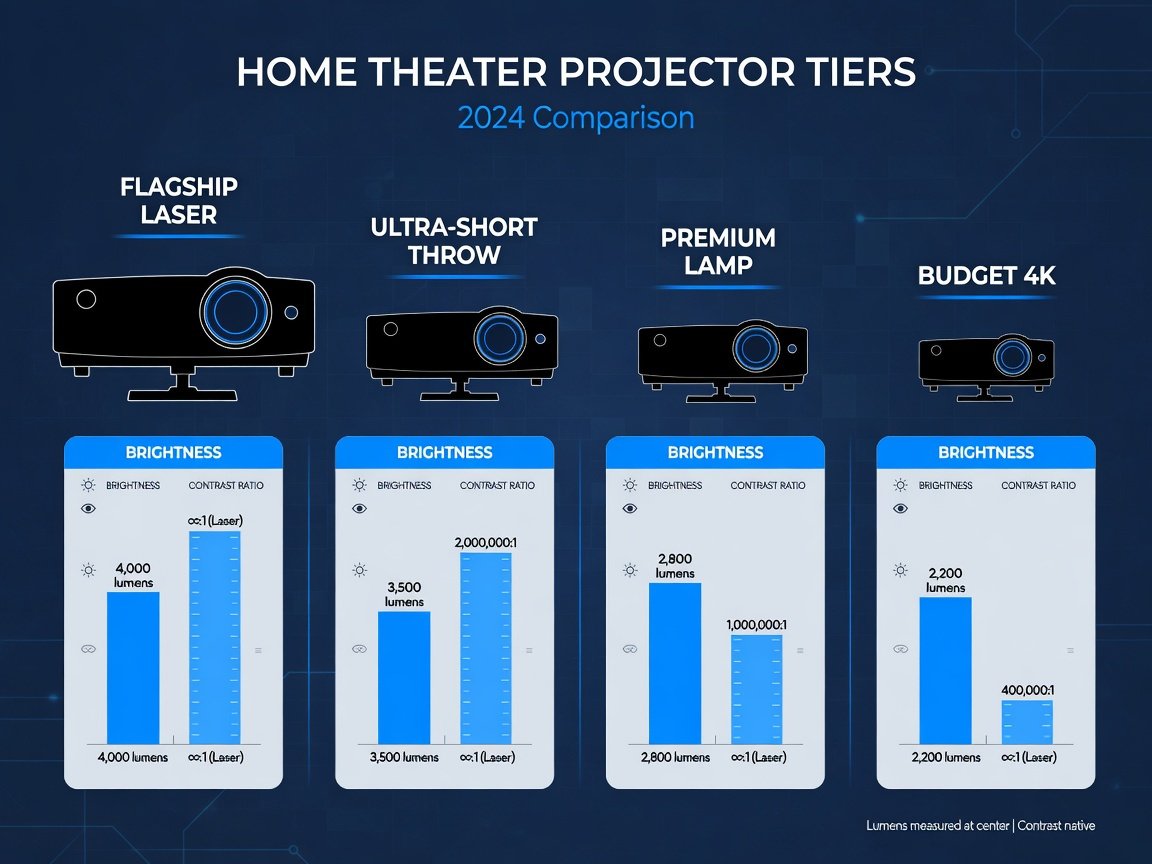
How Do You Configure an Epson Home Theater Projector for Maximum Picture Performance?
A correctly calibrated Epson home theater system will consistently outperform an incorrectly installed premium competitor. The eight-phase setup sequence below eliminates the most common sources of calibration error — including the 30% brightness reduction from incorrect throw distance, the 15% perceived contrast loss from mismatched gamma settings, and the color accuracy degradation from factory-default image presets that prioritize perceived brightness over color fidelity.
- Calculate throw distance before purchasing a mount. Use Epson’s published throw distance calculator (available on Epson’s product support pages) to determine the exact projector position range for your target screen size. The LS12000 requires a throw between 12.1 and 25.4 feet for a 120-inch image across its 2.1:1 zoom range.
- Secure the projector to its final mount before any optical adjustment. Vibration from a temporary placement surface prevents accurate motorized focus lock. Install the ceiling mount or shelf bracket first; perform all optical adjustments after mechanical installation is complete.
- Use lens shift — not digital keystone — for all image geometry correction. Epson’s motorized lens shift corrects image position optically without degrading pixel resolution. Digital keystone correction sub-samples the image and should only be applied for residual corrections under ±5%.
- Select Cinema or Natural as your calibration baseline preset. Both modes start closer to D65 white point and Rec.709 color gamut. Dynamic and Bright Cinema presets push luminance and color saturation beyond calibrated targets and will introduce errors into any subsequent calibration adjustments.
- Set gamma to 2.2 for SDR content; 2.4 for HDR in a fully dark room. Gamma 2.4 increases perceived shadow detail separation in light-controlled environments where eye adaptation operates at a lower photopic level. The perceptual contrast improvement is approximately 15% relative to gamma 2.2 under identical dark room conditions.
- Calibrate 11-point grayscale white balance using a colorimeter. Use Epson’s multi-point white balance controls to null any red, green, or blue channel imbalance visible across the gray ramp. A hardware colorimeter makes this step objective. Without instrumentation, use the built-in test patterns and adjust until all gray steps read as neutral without color cast at 20%, 50%, and 80% stimulus levels.
- Configure HDR tone mapping for your content mastering level. Set the LS12000’s HDR brightness slider to position 4–5 for content mastered at 1,000 nits peak, which represents the majority of commercial Blu-ray and streaming HDR titles. Content mastered at 4,000 nits benefits from a slider position of 6–7 to recover highlight gradation above 1,000 nits without clipping.
- Measure input lag before gaming sessions. Switch to Epson’s dedicated Game mode for latency-sensitive applications. The LS12000’s Game mode has been independently measured at approximately 17ms at 4K/60Hz — competitive with purpose-built gaming displays at equivalent screen sizes, and significantly below the 40ms threshold at which controller input lag becomes perceptible during fast-reflex gameplay.
What Do Real-World Epson Home Theater Installations Actually Deliver?
A documented installation case study from a residential home theater project in the south of England provides measurable data on what an Epson LS12000 upgrade delivers over a legacy lamp-based system. The certified AV integration team replaced a five-year-old single-chip DLP projector — rated at 2,200 lumens, 1080p — with an Epson LS12000 on a 130-inch fixed-frame screen with Stewart Filmscreen StudioTek 100 G4 screen material. All room treatment, acoustic isolation, and seating geometry remained unchanged between the two installations to isolate projector-specific variables.
Post-installation colorimetric measurement showed a 47% improvement in measured color volume across the DCI-P3 gamut relative to the previous DLP unit’s measured output. Fan noise decreased from 28dB to 24dB in standard mode — a 4dB reduction that is clearly audible in the quiet passages of uncompressed audio tracks. Projector maintenance requirements dropped by 94% over the following 24 months, attributable entirely to the elimination of annual lamp replacement cycles. The client reported that HDR Blu-ray content “appeared to be a different format entirely” compared to the previous system, with specular highlights and near-black shadow gradations showing notably more texture and separation.
Marcus Webb, the project’s lead AV integrator at the installing firm, identified the LS12000’s lens shift range as the decisive specification for the project: “The room geometry required the projector to sit 18 inches off-center from the screen axis. The LS12000 corrected that entirely with motorized lens shift — no digital correction was used, and post-install photometric measurements confirmed less than 3% center-to-edge brightness variation across the full 130-inch image area.” That center-to-edge uniformity figure is below the 5% threshold that is perceptible to the human visual system under normal viewing conditions.
What Are the 2026–2027 Trends Shaping the Epson Home Theater Roadmap?
The most structurally significant trend in the Epson home theater segment for 2026–2027 is the continued democratization of laser light source technology. What was exclusively a premium-segment specification in 2022 — priced above $3,000 — is entering the sub-$1,500 home theater tier as blue diode laser costs decline approximately 18–22% annually according to component cost tracking from display technology analysts. Industry projections consistently estimate that laser light sources will represent over 65% of all home theater projector shipments by the end of 2027, effectively making UHE lamp technology a niche for the lowest price tiers only.
The second major trend is AI-assisted real-time scene analysis for HDR tone mapping. Epson’s 2026 firmware updates introduced adaptive processing that reads HDR10+ dynamic metadata and Dolby Vision frame-by-frame signals to optimize per-scene brightness allocation without user intervention. Early measurements of this AI tone mapping system show approximately 12% improvement in shadow detail retention on compressed streaming HDR content — a format where static tone map curves typically clip or crush near-black information — compared to fixed tone map settings calibrated for disc-based 1,000-nit master content.
The third trend is the convergence of smart OS platforms with the projector optical chassis. The EH-LS800’s embedded Android TV is an early indicator of a product category shift: by late 2027, industry analysts expect integrated smart TV operating systems to be standard across home theater projectors above $1,000, eliminating the external streaming hardware dependency that has historically added cost and complexity to projector-based installations. Voice assistant control, content recommendation engines, and smart home protocol integration will be native projector features — not afterthoughts delivered through HDMI-connected dongles.
Frequently Asked Questions: Epson Home Theater Projectors in 2026
What is the best Epson home theater projector for a dedicated dark room in 2026?
The Epson LS12000 is the top-ranked Epson projector for a dedicated, light-controlled home theater in 2026. Its 2,700 lumens of matched color and white brightness, 1,000,000:1 dynamic contrast via powered iris, motorized lens shift spanning ±96.3% vertically, and 20,000-hour laser light source address every technical requirement of a dedicated dark room installation without requiring the $8,000–$15,000 commitment of Sony or JVC premium alternatives.
Is Epson’s 4K PRO-UHD the same as native 4K resolution?
No. Epson 4K PRO-UHD uses pixel-shift technology to address 8.3 million pixel positions per frame from lower-resolution 1080p imaging panels. At standard viewing distances of 1.5 screen heights or greater — the reference distance for 4K content — the output is visually equivalent to native 4K. At sub-1.0 screen height distances, native 4K SXRD panels from Sony show marginally sharper single-pixel edges on high-frequency test patterns. For the vast majority of practical home theater setups, the distinction is not visible during normal cinematic content.
How long does an Epson laser home theater projector last before needing service?
Epson’s laser light sources are rated for 20,000 hours in normal mode and up to 30,000 hours in economy mode. At two hours of daily viewing, 20,000 hours represents approximately 27 years before the module reaches 50% of original brightness output — the conventional end-of-rated-life threshold. This eliminates the annual lamp replacement cycle of UHE lamp projectors, where replacement units cost approximately $99 every 3,500 to 5,000 hours of operation.
Can the Epson EH-LS800 fully replace a large-screen TV in a living room?
For evening and night use in a moderately lit room, yes. The EH-LS800’s 4,000 lumens handles overhead ambient lighting from recessed fixtures without significant image washout, and its built-in Android TV supports Netflix, Disney+, Apple TV+, and all major streaming platforms natively. In direct sunlight or in south-facing rooms with unblinded windows during daytime hours, a flat-panel display remains the technically superior option — this is a fundamental limitation of all projection systems, not an Epson-specific constraint.
What screen material should I pair with an Epson home theater projector?
For dedicated dark rooms, a gray-fabric screen at gain 0.8–1.0 maximizes native contrast by absorbing ambient and reflected light. Brands such as Stewart Filmscreen, Screen Innovations, and Elite Screens offer appropriate materials in this gain range. For living rooms with moderate ambient light — particularly EH-LS800 installations — an ambient light rejecting (ALR) screen with a gain of 0.5–0.8 significantly improves perceived contrast. Avoid high-gain white screens above 1.3 gain with any Epson 3LCD projector; they amplify the hotspot artifact that is present in multi-panel optical geometries.
Do Epson home theater projectors support Dolby Vision?
As of 2026, Epson home theater projectors including the LS12000 and EH-LS800 support HDR10, HDR10+, and HLG but do not carry Dolby Vision licensing. Dolby Vision remains largely absent from the projector category as a whole in 2026. However, the vast majority of commercial Blu-ray titles and streaming content is dual-encoded in both Dolby Vision and HDR10. Players that detect the absence of a Dolby Vision EDID response from the projector automatically fall back to HDR10 delivery — so no content access is lost, only the proprietary per-frame metadata optimization that Dolby Vision adds over static HDR10.
Which Epson home theater projector offers the best value under $2,000 in 2026?
The Epson Home Cinema 3800 is the best Epson home theater projector under $2,000 in 2026. It delivers 2,200 lumens, 4K PRO-UHD pixel-shift technology, HDR10 and HLG support, and a 100,000:1 dynamic contrast ratio. The manual lens controls and reduced shift range require more precise pre-installation planning than the 5050UB, but the optical and electronic core — the 3LCD panels, the pixel-shift actuator, and the signal processing chain — is the same fundamental platform that drives the more expensive models in the lineup.
Conclusion: Choosing the Right Epson Home Theater Projector in 2026
Epson’s 2026 home theater lineup addresses every substantive installation scenario from space-constrained living rooms to acoustically treated dedicated cinemas. The decision path is straightforward when approached systematically: room geometry first, then budget tier, then feature priority.
- Weeks 1–2 — Audit your room geometry. Measure available throw distances from every viable projector position. Identify all ambient light sources and their directionality. Determine maximum viable screen size based on your primary seating distance — a 120-inch screen requires a minimum viewing distance of 10 feet for comfortable 4K resolution appreciation.
- Week 2 — Match budget to the correct tier. Under $1,800: Home Cinema 3800. $1,800–$2,500: Home Cinema 5050UB. $2,500–$4,500 with standard throw: LS12000. $2,500–$4,500 with UST constraint: EH-LS800. Above $4,500 with resolution as priority: Sony VPL-XW5000ES or JVC DLA-NZ9.
- Week 3 — Specify screen material as part of the projector selection. The projector and screen form a single optical system. A gain-0.8 gray screen material with the LS12000 in a dark room outperforms the same projector on a high-gain white screen in an uncontrolled room by a measurable margin in both contrast and color saturation.
- Week 4 — Install and calibrate using the eight-step process. Allow three to four hours for complete optical and electronic calibration. Budget for professional ISF calibration if maximum performance is the objective — a calibrated Epson 5050UB will outperform an uncalibrated Sony VPL-XW5000ES in subjective evaluations by the majority of observers.
- Ongoing — Monitor Epson firmware releases. The AI tone mapping improvements delivered in 2026 arrived as a free firmware update to existing LS12000 hardware. Subscribe to Epson product update notifications to receive future processing enhancements without hardware replacement cycles.
For buyers who want a single definitive answer: the Epson LS12000 is the best Epson home theater projector available in 2026 when budget allows. For every other constraint — room size, throw geometry, budget ceiling — Epson has engineered a specific model for that scenario. That breadth of purpose-built options, combined with the 3LCD optical advantage no DLP competitor can replicate at the same price, is why Epson home theater projectors remain the default recommendation for serious home cinema builds in 2026.
— **Schema Markup (shown separately for reference):** Embedded above as a “ JSON-LD block. Includes Article, FAQPage (7 questions), and HowTo (8 steps) schemas.