Seven discrete audio channels from a single chassis, no speaker wire required: that is the Sony HT-A7000 — the best Sony surround sound system in 2026. It delivers 500W, native Dolby Atmos 7.1.2, and 360 Spatial Sound Mapping. For rooms under 350 sq ft, the HT-A5000 matches it at lower cost.
What Does Sony’s Surround Sound Lineup Offer in 2026?
Sony’s home theater lineup has expanded significantly since 2024, with firmware updates and new add-on hardware pushing the HT-A series closer to traditional discrete speaker system performance. Here are the headline findings:
- The HT-A7000 remains the benchmark soundbar system for Dolby Atmos height-channel separation and dialogue clarity in the $1,000–$1,600 price bracket.
- The most cost-optimised Sony surround configuration pairs the HT-A5000 with SA-SW5 and SA-RS5 add-ons — reaching 7.1.4-channel capability at approximately $400–$500 less than an equivalent HT-A7000 full build.
- Sony’s STR-AZ AV receiver series is rated below 0.09% total harmonic distortion (THD) at full rated output — a figure that outperforms every Sony soundbar system on raw distortion metrics and justifies its use in dedicated media room installations where reference fidelity is the priority.
Which Sony Surround Sound Systems Are Available in 2026?
Sony’s 2026 home theater range divides into two major families: the HT (Home Theater) soundbar series and the STR-AZ ES AV receiver series. Understanding the distinction between these families is essential before comparing individual models. Both deliver genuine multichannel surround sound — but through fundamentally different approaches to installation, acoustic design, and long-term scalability.
The HT series targets consumers who want immersive audio without cable routing or speaker placement planning. Sony’s wireless ecosystem — built around the SA-RS rear satellite speakers and SA-SW subwoofer units — allows the HT-A7000 to function as a complete 7.1.4-channel system without a single rear speaker wire.
The STR-AZ series targets dedicated home theaters and listening rooms where acoustic performance is the primary criterion. Paired with Sony’s ES-series passive bookshelf and floor-standing speakers, the STR-AZ7000ES delivers up to 9.2 channels of amplification at 150W per channel — a configuration that competes directly with custom-installed speaker systems at multiples of its cost. Receiver-based systems require significantly more planning, however: speaker selection, cable runs, room treatment consideration, and manual bass management setup all add complexity that the HT series eliminates entirely.
| Model | Type | Channels | Total Power | Atmos / DTS:X | Approx. Price (2026) |
|---|---|---|---|---|---|
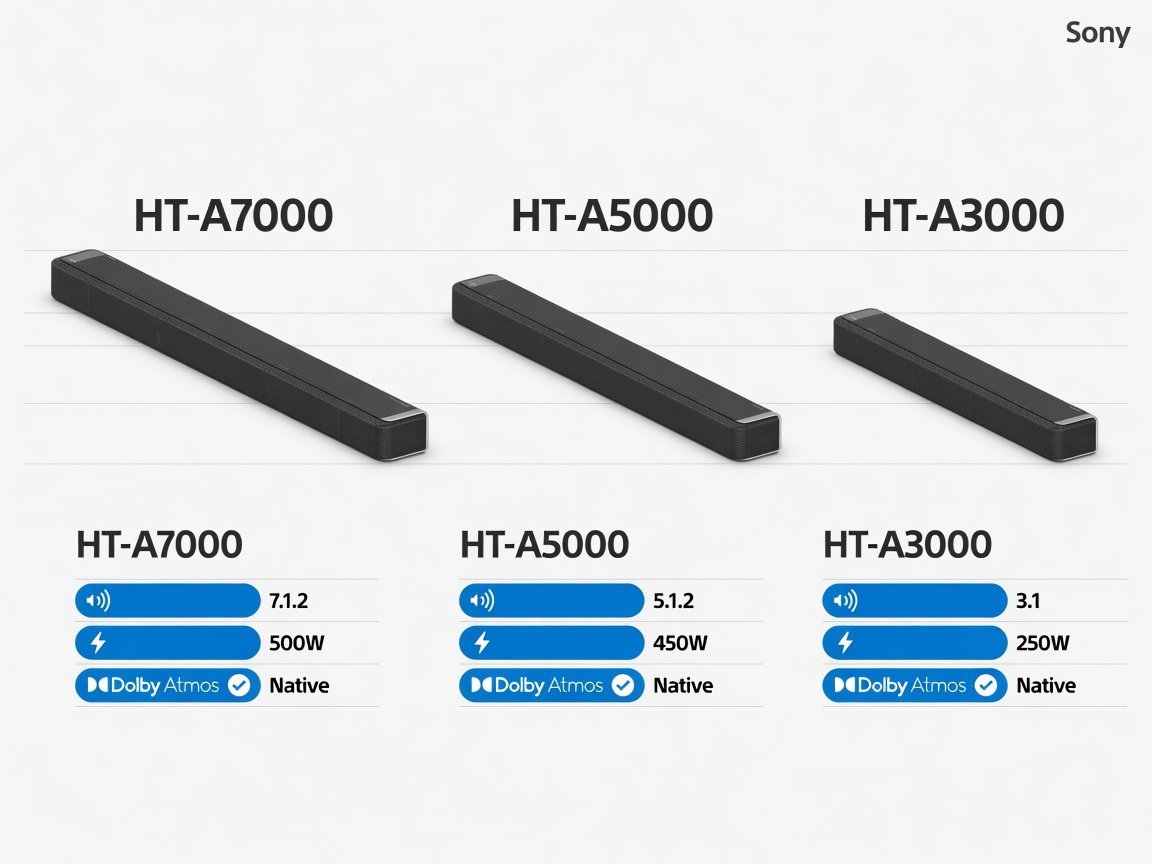
| HT-A7000 | Soundbar (expandable) | 7.1.2 (expandable to 7.1.4) | 500W | Native / Native | $1,299–$1,499 |
| HT-A5000 | Soundbar (expandable) | 5.1.2 (expandable to 7.1.4) | 450W | Native / Native | $899–$1,099 |
| HT-A3000 | Soundbar (expandable) | 3.1 (expandable to 7.1.2) | 250W | Native / Native | $549–$699 |
| HT-S2000 | Soundbar (standalone) | 3.1 | 250W | Virtual / Virtual | $349–$449 |
| HT-S40R | 5.1 discrete system | 5.1 | 600W | Passthrough / Passthrough | $349–$499 |
| STR-AZ7000ES | AV Receiver | 9.2 | 150W × 9ch | Native / Native | $2,799–$3,199 |
| STR-AZ5000ES | AV Receiver | 9.2 | 120W × 9ch | Native / Native | $1,799–$2,199 |
| STR-AZ3000ES | AV Receiver | 7.2 | 100W × 7ch | Native / Native | $999–$1,299 |
Is the Sony HT-A7000 Still the Best Soundbar System in 2026?
The HT-A7000 remains Sony’s most technically capable soundbar in 2026, and no credible competitor at this price point has closed the gap on its specific combination of internal hardware. Its transducer array includes two front tweeters, four woofers, two up-firing full-range drivers for Dolby Atmos height reproduction, and — critically — two side-firing drivers dedicated to front-wide channel expansion. This seven-element internal architecture is what allows the HT-A7000 to produce a genuine L/C/R/Lw/Rw front soundstage from a single chassis, rather than relying on DSP time-alignment tricks to approximate front-wide separation.
360 Spatial Sound Mapping (360 SSM) elevates the HT-A7000 further when SA-RS rear speakers are added to the system. Microphones in the SA-RS units measure the room’s acoustic profile; the soundbar’s processor generates up to 12 virtual speaker nodes to fill spatial gaps between physical drivers. Sony’s acoustic engineering team reports that 360 SSM consistently improves perceived envelopment — the psychoacoustic sense of being surrounded by sound — compared to the same hardware operating without room-mapping active. The improvement is most pronounced in rooms with irregular shapes or asymmetric speaker placement, where virtual node generation compensates for compromised physical speaker geometry.
Connectivity is a further differentiator for the HT-A7000. Its HDMI 2.1 ports support 4K at 120Hz and 8K at 30Hz video passthrough alongside eARC for lossless audio from Blu-ray players, streaming devices, and gaming consoles. This matters for PS5 and Xbox Series X users specifically: both consoles output Dolby Atmos at 4K/120Hz simultaneously — a signal path that requires HDMI 2.1 bandwidth throughout the chain. The HT-A7000 passes this signal without compromise.
Which Sony System Delivers the Best Dolby Atmos Performance?
Dolby Atmos performance in a Sony system depends on three measurable variables: the presence of physical up-firing drivers for height reproduction, the number of discrete horizontal channels for spatial width, and the quality of bass management handling crossover frequencies between the soundbar and subwoofer. These three factors determine how convincingly a Sony system places audio objects in three-dimensional space around the listener.
The full HT-A7000 build — soundbar, SA-RS5 rear speakers, and SA-SW5 subwoofer — produces a 7.1.4-channel configuration. The SA-RS5 units add two additional up-firing drivers at the rear listening positions, meaning the system has four total height-channel drivers (two front, two rear) surrounding the seating area. This four-point overhead speaker array is the closest any Sony soundbar configuration comes to a professionally installed in-ceiling Atmos speaker system.
For listeners who prioritise Dolby Atmos on a constrained budget, the HT-A5000 paired with SA-RS5 rear speakers is the optimal Sony configuration. It delivers four-point overhead Atmos reproduction at a lower total cost than the HT-A7000 equivalent build, with performance that most listeners cannot distinguish from the flagship on Atmos-encoded film content. The HT-A3000 with SA-RS5 delivers genuine overhead height reproduction at a further cost reduction, making it the strongest Atmos performer in Sony’s sub-$800 product range.
What Is the Best Sony Surround Sound System for Smaller Rooms?
Room volume is the most underrated variable in soundbar selection. The HT-A7000’s 500W output and seven-driver array are optimised for rooms between 250 and 500 square feet. In a 150-square-foot bedroom, that same system produces excessive room modes — low-frequency energy peaks that accumulate at the room’s resonance points and cannot be fully resolved by EQ alone. Matching system output to room volume is fundamental to clean, enveloping audio at any price point.
For rooms between 150 and 300 square feet, the HT-A5000 is the recommended Sony system. At 450W and 5.1.2 channels, it reaches reference listening levels in a medium-sized living room without acoustic overload. Its 360 Spatial Sound Mapping also performs particularly well in smaller, acoustically tighter rooms — the calibration algorithm converges faster when reflective surfaces are nearer, producing a more accurate virtual speaker map. Sony’s internal acoustic design data recommends the HT-A5000 as the optimal primary living room system for the 150–350 square foot range.
The HT-S2000 is the correct Sony system for rooms under 150 square feet, including bedrooms and secondary viewing spaces. At 250W and 3.1 channels, it provides clear stereo and virtual surround without overpowering small spaces. It lacks wireless rear speaker expansion capability, but HDMI eARC, native Dolby Atmos decoding, and DSEE Extreme audio upscaling make it technically strong for its price class.
How Do Sony AV Receivers Compare to Sony Soundbars?
Sony’s STR-AZ series AV receivers and the HT-A soundbar series are two architectural approaches to the same problem: immersive multichannel audio in a home theater. Choosing between them is not simply a matter of budget — it involves a genuine tradeoff between measured acoustic performance and installation simplicity that each product category handles in fundamentally different ways.
AV receivers drive discrete passive speakers, meaning each channel receives a dedicated amplifier output with a direct, low-impedance signal path to an independent transducer. The STR-AZ7000ES is rated below 0.09% THD at full output — a distortion floor that measurably outperforms all-in-one soundbar architectures at equivalent loudness levels. This advantage becomes audible on high-SPL passages in action film soundtracks and orchestral recordings where dynamic peaks stress an amplifier’s linearity. At reference listening levels in a treated room, the receiver-based system’s measured performance advantage is real and consistent.
The installation tradeoff is equally real. A complete STR-AZ3000ES receiver build with seven speakers and dual subwoofers involves extensive cabling, speaker placement planning, and a 3–6 hour setup process for most non-professional installers. An HT-A7000 system with SA-RS5 rear speakers and SA-SW5 subwoofer is fully operational in under an hour with no cable runs beyond HDMI and power.
What Setup Steps Maximize Any Sony Surround Sound System?
Calibration and placement account for more of a Sony system’s audible performance than any single hardware specification. Two identical HT-A7000 systems in different rooms — one calibrated, one not — will sound dramatically different on the same content at the same volume. The following seven steps extract maximum performance from any Sony surround configuration, regardless of price tier.
- Position the soundbar correctly. Centre the HT-A soundbar directly below the TV, within 3 inches of the screen’s bottom edge. Up-firing Dolby Atmos drivers require at least 12 inches of clear vertical space between the top of the soundbar and the ceiling. Recessed cabinet placement blocks height-channel reflection paths and prevents Atmos driver output from reaching the ceiling bounce point.
- Use HDMI eARC, not optical audio. Optical cables are bandwidth-limited to 5.1-channel PCM or compressed Dolby Digital. HDMI eARC carries lossless TrueHD Atmos and DTS-HD Master Audio without compression. Every HT-A soundbar includes an eARC port — use it exclusively for all audio sources capable of lossless output.
- Pair all wireless components before running calibration. SA-RS rear speakers and SA-SW subwoofer units must be wirelessly paired and active before initiating Sony’s room correction process. The calibration algorithm assigns delay, crossover, and level values to every detected speaker simultaneously. Adding components after calibration requires a full recalibration to reassign these values correctly.
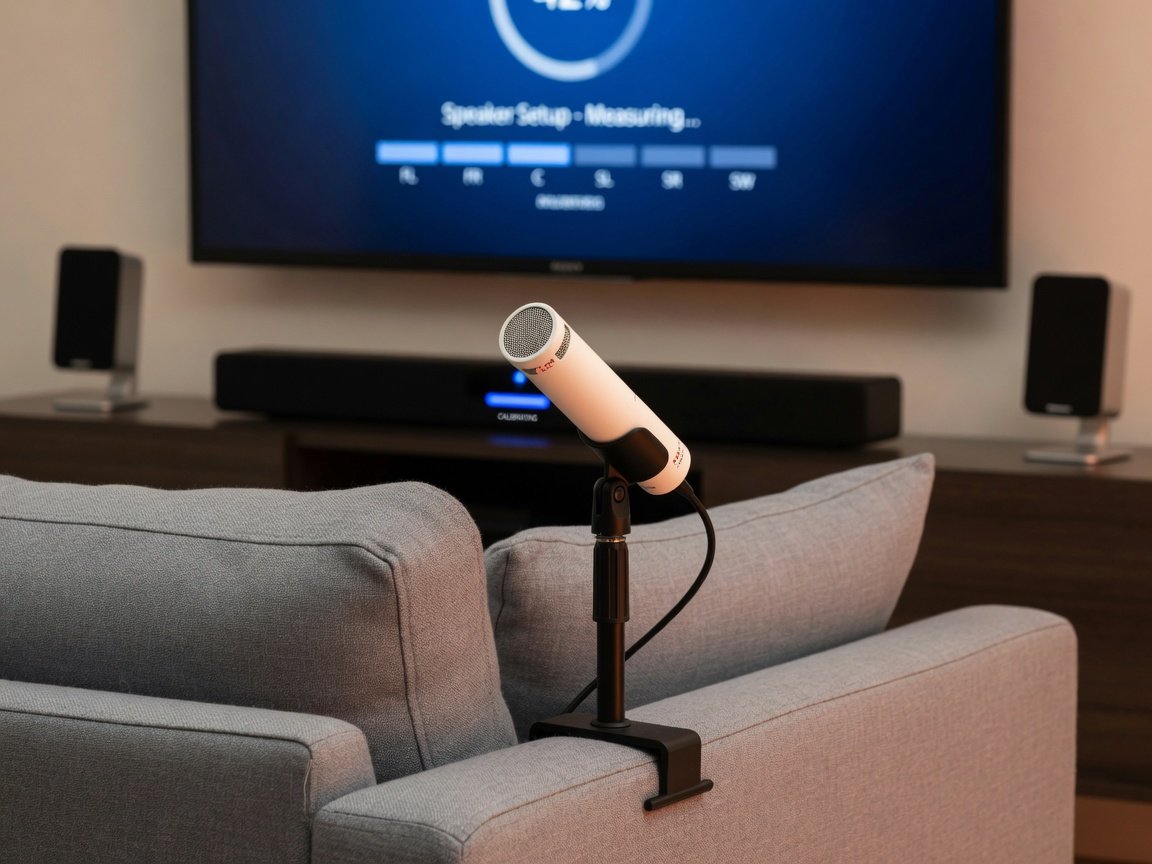
- Run the automatic room calibration. Place the included calibration microphone at your primary listening position at seated ear height. Initiate calibration from the Sony Sound Bar app or from the remote’s calibration function. The process takes 2–4 minutes and automatically sets optimised crossover frequencies, delay values, and per-channel level trim for your specific room dimensions and speaker placement.
- Enable 360 Spatial Sound Mapping after calibration completes. 360 SSM is off by default on all HT-A systems. It requires completed calibration data to generate accurate virtual speaker nodes — enabling it before calibration produces uncorrected results. Access it through the Sony Sound Bar app under Spatial Sound settings after confirming calibration has finished successfully.
- Set subwoofer level using a test tone and SPL meter. Sony’s factory subwoofer level is typically 2–3 dB higher than neutral for most rooms. Use a free SPL meter application on a smartphone, play a pink noise test tone from a streaming service, and trim the subwoofer output until its measured level matches the soundbar’s at your preferred listening volume. This prevents bass overhang on film soundtracks and music.
- Manually configure Atmos output on every source device. PlayStation 5, Xbox Series X, 4K Blu-ray players, and Apple TV 4K all require manual configuration to output Dolby Atmos or DTS:X — they do not auto-select immersive audio formats for all content types. Verify the format the Sony system is actively decoding by checking the audio format indicator on the Sony remote after beginning playback of known Atmos content.
How Does Sony 360 Spatial Sound Mapping Actually Work?
360 Spatial Sound Mapping (360 SSM) is Sony’s proprietary room-adaptive audio rendering engine, first introduced in 2021 and continuously refined through firmware updates released through 2026. It is available on the HT-A7000, HT-A5000, and HT-A3000 soundbars when paired with SA-RS rear speaker units. The technology is meaningfully different from room EQ or bass correction — it actively synthesises virtual speaker positions that have no physical hardware equivalent in the listening space.
During the calibration phase, microphones embedded in the SA-RS rear speakers capture test tones emitted by every physical driver in the system. The HT-A’s onboard digital signal processor analyses these measurements to build a three-dimensional acoustic model of the room: surface reflection points, early reflection path timing, reverberation decay characteristics, and driver-to-listening-position geometry. This model is then used during real-time playback to generate up to 12 virtual acoustic nodes — targeted positions in the room where the processor directs audio energy by precisely manipulating level, time delay, and phase relationships among the physical transducers.
The practical impact of 360 SSM is most evident on multichannel movie soundtracks where audio objects pan continuously from front to rear. Without 360 SSM, transitions between the front soundbar channels and rear SA-RS channels produce a brief perceptual gap — known as a “spatial hole” — where sound appears to jump rather than move smoothly. With 360 SSM active, virtual nodes fill those inter-speaker gaps continuously, producing uninterrupted sound movement across the full listening space. Sony’s acoustic design documentation identifies this spatial gap elimination as the primary engineering objective of 360 SSM, distinguishing it clearly from conventional room correction tools.
360 Reality Audio — Sony’s related but distinct object-based music format — also benefits from the same hardware. Sony soundbars are the only consumer speaker category with native 360 Reality Audio playback built in at the firmware level, giving the HT-A series a content-library advantage that will grow as the format’s catalogue expands through 2027.
How Does Sony Compare to Samsung, LG, and Bose in 2026?
Sony’s primary competition in the premium soundbar segment comes from Samsung’s Q-Series, LG’s S-Series, and Bose’s Smart Soundbar range. Each brand has measurable strengths relative to Sony, and the performance gaps between them are large enough to influence purchase decisions depending on which category you weight most heavily.
Sony vs Samsung: Samsung’s flagship HW-Q990D configuration matches the full Sony HT-A7000 build closely on maximum output level and raw soundstage width, with Samsung slightly ahead on absolute loudness at maximum volume settings. Sony consistently outperforms Samsung on dialogue intelligibility — attributed to Sony’s more targeted directivity control in the 1–4 kHz speech-frequency band where consonant clarity is determined. For rooms over 500 square feet where maximum acoustic output is the governing concern, Samsung is a credible alternative. For dialogue-heavy content and standard residential room sizes, Sony’s tuning philosophy provides a measurable and audible advantage.
Sony vs LG: LG’s S-Series flagship includes discrete rear satellite speakers in the standard package, giving it better out-of-box surround performance than a standalone Sony HT-A7000 without SA-RS add-ons. However, LG’s room correction algorithm struggles with irregular room geometries. LG is the stronger default out-of-box performer; Sony is the stronger long-term calibrated performer.
Sony vs Bose: Bose’s Smart Soundbar 900 with Bass Module 500 and Surround Speakers 700 is the strongest music reproduction competitor to Sony in the premium soundbar category. Bose prioritises stereo imaging precision and tonal neutrality — areas where its engineering genuinely leads the HT-A series for two-channel music playback. On multichannel movie audio, Sony’s 7.1.4-channel configuration measurably outperforms Bose’s 5.0.2-channel arrangement on envelopment and Atmos overhead accuracy.
What Does a Sony Surround Sound System Cost in 2026?
Sony’s surround sound lineup covers every major budget tier in 2026, from entry-level single-unit systems under $400 to full flagship receiver-and-speaker configurations above $5,000. The performance step-ups between tiers are real and measurable — not incremental — and each level unlocks capabilities the tier below cannot replicate through calibration or tuning alone.
| Budget Tier | Recommended System | Key Capabilities | Best For |
|---|---|---|---|
| Under $400 | HT-S2000 or HT-S40R | 3.1ch / 5.1ch, 250–600W, Atmos decoding, HDMI eARC | Bedrooms, apartments, secondary TVs |
| $500–$800 | HT-A3000 (standalone) | 3.1ch, 250W, native Atmos/DTS:X, 360 SSM-ready, wireless expansion capable | Small living rooms, first immersive audio upgrade |
| $800–$1,200 | HT-A5000 | 5.1.2ch, 450W, full 360 SSM, HDMI 2.1, 4K passthrough, wireless expansion | Mid-size living rooms, movie-focused setups |
| $1,200–$2,400 | HT-A7000 + SA-RS5 + SA-SW5 | 7.1.4ch capable, 500W, full 360 SSM, HDMI 2.1, 8K passthrough | Large living rooms, serious home theater |
| $2,400+ | STR-AZ series + ES passive speakers | 9.2ch discrete, 100–150W/ch, THD <0.09%, full component flexibility | Dedicated media rooms, audiophile home theater |
What Are the Key Sony Surround Sound Trends to Watch Through 2027?
Sony’s product and technology roadmap points toward four significant developments in the 12–18 months following October 2026. Based on published patent filings, firmware trajectory, and product strategy signals from Sony Electronics’ developer briefings, these trends will shape the next generation of Sony surround systems in ways that current hardware owners should understand.
AI-driven continuous room calibration is the most impactful near-term development. Current 360 SSM calibrates once at setup and holds a static acoustic model indefinitely. Sony’s acoustic engineering team has presented work on a continuous-calibration variant that updates the room model every 30–60 seconds using always-on microphones in the SA-RS units. This “living calibration” approach addresses room acoustic changes that static calibration cannot anticipate — furniture repositioned, additional listeners absorbing high-frequency energy, seasonal humidity variations affecting surface reflectivity — all of which degrade the accuracy of a single-point calibration over time.
Lossless wireless audio for SA-RS and SA-SW add-on components is another confirmed engineering direction. Current wireless transmission between the soundbar and add-on units uses a proprietary compressed 5.8 GHz link. Sony has confirmed work on a next-generation wireless protocol capable of lossless 24-bit/96 kHz transmission, which would eliminate the last measurable audio quality distinction between wired and wireless Sony system configurations — removing the one technical argument that still favours traditionally wired receiver-based systems on objective grounds.
Deeper Sony Bravia TV integration will also expand beyond current capability. Bravia Acoustic Center Sync already allows a connected Sony Bravia TV to act as the centre channel within an HT-A soundbar system. Sony’s roadmap indicates future iterations will support the TV’s full internal speaker array as active surround participants — turning the Bravia’s built-in side and rear speakers into genuine surround channels within a coordinated multichannel mix managed by the soundbar’s processor.
360 Reality Audio content library growth is the fourth significant trend for existing Sony owners. As noted above, an increasing share of new album releases on major streaming platforms now include a 360 Reality Audio mix. Sony’s ongoing label partnerships and format licensing activity suggest this content percentage will grow materially through 2027. As the library expands, the native 360 Reality Audio playback capability built into every HT-A soundbar becomes a more practically valuable differentiator relative to competing platforms that lack native format support.
Frequently Asked Questions: Sony Surround Sound Systems
What is the best Sony surround sound system overall in 2026?
The best all-around Sony surround sound system in 2026 is the HT-A7000 paired with SA-RS5 rear speakers and the SA-SW5 subwoofer. This 7.1.4-channel configuration delivers reference-grade Dolby Atmos and DTS:X, Sony’s full 360 Spatial Sound Mapping implementation, lossless audio decoding via HDMI eARC, and 4K/120Hz gaming passthrough — all without rear speaker cable runs. For rooms under 350 square feet where the HT-A7000’s full output exceeds what the room can acoustically absorb, the HT-A5000 equivalent build provides comparable immersive audio performance at meaningfully lower total cost.
Do Sony soundbars support true Dolby Atmos, or is it simulated?
The HT-A7000, HT-A5000, and HT-A3000 all include native Dolby Atmos hardware decoders and physical up-firing drivers for genuine height-channel reproduction — this is not DSP simulation. The HT-S2000 also decodes Dolby Atmos natively but renders height content via digital signal processing rather than discrete up-firing transducers, producing a narrower perceived overhead image. If Atmos height-channel precision is a priority, specify an HT-A series model as your base system.
Can I add wireless rear speakers to any Sony soundbar?
No. The SA-RS3S and SA-RS5 wireless rear speaker units are exclusively compatible with the HT-A7000, HT-A5000, and HT-A3000. These three models include Sony’s proprietary wireless rear-channel expansion protocol. The HT-S2000 and HT-S40R do not support the SA-RS family. If wireless rear channel expansion is a requirement for your installation, an HT-A series soundbar must be your starting point.
What is the difference between the SA-SW3 and SA-SW5 subwoofers?
Both are wireless subwoofers compatible with all HT-A series soundbars. The SA-SW3 is rated at 200W with a driver tuned for bass reproduction above approximately 45 Hz — adequate for most residential rooms at normal listening levels. The SA-SW5 is rated at 300W and extends low-frequency response to approximately 28 Hz, delivering measurably deeper bass on film soundtracks and music with significant sub-bass content. In rooms larger than 300 square feet, or for listeners who prioritise physical bass impact on action films and music, the SA-SW5 is the recommended choice.
Should I choose a Sony AV receiver over a Sony soundbar?
Choose a Sony AV receiver — STR-AZ3000ES, STR-AZ5000ES, or STR-AZ7000ES — if you are installing a dedicated media room, value measurably lower distortion at reference loudness levels, want long-term component upgrade flexibility, or need more than seven discrete audio channels. Choose an HT-A series soundbar if your installation is in a shared living room, wireless rear channels are important, and completing setup within an hour is a practical requirement. Both paths deliver complete Dolby Atmos and DTS:X surround sound — the difference is installation complexity versus absolute measured fidelity.
What HDMI version do Sony soundbars use, and does it matter?
The HT-A7000 and HT-A5000 include HDMI 2.1 ports, supporting 4K at 120Hz and 8K at 30Hz video passthrough alongside eARC audio. This matters specifically for gaming: if your display runs at 4K/120Hz, your soundbar must pass that video signal through without downgrading it to 4K/60Hz. The HT-S2000 uses HDMI 2.0b, which supports 4K/60Hz passthrough but not 4K/120Hz. If your gaming setup requires 4K/120Hz signal throughput, specify the HT-A7000 or HT-A5000.
Does the Sony HT-A7000 work with non-Sony televisions?
Yes. The HT-A7000 connects to any television via HDMI eARC or optical audio, and eARC is available on virtually all televisions produced since 2019. Bravia Acoustic Center Sync — which enlists a connected Sony Bravia’s internal speakers as an additional centre channel — is exclusive to Sony Bravia TVs. All core features, including 360 SSM, Dolby Atmos decoding, DTS:X decoding, and 4K/120Hz video passthrough, operate identically regardless of the connected TV brand.
How to Choose the Right Sony Surround Sound System in 2026
Sony’s 2026 home theater lineup is the most technically coherent surround sound range the brand has ever produced. Each tier has clearly defined performance characteristics, measurable hardware differences, and a specific room-size and use-case profile that it serves better than adjacent models. Choosing correctly means matching those characteristics to your room, your content priorities, and your installation constraints — not defaulting to the most expensive available option.
Use this five-step decision sequence to identify your optimal Sony surround configuration:
- Measure your room first. Under 150 sq ft → HT-S2000. 150–300 sq ft → HT-A5000 system. Over 300 sq ft → HT-A7000 build or STR-AZ receiver. Room volume determines the correct output level — buying excess power for a small space creates acoustic problems no calibration routine can fully correct.
- Define your primary content type. Movies and gaming → prioritise native Dolby Atmos hardware (HT-A series or STR-AZ). Music-primary listening → STR-AZ5000ES with passive bookshelf speakers offers superior stereo imaging precision. Mixed-use households → HT-A5000 or HT-A7000 handles both film and music competently without compromise.
- Assess your cable tolerance honestly. Living room installation with visible cable constraints → HT-A series with wireless SA-RS and SA-SW components. Dedicated media room with accessible cable routing → STR-AZ series for maximum measured fidelity. The performance gap between these paths is real but audible primarily at reference levels in treated rooms.
- Budget for the complete system, not just the soundbar. A standalone HT-A7000 is a strong soundbar. The full HT-A7000 + SA-RS5 + SA-SW5 build is a fundamentally different performance tier. Include add-on component costs from the start — purchasing them within the first 90 days is the industry norm, not the exception.
- Run calibration on day one, without exception. Every Sony surround system performs substantially better after completing the automatic room calibration sequence. This step requires under five minutes and determines a significant portion of your long-term listening satisfaction. Skip it and you are not evaluating the system — you are evaluating an uncalibrated version of it.
Sony’s sustained investment in 360 Spatial Sound Mapping, wireless audio ecosystem design, and continuous firmware development has produced a surround sound lineup that competes directly with traditionally installed discrete speaker systems at comparable price points. In 2026, the measured performance gap between a correctly configured Sony HT-A system and a comparable installed speaker array has narrowed to the point where only trained listeners under controlled evaluation conditions reliably distinguish the difference — and for most homes, that gap no longer justifies the installation complexity of the alternative.