Small surround sound speakers — compact two-way enclosures housing 2.5- to 4-inch mid-bass drivers in sealed or ported cabinets typically under eight inches tall — deliver the discrete side, rear, and height channels essential to immersive home theater. By 2026, advances in driver metallurgy, precision crossover engineering, and onboard DSP mean these compact designs compete directly with full-size alternatives across every measurable performance dimension when correctly integrated.
Quick Findings: What the Specs and Research Reveal
- A quality 3- to 4-inch driver in a well-designed sealed enclosure is rated for total harmonic distortion below 0.5% at 95dB SPL — a specification comparable to many full-size bookshelf speakers at equivalent price points.
- Correct bass management crossover configuration substantially improves perceived dynamic headroom for compact surrounds compared to running the same speakers full-range without subwoofer support.
- Dolby Atmos adoption has grown to make height-channel compatibility and dispersion characteristics critical evaluation criteria for compact surround speaker purchases at every budget tier.
What Makes a Small Surround Sound Speaker — and Does the Size Penalty Actually Exist?
In home theater engineering, “small” refers to speakers with primary driver diameters between 2.5 and 4 inches, housed in enclosures typically under eight inches in height and six inches in depth. These dimensions enable unobtrusive wall mounting, compact stand placement, or discrete ceiling installation in multipurpose living spaces. Room placement flexibility is a primary purchasing driver for buyers choosing compact surrounds over full-size alternatives — ahead of both price and brand recognition.
The question most prospective buyers ask is whether these smaller enclosures impose an audible penalty. In a correctly configured bass management system, the answer is no. A compact two-way speaker crossing over to a dedicated subwoofer at 80Hz — the Dolby reference standard — hands off the lowest octaves to a driver specifically engineered to reproduce them. The compact surround’s operating brief is accurate reproduction from 80Hz to 20kHz. A well-designed 3-inch woofer handles this with measurable headroom to spare. Size only becomes a liability when compact speakers are run full-range without subwoofer support — a configuration error, not a design flaw.
Enclosure type matters significantly at this driver scale. Sealed designs offer a gentler 12dB-per-octave rolloff slope below their tuned frequency. This gentle rolloff makes the transition to the subwoofer acoustically transparent and predictable. Ported enclosures extend slightly lower in absolute terms but introduce a steeper rolloff below port tuning and potential port noise under high output conditions. For surround applications with an 80Hz crossover point, sealed enclosures are consistently the preferred engineering choice across every price tier.
How Have Small Surround Sound Speakers Evolved by 2026?
The compact surround speaker category has undergone a fundamental materials and engineering transformation over the past decade. Early satellite systems — popularized in the lifestyle audio segment through the 1990s and 2000s — prioritized form factor and aesthetics over measured fidelity. The modern category is built on an entirely different technical foundation, and the performance gap between compact and full-size speakers has narrowed to the point of imperceptibility in properly configured systems.
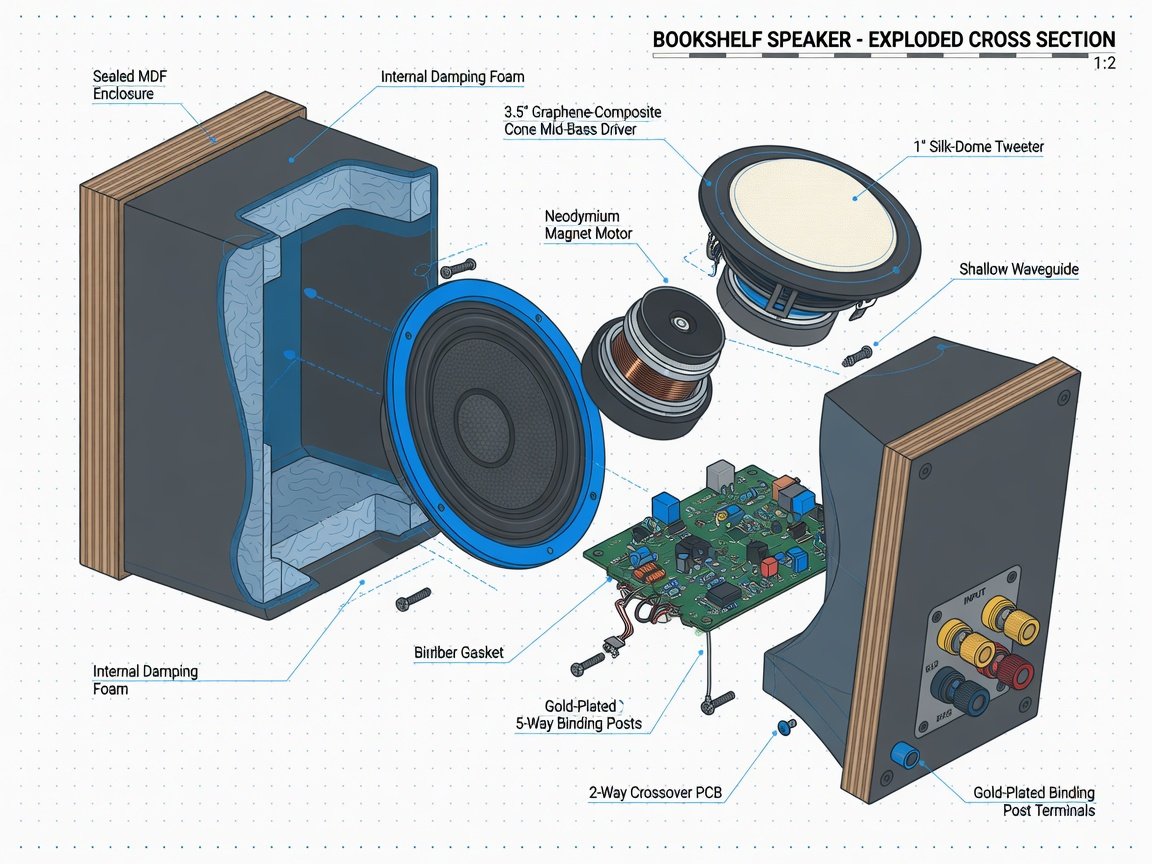
Driver materials represent the most consequential advance. Traditional polypropylene cone mid-bass drivers have been largely replaced at mid-range and premium price points by woven glass fiber, aluminum, and graphene-composite cones. These materials offer significantly higher stiffness-to-mass ratios. The practical result is reduced cone breakup distortion and cleaner midrange transient reproduction. Graphene-composite drivers are designed to deliver lower THD at equivalent listening levels compared to polypropylene counterparts at the same price tier — an advantage in a frequency range as perceptually salient as the upper midrange.
Tweeter technology has evolved in parallel. Soft-dome silk tweeters remain the standard for smooth, listening-fatigue-free high-frequency reproduction throughout the mid-range tier. Premium compact speakers increasingly deploy aluminum or beryllium dome designs for extended frequency response and superior detail retrieval. Waveguide integration — a shallow horn structure controlling tweeter dispersion — has measurably improved off-axis frequency response and time alignment in compact enclosures. Speakers with well-designed waveguides maintain flat response to ±30° off-axis, a critical performance characteristic for surround speakers placed at oblique listening angles. The WiSA 2.0 wireless standard, finalized in late 2025, now supports lossless 24-bit/96kHz audio transmission with sub-2.5ms latency, enabling fully wireless compact surround installations without signal quality compromise.
Which Technical Specifications Actually Matter When Comparing Small Surround Speakers?
Not every specification printed on a speaker’s packaging reflects real-world performance. Understanding which numbers carry genuine predictive value — and how to read them correctly — is the difference between an informed purchase and a decision driven by marketing language. Three specifications demand rigorous evaluation above all others.
Sensitivity is the single most practically important specification. Measured in dB/W/m — decibels of sound pressure level at one meter with one watt of input signal — sensitivity determines how hard your AV receiver’s amplifier must work to reach reference listening levels. Budget compact surrounds typically measure 85–87dB. Mid-range models reach 88–90dB. Premium compact speakers frequently exceed 90dB, with select high-efficiency designs exceeding 93dB. A 3dB increase in sensitivity halves the amplifier power required for the same output level. In a large room requiring sustained output, this gap is audible under dynamic peaks.
Frequency response tolerance windows must be scrutinized carefully. A specification claiming “60Hz–20kHz” without a stated ±dB tolerance is acoustically meaningless. The industry standard is ±3dB. A speaker rated 85Hz–20kHz (±3dB) provides genuinely flat response within that range. A speaker claiming 60Hz–20kHz at an unstated ±10dB may produce a 10dB output variation across its frequency range — audible as significant coloration. Always confirm the tolerance specification before purchase. Manufacturers who omit it should prompt immediate caution. Nominal impedance determines compatibility with your amplifier. Most compact surrounds are rated 8Ω nominal. Budget models sometimes dip to 4Ω minimum impedance under reactive loads. Verify your AV receiver’s minimum impedance specification — many entry-level AVRs are not rated for 4Ω loads on all channels simultaneously.
| Specification | Budget Under $200/pair | Mid-Range $200–$500/pair | Premium $500+/pair |
|---|---|---|---|
| Primary Driver Diameter | 2.5″–3″ | 3″–4″ | 3.5″–4.5″ |
| Sensitivity (dB/W/m) | 85–87 | 88–90 | 90–93+ |
| Frequency Response (±3dB) | 100Hz–20kHz | 85Hz–22kHz | 80Hz–28kHz |
| THD at 90dB SPL | <1.5% | <0.7% | <0.3% |
| Nominal Impedance | 8Ω (may dip to 4Ω) | 8Ω | 8Ω |
| Tweeter Type | Polyester soft-dome | Silk soft-dome | Silk / aluminum / beryllium |
| Cone Material | Polypropylene | Woven glass fiber | Aluminum / graphene composite |
| Enclosure | Sealed or ported | Sealed preferred | Sealed with boundary EQ switch |
| Off-Axis Response (±30°) | ±4–6dB variation | ±2–4dB variation | ±1–2dB variation |
How Do Satellite Speakers Differ From Compact Bookshelf Speakers for Surround Applications?
Two distinct product categories compete in the compact surround space: purpose-designed satellite speakers and compact bookshelf speakers adapted for surround duty. These are not interchangeable concepts, and the differences have meaningful implications for system performance and integration.
Satellite speakers are engineered explicitly for paired subwoofer operation. They make no pretense of full-range reproduction. Their internal crossovers, enclosure volumes, driver selections, and port tuning — where present — are all optimized for performance above 80–120Hz. Satellites are typically under 3kg, designed for bracket wall-mounting or compact stand use, and acoustically tailored for direct-radiating or dipole/bipole surround placement. Because they are purpose-built, they frequently offer superior time alignment and controlled dispersion characteristics for their intended surround position. Many high-quality satellite designs also implement boundary compensation EQ — a fixed or switched filter that corrects for bass reinforcement when the enclosure is mounted within 12 inches of a wall surface.
Compact bookshelf speakers repurposed as surrounds bring different tradeoffs. Many genuine compact bookshelf designs from Q Acoustics, Wharfedale, ELAC, and similar manufacturers were engineered for full-range reproduction down to 60–70Hz. This low-frequency extension is acoustically irrelevant — and potentially counterproductive — in a bass-managed system where everything below 80Hz routes to the subwoofer. However, compact bookshelves frequently deliver superior driver quality, more robust cabinet construction, and broader placement versatility. Many audiophile-grade home theater builders choose compact bookshelf speakers for surround channels, citing driver quality and long-term upgrade path flexibility as primary motivations. For buyers prioritizing sonic performance per dollar and flexibility of use, the compact bookshelf route deserves serious consideration.
How Do Small Surround Speakers Handle Dolby Atmos and Object-Based Immersive Audio in 2026?
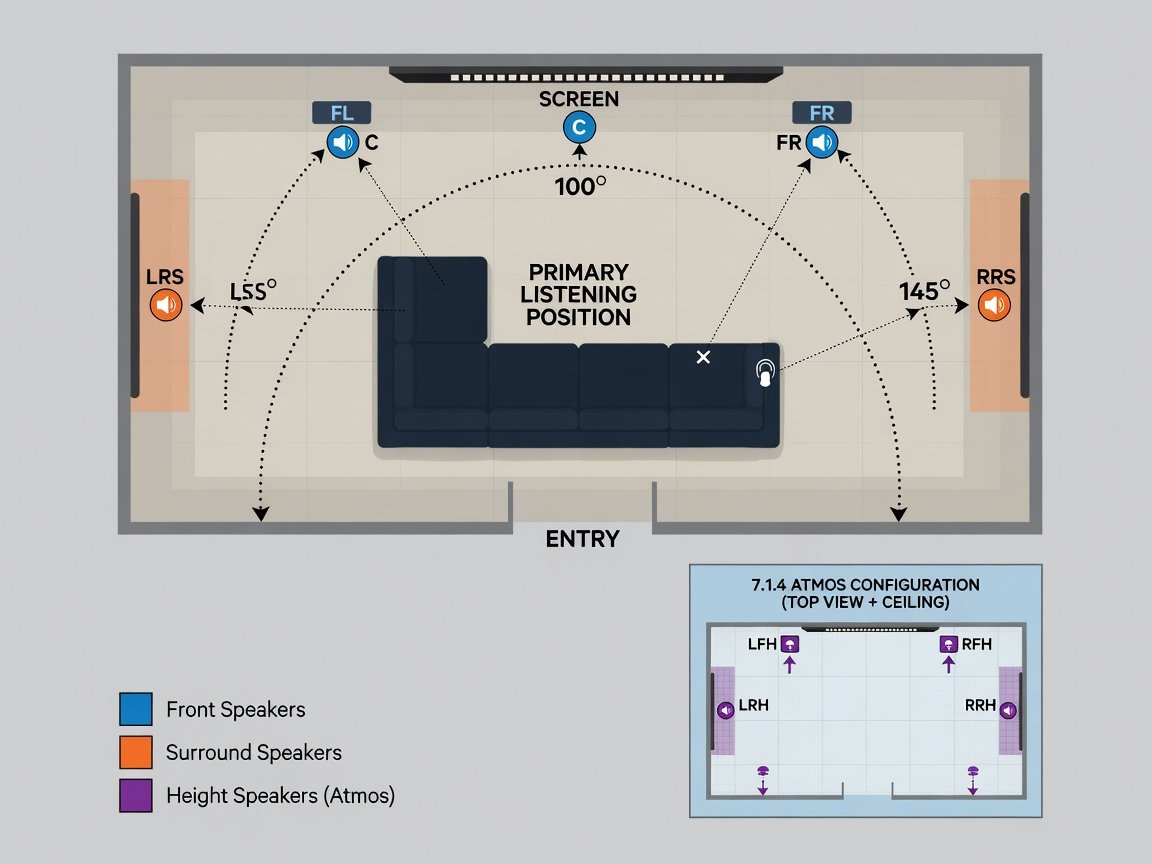
Dolby Atmos and DTS:X have fundamentally redefined the surround channel workload. In a traditional 5.1 configuration, four discrete surround channels carry ambient, directional, and atmospheric content. In a full 7.1.4 Atmos configuration, compact speakers may occupy all four horizontal surround positions plus up to four ceiling or upward-firing height positions — meaning eight matched compact speakers surrounding the listening area. The scalability demands of Atmos make compact speaker selection more consequential in 2026 than it has ever been.
The Dolby Atmos specification for surround and height channels requires a minimum frequency response of 80Hz to 20kHz in a bass-managed system configuration — a standard comfortably met by any quality compact speaker rated to that range. The Dolby Atmos content library has expanded substantially across major streaming platforms in 2026, making format compatibility a genuine purchasing imperative rather than speculative future-proofing.
Height channel performance places specific demands on compact speaker dispersion. For in-ceiling or overhead Atmos positions, wider dispersion is more important than absolute output. Speakers maintaining flat response beyond ±45° off-axis at 10kHz — achieved through waveguide integration — deliver superior height localization from overhead positions. Compact designs with waveguide-controlled tweeters consistently outperform those relying on bare dome tweeters in overhead installations, where the listener sits off-axis in both horizontal and vertical planes simultaneously. Atmos Enabled upward-firing modules, now available in compact standalone configurations from multiple manufacturers, have matured significantly in 2026. Measured room impulse responses from current-generation Atmos Enabled designs demonstrate convincing height perception in standard rooms with 8- to 10-foot ceiling heights.
How Do Compact Surround Speakers Perform in Real-World Installations?
Anechoic chamber measurements capture speaker performance in laboratory isolation, but how compact surrounds interact with actual acoustic environments — and the practical placement constraints of real rooms — matters as much as on-paper specifications.
The persistent belief that larger speakers are inherently superior in the surround position is acoustically unfounded. A well-designed compact speaker operating above its 80Hz crossover point has a simpler performance task than a full-range driver simultaneously managing room modes below that frequency. The real performance differentiators are driver quality, enclosure integrity, and crossover precision — not cabinet volume.
How Should You Match Small Surround Speakers to Your Subwoofer and AV Receiver?
System integration is where most compact surround installations succeed or fail. A technically capable compact speaker incorrectly integrated will underperform a budget speaker correctly configured. The foundation of every successful compact surround system is proper bass management — and in 2026, this is easier to execute correctly than at any previous point in home theater history, thanks to increasingly sophisticated AV receiver room correction platforms.
Set all compact surround channels to “Small” in your AV receiver’s speaker configuration menu without exception. This redirects all bass content below the crossover frequency to the subwoofer channel, protecting compact drivers from low-frequency strain and maintaining output linearity. Set the crossover frequency to 80Hz for any speaker with measured response to 80Hz or better at ±3dB — this is the Dolby-recommended reference standard. For speakers whose rated response begins at 100Hz, apply a 100Hz crossover and ensure your subwoofer is positioned and tuned to provide seamless coverage through that frequency. Leaving compact speakers set to “Large” in the AVR is a common configuration error — it forces the drivers to attempt full-range reproduction and introduces distortion at reference levels.
AV receiver room correction systems substantially improve compact surround performance when correctly applied. Audyssey MultEQ XT32 — deployed in Denon and Marantz AVRs — remains the most widely used consumer room correction platform. Yamaha’s YPAO-R.S.C. with reflected sound correction addresses room reflection issues specific to compact speaker wall-mounting positions. Pioneer and Onkyo deploy MCACC Pro. Dirac Live is available as a premium licensed option in select hardware from multiple manufacturers. Each of these systems applies measured correction filters to the frequency response anomalies introduced by room acoustics. For compact surrounds placed near walls or in asymmetrical positions — common in retrofitted rooms — these corrections frequently produce significant improvement across the critical midrange band. Running room correction without subsequently reviewing the output settings manually is itself a common error; always verify that crossover frequencies and SPL reference levels have not been incorrectly reassigned by the automated process.
What Are the Best Small Surround Sound Speakers at Each Price Tier in 2026?
The compact surround market in 2026 is structured across three well-defined performance tiers. Each tier represents a distinct level of driver technology, enclosure engineering, and integration sophistication. Understanding what differentiates them — and what to look for within each tier — is more useful than any single ranked list, because room size, AV receiver capability, and subwoofer quality all influence which tier delivers optimal performance in a specific installation.
Budget Tier: Under $200 per Pair
At the entry level, brands including Polk Audio, Klipsch, Pioneer, and Wharfedale compete with compact satellite speakers and small sealed two-way bookshelf designs. Polypropylene cone drivers and polyester-dome tweeters are standard at this price point. Budget compact surrounds typically deliver 85–87dB sensitivity and may present 4Ω minimum impedance loads under reactive conditions. The critical evaluation criteria for this tier: a sealed enclosure (more predictable rolloff than ported alternatives at 80Hz), minimum 8Ω nominal impedance, and a published frequency response specification with a stated tolerance window. Entry-level manufacturers that omit the tolerance should be approached with caution. At this price point, Klipsch’s satellite designs stand out for consistently high sensitivity figures — frequently exceeding 90dB — enabling excellent output from modest amplifier power.
Mid-Range Tier: $200–$500 per Pair
The mid-range tier delivers a meaningful step in driver materials and cabinet engineering. Monitor Audio, Q Acoustics, ELAC, and Klipsch Reference Premiere produce compact options well-regarded for their surround integration performance at this price level. Woven glass fiber and aluminum cone drivers replace polypropylene. Silk-dome tweeters replace polyester. Cabinet damping improves measurably. The best mid-range compact speakers are specified at under 0.5% THD at 90dB SPL — a figure on par with many premium alternatives. Monitor Audio’s C-SMD ribbon-derived tweeter technology, incorporated in select compact bookshelf designs, appears in surround configurations at this price point and delivers measurably extended high-frequency dispersion compared to conventional soft-dome designs. In 2026, the mid-range tier represents the strongest value proposition for buyers seeking audiophile-grade surround performance without premium pricing.
Premium Tier: $500+ per Pair
Premium compact surrounds are defined by coaxial driver alignment, advanced boundary equalization, and enclosure resonance management. KEF’s Uni-Q coaxial array — which positions the tweeter at the acoustic centre of the mid-bass driver — is the most recognized implementation, delivering time-coherent, point-source radiation that maintains consistent tonal character across a wide listening area. SVS’s Ultra Satellite designs bring neodymium magnet motor systems and constrained-layer-damped cabinets to compact form factors. Focal, Bowers & Wilkins, and Revel operate in this tier with proprietary driver technologies. The distinguishing characteristic of premium compact surrounds is flat off-axis response — maintaining ±1–2dB variation to ±30° off-axis. In surround positions where oblique listening angles are unavoidable, this consistency translates directly into a more natural, enveloping soundfield. For a complete 7.1.4 Atmos build requiring eight compact surrounds, the per-speaker cost at premium tier makes careful auditioning essential before committing at scale.
How Do You Position and Set Up Small Surround Sound Speakers for Maximum Performance?
Correct physical placement is as important as speaker quality in determining surround system performance. A premium compact surround speaker placed at an incorrect angle delivers measurably inferior localization compared to a budget speaker placed correctly per the ITU-R BS.775 angular standard. The following nine-step sequence covers the installation methodology recommended for professional home theater builds.
- Measure your room and mark the primary listening position. All subsequent placement decisions reference this point. In a rectangular room, the optimal listening position is typically one-third of the way from the rear wall.
- Calculate surround speaker angles per ITU-R BS.775. For 5.1 configurations, position surround speakers at 90°–110° to either side of the listening axis. For 7.1 configurations, place side surrounds at 90°–100° and rear surrounds at 135°–150°.
- Determine mounting height. Ear-level placement (approximately 44–48 inches from floor) is optimal for direct-radiating surrounds. If furniture or room layout prevents ear-level mounting, position speakers 18–24 inches above ear height and angle them 10–15° downward toward the listening position.
- Route all speaker cables before finalizing mounts. For wireless installations, position WiSA or proprietary wireless receivers at this stage. Confirm signal strength before committing to final mounting locations.
- Connect to the AV receiver and configure all surround channels as “Small” in the speaker setup menu. Do not skip this step — this setting activates bass management and redirects low-frequency content to the subwoofer channel.
- Set the crossover frequency to 80Hz for speakers rated to 80Hz at ±3dB. Use 100Hz for speakers with more limited low-frequency extension. Do not set the crossover lower than the speaker’s rated response.
- Run the AV receiver’s automated room correction system. Place the measurement microphone at the primary listening position, at ear height. Follow the manufacturer’s measurement protocol precisely. Allow the full measurement sequence to complete without interruption.
- Manually review the calibration output. Verify that all surround channels remain designated “Small,” that crossover frequencies were not overridden by the automated system, and that all channel SPL reference levels are matched (typically 75dBSPL with an 85dB test signal).
- Perform a final critical listening evaluation using reference Dolby Atmos or DTS:X demo content. Confirm surround localization is accurate and envelopment is consistent. Adjust speaker angle by 5–10° in either direction if localization appears imprecise at the primary seat.
The most consistent error in compact surround installations is not speaker selection — it is placement geometry. ITU-R angular recommendations have been psychoacoustically validated across decades of listening research. A compact speaker placed at the correct 90° position in a 5.1 system delivers superior envelopment and localization compared to one placed at 60° for aesthetic reasons. When acoustics and aesthetics conflict, prioritise acoustics.
What Do Audio Engineers and Researchers Say About Compact Versus Full-Size Surround Speakers?
The academic and professional audio engineering community has reached a broad consensus that compact surround speakers, when correctly integrated, do not represent a fidelity compromise in home theater applications.
Human spatial perception in listening environments relies far more on early reflection patterns and inter-aural time differences than on raw loudspeaker output levels. A compact speaker correctly positioned to generate the proper reflection geometry and surround arrival timing performs the envelopment function as effectively as a floor-standing alternative — provided the crossover integration is correct.
Surround localization accuracy — the perceptual metric most critical to home theater immersion — correlates more strongly with speaker placement precision and off-axis response consistency than with driver diameter or enclosure volume. A compact speaker with flat response to ±30° off-axis, correctly positioned at ITU-recommended angles, can be expected to deliver superior envelopment and localization compared to a large-format speaker with high directivity placed at a suboptimal angle. This understanding has informed how premium speaker manufacturers approach compact surround design in 2026, with off-axis performance now featured explicitly in product specification sheets that previously emphasized only on-axis measurements.
What Trends Will Shape Small Surround Sound Speaker Design Through 2027?
The compact surround speaker segment is at a technical inflection point in 2026. Several converging trends will define the category’s trajectory through 2027 and beyond — and buyers making purchasing decisions today should consider how these developments affect the value of current versus near-future hardware.
Frequently Asked Questions: Small Surround Sound Speakers
Can small surround sound speakers genuinely fill a large room?
Yes — with properly configured bass management and appropriate sensitivity specifications. A compact speaker’s effective frequency range (80Hz–20kHz in a bass-managed system) is not reduced by room volume. Larger rooms require higher output levels to reach reference SPL, which means sensitivity becomes a more critical selection criterion. For rooms exceeding 400 square feet, prioritise compact speakers with 90dB or higher sensitivity ratings. Pair them with an AV receiver delivering at least 80W per channel at 8Ω to maintain clean headroom under dynamic peak material.
What crossover frequency should I set for small surround speakers?
Set the crossover to 80Hz for any speaker with a rated frequency response of 80Hz or better at ±3dB. This is the Dolby reference standard and the frequency at which the vast majority of well-designed compact surrounds operate cleanly. For speakers with a rated response beginning at 100Hz or higher, apply a 100Hz crossover and confirm your subwoofer provides seamless output through that frequency. Never set the crossover lower than the speaker’s rated response — this forces the driver to reproduce content outside its linear operating range, introducing distortion and compressing dynamic range.
Do I need a subwoofer when using small surround sound speakers?
In a home theater context, yes — a subwoofer is essential when using compact surrounds. The subwoofer handles all content below the crossover frequency from every channel, plus the dedicated LFE (.1) bass track present in Dolby Digital, Dolby Atmos, DTS:X, and all other discrete surround formats. Running compact surrounds without a subwoofer forces their small drivers to attempt bass reproduction beyond their linear range. The result is measurable distortion, output compression under peak bass content, and accelerated driver fatigue. A quality compact subwoofer is a technical requirement, not an optional accessory, in this system configuration.
Are wireless small surround speakers as good as wired alternatives in 2026?
With WiSA 2.0 certification, yes — they are acoustically equivalent. WiSA 2.0 delivers uncompressed 24-bit/96kHz audio at latency below 2.5ms, which is below the threshold of audible detection in surround applications. Earlier proprietary wireless systems introduced compression artefacts and measurable latency inconsistency. Non-WiSA wireless surround systems should be evaluated carefully before purchase — some consumer wireless surround implementations use compressed audio formats that reduce signal quality relative to lossless wired connections. Always verify the wireless standard and audio format specification before treating wireless convenience as acoustically neutral.
How much amplifier power do small surround speakers actually need?
Most compact surrounds are rated for 20–100W continuous power handling. For home theater listening at reference levels in rooms under 350 square feet, an AV receiver delivering 50–80W per channel at 8Ω is more than sufficient. The more practically useful amplifier specification is current delivery capability under dynamic conditions — peak transients in film soundtracks can demand brief power bursts of 4–8× the continuous listening level. AVRs with robust power supply stages handle these peaks without audible clipping more reliably than those with identical continuous wattage ratings but undersized transformers.
Can I use compact small speakers for Dolby Atmos overhead height channels?
Yes — compact speakers are well-suited for in-ceiling and overhead Atmos height channel positions. Dolby’s specification for height channels requires frequency response from 80Hz to 20kHz in a bass-managed system — a standard met by any quality compact speaker rated to that range. For overhead positions specifically, prioritise speakers with wide horizontal and vertical dispersion exceeding 100° at 10kHz. Speakers using waveguide-controlled tweeters consistently outperform those with bare dome tweeters in overhead installations, where the listener sits off-axis in both planes simultaneously. Atmos Enabled upward-firing modules provide a ceiling-mount-free alternative in rooms where overhead installation is not feasible.
Conclusion: The 2026 Case for Compact Surround Speakers Is Technical, Not Just Practical
The best small surround sound speakers in 2026 are not second-tier compromises. They are purpose-engineered components that — when correctly matched to a capable subwoofer, properly integrated with AV receiver bass management, and placed at the correct angular positions per ITU-R BS.775 — deliver measurably competitive surround performance at every budget tier. The case for compact surrounds is supported by psychoacoustic research, acoustic engineering principles, and a manufacturing landscape that has applied genuine engineering ambition to the category for over a decade.
Follow this implementation sequence to achieve the best results from your compact surround build:
- Week 1 — Define and Plan: Confirm your room dimensions, listening position, and target configuration (5.1, 7.1, or 7.1.4 Atmos). Determine how many compact speakers you require and set a total system budget including subwoofer and AV receiver.
- Week 1–2 — Select by Tier: Match speaker selection to the sensitivity, impedance, and frequency response criteria outlined in this guide. Prioritise sealed enclosures, 8Ω impedance, and stated ±3dB tolerance specifications. Audition if possible — or confirm a return policy before purchasing.
- Week 2 — Install and Configure: Mount speakers at ITU-R-compliant angles and heights. Configure all channels as “Small” in your AVR. Set the 80Hz crossover. Run automated room correction.
- Week 2 — Verify and Refine: Review calibration output manually. Measure with REW if possible. Perform a blind listening evaluation with reference Atmos or DTS:X content.
- Ongoing: Re-run room correction after any significant furniture change. Monitor driver condition annually. Review the emerging WiSA 2.0 and active speaker market if upgrading in 2027.
Compact surround speakers improve faster than any other segment in the home theater category. The engineering momentum is clear, the acoustic science is settled, and the value proposition strengthens every year. The only remaining variable is correct integration — and that is entirely within your control.