Dolby Atmos is an object-based audio format that places up to 128 discrete sound objects in three-dimensional space — including directly overhead — rendered in real time by a compatible AV receiver or processor. It is the global standard for immersive cinema and home theater audio.
- Object-based rendering: Dolby Atmos encodes audio as positional metadata objects, not fixed channels — the renderer maps those objects to whichever speaker configuration is installed in the room.
- Scalable configurations: From a minimum 5.1.2 layout to a full 9.1.6 installation, Dolby Atmos scales to any room size, budget, and speaker count without requiring a separate mix.
- Vast content library: As of Q3 2026, the combined Dolby Atmos catalogue exceeds 7,500 film and television titles across streaming and physical media, plus over 100 million music tracks via Dolby Atmos Music.
- Industry standard: Dolby Atmos is deployed in over 5,000 commercial cinemas globally and is the reference audio format for all major theatrical post-production.
What Is Dolby Atmos and How Does It Work?
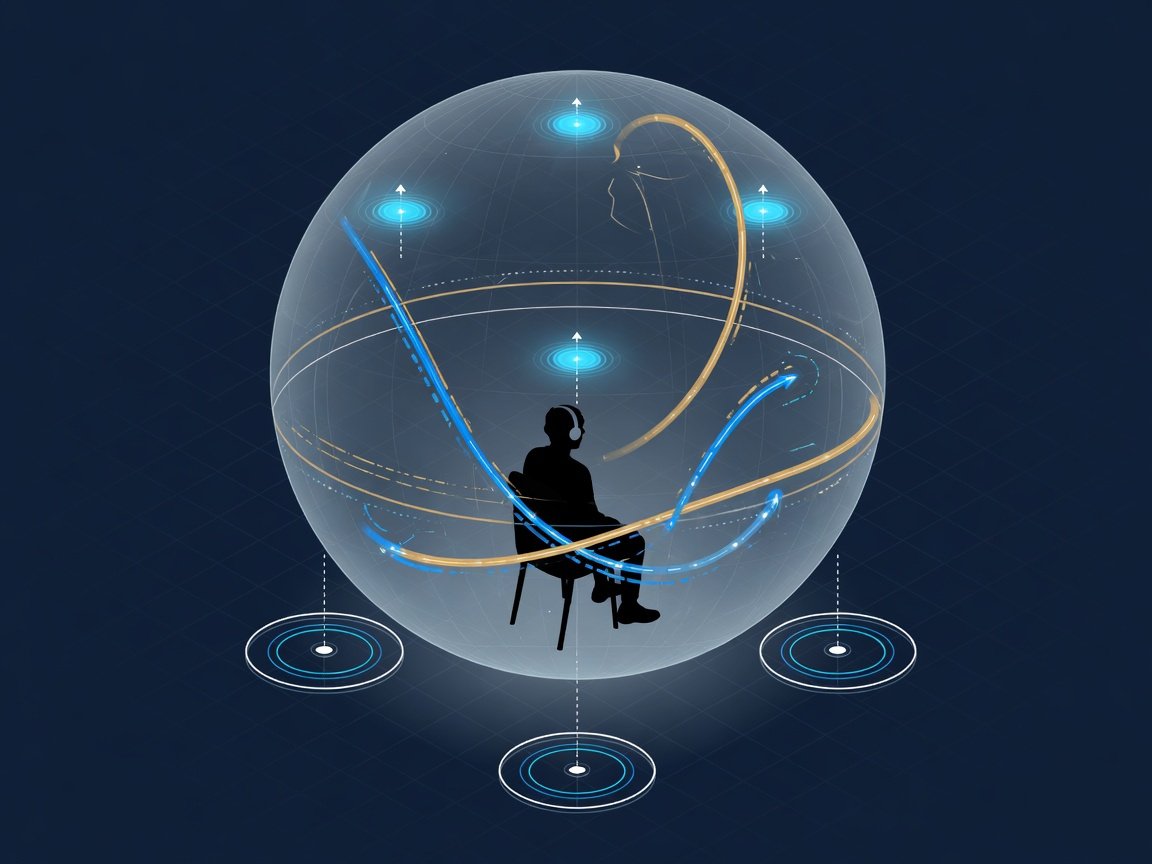
Dolby Atmos was developed by Dolby Laboratories and commercially launched in 2012 with the Pixar film “Brave” at the El Capitan Theatre in Hollywood. Unlike every preceding surround sound format — which locked audio to a fixed number of discrete channels — Dolby Atmos encodes each sound element as an independent audio object. Each object carries positional metadata: X (left–right), Y (front–back), and Z (height) coordinates, along with gain, size, and movement parameters. At playback, the Dolby Atmos renderer inside the AV receiver reads these objects and calculates in real time the precise output mix required for the room’s specific speaker configuration.
The format supports up to 128 simultaneous audio objects per scene. In a commercial cinema, Dolby Atmos drives up to 64 discrete speaker feeds, including multiple overhead arrays. In the home, configurations range from 5.1.2 to 9.1.6 — always following the notation: floor channels . subwoofers . height channels. This object-to-speaker mapping means a single Dolby Atmos master file contains complete positional data that renders correctly — scaled appropriately — on a soundbar, a 5.1.2 living room setup, or a reference 9.1.6 screening room. Channel-based formats cannot achieve this without creating an entirely separate mix for each speaker layout.
The home theater arrival of Dolby Atmos for home theater came in 2014 with the Blu-ray release of “Transformers: Age of Extinction,” coinciding with compatible AV receivers from Denon, Onkyo, and Yamaha. Since then, the format has expanded into streaming services, mobile devices, gaming consoles, Dolby Atmos Music, and binaural headphone rendering — cementing its position as the most widely deployed immersive audio standard in consumer electronics history.
How Does Dolby Atmos Differ from Traditional 5.1 and 7.1 Surround Sound?
Conventional surround sound formats — Dolby TrueHD 7.1, DTS-HD Master Audio, and their predecessors — encode audio into a fixed number of channels. A 7.1 mix contains eight discrete audio channels, each assigned to a specific speaker position. If a listener has only five speakers, the processor must down-mix, discarding spatial information in the process. The spatial resolution of the recording is permanently constrained by the number of channels the mix engineer chose at the dubbing stage.
Dolby Atmos removes this constraint entirely. A sound designer places a helicopter as an audio object at positional coordinates — overhead, slightly right, moving forward — and the renderer resolves that to whatever overhead speaker configuration the listener has installed. Two height speakers produce a credible approximation; six height speakers produce a more precise rendition.
There is also a structural difference in vertical coverage. Traditional 7.1 has no vertical component — all eight speakers sit at ear level in a horizontal plane. Dolby Atmos adds one or two additional layers of speakers above the horizontal plane. The psychoacoustic effect is significant: the human auditory system is particularly sensitive to overhead sounds — rain, collapsing architecture, low-flying aircraft — and their absence from horizontal-only formats is among the most readily noticeable perceptual differences between the two systems.
What Speaker Configurations Does Dolby Atmos Support?
Dolby Atmos home configurations use the floor.subwoofer.height notation. The floor and subwoofer layers replicate a conventional surround setup; the height layer adds the vertical dimension. Dolby Laboratories’ certified home configurations include 5.1.2, 5.1.4, 7.1.2, 7.1.4, 9.1.4, and 9.1.6. The absolute minimum recommended configuration for a genuine Atmos experience is 5.1.2 — a standard 5.1 system with two ceiling-mounted or upward-firing height speakers added.
Choosing the right Dolby Atmos speakers for the height channels is one of the most consequential decisions in any Atmos installation. Three physical approaches exist. In-ceiling speakers mounted directly above the listening position provide the highest accuracy and the cleanest localisation — this is the method Dolby itself recommends as the reference implementation. Dolby Atmos-enabled upward-firing speakers — driver modules placed on top of existing floor-standing or bookshelf speakers — use ceiling reflections to simulate overhead sources; their performance depends heavily on ceiling material, height, and surface reflectivity. The third approach, Dolby Atmos Height Virtualizer, is a DSP algorithm that synthesises height cues on a conventional surround system with no physical height speakers — useful where installation is impractical, but delivering lower spatial resolution than physical height drivers.
| Configuration | Floor Speakers | Subwoofers | Height Speakers | Ideal Room Size |
|---|---|---|---|---|
| 5.1.2 | 5 | 1 | 2 | Up to 20 m² |
| 5.1.4 | 5 | 1 | 4 | Up to 25 m² |
| 7.1.2 | 7 | 1 | 2 | 20–30 m² |
| 7.1.4 | 7 | 1 | 4 | 25–40 m² |
| 9.1.4 | 9 | 1 | 4 | 35–50 m² |
| 9.1.6 | 9 | 1 | 6 | 50 m²+ |
7.1.4 has become a common advanced configuration in purpose-built dedicated home theater rooms. When planning the complete speaker system for home theater, factors including room dimensions, ceiling height, speaker sensitivity, and amplifier output power must all be evaluated together — no single specification guarantees performance in isolation.
What AV Receivers and Processors Support Dolby Atmos?
Every Dolby Atmos home installation requires a Dolby Atmos-licensed AV receiver (AVR) or a standalone processor paired with external amplification. These units contain the Dolby Atmos renderer — the computational core that reads object metadata from the decoded bitstream and calculates real-time speaker feeds for the specific room configuration. As of 2026, native Dolby Atmos decoding is standard across mid-range and premium AV receivers, and the technology has migrated down to entry-level units priced below £300 / $350.
Key specifications when selecting an AVR for a Dolby Atmos system: total amplified channel count (a 7.1.4 system requires an 11-channel receiver; 9.1.6 requires 16 channels or a processor plus external amplification); HDMI 2.1 ports for 4K 120Hz video passthrough; Dolby Vision video passthrough for a matched audio-visual pipeline; eARC on at least one HDMI output for lossless TrueHD passthrough from the television; and support for a sophisticated room correction platform such as Dirac Live Full Bandwidth, Audyssey MultEQ XT32, or YPAO with Reflected Sound Control. Brands with active Dolby Atmos licensing in 2026 include Denon, Marantz, Yamaha, Onkyo, Pioneer, Anthem, Arcam, and StormAudio.
The renderer in a modern AV receiver is extraordinarily sophisticated. Given a well-calibrated room and a correctly decoded Atmos bitstream, the spatial accuracy can approach what professional dubbing stages deliver. The gap between home and cinema has narrowed substantially over the past decade.
Room correction is no longer optional in a serious Atmos installation. Automated room correction substantially improves perceived height localisation accuracy in untreated domestic rooms. Running a multi-point calibration sequence at every seat in the room, rather than a single-point measurement at the primary seat, is one of the highest-value steps available at any system budget.
How Do You Set Up Dolby Atmos in Your Home Theater Step by Step?
A properly executed home theater setup for Dolby Atmos is methodical and sequential. Skipping the calibration phase — the single most commonly omitted step in consumer installations — accounts for the majority of disappointing Atmos experiences reported in domestic rooms. Follow this sequence in full.
- Plan speaker positions. Decide on a configuration (minimum 5.1.2). Using Dolby’s published angle guidelines, mark ceiling speaker positions: front height speakers at 30–55° above ear level, positioned 30–45° to the side of the primary listening position. Rear height speakers at 30–55° above ear level, 130–150° to the side.
- Install and cable all speakers. Use in-wall or in-ceiling rated cable throughout. Keep all speaker runs identical in gauge and approximately equal in length to maintain balanced impedance. Label each run clearly at both the speaker terminal and the AVR binding post.
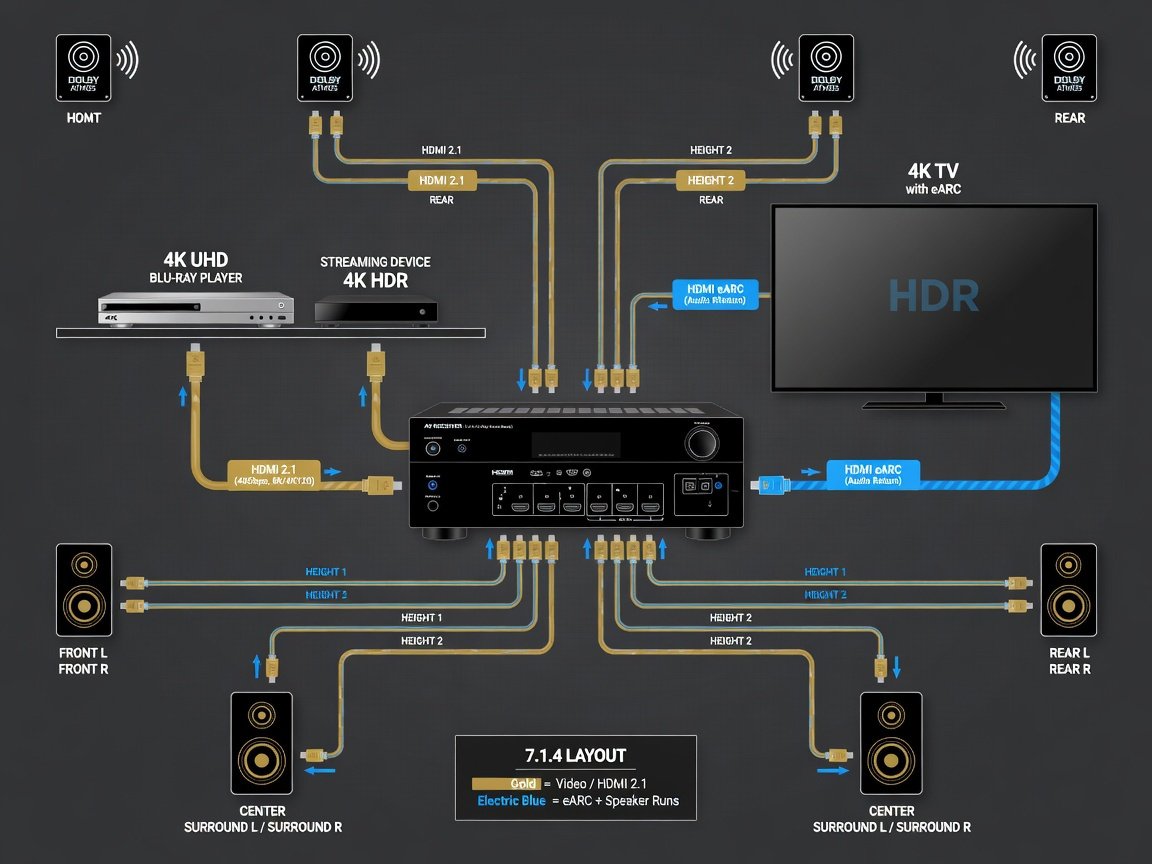
- Connect the AV receiver. Run HDMI 2.1 cables from all sources — Blu-ray player, streaming device, game console — directly to HDMI inputs on the AVR. Connect one HDMI eARC cable from the AVR’s HDMI Monitor output to the television’s eARC port. This single connection returns audio from the TV’s built-in streaming apps to the AVR without transcoding the Atmos bitstream.
- Assign speaker channels. In the AVR’s setup menu, assign each physical speaker output terminal to its correct logical channel: front left, centre, front right, surround left, surround right, surround back left, surround back right, top front left, top front right, top rear left, top rear right (for a 7.1.4 system). Incorrect channel assignments are the most common installation error and produce reversed height imaging and incoherent object localisation.
- Run automated room calibration. Place the included measurement microphone on a stand at ear height in the primary listening seat. Run the AVR’s built-in calibration system — Audyssey, Dirac Live, or YPAO. For multi-seat rooms, complete additional microphone positions at each seat if the system supports multi-point measurement.
- Verify the Dolby Atmos signal chain. Play a Dolby Atmos-encoded test disc or a confirmed streaming Atmos title. The AVR’s front panel must display “Dolby Atmos” — not merely “Dolby TrueHD” — confirming that object metadata is being received and decoded, not just the base TrueHD 7.1 layer.
- Set speaker levels and distances. Using a calibrated SPL meter (or the AVR’s internal test tones), set all speakers — including height channels — to 75 dB SPL at the primary listening position. Adjust per-speaker distance settings in 0.1-metre increments until spoken dialogue locks firmly and naturally to the screen image.
What Dolby Atmos Content Is Available in 2026?
Content availability is no longer a limiting factor for Dolby Atmos in 2026. The combined catalogue across physical media and streaming platforms exceeds 7,500 Dolby Atmos film and television titles. Netflix delivers Dolby Atmos on compatible devices with its Premium plan. Apple TV+ encodes the majority of its original programming in Dolby Atmos paired with Dolby Vision. Disney+ carries Atmos content on selected titles through its Premium tier. Amazon Prime Video, Paramount+, and Apple TV channels all offer expanding Dolby Atmos libraries.
Physical media remains the definitive format for Dolby Atmos fidelity. 4K Ultra HD Blu-ray discs carry lossless Dolby TrueHD with Atmos object metadata — the identical bitstream used in the theatrical post-production suite. Streaming platforms transcode Dolby Atmos to Dolby Digital Plus (DD+), a lossy codec capped at 768 kbit/s on Blu-ray and typically lower on streaming pipelines. The perceptual difference between lossless TrueHD Atmos and DD+ Atmos is recording-dependent, but the difference is most readily apparent in transient-heavy action sequences and orchestral passages where codec artefacts accumulate most audibly.
Dolby Atmos Music has expanded at pace since launching on Apple Music and Tidal. By 2026, the Dolby Atmos Music catalogue on Apple Music alone exceeds 100 million tracks — encompassing spatially remixed classic albums and native Atmos productions recorded specifically for three-dimensional playback. On a properly configured home theater system, Dolby Atmos Music uses the same object-based renderer as film audio. Instruments can be positioned anywhere in the room, soundstages extend naturally beyond the front speakers, and the listening experience is qualitatively distinct from conventional two-channel stereo playback.
How Does Room Size and Acoustics Affect Dolby Atmos Performance?
Room acoustics are the most significant variable in Dolby Atmos performance — and receive less attention than speaker selection or AV receiver specifications in most planning discussions. In an untreated domestic room, low-frequency room modes below 300 Hz can add or remove up to 20 dB of level at specific frequencies at the listening position. This irregularity in bass response directly degrades Dolby Atmos subwoofer integration and the convincingness of low-frequency audio objects placed at precise positional coordinates by the renderer.
Ceiling height is particularly critical for height channel performance. Dolby Laboratories specifies a minimum ceiling height of 2.4 metres for reliable height channel imaging. At lower ceiling heights, the angular separation between floor-level and ceiling speakers collapses, reducing the perceptual differentiation between conventional surround and overhead Atmos channels. Rooms with 2.7 to 3.0 metre ceilings are expected to produce better height localisation. Hard, reflective ceilings — common in contemporary construction — scatter overhead reflections that smear Atmos object imaging; broadband acoustic absorbers at first-reflection points on the ceiling and side walls substantially improve overhead clarity.
Careful planning of home theater seating position is equally important. The primary listening seat should be placed at approximately 60% of the room’s length from the front wall — positioning it clear of the rear wall bass build-up that occurs in all rectangular rooms. For multi-row configurations, row-to-row spacing and seat rake (vertical rise between rows) affect both sight lines and the degree to which front-row seats shadow height channel audio arriving at rear rows. A minimum rake of 150mm per row is the standard acoustic and sightline guideline for dedicated home theater rooms.
How Does Dolby Atmos Compare to DTS:X and IMAX Enhanced?
Three premium immersive audio formats compete in the home theater market in 2026: Dolby Atmos, DTS:X, and IMAX Enhanced. All three use object-based audio principles — positional metadata rather than fixed channels — but they differ substantially in codec structure, content library depth, hardware requirements, and the scale of their respective music offerings.
| Feature | Dolby Atmos | DTS:X | IMAX Enhanced |
|---|---|---|---|
| Maximum Audio Objects | 128 | 128 | 128 (via DTS:X Pro) |
| Lossless Home Codec | Dolby TrueHD | DTS-HD Master Audio | DTS:X Pro |
| Lossy Streaming Codec | Dolby Digital Plus | DTS:X (streaming) | DTS:X (streaming) |
| Home Content Titles (2026) | 7,500+ | ~3,000 | ~400 |
| Music Spatial Format | Dolby Atmos Music (100M+ tracks) | Limited catalogue | None |
| Native Virtualisation | Height Virtualizer | DTS Virtual:X | Limited |
DTS:X is the closest technical equivalent to Dolby Atmos. Both formats support up to 128 audio objects, both use object metadata for speaker-adaptive rendering, and virtually every AVR that decodes Dolby Atmos also decodes DTS:X — hardware compatibility is not a differentiating factor for consumers in 2026. The substantive difference is content depth: the Dolby Atmos home library is approximately 2.5 times the size of the DTS:X library, and the Dolby Atmos Music catalogue has no DTS equivalent at meaningful scale. For consumers investing in a long-term home theater platform, content breadth is the more durable competitive advantage.
IMAX Enhanced is a co-branded certification from Sony and IMAX Corporation. It pairs DTS:X Pro audio with IMAX-remastered 4K video — expanded aspect ratio, higher peak brightness, and scene-by-scene colour grading — and competes on a different axis to Atmos altogether. The library is substantially smaller and concentrated on action and spectacle genres where the IMAX visual format provides the most added value. Most AV receivers decode DTS:X Pro natively, so an IMAX Enhanced disc plays correctly on any DTS:X-equipped system without additional hardware.
Dolby Atmos leads the consumer immersive audio market on content depth. The music catalogue alone — exceeding 100 million spatial audio tracks on Apple Music — gives it a reach no competing format currently approaches. DTS:X remains a technically excellent format for film, but content breadth is a significant driver of long-term platform adoption.
What Are the Latest Dolby Atmos Developments in 2026?
Dolby Laboratories has extended the Atmos platform into new form factors and territories throughout 2026. Dolby Atmos FlexConnect — introduced in 2025 — enables wireless height speaker placement without sacrificing the timing and object synchronisation accuracy that object-based rendering requires. FlexConnect operates over a dedicated 6 GHz Wi-Fi 7 network channel, maintaining inter-speaker latency within 1 millisecond, eliminating the principal installation barrier in homes where running cable to ceiling positions is structurally impractical.
Binaural Dolby Atmos rendering has advanced significantly for headphone and spatial computing applications. The 2026 iteration of Dolby’s binaural renderer uses personalised head-related transfer functions (HRTFs) derived from ear geometry measurements — a technique previously available only in research environments. This approach is designed to improve the perceptual externalisation score — the sense that sound originates outside the head rather than within it — compared to a generic HRTF baseline. The improvement is particularly significant for Apple Vision Pro, Meta Quest 3S, and competing mixed-reality headsets that deliver Dolby Atmos as a primary audio pipeline.
In the world of cinema reference design, the Dolby Theatre in Hollywood — the 3,400-seat venue that hosts the Academy Awards, equipped with a bespoke reference Dolby Atmos installation — served in 2026 as the public preview platform for Dolby’s next-generation immersive audio research. Dolby published a technical white paper this year describing an experimental 22.2 overhead-enriched speaker array for large commercial venues. This architectural reference design is expected to inform the premium home theater configurations that become commercially available by 2028.
What Do Audio Experts and Real-World Installations Reveal About Dolby Atmos?
Object-based audio represents a fundamentally different philosophy for how sound is represented, stored, and reproduced. What Dolby Atmos enables is the delivery of a complete spatial intent from the mixing stage to the listener’s room, intact — something not achievable with any channel-based format.
One of the most technically underrated aspects of Dolby Atmos is the renderer’s capacity to optimise for any speaker configuration. The object metadata is source-agnostic to the playback system. Whether the listener has a 5.1.2 or a 9.1.6 system, the renderer calculates the best available output from what is physically present — sophisticated adaptive signal processing delivered at entry-level consumer price points.
Example scenario — 7.1.4 dedicated installation: An illustrative scenario applying the principles in this guide. A basement home theater (approximately 5.5 × 8.2 × 2.7m) built with staggered stud construction, Green Glue damping compound, and an acoustic floating floor. System: an 11-channel AVR driving a three-way centre, twin floorstanding fronts, bookshelf surrounds and rears, four in-ceiling height speakers at 40° elevation, and dual subwoofers in a dual-opposed configuration. Dirac Live Full Bandwidth calibration was applied post-installation to improve bass response at the primary seat below 120 Hz — the type of acoustic improvement described in the setup and room acoustics sections above.
Frequently Asked Questions About Dolby Atmos
Do I need special speakers to use Dolby Atmos?
The floor-level speakers in a Dolby Atmos system are standard passive speakers — any quality speaker appropriate for the room’s size and the amplifier’s output characteristics can serve a floor channel role. Height channels specifically require either in-ceiling speakers, upward-firing Atmos-enabled modules placed on top of existing speakers, or a Dolby Atmos soundbar with upward-firing drivers. There is no requirement to purchase speakers marketed specifically as “Dolby Atmos speakers” for floor positions, though purpose-designed Atmos-enabled modules are engineered and measured specifically for upward-firing bounce-reflection performance.
Can a soundbar deliver a genuine Dolby Atmos experience?
A flagship Dolby Atmos soundbar from brands such as Sonos, Samsung, LG, or Sony delivers a credible spatial audio approximation through upward-firing drivers and DSP virtualisation. The best-performing soundbars deliver a credible approximation but fall short of the spatial accuracy of a discrete 5.1.2 speaker system. For rooms under 25 square metres and casual viewing contexts, the gap may be imperceptible. For a dedicated home theater room optimised for Atmos performance, a discrete multi-speaker system outperforms a soundbar’s virtualised height channels in both measurable and perceptible terms.
What is the difference between Dolby Atmos and Dolby TrueHD?
Dolby TrueHD is the lossless delivery codec used to carry Dolby Atmos object metadata on 4K Ultra HD Blu-ray. When a disc is labelled “Dolby TrueHD with Dolby Atmos,” the TrueHD bitstream includes Atmos object metadata as an extension layer alongside a conventional 7.1 base channel mix. An older Atmos-incompatible receiver decodes only the TrueHD base layer. A Dolby Atmos receiver extracts the full object metadata and drives height speakers accordingly. On streaming services, Dolby Atmos is delivered via the lossy Dolby Digital Plus (DD+) codec — lower bitrate, but the object metadata structure is preserved and decoded by compatible receivers.
How many height speakers does a Dolby Atmos system actually need?
The Dolby-specified minimum is two height speakers in a 5.1.2 configuration. Two height speakers reproduce height objects but cannot convey front-to-back overhead movement — a helicopter flying the length of the room is reproduced as a stationary overhead sound. Four height speakers in a 5.1.4 or 7.1.4 configuration deliver full front-to-rear overhead object movement and are the practical target for a dedicated home theater. Six height speakers in a 9.1.6 configuration provide the highest spatial density and are appropriate for rooms where ceiling coverage is otherwise incomplete across the full seating area.
Does Dolby Atmos require HDMI eARC, or does standard ARC work?
HDMI ARC supports Dolby Atmos only via the lossy Dolby Digital Plus codec — its bandwidth is insufficient for lossless Dolby TrueHD with Atmos. HDMI eARC, part of the HDMI 2.1 specification, carries the full TrueHD bitstream with Atmos metadata intact. This distinction matters only when the television is the primary signal hub — routing audio from built-in streaming apps back to the AVR. Sources connected directly to the AVR via their own HDMI inputs bypass ARC and eARC entirely, delivering the full bitstream natively. For maximum Atmos fidelity from both TV apps and direct sources, eARC on the TV-to-AVR connection is the correct configuration.
Is Dolby Atmos worth investing in for a music-only listening system?
Dolby Atmos Music is available on Apple Music, Tidal, and Amazon Music Unlimited at no additional hardware cost on any Atmos-equipped system. The Apple Music catalogue alone exceeded 100 million Atmos tracks as of 2026. For orchestral music, jazz, progressive rock, and cinematic compositions, well-engineered Dolby Atmos Music mixes deliver a genuinely expanded soundstage relative to stereo on a 5.1.2 or larger system. Listeners who prefer the focused, intimate presentation of a stereo mix are equally accommodated — most streaming platforms allow per-track or account-wide toggling between stereo and spatial audio without requiring any changes to the hardware.
How Do You Start Your Dolby Atmos Installation? A Practical 2026 Timeline
Dolby Atmos is no longer a premium outlier. In 2026, a genuinely capable 5.1.2 Atmos system assembles for under £1,500 / $1,800. The streaming content library is expansive, the hardware ecosystem is mature, and the installation process is well-documented. The following timeline provides a practical roadmap from planning to first Atmos play.
- Week 1 — Plan the room. Measure the room. Confirm ceiling height meets the 2.4m minimum. Identify height speaker mounting positions using Dolby’s angle guidelines. Decide between in-ceiling and upward-firing height delivery based on ceiling construction and installation budget.
- Week 2 — Specify the system. Select a Dolby Atmos-licensed AVR with a channel count matching the chosen configuration. Pair height speakers rated for the ceiling-to-seat throw distance. Confirm subwoofer output level at the planned crossover frequency with the amplifier’s power rating.
- Weeks 3–4 — Install and cable. Mount ceiling speakers. Run all speaker cable. Connect HDMI sources to the AVR. Connect the AVR to the television via HDMI eARC if the TV serves as a streaming source hub.
- Week 5 — Calibrate and verify. Run the AVR’s automated room calibration with the measurement microphone at ear height. Confirm the AVR panel reads “Dolby Atmos” on a test Atmos source. Adjust distance and level settings with an SPL meter.
- Ongoing — Build the content library. Subscribe to a streaming platform carrying Dolby Atmos. Invest in 4K Ultra HD Blu-ray for the reference-quality lossless TrueHD Atmos recordings that represent the format at its full technical potential.
hometheaterinfoline.com covers every layer of this process — from equipment selection and cable routing to acoustic treatment priorities and post-calibration fine-tuning — across the full depth of the knowledge base. Whether the destination is a compact 5.1.2 living room system or a purpose-built 9.1.6 screening room, the principles governing a successful Dolby Atmos installation are consistent: accurate speaker placement, clean signal routing, and properly executed room calibration deliver the format at its full potential at every price point.
Pingback: Dolby Theatre Explained: What Every Home Theater Enthusiast Needs to Know in 2026 - Home Theater InfoLine
Pingback: How to Set Up Dolby Atmos for Home Theater in 2026: The Complete Technical Guide - Home Theater InfoLine