The Dolby Theatre in Hollywood is the world’s most technically refined entertainment venue — built around the same dolby atmos object-based audio architecture that defines premium home theater systems worldwide. Situated at Hollywood & Highland on Hollywood Boulevard, it holds 3,400 people and serves as the permanent home of the Academy Awards. Every acoustic, optical, and signal-processing decision inside its walls represents a benchmark that home theater builders can measure, study, and replicate at residential scale.
Executive Summary
- The Dolby Theatre opened February 18, 2001 as the Kodak Theatre and was renamed in January 2012 when Dolby Laboratories signed a 20-year naming-rights agreement — the first major entertainment venue to carry the Dolby name.
- Its audio system runs on Dolby Atmos processing capable of handling up to 128 simultaneous audio objects in three-dimensional space — the same core format available to home theaters configured up to 9.1.6 channels in 2026.
- Dolby Vision projection delivers 12-bit color depth (68.7 billion color values) and up to 10,000 nits peak brightness — well beyond the approximately 48-nit luminance ceiling of standard dynamic range cinema projection.
- For home theater engineers and enthusiasts, the Dolby Theatre provides a fully documented technical target: object-based spatial audio, calibrated RT60 room acoustics, dynamic HDR projection, and reference-level signal processing from source to speaker.
What Is the Dolby Theatre?
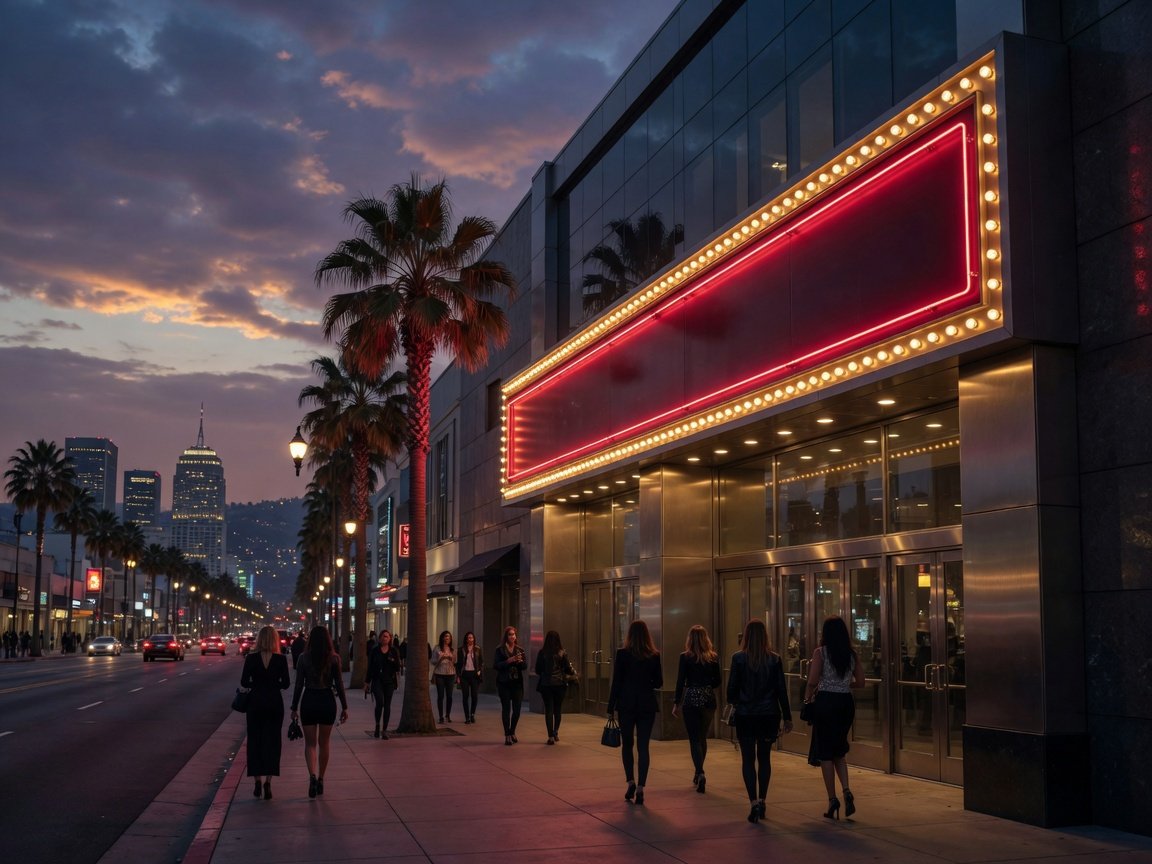
The Dolby Theatre occupies the north end of the Hollywood & Highland entertainment complex at 6801 Hollywood Boulevard, Los Angeles. Architect David Rockwell’s interior was engineered to satisfy an unusual dual mandate: simultaneous support for live theatrical performance and reference-quality cinema presentation. This dual mandate drives every technical specification in the building — speaker placement, acoustic treatment ratios, projection geometry, and stage dimensions must serve both formats without compromising either.
Construction completed in late 2000, and the venue opened officially on February 18, 2001, under its original name, the Kodak Theatre. Kodak held naming rights throughout the building’s first decade. When Kodak entered financial difficulty, those rights became available, and in January 2012 Dolby Laboratories executed a 20-year naming agreement. The renaming was not merely cosmetic. Dolby audio processing was already integral to the building’s infrastructure, and the name change aligned the brand identity with the technical reality that had existed since opening day.
The proscenium stage measures 33 feet wide and 26 feet deep. Seating spans three levels — main floor, mezzanine, and balcony — for a total capacity of 3,400. The theatre has been the primary venue for the Academy Awards since the 74th ceremony in March 2002, and operates year-round for concerts, film premieres, corporate events, and touring theatrical productions. Its technical systems are configured to support broadcast-quality output for each event type, placing unusually broad demands on the signal chain and acoustic infrastructure.
What Audio Technology Powers the Dolby Theatre?
Dolby Laboratories designed and integrated the theatre’s audio infrastructure from specification through commissioning. The system is anchored by Dolby Atmos — the object-based immersive audio format that routes sound according to three-dimensional coordinate data rather than assigning it to fixed speaker channels. In the commercial cinema implementation deployed at the Dolby Theatre, the Atmos rendering engine handles up to 128 simultaneous audio objects, each carrying real-time positional metadata that instructs the system exactly where within the physical speaker array to place that sound.
The speaker distribution extends well beyond the conventional left-center-right screen cluster. Overhead arrays deliver height coverage across the full ceiling plane. Side-surround banks and rear-surround clusters complete the horizontal surround field. Dedicated subwoofer systems handle content below 80 Hz. This multi-dimensional distribution eliminates the discrete positional jumps inherent in legacy 5.1 and 7.1 systems, where audio snaps abruptly between fixed driver locations rather than moving fluidly through three-dimensional space. The result is a continuous, seamless sound field across all 3,400 seats simultaneously.
Dolby’s amplification and digital signal processing chain calibrates every speaker cluster to a single consistent acoustic reference: 85 dB SPL at the primary listening position with 20 dB of dynamic headroom. This calibration target is codified in SMPTE and ISO cinema standards and is identical to the reference level used in professionally configured home theater installations. A home theater builder working to this specification is targeting the exact same loudness calibration as the Dolby Theatre’s own engineering team.
The object-based routing, calibrated reference level, and acoustic treatment ratios that define the Dolby Theatre are all principles that apply at residential scale. The underlying physics do not change with room size.
How Does Dolby Atmos Deliver Immersive Sound Inside the Theatre?
Dolby Atmos decouples audio content from the channel structure of the playback system. A conventional 7.1 discrete mix assigns every sound to one of eight channels at mix time; the playback hardware reproduces those eight channels and spatial placement is locked in the mix. Atmos changes this by encoding sounds as objects with three-dimensional coordinate metadata. The Atmos renderer in the playback processor — whether a commercial cinema unit or a consumer AV receiver — calculates in real time which physical speakers reproduce each object and at what relative level, based on the specific speaker array installed in that room.
Height channels are the perceptually dominant addition over flat-plane surround systems. Inside the Dolby Theatre, ceiling-mounted arrays create genuine vertical dimensionality — weather sequences moving overhead, musical score elements rising past the balcony level, spatial bloom from a live orchestral performance extending upward beyond the proscenium. These height cues are entirely absent in 5.1 or 7.1 configurations. They account for a large share of the spatial superiority listeners attribute to Atmos-equipped venues over legacy horizontal-only surround systems.
The maximum home Dolby Atmos configuration in 2026 is 9.1.6 — nine horizontal speakers, one subwoofer channel, and six overhead drivers. AV processors from Denon, Marantz, Yamaha, NAD, and Trinnov support this layout natively. Automated room correction systems — Audyssey MultEQ XT32, Dirac Live, YPAO R.S.C., and Trinnov Optimizer — use impulse response measurements to calibrate speaker levels, timing delays, and frequency response at the listening position. This algorithmic calibration compensates for the acoustic differences between the Dolby Theatre’s purpose-built environment and a residential room.
What Visual Technology Does the Dolby Theatre Use?
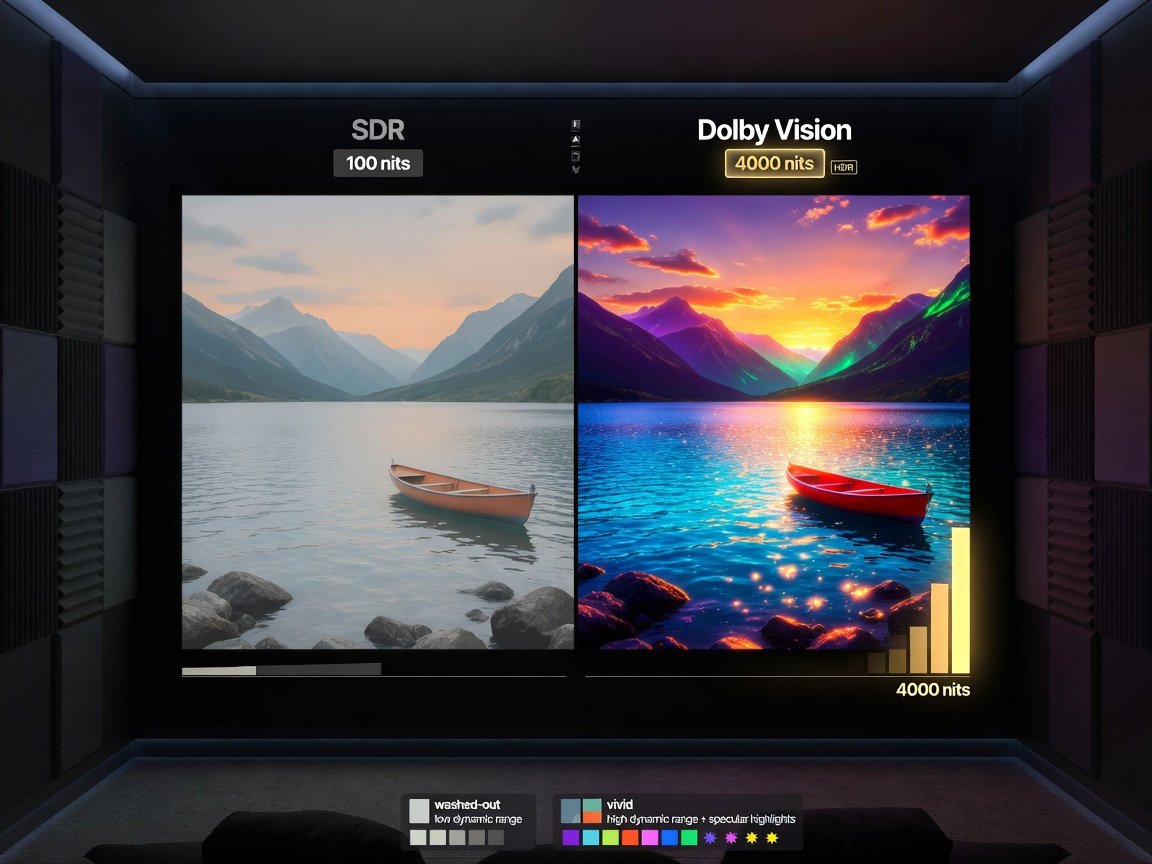
The Dolby Theatre’s projection system operates under Dolby Vision — Dolby’s proprietary high dynamic range imaging format. Standard dynamic range cinema projection achieves a peak screen luminance of approximately 48 nits under the DCI specification. Dolby Vision’s commercial projection spec targets up to 10,000 nits — a factor-of-200 increase that allows specular highlights such as sun on water, explosions, or approaching headlights to render at brightness levels approaching their real-world physical counterparts rather than clipping against a flat luminance ceiling.
Color depth is the second major axis of improvement. Standard 8-bit display and projection systems encode 16.7 million discrete color values. Dolby Vision processes the full pipeline at 12-bit, delivering up to 68.7 billion distinct color values. In perceptual terms, this expanded bit depth eliminates the contouring and banding artifacts that appear in 8-bit reproduction of subtle gradients — skin tones in low light, sky gradations near the horizon, shadow detail in underexposed frames. These are visible differences in direct A/B comparison on any properly calibrated display.
The defining capability of Dolby Vision over the competing HDR10 open standard is dynamic metadata. HDR10 applies a single static tone map to an entire film, calculated from its peak brightness frame. Every scene receives the same mapping regardless of its actual luminance content. Dolby Vision attaches scene-by-scene — and optionally frame-by-frame — metadata that instructs the display to recalculate its brightness and color mapping at each cut. A dark exterior sequence receives different tone mapping than a sunlit interior, and the display adapts without sacrificing shadow or highlight detail at either luminance extreme.
In a calibrated home theater environment, Dolby Vision’s dynamic metadata system recovers detail in transitions between dark and bright scenes that fixed tone mapping discards. If your display supports Dolby Vision, it is the recommended HDR format to run.
How Do the Theatre’s Acoustics Achieve Cinema-Grade Clarity?
Room acoustics are the primary performance variable in the Dolby Theatre — and the most controllable variable in any home theater project. The theatre achieves its characteristic dialogue intelligibility and spatial imaging through a calibrated balance of absorption, diffusion, and isolation. The primary acoustic target is an RT60 — reverberation time measured at the 60 dB decay threshold — between 0.3 and 0.4 seconds in the mid-frequency band. An RT60 below 0.3 seconds produces an acoustically dead room that sounds clinical and unnatural. Above 0.4 seconds, the room accumulates reflected energy that smears transient information and reduces intelligibility for both fast speech and high-frequency musical detail.
The theatre achieves its RT60 target through a combination of deep-pile upholstered seating, wall-mounted acoustic treatment panels, and a rear-wall diffusion array that scatters specular reflections without fully absorbing them. The absorption-diffusion ratio is a critical engineering decision. A room treated exclusively with absorption loses the acoustic energy that gives cinematic sound its perceived spaciousness and three-dimensional quality. The Dolby Theatre’s acoustic treatment preserves controlled ambience while eliminating the discrete echo patterns and standing-wave resonances that degrade intelligibility in untreated or poorly treated spaces.
Low-frequency management is the technically demanding element of any room acoustic project. Bass energy accumulates at room corners and at axial mode frequencies determined by the ratio of room dimensions. The Dolby Theatre addresses this through large-volume corner absorption and a room geometry engineered to avoid integer dimensional ratios — the condition where length, width, and height share common factors that cause resonance modes to stack at the same frequencies, producing severe seat-to-seat bass variation. This modal design discipline is directly applicable to home theater room selection and construction.
| Parameter | Dolby Theatre (Commercial) | Home Theater Target (2026) | Untreated Living Room |
|---|---|---|---|
| RT60 at 500 Hz | 0.3 – 0.4 s | 0.3 – 0.5 s | 0.8 – 1.5 s |
| Reference SPL calibration | 85 dB + 20 dB headroom | 75 – 85 dB + 20 dB headroom | Variable / uncalibrated |
| Dolby Atmos audio objects | Up to 128 (commercial renderer) | Up to 118 (9.1.6 consumer config) | Stereo or 5.1 typical |
| Peak HDR brightness | Up to 10,000 nits | 1,000 – 4,000 nits (consumer 2026) | 100 – 400 nits SDR typical |
| Color depth | 12-bit (Dolby Vision pipeline) | 10 – 12-bit (Dolby Vision display) | 8-bit SDR |
| Bass treatment | Full corner + SBIR coverage | All 4 vertical corners minimum | None |
How Does the Dolby Theatre Compare to Other Major Entertainment Venues?
The Dolby Theatre occupies a narrow technical niche: engineered simultaneously for live theatrical performance, broadcast-quality event production, and reference cinema presentation. Few venues are built to that tri-modal standard. The TCL Chinese Theatre, also on Hollywood Boulevard, is a dedicated cinema house without a live-performance mandate. Its acoustic design prioritizes screen-channel coverage over stage coverage, producing a flatter RT60 profile optimized for film reproduction but offering less flexibility for the live and broadcast event configurations the Dolby Theatre handles throughout its operational year.
Concert hall acoustics represent the opposite end of the RT60 spectrum. A purpose-built orchestral venue targets a reverberation time of 1.5 to 2.0 seconds — a longer decay that supports orchestral bloom and warmth but renders cinematic speech indistinct. Playing a film soundtrack in a concert hall at a 1.8-second RT60 produces demonstrably unintelligible dialogue and smeared transients. The Dolby Theatre achieves short-RT60 cinema clarity while retaining the flexibility to extend its acoustic profile for live musical events through variable panel systems and configurable stage-shell geometry.
For home theater calibration, the Dolby Theatre acoustic specification is the directly applicable reference. Concert hall RT60 targets are acoustically counterproductive for film reproduction and are a recurring source of calibration error in home spaces that double as music listening rooms. If the room must serve both functions, design to the cinema RT60 range (0.3–0.5 s) and apply algorithmic compensation for music listening. The inverse — trying to reproduce cinema in a 1.5-second reverb environment — is not correctable by any room correction processing chain currently available.
How Can You Replicate Dolby Theatre Performance at Home?
Replicating the Dolby Theatre at residential scale is an exercise in principled prioritization. The full commercial specification is categorically different from a home room in volume, speaker count, and treatment surface area. But the underlying technical principles are fully portable. The performance delta between a well-specified home theater and the Dolby Theatre has narrowed measurably as Dolby Atmos and Vision technology has matured into the consumer market. The sequence below orders actions by return on investment, from highest-impact first to incremental refinement.
Download Room EQ Wizard (free) and pair it with a calibrated USB measurement microphone. Run a full-range impulse response sweep at the primary listening position to establish your baseline RT60 and frequency response curve. You cannot target the Dolby Theatre specification without knowing where you currently stand.
Place broadband bass traps (minimum 4-inch-depth rigid fiberglass or mineral wool, floor-to-ceiling) in all four vertical room corners. Bass modal problems cannot be resolved with parametric EQ alone; physical trapping at the pressure maxima — the corners — is the only effective intervention. This step delivers the highest measurable acoustic improvement per pound spent of any treatment action.
Locate first-reflection points using the mirror method — the position on each side wall and the ceiling where you can see the nearest speaker from the listening seat. Place 2-inch or 4-inch absorption panels at each of these points. This step is the primary driver of imaging precision and early RT60 reduction in a typical rectangular room.
Fit a QRD or skyline diffuser on the rear wall rather than additional absorptive panels. Full rear-wall absorption collapses the perceived spatial width of the sound field and produces an unnaturally dry environment. Diffusion scatters reflected energy in a frequency-controlled pattern, preserving ambience while eliminating the discrete rear-wall echo that degrades imaging at the listening seat.
Use the pink noise test tones in your AV receiver’s setup utility and a calibrated SPL meter at the primary listening position to set each speaker to 75–85 dB. This aligns your system’s loudness calibration with the 85 dB reference level used at the Dolby Theatre and defined in the SMPTE cinema standard.
Execute Audyssey MultEQ XT32, Dirac Live, or YPAO R.S.C. only after physical acoustic treatment is in place. Room correction is a complement to treatment, not a substitute for it. Applied after treatment, it resolves residual frequency-response irregularities and inter-channel timing errors that panels alone cannot correct. Applied before treatment, it attempts to compensate for problems the algorithm cannot fully address.
Install in-ceiling or Atmos-enabled upward-firing height speakers to create the vertical audio dimension central to the Dolby Theatre’s Atmos implementation. Simultaneously upgrade any SDR or HDR10-only display to a Dolby Vision-certified panel or laser projector and calibrate to the Dolby Vision cinema preset — not the factory default, which is tuned for retail-floor ambient light levels, not accurate reproduction in a treated room.
What Does a Dolby Theatre-Inspired Home Setup Cost in 2026?
The cost range for a Dolby Theatre-referenced home theater spans several orders of magnitude depending on room size, equipment tier, and installation complexity. The table below structures the cost landscape by tier to clarify where budget should be prioritised at each investment level.
| Tier | Acoustic Treatment | Audio System | Display | Budget Range |
|---|---|---|---|---|
| Entry — 7.1.2 Atmos | DIY panels and corner traps | Denon AVR-X3800H + 7.1.2 speaker kit | 65-inch OLED (Dolby Vision) | £3,500 – £6,000 |
| Mid — 7.1.4 Atmos | Professional panel installation | Marantz Cinema 60 + dedicated Atmos speakers | 77-inch OLED or 120-inch UST projector (DV) | £10,000 – £20,000 |
| High-End — 9.1.6 Atmos | Full room build, floated floor, bass trap array | Trinnov Altitude32 + dedicated driver array | 4K laser projector (Dolby Vision certified) | £40,000 – £100,000+ |
Acoustic treatment consistently delivers the highest return on investment regardless of tier. A £400–£600 investment in bass traps and first-reflection absorption panels produces a larger measurable improvement in audio quality than a £2,000 speaker upgrade in an untreated room. This principle mirrors the Dolby Theatre’s own design hierarchy: the room is the foundation, and the technology performs to the room’s acoustic limits — not beyond them.
Example Scenario — Residential 7.1.4 Atmos Build
This is an illustrative scenario. A dedicated home theater in a 5.5 m × 4 m × 2.6 m basement room, treated with 4-inch corner traps in all four vertical corners, side-wall absorption panels at first-reflection points, and a QRD diffuser on the rear wall, represents the systematic approach needed to bring an untreated room’s RT60 toward the Dolby Theatre target range of 0.3–0.4 seconds.
What 2026 Trends Are Shaping Dolby Theatre Technology and Its Home Equivalents?
The performance gap between commercial Dolby venues and consumer home theater technology is narrowing faster in 2026 than at any preceding point in the format’s history. Three developments are driving this convergence and are directly relevant to home theater builders planning installations this year.
Dolby Vision IQ reaches the mass-market display tier. Dolby Vision IQ — the variant that reads the display’s ambient light sensor and adjusts tone mapping dynamically to the viewing environment — is standard on mid-range televisions in 2026. This feature closes the gap between a calibrated dark-room cinema and a multipurpose living room by allowing the display to approximate dark-room HDR performance in variable ambient lighting. The Dolby Theatre operates in a controlled, darkened auditorium; Dolby Vision IQ brings a measurable portion of that performance advantage to rooms that cannot maintain full light control.
Dolby Atmos Flex Connect enables wireless height channels. Announced for consumer rollout in late 2025 and broadly available by mid-2026, Atmos Flex Connect routes height channel signals to compatible wireless speakers without sacrificing the time-alignment precision that object-based audio requires. This removes the primary installation barrier to full Atmos deployment — ceiling wiring — and is expected to accelerate adoption of 7.1.4 and 9.1.4 configurations significantly through 2026 into 2027.
Laser projector brightness crosses 5,000 lumens at sub-£5,000 price points. In 2026, consumer laser projectors delivering 5,000+ ANSI lumens with Dolby Vision certification have entered the sub-£5,000 bracket for the first time. This brightness level enables Dolby Vision content to be displayed at peak luminance values meaningfully higher than lamp-based projectors could achieve, beginning to close the perceptual distance between home projection and the commercial Dolby Vision specification in the theatre itself.
Consumer tools for replicating commercial Dolby performance are increasingly available; the constraint now is room acoustics and calibration knowledge, not the hardware.
Frequently Asked Questions About the Dolby Theatre
What was the Dolby Theatre called before it was renamed?
The Dolby Theatre opened on February 18, 2001 under the name Kodak Theatre. Kodak held naming rights for the venue’s first decade. When Kodak encountered financial difficulty in the late 2000s, Dolby Laboratories acquired the naming rights under a 20-year agreement that took effect in January 2012. The venue has carried the Dolby name since, aligning its commercial identity with the audio and visual technology systems that form the core of its technical infrastructure.
Does the Dolby Theatre use Dolby Atmos?
Yes. The Dolby Theatre’s audio infrastructure is built on Dolby Atmos — the object-based immersive audio format that Dolby Laboratories developed and that is now the global standard for premium cinema and home theater sound. The commercial implementation handles up to 128 simultaneous audio objects, routed to a multi-zone speaker array that includes overhead channels for three-dimensional vertical coverage. This is the same Dolby Atmos format available in consumer AV receivers and certified home theater system configurations.
How is the Dolby Theatre relevant to home theater design?
The Dolby Theatre is the commercial implementation of the exact technologies — Dolby Atmos and Dolby Vision — that are available in consumer home theater equipment. Its acoustic specification (RT60 target of 0.3–0.4 seconds, 85 dB SPL reference level, absorption-diffusion treatment ratios) translates directly to home theater room design. Builders who understand the theatre’s technical parameters have a concrete, measurable specification to work toward rather than an abstract performance aspiration.
How many seats does the Dolby Theatre have?
The Dolby Theatre seats 3,400 people across its main floor, mezzanine, and balcony levels. This capacity makes it one of the larger dedicated entertainment venues in Hollywood. The scale drives the complexity of its speaker distribution system and acoustic treatment design, both of which must deliver consistent performance to every seat in the house simultaneously rather than to a single calibrated listening position.
What is Dolby Vision and can I get it at home?
Dolby Vision is Dolby’s proprietary high dynamic range format, delivering 12-bit color depth and peak brightness capability up to 10,000 nits in its commercial specification. Its defining feature is dynamic metadata, which adjusts tone mapping scene by scene rather than applying a fixed map to the entire film. In 2026, Dolby Vision is available on consumer OLED and QLED televisions and on an expanding range of laser projectors. It is the recommended HDR format for home theaters targeting reference-quality image accuracy, and it delivers a measurably different result from HDR10 in a properly calibrated environment.
How do I calibrate my home theater to the Dolby Theatre reference level?
The Dolby Theatre calibrates to 85 dB SPL at the reference position with 20 dB of dynamic headroom. For home theater applications, the practical target is 75–85 dB SPL depending on room size and acoustic isolation constraints. Use a calibrated measurement microphone or analog SPL meter with the pink noise test signals in your AV receiver’s setup routine to set each speaker to the target level at the primary listening position. Follow this with your receiver’s automated room correction routine to resolve residual frequency-response irregularities that level calibration alone does not address.
Is the Dolby Theatre only used for the Academy Awards?
No. The Dolby Theatre operates as a full-time entertainment venue year-round. Its programming includes concerts, theatrical productions, film premieres, awards ceremonies beyond the Oscars, and corporate events. The Academy Awards is its highest-profile annual event, but the building’s technical systems are configured to support broadcast-quality output across all event types throughout the calendar year. Its dual theatrical-and-cinema design mandate means the acoustic and technical infrastructure must serve a wide range of production requirements, not a single annual event.
What Should You Do Next?
The Dolby Theatre is not an aspirational abstraction — it is a precisely documented technical specification housed in a building whose acoustic and photometric targets are derived from the same standards available in consumer home theater equipment. The gap between that venue and a well-built residential cinema is one of scale, not of principle. The physics that govern RT60, reference SPL, Atmos object routing, and Dolby Vision tone mapping apply identically at both scales.
Follow this implementation sequence to build toward the same specification at home in 2026:
- Measure first. Run a Room EQ Wizard session with a calibrated microphone to establish baseline RT60 and frequency response. Every subsequent decision should be validated against measurement data.
- Treat bass before buying any hardware upgrade. Corner traps in all four vertical room corners are the single highest-return acoustic intervention available. Budget minimum £300–£500 in treatment materials before any equipment purchase.
- Control first reflections and add rear-wall diffusion. Absorption at first-reflection points collapses early reflections and improves imaging. Diffusion at the rear wall preserves spatial ambience. Both steps are required; neither substitutes for the other.
- Calibrate to reference level after treatment. Use pink noise and an SPL meter to set each speaker to 75–85 dB at the listening position, then run your AV receiver’s room correction routine.
- Upgrade receiver and height channel configuration. Move to a current-generation Dolby Atmos-certified receiver if not already done, and install a minimum of two overhead or upward-firing height speakers to enable the vertical audio dimension central to the Dolby Theatre’s performance.
- Deploy a Dolby Vision-certified display. Replace any SDR or HDR10-only panel with a Dolby Vision-certified OLED television or laser projector. Calibrate to the manufacturer’s Dolby Vision cinema mode rather than the factory default.
- Source the highest-bitrate Dolby content available. 4K UHD Blu-ray delivers the highest bitrate Dolby Atmos and Dolby Vision implementation available to consumers and is the reference source tier for evaluating your system’s performance against the Dolby Theatre standard.
The Dolby Theatre sets the standard. Each step in this sequence moves your room measurably closer to it.
Related guides: How to Set Up Dolby Atmos for Home Theater in 2026: The Complete Technical Guide · How to Design a Home Theater: A Practical Guide for 2026