Research from home theater integration specialists shows that the majority of residential systems are never calibrated after initial installation — meaning most home cinemas operate well below their measured performance potential. A properly planned home theater setup corrects this from the start. When display technology, speaker configuration, AV signal routing, and room acoustics are treated as a single integrated system rather than isolated purchases, the result can achieve exceptional calibration precision and acoustic consistency.
Executive Summary
- The three technologies defining 2026 home theater are object-based Atmos and DTS:X audio, 48 Gbps HDMI 2.1 signal infrastructure, and AI-assisted adaptive room correction — all now accessible at prosumer price points starting below $5,000 for a complete system.
What Does a Complete Home Theater Setup Actually Include?
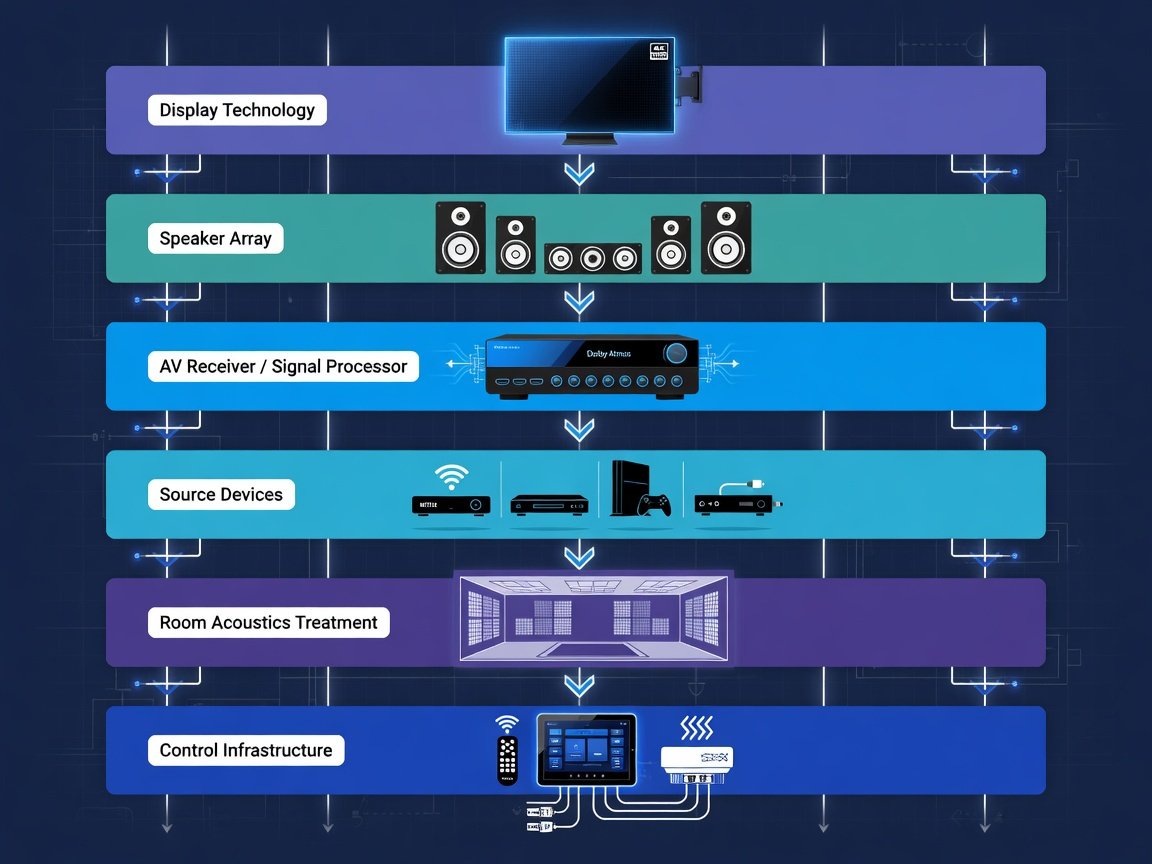
The term “home theater” covers a wide performance spectrum — from a premium soundbar paired with an 85-inch TV to a dedicated acoustic room with a 4K laser projector and a twelve-channel speaker array. Six functional layers are consistent across every build regardless of budget: a display or projection system, a speaker array, an AV signal processor, source devices, room acoustic treatment, and control infrastructure. Every successful home theater set up addresses all six — skipping or under-specifying any single layer creates a performance bottleneck that no amount of spending elsewhere can resolve.
A professionally integrated home theater installation typically costs between $15,000 and $60,000 fully commissioned. A capable DIY system starts from $3,000 to $5,000. Critically, a well-planned $5,000 system can outperform a poorly planned $20,000 system across acoustic and visual parameters. System planning is higher leverage than component budget — by a significant margin.
The six-layer model prevents specification drift during the build. Defining your display target, audio format, source ecosystem, and acoustic strategy before purchasing a single component separates a coherent high-performance system from an expensive collection of individually capable but poorly integrated hardware. At hometheaterinfoline.com, every guide begins with this systems-level framework — component selection follows room physics, not the reverse.
How Do You Choose the Right Room for Your Home Theater?
Room geometry is the most consequential single variable in home theater design — more impactful on final measured performance than any component decision. A rectangular room between 12×16 feet and 20×30 feet, with a ceiling height of 8–10 feet, provides the modal distribution required for balanced bass response and surround-field development. Square rooms are the worst performers: parallel walls of equal length create standing waves at identical frequencies in two dimensions simultaneously, producing bass buildup that is physically impossible to fully equalize.
EBU (European Broadcasting Union) reference room guidelines recommend a length-to-width ratio of approximately 1.6:1 and a height-to-width ratio of 0.7:1. These proportions distribute low-frequency room modes across a wider frequency range, reducing the severity of bass nodes and antinodes at the primary listening position. Following these ratios during room selection — or during partition construction in a basement conversion — has a greater measurable impact on bass quality than any subwoofer technology or equalization approach available in 2026.
Light control is the secondary critical factor. A projector producing 3,000 lumens generates a screen luminance of approximately 16 cd/m² on a 120-inch screen — any competing ambient light source compresses perceived contrast dramatically. Electrical infrastructure planning at room selection is equally important: a fully loaded system draws 15–30 amps continuously from AV receivers, amplifiers, displays, and source devices combined. For home theater seating layout, plan a minimum distance of 1.5 screen heights from the front row to the screen, measured eye-to-screen, per ITU-R BS.1116 reference room guidelines.
A dedicated 20-amp circuit on its own breaker is a mandatory specification for any reference-quality installation. Without a dedicated circuit, home theater systems are vulnerable to ground loops, tripped breakers under dynamic load, and electrical noise contamination in sensitive analog audio stages. Plan the circuit at the room selection stage, before any finishing work is done.
What Display Technology Should You Choose in 2026?
Home theater buyers in 2026 face the most technically complex display market in the technology’s history. OLED, QD-OLED, Mini-LED LCD, MicroLED, and 4K laser projection each occupy distinct performance niches defined by contrast ratio, peak brightness, screen size ceiling, and ambient light tolerance. Choosing the wrong technology for your room conditions and content mix is the single most expensive mistake in home theater setup — and the hardest to reverse after installation.
OLED and QD-OLED panels deliver the highest native contrast ratios in flat-panel technology — exceeding 1,000,000:1 per pixel — making them the reference recommendation for dark-room, high-quality streaming installations up to approximately 83 inches. QD-OLED adds quantum dot colour volume to OLED’s infinite black levels, producing peak brightness above 2,000 nits on current 2026 panels while preserving the per-pixel dimming capability that makes OLED’s contrast performance distinctive against any zone-based competitor.
MicroLED, now commercially available in consumer form factors at 89 and 108 inches, eliminates OLED’s burn-in risk while matching its contrast performance. Peak brightness exceeds 4,000 nits on 2026 MicroLED panels, making them viable in rooms with residual ambient light. However, entry consumer pricing begins at approximately $20,000 for the 89-inch form factor, placing MicroLED firmly at the premium tier for now. The ISF (Imaging Science Foundation) recommends professional calibration for any display used as a home theater primary source — factory colour settings typically deviate significantly from the BT.2020 reference standard before calibration.
| Technology | Peak Brightness | Contrast Ratio | Optimal Room Type | 2026 Entry Price |
|---|---|---|---|---|
| QD-OLED (65″) | 2,000–2,500 nits | Infinite (per pixel) | Dark / light-controlled | ~$1,800 |
| OLED (77″) | 1,000–1,500 nits | Infinite (per pixel) | Dark room | ~$2,200 |
| Mini-LED LCD (85″) | 2,000–4,000 nits | Up to 1M:1 (zone-based) | Mixed / bright room | ~$1,500 |
| 4K Laser Projector (120″) | 3,000–6,000 lumens | 2,000:1–4,000:1 native | Dark / light-controlled | ~$3,500 |
| MicroLED (89″) | 3,000–4,000+ nits | Infinite (per pixel) | Any room condition | ~$20,000 |
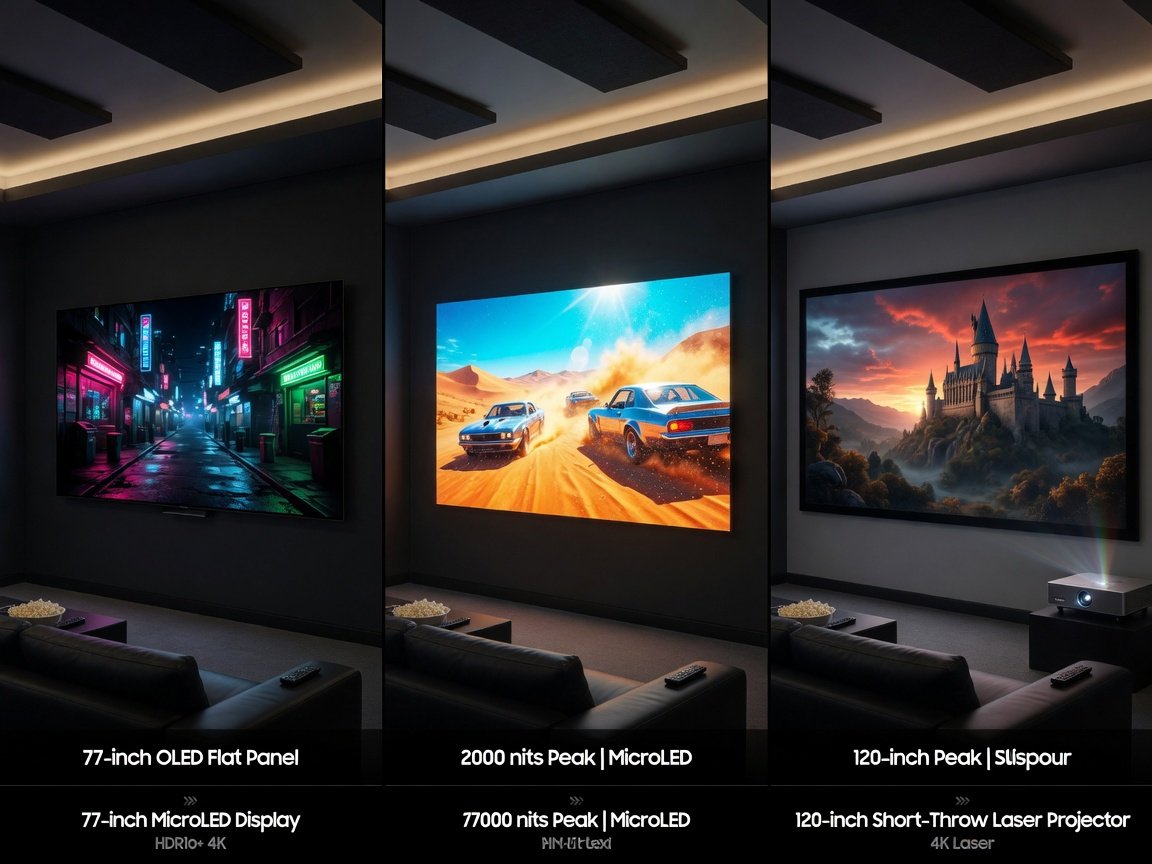
4K laser projectors offer the best screen-size-per-dollar ratio of any display technology in 2026. A short-throw 4K laser projector at approximately $3,500 delivers a 120-inch image with 2,500–4,000 lumens — sufficient for dark-room home theater use and far more cinematic in field-of-view terms than any flat-panel at a comparable price point. For an installation where full blackout is achievable, a laser projector remains the technically correct choice for delivering the immersive screen scale that the home theater format was designed around.
Which Audio Format Delivers the Best Immersive Sound in 2026?
Audio format selection sets the maximum immersive ceiling of your system before a single speaker is placed. Three formats define the 2026 home theater audio landscape: dolby atmos, DTS:X, and Auro-3D. Each uses a different delivery and rendering model with direct implications for speaker layout, receiver selection, and content availability across streaming and physical media sources.
Dolby Atmos uses object-based audio encoding: individual sound elements carry positional metadata rather than being pre-assigned to discrete output channels. The decoder in your AV receiver renders those objects to the physical speakers present in your room — meaning a 5.1.2 system and a 9.1.6 system both decode the same Atmos source, with the larger speaker array resolving object positions with greater spatial precision. Dolby Atmos content is widely available across major streaming platforms and physical Blu-ray releases in 2026, with a substantially larger library than DTS:X.
Object-based audio formats like Atmos and DTS:X represent the single largest qualitative leap in home audio since the introduction of multichannel surround sound. A correctly configured Atmos system in an acoustically treated room can approach the spatial precision of professional mix studio monitoring.
DTS:X holds a specific advantage for collections built on DTS-HD Master Audio Blu-ray discs — it upmixes legacy 5.1 content without requiring height speakers, making it practical for systems in transition. Auro-3D, favoured in custom cinema builds, uses a fixed-channel 9.1 or 13.1 height-layering architecture rather than object placement. It is compelling in rooms with discrete ceiling speakers, but content availability is significantly narrower than either Atmos or DTS:X in 2026.
For most home theater builds in 2026, Dolby Atmos is the primary format recommendation by a significant margin. A minimum 5.1.2 configuration — five ground-plane channels, one subwoofer, two overhead speakers — delivers a meaningful Atmos height experience. The target configuration for a dedicated room is 7.1.4: three front channels (L/C/R), two side surrounds, two rear surrounds, one subwoofer, and four ceiling or Atmos-enabled elevation speakers. Configure DTS:X as the secondary format on any capable receiver for maximum content compatibility across your full library.
How Do You Select the Right Speaker System for Your Theater?
Selecting a speaker system for home theater requires matching four parameters simultaneously across the full array: frequency response, sensitivity, dispersion pattern, and tonal family consistency. Mismatching speaker families — most commonly using a different manufacturer or driver architecture for the centre channel versus the left and right mains — creates a localisation gap in dialogue and foreground sound that no level adjustment can correct. The problem is tonal, not volumetric.
THX Home Cinema certification requires all speakers from the left-front plane through the surround positions to share the same acoustic driver family, with a frequency response deviation of no more than ±3 dB from 80 Hz to 10 kHz measured in-room. This standard is achievable with mid-tier matched speaker systems when placement geometry and boundary interactions are properly managed. Spending more on a higher-tier matched package from a single manufacturer delivers better results than assembling premium individual speakers from different brands.
Speaker sensitivity — measured in dB SPL at 1 watt/1 metre — directly determines amplifier power requirements. An 88 dB sensitivity speaker requires twice the amplifier power of a 91 dB sensitivity model to achieve the same listening level. In a 12×18-foot room, reaching THX reference level (85 dB SPL at the primary seat, per channel) requires approximately 100 watts RMS per channel into 88 dB sensitivity speakers. Amplifier clipping under dynamic peaks — not sustained underpowering — is the primary cause of driver failure in residential home theater systems.
Subwoofer placement deserves separate analysis. A single subwoofer in a front corner delivers adequate bass output but creates significant seat-to-seat level variation — up to ±12 dB across seating positions in typical rectangular rooms. A dual-subwoofer arrangement, one unit in each front corner, reduces this variation substantially. Dual-subwoofer configurations substantially reduce bass frequency variance across all listening seats, producing far more uniform bass for every viewer in the room simultaneously.
What AV Receiver Should You Buy for a Home Theater Setup?
The AV receiver (AVR) is the signal routing and processing nerve centre of any home theater system setup. It handles audio decoding for every format from legacy Dolby Digital through full-resolution Dolby TrueHD Atmos, HDMI signal switching, room correction DSP, and — in most residential installations — amplification for all speaker channels simultaneously. Selecting a receiver that correctly matches your speaker load, format requirements, and input count determines whether the rest of your component investment operates at or below specification.
HDMI 2.1 at 48 Gbps bandwidth is the non-negotiable baseline for any new AVR purchase in 2026. This specification supports 4K/120Hz passthrough for gaming and sports content, 8K/60Hz for emerging content formats, Variable Refresh Rate (VRR), Auto Low Latency Mode (ALLM), and eARC (Enhanced Audio Return Channel) for full-resolution audio extraction from smart TVs. Any AVR without confirmed full HDMI 2.1 across all inputs — as opposed to partial implementations with only some ports at full bandwidth — is already a constraint relative to current 2026 source devices.
The quality differential between a properly room-corrected mid-tier receiver and an uncorrected flagship receiver can be substantial. Room correction addresses the physical acoustics of your specific space — hardware specification alone cannot do that. Every serious home theater build in 2026 should treat Dirac Live or an equivalent DSP correction platform as a mandatory specification, not an optional upgrade.
Room correction processing is the decisive differentiator between AVR performance tiers. Dirac Live, available across receivers from multiple manufacturers, uses a mathematically rigorous minimum-phase correction approach that can improve measured in-room frequency response flatness to within ±1.5 dB across 20 Hz–20 kHz at the primary listening position. Competing proprietary systems — Audyssey MultEQ XT32, YPAO-R.S.C, AccuEQ — are effective but typically achieve ±3–4 dB residual deviation in acoustically challenging rooms. For any room not professionally treated to reference standard, Dirac Live is the specification target.
Pre-amplifier outputs on all channels are essential for system scalability. A nine-channel AVR with full pre-amp outputs on every channel allows external power amplifiers to be added to the most demanding channels — typically the left, centre, and right mains — as budget permits, without replacing the receiver itself. This upgrade path is especially appropriate for any installation using speakers with nominal sensitivity below 87 dB or nominal impedance below 6 ohms.
How Do You Treat Room Acoustics Properly?
Room acoustic treatment is the highest-return investment in home theater design that most builders delay or skip entirely. Electronic correction systems — Dirac Live, Audyssey, YPAO — compensate effectively for steady-state frequency response irregularities, but they cannot address time-domain problems: early reflections, flutter echo, and excessive reverberation time (RT60). These are physical acoustic phenomena that require physical treatment materials positioned at specific geometric relationships to the speakers and the listening position.
Acoustic treatment is non-negotiable in any high-performance home theater environment. Speakers and electronics capable of resolving subtle spatial and dynamic information cannot deliver on that capability if the room is working against you. Treat the room first; buy the electronics second.
The target reverberation time (RT60) for a dedicated home theater room is 0.25–0.35 seconds across the midrange and high frequencies (500 Hz–4 kHz). An untreated room with hard plaster walls, a hardwood floor, and minimal furnishing typically measures 0.5–0.8 seconds at the same frequencies. Each 0.1-second reduction in RT60 through calibrated absorption and diffusion produces measurable improvements in dialogue intelligibility, surround localisation accuracy, and Atmos height-plane precision.
Bass trapping — broadband absorption targeting the 40–200 Hz range — is the first treatment priority. Low-frequency energy accumulates in room corners where multiple room mode axes converge. Floor-to-ceiling corner bass traps using high-density mineral wool (minimum 100 kg/m³ at 100 mm depth) provide meaningful absorption below 100 Hz. Four corner treatments are the entry baseline; six — including upper wall-to-ceiling tri-corner positions — is optimal for rooms under 400 square feet. Adequate corner bass trapping provides meaningful RT60 reduction at 63 Hz — the frequency range most responsible for perceived “boomy” or undefined bass in home listening environments.
Mid-to-high frequency treatment addresses six critical positions: side walls at first reflection points adjacent to the primary listening seat (left and right), the ceiling between the listening position and the front speakers, and the rear wall. Absorptive panels — minimum 50 mm of 60 kg/m³ mineral wool or equivalent — at these positions prevent the early reflections that smear the stereo image and reduce Atmos height-plane localisation resolution. Quadratic residue diffusers (QRDs) placed on the rear wall scatter rather than absorb reflected energy, maintaining acoustic liveliness while breaking up the specular reflections that cause comb filtering at the listening seat.
What Are the Best Source and Streaming Devices for 2026?
Source device selection sets the quality ceiling for both audio and video delivery to your system. In 2026, the primary source hierarchy for a home theater is: 4K UHD Blu-ray player (physical media reference quality) → dedicated streaming media player (platform content access) → gaming console (interactive content and 4K HDR gaming). Each serves a distinct function; none is fully substitutable by the others in a reference-quality installation.
A 4K UHD Blu-ray player remains the absolute quality reference for both video and audio. Physical Blu-ray discs carry lossless Dolby TrueHD Atmos and DTS-HD Master Audio soundtracks — streaming platforms compress audio equivalents for bandwidth efficiency. Dolby Digital Plus Atmos, the standard streaming audio delivery format, operates at a maximum of 768 kbps; Dolby TrueHD Atmos on Blu-ray carries up to 18 Mbps of audio data. For listeners with capable speaker systems, the difference is audible on complex orchestral and highly dynamic film soundtracks. 4K Blu-ray video also carries higher sustained bitrates — typically 60–80 Mbps versus 15–25 Mbps for streaming 4K HDR.
The 2026 streaming ecosystem has largely closed the gap on video quality versus physical media — HDR metadata handling and encode quality have improved substantially. The remaining quality advantage of disc is concentrated almost entirely on the audio side: lossless TrueHD Atmos soundtracks on Blu-ray carry audio data that no current streaming delivery codec can fully preserve.
Streaming quality has improved substantially at the platform level, with 4K HDR content widely available across major streaming services. The Apple TV 4K (3rd generation and later) and the NVIDIA Shield Pro are the current reference streaming players — both support Dolby Vision IQ, HDR10+, and Dolby Atmos at the highest bitrates each platform delivers, with HDMI 2.1 output ensuring full-bandwidth delivery to a capable receiver or display.
Local media server solutions — Plex, Emby, or Jellyfin running on a NAS — are increasingly standard in enthusiast builds. A NAS configured with 12–24 TB of storage allows bitrate-unlimited local playback of full-resolution Blu-ray disc images at original encode quality, served directly to an NVIDIA Shield Pro or Apple TV 4K client. This approach eliminates all streaming platform quality constraints for owned physical media, delivering the complete Blu-ray audio and video specification over a local gigabit network.
How Do You Wire and Connect Everything in a Home Theater?
Signal routing architecture is an area where planning during room design prevents expensive rework after installation is complete. The standard home theater topology routes all source devices to the AV receiver via HDMI, with a single HDMI output from the receiver to the display. This centralises all signal processing, simplifies input switching, and ensures the receiver intercepts and decodes every audio stream from every source — rather than the display’s internal decoder handling audio and potentially downmixing or recompressing it before passing back to the receiver.
HDMI cable specification is critical at installation distances over 3 metres. Passive HDMI 2.1 cables at full 48 Gbps bandwidth perform reliably to approximately 3 metres; beyond that, signal integrity begins to degrade. Active Optical HDMI (AOC) cables maintain 48 Gbps bandwidth at runs of 10–50 metres with zero signal degradation — the correct specification for any installation where the AV rack is not immediately adjacent to the display wall. AOC cables are directional: the source end and display end are labelled and cannot be reversed without total signal loss.
Speaker cable gauge determines series resistance and therefore effective amplifier damping factor at the speaker terminals. For runs under 5 metres, 16 AWG is adequate for nominal 8-ohm speakers. For runs over 5 metres or with nominal 4-ohm speakers, 14 AWG or 12 AWG is required. At 25 feet (7.6 metres) of 16 AWG cable, series resistance is approximately 0.12 ohms — sufficient to reduce a nominal amplifier damping factor of 200 to approximately 60 at the speaker terminal, which measurably affects bass transient control and clarity.
Use CL2 or CL3 rated cable for any speaker or signal cable run through wall cavities — a building code requirement in most jurisdictions and a practical fire safety requirement in all of them. Install empty conduit wherever possible during the rough-in phase: even unused conduit transforms future cable upgrades from a disruptive structural job into a simple pull-and-replace operation.
What Is the Correct Step-by-Step Home Theater Setup Process?
The sequence of setup and calibration steps is as important as the components themselves. Performing steps in the wrong order generates cascading rework that costs time and money. The correct process for home theater set ups of any scale follows a strict dependency chain — room assessment first, acoustic treatment second, electrical infrastructure third, hardware fourth, cabling fifth, electronic calibration last. Reversing any step in this chain creates problems the next step cannot fix.
Example Scenario: Basement Conversion to Reference Home Theater
The following illustrative example applies systematic planning to a challenging space. The scenario assumes an 18×22-foot unfinished basement converted into a dedicated screening room on a budget of $28,000, including structural preparation, acoustic treatment, display system, audio electronics, cabling, and seating.
Bass accumulation at predictable frequencies is expected given the near-square end-wall proportions. The acoustic treatment specification addresses this with six floor-to-ceiling corner bass traps (four primary positions plus two upper tri-corners), absorptive panels at all first reflection points, and a full-width QRD diffuser array across the rear wall — designed to bring RT60 into the 0.25–0.35 second home theater target band.
The display system used a 4K laser projector at 4,500 lumens projecting onto a 120-inch acoustically transparent fixed-frame screen. The audio specification was a 7.1.4 Dolby Atmos array: matched three-way tower speakers for L/C/R, matching bookshelf boundary-mount speakers for side and rear surround positions, and four flush-mount in-ceiling speakers for the Atmos height layer. Bass management used a dual-18-inch sealed subwoofer configuration in both front corners, crossed over at 80 Hz. Room correction used Dirac Live on a dedicated pre-amplifier feeding a seven-channel external power amplifier.
A project of this scope typically spans around 11 weeks: room preparation and electrical work (3 weeks), acoustic treatment fabrication and installation (2 weeks), equipment procurement (2 weeks), hardware installation and cabling (2 weeks), calibration and optimisation (2 weeks).
What Home Theater Trends Will Define 2026 and 2027?
Three converging technological developments are reshaping home theater performance and economics in 2026. Understanding where each is heading informs which infrastructure and component investments made today will remain relevant through 2028 and beyond — and which specifications are already being superseded.
MicroLED mainstream entry. Commercial MicroLED displays reached sub-$20,000 price points in 2026 for 89-inch form factors. MicroLED pricing is expected to continue falling, positioning it as a direct OLED competitor at the premium home theater tier. MicroLED’s combination of infinite per-pixel contrast, 4,000+ nit peak brightness, zero burn-in risk, and a projected 100,000-hour operational lifespan makes it the technically optimal long-term flat-panel technology for any room condition.
AI-assisted adaptive room correction. Multiple AVR manufacturers deployed AI-based room correction in 2025–2026 that uses always-on room monitoring microphones to continuously update correction curves as environmental conditions change. Unlike a static calibration event that degrades as temperature, humidity, and room contents shift, adaptive systems maintain calibration accuracy indefinitely. Early implementations indicate improved long-term frequency response stability at the primary seat compared to static correction curves taken at a single calibration event.
The convergence of AI-driven room correction, MicroLED display technology, and advancing lossless streaming audio formats is making high-performance home theater increasingly accessible at prosumer price points.
Lossless audio streaming. Apple Lossless (ALAC) audio at CD resolution is already deliverable over streaming infrastructure in 2026. The next evolution — lossless Dolby TrueHD Atmos delivered at full master bitrate over IP — is technically feasible on current broadband infrastructure and is expected to reach at least one major streaming platform by late 2027. If realised, this eliminates the last meaningful audio quality advantage of physical Blu-ray disc for the majority of listeners.
HDMI 2.2 infrastructure readiness. The HDMI Forum ratified the HDMI 2.2 specification at 96 Gbps maximum bandwidth in 2025. No consumer source device currently outputs at HDMI 2.2 bandwidth, but forward-thinking AVR and display manufacturers are beginning to include HDMI 2.2-ready ports in flagship 2026 products. Any conduit, wall plate, or cable management infrastructure installed during a 2026 home theater build should be dimensioned to accommodate HDMI 2.2 cable replacement without structural rework.
Frequently Asked Questions
What is the minimum budget for a home theater setup in 2026?
A functional home theater setup — a 65-inch or larger 4K display, a 5.1 surround speaker system, and an HDMI 2.1 AV receiver — is achievable from approximately $2,500–$3,500 in 2026. Adding basic acoustic treatment increases this to $3,500–$5,000 and delivers the highest performance return per dollar of any investment at this tier. A reference-class DIY build with a 4K laser projector, a 7.1.2 Atmos speaker system, and correct acoustic treatment typically runs $10,000–$15,000.
Do I need a dedicated room for a home theater setup?
No. High-quality home theater performance is achievable in a multipurpose living room with careful component selection, appropriate speaker placement, and targeted acoustic treatment. Area rugs, upholstered furniture, and fabric-covered acoustic panels can be integrated aesthetically into living spaces. The critical limitation is ambient light: projector-based systems require a darkened room for adequate contrast, making them significantly harder to deploy in rooms used during daylight hours. Flat-panel OLED or MicroLED displays are better suited to dual-purpose spaces that cannot be fully darkened.
How many speakers do I need for Dolby Atmos?
Dolby Atmos requires a minimum 5.1.2 configuration — five ground-plane channels, one subwoofer, and two overhead or Atmos-enabled elevation speakers. This delivers a perceptibly three-dimensional audio experience. The recommended configuration for a dedicated room is 7.1.4: this matches professional studio monitoring geometry and resolves Atmos object positions with the spatial accuracy the format was designed to achieve. Configurations beyond 9.1.6 deliver diminishing perceptual returns in rooms under 400 square feet.
What is the correct screen size for a home theater?
Screen size should be calculated from viewing distance, not room size. THX standards recommend a horizontal field of view of approximately 36° at the primary seat — equating to roughly one screen height of viewing distance from the display. At 12 feet of viewing distance, the optimal screen size is 90–100 inches diagonal. The SMPTE reference angle of 30° is slightly more conservative. Erring toward larger screen sizes is perceptually correct: most residential home theater builds significantly underspecify screen size relative to field of view.
Is OLED or a laser projector better for a dedicated home theater room?
In a fully light-controlled dedicated room, a 4K laser projector at 100+ inches delivers a more cinematic field-of-view experience at lower cost-per-inch than any flat-panel technology. A 120-inch laser projection setup costs approximately $5,000–$7,000 including screen, versus $8,000–$12,000 for a comparable-impact flat-panel at 85 inches. For a dual-purpose room that cannot be fully darkened, OLED or MicroLED is the practical choice due to superior ambient light resistance and zero alignment requirements. Both technologies achieve visually indistinguishable image quality from reference seating in calibrated dark-room conditions.
How do I reduce echo and reverberation in a home theater room?
Echo and reverberation reduction requires physical acoustic treatment — electronic equalization addresses frequency response but cannot remove time-domain reflections. Start with bass traps in all four floor-to-ceiling corners to control low-frequency modal buildup. Add 50 mm absorptive panels at the side-wall first reflection points at ear height and at the ceiling between the front speakers and the primary seat. If flutter echo is audible as a “ping” or “slapback” when you clap sharply, add rear-wall diffusion or absorption. Target a post-treatment RT60 of 0.25–0.35 seconds across 500 Hz–4 kHz for a dedicated home theater room.
What HDMI version do I need for a home theater in 2026?
HDMI 2.1 at full 48 Gbps bandwidth is the mandatory specification for any new home theater component purchase in 2026. This version supports 4K/120Hz passthrough, 8K/60Hz, Variable Refresh Rate (VRR), Auto Low Latency Mode (ALLM), and eARC for full-resolution lossless audio extraction from smart displays. HDMI 2.0 is inadequate for 4K/120Hz and should not be accepted in any new component. Verify that all HDMI ports on shortlisted AV receivers and displays are full HDMI 2.1 specification — partial implementations with some ports at HDMI 2.0 are common in mid-tier hardware and create routing constraints that limit system flexibility.
Conclusion: Your 2026 Home Theater Setup Action Plan
Building a high-performance home theater setup in 2026 is an exercise in systematic planning applied to a technology landscape that has never been more capable or more accessible. MicroLED displays, object-based Atmos audio, Dirac Live room correction, 4K laser projection, and HDMI 2.1 signal infrastructure are all available at prosumer price points. The variable that determines success or failure is not component budget — it is how rigorously each component is matched to the physical reality of the room around it.
Follow the ten-step implementation sequence: acoustic room assessment first, electrical infrastructure second, physical treatment third, hardware placement fourth, cabling fifth, electronic calibration last. Budget acoustic treatment as a non-negotiable line item — it multiplies the performance of every component it surrounds. Select display technology matched to your room’s light environment. Build your speaker array from a matched product family. Specify an AV receiver with HDMI 2.1 on all inputs and a high-quality room correction platform as the minimum baseline. At hometheaterinfoline.com, every technical guide and buyer resource is structured around this systems-level approach to home theater design.
Implementation Timeline
- Weeks 1–2: Room acoustic assessment, mode analysis, and full component specification
- Weeks 3–4: Electrical infrastructure installation, conduit runs, and rough-in work
- Weeks 5–6: Acoustic treatment fabrication and installation; baseline RT60 measurement
- Weeks 7–8: Component procurement and logistics
- Weeks 9–10: Hardware installation, cable infrastructure, and signal routing
- Weeks 11–12: Electronic room correction, display calibration, reference level verification, and system commissioning
Pingback: Best Home Theater Seating: Compared and Ranked for 2026 - Home Theater InfoLine
Pingback: How to Design a Home Theater: A Practical Guide for 2026 - Home Theater InfoLine