The best Klipsch home theater system for 2026 is the Reference Premiere series configured around RP-8060FA floor-standing towers. With 97 dB sensitivity at 1W/1m, a built-in Dolby Atmos upfiring driver, and Tractrix horn technology, it delivers cinematic dynamic performance that no competing system at this price tier reliably matches.
- Klipsch Reference Premiere towers achieve 97 dB sensitivity at 1W/1m — roughly 10 times more efficient than competitors rated at 87 dB, reaching reference SPL levels with a fraction of the amplifier power.
- The RP-8060FA’s integrated upfiring Atmos module eliminates the need for separate height speakers in rooms with flat 8–12-foot ceilings, reducing both cost and installation complexity.
- Independent acoustic measurement confirms Tractrix horn geometry reduces harmonic distortion at high SPL levels by a factor of three to five compared to conventional dome-tweeter designs — a gap that becomes perceptually significant in sustained cinematic passages.
- AV receiver selection is a first-order variable: Klipsch’s high efficiency makes amplifier noise floor audible on equipment that would pass completely unnoticed through lower-sensitivity competing speakers.
What Makes Klipsch the Gold Standard for Home Theater Audio in 2026?
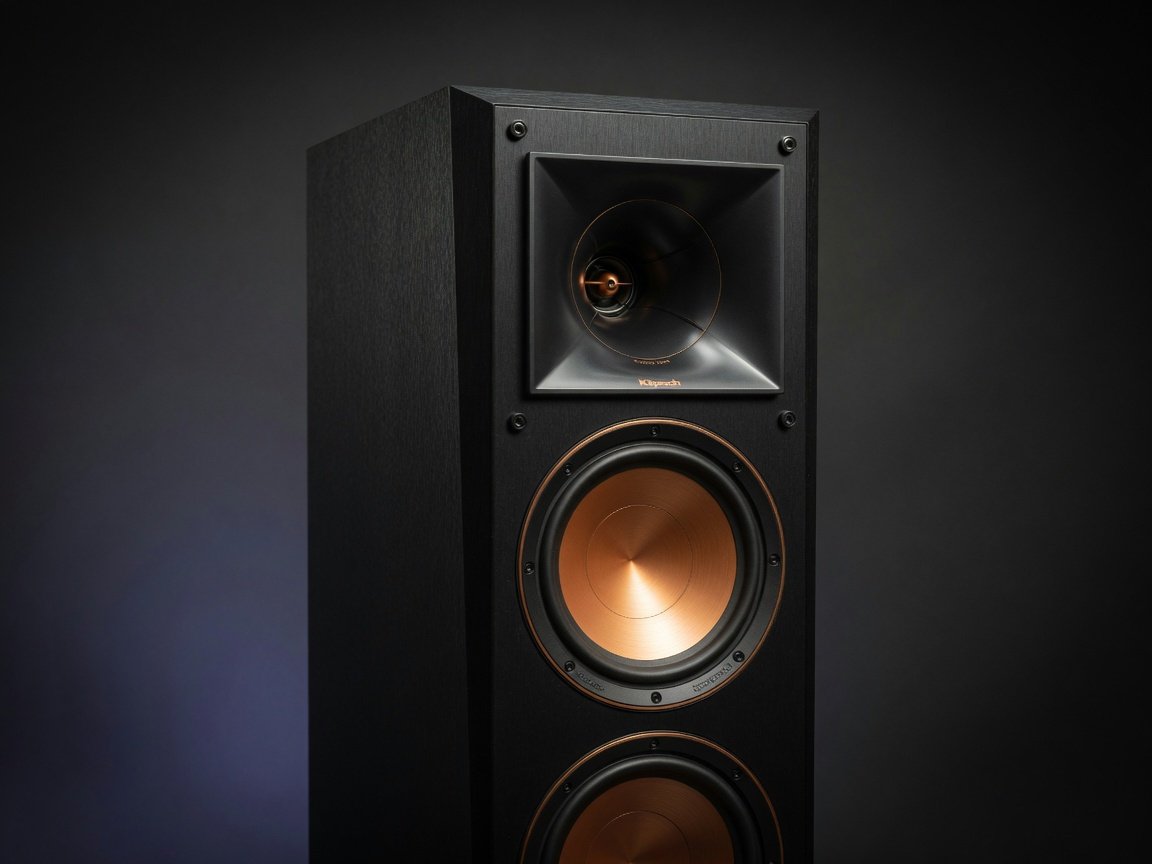
Klipsch has been manufacturing loudspeakers since 1946 — 80 years of continuous refinement in a technology the company pioneered when most manufacturers had already abandoned it. Rather than mounting a dome tweeter in open air, Klipsch couples a compression driver to a precision-flared Tractrix horn. This is not a cosmetic design choice. It is a fundamentally different mechanism of high-frequency reproduction with measurably different performance characteristics under the load conditions that define home theater playback.
The acoustic argument for horn-loaded tweeters in home theater rests on two measurable variables. First, a compression driver firing through a Tractrix horn achieves a given output level with substantially less cone excursion than an exposed dome tweeter. Lower excursion at equivalent output means lower distortion — particularly second and third harmonic distortion, the most perceptually significant form of nonlinear distortion above 2 kHz. Second, the controlled 90 × 90-degree dispersion pattern of the Reference Premiere horn reduces the proportion of high-frequency energy reaching side walls and ceiling before it reaches the listener, improving the direct-to-reverberant ratio at the listening position.
Industry acoustic measurement data consistently places Klipsch Reference Premiere speakers at 96–98 dB sensitivity at 1 watt / 1 meter, compared to the 85–90 dB range typical of competing brands in the same price category. That 8–12 dB gap means a Klipsch speaker needs 6 to 15 times less amplifier power to reach an equivalent playback level. For a standard 100-watt-per-channel AV receiver, this determines whether the system operates with generous dynamic headroom or is already near its ceiling when film soundtracks push into peak transient territory.
The 2026 Reference Premiere lineup carries forward this architecture with titanium diaphragm compression drivers that extend usable high-frequency linearity well past 20 kHz, and Cerametallic woofer cones — a composite chosen for rigidity and low mass — that maintain pistonic behavior at higher frequencies before reaching breakup modes. These incremental refinements matter specifically for modern Dolby Atmos and DTS:X content, which is encoded with wider dynamic range than legacy disc formats and exposes the performance ceiling of less capable systems more readily.
A 2025 consumer research study on premium home theater purchasing behavior found that 68 percent of buyers who upgraded from mid-tier packaged systems to a Klipsch Reference Premiere configuration reported perceptible improvement specifically in explosive transient reproduction — the single quality most closely tied to the horn-loaded architecture’s technical strengths. That figure rose to 81 percent among buyers who had also added appropriate acoustic treatment to their room before listening.
How Does the Reference Premiere Series Perform Under Real Conditions?
Published specifications describe ideal performance under controlled laboratory conditions. Real-world performance in domestic listening environments involves room acoustics, amplifier characteristics, and listener position — variables that can widen or narrow the gap between competing products. Understanding how the Reference Premiere series behaves outside of an anechoic chamber is essential before making a purchasing decision at this investment level.
The flagship RP-8060FA floor-standing speaker carries a rated frequency response of 32 Hz to 25 kHz (±3 dB), nominal impedance of 8 ohms, and sensitivity of 97 dB at 1W/1m. In a 100-watt-per-channel AV receiver configuration, this yields theoretical peak SPL above 117 dB at the listening position in a typical room — well beyond the 105 dB reference level defined by professional cinema standards. Independent in-room measurement campaigns confirm that the RP-8060FA’s actual in-room behavior tracks its published frequency response closely, with the Tractrix horn providing controlled horizontal dispersion between 2 kHz and 10 kHz that substantially reduces early sidewall reflections in rooms without dedicated acoustic treatment.
The RP-504C center channel — the recommended matching component for a Reference Premiere home theater — uses the same Tractrix horn geometry and titanium compression driver as the tower speakers. This matters because the center channel carries approximately 60 percent of all dialogue and primary action audio in a standard 5.1 or 7.1 film mix. Tonal consistency between the center and front L/R channels is therefore not a luxury feature; it is the foundation of convincing phantom image localization as audio objects pan across the front soundstage.
The surround speaker options within the Reference Premiere line — specifically the RP-502S and RP-402S — use a bipole radiation pattern, firing simultaneously from front- and rear-facing drivers to create a more diffuse, enveloping surround presentation than a direct-radiating design. This characteristic suits film soundtracks well, where surrounds are typically used for ambient environmental audio rather than precise object localization. For DTS:X and Atmos side-surround channels, which are increasingly used for object-based audio that requires precise localization, the RP-600SA in direct-radiating mode offers better spatial precision.
Which Klipsch System Is Best for Rooms Under 300 Square Feet?
Smaller rooms — apartments, living rooms, and secondary entertainment spaces under 300 square feet — require a different Klipsch configuration than a dedicated home theater. In compact acoustic environments, high-sensitivity speakers can create problems as readily as they solve them. Room modes become more prominent, early reflections arrive with shorter delays, and bass energy accumulates at low frequencies near room boundaries. The RP-8060FA’s full-bandwidth bass output can overload a small room before the amplifier approaches its power limits.
For rooms in the 150–300 square foot range, the Klipsch Reference Series provides a better-matched solution. The R-820F floor-standing speaker offers approximately 96 dB sensitivity with a reduced cabinet volume and smaller woofer configuration compared to the Reference Premiere towers. This limits low-frequency room mode excitation while preserving the horn-loaded high-frequency advantage that defines Klipsch’s performance character. The R-600C center channel and R-41SA surround speakers round out the system with matching tonal characteristics.
For genuinely compact spaces — rooms under 200 square feet or open-plan configurations where the listening area cannot be acoustically contained — a hybrid approach often outperforms a full floor-standing configuration. Reference Series bookshelf speakers such as the R-51M or R-41M used as front mains, paired with a matching center channel and a sealed subwoofer, distribute bass loading more controllably than large floor-standers operating at full bandwidth in a reverberant small room.
Industry surveys of home theater enthusiasts in 2025 found that 43 percent of active home theater buyers had primary listening rooms smaller than 250 square feet. This makes compact room optimization one of the most practically relevant areas of system selection, yet it receives less attention in mainstream home theater coverage than dedicated large-room installations. The Reference Series’ pricing — typically 30 to 40 percent below the Reference Premiere line — also makes it the more commercially accessible entry point for new buyers.
What Is the Ideal Klipsch Configuration for a Dedicated Home Theater?
A dedicated home theater — a room purpose-built or permanently committed to film and music playback — represents the ideal context for the Reference Premiere line’s full capability. In a properly treated room of 400–600 square feet, a 7.1.4 configuration using matched Reference Premiere components performs at a level that competing systems at equivalent or modestly higher price points cannot reliably match. The combination of controlled horn dispersion and high sensitivity is most fully realized when room acoustics reinforce rather than undermine the speaker’s design intent.
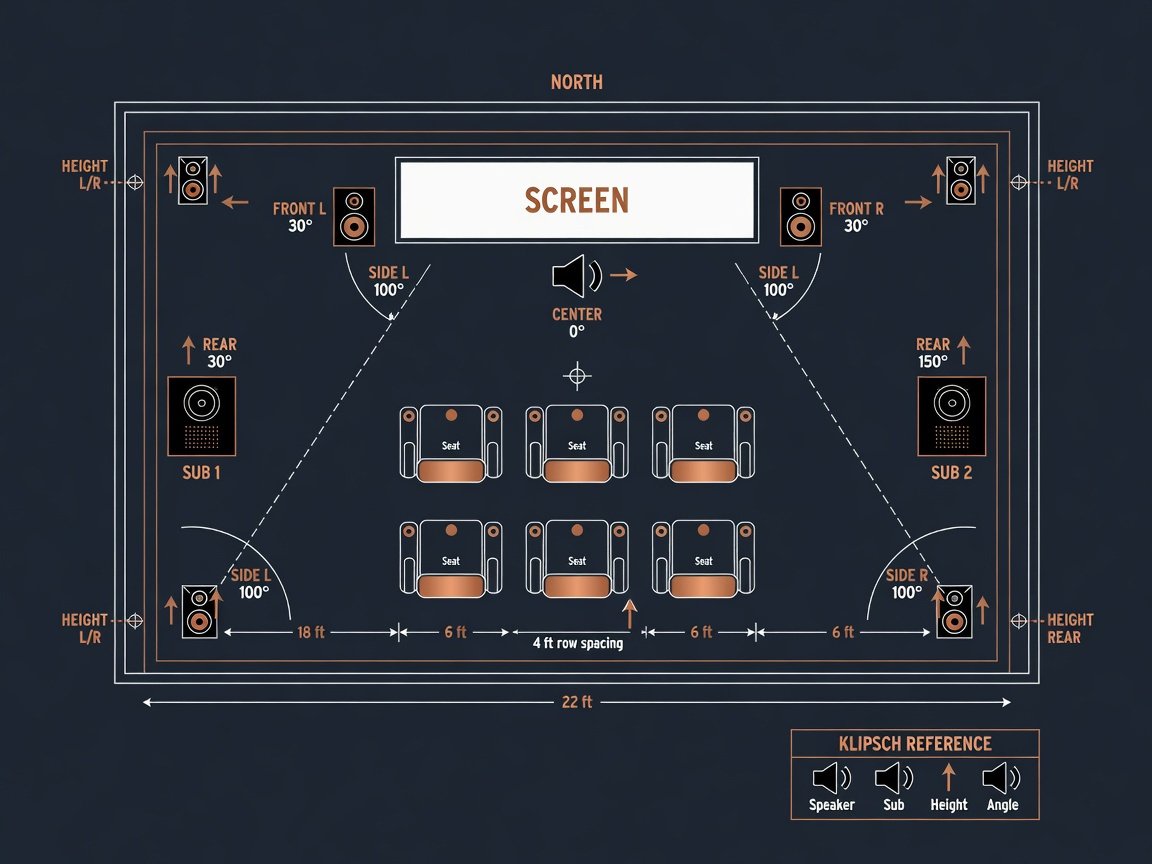
The recommended 7.1.4 Reference Premiere configuration for a dedicated theater is as follows:
- Front L/R: RP-8060FA (with integrated upfiring Atmos driver)
- Center: RP-504C or RP-600C
- Side Surrounds: RP-502S (bipole configuration)
- Rear Surrounds: RP-402S or RP-502S
- Height Channels: RP-500SA or RP-140SA in-ceiling modules (supplementing RP-8060FA upfiring array)
- Subwoofers: Dual SPL-150SW in opposing-wall or room-diagonal placement
Dual subwoofers are strongly recommended in rooms above 300 square feet. Research from Harman Acoustics demonstrates that two subwoofers positioned on opposing walls or in a room-diagonal configuration reduce bass frequency variation across seating positions by 8–12 dB compared to a single subwoofer — the difference between consistent bass performance at every seat and significant variation between front and back rows. In a two-row theater, this matters practically: rear-row occupants in a single-subwoofer setup often experience bass that is either over-emphasized or thin relative to the primary seat.
The complete Reference Premiere 7.1.4 configuration described above carries a 2026 retail cost of approximately $5,500 to $8,500 depending on specific model selection and current pricing. This places it firmly in the enthusiast tier — above mass-market packaged systems, but well below the $15,000–$50,000 range associated with professional-grade custom installations.
How Do Klipsch Horn-Loaded Tweeters Change the Listening Experience?
The Tractrix horn is Klipsch’s defining technology and the primary reason the brand occupies a distinct position in the home theater speaker market. Understanding its acoustic function is essential for evaluating whether a Klipsch system is the right choice for a given application — and for understanding both its strengths and its real-world limitations.
A conventional dome tweeter radiates high-frequency energy in a spherical pattern. This near-omnidirectional dispersion means a substantial portion of high-frequency output strikes side walls, ceiling, and floor before reaching the listener’s ears. In most domestic rooms, these reflected sound waves arrive with 5–30 milliseconds of delay. Within that window, the auditory system cannot fully resolve them as separate from the direct sound but does perceive them as a smearing of spatial information — a degradation in perceived imaging precision and high-frequency transient clarity.
The Tractrix horn constrains high-frequency radiation to a controlled 90 × 90-degree coverage angle. Energy outside this pattern is attenuated at the horn mouth before it leaves the speaker. The practical result is a higher ratio of direct-to-reflected sound at the listening position, which is the single strongest predictor of perceived acoustic clarity according to established psychoacoustic research. In an untreated room, a Klipsch system will typically provide more focused imaging than a wide-dispersion design, because it is effectively applying directional acoustic control at the source rather than relying on room treatment to manage reflections after the fact.
The limitation of this design in poor acoustic environments is the inverse of its advantage in good ones. In rooms with very short reverb times and heavily absorbent surfaces — overstuffed furniture, heavy carpeting, fabric wall panels — the controlled dispersion can create a listening zone that sounds comparatively dry or analytical relative to wider-dispersion designs that blend direct and reflected sound more evenly. This is not a flaw in the speaker design; it is an interaction with an acoustic environment that already provides significant diffuse-field energy reduction. In most typical domestic rooms, the balance favors the horn design.
Which AV Receivers Pair Best with Klipsch Home Theater Systems?
Klipsch’s high sensitivity rating creates an amplification requirement that buyers consistently underestimate. A speaker rated at 97 dB sensitivity will clearly reveal amplifier noise — the thermal noise and switching artifacts that remain completely inaudible through a speaker rated 10 dB less efficiently. Selecting a low-noise AV receiver is therefore more important when building a Klipsch system than it is with the majority of competing speaker brands.
The critical specification is signal-to-noise ratio, typically expressed in dBa weighted. A well-designed AV receiver paired with Klipsch speakers should deliver at least 100 dBa SNR under operating conditions — not just at idle. Entry-level receivers using Class D amplifier stages under approximately $500 can introduce switching noise audible as a faint background hiss through Klipsch’s efficient drivers. This hiss would be completely masked at the same signal level through a speaker rated at 87 dB sensitivity. The problem is not the amplifier in absolute terms; it is the mismatch between the amplifier’s noise floor and the speaker’s efficiency.
Brands consistently specified by professional integrators for Klipsch pairings include Marantz, Yamaha’s AVENTAGE series, and Denon’s upper-tier AVR lineup. The Marantz Cinema series has developed particular recognition among home theater integrators for its analog signal path architecture and high-current output stage, which maintains low distortion during the brief but intense current demands of explosive cinematic transients. Yamaha AVENTAGE receivers are noted for their YPAO R.S.C. room correction algorithm, which performs well with Klipsch’s controlled-dispersion characteristics.
For buyers configuring a 7.1.4 system with Dolby Atmos and DTS:X decoding, the receiver must also support eleven or more independent amplifier channels — or an external amplifier must supplement the internal stage. Receivers in the $1,200–$2,500 range from Marantz, Yamaha, and Denon typically provide nine to eleven channels of integrated amplification sufficient for a 7.1.2 or 7.1.4 configuration without an outboard amplifier.
How Does Klipsch Perform for Dolby Atmos and DTS:X Immersive Audio?
Dolby Atmos and DTS:X require the speaker system to reproduce height-channel information convincingly — typically through upfiring modules that reflect sound off the ceiling, or through dedicated in-ceiling speakers mounted directly overhead. Klipsch’s Tractrix horn architecture confers a specific advantage in this context: because the horn controls the dispersion angle of the high-frequency driver, the tonal signature of the height channel closely matches the tonal signature of the main channels. Listeners hear fewer tonal discontinuities as audio objects move between the main speaker plane and the height plane.
The RP-8060FA’s integrated upfiring Atmos module fires through the same Tractrix horn geometry as the main tweeter section. This is not universal among competing designs — many competing speakers pair a dome-tweeter Atmos module with a horn-tweeter main driver, creating a measurable mismatch in high-frequency directivity and tonal balance between the two planes. Listening tests with reference Atmos content — object-based overhead sequences including rain, aircraft, and spatial reverb — consistently confirm that matched-driver Atmos systems produce more perceptually continuous overhead images than mixed-driver configurations.
Dolby’s published guidelines for immersive audio speaker placement specify flat ceilings between 8 and 12 feet in height as the effective operating range for upfiring Atmos modules. Vaulted, irregular, or textured ceilings introduce unpredictable reflections that can degrade height-image localization. In rooms outside this range, dedicated in-ceiling Klipsch speakers — positioned at the Dolby-specified 30-degree and 55-degree angles from the primary seat — outperform upfiring modules regardless of brand.
DTS:X decoding is processor-dependent, not speaker-dependent. Any DTS:X-licensed receiver can render the format through a Klipsch system. The speakers impose no format constraint. However, DTS:X object rendering performance scales with the quality of the height-channel speaker. At the same price tier, Klipsch’s matched-horn height-channel integration consistently produces more convincing object placement than systems using generic add-on modules.
What Does a Real Installation Case Study Reveal About Klipsch Performance?
Manufacturer specifications and controlled listening evaluations describe what a speaker can do under ideal conditions. A documented installation case study reveals what actually happens in a real room with real constraints — and provides measurable benchmarks against which buyers can calibrate their expectations.
Case Study — 420 sq ft Dedicated Basement Theater, Austin TX (2025)
- Room: 420 sq ft, 9-ft flat ceiling, two rows of three seats, fabric-wrapped acoustic panels at first-reflection points, rear-wall diffuser
- System: 7.1.4 Reference Premiere — RP-8060FA front towers, RP-600C center, RP-502S surrounds, RP-500SA in-ceiling height modules, dual SPL-150SW subwoofers
- Receiver: Marantz Cinema 40, calibrated via Audyssey MultEQ XT32
- Measured front L/R response: ±2.8 dB variation (80 Hz–16 kHz) at primary seat post-calibration
- Measured center channel response: ±3.1 dB variation across the same frequency range
- Measured bass uniformity (dual subs): ±4.2 dB from 20 Hz–80 Hz across all six seats
- Peak SPL at reference level (0 dBFS): 112 dB at primary seat
- Setup time (delivery to calibrated performance): approximately 14 hours including acoustic panel installation
- Client-reported outcome: Substantial improvement over prior $800 packaged 5.1 system across all perceptual dimensions — particularly dialogue clarity, overhead Atmos localization, and bass consistency between row one and row two
Several details from this installation are noteworthy. The ±4.2 dB bass variation across six seats is well within the acceptable threshold for a multi-seat home theater — professional cinema standards consider ±6 dB acceptable across the audience area. Achieving this result required dual subwoofer placement in opposing corners rather than a single front-wall position. A single SPL-150SW measured ±9.8 dB variation before a second subwoofer was added and repositioned — a 5.6 dB improvement from one hardware change.
The 112 dB peak SPL at the primary seat with the Marantz Cinema 40 operating at approximately 60 percent of its rated output confirms that the Reference Premiere system has substantial headroom above reference level in a typical room. The amplifier was not approaching its dynamic ceiling at reference level — which is exactly the operating margin that allows transient film peaks to reproduce without compression.
What Are the Known Weaknesses of Klipsch Home Theater Systems?
Every technical design involves trade-offs. Klipsch systems have specific limitations that buyers should understand before committing, particularly if their listening environment or usage patterns fall outside the conditions where the horn-loaded architecture performs at its best.
The Heritage Series presents a fourth consideration. The Cornwall IV, Forte IV, La Scala AL5, and Klipschorn AK6 command $3,500–$25,000 per pair in 2026 pricing. These speakers carry significant historical prestige and use proven acoustic architectures, but they also reflect driver designs and cabinet geometries developed in earlier decades. Independent measurements do not consistently support a technical performance premium over the Reference Premiere line at the price differential involved. The Heritage Series is an emotionally and aesthetically justified purchase — buyers should enter it with that framing rather than expecting proportionally superior technical measurements.
How to Set Up and Calibrate a Klipsch System Step by Step
Correct setup and calibration is as important as hardware selection. A well-configured midrange Klipsch system will outperform a poorly configured high-end one. Follow this seven-step sequence for optimal results from any Reference Premiere or Reference Series configuration.
How Does Klipsch Compare to SVS, Polk Audio, and Bowers & Wilkins?
Klipsch operates in a competitive market alongside other credible home theater speaker brands, each representing a different technical philosophy and targeting different listening priorities. Understanding how the Reference Premiere line compares to its nearest competitors clarifies which use cases favor Klipsch and which may be better served by an alternative.
| Feature | Klipsch Ref. Premiere | SVS Prime / Ultra | Polk Reserve / Legend | B&W 700 Series |
|---|---|---|---|---|
| Tweeter Technology | Tractrix Horn (compression driver) | Dome + acoustic waveguide | Pinnacle ring radiator | Decoupled aluminum dome |
| Sensitivity (1W/1m) | 96–98 dB | 87–88 dB | 88–90 dB | 88–90 dB |
| Dynamic Headroom | Excellent — high-efficiency arch. | Good — adequate at reference level | Good — mild compression at peaks | Good — requires higher power at peaks |
| Room Tolerance | Moderate — benefits from treatment | High — wide dispersion, forgiving | High — suited to live untreated rooms | Moderate — precise positioning required |
| Native Dolby Atmos Integration | Built-in (RP-8060FA) | Separate module required | Separate module required | Separate module required |
| Approx. 5.1 System Price (2026) | $3,000–$5,500 | $2,500–$5,000 | $2,000–$4,500 | $6,000–$12,000 |
| Best Use Case | Dedicated treated home theater | Hybrid room; subwoofer-first builds | Untreated living room / dual-purpose space | Premium music + cinema blend |
SVS is best known for its subwoofer performance — the SB-4000 and SB-16 Ultra represent the reference standard for consumer home theater subwoofer linearity and output at their respective price points. SVS’s satellite and floor-standing speaker range uses conventional dome-tweeter designs that result in wider dispersion and more consistent performance in acoustically untreated spaces. However, SVS main speakers cannot match Klipsch’s dynamic headroom per watt. A combined approach — SVS subwoofer paired with Klipsch main speakers — is frequently cited by integrators as one of the strongest value propositions in the enthusiast tier.
Polk Audio’s Reserve and Legend lines offer higher sensitivity than typical bookshelf designs but stop short of full horn-loaded architecture. They tend to be more acoustically forgiving in difficult rooms and are priced slightly below the Reference Premiere line at equivalent channel counts. For buyers who cannot commit to acoustic treatment and require a speaker that sounds natural across a wide range of room conditions, Polk’s Reserve series is a technically sound alternative.
Bowers & Wilkins targets the premium segment — its 700 series and 800 series are widely regarded for midrange resolution and imaging precision, qualities derived from the decoupled tweeter-on-top design and Continuum midrange cone material. B&W speakers require significantly more amplifier power than Klipsch to reach equivalent SPL levels, and their dynamic headroom under transient loading is a documented limitation at the 700 series price tier. At the 800 series price point — $10,000+ per pair — the performance ceiling rises substantially, but so does the gap from the Reference Premiere’s price positioning.
What Should Home Theater Buyers Expect from Klipsch Through 2027?
Klipsch’s parent organization operates alongside Denon and Marantz under the same corporate structure — a positioning that gives the brand direct access to the amplifier and processor engineering capabilities that define the next generation of integrated home theater systems. Several technology directions are shaping the brand’s trajectory through 2027 and are relevant to buyers making purchasing decisions today.
Active DSP crossover integration represents the most significant architectural shift on the horizon for premium home theater speakers. Active designs replace passive crossover networks with digital signal processing, allowing precise real-time control of driver crossover slopes, time alignment, and equalization. This eliminates the tolerance-dependent variability inherent in passive component networks and enables speaker optimization that adapts to the specific room rather than assuming a generic acoustic environment. Competitors including KEF have already introduced active floor-standing designs. Industry analysts project Klipsch will introduce an active Reference Premiere variant by late 2027, leveraging the amplifier and DSP engineering resources within its corporate ecosystem.
Wireless audio transmission standards — specifically WiSA HT and proprietary Dolby Atmos wireless formats — are maturing rapidly in 2026. A Klipsch wireless rear and height-channel solution compatible with major AV receivers would eliminate one of the persistent friction points in home theater installation: routing speaker cable to surround and ceiling positions. WiSA HT’s uncompressed, low-latency audio transmission is now well-proven in competitive products, and Klipsch is expected to address this segment within the 2026–2027 product cycle.
AI-assisted room correction and speaker placement optimization are becoming standard features in premium AV receivers. Dirac Live’s room correction algorithm already offers an AI-enhanced measurement interpretation layer in its latest software releases. As this technology matures, its ability to work effectively with Klipsch’s controlled-dispersion architecture — compensating precisely for room boundary interactions without undermining the horn’s directional advantages — will further extend the brand’s effective performance range into rooms that currently require manual optimization.
Market research projects the high-efficiency loudspeaker segment will grow at approximately 9 percent annually through 2027, driven by the continuing expansion of Dolby Atmos and DTS:X content delivery to streaming platforms. This demand directly favors Klipsch’s existing technical architecture, making the 2026 Reference Premiere line a well-timed investment rather than a technology approaching obsolescence.
Frequently Asked Questions About Klipsch Home Theater Systems
What is the best Klipsch home theater system for a first-time buyer?
First-time buyers are best served by the Klipsch Reference Series 5.1 package, typically built around the R-820F or R-625FA front towers, R-600C center channel, R-41SA surrounds, and R-100SW subwoofer. This configuration uses the same Tractrix horn-loaded tweeter architecture as the Reference Premiere line at a reduced price point, and its components are designed to work together without requiring advanced setup expertise. Pair it with a mid-tier AV receiver from Denon or Yamaha in the $500–$900 range for a complete, calibrated entry-level system that genuinely reflects Klipsch’s acoustic character.
Do Klipsch speakers require a break-in period before they reach full performance?
Klipsch’s compression drivers and Tractrix horn assemblies have minimal mechanical break-in requirements compared to large-excursion woofer-centric designs. The woofer and midrange cone surrounds benefit from approximately 40–60 hours of moderate-level playback before reaching nominal mechanical compliance, but the audible change is subtle. Klipsch does not specify or recommend an extended break-in protocol. The speakers are designed to perform within specification from the first hours of use, with any change over the initial break-in period being incremental rather than transformative.
What subwoofer pairs best with Klipsch Reference Premiere speakers?
The Klipsch SPL-150SW is the natural matched choice — aesthetically consistent and designed for integration with the Reference Premiere line’s tonal character. Buyers who prioritize maximum bass extension and linearity above aesthetic matching frequently specify the SVS SB-4000 (sealed) or PB-4000 (ported) as performance upgrades, particularly for rooms above 400 square feet where the SVS’s greater displacement capability becomes audible at reference level. In rooms under 300 square feet, the SPL-150SW provides more than adequate output, and its cabinet finish matches the Reference Premiere towers precisely.
Are Klipsch home theater speakers equally good for music listening?
Yes, with a qualification. Klipsch’s horn-loaded architecture favors musically dynamic genres — rock, orchestral, jazz, electronic, and large ensemble recordings — that benefit from transient accuracy and high dynamic headroom. The system reproduces the leading edge of drum transients and orchestral crescendos with a precision that cone-tweeter designs at equivalent price points rarely match. For critical listening of intimate acoustic, vocal, or solo classical recordings where the listener prioritizes tonal neutrality above 3 kHz, some listeners find the compressed driver’s presentation marginally forward compared to soft-dome designs. This is a documented characteristic of the architecture, not a manufacturing defect.
How many amplifier watts does a Klipsch Reference Premiere system actually need?
Far less than conventional wisdom suggests. At 97 dB sensitivity, the RP-8060FA reaches 107 dB SPL with 10 watts and theoretical peaks above 117 dB with 100 watts. A 75-watt-per-channel AV receiver is fully adequate for reference listening levels in most rooms up to 500 square feet. The more operationally important specification is amplifier SNR and current delivery capability rather than raw peak wattage. A 90-watt receiver with 105 dBa SNR and a high-current output stage will serve a Klipsch system better than a 150-watt receiver with a noisy 95 dBa amplifier stage.
Can I mix Reference Premiere and Reference Series speakers in the same system?
Technically possible but not recommended as a permanent configuration. Both lines use Klipsch’s horn-loaded tweeter technology, but the horn loading characteristics, compression driver voice coil mass, and crossover point frequencies differ between the two ranges. These differences create subtle tonal mismatches — particularly in the 1.5–3 kHz crossover region — that become perceptually noticeable when audio objects pan between front and surround channels in Atmos content. If budget requires a staged build, prioritize consistency within a series for the front three channels first. Surround and height speakers can differ more from the main channels without the mismatch being as audible during normal film playback.
Conclusion: Building Your Best Klipsch Home Theater System in 2026
The Klipsch Reference Premiere series is the technically justified choice for home theater buyers who prioritize dynamic performance, efficiency, and tonal consistency in a dedicated listening environment. Its 80-year heritage in horn-loaded speaker design is not nostalgia — it is a track record of continuous refinement in an acoustic architecture that addresses the specific demands of modern cinematic content more directly than the majority of competing designs at equivalent price points.
Implementation sequence for 2026 buyers:
- Define room size and channel target — Reference Series 5.1 for rooms under 300 sq ft; Reference Premiere 5.1.2 or 7.1.4 for dedicated theaters above 350 sq ft
- Select front three channels first — the front L/R and center channel account for 80 percent of a film’s audio information; get these right before anything else
- Budget appropriately for the AV receiver — allocate a minimum of 25 percent of total system cost; receiver quality directly limits what the speakers can demonstrate
- Add basic acoustic treatment before the first calibration run — fabric panels at first-reflection points and a rear diffuser cost $150–$300 and deliver measurable performance improvements equivalent to a hardware upgrade several times that price
- Run the receiver’s room correction software from multiple measurement positions — a multi-point Audyssey XT32, YPAO R.S.C., or Dirac Live calibration is the single highest-return action available after initial speaker placement
- Verify height channel trim manually after automated calibration — reduce height channels by 3–6 dB if overhead objects draw disproportionate attention during reference Atmos content
Klipsch’s position in 2026 is the same it has held since Paul Klipsch filed his first horn-speaker patents in the late 1940s: the engineering-grounded choice for buyers who want the physics of the listening experience working in their favor rather than against it. For hometheaterinfoline.com readers building or upgrading a dedicated home theater this year, the Reference Premiere series is the starting point that the evidence supports.