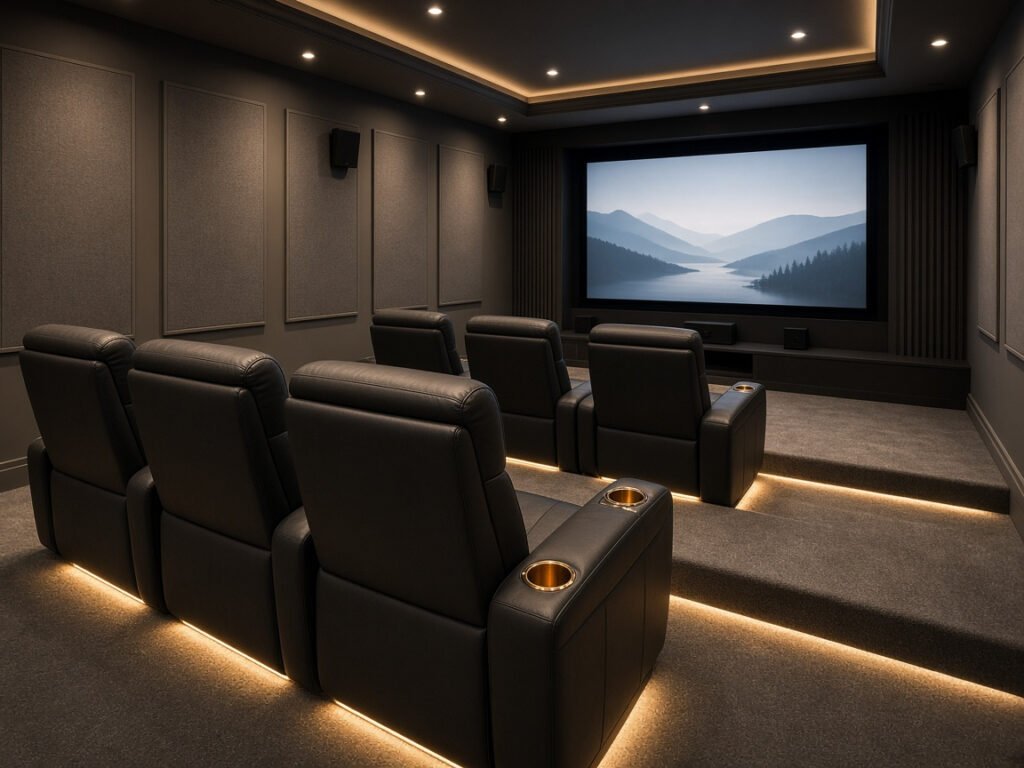
Choosing the right home theater seats determines how long you can watch comfortably, how well the room uses its available space, and how much the overall setup delivers a true cinematic environment. This guide compares home movie theater seats across seating type, reclining mechanism, upholstery material, feature set, and price tier — providing a technically grounded framework for making the right decision for your room and use case.
- Wall-hugger power-recline mechanisms are the technically correct choice for rooms where rear rows sit within 18 inches of a back wall — standard recline actuators cannot reach their designed angle in that clearance.
- Upholstery material — top-grain leather, bonded leather, PU faux leather, and microfiber — directly affects long-term durability, thermal comfort during extended sessions, and passive acoustic behavior in the room.
- Seat configuration type (individual chairs, row units, loveseats, modular sectionals) must be matched to room width, row depth, and riser geometry before purchase — most multi-seat row units are non-returnable after delivery.
- Feature density (cup holders, storage, USB charging, massage, heat, smart-home integration) adds cost incrementally; prioritizing features matched to actual viewing habits keeps the investment rational and proportional to system budget.
What Makes Home Movie Theater Seats Different From Standard Furniture?
Home movie theater seats are engineered around a fixed, sustained viewing position. Standard living room sofas and accent chairs are designed for social interaction — shallow seat depth, upright back angles, and no mechanism supporting prolonged recline. Home theater seats invert these priorities. The seat pan is typically deeper than a standard sofa cushion, the designed rest angle sits at approximately 100–115 degrees from vertical, and the headrest height is calibrated so that a fully reclined viewer’s eye line lands near the vertical center of the screen.
The structural difference is substantive. Theater-grade frames use hardwood or steel subframes designed to withstand load through thousands of repeated full-recline cycles over years of daily use. Consumer-grade recliners built for occasional use may not tolerate the daily cycling that a primary media room demands. Mechanism quality — particularly the actuator motor in power units — is the most critical differentiator between price tiers. Most standard home theater recliners publish a per-seat weight rating in their product specifications; the common range is 250–350 lbs per position, with reinforced heavy-duty variants rated higher and specified accordingly in the product data sheet.

What Seat Types Are Available for a Dedicated Home Theater?
The market segments home theater seating into four primary configuration types, each with distinct structural, spatial, and aesthetic implications. The right choice depends on room geometry, the number of viewers the room must accommodate, and whether the space is a dedicated screening room or a multi-purpose media area.
Individual Recliner Chairs
Single-unit recliners offer the highest flexibility in room arrangement. They can be spaced, angled, or placed on independent risers. The spatial cost is armrest duplication — adjacent individual chairs each carry their own outboard armrest, consuming 6–8 additional inches of room width per inter-seat gap compared to row units that share center consoles. This matters most in rooms under 14 feet wide, where individual chairs may yield one fewer seat per row than a comparable row unit.
Row Units and Linked Seat Configurations
Row-style seating links two to five seats into a shared frame or connects them through shared center consoles. These units deliver an authentic cinema aesthetic and use floor width more efficiently than individual chairs because armrests are shared between positions. Many manufacturers sell row configurations in two-seat, three-seat, and four-seat runs, with center consoles containing cup holders and covered storage. The trade-off is rigidity in handling — a five-seat row unit is a minimum two-person delivery job, and doorway clearance must be measured against the packed shipping dimensions before ordering.
Loveseats and Curved Row Configurations
Loveseats pair two seats with a shared center console and are proportioned for two viewers. Curved row configurations — where each seat position is angled slightly toward screen center — are designed for rooms wider than approximately 14 feet, where edge seats in a straight row may face a horizontal off-axis viewing angle exceeding 15–20 degrees from screen normal. Curved configurations add fabrication complexity and cost but meaningfully improve viewing geometry consistency across all seat positions in a wide room.
Modular Sectional Seating
Modular sectional systems combine reclining end units, armless middle units, and wedge corner pieces into a continuous seating island. These are common in multi-purpose rooms where the theater configuration shares space with general living use. They are not ideal for tiered or stadium-style rooms because the continuous profile makes it mechanically difficult to position units at different elevations without custom riser fabrication and frame modification.
| Seat Type | Best Application | Space Efficiency | Placement Flexibility |
|---|---|---|---|
| Individual Recliner | Tiered / riser setups, mixed-angle rooms | Moderate | High |
| Row Unit | Dedicated rectangular screening rooms | High | Low |
| Loveseat | Smaller rooms, couples, secondary spaces | Moderate | Moderate |
| Modular Sectional | Multi-purpose media/living rooms | High | Moderate |
How Do Reclining Mechanisms Compare for Home Theater Use?
The reclining mechanism is the most mechanically complex component in a home theater seat and the most common source of long-term reliability issues in lower-tier products. Understanding the three primary mechanism types allows buyers to match the seat to both the room’s spatial constraints and the expected frequency of use.
Manual Recline
Manual recliners engage recline via a hand-pull lever or a push-back mechanism activated by body weight. They carry the highest long-term reliability profile because there are no electrical components to fail, no motor cycle life to exhaust, and no power dependency. The practical drawback in a theater context is the mechanical disruption — pulling a lever or shifting body weight to engage or disengage recline disturbs adjacent viewers in a row, particularly during the film. Manual mechanisms also typically require 8–12 inches of rear wall clearance to reach their full designed recline angle, because the seat base moves backward during recline.
Standard Power Recline
Standard power recline uses an electric actuator motor driven by a hand control or side-panel button. The movement is smooth, nearly silent, and infinitely adjustable to any intermediate angle between fully upright and fully reclined — which is a meaningful comfort advantage over manual mechanisms that have discrete lock positions. Most manufacturers publish a minimum motor cycle rating in the product specification; heavy-duty actuators in upper-tier seats significantly exceed the cycle life of entry-level motors. Standard power recline still requires 10–14 inches of rear wall clearance because the seat base translates backward during the recline motion.
Wall-Hugger Power Recline
Wall-hugger mechanisms resolve the rear clearance problem by simultaneously moving the seat pan forward as the backrest reclines. The net result is that the seat can be positioned as close as 2–4 inches from the rear wall and still reach its full designed recline angle without contact. This is the technically preferred mechanism for dedicated theater rooms where every row of seating must be positioned close to the wall behind it in order to maximize front-to-back row depth and maximize total row count within the room. The wall-hugger actuator system is mechanically more complex than a standard power recliner and commands a higher price point, but that premium is functionally justified whenever rear clearance is constrained.
If your rear-row seats are within 18 inches of a back wall, a wall-hugger mechanism is not a preference — it is the only mechanism type that allows full recline without bottoming out against the wall. Standard power recliners and manual recliners will reach their designed recline limit before achieving full angle in that clearance window.

What Materials and Upholstery Perform Best in a Home Theater?
Upholstery selection affects durability under high-frequency use, thermal comfort during 2–3 hour sessions, maintenance complexity, and — in a less obvious way — the acoustic character of the room. Each material category carries a distinct technical profile that maps differently to different use cases.
Genuine Leather (Top-Grain and Full-Grain)
Top-grain and full-grain genuine leather is the highest-durability upholstery category for high-frequency seating. It resists abrasion, is easy to clean with a damp cloth, and develops a patina over time rather than cracking or flaking under normal conditions. The principal drawback in a theater context is thermal transfer — genuine leather conducts body heat in warmer rooms and feels initially cool in air-conditioned spaces, which can be uncomfortable during the first minutes of a long session. Genuine leather requires periodic conditioning every three to six months to maintain suppleness at flexion points; without it, drying and cracking develops at seat-back fold lines and armrest edges.
Bonded Leather
Bonded leather uses a fiber or fabric backing material with a thin layer of real leather scraps bonded to its surface. It is visually indistinguishable from genuine leather at the time of purchase but is significantly less durable under sustained use — it tends to peel, flake, and delaminate after several years of daily cycling, particularly at seam points and fold lines where flex stress concentrates. For a primary home theater with daily use, bonded leather is a poor investment regardless of its attractive price point. It is better suited to occasional-use secondary viewing spaces where total cycle count remains low.
PU Faux Leather
Polyurethane (PU) faux leather is a fully synthetic material that avoids the delamination failure mode of bonded leather. It is easier to clean than fabric, requires no conditioning, and is available at a lower price point than genuine leather. Many mid-range home theater seating lines use PU and market it under trade names such as “air leather,” “Italian leather feel,” or “top-grain match.” Buyers should verify the material specification in the product data sheet rather than relying on marketing nomenclature. Quality PU upholstery performs well in primary theater applications and represents a reasonable balance of durability, maintenance simplicity, and cost.
Microfiber and Performance Fabric
Microfiber and performance fabric upholstery offer better breathability than any leather variant. This makes fabric the more comfortable material choice for extended viewing sessions in rooms without active air conditioning, or for viewers who run warm during long reclined periods. The acoustic contribution of fabric seating is also relevant: fabric surfaces absorb broadband sound energy — particularly in the upper midrange and high-frequency ranges above 1 kHz — which provides passive acoustic benefit in rooms with minimal dedicated panel treatment. Maintenance is more demanding: spills require prompt blotting and deep staining typically requires professional cleaning. For climate-controlled dedicated rooms with comprehensive acoustic panel budgets, leather is functionally superior; for warm rooms or acoustically bare spaces, fabric warrants serious consideration.
| Material | Durability (High Use) | Breathability | Maintenance | Relative Price |
|---|---|---|---|---|
| Top-Grain Genuine Leather | Excellent | Low | Moderate — periodic conditioning | High |
| Bonded Leather | Poor (peels at seams) | Low | Easy — wipe clean | Low–Mid |
| PU Faux Leather | Good | Low–Moderate | Easy — mild soap and water | Mid |
| Microfiber / Performance Fabric | Good | High | Moderate — spot care required | Mid |
Which Features Add Genuine Value to Home Theater Seating?
Feature density in home theater seating ranges from pure recline-and-sit simplicity to fully loaded configurations with massage, heat, ambient lighting, and USB charging. Identifying which features map to actual use patterns avoids paying for complexity that never gets engaged. The right seat features can also meaningfully extend comfortable viewing time when paired with high-quality projection — the options covered in our guide to the best home movie theater projectors address the display side of that equation.
Cup Holders
Cup holders are the most universally used feature in theater seating and appear across all price tiers. They are built into console arms, center consoles, or the seat armrests depending on configuration. Lighted cup holders — illuminated by integrated LED strips — are common at the mid-range and above and serve a practical navigational purpose in a fully darkened room. The critical specification is interior diameter: standard cup holders accommodate most 12 oz cans and tumblers, but oversized tumblers and wide-base insulated bottles may not fit without an insert adapter. Verify the cup holder diameter specification if you use large-format drinkware regularly.
Storage Consoles
Center consoles with covered storage compartments are standard in row-style and loveseat configurations. They hold remotes, charging cables, snacks, and accessories that would otherwise be scattered across the room. Console depth and lid style — lift-top versus flip-open versus sliding — varies by manufacturer and affects usability in a reclining position. For seats with integrated USB charging, the port is typically routed through or directly alongside the console housing.
USB and USB-C Charging Ports
Integrated USB charging is increasingly standard on mid-to-upper tier home theater seats. Most furniture-integrated USB-A ports output 5V at 1A (5W) — adequate for maintaining charge on a phone or tablet during light use but not sufficient for fast-charging modern smartphones or tablets. Seats with USB-C ports capable of Power Delivery output are still relatively uncommon in this category and represent a genuinely useful upgrade for buyers who routinely use devices during viewing. Verify the port output specification in the product data sheet rather than the marketing summary, as USB port specs are frequently omitted from headline marketing copy.
Heat and Massage Functions
Heat elements in theater seating are typically resistive heating pads built into the seat and back cushions with low, medium, and high temperature settings. Massage functions use vibration motors positioned at lumbar and thigh zones. These features add meaningful comfort during cold-weather use and for viewers with chronic back discomfort during long sessions. They also add electrical complexity — heat and massage functions draw additional current load and require the seat to be positioned within reach of an accessible dedicated outlet, which affects placement planning and may require additional floor outlet installation in a purpose-built room.
How Do You Plan Seating Layout and Configuration for a Home Theater Room?
Seating layout is fundamentally a spatial engineering problem. The key variables are room dimensions, screen size and position, desired viewing distance, reclining footprint, and the number of viewers the room must serve at capacity. Resolving these variables correctly before purchase is essential — most home theater seat manufacturers do not accept returns on row units after delivery and installation.
Recommended Viewing Distance
The Society of Motion Picture and Television Engineers (SMPTE) specifies a minimum horizontal viewing angle of 30 degrees for a satisfying cinematic experience. That corresponds to a seating distance of approximately 1.5–2.5 times the screen width, depending on how immersive an experience is desired. For a 120-inch diagonal 16:9 screen — which measures approximately 104 inches wide — the SMPTE 30-degree guideline places the primary viewing row at roughly 13–21 feet from the screen surface. Pairing seat placement calculation with an appropriately sized projection surface is a critical co-decision; our comparison of the best home theater movie screens covers gain, screen width, and viewing distance in detail.
Row Depth and Reclining Footprint
A single row of fully reclining home theater seats typically occupies 55–70 inches of floor depth from the front of the fully extended footrest to the rear of the upright seat back. This footprint must be measured with the footrest fully extended — not just the seat at rest — because that is the operative dimension during use. When planning a second row on a riser, the riser must elevate the rear-row eye level high enough to clear the head of a fully reclined front-row viewer. Because reclined eye height is substantially lower than upright eye height, the sightline clearance calculation must use the reclined position as the baseline, not the seated-upright position.
Aisle and Egress Width
Maintaining at least 24–30 inches of clear walkway alongside or in front of seated rows is a practical minimum for residential home theaters. This prevents foot-extension conflicts when seats in an adjacent position are fully reclined and allows viewers to enter and exit without asking others to retract their footrests. If the room is classified or used as an assembly space in any jurisdiction, applicable egress requirements may specify a 36-inch minimum aisle — verify local building regulations for any room intended for guest or commercial use. Plan egress width before finalizing seat count per row; the outermost seat in a row is frequently the one that must be sacrificed to preserve a clear path.
- Measure room width and subtract side clearance (minimum 12 inches per side) to find usable seat span
- Divide usable seat span by seat unit width (including armrests) to determine maximum seats per row
- Tape the reclining footprint on the floor to confirm footrest-to-wall clearance before ordering
- Calculate rear-row riser height using the reclined — not upright — first-row eye height as the sightline baseline
- Measure all doorway widths, hallway turns, and stairwell dimensions against the packed shipping dimensions of any multi-seat row unit before purchase
What Does Each Price Tier Deliver in Home Movie Theater Seating?
Home movie theater seats span a wide price range, and the difference between tiers correlates directly with mechanism quality, frame construction, motor cycle life, upholstery grade, and warranty terms — not primarily with aesthetics. Understanding what each tier delivers allows buyers to match investment level to the intensity of their use case and the overall system budget.
Entry Level (Under $400 Per Seat)
At the entry level, buyers typically receive a manual or basic power recliner with PU or bonded leather upholstery, a simple cup holder, and a standard frame with a limited warranty — commonly one to two years on the frame and 90 days on the mechanism. These seats are suitable for occasional-use or secondary viewing spaces where daily cycling is not expected. For a primary home theater with daily use, entry-level mechanism cycle life may not sustain multi-year performance without premature wear at the actuator or hinge points.
Mid-Range ($400–$900 Per Seat)
The mid-range is where most dedicated home theater buyers find the most practical value equilibrium. At this price point, power recline with a wall-hugger option becomes available, lighted cup holders and storage consoles are standard inclusions, USB charging is integrated, and upholstery steps up to quality PU or entry-level genuine leather. Frame warranties extend to three to five years on most brands at this tier. This tier is well-suited to high-frequency daily use in a primary theater room and represents the minimum appropriate investment for a purpose-built space.
Premium ($900–$2,500+ Per Seat)
Premium home theater seating adds top-grain or full-grain leather, heavy-duty actuator motors with extended published cycle ratings, integrated massage and heat, and architectural details such as ambient LED lighting beneath the seat base. Some premium lines offer fully motorized headrests, power lumbar support adjustment, and smart-home integration via Zigbee or Z-Wave radio modules. Frame warranties at this tier commonly extend to ten years or lifetime coverage. For a room whose total system investment runs into five figures — factoring in a projector, surround sound, acoustic treatment, and media source components — premium seating is the proportionally appropriate finishing component. Our round-up of the best complete home theater systems covers integrated packages for buyers equipping the full system simultaneously.
How Does Seating Material Affect Home Theater Room Acoustics?
The acoustic interaction between seating upholstery and the room environment is an underappreciated technical factor in home theater design. When seats are unoccupied, the surface material affects how sound energy reflects within the room across the frequency spectrum.
Fabric and microfiber upholstery provides meaningful broadband absorption, particularly in the 1 kHz–8 kHz range corresponding to upper midrange and presence frequencies. Leather surfaces — both genuine and PU — reflect rather than absorb in this range, which maintains a more acoustically live room character. Neither is universally superior: the optimal choice depends on the existing acoustic treatment budget and the acoustic character of the bare room. A room with dedicated panel absorbers and diffusers integrated into the wall surfaces can accommodate leather seating without audible excess brightness. A room with minimal dedicated treatment may benefit meaningfully from the passive absorption contribution of fabric seating across all seat positions combined.
Low-frequency acoustic performance — the deep bass response critical to theater immersion — is not meaningfully affected by seat upholstery material. Bass management strategy, subwoofer placement, and room boundary interaction drive low-frequency results. For detailed subwoofer selection guidance, the hometheaterinfoline.com review of the best home theater subwoofers covers sealed and ported designs across room size categories.
How Do You Maintain Home Theater Seating for Long-Term Performance?
Long-term maintenance requirements differ substantially by upholstery material and mechanism type. A preventive maintenance routine matched to the seat’s material and mechanism keeps the investment performing at specification and extends the usable service life before visible wear or functional degradation develops.
Genuine Leather Care
Genuine leather requires conditioning every three to six months with a furniture-grade leather conditioner. Conditioning prevents the hide from drying and cracking at flexion points — particularly at the seat-back junction, fold lines along the lower back, and armrest edge surfaces where repeated flexing concentrates stress. Spills should be blotted immediately with a dry cloth; avoid saturating leather surfaces with water, as it can cause discoloration and stiffening. Direct sunlight exposure accelerates leather degradation significantly. If the room has natural light sources, UV-blocking window film or blackout shades are a worthwhile addition to the room’s infrastructure budget.
PU Faux Leather Care
PU leather requires less routine maintenance than genuine leather but is more sensitive to harsh cleaning agents. A mild soap and water solution is the standard recommended cleaning method for most PU furniture surfaces. Avoid alcohol-based cleaners, acetone, and hydrocarbon solvents — these degrade the PU coating chemistry and accelerate the peeling process. Inspect seam edges annually; PU delamination typically initiates at seam lines and can be slowed with early application of a compatible fabric sealant or edge sealer before the delamination front spreads to the main seat surface.
Power Mechanism Maintenance
Power recline mechanisms benefit from periodic inspection of motor mounting hardware and cable connections. Vibration from repeated cycling can progressively loosen mounting fasteners over time; manufacturers typically specify torque values for mechanism mounting hardware in the assembly instructions, and periodic retorquing to specification prevents play developing in the mechanism frame. Lubrication of pivot points and recliner mechanism guide rails with a light machine oil or furniture lubricant every 12–24 months reduces metal-on-metal wear and prevents the creaking that develops in unsealed contact points after extended use cycles.
How Will Home Movie Theater Seating Evolve Through 2026 and Beyond?
Several converging trends in home theater seating design are relevant for buyers planning a room build now who want their investment to remain current through 2026 and into 2027.
Smart-home integration is expanding beyond basic USB charging. A growing number of premium seating lines are introducing Zigbee and Z-Wave radio modules that allow recline position, heat level, and massage intensity to be controlled from smart home platforms including Apple HomeKit, Google Home, and Amazon Alexa ecosystems. This integration enables automated seat-position presets tied to scene macros — for example, a “Movie Start” scene that simultaneously dims room lighting, lowers a motorized projection screen, activates the AV receiver, and reclines seats to a preset angle — all from a single voice command or app trigger.
Modular acoustic seating is an emerging category aimed at the audiophile home theater segment. These units integrate acoustic absorption panels into the rear face of each seat’s back, combining the furniture piece and the rear-wall treatment into a single element. This approach reduces the planning complexity of independent panel placement and makes acoustic treatment accessible to buyers who would not otherwise budget for a separate acoustic panel project. The category is currently concentrated at the premium price tier but is expected to broaden in price range as the form factor matures through 2026 and 2027.
Materials innovation is producing microperforated synthetic leathers — materials that use mechanical perforation patterns to introduce air channels into a leather-appearance surface without compromising visual profile or cleanability. This technology has been standard in automotive seating for years and is now appearing in furniture-grade theater seating at the premium tier. If breathability during long sessions is a primary concern but fabric aesthetics are undesirable for the room, this category is worth evaluating as availability broadens through 2026. As seating technology evolves, so does the audio and system ecosystem it pairs with; the best home theater systems of 2026 reflect the same integration and smart-control trends reshaping the seating segment.
Frequently Asked Questions About Home Movie Theater Seats
How much rear wall clearance does a home theater seat actually need?
Standard power and manual recliners require 10–14 inches of clearance behind the seat back to reach full designed recline without contacting the wall. Wall-hugger power mechanisms reduce this to approximately 2–4 inches by moving the seat pan forward as the back reclines. If your rear-row placement sits within 18 inches of a wall, specify wall-hugger recline — standard mechanisms will bottom out against the wall before reaching their intended recline angle.
Is genuine leather worth the premium over PU for a primary home theater?
For a primary home theater with daily use, top-grain genuine leather delivers a substantially longer service life before visible wear than PU or bonded leather. The premium is proportionally justified when the seating will see high-frequency cycling over several years. For secondary or occasional-use viewing spaces, quality PU leather performs adequately and the cost difference is better allocated toward mechanism grade or additional seat positions.
What is the standard weight capacity for home theater recliners?
Most standard home theater recliners carry a manufacturer-rated weight capacity of 250–350 lbs per seat position. Heavy-duty and reinforced variants are available with ratings above 400 lbs per seat and are specified in the product data sheet. Always verify the per-seat weight capacity rather than a total row rating — manufacturers sometimes list aggregate capacity for multi-seat units, which can mislead buyers into assuming per-position capacity is higher than it is.
Can I add a second row of seating on a riser in a standard room?
Yes, provided the riser height is calculated correctly. The riser must elevate second-row eye level high enough to clear the head of a fully reclined first-row viewer. Because reclined eye height is significantly lower than upright eye height, the sightline clearance must be calculated using the reclined position as baseline. Many home theater design references recommend a minimum riser height of 12–18 inches, though the precise value depends on row-to-row depth and the vertical angle to screen center.
Are the USB charging ports in theater seats fast enough for modern devices?
Most furniture-integrated USB-A ports output 5V at 1A (5W), which is sufficient to maintain charge on a smartphone or tablet during light passive use but will not fast-charge modern devices with Qualcomm Quick Charge or USB Power Delivery requirements. Seats with USB-C Power Delivery ports capable of 18W or higher output are available in some premium lines and represent a genuinely useful upgrade. Verify the port output specification in the product data sheet — USB port specs are frequently absent from headline marketing copy.
How many seats fit in a 15×20 foot dedicated home theater?
A 15×20 foot room can typically accommodate two rows of three seats each, subject to seat unit width and mechanism type. Front-row seating occupies approximately 65–70 inches of depth when fully reclined plus aisle clearance, leaving the rear row at roughly 10–12 feet from the screen wall. A three-seat row unit ranges from 90 to 120 inches wide depending on model; at the lower end of that range it fits within 15 feet with adequate side clearance. Use floor tape to simulate both rows’ full reclining footprints before ordering.
Does the upholstery material on theater seats really affect room sound?
Yes, though the magnitude is secondary to purpose-built acoustic panel treatment. Fabric and microfiber surfaces absorb upper-midrange and high-frequency energy, reducing flutter echo and excess room brightness — an effect that compounds meaningfully across six or eight seats in a room with no other treatment. Leather upholstery reflects in this frequency range, maintaining a more acoustically live character. For rooms with comprehensive dedicated panel treatment, the difference is minor. For rooms with no acoustic treatment budget, fabric seating provides a passive acoustic contribution that can partially compensate.
What Should Be Your Next Steps When Choosing Home Movie Theater Seats?
Choosing home movie theater seats is a structured decision with a clear and ordered sequence. Following these steps prevents the most common and most expensive mistakes — ordering seats that don’t fit the room, selecting recline mechanisms that bottom out against walls, or committing to upholstery that degrades within two years under primary-use conditions.
- Measure the room completely. Record width, depth, and ceiling height. Mark all outlets, HVAC vents, in-wall speaker locations, and fixed architectural obstacles that affect seat positioning.
- Establish screen position and primary viewing distance. Use SMPTE’s 30-degree minimum horizontal viewing angle guideline as your anchor calculation. If you’re still choosing your screen, our guide to the best home theater movie screens covers screen size, gain, and viewing distance calculations in one place.
- Determine row count and seat count per row. Use floor tape to simulate both the seated and fully reclined footprint of each row. Confirm footrest-to-wall clearance and aisle widths in the actual space before proceeding.
- Select the mechanism type. If rear wall clearance is under 18 inches for any row, specify wall-hugger power recline for that row. For rows with adequate clearance, standard power recline at the mid-range tier represents the best-value choice for primary theater use.
- Choose upholstery based on room conditions. Warm room or extended sessions without active air conditioning → fabric or microfiber. Dedicated temperature-controlled theater with acoustic treatment budget → genuine top-grain leather or quality PU based on total seating investment.
- Verify manufacturer specifications in the product data sheet. Confirm weight capacity per seat position, motor cycle rating, warranty terms by component, and USB port output specification before ordering.
- Plan delivery logistics in advance. Measure all doorway widths, hallway turns, and stairwell clearances against the packed box dimensions of any multi-seat row unit. Confirm white-glove in-room delivery service if the unit exceeds single-person handling weight or requires assembly beyond the entry point.
Once seating is confirmed, every other system component contributes to the experience those seats are designed to serve. The hometheaterinfoline.com editorial team’s full review of the best home theater systems of 2026 covers integrated audio, source, and display packages at every room size and budget tier.