The best Kenwood speakers in 2026 are the Excelon (KFC-X) series for home theater satellite and surround positions, and the standard KFC series for budget builds and secondary rooms. For anyone evaluating dedicated home theater speakers across all price points, Kenwood’s tiered lineup offers technically grounded choices — once you have confirmed your receiver explicitly supports the 4-ohm impedance that all Kenwood car audio drivers carry.
Executive Summary
- Three-tier structure: Kenwood’s speaker range divides into the entry KFC series, the mid-tier KFC Performance Standard, and the Excelon (KFC-X) performance line — each serving a distinct acoustic performance bracket and home theater application role
- Critical 4-ohm requirement: Every Kenwood car audio speaker is rated at 4 ohms — a specification that must be explicitly matched against your receiver’s minimum impedance rating before any home theater integration proceeds
- Excelon’s engineering advantage: Glass fiber composite and metallized polypropylene cone constructions in the KFC-X series deliver higher stiffness-to-mass ratios than the standard KFC’s polypropylene, producing cleaner transient response and better high-frequency dispersion, per Kenwood’s published product documentation
- Mandatory bass management: Kenwood coaxials are not designed for sub-80 Hz output — every home theater installation requires a dedicated subwoofer and correct “Small” channel configuration at the receiver, with an 80 Hz minimum crossover frequency
What Does Kenwood’s 2026 Speaker Range Actually Cover?
Kenwood, operating under the JVC Kenwood Corporation since the 2008 merger, structures its speaker portfolio around two distinct categories. The larger and more technically developed is car audio, covering coaxial drivers, component sets, and subwoofer designs built for automotive acoustic environments. The smaller segment covers home audio micro-systems and compact bookshelf-format speakers aimed at desktop and near-field use.
This distinction is critical for home theater buyers. Kenwood is not a dedicated home loudspeaker manufacturer in the way that Klipsch, Polk Audio, or Bowers & Wilkins are. Its engineering investment concentrates in car audio driver technology — a focus that creates a specific and genuinely useful overlap with home theater satellite and surround applications, while also establishing firm constraints around bass extension and receiver compatibility.
The practical result is that Kenwood’s strongest home theater value comes from applying their car audio coaxial drivers to satellite, surround, and in-wall positions rather than from a dedicated home theater loudspeaker portfolio. The KFC, KFC Performance Standard, and Excelon (KFC-X) families represent the best of this engineering. Each targets a distinct price and application tier within the home theater context, and understanding the differences between them is the foundation of a correct Kenwood purchase decision.
How Does Kenwood’s Car Audio Engineering Shape Speaker Performance?
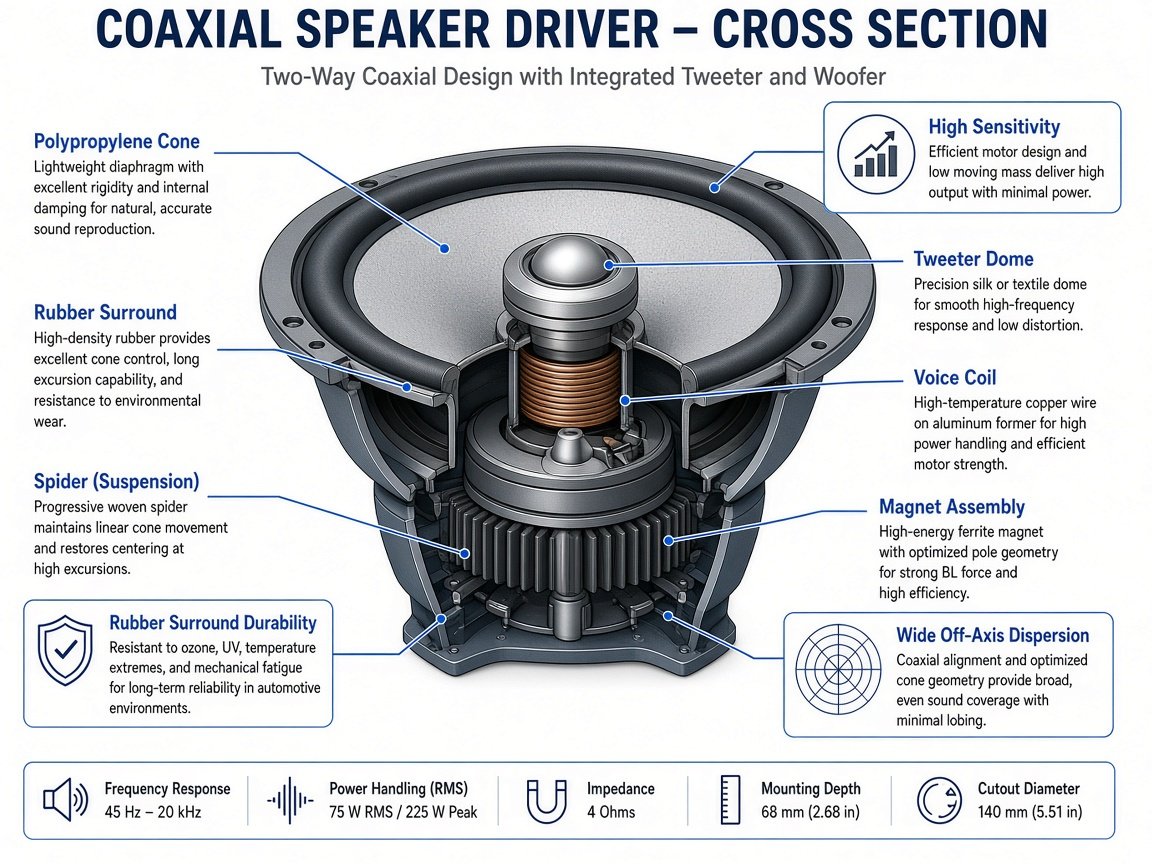
Car audio environments impose specific acoustic demands that shape Kenwood’s design philosophy. Enclosure volumes in automotive applications are severely constrained. Ambient noise floors are high. Power delivery from head units and amplifiers varies considerably. These conditions push manufacturers to build drivers with high sensitivity — producing more output per watt of amplifier power — broad power-handling ranges, and wide off-axis dispersion for even coverage across irregular cabin geometries.
Translated to home theater, this engineering profile produces speakers that generate high output from the relatively modest per-channel power that home theater receivers deliver. Rubber surrounds, standard across Kenwood’s range, outlast foam alternatives in long-term durability and maintain consistent excursion geometry throughout the driver’s rated stroke. Treated polypropylene and glass fiber composite cones tolerate the temperature swings of automotive environments, maintaining stable acoustic properties through extended listening sessions.
The principal limitation is frequency extension. Kenwood coaxials are engineered for automotive acoustic environments where a vehicle’s cabin structure handles low-frequency reinforcement. They are not designed to reach below 80 Hz. In home theater, this means every Kenwood coaxial deployment requires a dedicated subwoofer and correct bass management at the receiver. This is a fixed design constraint — not an addressable limitation — and it must be treated as a system requirement, not a workaround.
🔊 Sensitivity Advantage: Car audio speakers are engineered for high-sensitivity output. Kenwood’s car audio drivers produce strong output from the modest per-channel power of a home theater receiver — an engineering characteristic that works directly in favor of home theater satellite applications where amplifier headroom is limited.
What Makes the KFC Series the Right Entry-Level Choice?
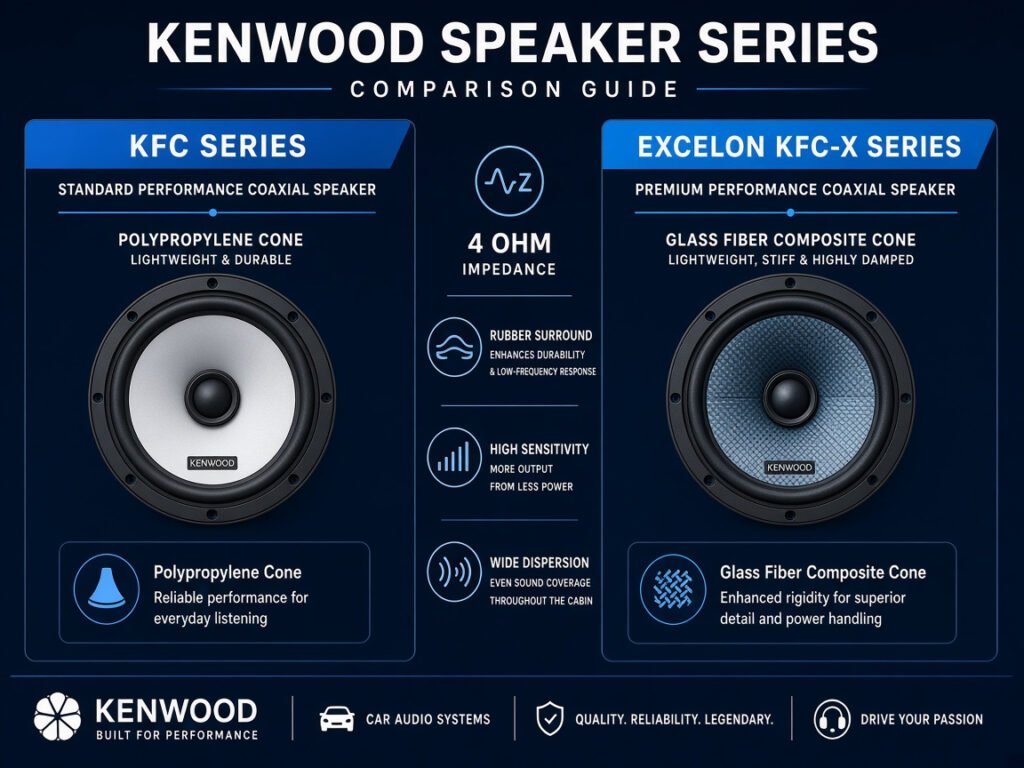
The Kenwood KFC series covers the accessible end of their driver range, spanning compact 4-inch units through 6×9-inch three-way coaxials. Construction across the KFC line uses injection-molded polypropylene cones, chosen for their balance of cone stiffness, low mass, and resistance to environmental degradation. KFC tweeters are predominantly mylar or balanced-dome designs — functionally adequate for high-frequency reproduction where absolute resolution is not the primary specification.
Rubber surrounds on KFC woofers provide greater long-term durability than foam alternatives and maintain consistent excursion geometry throughout the driver’s rated stroke. For buyers prioritizing cost-effective coverage — a secondary room build, a garage system, or satellite positions in a larger distributed audio installation — the KFC series delivers technically sound and reliable performance. Polypropylene cone construction is well-understood, predictable in its acoustic behavior, and resistant to the humidity and temperature variations that degrade foam-surround alternatives over time.
The KFC line’s limitation is proportional to its price positioning. Polypropylene cone and mylar tweeter construction, while adequate, does not match the transient precision or high-frequency dispersion of the Excelon line’s more sophisticated driver assemblies. For main satellite and primary surround positions in a focused home theater build, the upgrade path to Excelon is technically justified. For secondary and distributed system positions where cost efficiency is the governing specification, the KFC series delivers its specification efficiently within its price bracket.
How Does the Excelon (KFC-X) Series Raise the Technical Bar?
The Excelon line — designated KFC-X in Kenwood’s product numbering — is their performance-oriented speaker range and represents the most significant engineering differentiation within their current portfolio. Where the KFC series uses standard polypropylene, Excelon cone constructions use glass fiber composite and metallized polypropylene designs that deliver higher stiffness-to-mass ratios, per Kenwood’s published product documentation.
Lower cone mass reduces the energy required to accelerate the driver. This improves transient response — the ability to start and stop quickly in response to sharp audio signals such as percussion transients and film effects work. In a home theater context, rapid dynamic changes in a film soundtrack place high demands on driver linearity. Glass fiber composite cones handle these demands with less cone-flex distortion than polypropylene designs at comparable excursion levels. This difference is most audible during explosions, dialogue plosives, and high-energy music passages where the driver must respond accurately across a wide instantaneous level range.
Excelon tweeters use soft-dome designs with wider dispersion patterns and better high-frequency smoothness compared to the harder materials in the KFC range. Crossover networks in the Excelon series use tighter-tolerance components to reduce phase anomalies at the driver handoff frequency. Owner reviews across multiple retail platforms consistently describe the Excelon as delivering measurably improved detail, imaging precision, and high-frequency refinement compared to base KFC models — an assessment consistent with the material specification differences between the two lines.
Top Kenwood Pick for Home Theater: Excelon (KFC-X) Series
For home theater satellite and surround channel positions, the Excelon series represents the strongest engineering case in Kenwood’s 2026 lineup. Glass fiber composite cones, soft-dome tweeters, and tighter-tolerance crossover components deliver cleaner transient response and better high-frequency dispersion than the standard KFC line. The same 4-ohm receiver compatibility requirement applies across the entire Kenwood range — confirm before installation.
How Are Kenwood Speakers Ranked for 2026?
The table below ranks Kenwood’s three main speaker tiers by home theater application fit, cone engineering, and technical specification profile. All three tiers share the 4-ohm impedance requirement. Specific sensitivity and power handling figures vary by individual model within each series — consult Kenwood’s product documentation for the exact specifications of your chosen unit before matching to a receiver.
| Rank | Series | Cone Material | Tweeter Type | Key Home Theater Strength | Best Application | Price Tier |
|---|---|---|---|---|---|---|
| #1 | Excelon (KFC-X) | Glass Fiber Composite / Metallized PP | Soft Dome | Highest stiffness-to-mass ratio; widest HF dispersion; cleanest transient response | Main satellite, primary surround, in-wall positions | Premium |
| #2 | KFC Performance Standard | Treated Polypropylene | Balanced Dome | Improved damping over entry KFC; better surround articulation at mid-range pricing | Surround channels, secondary satellite positions | Mid-range |
| #3 | KFC (Entry) | Polypropylene | Mylar / Balanced Dome | Cost-effective, durable, wide format availability across 4-inch through 6×9-inch sizes | Secondary rooms, distributed audio, effects channels | Budget |

Can Kenwood Car Audio Speakers Work in a Home Theater System?
Using Kenwood car audio speakers in a home theater system is technically viable in DIY and custom installation contexts, provided specific engineering conditions are met. The approach is well-established in custom home theater integrator practice. Kenwood coaxials’ high-sensitivity, wide-dispersion characteristics transfer effectively to domestic room acoustics when mounted and configured correctly — with the two non-negotiable conditions of 4-ohm receiver compatibility and correct bass management always in place.
The primary consideration is enclosure format. Kenwood car audio coaxials are designed for specific mounting depths and baffle conditions. Their free-air resonance characteristics differ from those of speakers engineered for sealed or ported home enclosures. When mounted in an open-baffle dipole configuration — the most common approach for surround channels in custom home theater builds — their sensitivity and dispersion characteristics produce effective room coverage without the bass loading issues that can arise in poorly matched sealed enclosures. For in-wall and in-ceiling applications, shallow-depth Kenwood models are well-suited to finished-baffle mounting where full enclosure construction is not possible.
The fundamental bass limitation remains constant across every mounting configuration. All Kenwood coaxials must be paired with a dedicated subwoofer in any home theater installation. Bass management at the receiver must be set to treat these speakers as “Small,” with a crossover point matched to their rated lower rolloff frequency. For current-generation subwoofer options that complement compact satellite speakers like Kenwood coaxials, the best bass speakers for home theater in 2026 covers models across all output levels and room sizes.
All Kenwood car audio speakers are rated at 4 ohms — not the 8-ohm standard of most home audio products. Operating a receiver rated for a 6-ohm minimum into 4-ohm speakers can trigger thermal protection shutdowns during sustained listening or cause long-term amplifier section damage. Always locate your receiver’s minimum impedance specification on its product specification page before connecting any Kenwood car audio driver.
What Specifications Should You Prioritize When Choosing Kenwood Speakers?
Sensitivity (expressed in dB at 1W/1m) is the most practically significant specification for home theater integration. A higher sensitivity produces more output from the same amplifier power. Car audio speakers are built for high-sensitivity output — a design priority engineered for automotive amplifier constraints that works directly in favor of home theater satellite applications, where receiver per-channel power is often modest. Sensitivity figures vary across Kenwood’s model range; verify the specific figure on the product’s specification sheet.
Frequency response determines where the speaker requires subwoofer support. The lower rolloff point informs your bass management crossover setting at the receiver. A speaker with a rated lower limit of 65 Hz should run a crossover point of 80 Hz minimum — the THX standard for small satellite speakers — to ensure a clean handoff to the subwoofer without a coverage gap at the transition frequency.
Power handling (RMS) should always be the reference figure for receiver matching, not the peak specification. Home theater content sustains higher average power levels than the brief transient bursts implied by peak ratings. Matching RMS power handling to your receiver’s per-channel output prevents thermal stress across the tweeter dome and voice coil during extended high-volume listening. Impedance is the critical compatibility gate: all Kenwood car audio speakers are rated at 4 ohms, requiring explicit verification against your receiver’s minimum impedance specification before purchase. It is not sufficient to assume compatibility — verify the minimum impedance rating on the receiver’s product specification page before ordering.
How Do You Correctly Match and Configure Kenwood Speakers with a Receiver?
Correctly integrating Kenwood speakers with a home theater receiver requires a systematic approach. The 4-ohm impedance is a hard constraint resolved at step one — before any other configuration proceeds. Selecting a home theater receiver that explicitly supports 4-ohm loads is a non-negotiable prerequisite for any Kenwood car audio integration. The following steps apply to any Kenwood KFC or Excelon deployment in a home theater system.
- Verify 4-ohm receiver compatibility. Locate the receiver’s specification sheet and confirm the minimum impedance rating. Explicit “4Ω compatible” or “4-ohm stable” wording confirms compatibility. A “6-ohm minimum” rating without 4-ohm qualification is not suitable for continuous Kenwood car audio driver use.
- Match RMS power output to speaker handling. Identify the receiver’s RMS (continuous) per-channel power output and confirm it falls within the Kenwood model’s rated RMS handling range. Under-powering risks distortion-driven tweeter damage; significantly over-powering risks voice coil thermal failure at sustained high-volume levels.
- Set all Kenwood-driven channels to “Small.” In the receiver’s speaker configuration menu, designate every channel driven by a Kenwood coaxial as “Small.” This engages the bass management system and routes low-frequency content to the subwoofer output rather than the speaker terminals.
- Set the crossover frequency to 80 Hz minimum. The THX standard for small satellites is 80 Hz. For compact coaxials below 5.25 inches, a 100 Hz crossover provides additional protection against low-frequency driver stress. Set the receiver’s crossover at or above this threshold based on your specific Kenwood model’s rated lower rolloff point.
- Align the subwoofer crossover. Confirm the subwoofer’s low-pass filter frequency matches the receiver’s bass management crossover setting. A mismatch creates either a coverage gap or an overlapping region — both degrade transition clarity and dialogue intelligibility.
- Run the receiver’s automated room correction. Use the receiver’s calibration system (Audyssey, YPAO, MCACC, or equivalent) to set channel levels, delays, and EQ. This corrects for placement asymmetries in the room and optimises the low-frequency handoff between the Kenwood coaxials and the subwoofer in your specific acoustic environment.
How Do Kenwood Speakers Compare to Competing Brands?
In car audio, Kenwood’s direct competitors include Pioneer, JBL, Sony, and Alpine. The KFC series competes closely with Pioneer’s TS line and Sony’s XS series at comparable price points, sharing broadly similar polypropylene cone architectures and rubber-surround construction. The Excelon line’s glass fiber composite construction differentiates it at its market position — competing with Alpine’s Type-S range and JBL’s Stadium series, which offer comparable material sophistication at broadly similar price brackets. Within its price tier, the Excelon’s combination of cone material engineering and soft-dome tweeter dispersion represents a competitive specification profile.
In home audio, the comparison framework shifts entirely. Dedicated home loudspeaker manufacturers design products from the ground up for domestic room acoustics and standard 8-ohm home amplifier compatibility. Brands like Denon — whose purpose-built home speaker models for 2026 are engineered specifically for domestic listening environments and room-loading enclosure volumes — occupy a fundamentally different engineering context from Kenwood’s car audio driver approach. Dedicated home theater lines from Klipsch, Polk, and Bowers & Wilkins similarly target the domestic room loudspeaker market with products engineered for 8-ohm home amplifier chains.
Kenwood’s value proposition is not competing with dedicated home theater lines on absolute acoustic performance. It is delivering automotive-grade driver engineering — particularly the high-sensitivity, durable construction, and wide-dispersion characteristics — to home theater satellite and surround positions at car audio pricing. For a home theater builder sourcing satellite channels at budget-to-mid price points, that engineering heritage is a practical advantage rather than a compromise — provided the 4-ohm compatibility and bass management requirements are met.
What Limitations Must You Address Before Buying Kenwood Speakers?
Bass extension is not adjustable. No Kenwood coaxial driver in the current range is designed for sub-80 Hz output. This is a correct engineering trade-off for automotive applications, not a defect. In home theater, it means a dedicated subwoofer is not optional — it is a system requirement. Running Kenwood coaxials without correct bass management produces audible distortion at bass-heavy content peaks and risks progressive driver damage at high excursion levels.
Impedance incompatibility eliminates some receivers. The 4-ohm rating is a hard constraint. Receivers rated for 6-ohm minimum loads should not be used with Kenwood car audio drivers for continuous listening sessions. Confirm receiver compatibility before purchase — this is the most common and most consequential integration failure point in Kenwood home theater deployments. For a comprehensive look at structuring a full multi-channel system around the right receiver and satellite speakers, the best speaker system for home theater guide covers complete architecture recommendations across all channel configurations.
Enclosure loading requires care. Kenwood coaxials are designed for thin baffle mounting rather than boxed enclosure loading. Installing them in a sealed box without accounting for their free-air resonance parameters can produce elevated low-frequency roll-off or mid-bass emphasis. Open-baffle and thin-baffle mounting configurations generally produce more accurate results for home theater satellite use. No turnkey home theater package exists. Kenwood does not offer a matched 5.1 or 7.1 home theater speaker package. Building a Kenwood-based surround system means sourcing individual car audio units, managing cosmetic consistency, and constructing or sourcing appropriate mounting hardware — a process that suits experienced DIY builders and custom integrators more readily than buyers seeking a packaged solution.
Frequently Asked Questions About Kenwood Speakers
Are Kenwood speakers good for home theater use?
Kenwood car audio speakers are technically well-suited to home theater satellite and surround positions. Their high sensitivity, durable rubber surround construction, and wide off-axis dispersion transfer effectively to domestic room acoustics. Two conditions must be met for successful integration: your receiver must explicitly support 4-ohm loads, and all Kenwood-driven channels must be configured with correct bass management and a dedicated subwoofer handling content below 80 Hz.
What is the difference between Kenwood KFC and Excelon series speakers?
The KFC series uses injection-molded polypropylene cones and mylar or balanced-dome tweeters. The Excelon (KFC-X) series uses glass fiber composite and metallized polypropylene cones with soft-dome tweeters, delivering higher stiffness-to-mass ratios and improved high-frequency dispersion, per Kenwood’s product documentation. Excelon crossover networks use tighter-tolerance components for better phase performance at the driver crossover frequency. Owner feedback across multiple retail platforms consistently describes the Excelon as delivering more detail, better imaging, and improved high-frequency refinement than the standard KFC line.
What impedance are Kenwood car audio speakers?
All Kenwood car audio speakers — across both KFC and Excelon series — are rated at 4 ohms. This differs from the 8-ohm standard for most dedicated home audio speakers and requires explicit receiver compatibility verification before installation. Locate and confirm the minimum impedance rating on your receiver’s product specification page. Do not assume compatibility from the receiver’s brand or price tier alone.
Do Kenwood speakers need a subwoofer in a home theater system?
Yes — without exception. Kenwood coaxial speakers are not designed for sub-80 Hz bass reproduction. All home theater installations must set Kenwood-driven channels to “Small” with an 80 Hz minimum crossover at the receiver, with a matched subwoofer handling the low-frequency content. Running Kenwood coaxials full-range produces audible distortion during bass-heavy film content and risks progressive driver damage at the woofer’s lower cone excursion limits over time.
Can I use Kenwood coaxial speakers as surround sound speakers?
Yes. Kenwood coaxials are well-matched to surround and satellite positions in home theater builds. Their high sensitivity and wide off-axis dispersion — engineered for automotive cabin coverage — produce effective room coverage in home theater surround configurations. Open-baffle dipole mounting is the most common and effective approach for rear and side surround positions in custom home theater installations, avoiding the enclosure matching complications of sealed-box configurations.
How much power do Kenwood speakers need from a home theater receiver?
Match the receiver’s RMS (continuous) per-channel power output to Kenwood’s RMS power handling specification for your chosen model. Never base the match on peak power ratings, which reflect brief transient handling rather than sustained output capacity. Excelon models typically carry higher RMS power handling ratings than standard KFC units — verify the specific figure in Kenwood’s product documentation for your model before purchase.
How do I confirm my receiver is compatible with Kenwood 4-ohm speakers?
Locate the minimum impedance specification on the receiver’s product specification sheet. Explicit wording such as “4Ω compatible,” “4-ohm stable,” or “supports 4-ohm loads” confirms compatibility. If the specification page states only “6 ohm minimum” or “8 ohm” without 4-ohm qualification, do not use that receiver with Kenwood car audio drivers without manufacturer confirmation of 4-ohm stability at your expected listening power levels.
Conclusion: Choosing the Right Kenwood Speaker for Your Home Theater
Kenwood speakers in 2026 represent a technically coherent choice for home theater builders who understand the application parameters. The Excelon (KFC-X) series is the top-ranked option for primary satellite and surround positions — glass fiber composite construction and soft-dome tweeters deliver meaningfully better transient response and high-frequency dispersion than the standard KFC line, justifying the price premium wherever acoustic performance matters. The KFC line remains the right choice for secondary room coverage, distributed audio positions, and budget builds where cost efficiency is the governing specification.
Both series require the same three non-negotiable integration conditions: confirmed 4-ohm receiver compatibility, correct “Small” channel configuration with an 80 Hz minimum bass management crossover, and a subwoofer matched to the coaxials’ lower rolloff frequency. Meeting all three is prerequisite to successful home theater integration. Missing any one of them — particularly the impedance verification — creates the most common failure modes seen in Kenwood home theater deployments.
The hometheaterinfoline.com editorial team recommends the following sequenced approach: confirm receiver impedance compatibility first, then match Kenwood model selection to your room’s channel count and your receiver’s per-channel RMS power delivery. For primary satellite and surround positions with a focused acoustic standard, invest in the Excelon series. For secondary and effects channel positions where cost-per-channel is the priority, the KFC series delivers its specification reliably. Address bass management configuration before any critical listening — it is the single step that most determines whether a Kenwood home theater installation succeeds or fails.