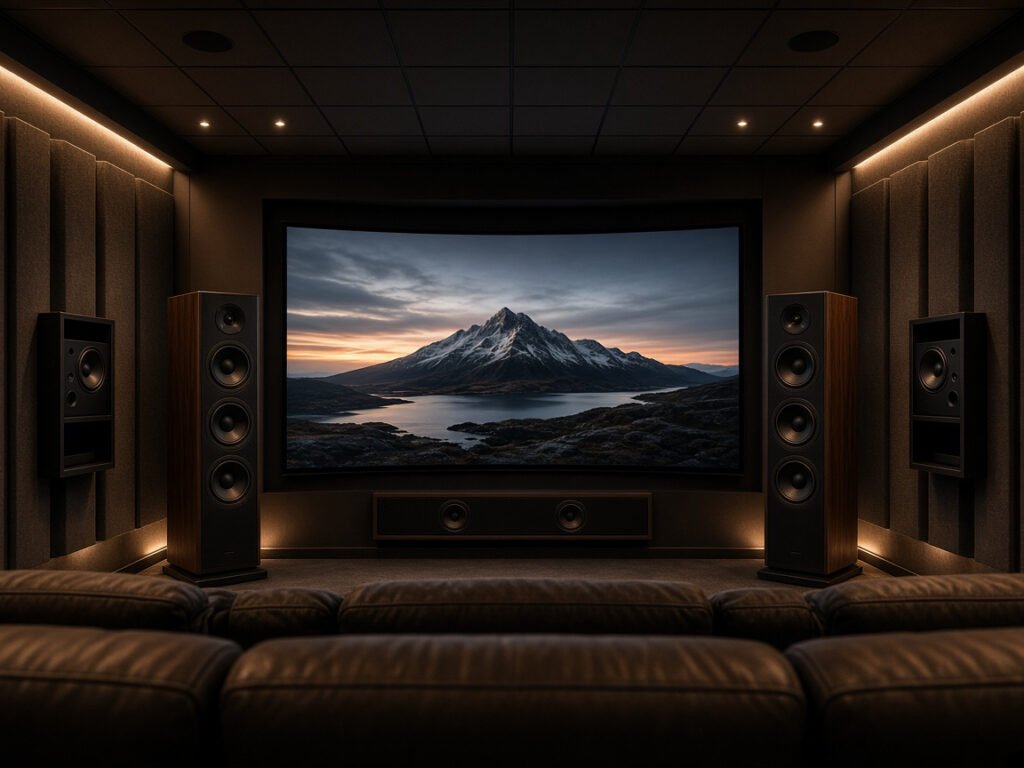
Home theater speakers deliver cinematic performance when sensitivity, impedance matching, and timbre consistency across all channels are aligned with the room’s acoustic properties. The rankings below compare the leading speaker brands and formats by manufacturer specifications and owner-verified performance for 2026.
- Floorstanding speakers offer the greatest dynamic headroom and low-frequency extension, making them the preferred front-channel choice for rooms larger than approximately 300 square feet
- Manufacturer-specified sensitivity above 90 dB/W/m delivers higher output from less amplifier power — a critical pairing factor for AV receivers rated below 100 W/ch
- Timbre consistency across the front, center, and surround channels outweighs any single-speaker performance metric when evaluating the overall coherence of a multi-channel system
- Room acoustic treatment addresses low-frequency buildup and early reflections that speaker selection alone cannot resolve at any price point
What Defines Reference-Grade Performance in Home Theater Speakers?
Reference-grade performance begins with frequency response accuracy. Manufacturers publish frequency response curves as the primary measure of how faithfully a speaker reproduces the input signal across the audible spectrum. The tighter the variation — ideally within ±3 dB over the rated bandwidth — the more linearly the driver performs across its assigned frequency range. Practical floorstanding designs extend usable bass to approximately 30–40 Hz before requiring subwoofer support, while compact bookshelf speakers typically roll off between 50 and 80 Hz depending on cabinet volume and driver diameter.
Sensitivity is the second fundamental specification. Expressed in dB measured at one watt input at one meter, it quantifies how efficiently a driver converts amplifier power into sound pressure. A 3 dB difference in sensitivity equates to a doubling of amplifier power required to reach the same perceived output level. A speaker rated at 91 dB sensitivity therefore requires half the amplifier power of an 88 dB design to match it volume-for-volume. This relationship determines how well a given speaker pairs with a specific AV receiver’s rated output — and why sensitivity is the first specification to cross-reference against receiver power.
Cabinet construction governs coloration and stored energy. Premium designs use internally braced enclosures, mass-loaded panels, and bitumen or acoustic foam damping to prevent cabinet walls from vibrating sympathetically with driver excursion. These resonances, when uncontrolled, add low-frequency artifacts unrelated to the input signal. Crossover network design completes the acoustic picture — passive crossovers must maintain phase coherence between drivers so that the combined acoustic output of woofer, midrange, and tweeter arrives at the listening position as a single coherent wavefront. This engineering principle applies with equal importance to every speaker in the system, from the front left and right positions through to the surround and height channels.
Speaker Formats and Their Role in a Multi-Channel System
A fully specified home theater speaker system assigns a distinct acoustic task to each channel. Front left and right speakers carry the primary stereo image, music content, and high-amplitude dynamic transients — which is why floorstanding tower designs dominate front-channel applications, where their extended bass response and high output capability most directly contribute to cinematic impact. The center channel handles on-screen dialogue and anchor sound effects, carrying the majority of a typical film soundtrack’s identifiable audio by content density. Surround and rear channels reproduce ambient cues, environmental effects, and directional sound movement — tasks that prioritize accurate spatial imaging over raw bass extension, making compact designs well suited.
Dedicated subwoofers take over low-frequency reproduction below the main speakers’ crossover point, typically set between 60 and 120 Hz via the AV receiver’s bass management. This configuration allows each speaker to operate within its optimal frequency range, reducing excursion demand on the main drivers and lowering distortion in the midrange at high playback levels. This division of acoustic labor — where each format handles its assigned bandwidth — is what distinguishes a properly configured multi-channel system from a collection of speakers playing simultaneously without coordination.
For rooms where a full discrete speaker system is impractical to install, great sound bars provide a compact multi-channel alternative. Sound bars process spatial cues electronically through DSP rather than from physically separated speaker positions, which limits the precision and envelopment of the reproduced soundfield compared to a discrete multi-speaker configuration. That trade-off is acceptable for many rooms; understanding it helps buyers select the right format for their specific constraints and priorities before committing to either approach.
Critical Specifications to Evaluate Before Purchasing
- Sensitivity (dB/W/m): Above 90 dB is efficient; below 85 dB demands substantial amplifier current for home theater output levels.
- Nominal Impedance (Ω): Most AV receivers are optimized for 6–8 Ω loads. Speakers rated at 4 Ω can stress lower-current receiver output stages, particularly at high drive levels.
- Frequency Response Tolerance: Always look for the ±dB figure alongside the Hz–kHz range. Without a stated tolerance, the measurement is acoustically meaningless as a comparative specification.
- Power Handling (Watts RMS): Both minimum and maximum figures should be confirmed against the receiver’s rated output. Underpowering — not overpowering — is the more common cause of driver damage from amplifier clipping.
- Minimum Impedance: Some speakers dip well below their nominal impedance figure at certain frequencies. Cross-reference this against the receiver’s minimum stable load specification before purchase.
Impedance compatibility deserves particular attention in home theater setups where receivers drive multiple channels simultaneously. Many AV receivers specify rated output at 8 Ω; actual current delivery at 4 Ω loads varies significantly between models. A speaker specified at a nominal 4 Ω impedance — especially if it dips below 3 Ω at certain frequencies — can clip the receiver’s output stage at moderate playback levels, introducing audible distortion before perceived loudness ceilings are reached. Both nominal and minimum impedance figures from the speaker’s data sheet should be cross-referenced against the receiver’s minimum stable load specification. For detailed rankings of the best bass speakers for home theater — including models optimized for impedance compatibility with mid-tier AV receivers — the hometheaterinfoline.com editorial team maintains a dedicated ranking updated for 2026.
Frequency response tolerance figures deserve scrutiny beyond the headline specification. A measurement stated as “20 Hz–20 kHz” with no tolerance figure can mask variation of ±15 dB or more across that bandwidth and still technically comply with that description. The IEC 60268-5 standard for loudspeaker measurement requires tolerance to be stated alongside frequency limits. Premium manufacturers publish ±3 dB or ±6 dB tolerance figures on their data sheets, and those numbers enable meaningful comparisons between competing products. When a manufacturer omits the tolerance figure entirely, the stated frequency response range should be treated as a marketing claim rather than a measured specification.
Top Floorstanding Speakers for Home Theater in 2026
Floorstanding tower speakers remain the dominant front-channel choice for dedicated home theater rooms. Their large cabinet volumes support multiple woofer drivers and extended bass loading, allowing bass response well below the typical crossover point without reaching mechanical excursion limits at high playback levels. The leading brands competing in this category for 2026 include Klipsch, SVS, KEF, Polk Audio, Bowers & Wilkins, Monitor Audio, Focal, and Dynaudio, each applying distinct engineering approaches to the same fundamental acoustic objective.
Klipsch’s Reference Premiere line uses horn-loaded tweeter technology to achieve sensitivity ratings that the manufacturer specifies at 96–98 dB for flagship models such as the RP-8000F. This high efficiency allows high dynamic output from modest receiver power, with the Tractrix horn geometry controlling treble dispersion and limiting early reflections from room boundaries. Sony tower speakers approach floorstanding design from a consumer electronics integration standpoint, emphasizing broad frequency coverage and seamless pairing with Sony AV receiver platforms — a rational choice for buyers who have standardized on Sony components throughout their system and prioritize ecosystem coherence alongside acoustic performance.
SVS designs its Prime and Ultra tower lines around controlled directivity and extended low-frequency performance, with the company publishing detailed frequency response data on its website for independent verification. Dynaudio’s Emit and Contour series apply MSP (Magnesium Silicate Polymer) cone construction — a material the company specifies for its combination of stiffness, low moving mass, and internal damping — producing low driver coloration and high transient accuracy across the midrange. Buyers evaluating premium Danish engineering should consult the full analysis of the best Dynaudio speakers for a detailed breakdown of which models perform best in a home theater surround context, including comparisons of the Emit and Contour lines across different room sizes.
| Brand / Line | Tweeter Design | Sensitivity (Mfr. Spec.) | Key Engineering Focus |
|---|---|---|---|
| Klipsch Reference Premiere | Horn-loaded Titanium LTS | 96–98 dB | High efficiency, dynamic headroom |
| SVS Prime / Ultra Tower | Aluminium dome, wide-dispersion waveguide | ~87–88 dB | Low-distortion bass extension, controlled directivity |
| KEF Q Series | Uni-Q coincident array | ~88–91 dB | Wide stereo imaging, consistent off-axis response |
| Polk Audio Reserve R700 | Klippel-optimised ring radiator | ~89 dB | Measured accuracy, audiophile value tier |
| Bowers & Wilkins 600 S3 | Decoupled aluminium dome | ~90 dB | Low coloration, tonal neutrality |
| Dynaudio Emit / Contour | Esotar-derived soft dome | ~86–88 dB | Transient accuracy, driver resolution |
| Monitor Audio Silver 500 | Gold dome ribbon hybrid | ~89–90 dB | High-frequency extension and micro-detail |
All sensitivity figures in the table are drawn from manufacturer-published data sheets for representative models in each line. Because manufacturers apply different measurement conditions and room loading assumptions, direct numerical comparison requires attention to the stated standard. All brands listed are designed for compatibility with the full dynamic range of Dolby Atmos and DTS:X encoded soundtracks at typical home theater playback levels without audible compression.
Best Bookshelf Speakers for Surround Channels in 2026
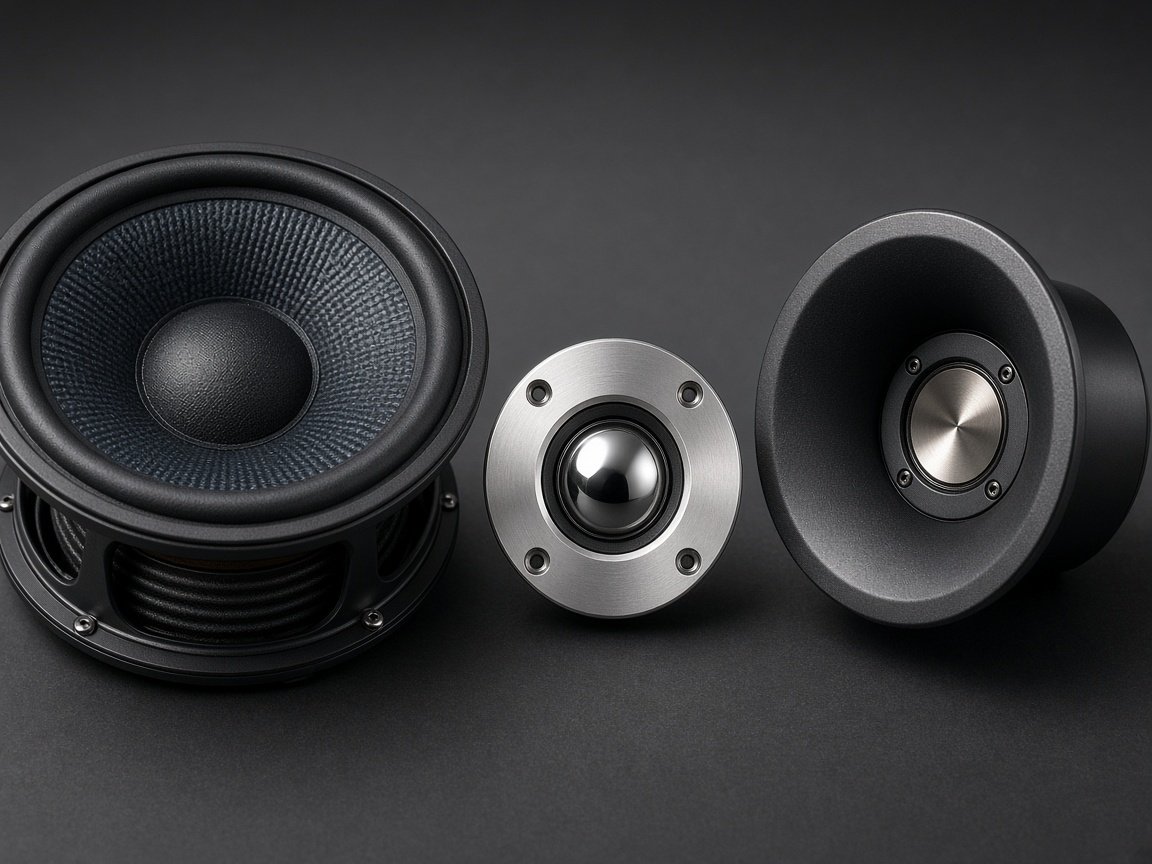
Bookshelf and compact monitor speakers fill the surround and rear channel positions in configurations from 5.1 through 7.1.4. Their compact cabinet volume limits bass extension compared to floorstanders — most roll off between 60 and 90 Hz in-room — but this is acoustically irrelevant for surround duties where the AV receiver’s bass management redirects low-frequency content to the subwoofer. The properties that matter for surround channel placement are controlled directivity, stable off-axis imaging, and timbre matching with the front speakers already selected for the system.
Monitor Audio’s Bronze and Silver series produce output well above what their cabinet dimensions suggest, with the company specifying sensitivity in the 86–88 dB range for compact models. KEF’s bookshelf designs leverage the Uni-Q coincident driver — where the tweeter mounts concentrically within the midrange driver — to deliver a wide, stable stereo image that remains accurate well off the central axis. This is a measurable advantage for surround placement on side walls, where listeners are rarely positioned at the manufacturer’s specified sweet spot. Bowers & Wilkins 607 S3 and 606 S3 models continue the brand’s driver material research program, applying Continuum cone technology developed for the flagship 800 series to mid-tier bookshelf designs. For buyers evaluating Japanese-market audio products, Kenwood speakers in the LS and VRS series offer solid build quality and reliable tonal balance that is well suited to surround channel applications in home theater systems.
Wall-mounting compatibility is a practical consideration often overlooked at the specification stage. Many bookshelf designs include keyhole mounting slots or threaded inserts on the rear cabinet panel, allowing placement on side or rear walls without stands. Cabinet depth matters equally: shallower designs under 25 cm integrate more easily on standard drywall surfaces without protruding into the room. The choice between bipole, dipole, and direct-radiating surround placement affects the character of the rear soundfield. Direct-radiating designs produce tighter, more precisely localized surround cues; dipole designs produce wider, more enveloping ambience by radiating out of phase from front and rear baffles simultaneously. Neither is universally correct — the optimal choice depends on room geometry and whether envelopment or precision is the higher priority.
Center Channel Speakers: The Acoustic Anchor of Your System
The center channel speaker carries dialogue and anchor on-screen sound in virtually every film and television soundtrack mixed in surround. Sound editors assign voices, on-screen effects, and the sonic elements that tie to what is visible on screen to the center channel. This makes the center channel speaker the single highest-impact purchase decision in any home theater system — not because it needs to be the most expensive unit in the array, but because a timbre mismatch between the center and front L/R speakers is immediately audible every time dialogue pans across the front soundstage or a sound effect moves from screen-left to screen-right.
Timbre matching requires that the center speaker use the same or acoustically equivalent drivers and crossover topology as the front L/R speakers. This is why speaker manufacturers design dedicated center channel models that share driver complements with their floorstanding lines. Klipsch pairs its RP-504C and RP-404C center channels directly with the RP tower series. KEF’s Q250c center uses the same Uni-Q driver array as the Q-series floorstanders. Sony speakers designed for home theater include center channel models engineered to match the company’s main speaker lines, providing tonal coherence across the front soundstage for buyers who have standardized on Sony-branded equipment throughout their system.
Cabinet orientation presents a physical design challenge unique to center channels. The wide, low-profile horizontal form factor required for placement above or below a display screen affects directivity in the vertical plane. Well-designed center speakers use MTM (Midrange-Tweeter-Midrange) driver arrangements to control lobing — the vertical interference pattern created when two woofer drivers are separated by more than half a wavelength at the crossover frequency. MTM designs minimize off-axis coloration for listeners at varying heights in a multi-row theater environment, a measurable acoustic advantage over woofer-tweeter-woofer configurations where driver spacing relative to the crossover frequency is not carefully optimized in the cabinet geometry.
Height Channels and Dolby Atmos-Enabled Speaker Options
Dolby Atmos and DTS:X encode audio as three-dimensional objects rather than fixed channel assignments, allowing mixers to place sounds at any position in a spherical soundfield including directly overhead. Reproducing the overhead dimension requires either dedicated in-ceiling speakers or Atmos-enabled upward-firing modules that reflect sound off the ceiling toward the listening position. The practical performance difference between these two approaches is substantial: in-ceiling speakers produce more accurate vertical imaging because they radiate directly from above, while bounce modules depend on flat, parallel ceiling surfaces and specific room geometries to function as designed.
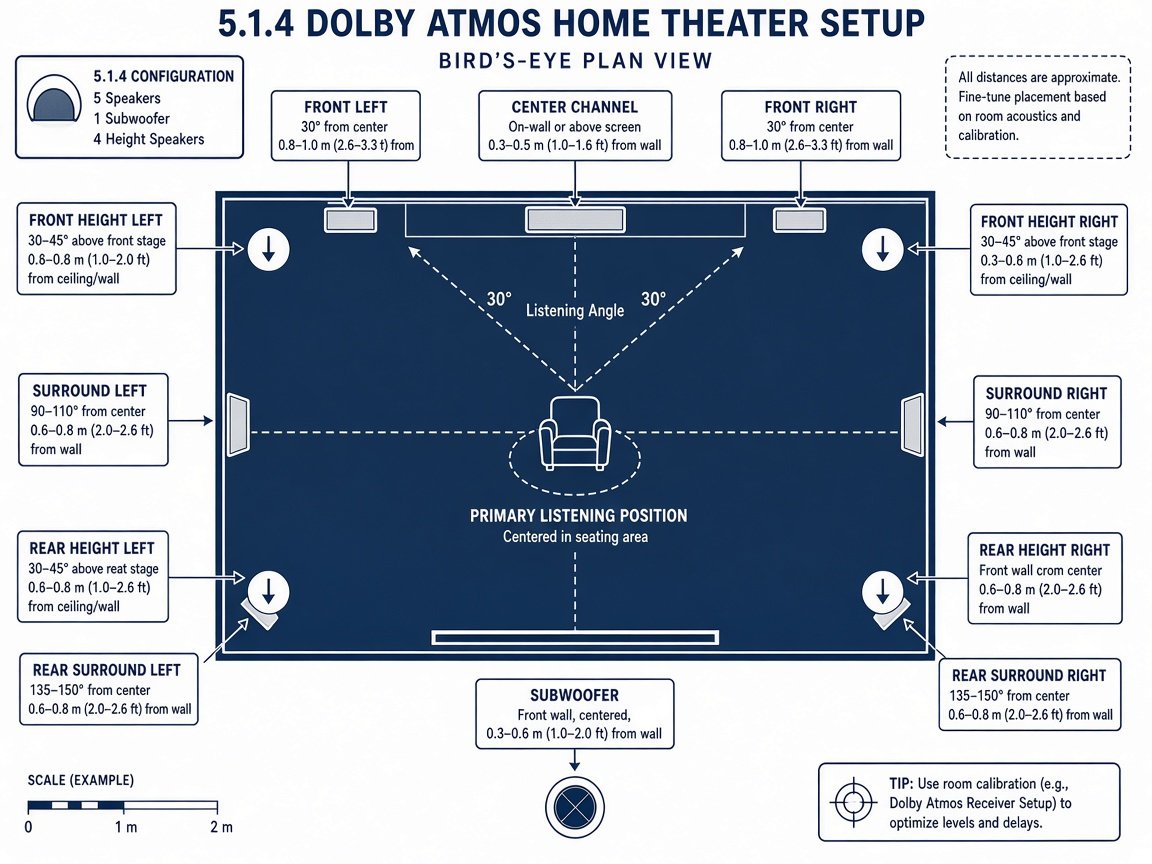
For Dolby theater-grade overhead reproduction at home, Dolby Laboratories specifies in-ceiling height speakers positioned at 30–55 degrees of elevation from the primary listening position, as documented in the Dolby Atmos Home Theater Installation Guidelines. This governs placement of both in-ceiling and Atmos-enabled speakers for optimal vertical imaging. Major manufacturers now produce dedicated in-ceiling Atmos models — Klipsch’s CDT and THX series, Monitor Audio’s in-ceiling lineup, and Polk Audio’s ceiling speaker range all address this specification. At minimum, two height channels (front top left and right) produce a discernible overhead dimension; four height channels add rear overhead coverage and deliver the ceiling-envelopment characteristic of commercial Atmos installations.
Atmos-enabled upward-firing modules offer a practical alternative where ceiling access for in-ceiling installation is unavailable or impractical. Klipsch, Polk Audio, and SVS produce upward-firing modules designed to sit atop floorstanding speakers or as standalone units. Owner reviews of these products consistently describe performance that scales with ceiling height and uniformity — rooms with coffered, vaulted, or angled ceilings produce less effective reflective paths and reduce the perceived height of the overhead soundfield. Manufacturer placement guides should be followed precisely for bounce-module designs, as the reflective geometry is less forgiving of deviation than standard speaker positioning.
Matching Home Theater Speakers to Your AV Receiver
Speaker and AV receiver compatibility determines system performance independently of the quality of either component in isolation. The receiver’s rated output power, minimum stable impedance load, and total harmonic distortion at rated power must be matched to the speaker configuration it drives. A receiver rated at 100 W/ch at 8 Ω that is not stable into 4 Ω loads will clip when driving low-impedance speakers at moderate output levels, producing audible distortion and potentially damaging driver voice coils — particularly at high-excursion frequencies where voice coil displacement creates additional impedance variation that compounds the stress on the output stage.
Bi-amplification is an advanced option available on many premium speakers that include separate binding post pairs for the low-frequency and high-frequency driver sections. Assigning separate amplifier channels to each driver section — achievable on receivers with assignable amplifier channels — produces measurable improvements in dynamic headroom and crossover interaction compared to passive operation from a single amplifier channel. The hometheaterinfoline.com editorial team has ranked the best receivers for home theater by output quality, channel count, impedance stability, and room correction capability — a valuable companion resource when finalizing a speaker-receiver pairing for any configuration from 5.1 through 9.1.4.
Room correction DSP, available across receiver brands — Yamaha’s YPAO, Denon and Marantz’s Audyssey, Pioneer’s MCACC, and Anthem’s ARC Genesis — applies measured equalization and time alignment to compensate for room-induced frequency anomalies at the listening position. These systems measure the acoustic output of each speaker using a calibration microphone and generate correction filters that flatten the in-room response. Owner reports and independent acoustic measurements consistently demonstrate that room correction produces more uniform frequency response at the listening position than any physical speaker placement optimization alone can achieve. Running calibration is an integral step in configuring a home theater speaker system — not an optional enhancement added after the fact.
Room Acoustics and Speaker Placement Principles
Speaker selection is inseparable from room acoustics because the acoustic environment shapes perceived frequency response more profoundly than driver design in most untreated rooms. Early reflections — sound that reaches the listening position after bouncing off side walls, ceiling, and floor within approximately 15–20 milliseconds of the direct signal — smear transient reproduction and reduce image definition regardless of speaker quality. Absorptive panels at first-reflection points on side walls and the ceiling reduce early reflection energy and improve perceived clarity and imaging precision without altering the speaker’s inherent anechoic response.
Bass modes — also called room modes or standing waves — are a function of room dimensions, not speaker quality. When a room’s length, width, or height dimensions align with the half-wavelength of a sound frequency, that frequency is acoustically reinforced at certain positions and cancelled at others. This produces the familiar sensation of bass that varies dramatically as you move around the room — full and boomy in one chair, thin and absent two meters away. Bass traps positioned in room corners absorb low-frequency energy more effectively than equalization-only approaches because they address the physical energy storage at the room boundaries rather than applying corrective gain at the receiver level, which cannot add energy that the room has already cancelled.
Front speaker placement recommendations from the ITU-R BS.775-3 standard specify the front L/R pair at 30 degrees off center axis from the primary listening position, at a distance that forms an equilateral triangle with the listening seat. The center speaker should be on the same horizontal plane as the tweeter axes of the front L/R pair to avoid vertical lobing discontinuities at the crossover between center and front channels. Toeing the front speakers in by 10–15 degrees toward the listening position improves on-axis response at the seat and reduces energy directed at side walls — a measurable reduction in first-reflection intensity that most room correction DSP systems cannot fully compensate for without first optimizing physical placement.
How to Build a Complete Home Theater Speaker System: Step by Step
Building a complete home theater speaker system is most effectively approached in a defined sequence. Beginning with the acoustically critical front channels establishes the tonal foundation before surround and height channels are added, allowing each stage to be evaluated and adjusted before the next layer of complexity is introduced. The following steps apply to configurations from 5.1 through 7.1.4 Dolby Atmos.
- Establish room boundaries and access constraints. Measure room dimensions, identify wall-mount and in-ceiling access points, and confirm the primary listening position. This defines which speaker formats are physically compatible before any purchase commitment is made.
- Select front L/R speakers as the system’s tonal anchor. Choose a floorstanding design for large rooms (typically over 300 sq ft) or a bookshelf-on-stand configuration for smaller spaces. The front L/R pair sets the system’s tonal character — all subsequent speakers should be matched to it.
- Match the center channel from the same manufacturer line. Use the identical or acoustically matched center channel designed for the chosen front speaker series. This guarantees driver and crossover alignment without subjective comparison.
- Choose surround speakers from the same brand and line where possible. Wall-mountable bookshelf designs from the matching manufacturer series maintain timbre continuity across the full soundfield. Confirm mounting depth and bracket compatibility before purchase.
- Add height channel speakers if the receiver supports them. At minimum, two front-height positions improve the vertical dimension of Atmos and DTS:X content. Plan ceiling access or select Atmos-enabled upward-firing modules where ceiling installation is impractical.
- Select a subwoofer based on room volume and bass extension target. Output capability must scale to room volume. Larger rooms require drivers with higher excursion capability and amplifiers with greater current delivery for flat bass response at the listening position.
- Confirm AV receiver compatibility before final purchase. Verify rated output power, minimum stable impedance, and channel count against the completed speaker configuration. Run the calculation at both 8 Ω and 4 Ω to identify any impedance mismatch risk.
- Run room correction DSP calibration after installation. Every major receiver platform includes auto-calibration. Run it only after all speakers are in permanent positions with room furniture in place, as furnishing significantly affects the measured in-room frequency response.
For buyers who prefer a fully integrated solution, the hometheaterinfoline.com ranking of the best 5.1-channel home theater systems covers matched packages that guarantee timbre consistency from the outset — an efficient route for buyers who want a coherent configuration without the component-by-component selection process. Professional installation services — including Walmart home theater installation — are worth exploring for buyers who require wall-mounting, in-ceiling speaker installation, and calibration work completed alongside equipment setup.
Home Theater Speaker Technology: What to Expect in 2027–2028
The next 24 months in home theater speaker development will be shaped by three converging trends: wider adoption of DSP-integrated active speaker designs at mid-tier price points, advances in driver materials targeting higher stiffness-to-mass ratios, and deeper integration between speaker management and AV receiver room correction platforms. Each of these trends is already visible in current premium products and is expected to reach broader market segments by 2028.
Active speaker designs — incorporating built-in amplification and per-driver DSP — have expanded significantly in the two-channel market and are beginning to appear in home theater formats. By co-locating amplification with the cabinet, manufacturers can apply individual driver equalization, limiting, and time alignment in ways that passive crossovers cannot replicate. This reduces system dependence on external receiver quality, trading flexibility in component selection for more consistent out-of-box performance from the cabinet. KEF’s LS series, SVS’s powered designs, and Devialet’s integrated speaker systems have demonstrated commercial viability in this segment; expansion into full multi-channel surround configurations is an expected development over the next product cycle.
Driver material research continues targeting reduced moving mass combined with increased stiffness — the factors that determine a cone’s first breakup mode frequency, beyond which distortion increases sharply and high-frequency linearity degrades. Beryllium and diamond tweeter domes have established the theoretical ceiling for high-frequency linearity in current production speakers. Research into cost-reduction pathways for these materials may bring them into mid-tier product lines by 2028. For the low-frequency end, improved excursion linearity — controlling driver motion accuracy at high displacement — remains the primary focus in subwoofer development, where distortion at high output levels limits perceived bass quality more than frequency extension alone. Servo-controlled woofer designs, currently found in premium products, are expected to become more accessible as motor and position-sensor manufacturing costs decrease.
Frequently Asked Questions About Home Theater Speakers
What is the most important speaker in a home theater system?
The center channel speaker carries the most acoustically critical content — dialogue, anchor on-screen effects, and the sonic elements that tie directly to the visual image. Because it handles the majority of a surround soundtrack’s identifiable audio, timbre matching between the center and front L/R speakers produces a larger perceptible quality improvement than any other single speaker upgrade in an existing system.
How many speakers do I need for Dolby Atmos at home?
Dolby Atmos requires a minimum of a 5.1.2 configuration — five standard channels, one subwoofer, and two height channels. This typically means front L/R, center, two surround speakers, one subwoofer, and two front-height or top-front speakers. More height channels (5.1.4, 7.1.4) improve overhead envelopment but require a receiver with sufficient amplifier channels and a room geometry that supports overhead speaker placement at Dolby’s specified 30–55 degree elevation angles.
Can I mix speaker brands in a home theater system?
Mixing brands is technically possible but risks audible timbre discontinuity when sound pans across channels. The most critical match is between the front L/R and center channel speakers — tonal differences here are immediately audible on dialogue-heavy content. Surround channels are less perceptually sensitive to tonal matching, so mixing brands at the surround positions is a more acceptable compromise than mixing at the front-to-center boundary.
What sensitivity rating should I look for in home theater speakers?
For typical home theater applications with AV receivers rated at 80–120 W/ch into 8 Ω, speakers with manufacturer-specified sensitivity of 87 dB or above are generally adequate for rooms up to approximately 300 square feet. Larger rooms or systems targeting cinema-reference playback levels benefit from 90 dB or above. High-sensitivity designs — such as the Klipsch Reference Premiere line, which Klipsch specifies at 96–98 dB for flagship models — are particularly effective with mid-power receivers where dynamic headroom is otherwise limited by amplifier clipping rather than driver capability.
Do I need a subwoofer if my floorstanding speakers have good bass extension?
Yes, in virtually all home theater applications. Even floorstanding speakers with manufacturer-specified bass response to 30 Hz cannot match a dedicated subwoofer’s output capability at the same frequencies during high-level film playback. Film soundtracks contain low-frequency effects content down to 20 Hz at playback levels that require significant driver excursion and dedicated amplifier power. A subwoofer handles this content while allowing main speakers to operate in their optimal frequency range, reducing distortion in the midrange at high output levels simultaneously.
How should I set the crossover point between main speakers and subwoofer?
The standard starting point is 80 Hz — the THX specification and a reasonable default for most speaker and subwoofer combinations. Smaller bookshelf speakers with limited bass extension (rolling off at 80 Hz or above) benefit from a higher crossover point, typically 100–120 Hz. Modern AV receivers with room correction DSP will suggest or automatically set appropriate crossover frequencies based on the measured acoustic output of each speaker during calibration, making manual optimization less necessary than it was with earlier receiver generations.
Choosing the Best Home Theater Speakers for Your Room and System in 2026
Selecting the best home theater speakers for 2026 requires aligning technical specifications — sensitivity, impedance, frequency response tolerance — with the specific acoustic demands of the room, the AV receiver pairing, and the listening priorities of the household. No single brand dominates every category: Klipsch leads on efficiency and dynamic headroom; KEF on wide-axis imaging precision; SVS on measured bass extension and controlled dispersion; Dynaudio on driver resolution and transient accuracy. The optimal choice depends on which combination of these properties aligns most closely with room size, acoustic treatment level, and receiver capabilities.
Timbre consistency across all channels remains the highest-leverage configuration decision in any home theater speaker system. It requires no additional investment beyond careful brand selection — matching the center channel to the front L/R pair from the same manufacturer line costs nothing over choosing them separately — yet it produces an immediately audible improvement in perceived audio coherence on any well-mixed film soundtrack. Beginning with that principle and working outward through surround, height, and bass management produces a system that accurately reproduces what the mix engineer intended at every seat in the room.
The hometheaterinfoline.com editorial team recommends the following sequence for buyers finalizing speaker selection in 2026:
- Determine room volume and primary listening distance to establish minimum sensitivity and power handling requirements
- Select front L/R speakers from a manufacturer whose center channel and surround lineup shares driver and crossover architecture with the same line
- Confirm AV receiver compatibility at both nominal and minimum impedance figures before committing to a purchase
- Add height channel speakers for Dolby Atmos or DTS:X, using in-ceiling designs where room access permits and Atmos-enabled bounce modules where it does not
- Commission room correction DSP calibration after all speakers are installed in their permanent positions with room furnishing complete
For buyers seeking a fully matched starting point rather than individual component assembly, the hometheaterinfoline.com ranking of the best home theater speaker systems for 2026 covers pre-configured multi-channel packages across budget tiers — an efficient route to a coherent, calibrated system without the selection complexity of building from individual components.