
The best whole home audio systems of 2026 distribute synchronized, high-resolution sound across every room through a single app. Sonos, Bluesound, Yamaha MusicCast, and Denon HEOS lead the category — each optimized for different priorities, from audiophile-grade fidelity to deep smart home integration and native AV receiver compatibility.
What to Know Before You Buy: 2026 Executive Summary
- Sonos is the benchmark for setup simplicity and ecosystem breadth. The Era 300 adds native Dolby Atmos spatial audio to its already comprehensive multi-room platform.
- Bluesound (BluOS) leads the category for audiophile performance. Every component in the lineup is rated to handle hi-res audio at up to 24-bit/192kHz, per Bluesound manufacturer specifications.
- Yamaha MusicCast and Denon HEOS offer the most seamless expansion path for homes already running those brands’ AV receivers — no additional bridge hardware required.
- Open-protocol options — Apple AirPlay 2 and Alexa multi-room audio — provide cross-brand flexibility, though they sacrifice some ecosystem cohesion compared to proprietary platforms.
What Is a Whole Home Audio System?
A whole home audio system — also called a distributed audio or multi-room audio system — is a network of speakers, amplifiers, and control software. It allows different audio streams to play simultaneously in separate rooms. Unlike a single Bluetooth speaker or conventional stereo, these systems scale across an entire property. Control is centralized through an app, voice assistant, or dedicated hardware controller.
Modern systems fall into two principal categories. Wireless mesh systems use the home’s existing WiFi network to link active speakers and streaming components. Structured wiring systems route audio over dedicated cable runs — typically Cat6 or coaxial — to passive in-wall or in-ceiling speakers powered by a central amplifier matrix. Wireless platforms, led by Sonos, Bluesound, and Yamaha MusicCast, dominate the consumer market because they require no professional cabling to begin deployment. Structured wiring systems, specified by brands including Control4, Crestron, and Russound, are typically designed by custom AV integrators for large or acoustically complex properties where reliability and latency demand a wired backbone.
The defining feature of any multi-room platform is grouping. A user can play the same source in every zone simultaneously — commonly called party mode — or route independent streams to separate rooms. A morning scenario might put a news podcast in the kitchen, a streaming playlist in the bedroom, and silence in unoccupied spaces, all managed through a single interface. This flexibility is the core value proposition of the category.
How Do Multi-Room Audio Systems Distribute Sound?
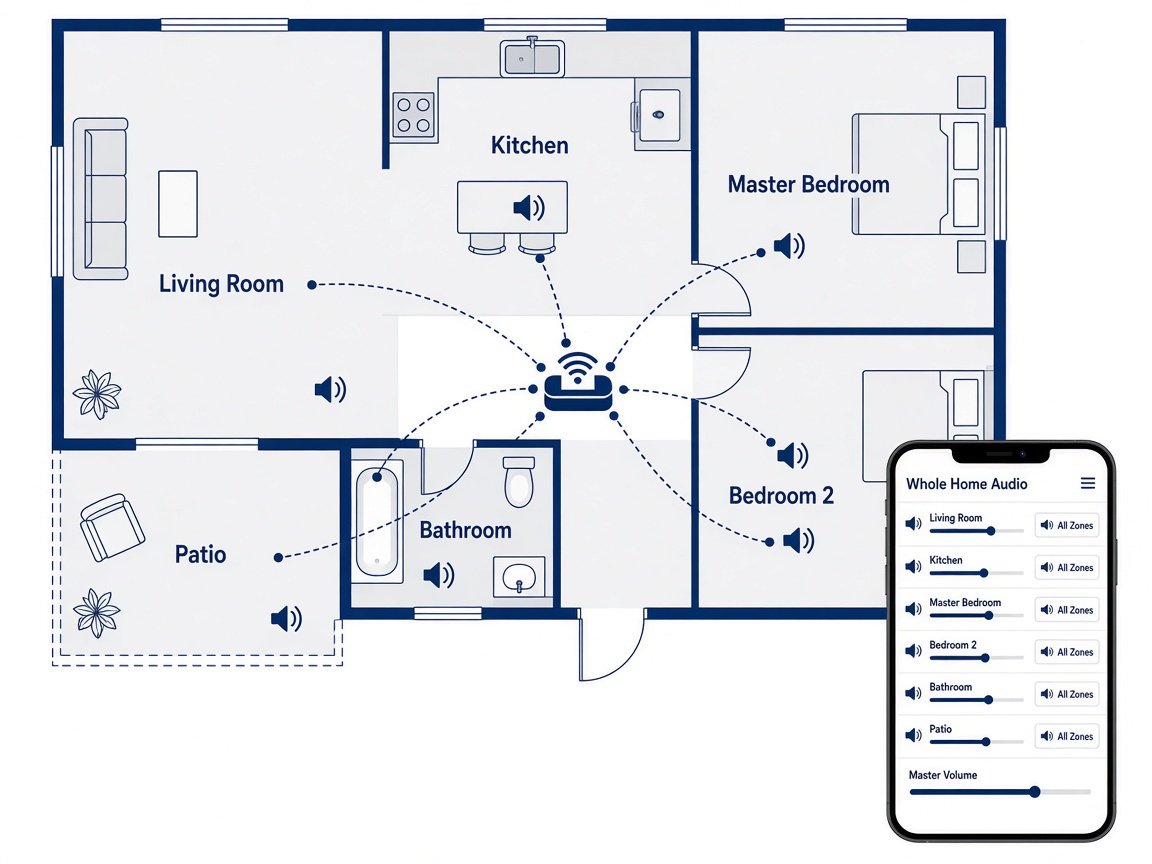
Signal distribution is the technical backbone of every multi-room audio platform. In WiFi-based systems, each speaker or streaming component connects independently to the home network. A software server — running on a dedicated device or in the cloud — coordinates playback, synchronization, and zone routing. Synchronization is achieved through software timestamping: each endpoint receives the same stream, buffers it to a shared timestamp, and plays back in phase. This prevents the audible echo that occurs when nearby speakers play the same content fractionally out of sync.
Proprietary synchronization protocols handle this differently across platforms. Sonos’s current Era-series speakers connect directly to the home router via WiFi and use Sonos’s cloud-assisted synchronization engine. Yamaha MusicCast operates across standard 2.4 GHz and 5 GHz WiFi bands with its own coordination layer. Denon’s HEOS architecture is embedded directly into receiver firmware, treating each receiver zone as a network audio node. Bluesound’s BluOS platform supports both WiFi and wired Ethernet connections — the latter delivering lower jitter, which is relevant when streaming bit-perfect hi-res audio at high sample rates.
For homes with existing structured cabling, connecting a Bluesound NODE or Yamaha MusicCast component via Ethernet rather than WiFi eliminates the most common source of multi-room audio reliability issues. In larger properties, dead WiFi zones are a more frequent problem than platform software deficiencies. A WiFi 6 or WiFi 6E mesh router system with wired Ethernet backhaul between nodes is the recommended infrastructure baseline for a whole home audio installation covering more than four zones.
Which Whole Home Audio Platforms Lead in 2026?
The table below compares the primary technical capabilities and use-case fit of each major whole home audio platform available in 2026. Specifications are sourced from manufacturer product documentation.
| Platform | Primary Protocol | Max Audio Resolution | Smart Home Ecosystems | Best For |
|---|---|---|---|---|
| Sonos | WiFi / AirPlay 2 | 24-bit lossless streaming (TIDAL, Qobuz) | Alexa, Google Assistant, Apple Home | Setup simplicity, Dolby Atmos, broad ecosystem |
| Bluesound (BluOS) | WiFi / Ethernet / BluOS | Up to 24-bit/192kHz (NODE, PULSE); 32-bit/384kHz (NODE X) | Alexa, Google Assistant | Audiophile-grade fidelity, lossless libraries |
| Yamaha MusicCast | WiFi / Ethernet / MusicCast | Up to 24-bit/192kHz; DSD support | Alexa, Google Assistant, Apple Home | Yamaha AV receiver integration |
| Denon HEOS | WiFi / HEOS | Up to 24-bit/192kHz | Alexa, Google Assistant, Apple Home | Denon / Marantz AV receiver owners |
| Apple AirPlay 2 | WiFi (AirPlay 2) | 24-bit/48kHz (protocol ceiling) | Apple HomeKit native | All-Apple households |
| Control4 / Crestron | Ethernet / IP / RS-232 | Source-dependent (lossless capable) | Full custom integration | Large custom installs, commercial-grade reliability |
Beyond standalone speaker platforms, great sound bars can function as single-zone anchors within any of these ecosystems. The Sonos Arc Ultra and Yamaha MusicCast sound bars both integrate natively with their respective multi-room networks, allowing the living room bar to participate in whole-home groupings without a separate streaming component.
Why Does Sonos Remain the Benchmark for Whole Home Audio?
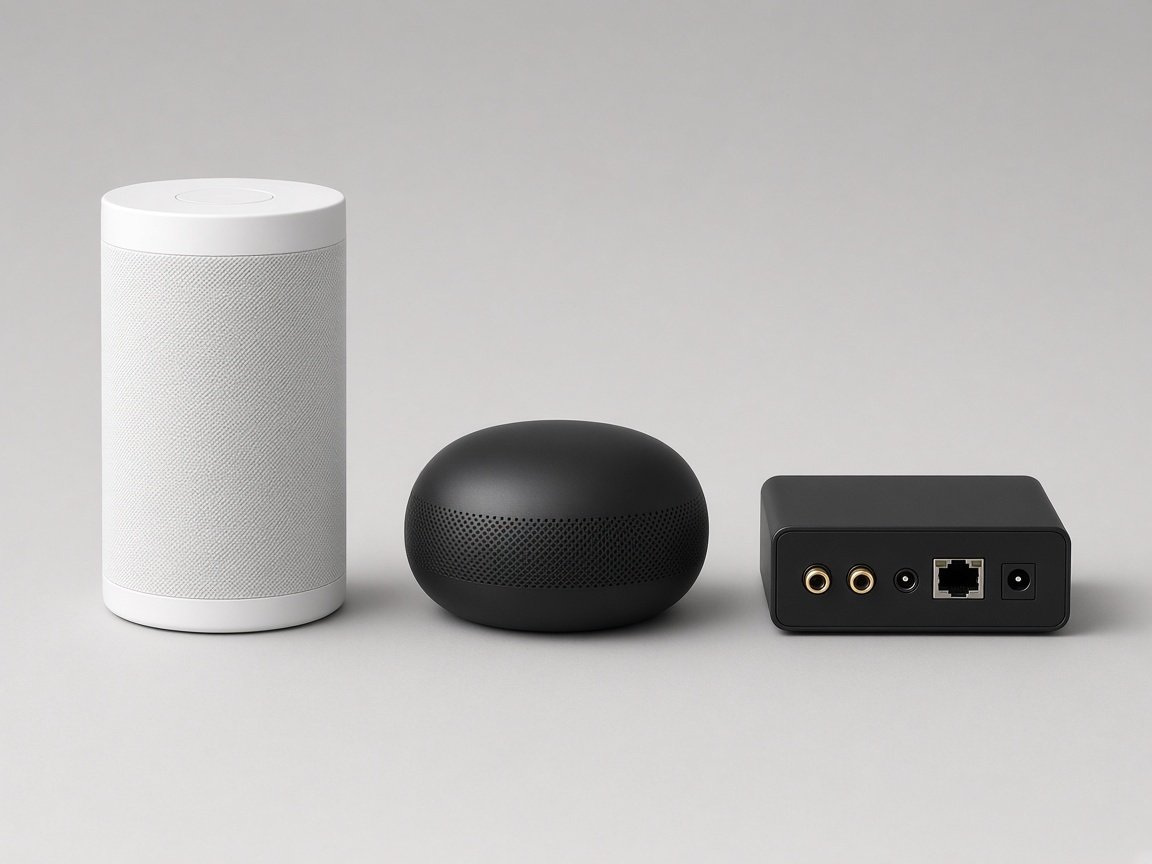
Sonos has anchored the consumer multi-room audio category for over a decade, and its current generation continues to extend that lead through hardware design and software maturity. The Era 300 — the flagship wireless speaker — is engineered around Dolby Atmos spatial audio. It uses six Class-D amplifier channels driving four tweeters and three midwoofers across a 360-degree driver array. Sonos product specifications describe it as designed to render height and surround content from a single standing speaker, without an external processor or dedicated ceiling-mounted height drivers. This makes it one of the few standalone speakers designed to deliver a credible Dolby theater-grade spatial audio experience within a residential room geometry.
The broader Sonos lineup spans the Era 100 (stereo wireless), Move 2 (portable with IP56 weather resistance), Roam 2 (compact portable), Amp (for passive speaker pairs), and Port (for integrating legacy stereo systems). Every product connects through the Sonos S2 app. Owners report that multi-room grouping latency — the interval between pressing play and hearing synchronized output from multiple rooms — is effectively imperceptible during normal use.
A well-established deployment scenario is using Sonos as a home theater backbone: an Arc Ultra paired with Era 300 rear surrounds and a Sub 4 creates a fully wireless Dolby Atmos cinema system without a single speaker cable run. Owners exploring how to extend Sonos with home theater components should note that Arc Ultra supports both ARC and eARC connections from compatible televisions, simplifying integration with any current flat-panel display.
How Does Yamaha MusicCast Turn an AV Receiver into a Multi-Room Hub?
Yamaha MusicCast is built around a central insight: most homes with serious audio needs already own a Yamaha AV receiver. Rather than requiring a separate streaming bridge, MusicCast firmware turns any compatible Yamaha receiver — including current models in the RX-V and RX-A Aventage series — into a first-class multi-room audio node. The MusicCast app treats the receiver identically to a standalone MusicCast speaker: it can serve as a master zone, an independent streaming endpoint, or a grouped zone within a home-wide playback session.
The system supports hi-res audio streaming at up to 24-bit/192kHz via both network streaming and USB input, per Yamaha’s product documentation. MusicCast also passes DSD streams, a format preferred by some audiophile listeners for its direct conversion from SACD masters. For homes where the living room already runs a Yamaha home theater system, MusicCast is the most cost-efficient path to whole-home distribution. It requires only MusicCast wireless speakers for secondary zones rather than a parallel platform purchase.
Yamaha’s MusicCast surround products also allow rear surround and height channels to be delivered wirelessly in a home theater configuration, reducing cable burden in AV installations where routing speaker wire is architecturally impractical. MusicCast thus functions as a hybrid platform: a full surround system in the main listening room and a multi-room audio network everywhere else, managed through a single app.
How Do Denon HEOS and Bluesound Handle Audiophile-Grade Multi-Room Audio?
Denon’s HEOS architecture is embedded in the firmware of current Denon and Marantz AV receivers, pre-amplifiers, and select powered speakers. Like MusicCast, buyers with compatible Denon hardware gain multi-room capability through a firmware feature rather than a hardware upgrade. The Denon home speaker lineup expands the ecosystem into active wireless speakers, allowing HEOS to cover additional zones outside the main listening room. HEOS supports hi-res audio streaming at up to 24-bit/192kHz, as listed in Denon’s product specifications.
Bluesound takes a different architectural approach. Every product in the BluOS family — the NODE streamer, POWERNODE integrated amplifier, PULSE wireless speakers, and FLEX 2i portable — shares the same BluOS firmware. The NODE X, Bluesound’s reference streaming component, is specified by the manufacturer to handle PCM up to 32-bit/384kHz and DSD up to DSD256. These figures exceed the output capability of most consumer DACs and represent the current ceiling of consumer hi-res audio formats.
For buyers focused primarily on music playback quality, the Bluesound ecosystem is the strongest technical argument in the multi-room audio category. The best home sound systems built around music performance frequently feature Bluesound NODE streamers paired with high-performance separate amplifiers and passive loudspeakers — a configuration that scales from a single zone to a full BluOS network as more components are added.
What Technical Specifications Should You Prioritize?
Several technical parameters differentiate capable multi-room platforms from entry-level alternatives. Understanding each helps match a system to actual listening requirements rather than marketing claims.
Audio Resolution and Codec Support
Standard streaming audio — Spotify Connect, Apple Music at AAC, Amazon Music Standard — operates at lossy compression or 16-bit/44.1kHz lossless. This resolution is adequate for most rooms and casual listening contexts. Buyers who maintain lossless libraries, subscribe to TIDAL HiFi Plus, or stream from Qobuz Studio should verify that every component in their chosen platform supports at least 24-bit/96kHz decoding. Bluesound, Yamaha MusicCast, and Denon HEOS all meet this threshold by manufacturer specification. Sonos supports 24-bit lossless streaming on its current Era-series hardware.
Network Protocol and Infrastructure
Wireless whole home audio systems depend entirely on the quality of your home’s WiFi infrastructure. A dual-band 802.11ac (WiFi 5) or 802.11ax (WiFi 6/6E) mesh router is the minimum recommended foundation for a system of four or more zones. Interference from neighboring networks, dense building materials, and concurrent device load can interrupt stream buffering. Where possible, connecting the main listening room directly via Ethernet significantly improves reliability and reduces latency. The best audio receivers for home theater now frequently include native WiFi 6 and Gigabit Ethernet ports for exactly this reason.
Amplifier Architecture and Zone Outputs
Multi-room amplifier matrices from brands including Russound and Monoprice accept stereo inputs and distribute amplified signals to passive in-ceiling or in-wall speakers across multiple zones. These differ from active wireless speaker platforms: they require structured cable runs but deliver lower noise floors and are independent of WiFi reliability. A 6-zone matrix amplifier, for example, can power six pairs of in-ceiling speakers from a single rack-mounted unit. This architecture is typically the domain of a custom AV installer, though technically confident homeowners can undertake intermediate-difficulty DIY installations with appropriate planning.
How Do You Plan and Install a Whole Home Audio System?
Planning is the highest-leverage step in any whole home audio installation. Decisions made at the planning stage — platform choice, speaker placement, amplifier topology — are expensive to reverse after installation begins. The sequence below applies to both wireless and wired system architectures.
- Define your zones first. List every space that requires audio: kitchen, living room, master bedroom, bathrooms, office, patio. Prioritize by use frequency. A focused five-zone system in daily-use rooms delivers more value than an overscoped twelve-zone install that strains budget and complicates the network.
- Choose your platform topology. Decide between wireless active speakers, wireless speakers plus passive in-ceiling zones driven by a network-connected amplifier, or a fully wired matrix amplifier system. Hybrid approaches are common: wireless speakers in bedrooms, wired in-ceiling speakers in kitchen and bathrooms.
- Audit your network infrastructure. Confirm WiFi coverage, router band-steering settings, and available Ethernet ports at each proposed zone location. For wireless platforms, dead zones must be resolved before speaker placement is finalized.
- Confirm streaming service compatibility. Identify your primary music services — TIDAL, Spotify, Apple Music, Qobuz, or a local NAS library — and verify that your chosen platform supports them natively. Platforms relying on AirPlay 2 or Chromecast for third-party service access introduce more variables than those with direct integrations.
- Commission a professional assessment if wiring is involved. In-ceiling speaker installations require attic or wall access, appropriate cable runs, and volume control wiring. A professional AV integrator or entry-level services such as Walmart home theater installation can confirm structural feasibility and provide labor pricing before you commit to a configuration.
- Stage your deployment. Start with the two or three highest-priority zones, verify system stability over several days, then expand. This prevents network congestion and synchronization issues from going undiagnosed until a large system is already fully installed.
Can You Extend Whole Home Audio to Outdoor Spaces?
Outdoor audio is a natural extension of a whole home system, but hardware requirements differ substantially from indoor zones. All outdoor components must carry an appropriate weather-resistance rating — IP65 or higher for direct rain exposure, with UV-stabilized enclosures for permanent mounting. The most common architecture pairs indoor electronics with outdoor passive speakers: a weatherproof in-wall volume control at the patio entry, an indoor-mounted amplifier channel, and outdoor-rated passive speakers. This configuration keeps sensitive electronics inside while delivering durable audio performance outdoors.
Wireless outdoor speakers are an increasingly practical alternative. Sonos Move 2 carries an IP56 weather-resistance rating and participates fully in the Sonos ecosystem. Yamaha MusicCast offers dedicated outdoor speaker products for permanent installation. Klipsch’s AW series of weatherproof passive speakers are frequently paired with HEOS or MusicCast amplifiers in outdoor zones. Building a fully integrated sound system for outdoors — one that participates in whole-home groupings, responds to voice commands, and survives year-round weather exposure — is achievable with either wireless or wired infrastructure.
Key outdoor-specific installation considerations include direct-burial-rated cable for in-ground runs, ground fault circuit interrupter (GFCI) protection for any outdoor-mounted powered electronics, and ensuring WiFi or Ethernet coverage reaches outdoor zones. A WiFi extender or dedicated outdoor mesh node placed inside the home near exterior walls is typically sufficient to extend reliable coverage to a rear patio or garden area.
How Does Whole Home Audio Integrate with Smart Home Platforms?
Multi-room audio integration with smart home automation platforms has matured substantially. The three primary consumer ecosystems — Amazon Alexa, Google Home, and Apple HomeKit — each support direct voice control of multi-room audio groupings, though the depth of integration varies by platform.
Amazon Alexa offers the broadest compatibility across platforms. Sonos, Bluesound, Yamaha MusicCast, and Denon HEOS all carry native Alexa skills. Voice commands can trigger cross-zone groupings without opening an app. Alexa Routines allow audio triggers tied to time of day, motion sensors, or smart lock events — for example, playing a morning playlist automatically when a bedroom light activates.
Apple HomeKit integration is native on Sonos through AirPlay 2 and available on MusicCast and HEOS systems, though some advanced features require the platform’s own app rather than the Home app. For fully committed Apple household users running HomePod mini or second-generation HomePod, AirPlay 2 multi-room audio eliminates the need for a proprietary platform entirely. The best Bluetooth home theater systems worth evaluating in 2026 also include AirPlay 2 as a secondary protocol, giving buyers flexibility without a full platform commitment.
Matter and Thread — the cross-vendor smart home standards published by the Connectivity Standards Alliance — are progressing toward audio device profiles in 2026. While full Matter-native multi-room audio control is still maturing, its adoption indicates that cross-platform interoperability between audio and home automation systems will improve significantly over the next 24 months. Buyers making purchasing decisions now should favor platforms with active firmware development teams, as Matter support is likely to arrive as an update rather than requiring hardware replacement.
What Does a Whole Home Audio System Cost in 2026?
System cost varies considerably based on zone count, platform choice, and whether installation involves in-ceiling speakers or standalone wireless units. The following tiers reflect the general market as of 2026, based on published hardware pricing and commonly cited installation labor ranges in the US market. Prices vary by retailer and region.
The best complete home theater systems of 2026 often bundle a living-room AV system with multi-room distribution capability, which can reduce total cost compared to purchasing a home theater system and a separate multi-room platform as independent projects.
What’s Next for Whole Home Audio Over the Next 12–24 Months?
The whole home audio market is developing across three distinct trajectories simultaneously. Each has practical implications for buyers making purchasing decisions now.
AI-driven audio personalization is emerging as a differentiating feature. Sonos has signaled investment in adaptive sound profiles — systems designed to adjust EQ and room correction dynamically based on occupancy and ambient noise levels, rather than requiring manual calibration. Yamaha’s YPAO room correction technology, already deployed across its AV receiver lineup, is being progressively extended to MusicCast speaker products. Automatic acoustic optimization is expected to become a baseline expectation across mid-range and premium products within 24 months.
Matter audio profiles represent a potential platform consolidation event. If the Connectivity Standards Alliance ratifies a comprehensive Matter audio specification covering multi-room grouping, volume control, and source selection, it will reduce the competitive differentiation that proprietary platforms currently hold through closed ecosystems. Products certified to a common standard could interoperate across brands without restrictions, though proprietary software features and acoustic performance would remain meaningful differentiators.
Spatial audio in multi-room contexts is an active engineering challenge for the industry. Dolby Atmos, DTS:X, and Sony 360 Reality Audio are designed for fixed listening positions with calibrated speaker arrays. Delivering meaningful spatial audio to varied room geometries — a kitchen, a bathroom, a bedroom — without a full speaker array in each space requires object-based rendering algorithms and hardware with multiple driver arrays per enclosure. The Sonos Era 300 is an early commercial example of this approach. This technology is expected to reach lower price points by 2027, making immersive spatial audio a credible whole-home proposition rather than a living-room exclusive.
Frequently Asked Questions About Whole Home Audio Systems
Can different brands of speakers work together in one whole home audio system?
Yes, with caveats. Speakers sharing a common protocol — such as AirPlay 2 or Alexa multi-room audio — can play the same stream simultaneously regardless of brand. However, app-level grouping, volume synchronization, and advanced features such as zone scheduling work most reliably within a single proprietary ecosystem (Sonos, BluOS, MusicCast, or HEOS). Mixing brands across a protocol-agnostic backbone is feasible but introduces management complexity and may limit access to platform-specific features.
How many zones can a whole home audio system support?
It depends on the platform. Wireless systems like Sonos and BluOS are network-scalable — practical limits are set by your router’s device capacity and home WiFi performance, not an arbitrary software ceiling. Wired matrix amplifier systems are sized in fixed zone increments (4, 6, 8, or 12 zones) based on the amplifier model. For most households, four to eight zones covers all occupied spaces; twelve-plus-zone systems are typically specified for large custom installations.
Does a whole home audio system require professional installation?
Wireless systems like Sonos, Yamaha MusicCast, and Denon HEOS require no professional installation for standalone speaker setups — out-of-box setup is app-guided. In-ceiling or in-wall speaker installations that involve cable runs, junction boxes, or amplifier rack mounting typically require a licensed electrician or AV integrator for the physical work. Many retailers and custom install firms offer scoped installation services for buyers who prefer a turnkey approach.
What internet speed do I need to run a whole home audio system?
Streaming audio consumes relatively modest bandwidth. A lossless FLAC stream at CD quality (16-bit/44.1kHz stereo) requires under 2 Mbps per zone. Uncompressed PCM at 24-bit/192kHz reaches approximately 9 Mbps per zone at the theoretical ceiling; FLAC compression at that resolution reduces this meaningfully in practice. A standard 100 Mbps broadband connection is more than sufficient for even a large multi-zone system. The practical bottleneck is almost always local WiFi quality and router performance, not internet throughput.
Can I use a whole home audio system without a streaming subscription?
Yes. All major platforms support local library playback. Sonos, Bluesound (BluOS), Yamaha MusicCast, and Denon HEOS can browse and stream files from a network-attached storage device or a computer running a UPnP/DLNA media server. Bluesound’s BluOS has particularly strong local library support, with metadata display and album art handling for large collections described consistently positively in owner reviews.
Is a whole home audio system the same as a home theater system?
No, though the two overlap significantly. A home theater system is optimized for surround sound reproduction in a single room — typically 5.1, 7.1, or Dolby Atmos channel configurations. A whole home audio system distributes audio across multiple rooms and zones. Many platforms serve both roles simultaneously: Sonos can build a Dolby Atmos home theater in the living room while distributing background music throughout the home. The two categories are increasingly served by the same hardware ecosystems.
How Should You Approach Building a Whole Home Audio System?
Building a whole home audio system is a staged process, not a single purchase event. The sequence below represents the most effective approach for buyers in 2026, regardless of budget tier.
- Identify your priority zones first. Start with the two or three rooms where you spend the most time. A well-chosen two-zone system in daily-use spaces delivers more value than a poorly planned eight-zone system.
- Audit your existing hardware. If you already own a Yamaha or Denon AV receiver with MusicCast or HEOS built in, your living room zone is already provisioned at no additional hardware cost. Build outward from that foundation.
- Match the platform to your listening priorities. Audiophile hi-res streaming → Bluesound. Maximum setup simplicity and ecosystem breadth → Sonos. AV receiver integration → MusicCast or HEOS. All-Apple household → AirPlay 2.
- Confirm network infrastructure before purchasing speakers. A WiFi 6 mesh router with wired Ethernet backhaul eliminates most of the reliability issues reported by multi-room audio owners in online reviews and community forums.
- Plan for outdoor zones at the design stage. Retrofitting outdoor audio after indoor installation is complete significantly increases cost. Including an outdoor zone in the initial cable run or WiFi coverage plan is far more efficient.
- Revisit your platform choice in 12–18 months. Matter audio specifications are evolving rapidly. A platform-agnostic control layer — AirPlay 2 or Alexa — provides flexibility to integrate newer hardware as standards mature without replacing existing speakers.
Sonos is the best all-round choice for most buyers: the widest ecosystem, the simplest setup process, and the only platform delivering Dolby Atmos spatial audio from standalone wireless speakers. Bluesound earns the recommendation for audiophile listeners who prioritize hi-res fidelity above convenience. Yamaha MusicCast and Denon HEOS are the logical choices for homes already invested in those brands’ AV hardware. All four platforms are mature, well-supported, and capable of delivering a whole-home audio experience that justifies the investment.