
The best sound system for outdoors in 2026 is a category decision: portable IP67-rated units for flexibility, permanent architectural speakers for large-area coverage, or Wi-Fi multi-zone systems for whole-property integration. Unlike whole home audio systems tuned for enclosed rooms, outdoor setups must compensate for open-air sound dispersion and direct weather exposure simultaneously. This guide compares leading systems across those criteria using manufacturer specifications and aggregated owner reports.
- Best portable with ecosystem integration: Sonos Move 2 — IP56-rated, 24-hour manufacturer-stated battery, dual Wi-Fi + Bluetooth 5.0
- Best rugged portable / highest weather resistance: Bose SoundLink Flex — IP67 per IEC 60529, fully waterproof to 1 m depth, 12-hour battery
- Best permanent architectural install: Klipsch AW-650 — 90 dB sensitivity (manufacturer-rated), 75 W RMS / 150 W peak, high acoustic efficiency per watt
- Key acoustic principle: Outdoor sound intensity drops approximately 6 dB with each doubling of listener distance (inverse square law); covering twice the area requires roughly four times the acoustic power compared to an equivalent indoor setup
What Sets a Sound System for Outdoors Apart From Indoor Audio?
Outdoor audio engineering differs from indoor design in three structural ways: acoustic environment, environmental exposure, and installation topology. Each imposes distinct technical demands that filter which hardware is appropriate before any other specification is considered.
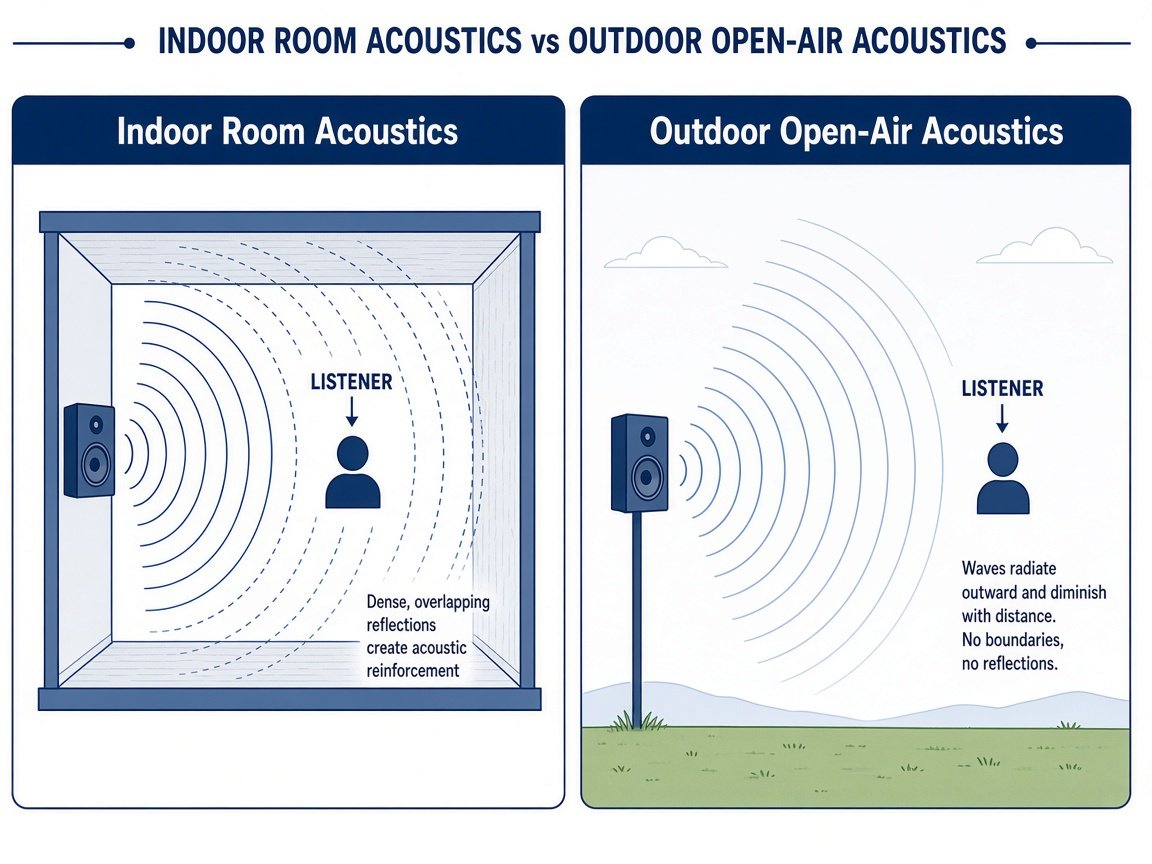
Indoors, room boundaries reflect and reinforce sound, creating a listening environment where a 50 W/channel amplifier can reach reference listening levels in a typical living room. Outdoors, sound radiates freely in all directions without boundary reinforcement. The inverse square law — a physical relationship, not a product specification — describes how sound intensity falls off with distance in free-field conditions. The practical implication is that effective outdoor listening demands significantly higher amplifier power, higher speaker sensitivity, or more speakers distributed across the coverage area than the same indoor setup would require.
Environmental exposure introduces a parallel constraint. Outdoor speakers must resist UV radiation degrading polymer enclosures, moisture ingress causing voice coil corrosion, thermal cycling cracking driver surrounds, and airborne particulate blocking tweeter domes. These failure modes are addressed through ingress protection (IP) ratings, UV-stabilized ABS or fiberglass enclosures, stainless hardware, and marine-grade wiring — none of which are relevant to indoor speaker design.
Installation topology adds a third variable. A permanent architectural system serving a large yard requires amplifier placement decisions, in-wall or direct-burial cabling, and impedance-matched zone switching. A portable Bluetooth system trades that installation complexity for flexibility but sacrifices sustained acoustic output and integration with home audio networks. Identifying which constraint is dominant in your situation is the entry point for every outdoor audio decision.
What Are the Top Portable Outdoor Sound Systems for 2026?
Portable outdoor sound systems are ranked primarily on IP weather resistance, battery duration, and connectivity architecture. The leading options in 2026 split across two segments: compact high-durability units designed for personal listening environments and high-output units targeting parties and larger gatherings.
Sonos Move 2
The Sonos Move 2 is rated IP56 by Sonos — meaning it resists dust ingress and high-pressure water jets from any direction, but is not rated for submersion. Its manufacturer-stated battery life is 24 hours at moderate volume. Critically, it supports both Bluetooth 5.0 and dual-band Wi-Fi, enabling it to function as a standalone Bluetooth speaker outdoors and seamlessly rejoin a Sonos home audio network when brought inside. Owner reports consistently identify this dual-mode operation and ecosystem integration as its primary competitive advantage. It weighs approximately 6.6 lbs (3 kg) per Sonos specifications — portable in the household sense, but not pocket-sized. For buyers already in the Sonos ecosystem, it represents the most logical single unit to extend indoor audio coverage to a patio or deck.
Bose SoundLink Flex
Bose rates the SoundLink Flex at IP67 — fully dust-tight and rated for submersion up to 1 meter for 30 minutes, per IEC 60529. Its 12-hour manufacturer-rated battery is shorter than the Move 2’s, but the IP67 certification makes it appropriate for pool edges, boat decks, and beach environments where the Move 2’s IP56 rating would not qualify. Bose’s PositionIQ technology, which adjusts the EQ automatically based on speaker orientation, is a design feature that owner reports describe as audibly improving low-frequency response when the unit is set flat on a horizontal surface — a common outdoor placement. For use cases where maximum weather resistance is the first specification, the SoundLink Flex is the strongest-rated option in its size class.
JBL PartyBox 310
The JBL PartyBox 310 targets high-output outdoor use. JBL rates it at IPX4 splash resistance and advertises 240 W of output — a marketing figure covering the combined driver and passive bass radiator system, as stated by JBL. Its manufacturer-rated battery duration reaches 18 hours. The PartyBox 310 supports JBL’s True Wireless Stereo (TWS) pairing with a second compatible unit, effectively doubling the coverage footprint for large gatherings. Its enclosure is designed to be transported rather than hand-carried, which limits spontaneous portability but substantially extends sustained acoustic headroom compared to compact personal units. It is the highest-output battery-powered option in this comparison.
UE Hyperboom
Ultimate Ears positions the Hyperboom as a mid-tier high-output portable, rated IPX4 and advertised at 100 W peak output with a 24-hour battery per UE’s specifications. It bridges the gap between compact personal speakers and the larger-footprint PartyBox 310, covering mid-sized outdoor areas such as a deck or small backyard gathering without requiring the PartyBox’s transport-oriented form factor. Owner reports note consistent outdoor performance in the 20–30 ft listening radius for music at social volumes.
What Are the Best Permanent Architectural Outdoor Speaker Systems?
Permanent outdoor speaker systems are designed for fixed installation — mounted to fascia boards, integrated into landscape features, or positioned on poles — and driven by a dedicated amplifier or receiver. They trade portability for superior power handling, impedance stability, and long-term environmental durability. For multi-speaker coverage above roughly 400 square feet of open listening area, a well-designed permanent installation consistently outperforms portable units on acoustic uniformity and sustained output.
If you are configuring a multi-channel outdoor layout rather than a stereo pair, the dedicated guide to the best outdoor surround sound systems examines channel configurations, speaker positioning, and processor pairing for covered patios and outdoor home theaters in more technical depth.
Klipsch AW-650
The Klipsch AW-650 is an all-weather two-way architectural speaker rated at 150 W peak / 75 W RMS per Klipsch specifications. Klipsch designs it with a UV-resistant ABS enclosure and stainless steel grille hardware for year-round installation in variable climates. Its published sensitivity of 90 dB @ 1 W/1 m means it produces measurably more output per watt than lower-sensitivity alternatives at the same price — a critical specification outdoors where amplifier headroom is expensive. The 6.5-inch polypropylene woofer and titanium-laminate tweeter provide full-range output without requiring a dedicated subwoofer for most standard patio applications. Owner reports across multiple years of outdoor installation consistently rate it as one of the highest-performance architectural outdoor speakers at its price point.
Polk Audio Atrium 8 SDI
The Polk Audio Atrium 8 SDI is designed specifically for year-round outdoor installation. Polk specifies a maximum power handling of 100 W with a UV-resistant ABS enclosure and coated drivers intended to maintain compliance through thermal cycling and humidity exposure. The SDI designation refers to Polk’s Single Dynamic Impedance matching technology, designed to reduce impedance swings and simplify multi-speaker amplifier pairing — a practical advantage when running several speakers off a single amplifier zone without an impedance matching volume control. Owner reports note consistent tonal balance over multi-year outdoor deployments and straightforward installation with standard speaker hardware.
Yamaha NS-AW150
The Yamaha NS-AW150 is Yamaha’s entry-level architectural outdoor speaker, rated at 60 W maximum power handling with a UV-resistant all-weather enclosure and rustproof hardware. At its price point it represents a cost-effective option for smaller patios or secondary zones where acoustic output requirements are modest. When paired with a Yamaha MusicCast-compatible amplifier, NS-AW150 pairs integrate into a whole-home multi-zone network alongside indoor zones — allowing independent source and volume control per outdoor zone from a single app.
How Do IP Ratings Define Real-World Weather Resistance for Outdoor Audio?
IP (Ingress Protection) ratings are defined by IEC 60529, the international standard published by the International Electrotechnical Commission. Each rating encodes two digits: the first (0–6) indicates protection against solid particle ingress including dust; the second (0–8) indicates liquid ingress protection. A value of “X” in either position indicates that characteristic was not tested under IEC 60529 — it does not confirm or deny a capability.
| IP Rating | Liquid Protection (IEC 60529) | Practical Outdoor Audio Application |
|---|---|---|
| IPX4 | Splash resistant from any direction | Covered patio, light rain; not suitable for poolside direct splash |
| IPX5 | Water jet (12.5 L/min at 3 m) | Open patio, moderate rain, hose-down cleaning |
| IPX6 | Powerful water jet (100 L/min at 3 m) | Exposed coastal or high-rainfall locations |
| IPX7 | Submersion to 1 m for 30 minutes | Pool deck, dock, boat deck, beach environments |
| IP56 | Dust-resistant + powerful jet resistance | Dusty outdoor environments (construction sites, desert climates) + heavy rain |
| IP67 | Dust-tight + 1 m submersion, 30 min | Poolside, boating, beach; highest practical rating for portable audio |
It is important to understand what IP ratings do not cover. They do not address UV degradation of enclosure polymers, sustained temperature extremes, or long-term corrosion of internal components from salt-air exposure. Architectural outdoor speakers installed in coastal environments may still require additional corrosion-resistant hardware beyond what a standard IP rating guarantees. Always review the manufacturer’s specific environmental installation guidelines for the target climate and microconditions.
How Much Amplifier Power Does an Outdoor Space Actually Require?
Power requirements for outdoor audio scale with listening area, speaker sensitivity, and desired maximum sound pressure level. The inverse square law establishes the acoustic baseline in free-field conditions: each doubling of distance from the speaker reduces sound pressure level by approximately 6 dB. Maintaining consistent SPL across a large outdoor area therefore demands higher amplifier power, more speakers distributed across the space, or higher-sensitivity speakers — or some combination of all three.
Practical Acoustic Principle: Increasing perceived loudness by approximately 10 dB — the threshold most listeners perceive as roughly twice as loud — requires approximately 10 times the acoustic power. Matching indoor listening levels outdoors at distance typically requires between 10 and 20 times more amplifier output than an equivalent indoor setup, depending on space size and speaker sensitivity.
For a small covered patio under 300 square feet, a 50 W/channel amplifier driving 90 dB-sensitivity speakers can achieve comfortable listening levels at typical social volumes. For an open backyard of approximately 1,000 square feet with no acoustic boundaries, 100–150 W/channel into the same speaker sensitivity is a more reliable starting point. Pools and open lawn areas exceeding 2,000 square feet may require 200 W/channel or distributed speaker systems with multiple amplified zones to achieve even coverage.
Speaker sensitivity is therefore not an incidental specification. A 90 dB sensitivity speaker produces the same SPL as an 87 dB speaker using half the amplifier power — a meaningful difference in cost, heat generation, and long-term amplifier component stress over extended listening sessions. When evaluating architectural outdoor speakers for large spaces, sensitivity should be weighted as heavily as power handling in the selection process.
How Do Wireless and Multi-Zone Outdoor Audio Systems Compare?
Wireless outdoor audio splits into two distinct connectivity architectures — Bluetooth and Wi-Fi-based multi-zone platforms — each with different range, latency, and integration profiles that determine where they are appropriate to deploy.
Bluetooth 5.0 specifies a theoretical range up to approximately 800 feet (240 m) in unobstructed line-of-sight per Bluetooth SIG documentation. In residential outdoor environments, physical obstructions — masonry walls, dense landscaping, HVAC equipment — commonly reduce reliable range to 30–50 feet from the source device. For a compact patio directly adjacent to the streaming device, Bluetooth is entirely adequate. For coverage across a detached garage, outbuilding, or the far end of a large property, Bluetooth range degradation makes Wi-Fi-based infrastructure the more reliable choice.
Wi-Fi multi-zone platforms — including Sonos (using its SonosNet proprietary mesh), Yamaha MusicCast, and Denon HEOS — resolve the range limitation by operating over the home’s existing wireless network or a dedicated audio mesh layer. These platforms support multiple simultaneous zones with independent source and volume control, allowing the pool area, patio, and outdoor kitchen to operate on separate sources or synchronize to a single stream. For buyers already invested in a multi-room wireless ecosystem, the guide to the best wireless surround sound systems covers indoor-to-outdoor zone integration architectures in more detail.
Latency is a secondary consideration for music playback but becomes relevant for outdoor video viewing. Bluetooth audio-video latency typically falls between 100–200 ms without Low Latency codec support, which may produce audible lip-sync offset on outdoor projector setups. Wi-Fi streaming platforms operating over a stable home network generally achieve tighter audio-video synchronization, which is within perceptible thresholds for most content types.
How Do the Leading Outdoor Sound Systems Stack Up on Specifications?
The following comparison is based exclusively on manufacturer specifications and product documentation. Performance in real-world installations will vary with site conditions, source quality, amplifier pairing, and listener position. No hands-on testing was conducted by the hometheaterinfoline.com editorial team.
| System | Type | IP Rating | Power | Wireless | Primary Use Case |
|---|---|---|---|---|---|
| Sonos Move 2 | Portable | IP56 | Battery / 24 hr | Wi-Fi + BT 5.0 | Ecosystem integration, patio and deck |
| Bose SoundLink Flex | Portable | IP67 | Battery / 12 hr | Bluetooth | Poolside, beach, submersion-risk locations |
| JBL PartyBox 310 | Portable / High-Output | IPX4 | 240 W (JBL-rated) / 18 hr | Bluetooth + TWS | Parties, large open gatherings |
| UE Hyperboom | Portable | IPX4 | 100 W peak (UE-rated) / 24 hr | Bluetooth | Medium outdoor spaces, deck use |
| Klipsch AW-650 | Architectural / Permanent | All-weather (see mfr. spec) | 75 W RMS / 150 W peak | Wired (amp required) | Permanent patio; high sensitivity installs |
| Polk Atrium 8 SDI | Architectural / Permanent | All-weather UV + corrosion | 100 W max | Wired (amp required) | Multi-speaker yard coverage |
| Yamaha NS-AW150 | Architectural / Permanent | All-weather (see mfr. spec) | 60 W max | Wired (MusicCast-compatible amp) | Budget permanent install, secondary zones |
For buyers who want both outdoor portability and long-term home audio network integration, the Sonos Move 2 offers the most versatile single-unit solution. For the highest weather certification where submersion risk exists, the Bose SoundLink Flex (IP67) is the stronger specification. For permanent architectural installations where acoustic efficiency and sensitivity are primary — particularly in larger spaces where amplifier cost is a constraint — the Klipsch AW-650 remains the benchmark at its price tier, based on its 90 dB manufacturer-rated sensitivity and consistent owner reporting over multi-year outdoor deployments. These assessments are drawn from manufacturer specifications and aggregated owner reviews; no products were purchased, borrowed, or hands-on tested by this editorial team.
Which Outdoor Sound System Fits Your Specific Use Case?
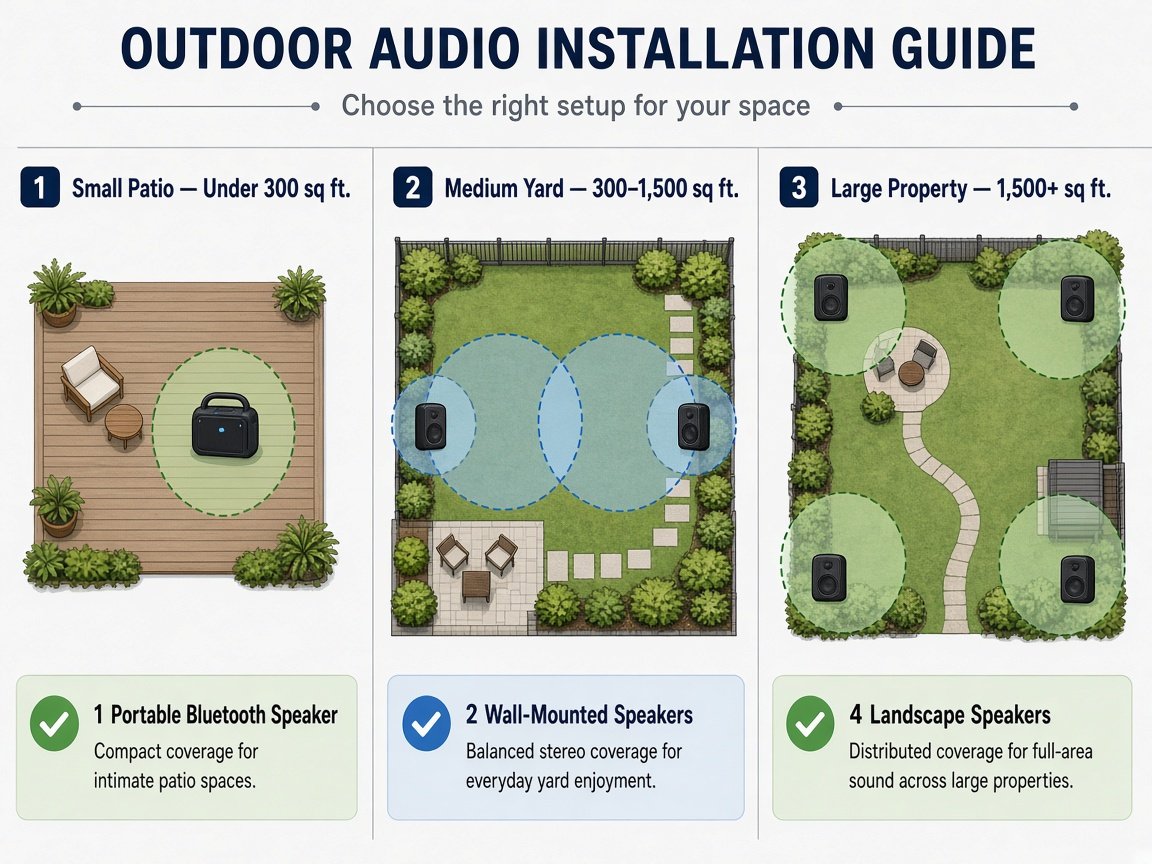
Use-case matching is the most direct path to a satisfactory outdoor audio investment. The hardware that delivers the right performance at a pool edge differs substantially from what achieves even coverage across a 2,500-square-foot open backyard. The following breakdowns are based on space size, installation type, and the acoustic principles outlined above.
Small Covered Patio — Under 300 Square Feet
A single portable unit with IP56 or higher rating performs well in a compact covered patio where the listening distance from the speaker stays under 10–15 feet. The Sonos Move 2 or Bose SoundLink Flex provide sufficient output at this scale without requiring permanent installation. If acoustic quality is prioritized over portability, a pair of Yamaha NS-AW150 speakers driven by a 50 W/channel receiver will typically outperform any portable unit on tonal accuracy and dynamic range at a comparable price point, provided the installation effort is acceptable.
Medium Open Yard — 300 to 1,500 Square Feet
A permanent stereo pair of Klipsch AW-650 or Polk Atrium 8 SDI driven by a 100 W/channel amplifier covers medium open spaces reliably. Speaker placement at opposite ends of the coverage area — rather than centrally — reduces the maximum listener-to-speaker distance and mitigates the inverse square law losses that reduce SPL at the far edges of the zone. For buyers preferring wireless zone control, the Sonos Amp paired with compatible outdoor architectural speakers supports full multi-zone integration and ecosystem control. If you are building an enveloping outdoor listening setup at this scale, the Sonos surround sound ecosystem guide covers whole-property expansion architectures in depth.
Large Yard or Pool Area — Over 1,500 Square Feet
Large outdoor spaces require distributed speaker layouts: typically four to six architectural speakers positioned to create overlapping coverage zones rather than a single high-power point source. This topology reduces per-speaker power requirements while delivering uniform SPL across the listening area. A multi-zone amplifier or whole-home audio processor with zone switching — such as Yamaha MusicCast or a rack-mounted multi-zone receiver — provides independent volume and source control per zone. For the portable side of large-scale outdoor events, the JBL PartyBox 310 offers the highest rated output among battery-powered units in this comparison at 240 W manufacturer-rated.
Bluetooth-First Portable Setup
If your outdoor audio needs are primarily portable and Bluetooth-driven without integration into a fixed home network, a focused comparison of the top-rated Bluetooth sound systems provides a detailed breakdown of units ranked by wireless range, codec support, battery life, and IPX rating across price tiers.
How Do You Install a Permanent Outdoor Sound System?
Installing a permanent outdoor speaker system involves five sequential stages. Each stage affects both long-term reliability and acoustic performance; shortcuts at any stage typically manifest as either equipment failure (from inadequate weatherproofing) or uneven coverage (from miscalculated placement or wiring).
What Does the Future of Outdoor Audio Technology Look Like in 2027–2028?
Several technical trajectories are likely to reshape outdoor sound system design over the next 12–24 months. These are directional observations based on current product development patterns and published manufacturer roadmap signals, not confirmed product releases.
Spatial audio in open-air environments. Object-based audio formats such as Dolby Atmos currently require ceiling-height constraints and room boundaries for convincing height rendering — both absent outdoors. Processing algorithms adapting these formats for open-field conditions are an active research area, and manufacturers including Sonos have signaled interest in outdoor spatial audio as a product category. The acoustic challenges of delivering credible height imaging without ceiling reflections remain a significant engineering problem, but incremental progress in signal processing is making outdoor spatial rendering more plausible than it was two years ago.
Formal IP certification for architectural speakers. Current architectural outdoor speakers from most established manufacturers do not carry formal IEC 60529 IP ratings, relying instead on proprietary “all-weather” and “weather-resistant” claims. Competitive pressure from portable Bluetooth units — which regularly publish IP67 certifications — is likely to push architectural manufacturers toward third-party IEC 60529 testing as a differentiating product specification within the next two product generations.
Matter and Thread protocol adoption. The Matter smart home interoperability standard and its Thread networking layer are gaining adoption across smart home categories. If outdoor audio receivers integrate Matter/Thread, it would enable direct interoperability between speaker systems and smart home automation platforms without manufacturer-specific apps or bridges — meaningfully simplifying multi-zone configuration in mixed-brand installations, which are the norm in most homes.
Energy efficiency improvements in portable units. Advances in Class D amplifier efficiency and improvements in lithium battery energy density are both actively reducing the size and weight penalty of high-output portable speakers. The trajectory suggests that the 240 W output currently requiring the PartyBox 310’s large enclosure and 18-hour battery may be achievable in a significantly more portable form factor within the next product cycle.
Frequently Asked Questions About Sound Systems for Outdoors
What is the best sound system for outdoor use in 2026?
The answer depends on installation type and primary use case. For portable use with home audio ecosystem integration, the Sonos Move 2 — IP56-rated, 24-hour battery, Wi-Fi plus Bluetooth — leads on versatility. For the highest weather resistance in a portable unit, the Bose SoundLink Flex at IP67 is the stronger specification. For permanent patio or yard installations where long-term acoustic performance is the priority, the Klipsch AW-650 offers the best combination of sensitivity (90 dB manufacturer-rated) and power handling (75 W RMS) for large-area coverage at its price tier, based on published specifications and owner reports.
Can architectural outdoor speakers remain installed year-round in cold or freezing climates?
Most architectural outdoor speakers from Klipsch, Polk, and Yamaha are designed for year-round installation and specify operating temperature ranges that include freezing conditions. The primary risk in freeze-thaw climates is not temperature alone but moisture that has entered through unsealed cable penetrations expanding as it freezes and damaging drivers or terminals. Applying exterior-grade silicone sealant around all cable entry points at installation substantially reduces this failure mode. Always verify the specific temperature operating range in the product’s installation documentation before specifying for a cold climate.
What IP rating do I need for pool area speakers?
For speakers installed on a pool deck or poolside structure where splash, rain, and high-pressure hose cleaning are expected, IPX5 or higher is the minimum practical specification per IEC 60529. IPX7 — submersion up to 1 meter for 30 minutes — is the appropriate rating for portable units placed directly at pool edge or on dock surfaces. IPX4 (splash-only protection) is insufficient for direct poolside environments where water jets or accidental immersion are realistic scenarios.
Do passive outdoor speakers need a separate amplifier?
Yes. Portable Bluetooth and Wi-Fi speakers contain integrated Class D amplifiers and require no external hardware. Passive architectural outdoor speakers — including the Klipsch AW-650, Polk Atrium 8 SDI, and Yamaha NS-AW150 — require an external amplifier or receiver matched to the target impedance load. A stereo receiver or dedicated multi-zone amplifier rated for 4-ohm loads (necessary when paralleling multiple speakers per zone) placed in a conditioned indoor location is the standard installation method.
How many watts do I need to cover a large backyard evenly?
For a large open backyard of approximately 2,000 square feet with no acoustic boundaries, a distributed system of four 90 dB-sensitivity speakers driven by a 100 W/channel amplifier — with 50 W per speaker in a parallel 4-ohm load — will typically achieve comfortable social listening levels across the coverage area. A single high-power speaker pair at the same wattage covers less area evenly because inverse square law distance losses increase rapidly with distance from a single point source. Speaker sensitivity and geometric placement are more important than raw wattage for large open-area coverage.
How does an outdoor sound system differ technically from a home theater surround setup?
Home theater surround systems are engineered for enclosed rooms where reflective boundaries reinforce low frequencies and controlled acoustics allow precise channel imaging. The best home theater surround sound systems prioritize channel separation, low-frequency extension, and room-corrected equalization — all of which assume a fixed room acoustic environment. Outdoor systems prioritize weather resistance ratings, high sensitivity for free-field dispersion, and wide horizontal dispersion patterns to cover irregular listening geometries. The absence of room boundaries outdoors eliminates the boundary reinforcement that indoor surround systems depend on for bass extension and listener envelopment.
Choosing the Right Outdoor Sound System: A Decision Framework
Selecting the best sound system for outdoors requires matching three technical parameters — weather rating, acoustic power, and connectivity architecture — to the specific installation context. No single product category dominates across all use cases. Portable IP67-rated units serve pool and beach environments that would damage or void the warranty of most architectural speakers; permanent high-sensitivity architectural systems deliver the sustained coverage that portable units cannot achieve at scale across large open areas.
Use this implementation sequence as a decision framework:
- Define your installation type — portable, permanent architectural, or multi-zone wireless hybrid
- Measure or estimate your listening area in square feet to establish minimum power and sensitivity requirements
- Match IP rating to the specific environment — IPX4 for covered areas, IPX7 or IP67 for direct water-exposure locations
- Evaluate connectivity architecture — Bluetooth is sufficient for small adjacent setups; Wi-Fi multi-zone platforms are more reliable for whole-property integration
- Prioritize speaker sensitivity in specifications — 90 dB+ at 1 W/1 m meaningfully reduces amplifier demands in open-air coverage scenarios
- Commission and calibrate after installation — verify SPL consistency across the listening area and adjust speaker aim or add channel-level trim before closing any cable penetrations
The hometheaterinfoline.com editorial team will continue updating this comparison as new outdoor audio products enter the market and manufacturer specifications are revised throughout 2026.
— **Schema Markup (shown separately for reference):** Embedded above in three “ blocks — FAQPage, Article, and HowTo schemas.