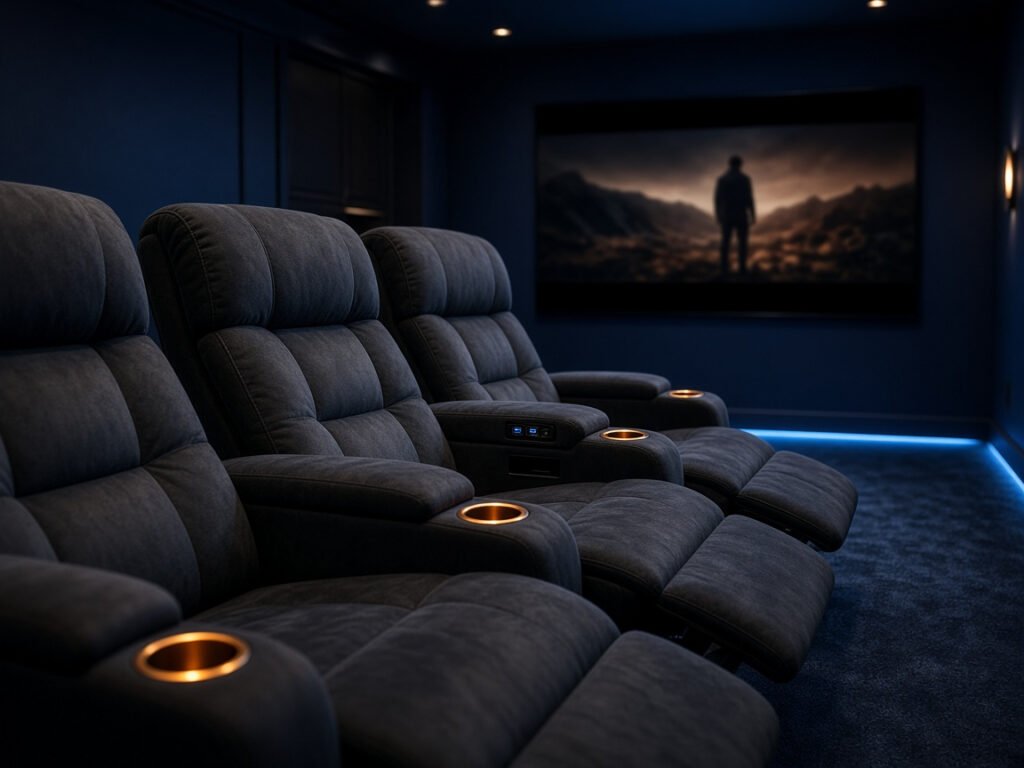
The best home theater seats in 2026 are determined by recline mechanism type, upholstery durability grade, and room-verified dimensions — in that order, before aesthetics factor in. The wrong choice produces a row that cannot extend fully, upholstery that fails within two years, or a configuration that makes half the room unusable from day one.
Executive Summary
- Recline mechanism is the primary performance differentiator. Power recline allows infinite positional adjustment via motor control; manual recline relies on fixed detent positions or body-weight push-back, offering less precision and requiring more physical effort to adjust mid-film.
- Three room measurements are non-negotiable before purchase. Individual seat width, row depth upright, and row depth at full extension must all be confirmed against your room before shortlisting a model — getting any one wrong means the row either cannot fit the space or cannot recline without hitting a rear wall or the row ahead.
- Material quality sets the long-term cost equation. Top-grain leather and high-density microfiber sustain surface integrity under daily use; bonded leather — a polyurethane laminate over compressed leather fibers — is widely reported by owners to delaminate within two to three years of regular use, and cannot be repaired once that process begins.
- Price tiers map to specific, verifiable feature packages. Entry level delivers manual recline with cupholder consoles; mid-range adds power recline and USB charging; premium adds zero-wall clearance, power headrests, massage, and heat; ultra-premium extends to wireless charging surfaces, smart home integration, and independently adjustable power lumbar zones.
What Sets Home Theater Seats Apart From Standard Recliners?
A standard living room recliner is designed for independent, single-person use at no fixed spatial relationship to a screen. Home theater seats are engineered for multi-person rows, extended viewing durations, and a consistent orientation toward a display positioned at a specific height and distance. That distinction is not marketing language — it drives every structural difference between the two categories and explains why a standard recliner placed in a screening row creates clearance, stability, and ergonomic problems that a purpose-built seat avoids by design.
Row-link brackets connect individual seat units into a stable assembly that behaves as a single piece of furniture, preventing lateral drift when any occupant reclines. Footrests are engineered to extend without encroaching on the row ahead — a constraint simply absent when a chair sits in isolation. Integrated center consoles, housing cupholders, storage compartments, and USB outlets, serve a shared-use row rather than a solo user. These are purpose-built architectural decisions embedded in the product’s engineering, not stylistic options added at the end of the design process.
Home movie theater seats are typically engineered with a lower seat height and wider hip dimension than standard living room recliners, placing occupants at an eye level better suited to a large-format screen positioned at or near floor height. Lumbar curvature on theater-class seats accounts for a semi-reclined, screen-facing posture rather than the upright, conversation-facing posture of a traditional chair — a distinction with direct ergonomic consequences across a two-hour and especially a four-hour session. The two product categories are not interchangeable in a dedicated screening room.
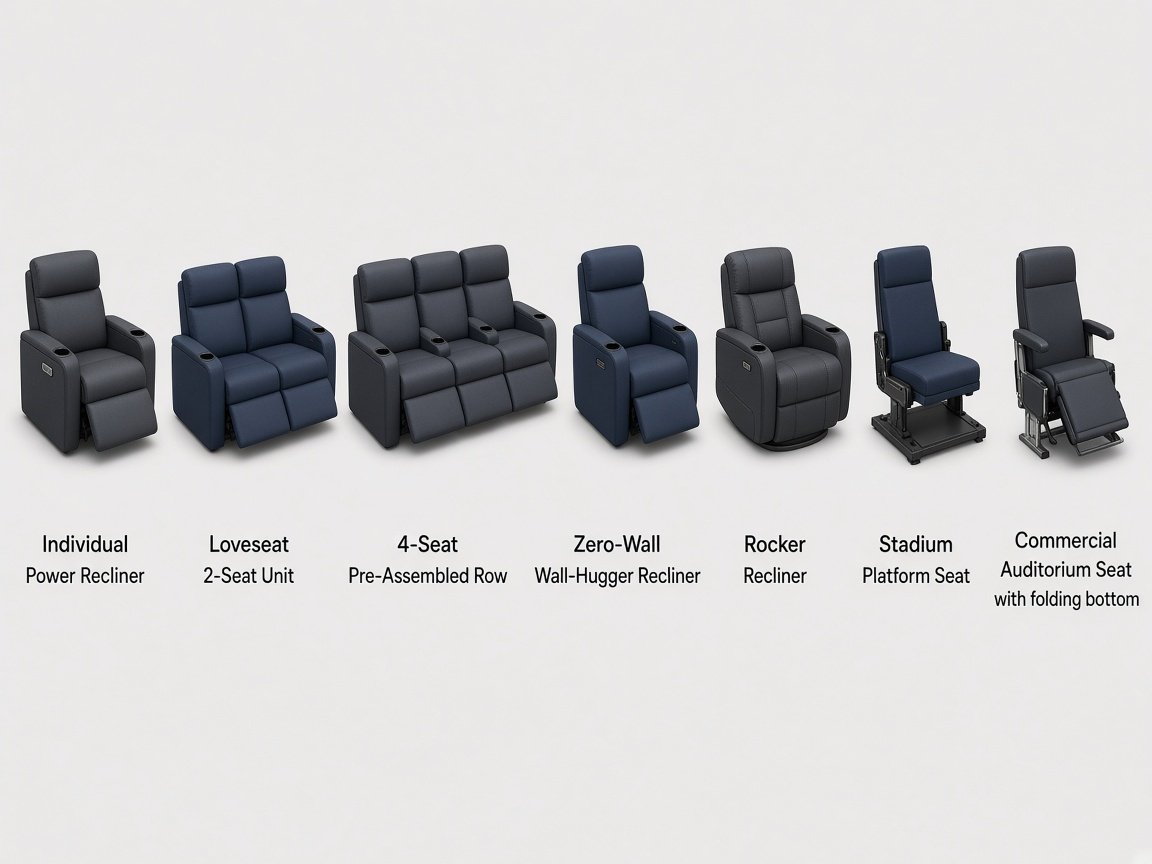
What Configuration Types Are Available for Home Theater Seating in 2026?
The home theater seating market segments into distinct configuration types, each with structural trade-offs that are determined before you evaluate any individual product. Understanding these categories first prevents the most expensive category of mismatch — ordering a seat type that is incompatible with your room’s layout or delivery access path.
| Seat Type | Configuration | Best For | Key Trade-off |
|---|---|---|---|
| Individual Power Recliner | Single seat; row-linkable via bracket | Flexible layouts; mixed-width rows; rooms where count may change | Higher per-seat cost; more assembly required on delivery |
| Loveseat (2-seat unit) | Two seats, shared fixed center console | Couples; compact dedicated rooms | Console position is fixed between occupants; spacing not adjustable |
| 3- or 4-Seat Pre-Assembled Row | Factory-assembled multi-seat unit | Large screening rooms; fixed occupant count | Bulky to deliver through standard doorways; row count cannot be extended |
| Zero-Wall (Wall-Hugger) Recliner | Single or multi-seat; mechanism shifts seat base forward on recline | Rooms with limited rear-wall clearance (under 6 in. available) | More complex mechanism; higher cost per seat than standard recline |
| Rocker Recliner | Single seat; integrated rocking base | Secondary positions; small supplemental rooms | No row-link bracket; footprint variability during rocking motion |
| Stadium / Platform Seat | Fixed or reclining; mounted on riser platforms | Dedicated tiered screening rooms | Requires platform construction; permanent or semi-permanent installation |
| Commercial Auditorium Seat | Fixed upright with spring-loaded folding bottom | Rooms replicating traditional cinema layout precisely | No recline; higher per-row seating density only; not suited to extended comfort sessions |
Commercial-style movie theater seats for home theater installs — fixed upright seats with folding bottoms modeled on auditorium chairs — deliver higher per-row seating density than padded power recliners but sacrifice the reclining comfort that most residential buyers prioritize. Brands such as Irwin Seating supply these to both commercial and residential installations. The experience is architecturally authentic but ergonomically different from a padded power recliner in every dimension that matters for extended viewing comfort, particularly sessions exceeding ninety minutes.
Which Specifications Should You Prioritize When Comparing Seats?
Specification comparison is the only reliable method for evaluating home theater seats before delivery. The hometheaterinfoline.com editorial team recommends organizing comparisons around six core measurement categories before any aesthetic or feature consideration. The figures below represent commonly published specification ranges across the home theater seating category; individual products vary, and direct verification against the manufacturer’s data sheet is always required before finalizing an order.
Foam density is a specification worth requesting but rarely prominently published by manufacturers. High-resilience (HR) foam with a density of 1.8 lb/ft³ or higher maintains its shape under repeated compression across years of regular use; lower-density foam compresses permanently within twelve to twenty-four months. Some manufacturers specify foam ILD (Indentation Load Deflection) ratings — values in the 25–35 ILD range indicate a medium-firm seating surface suited to extended sessions, firm enough to support the lower back through a full film without bottoming out. These figures are worth requesting directly when not published in the product listing.
⚠ Specification Verification Note: Product listings on major retail platforms frequently omit full recline depth. Contact the manufacturer or retailer directly for the fully-extended depth before ordering a row of four or more seats. A 70-inch extended depth across a row of four in a room with a 12-foot viewing depth may leave insufficient clearance between the extended footrests and the screen wall for safe entry and exit in a darkened room.
How Does the Recline Mechanism Affect Day-to-Day Use?
The recline mechanism is the most consequential single specification in a home theater seat. It determines how precisely each occupant can set their viewing angle, how much effort that requires mid-film, what the seat costs to maintain over its service life, and whether independent adjustment by one occupant disturbs the row as a whole.
| Parameter | Power Recline | Manual Recline |
|---|---|---|
| Positional control | Infinite positions via motor; button-controlled stop at any angle | Fixed detent positions or push-back; lever-locked at defined stops |
| Effort required | Button press only; no physical effort | Body weight for push-back; pull lever to extend footrest |
| Adjustment speed | Typically 3–8 seconds to full recline (varies by motor specification) | Instant, body-driven; speed controlled by occupant |
| Noise profile | Low motor hum during adjustment; audible in a quiet room | Mechanical click of lever or detent; brief and sharp |
| Power dependency | Requires AC power; most models rated for 110–120V standard outlet | No power required |
| Maintenance profile | Motor, wiring harness, and control board are long-term failure points | Spring and lever mechanism; simpler service profile over time |
| Approximate cost premium | Typically $100–$300 more per seat over a comparable manual model | Baseline cost reference |
Power recline motors in home theater seats typically operate on 24V DC supplied by an inline transformer from a standard 110V wall outlet. Most manufacturers specify a duty cycle that limits continuous motor operation — the seat is designed to reach a set position and hold it, not to run indefinitely. Owner reviews across major retail platforms consistently identify individually adjustable power recline as the most valued feature distinction in shared screening rooms, specifically because one occupant can refine their angle without introducing movement into the rest of the row.
Manual push-back mechanisms — where the occupant simply leans back against the chair back without operating a lever — are quieter and mechanically simpler than lever-activated models, but offer fewer defined positions and require the occupant to hold the seat against their own body weight to remain at an intermediate recline angle. For rows where occupants need to recline and return to upright frequently, manual systems require meaningfully more physical effort than power alternatives. Rooms aiming for the immersive experience associated with a Dolby theater-grade environment typically specify power recline with individually addressable headrests, since precise per-occupant angle control is as much a part of the experience as the display and audio configuration surrounding the seats.
Which Upholstery Materials Last Longest in a Home Theater Environment?
Upholstery material determines how the seat looks after three years of daily use, not how it looks on day one. The home theater environment places specific stresses on upholstery: repeated friction from the sitting and rising motion, body heat and perspiration during long sessions, and spillage from integrated cupholders operating at close proximity to the seat surface. The choice made at purchase is largely irreversible — most home theater upholstery cannot be replaced economically after the fact.
| Material | Durability Profile | Breathability | Maintenance | Typical Price Tier |
|---|---|---|---|---|
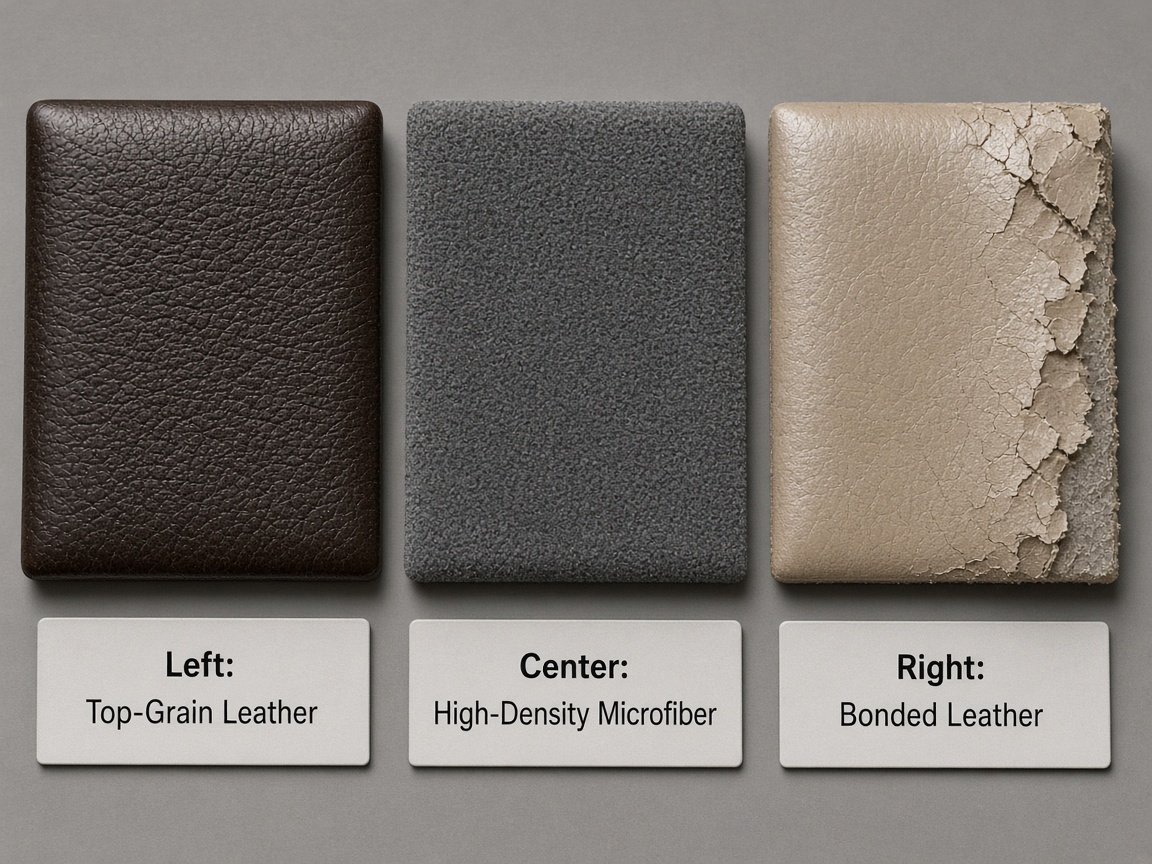
| Top-grain leather | High; surface layer is tightly bonded natural fiber with structural integrity | Moderate; warms with body heat during long sessions | Periodic conditioning required; resists spill penetration with treatment | Mid-range to ultra-premium |
| High-density microfiber | High; resists pilling and abrasion under frequent use cycles | High; best breathability of all categories | Spot-cleanable; some grades available as removable, machine-washable covers | Mid-range to premium; climate-sensitive rooms |
| Bonded leather (PU/bycast) | Low; polyurethane coating separates from compressed base layer under heat and use cycles | Low; non-breathable surface | Cannot be repaired once delamination begins; replacement is the only remedy | Entry-level only; not recommended for daily use |
| Full-grain PU vinyl (synthetic) | Moderate to high; no natural fiber base layer to separate | Low; similar feel to bonded leather but structurally different | Wipe-clean; resists spill penetration without conditioning | Entry to mid-range; easier care than natural leather |
| Performance velvet / contract fabric | Moderate; fiber quality and weave density determine actual longevity | High | Requires fabric cleaner; some grades stain permanently from oils | Niche residential; commercial cinema applications |
The Martindale abrasion test is the furniture industry’s standard for quantifying upholstery durability — a higher Martindale count indicates greater resistance to surface wear under repeated friction cycles. Furniture-grade upholstery is typically considered adequate for heavy domestic use at counts of 15,000 or more; contract-grade commercial fabric is rated above 25,000. Manufacturers who publish Martindale ratings are demonstrating measurable transparency about longevity that is worth factoring into the comparison. Those who do not publish these figures are worth querying directly before purchase.
Bonded leather is the most common source of post-purchase dissatisfaction in owner reviews across major retail platforms. The material replicates the appearance of genuine leather at a lower initial cost, but the polyurethane surface layer has no structural bond to the compressed fiber base layer adequate to survive the repeated heat and compression cycles of regular use. Owners report visible cracking and flaking typically beginning between eighteen months and three years of daily use — which is why top-grain leather or high-density microfiber represents the better value calculation at any price point above entry level, even when it requires a larger initial outlay.
How Do You Measure Your Room and Plan the Seating Layout?
Room measurement is the step most buyers skip and most regret. A row of four power recliners at standard 22-inch-per-seat dimensions extends to approximately 88 inches of assembled width and 70 inches of depth when fully reclined. The room must accommodate that footprint plus a minimum clearance path of 36 inches behind the row for safe entry and exit in a darkened space. The hometheaterinfoline.com editorial team recommends completing the following six-step measurement sequence before shortlisting any seat model — not after.
Tools Required for Room Measurement
- Steel measuring tape (25 ft. minimum) or laser distance measurer
- Graph paper or digital floor-plan tool for to-scale layout plotting
- Painter’s tape for marking row positions on the floor
- Notepad for recording upright and extended depth per model under review
- Measure total room width at the row position. Record the usable wall-to-wall dimension at the intended row centerline. Subtract a minimum of 12 inches from each side wall for a walkable access path, then divide the remaining figure by the per-seat width of the target model to determine the maximum number of seats in that row.
- Measure available row depth. Record the distance from the front face of the rear wall (or the face of the row behind this one, in a tiered configuration) to the front edge of the intended row position. This figure must exceed the fully-extended depth of the chosen seat model.
- Record rear-wall clearance. For non-zero-wall mechanisms, measure from the rear wall to where the back of the seat will rest in the upright position. Standard recline mechanisms require between 12 and 18 inches of clearance behind the seat back; zero-wall mechanisms typically require between 1 and 3 inches, as they achieve recline by sliding the seat base forward rather than tilting the back rearward.
- Check all doorway dimensions on the delivery path. Measure the width and height of every doorway between the delivery entry point and the final room position. Pre-assembled row units wider than 36 inches will not pass through a standard 32-inch doorway without disassembly — confirm whether the product supports in-field disassembly before ordering.
- Mark the screen-to-first-row distance and verify sight lines. Calculate the minimum viewing distance for your display size using the display manufacturer’s recommended range, and confirm the row position accommodates that distance from the screen wall. If you are using a projector, verify that the seating distance aligns with the projector’s throw range — the guide covering the best Epson home theater projectors for 2026 includes throw distance specifications useful for cross-referencing seat placement against projector positioning.
- Confirm electrical outlet positions. Power-recline rows require an accessible AC outlet within reach of each transformer cable — typically 6 to 8 feet. Plan outlet positions or extension cable routing before finalizing the row location, and ensure the circuit load accommodates the transformer draw plus any LED lighting and charging port load from the row.
If you are sourcing through big-box retail and require setup assistance beyond delivery, Walmart home theater installation services offer entry-level setup options for single-row configurations, including basic positioning and power connection for pre-assembled units. For multi-row tiered installations, complex electrical rough-in, or acoustic panel integration, a specialist home theater integrator is the more appropriate resource and will carry liability insurance for the work performed.
What Features Separate Entry-Level, Mid-Range, and Premium Price Tiers?
Price tiers in the home theater seating market map to specific, verifiable feature packages rather than to quality alone. Understanding what each tier delivers — and what it deliberately omits — prevents overspending on features that do not serve the room, and prevents underspending in ways that require replacement within three years. The figures below are drawn from published manufacturer specifications and current retailer listings across the category as of 2026.
| Tier | Approx. Per-Seat Price | Recline | Upholstery | Accessories | Wall Clearance |
|---|---|---|---|---|---|
| Entry | $150–$400 | Manual (push-back or lever) | Bonded leather or basic fabric | Fixed cupholders, basic storage console | Standard (12–18 in.) |
| Mid-Range | $400–$900 | Power recline, single motor | Top-grain leather or microfiber | USB-A/USB-C charging, lighted cupholders, storage console | Standard or reduced (6–12 in.) |
| Premium | $900–$1,800 | Power recline + power adjustable headrest | Top-grain leather with stitched detail | Massage zones, seat heat, ambient LED arm lighting, Qi wireless charging | Zero-wall (1–3 in.) standard |
| Ultra-Premium | $1,800+ | Multi-zone power (recline, headrest, lumbar, legrest independently addressable) | Full-grain leather or premium contract upholstery | Smart home integration, built-in bass transducers, power storage lifts, Qi2 wireless charging | Zero-wall; some models with negative clearance designs |
The entry-to-mid-range transition is defined by two simultaneous upgrades: manual to power recline, and bonded leather to genuine leather or microfiber. Both represent substantive durability and performance improvements rather than cosmetic ones. The mid-range-to-premium transition adds zero-wall clearance and power headrests — functionally significant for rooms with constrained rear-wall clearance and for occupants who require precise neck and head positioning during long sessions.
Editorial Assessment
For most dedicated home theater rooms, the mid-range tier represents the best feature-to-longevity ratio. Power recline with genuine upholstery at $400–$900 per seat avoids the two primary failure modes of the entry tier — inadequate recline control and bonded leather delamination — without the significant cost premium of zero-wall and massage features that most rooms do not require. Unless rear-wall clearance is under 6 inches or massage/heat features are a stated requirement, mid-range is the appropriate baseline.
How Do Integrated Accessories Affect the Long-Term Viewing Experience?
Center console and arm accessory design has an outsized effect on day-to-day usability in a row used regularly. Accessories that are poorly positioned or dimensionally inadequate introduce friction into every viewing session; well-engineered ones become invisible infrastructure. The difference between a cupholder that holds a standard beverage can securely and one that tips it at the first recline transition is a specification — not a category — difference.
Cupholder diameter and depth are frequently overlooked specifications. A cupholder rated for a standard 2.5-inch can rim will not securely hold a wide-based tumbler or a large beverage container. A recess depth below 3 inches is insufficient to prevent tipping during recline transitions. The hometheaterinfoline.com editorial team recommends verifying that any target model’s cupholders accept at least a 3-inch rim diameter and are recessed at least 3 inches in depth. Premium models increasingly incorporate dual-tier designs that accommodate both a standard 12 oz can and a larger insulated tumbler simultaneously, with LED ring illumination for use in darkened rooms.
USB charging ports vary significantly by charging standard and output. Entry-level seats frequently include USB-A ports at 5V/0.9A — adequate for overnight device charging but not for meaningful top-up during a screening session. Mid-range and premium seats increasingly specify USB-C ports with 18W or higher Power Delivery output. Wireless charging surfaces at the premium tier are rated for Qi or Qi2 standards depending on the model year. Verify the specific output specification rather than assuming “USB charging” means fast-charge compatible.
Bass transducers — also called bass shakers or tactile transducers — represent the most technically significant accessory integration in the premium and ultra-premium tiers. These are low-frequency vibration devices mounted within the seat frame that translate bass frequencies from the audio signal into physical sensation felt through the seat structure rather than through air. When the seating is paired with a capable low-frequency reproduction system — the type covered in the best home theater subs guide for 2026 — the effect creates a tactile dimension to low-frequency content across the typical transducer frequency response range of approximately 5–200 Hz. The amplifier driving the transducers must be a separate dedicated channel from the main speaker amplification chain.
Not every room requires a full discrete surround speaker array to deliver an effective audio experience around a row of seats. Pairing well-positioned home theater seating with great sound bars can provide adequate stereo imaging and virtual surround processing in rooms where full discrete speaker placement across five or more channels is not architecturally feasible — a valid alternative for converted living rooms or smaller dedicated spaces where wall mounting and cable routing present practical obstacles.
What Installation and Delivery Challenges Apply to Multi-Seat Rows?
Delivery and installation complexity scales with the number of seats in a row and the access path between the delivery point and the final room. These are not logistical details to address after purchase — they are specifications to verify before ordering, in the same way that seat dimensions are verified against room measurements. Discovering an access constraint after delivery is an expensive problem to solve.
Pre-assembled three- and four-seat row units are delivered as a single piece. The total assembled width of a four-seat row at standard 22-inch-per-seat dimensions is approximately 88 inches. A standard residential doorway is 32 to 36 inches wide. That gap is not bridgeable without disassembly of the row into individual seat units — which many pre-assembled factory-assembled rows do not support in the field. Ordering individually linkable seat units and assembling them into a row on-site eliminates this problem entirely and is the recommended approach for any room with standard residential doorway dimensions.
Weight is a secondary constraint that is frequently underestimated. A four-seat power recliner row at premium tier specifications may weigh between 400 and 600 lb fully assembled. Confirm that the floor structure can bear the concentrated load if the installation room is on an upper level, and verify that the delivery team is equipped for the actual assembled weight rather than the nominal shipping weight listed on the product page. These figures are not always identical.
Electrical requirements for a four-seat power recliner row typically involve four individual transformer cables each requiring a standard AC outlet. These should be distributed across at least two circuits to avoid overloading a single outlet run, particularly when LED accent lighting and device charging ports are also drawing from the same circuit simultaneously. Plan electrical outlet positions before the furniture arrives — retrofitting outlet positions around an installed row is significantly more disruptive than planning them during the measurement phase.
What Are the Most Common Buyer Mistakes When Selecting Home Theater Seats?
The hometheaterinfoline.com editorial team identifies six recurring mistakes that account for the majority of post-purchase dissatisfaction in the home theater seating category, drawn from patterns in owner reports and product return documentation across major retail platforms.
- Ordering without confirmed fully-extended depth. Product listings typically show upright depth only. A seat that fits the room in the upright position may hit the rear wall or the row ahead when extended, rendering it non-functional in its intended position. Always request the fully-extended depth from the manufacturer or retailer directly before ordering.
- Selecting bonded leather to reduce per-seat cost. The initial cost saving is offset within two to three years by replacement cost or by living with a visually degraded surface that cannot be repaired. Mid-range genuine leather or microfiber is the better long-term value at any price point where the choice exists.
- Ignoring weight capacity per seat. Manufacturers specify weight capacity per seat, not per row. Confirm that the stated capacity covers the intended occupant range; exceeding the per-seat capacity accelerates foam compression, stresses the recline mechanism, and may void the warranty entirely.
- Assuming a “wall-hugger” label implies minimal clearance. Some seats marketed as wall-huggers still require 10–12 inches of rear clearance. The marketing label is not a specification. Verify the specific wall clearance figure on the product’s data sheet — not the category label — before purchasing for a clearance-constrained position.
- Selecting too many seats for the room width. A row that occupies the full wall-to-wall dimension of the room eliminates the side-access path and creates a hazardous exit condition in a darkened room. Reserve a minimum of 12 inches of clearance from each side wall regardless of how appealing a maximum-density configuration appears on paper.
- Underestimating the delivery access problem before ordering. Confirming the seat dimensions against the room before purchase is the step most buyers complete. Confirming the assembled unit dimensions against every doorway, staircase turn, and corridor on the delivery path is the step most buyers skip — and it is the more expensive mistake to discover after the truck has arrived.
What Trends Will Shape Home Theater Seating Through 2027 and 2028?
Several converging developments in materials, electronics integration, and room technology are shaping the home theater seating category over the next twelve to twenty-four months. These trends are observable in 2026 model-year product releases and in manufacturer roadmap communications rather than in speculation.
Smart home protocol integration. Power recline mechanisms are increasingly adopting wireless control protocols that allow seat positions to be incorporated into scene-based home automation workflows. The same scene that dims the lights, lowers the motorized screen, and activates the projector can simultaneously move each seat to a preset recline angle. Compatibility with the Matter protocol — the unified smart home standard supported by Apple, Google, and Amazon platforms — is appearing in ultra-premium tier seats as of 2026 model years.
Built-in bass transducer standardization. Tactile transducer integration, previously limited to custom installation projects and ultra-premium products, is appearing at the mid-range price point in 2026. Manufacturers are embedding transducer mounting points and routing channels directly into seat frame construction rather than treating them as aftermarket additions — which improves coupling efficiency and reduces the complexity of the installation for the buyer.
Modular and reconfigurable row systems. Modular linkable seat systems that allow rows to be reconfigured without full disassembly — adding or removing a seat unit, or changing center console positions — are gaining commercial traction across the mid-range and premium categories. This directly addresses the fixed-configuration limitation of traditional pre-assembled row units and reduces the commitment risk for buyers whose occupant count or room use case may change.
Sustainable upholstery materials. Performance fabrics made from recycled polymer fibers are entering the mid-range home theater seating category with Martindale abrasion ratings competitive with synthetic leather. These materials are designed to match the cleanability and surface durability of PU vinyl while reducing the material and production footprint. Expect this specification to become a standard listed option rather than a premium feature distinction by 2027.
Pairing next-generation seating with a complete audio-visual system designed around the same room is the most effective way to realize the full value of a premium seat investment. The full selection context — covering display, audio, and control components alongside seating integration — is provided in the guide to the best complete home theater systems for 2026.
Frequently Asked Questions About Home Theater Seats
How much rear-wall clearance do home theater seats require?
Standard recline mechanisms typically require 12 to 18 inches of clearance between the rear of the seat back and the wall behind it. Zero-wall (wall-hugger) mechanisms require between 1 and 3 inches, as they achieve recline by sliding the seat base forward rather than tilting the back rearward. The marketing label “wall hugger” is not a standard — always verify the specific clearance figure in the product data sheet before purchasing for a clearance-constrained position.
What is the practical difference between power and manual recline in a shared screening room?
Power recline uses a motor (typically 24V DC from an inline transformer) to move to any angle between upright and fully reclined at the press of a button, stopping at the occupant’s chosen position. Manual recline uses either a body-weight push-back mechanism or a pull lever to reach a set of fixed detent positions. In a shared row, power recline allows one occupant to adjust their angle without introducing movement into adjacent seats and without requiring physical effort that may disturb the row during a quiet scene. For rooms used by a single occupant who maintains a fixed recline position throughout a film, manual mechanisms are entirely adequate and carry fewer long-term service variables.
Why do so many buyers report problems with bonded leather home theater seats?
Bonded leather is a polyurethane coating applied over a base layer of compressed leather fibers and binding agents. Under the repeated heat cycles and friction generated by regular sitting and rising, the coating separates from the base layer. This process is irreversible — once delamination begins, it accelerates. Owner reviews across major retail platforms report visible cracking and surface flaking typically beginning between 18 months and 3 years of daily use. The material replicates the initial appearance of genuine leather at a lower cost point but does not replicate its structural integrity under use. Top-grain leather or high-density microfiber is the recommended alternative at any price tier where the choice is available.
How do I calculate the maximum number of seats that will fit in my room?
Measure the usable wall-to-wall width at the intended row position. Subtract a minimum of 12 inches from each side wall for a walkable access path in a darkened room, leaving a usable row width. Divide that figure by the per-seat width of the target model. For example: a 120-inch room width minus 24 inches of side clearance leaves 96 usable inches; at 22 inches per seat, that accommodates four seats with approximately 8 inches of internal margin for arm clearance between linked units. Never fill the full wall-to-wall dimension — doing so eliminates the access path in a darkened room and creates a hazard.
What is a bass shaker and is it worth including in home theater seats?
A bass shaker — also called a tactile transducer — is a low-frequency vibration device mounted within the seat frame that converts bass audio frequencies from a dedicated amplifier channel into physical sensation felt through the seat structure. It operates separately from the main speaker amplifier and typically covers a frequency response range of approximately 5–200 Hz. Bass shakers are not required for a functional home theater seat, but they add a tactile dimension to low-frequency content — particularly in action, music, and effects-heavy material — that many occupants find enhances the immersive quality of the experience. They are built-in at the ultra-premium tier and available as aftermarket additions for most seat frames with accessible mounting points.
Can I add seats to my home theater row after the initial installation?
Yes, if the original seats were purchased as individually linkable units rather than as a pre-assembled factory row. Linkable units connect via row-link brackets; adding a seat requires detaching the end bracket, positioning and anchoring the new seat, and re-linking the assembly. Pre-assembled multi-seat row units typically cannot be extended after manufacture — adding capacity requires ordering a new unit of the target total width. This is the primary reason to prefer individually linkable seat units over pre-assembled rows in rooms where the occupant count may change, or in rooms being built out in phases.
What foam specifications should I request when evaluating home theater seats?
Request high-resilience (HR) foam with a density of 1.8 lb/ft³ or higher — this grade maintains its shape under repeated compression across years of regular use. Also request the foam ILD (Indentation Load Deflection) rating; values in the 25–35 ILD range indicate a medium-firm surface suited to extended sessions, firm enough to support the lower back through a full film without bottoming out. These specifications are not always listed in product descriptions. If the retailer or manufacturer cannot provide them on request, treat that as a signal about the overall transparency of their product data.
How to Approach the Selection Process in a Logical Sequence
Selecting home theater seats correctly requires completing the room verification steps before entering the product shortlisting phase. The sequence below reflects the logical dependency chain of the decision: each step narrows the field of viable options without requiring you to re-evaluate choices already eliminated by earlier constraints.
- Complete all six room measurements — total usable row width, row depth upright, row depth fully extended, rear-wall clearance, all doorway dimensions on the delivery path, and outlet positions — before shortlisting any product.
- Determine configuration type — individually linkable units versus pre-assembled rows, and standard recline versus zero-wall mechanism — based directly on the room measurements from step one, not on preference.
- Eliminate bonded leather from consideration unless the budget genuinely precludes alternatives; then decide between top-grain leather and high-density microfiber based on climate, cleaning preference, and budget.
- Select the recline mechanism — power recline is recommended for any shared screening room with two or more regular occupants who need independent angle control; manual mechanisms are adequate for single-occupant dedicated rooms where the seat stays at a fixed recline throughout a session.
- Verify accessory specifications — cupholder diameter and depth, USB charging output standard, and bass transducer provisions — against your actual use case rather than against the highest-available specification on the market.
- Confirm delivery logistics — assembled versus component delivery, doorway clearance path, floor load capacity, and electrical outlet sufficiency — before placing the order, not after it arrives.
The hometheaterinfoline.com editorial team maintains comparisons across all major home theater seating categories and updates specifications as new model-year data becomes available. For complete room system context — covering display, audio receiver, and speaker selection alongside seating — the best home theater system guide for 2026 provides the full integration picture that makes a seating investment deliver its intended return.