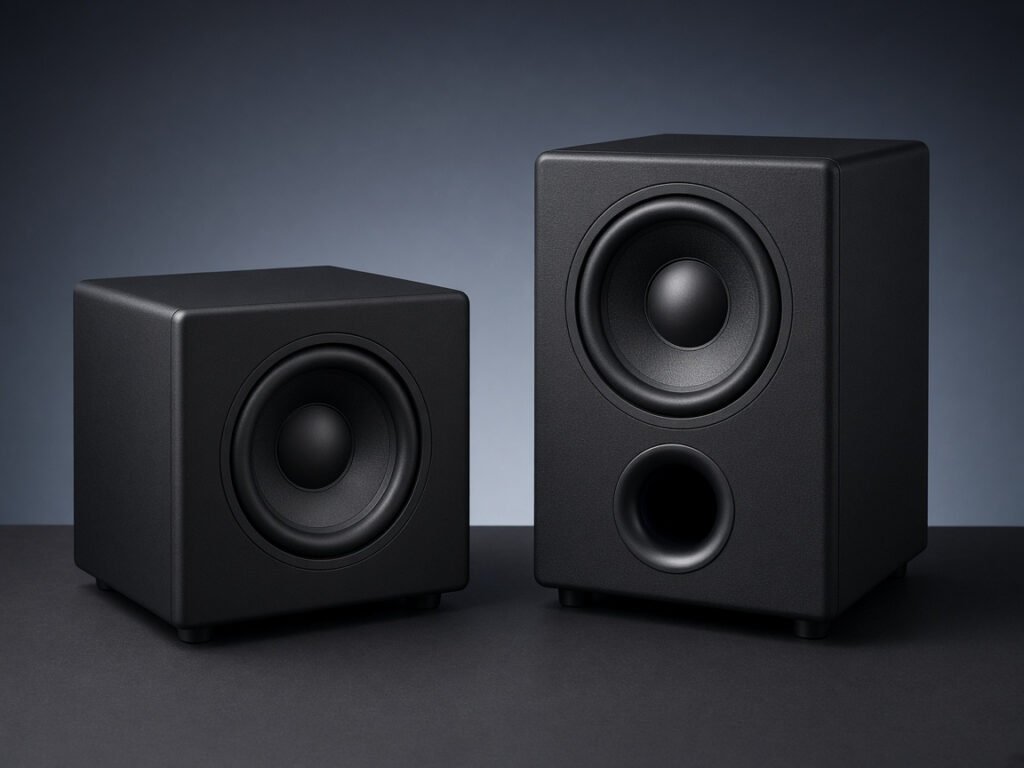
The best subwoofer for home theater depends on three measurable variables: room volume, enclosure design, and amplifier power rating. For medium rooms between 2,000 and 4,000 cubic feet, a 12-inch sealed or ported design rated at 500 watts RMS covers cinematic LFE content and music reproduction without operating near its mechanical limits.
Executive Summary
- Enclosure design is the most consequential single variable: sealed enclosures roll off at 12 dB/octave below the system resonant frequency for accurate transient response; ported designs extend usable output by half an octave or more but introduce rapid rolloff below port tuning and can generate port noise at high excursion
- Driver diameter should match room volume: 10-inch drivers for rooms under approximately 2,000 cubic feet; 12-inch for 2,000–5,000 cubic feet; 15-inch and above for large or acoustically challenging spaces
- Amplifier power ratings vary in methodology across manufacturers: prioritize continuous RMS figures over peak ratings, and confirm the percentage of total harmonic distortion (THD) at which the continuous figure is stated
- The 2026 market is well-stocked across all price tiers: DSP-integrated sealed designs from SVS and Monoprice sit alongside high-output ported models from HSU Research and REL, covering use cases from casual streaming rooms to dedicated screening spaces
What Makes a Subwoofer Right for Home Theater Use?
A home theater subwoofer reproduces the lowest octave of the audible spectrum — the 20–120 Hz range that full-range speakers cannot accurately generate at high output levels. The LFE (Low Frequency Effects) channel on Blu-ray, Dolby Atmos, and DTS:X content carries discrete bass information up to 120 Hz, routed exclusively to the subwoofer by the AV receiver’s bass management system. When that routing is configured correctly, the main speaker channels are relieved of low-frequency content below the crossover frequency, allowing them to operate at higher efficiency in their linear range.
Three physical parameters define a subwoofer’s capability: driver excursion (measured as Xmax, the maximum one-way linear displacement in millimeters), enclosure volume and tuning, and amplifier headroom. When amplifier power is insufficient for the driver’s demand at high volumes, the amplifier clips — generating harmonic distortion that degrades both the LFE channel and the broader soundstage. High-excursion drivers paired with well-matched enclosures preserve transient response and maintain accurate group delay across the crossover region. Modern streaming platforms deliver Dolby Atmos and DTS:X content with LFE tracks extending to 20 Hz — the same bass reproduction standard that defines the Dolby theater experience — making subwoofer extension and accuracy more audibly relevant than in earlier compressed-audio eras. For context on how dedicated subwoofers interact with broader bass reproduction choices, the best bass speakers for home theater overview covers complementary mid-bass driver selection alongside dedicated subwoofer technology.
Sealed vs. Ported Subwoofers: Which Enclosure Design Fits Your Room?
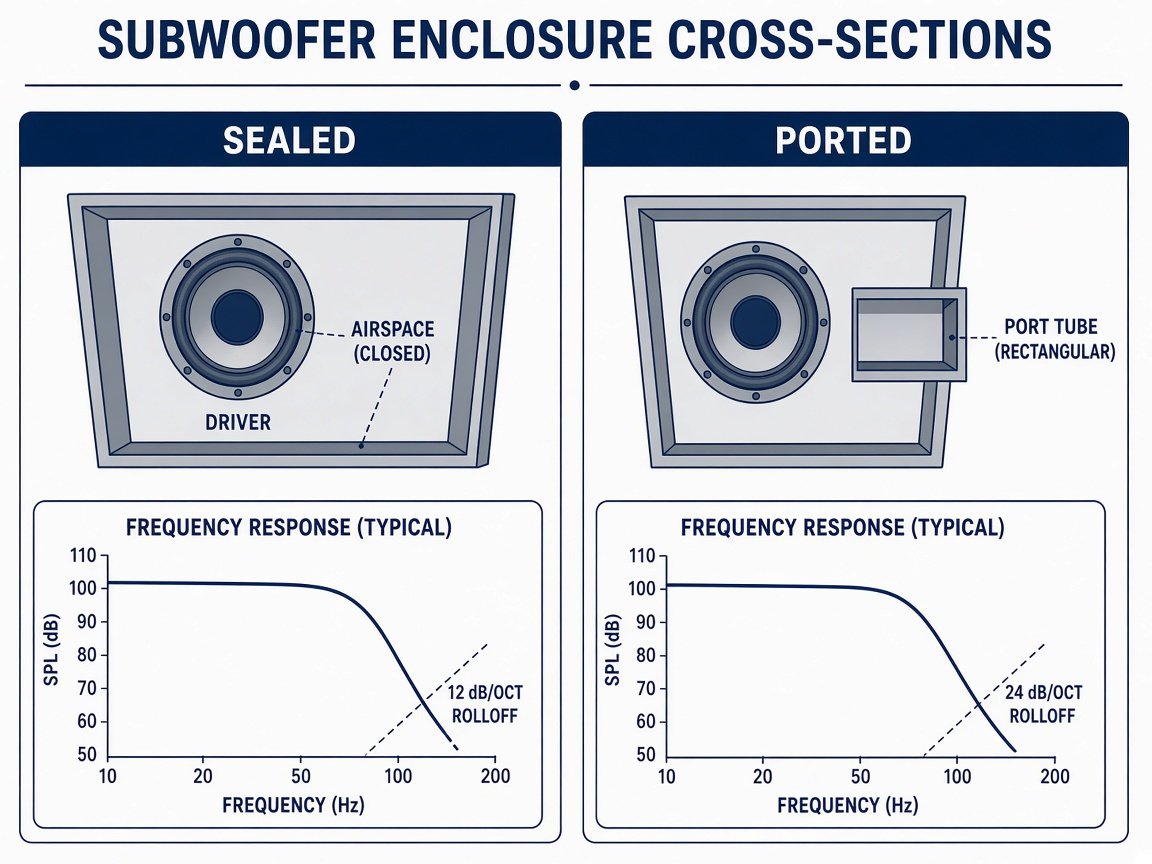
Sealed and ported enclosures represent fundamentally different engineering trade-offs that determine subwoofer behavior below its tuning frequency. A sealed enclosure suspends the driver in a fixed volume of air, producing a 12 dB-per-octave rolloff below the system resonant frequency. This gentle slope preserves transient accuracy and allows the driver to operate in a more controlled manner as it approaches excursion limits. The result is tighter, more pitch-accurate bass — a property that audiophile reviewers consistently associate with sealed designs — at the cost of maximum extension compared to a ported design of equivalent driver size.
Ported enclosures add a tuned port or passive radiator that augments driver output near the port’s resonant frequency, extending usable bass response by approximately half an octave. The trade-off is a steeper 24 dB/octave rolloff below the port tuning frequency, which rapidly unloads the driver and exposes it to mechanical overexcursion stress on content with significant sub-20 Hz energy. Port noise — an audible chuffing caused by air velocity through the port at high drive levels — is the other limiting factor. For action film soundtracks and deep synthesized LFE, ported designs consistently deliver greater output at a given price. For music-primary systems or rooms with significant sub-30 Hz bass buildup from room gain, sealed designs offer more predictable in-room behavior.
How Do You Match Driver Size and Amplifier Power to Your Room?
Driver diameter determines maximum cone area and, in combination with Xmax, the peak volume displacement the driver can generate. Larger drivers move more air per stroke, producing greater acoustic output at low frequencies without approaching mechanical limits as quickly. For consistently high-SPL bass reproduction across a wide bandwidth, matching driver size to room volume is a more reliable starting point than amplifier wattage ratings alone. The following framework is derived from manufacturer room-size recommendations across the product lines reviewed here:
- 10-inch drivers: Rooms under approximately 2,000 cubic feet. The REL T/9x — 10-inch driver, rated at 300 watts Class A/B by REL — is a representative option for this room category, particularly in music-and-film hybrid systems.
- 12-inch drivers: Medium rooms from 2,000 to 5,000 cubic feet. The widest range of product options sits at this diameter, from entry-level ported units to high-output sealed designs with DSP correction. The 12-inch format is the most versatile choice for typical living-room and dedicated media-room installations.
- 15-inch and larger drivers: Dedicated screening rooms or large open-plan spaces above 5,000 cubic feet. The HSU Research VTF-15H mk2 — 15-inch driver, rated at approximately 1,000 watts by HSU Research — represents this segment, with its variable-tuning enclosure well-suited to rooms where both maximum extension and controlled response are required.
Amplifier power must scale with room size and target SPL. For small rooms, 200–300 watts continuous is functional with an efficient 12-inch driver. Medium rooms benefit from 500–800 watts. Large dedicated home theaters targeting output above 105 dB SPL at the listening position generally require 1,000 watts or more, particularly in ported designs where amplifier headroom directly determines how far below port tuning the system can reach without driver unloading distortion. Class D amplification has become standard across all price tiers for subwoofers, offering thermal efficiency above 85% — suitable for the continuous-output demands of cinematic LFE reproduction — in a compact chassis. For further guidance on woofer driver selection across enclosure types and room scales, the best woofer for home theater comparison covers driver-to-room matching in detail.
Top Subwoofer Picks Compared and Ranked for 2026
The models below represent widely reviewed options across six budget tiers, selected by the hometheaterinfoline.com editorial team based on a research comparison of manufacturer specifications, published product data sheets, and owner review patterns. No hands-on testing was conducted. All power figures are as rated by each manufacturer; prices are approximate retail starting points as of 2026 and subject to change by retailer.
| Model | Enclosure | Driver | Amplifier Power (Mfr. Rating) | Approx. Price | Best For |
|---|---|---|---|---|---|
| Klipsch R-120SW | Ported | 12 in | 200W peak (Klipsch-rated) | ~$200 | Entry-level, small rooms |
| Polk Audio HTS 12 | Ported | 12 in | 200W (Polk-rated) | ~$250 | Casual home theater, budget |
| Monoprice Monolith 12 Sealed | Sealed | 12 in | 500W RMS (Monoprice-rated) | ~$450 | High-value mid-range, accurate bass |
| SVS SB-2000 Pro | Sealed | 12 in | 500W RMS (SVS Sledge STA-500D) | ~$500 | Medium rooms, music/film blend |
| REL T/9x | Ported | 10 in | 300W Class A/B (REL-rated) | ~$900 | Music + film hybrid, smaller rooms |
| SVS PB-3000 | Ported | 13 in | 800W RMS (SVS Sledge STA-800D2) | ~$900 | Movie impact, medium-large rooms |
| HSU Research VTF-15H mk2 | Variable ported | 15 in | ~1,000W (HSU-rated) | ~$900 | Large rooms, deep bass extension |
| SVS SB-4000 | Sealed | 13.5 in | 1,200W RMS (SVS Sledge STA-1200D) | ~$1,500 | Reference-grade sealed, any room |
| JL Audio Fathom f112v2 | Sealed | 12 in | 1,200W RMS (JL-rated) | ~$2,000 | Audiophile precision, any room |
Power ratings use each brand’s stated measurement methodology; sealed-vs-peak figures vary. Confirm current pricing with retailers before purchasing.
Entry Level: Klipsch R-120SW and Polk Audio HTS 12
At the sub-$300 tier, the Klipsch R-120SW and Polk Audio HTS 12 both use 12-inch ported enclosures suited to smaller rooms and moderate listening levels. The R-120SW uses Klipsch’s spun copper IMG (Injection Molded Graphite) driver, which Klipsch designs for high rigidity with low moving mass — a combination that aids transient response relative to heavier paper-cone drivers at this price. Owner reviews indicate useful output from roughly 35 Hz upward in typical living-room environments. At this budget level, the amplifier section is the limiting factor at high volumes: compression artifacts appear earlier than in mid-range models, and sustained high-SPL playback of LFE-heavy content will expose the limits of both designs.
Mid-Range: SVS SB-2000 Pro and Monoprice Monolith 12 Sealed
The SVS SB-2000 Pro is a sealed design built around a 12-inch high-excursion driver powered by SVS’s Sledge STA-500D Class D amplifier, rated at 500 watts RMS. SVS includes a smartphone application for iOS and Android that provides remote control of DSP-based EQ, volume, and low-pass filter settings — a meaningful convenience in rooms where subwoofer placement and receiver settings interact unpredictably with room modes. The Monoprice Monolith 12 Sealed offers a competing 500W RMS specification at a slightly lower retail price, making it a strong consideration for buyers prioritizing amplifier headroom within a strict budget. Both sealed designs roll off at 24 dB/octave in their enclosures, maintaining controlled output near the driver’s limits and making them well-suited to rooms where tight, accurate bass matters alongside raw extension.
Upper Mid-Range: SVS PB-3000, REL T/9x, and HSU Research VTF-15H mk2
The SVS PB-3000 is a ported design with a 13-inch high-excursion driver and an 800W RMS Sledge STA-800D2 amplifier. Its ported cabinet extends usable output below 20 Hz in larger rooms; SVS’s DSP-controlled port tuning and companion app allow some frequency-response shaping without external room correction hardware. The REL T/9x takes a different engineering approach: its 300W Class A/B amplifier — which REL argues preserves micro-dynamics lost in Class D topologies — drives a 10-inch driver in a compact ported enclosure. REL also supports high-level (speaker-level) input alongside the standard LFE RCA, allowing the subwoofer to track the main amplifier’s character directly. The HSU Research VTF-15H mk2 targets large-room buyers who need 15-inch displacement at a comparable price to the PB-3000 and T/9x, with variable port plugging offering the flexibility to convert between ported and sealed operation as room acoustics require.
Reference Tier: SVS SB-4000 and JL Audio Fathom f112v2
The SVS SB-4000 brings a 13.5-inch high-excursion driver and 1,200W RMS Sledge STA-1200D amplifier into a sealed enclosure, covering the full range of domestic room sizes with amplifier headroom in reserve. It retains SVS’s app-based DSP, three-band parametric EQ, and remote control, which makes it one of the most accessible high-output sealed subwoofers on the market in terms of setup complexity. The JL Audio Fathom f112v2 operates at the top of the market with a 12-inch driver and JL’s proprietary E²-IIR (Automatic Room Optimization) system, which measures the room’s bass response via an included microphone and applies digital correction filters. Owner reviews consistently cite the ARO calibration as the most audible improvement over uncorrected subwoofer placement, particularly in rooms with pronounced room modes between 40 and 80 Hz.
How Do You Set Up a Subwoofer in a Home Theater?
Correct placement and calibration have a larger measurable effect on bass performance than many hardware upgrades. The sequence below covers the key steps from initial placement through final calibration, applicable to any of the models reviewed here.
- Start at the front of the room. Place the subwoofer near the front wall, within a few feet of the main left and right speakers. This minimizes phase cancellation between the subwoofer and front L/R channels at the crossover frequency and reduces comb-filtering artifacts in the transition region.
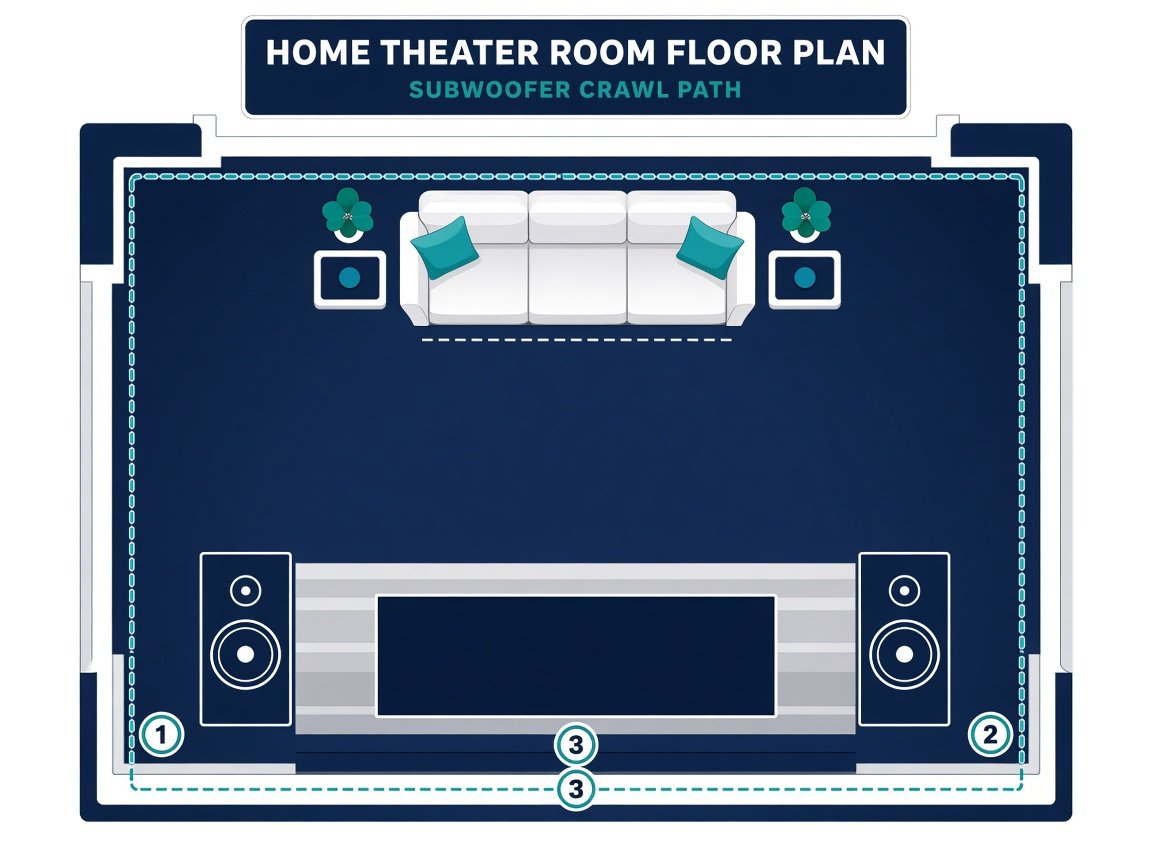
- Perform the subwoofer crawl. Temporarily place the subwoofer at the primary listening position and play a sustained test tone at 40–80 Hz (freely available as pink noise or sine wave sweeps). Walk the full perimeter of the room and identify the location where the bass sounds flattest and fullest. That position in the room typically represents the optimal long-term subwoofer placement location, with the fewest room-mode reinforcements and cancellations.
- Connect via LFE or balanced XLR. Most AV receivers output a dedicated LFE signal via RCA from the subwoofer pre-out. Subwoofers that accept balanced XLR connections benefit from lower noise floor across cable runs of 15 feet or more. If using REL’s high-level input method, connect directly to the amplifier’s speaker binding posts as specified in REL’s installation documentation.
- Set the receiver’s bass management crossover. The THX and Dolby home theater specifications recommend 80 Hz as the reference crossover for satellite speakers and bookshelf monitors. Larger floor-standing speakers with rated extension below 40 Hz can often be crossed over at 60 Hz. Set the subwoofer’s internal low-pass filter to its maximum or bypass position and allow the receiver’s crossover to manage frequency routing — running two overlapping crossovers degrades phase response in the transition region.
- Run the receiver’s auto-calibration system. Room correction platforms including Audyssey MultEQ XT32, Dirac Live, and Yamaha’s YPAO Reflected Sound Control measure the room’s acoustic response and apply correction filters to the subwoofer and main speaker channels. This step addresses the worst room-induced bass peaks and nulls without requiring manual parametric EQ work.
- Verify the subwoofer output level. After auto-calibration, confirm the subwoofer channel level matches the main channels at the reference position using an SPL meter or the calibration software’s output graph. The Dolby specification sets the LFE channel reference level 10 dB above the main channels; most receivers apply this offset automatically, but it is worth verifying after any gain changes.
- Confirm phase alignment. Play content at approximately 80 Hz — near the crossover frequency — and toggle the subwoofer’s 0°/180° phase switch (or use the continuous phase control if available). Select the phase setting that produces the highest SPL at the listening position, which indicates the subwoofer is adding constructively to the main speaker output rather than partially cancelling it.
For buyers who prefer not to perform the setup sequence themselves, professional installation services are available from several retailers. Walmart home theater installation services, for example, cover physical equipment placement and basic AV calibration. For the most accurate room correction results, an installer equipped with acoustic measurement software — such as the free Room EQ Wizard (REW) tool — can go substantially further than any retail-tier automated setup process.
Which Subwoofer Specifications Matter Most When Comparing Models?
Not every figure on a subwoofer’s data sheet translates directly to audible performance. The following breakdown prioritizes which specifications deserve scrutiny and which can be treated with appropriate skepticism.
- Frequency response (−3 dB and −6 dB points): This is the most informative single specification. A subwoofer rated at 20 Hz (−6 dB) in a ported enclosure will produce meaningful output at frequencies relevant to cinematic LFE content. Confirm whether the stated frequency is at −3 dB or −6 dB, as the measurement convention varies by manufacturer and can represent a difference of three to five Hz in perceived low-end extension.
- Maximum continuous SPL: Where published, this figure is more meaningful than amplifier wattage in isolation. Output is a function of driver efficiency, enclosure tuning, and amplifier headroom working together — a 500W amplifier driving an inefficient driver in an undersized enclosure produces less real-world output than a 300W unit in a well-designed ported cabinet.
- Amplifier THD at rated power: A power figure stated at 1% THD represents genuine continuous clean output. A specification stated at 10% THD includes distortion-laden headroom that most listeners in a quiet room would find audible. This distinction is frequently the difference between two products with similar nominal wattage but substantially different subjective performance.
- Driver Xmax (excursion limit): Higher Xmax figures indicate the driver can generate greater acoustic volume displacement before mechanical limits introduce distortion. This is particularly important in sealed designs, where the enclosure provides no port resonance to augment low-frequency output.
- Amplifier signal-to-noise ratio: Values above 90 dB A-weighted are functionally inaudible at normal listening levels. Below 80 dB, amplifier self-noise may be audible during quiet passages in an acoustically treated room — a relevant concern if the system is used for critical listening as well as home theater playback.
How Does a Subwoofer Pair With an AV Receiver?
Subwoofer integration depends heavily on the AV receiver’s bass management capabilities. Receivers that support multiple subwoofer pre-outputs — available on many mid-range and upper-tier models — allow dual-subwoofer configurations that partially cancel room modes and produce more even bass distribution across multiple seating positions. Single-subwoofer setups, the most common configuration in domestic installations, rely on correct crossover assignment and phase calibration to achieve smooth frequency response from the main speakers’ lower limit through the subwoofer’s usable bandwidth.
The choice of receiver matters as much as the subwoofer itself. Receivers with 32-bit DSP and advanced room-correction platforms — Audyssey MultEQ XT32, Dirac Live, and YPAO Reflected Sound Control being the most capable in the consumer price range — can compensate for room-induced bass anomalies that no subwoofer placement strategy can fully resolve. A well-matched receiver and subwoofer combination performs significantly better than an expensive subwoofer driven by a receiver with rudimentary bass management. For guidance on selecting a receiver optimized for bass management, subwoofer routing, and room correction, the best AV receiver for home theater comparison covers signal processing architecture, power output specifications, and room-correction platforms across multiple price tiers.
What Should You Budget for a Quality Home Theater Subwoofer?
Budget determines which performance trade-offs are made, not whether good bass is achievable. The entry tier — under $300 — delivers adequate output for small-room casual viewing at modest volume levels, with the Klipsch R-120SW and Polk Audio HTS 12 representing the cleaner options in this bracket. The mid-range ($400–$700) is where the relationship between driver quality, amplifier headroom, and enclosure engineering converges to produce audibly distinct results. Sealed designs from SVS and Monoprice in this range offer the most consistent owner satisfaction, particularly for buyers who run their system at reference or near-reference levels.
Above $800, diminishing returns set in more gradually. The upper mid-range ($800–$1,500) contains some of the strongest value propositions on the market, including the SVS PB-3000 and HSU Research VTF-15H mk2, both of which approach reference-class output at a fraction of flagship pricing. For buyers evaluating whether a dedicated subwoofer fits their use case — or whether an integrated bass solution is sufficient for their room and content mix — the guide to great sound bars outlines which integrated designs extend meaningfully below 50 Hz and where the trade-offs lie against a separate subwoofer. For buyers building a complete 5.1 or 7.1 system from scratch and wanting to understand how subwoofer selection fits within a matched speaker package, the best 5.1-channel home theater system overview addresses subwoofer selection in the context of satellite speakers and receiver pairings.
What Changes Should You Expect in Subwoofer Technology Over the Next 12–24 Months?
Several trends are shaping subwoofer design as of 2026. DSP-controlled bass management — previously a distinguishing feature of premium models — is now migrating into the mid-range, with app-based parametric EQ and room-correction filters appearing in units under $500. The practical result is that hardware excursion limitations are increasingly compensated by software-defined frequency shaping rather than purely by enclosure volume and driver mass, allowing smaller cabinets to produce more accurate in-room response than their physical dimensions would historically have permitted.
Wireless subwoofer connectivity is maturing beyond proprietary protocols with significant latency compromises. Products using lossless wireless audio operating in the 5.8 GHz band address the latency problems that plagued earlier Bluetooth-based subwoofer links; sub-5-millisecond wireless integration is becoming achievable at mid-market price points, and industry direction suggests this will be a standard feature across a broad range of home theater subwoofers within 18–24 months. Separately, the ongoing expansion of Dolby Atmos and DTS:X object-based audio in streaming content — now available on major platforms at no additional subscription cost — is increasing the frequency with which LFE tracks use the full 20–120 Hz bandwidth, making subwoofer extension and low-distortion headroom at high output levels more audibly relevant than in the earlier era of heavily compressed lossy bass tracks. Manufacturers across all tiers are responding with longer-excursion drivers and higher-headroom amplifier sections.
Frequently Asked Questions
Do I need a subwoofer if I already have floor-standing speakers?
Most floor-standing speakers roll off usable bass response somewhere between 35 and 50 Hz, and their lower-octave output compresses noticeably at high volume levels. A dedicated subwoofer takes over bass reproduction below the crossover frequency, removing low-frequency demand from the main amplifier channels and allowing the floor-standers to operate in their linear excursion range. For cinematic LFE content below 30 Hz, a dedicated subwoofer is functionally irreplaceable regardless of main speaker cabinet size or driver count.
What is the correct crossover frequency for a home theater subwoofer?
The THX home cinema standard specifies 80 Hz as the reference crossover frequency. Dolby’s bass management guidelines also recommend 80 Hz as the default setting for small and medium-sized satellite speakers. Larger floor-standing speakers with rated low-frequency extension below 40 Hz can be crossed over at 60 Hz or lower, though smooth integration between the main speakers and subwoofer depends on the receiver’s crossover filter slope and phase calibration more than on the specific crossover frequency selected.
How many subwoofers does a home theater need?
A single correctly placed subwoofer is sufficient for most domestic rooms. Two subwoofers positioned at opposite corners of the room — front-left and rear-right, or both on the front wall separated by most of the room width — create more even bass distribution across multiple seating positions by partially cancelling the room modes that a single unit excites unevenly. The incremental cost must be weighed against room size; in rooms under approximately 2,000 cubic feet with a single primary listening position, the benefit of a second subwoofer is typically less pronounced.
What is the LFE channel in home theater audio?
The LFE (Low Frequency Effects) channel is a discrete audio channel in multichannel formats including Dolby Digital, Dolby Atmos, DTS, and DTS:X. It carries bass content specifically mixed for the subwoofer channel, with an upper bandwidth limit of 120 Hz. The LFE channel is distinct from the bass management system in the AV receiver, which redirects low-frequency content from other channels (front L/R, surrounds) to the subwoofer when those speakers are set to “small” in the receiver’s speaker configuration. Both sources of bass reach the subwoofer via the receiver’s LFE output.
Should I choose a sealed or ported subwoofer?
Choose sealed if accurate transient response and low distortion at the driver’s limits matter more than raw extension — this includes music-primary systems, rooms with significant low-frequency room gain already present, or any setup where bass definition is prioritized over maximum output. Choose ported if maximum acoustic output and deep extension below 25 Hz are the priority, particularly for action film and LFE-heavy content in medium-to-large rooms. Variable-tuning designs (HSU Research VTF series) offer a practical compromise for buyers who are uncertain, as they can be reconfigured without replacing the unit.
How do I know if my subwoofer is properly calibrated?
A correctly calibrated subwoofer should blend with the main speakers at the crossover frequency without audible localization — the bass should seem to emanate from the full speaker array rather than a single point in the room. The subwoofer level should be matched to the main channels using an SPL meter or the receiver’s calibration software output. For a more detailed diagnostic, Room EQ Wizard (REW) is a free acoustic measurement application that generates a frequency response graph of the subwoofer’s in-room output, displaying the room-mode peaks and nulls that the auto-calibration system may not have fully corrected. This provides a verifiable basis for any additional parametric EQ adjustments.
Conclusion: Selecting the Best Subwoofer for Your Home Theater
The best subwoofer for home theater is not the most powerful unit available — it is the one matched to the room’s volume, the system’s primary content, and the receiver’s bass management capabilities. Following a structured selection process reduces the risk of overspending on driver size or amplifier power that the room cannot use, or underspending on a unit that compresses audibly at the volume levels the system is intended to reach.
Use this sequence when selecting a model:
- Measure your room volume (length × width × ceiling height in feet) and use the driver-size framework above to establish whether a 10-inch, 12-inch, or 15-inch driver is appropriate.
- Decide on enclosure type based on primary content — sealed for music-critical or acoustically lively rooms; ported for maximum cinematic output; variable-tuning for flexibility.
- Establish an amplifier power target using the continuous RMS figures in the comparison table, scaled to room size and target SPL.
- Set a budget tier and select the model within that tier that most closely matches the first three criteria, using manufacturer specifications and owner review patterns as the evidence base.
- Plan for calibration from the start. Budget for a receiver with a capable room-correction platform. The subwoofer and receiver work as a system; a $900 subwoofer on a receiver with rudimentary bass management underperforms a $500 subwoofer on a receiver with Dirac Live or Audyssey MultEQ XT32.
For buyers building a complete system rather than upgrading a single component, the best home theater surround sound system guide covers matched speaker packages, receiver pairings, and subwoofer integration across full 5.1 and 7.1 configurations — a useful reference once the subwoofer decision is finalized.